TThhee 
SScciieennttiiffiicc 
RReevvoolluuttiioonn
What is a Revolution? 
• A Revolution is a complete change, 
or an overthrow of a government, a 
social system, etc.
The Scientific Revolution 
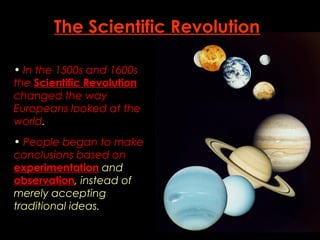
• In the 1500s and 1600s 
the Scientific Revolution 
changed the way 
Europeans looked at the 
world. 
• People began to make 
conclusions based on 
experimentation and 
observation, instead of 
merely accepting 
traditional ideas.
Before the Scientific Revolution… 
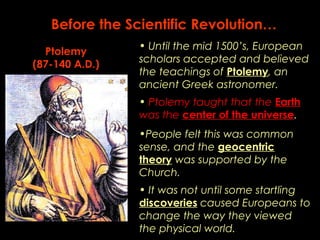
• Until the mid 1500’s, European 
scholars accepted and believed 
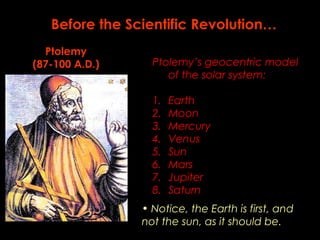
the teachings of Ptolemy, an 
ancient Greek astronomer. 
• Ptolemy taught that the Earth 
was the center of the universe. 
Ptolemy 
(87-140 A.D.) 
•People felt this was common 
sense, and the geocentric 
theory was supported by the 
Church. 
• It was not until some startling 
discoveries caused Europeans to 
change the way they viewed 
the physical world.
Before the Scientific Revolution… 
Ptolemy’s geocentric model 
of the solar system: 
1. Earth 
2. Moon 
3. Mercury 
4. Venus 
5. Sun 
6. Mars 
7. Jupiter 
8. Saturn 
Ptolemy 
(87-100 A.D.) 
• Notice, the Earth is first, and 
not the sun, as it should be.
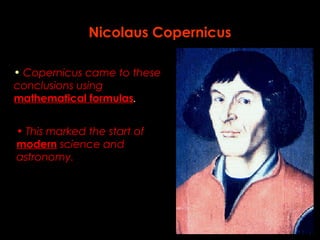
Nicolaus Copernicus 
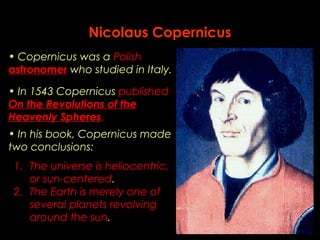
• Copernicus was a Polish 
astronomer who studied in Italy. 
• In 1543 Copernicus published 
On the Revolutions of the 
Heavenly Spheres. 
• In his book, Copernicus made 
two conclusions: 
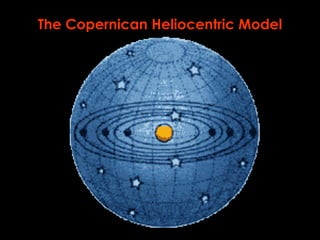
1. The universe is heliocentric, 
or sun-centered. 
2. The Earth is merely one of 
several planets revolving 
around the sun.
Nicolaus Copernicus 
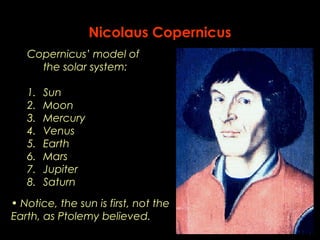
Copernicus’ model of 
the solar system: 
1. Sun 
2. Moon 
3. Mercury 
4. Venus 
5. Earth 
6. Mars 
7. Jupiter 
8. Saturn 
• Notice, the sun is first, not the 
Earth, as Ptolemy believed.
Nicolaus Copernicus 
• Copernicus came to these 
conclusions using 
mathematical formulas. 
• This marked the start of 
modern science and 
astronomy.
The Copernican Heliocentric Model
Reaction to Copernicus 
• Most scholars rejected his 
theory because it went against 
Ptolemy and the Church 
• Many scientists of the time also felt that if Ptolemy’s 
reasoning about the planets was wrong, then the 
whole system of human knowledge could be wrong.
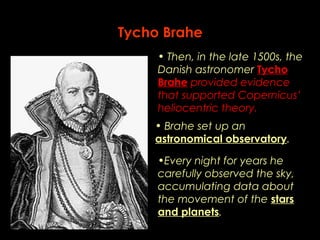
Tycho Brahe 
• Then, in the late 1500s, the 
Danish astronomer Tycho 
Brahe provided evidence 
that supported Copernicus’ 
heliocentric theory. 
• Brahe set up an 
astronomical observatory. 
•Every night for years he 
carefully observed the sky, 
accumulating data about 
the movement of the stars 
and planets.
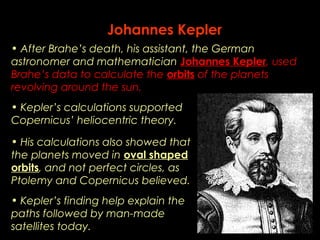
Johannes Kepler 
• After Brahe’s death, his assistant, the German 
astronomer and mathematician Johannes Kepler, used 
Brahe’s data to calculate the orbits of the planets 
revolving around the sun. 
• Kepler’s calculations supported 
Copernicus’ heliocentric theory. 
• His calculations also showed that 
the planets moved in oval shaped 
orbits, and not perfect circles, as 
Ptolemy and Copernicus believed. 
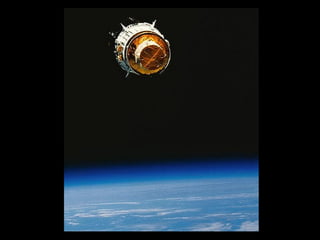
• Kepler’s finding help explain the 
paths followed by man-made 
satellites today.
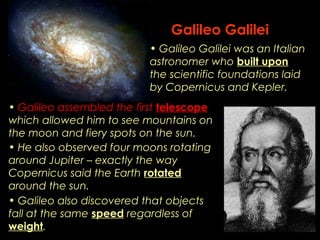
Galileo Galilei 
• Galileo Galilei was an Italian 
astronomer who built upon 
the scientific foundations laid 
by Copernicus and Kepler. 
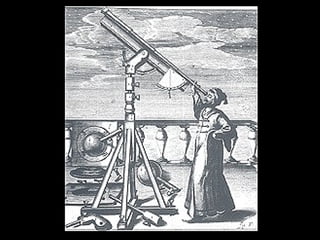
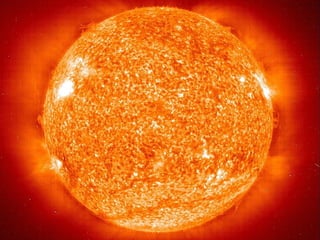
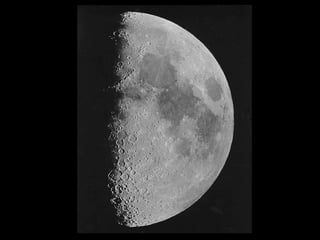
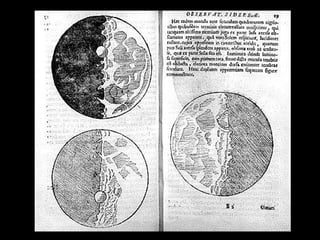
• Galileo assembled the first telescope 
which allowed him to see mountains on 
the moon and fiery spots on the sun. 
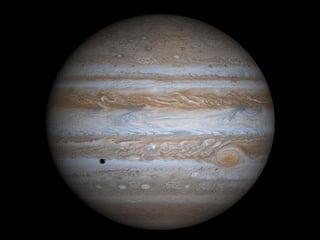
• He also observed four moons rotating 
around Jupiter – exactly the way 
Copernicus said the Earth rotated 
around the sun. 
• Galileo also discovered that objects 
fall at the same speed regardless of 
weight.
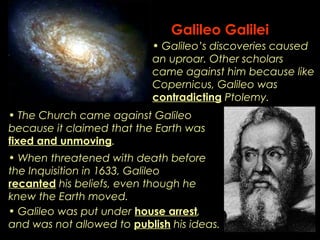
Galileo Galilei 
• Galileo’s discoveries caused 
an uproar. Other scholars 
came against him because like 
Copernicus, Galileo was 
contradicting Ptolemy. 
• The Church came against Galileo 
because it claimed that the Earth was 
fixed and unmoving. 
• When threatened with death before 
the Inquisition in 1633, Galileo 
recanted his beliefs, even though he 
knew the Earth moved. 
• Galileo was put under house arrest, 
and was not allowed to publish his ideas.
The Scientific Method 
• By the early 1600s, a new approach to science 
had emerged, known as the Scientific Method. 
Scientific Method – painstaking method used to 
confirm findings and to prove or disprove a hypothesis. 
• Scientists observed nature, made hypotheses, 
or educated guesses, and then tested these 
hypotheses through experiments. 
• Unlike earlier approaches, the scientific method 
did not rely on the classical thinkers or the Church, 
but depended upon a step-by-step process of 
observation and experimentation.
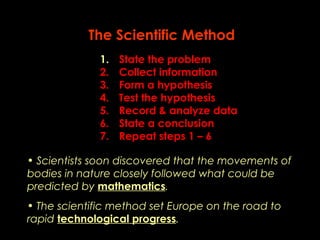
The Scientific Method 
1. State the problem 
2. Collect information 
3. Form a hypothesis 
4. Test the hypothesis 
5. Record & analyze data 
6. State a conclusion 
7. Repeat steps 1 – 6 
• Scientists soon discovered that the movements of 
bodies in nature closely followed what could be 
predicted by mathematics. 
• The scientific method set Europe on the road to 
rapid technological progress.
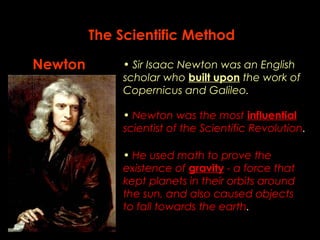
The Scientific Method 
Newton • Sir Isaac Newton was an English 
scholar who built upon the work of 
Copernicus and Galileo. 
• Newton was the most influential 
scientist of the Scientific Revolution. 
• He used math to prove the 
existence of gravity - a force that 
kept planets in their orbits around 
the sun, and also caused objects 
to fall towards the earth.
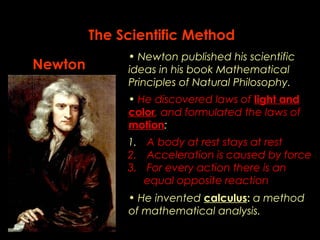
The Scientific Method 
• Newton published his scientific 
ideas in his book Mathematical 
Principles of Natural Philosophy. 
• He discovered laws of light and 
color, and formulated the laws of 
motion: 
• He invented calculus: a method 
of mathematical analysis. 
Newton 
1. A body at rest stays at rest 
2. Acceleration is caused by force 
3. For every action there is an 
equal opposite reaction
The Scientific Method 
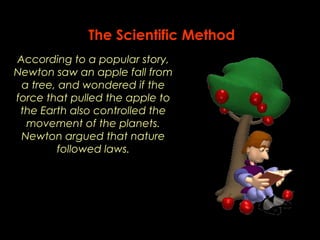
According to a popular story, 
Newton saw an apple fall from 
a tree, and wondered if the 
force that pulled the apple to 
the Earth also controlled the 
movement of the planets. 
Newton argued that nature 
followed laws.
The Scientific Method 
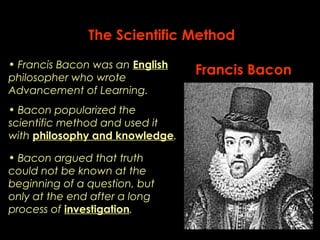
• Francis Bacon was an English Francis Bacon 
philosopher who wrote 
Advancement of Learning. 
• Bacon popularized the 
scientific method and used it 
with philosophy and knowledge. 
• Bacon argued that truth 
could not be known at the 
beginning of a question, but 
only at the end after a long 
process of investigation.
The Scientific Method 
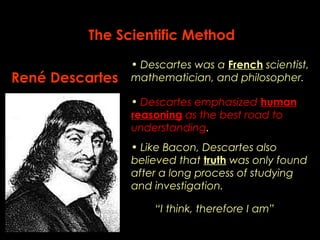
René Descartes 
• Descartes was a French scientist, 
mathematician, and philosopher. 
• Descartes emphasized human 
reasoning as the best road to 
understanding. 
• Like Bacon, Descartes also 
believed that truth was only found 
after a long process of studying 
and investigation. 
“I think, therefore I am”
Other Scientific Advances… 
Chemistry 
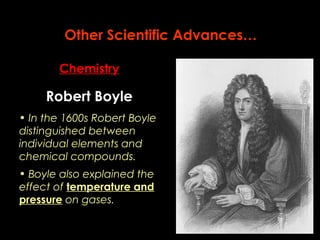
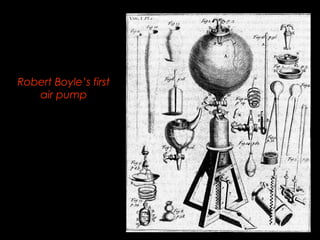
Robert Boyle 
• In the 1600s Robert Boyle 
distinguished between 
individual elements and 
chemical compounds. 
• Boyle also explained the 
effect of temperature and 
pressure on gases.
Robert Boyle’s first 
air pump
Other Scientific Advances… 
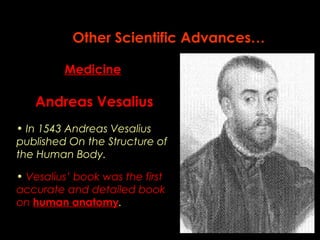
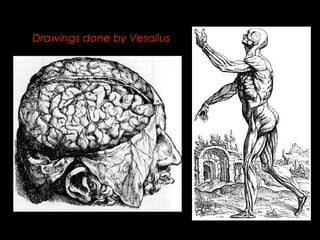
Medicine 
Andreas Vesalius 
• In 1543 Andreas Vesalius 
published On the Structure of 
the Human Body. 
• Vesalius’ book was the first 
accurate and detailed book 
on human anatomy.
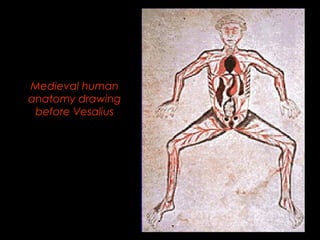
Medieval human 
anatomy drawing 
before Vesalius
Drawings done by Vesalius
Other Scientific Advances… 
Medicine 
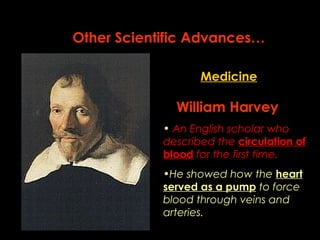
William Harvey 
• An English scholar who 
described the circulation of 
blood for the first time. 
•He showed how the heart 
served as a pump to force 
blood through veins and 
arteries.
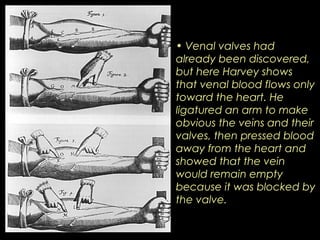
• Venal valves had 
already been discovered, 
but here Harvey shows 
that venal blood flows only 
toward the heart. He 
ligatured an arm to make 
obvious the veins and their 
valves, then pressed blood 
away from the heart and 
showed that the vein 
would remain empty 
because it was blocked by 
the valve.
Other Scientific Advances… 
Medicine 
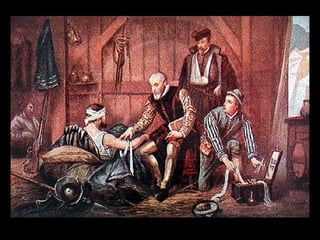
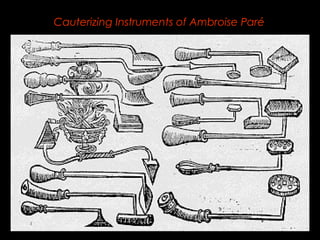
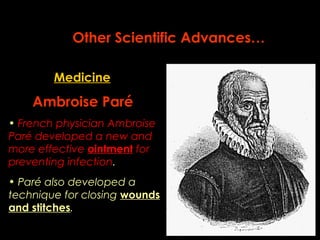
Ambroise Paré 
• French physician Ambroise 
Paré developed a new and 
more effective ointment for 
preventing infection. 
• Paré also developed a 
technique for closing wounds 
and stitches.
Cauterizing Instruments of Ambroise Paré
Other Scientific Advances… 
Medicine 
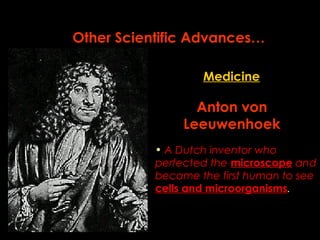
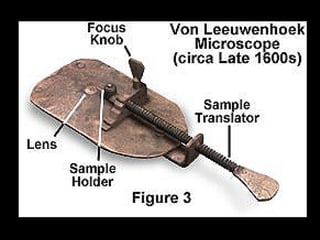
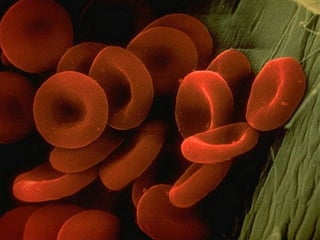
Anton von 
Leeuwenhoek 
• A Dutch inventor who 
perfected the microscope and 
became the first human to see 
cells and microorganisms.
63   scientific revolution

63 scientific revolution

  • 1.
  • 2.
    What is aRevolution? • A Revolution is a complete change, or an overthrow of a government, a social system, etc.
  • 3.
    The Scientific Revolution • In the 1500s and 1600s the Scientific Revolution changed the way Europeans looked at the world. • People began to make conclusions based on experimentation and observation, instead of merely accepting traditional ideas.
  • 4.
    Before the ScientificRevolution… • Until the mid 1500’s, European scholars accepted and believed the teachings of Ptolemy, an ancient Greek astronomer. • Ptolemy taught that the Earth was the center of the universe. Ptolemy (87-140 A.D.) •People felt this was common sense, and the geocentric theory was supported by the Church. • It was not until some startling discoveries caused Europeans to change the way they viewed the physical world.
  • 5.
    Before the ScientificRevolution… Ptolemy’s geocentric model of the solar system: 1. Earth 2. Moon 3. Mercury 4. Venus 5. Sun 6. Mars 7. Jupiter 8. Saturn Ptolemy (87-100 A.D.) • Notice, the Earth is first, and not the sun, as it should be.
  • 7.
    Nicolaus Copernicus •Copernicus was a Polish astronomer who studied in Italy. • In 1543 Copernicus published On the Revolutions of the Heavenly Spheres. • In his book, Copernicus made two conclusions: 1. The universe is heliocentric, or sun-centered. 2. The Earth is merely one of several planets revolving around the sun.
  • 8.
    Nicolaus Copernicus Copernicus’model of the solar system: 1. Sun 2. Moon 3. Mercury 4. Venus 5. Earth 6. Mars 7. Jupiter 8. Saturn • Notice, the sun is first, not the Earth, as Ptolemy believed.
  • 9.
    Nicolaus Copernicus •Copernicus came to these conclusions using mathematical formulas. • This marked the start of modern science and astronomy.
  • 10.
  • 11.
    Reaction to Copernicus • Most scholars rejected his theory because it went against Ptolemy and the Church • Many scientists of the time also felt that if Ptolemy’s reasoning about the planets was wrong, then the whole system of human knowledge could be wrong.
  • 12.
    Tycho Brahe •Then, in the late 1500s, the Danish astronomer Tycho Brahe provided evidence that supported Copernicus’ heliocentric theory. • Brahe set up an astronomical observatory. •Every night for years he carefully observed the sky, accumulating data about the movement of the stars and planets.
  • 13.
    Johannes Kepler •After Brahe’s death, his assistant, the German astronomer and mathematician Johannes Kepler, used Brahe’s data to calculate the orbits of the planets revolving around the sun. • Kepler’s calculations supported Copernicus’ heliocentric theory. • His calculations also showed that the planets moved in oval shaped orbits, and not perfect circles, as Ptolemy and Copernicus believed. • Kepler’s finding help explain the paths followed by man-made satellites today.
  • 15.
    Galileo Galilei •Galileo Galilei was an Italian astronomer who built upon the scientific foundations laid by Copernicus and Kepler. • Galileo assembled the first telescope which allowed him to see mountains on the moon and fiery spots on the sun. • He also observed four moons rotating around Jupiter – exactly the way Copernicus said the Earth rotated around the sun. • Galileo also discovered that objects fall at the same speed regardless of weight.
  • 16.
    Galileo Galilei •Galileo’s discoveries caused an uproar. Other scholars came against him because like Copernicus, Galileo was contradicting Ptolemy. • The Church came against Galileo because it claimed that the Earth was fixed and unmoving. • When threatened with death before the Inquisition in 1633, Galileo recanted his beliefs, even though he knew the Earth moved. • Galileo was put under house arrest, and was not allowed to publish his ideas.
  • 25.
    The Scientific Method • By the early 1600s, a new approach to science had emerged, known as the Scientific Method. Scientific Method – painstaking method used to confirm findings and to prove or disprove a hypothesis. • Scientists observed nature, made hypotheses, or educated guesses, and then tested these hypotheses through experiments. • Unlike earlier approaches, the scientific method did not rely on the classical thinkers or the Church, but depended upon a step-by-step process of observation and experimentation.
  • 26.
    The Scientific Method 1. State the problem 2. Collect information 3. Form a hypothesis 4. Test the hypothesis 5. Record & analyze data 6. State a conclusion 7. Repeat steps 1 – 6 • Scientists soon discovered that the movements of bodies in nature closely followed what could be predicted by mathematics. • The scientific method set Europe on the road to rapid technological progress.
  • 27.
    The Scientific Method Newton • Sir Isaac Newton was an English scholar who built upon the work of Copernicus and Galileo. • Newton was the most influential scientist of the Scientific Revolution. • He used math to prove the existence of gravity - a force that kept planets in their orbits around the sun, and also caused objects to fall towards the earth.
  • 28.
    The Scientific Method • Newton published his scientific ideas in his book Mathematical Principles of Natural Philosophy. • He discovered laws of light and color, and formulated the laws of motion: • He invented calculus: a method of mathematical analysis. Newton 1. A body at rest stays at rest 2. Acceleration is caused by force 3. For every action there is an equal opposite reaction
  • 29.
    The Scientific Method According to a popular story, Newton saw an apple fall from a tree, and wondered if the force that pulled the apple to the Earth also controlled the movement of the planets. Newton argued that nature followed laws.
  • 30.
    The Scientific Method • Francis Bacon was an English Francis Bacon philosopher who wrote Advancement of Learning. • Bacon popularized the scientific method and used it with philosophy and knowledge. • Bacon argued that truth could not be known at the beginning of a question, but only at the end after a long process of investigation.
  • 31.
    The Scientific Method René Descartes • Descartes was a French scientist, mathematician, and philosopher. • Descartes emphasized human reasoning as the best road to understanding. • Like Bacon, Descartes also believed that truth was only found after a long process of studying and investigation. “I think, therefore I am”
  • 32.
    Other Scientific Advances… Chemistry Robert Boyle • In the 1600s Robert Boyle distinguished between individual elements and chemical compounds. • Boyle also explained the effect of temperature and pressure on gases.
  • 33.
  • 34.
    Other Scientific Advances… Medicine Andreas Vesalius • In 1543 Andreas Vesalius published On the Structure of the Human Body. • Vesalius’ book was the first accurate and detailed book on human anatomy.
  • 35.
    Medieval human anatomydrawing before Vesalius
  • 36.
  • 37.
    Other Scientific Advances… Medicine William Harvey • An English scholar who described the circulation of blood for the first time. •He showed how the heart served as a pump to force blood through veins and arteries.
  • 38.
    • Venal valveshad already been discovered, but here Harvey shows that venal blood flows only toward the heart. He ligatured an arm to make obvious the veins and their valves, then pressed blood away from the heart and showed that the vein would remain empty because it was blocked by the valve.
  • 39.
    Other Scientific Advances… Medicine Ambroise Paré • French physician Ambroise Paré developed a new and more effective ointment for preventing infection. • Paré also developed a technique for closing wounds and stitches.
  • 41.
  • 42.
    Other Scientific Advances… Medicine Anton von Leeuwenhoek • A Dutch inventor who perfected the microscope and became the first human to see cells and microorganisms.