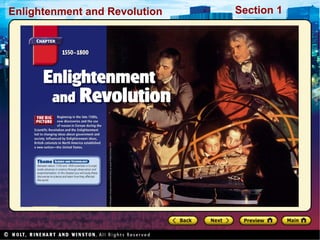
Section 1Enlightenment and Revolution
Preview
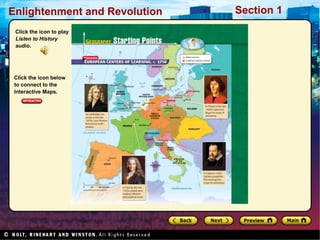
• Starting Points Map: European Centers of Learning
• Main Idea / Reading Focus
• Dawn of Modern Science
• Quick Facts: The Scientific Method
• Discoveries in Astronomy, Physics, and Math
The Scientific Revolution
Section 1Enlightenment and Revolution
Preview, continued
• Discoveries in Biology and Chemistry
• Science and Society
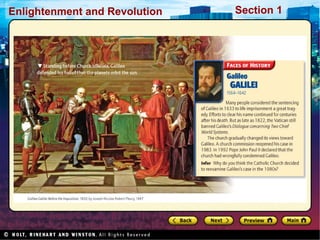
• Faces of History: Galileo Galilei
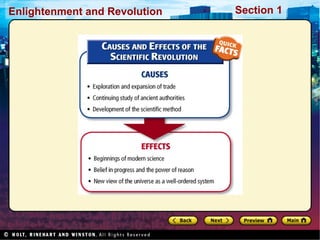
• Quick Facts: Causes and Effects of the Scientific Revolution
The Scientific Revolution
Section 1Enlightenment and Revolution
Click the icon to play
Listen to History
audio.
Click the icon below
to connect to the
Interactive Maps.
Section 1Enlightenment and Revolution
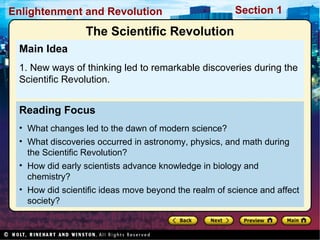
Reading Focus
• What changes led to the dawn of modern science?
• What discoveries occurred in astronomy, physics, and math during
the Scientific Revolution?
• How did early scientists advance knowledge in biology and
chemistry?
• How did scientific ideas move beyond the realm of science and affect
society?
Main Idea
1. New ways of thinking led to remarkable discoveries during the
Scientific Revolution.
The Scientific Revolution
Section 1Enlightenment and Revolution
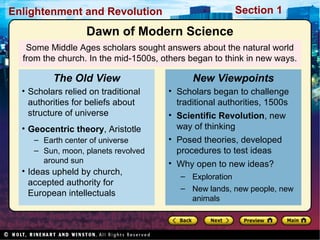
Some Middle Ages scholars sought answers about the natural world
from the church. In the mid-1500s, others began to think in new ways.
• Scholars relied on traditional
authorities for beliefs about
structure of universe
• Geocentric theory, Aristotle
– Earth center of universe
– Sun, moon, planets revolved
around sun
• Ideas upheld by church,
accepted authority for
European intellectuals
The Old View
• Scholars began to challenge
traditional authorities, 1500s
• Scientific Revolution, new
way of thinking
• Posed theories, developed
procedures to test ideas
• Why open to new ideas?
– Exploration
– New lands, new people, new
animals
New Viewpoints
Dawn of Modern Science
Section 1Enlightenment and Revolution
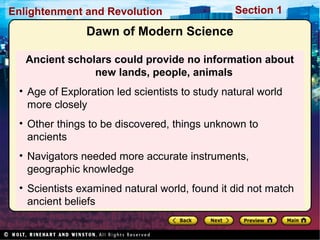
Dawn of Modern Science
Ancient scholars could provide no information about
new lands, people, animals
• Age of Exploration led scientists to study natural world
more closely
• Other things to be discovered, things unknown to
ancients
• Navigators needed more accurate instruments,
geographic knowledge
• Scientists examined natural world, found it did not match
ancient beliefs
Section 1Enlightenment and Revolution
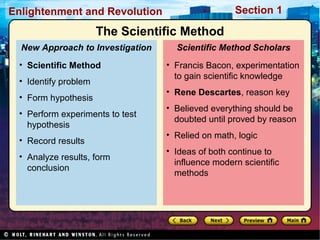
• Francis Bacon, experimentation
to gain scientific knowledge
• Rene Descartes, reason key
• Believed everything should be
doubted until proved by reason
• Relied on math, logic
• Ideas of both continue to
influence modern scientific
methods
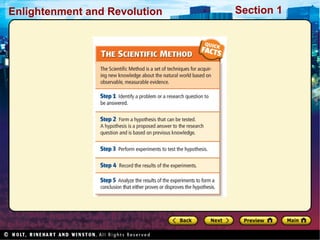
Scientific Method Scholars
• Scientific Method
• Identify problem
• Form hypothesis
• Perform experiments to test
hypothesis
• Record results
• Analyze results, form
conclusion
New Approach to Investigation
The Scientific Method
Section 1Enlightenment and Revolution
Find the Main Idea
What was the Scientific Revolution?
Answer(s): a new way of thinking about the
natural world that challenged traditional views and
instead relied upon experimentation
Section 1Enlightenment and Revolution
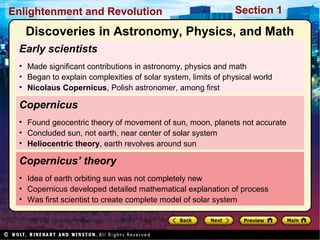
Early scientists
• Made significant contributions in astronomy, physics and math
• Began to explain complexities of solar system, limits of physical world
• Nicolaus Copernicus, Polish astronomer, among first
Copernicus’ theory
• Idea of earth orbiting sun was not completely new
• Copernicus developed detailed mathematical explanation of process
• Was first scientist to create complete model of solar system
Copernicus
• Found geocentric theory of movement of sun, moon, planets not accurate
• Concluded sun, not earth, near center of solar system
• Heliocentric theory, earth revolves around sun
Discoveries in Astronomy, Physics, and Math
Section 1Enlightenment and Revolution
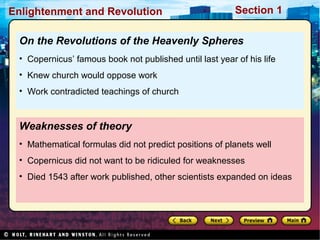
Weaknesses of theory
• Mathematical formulas did not predict positions of planets well
• Copernicus did not want to be ridiculed for weaknesses
• Died 1543 after work published, other scientists expanded on ideas
On the Revolutions of the Heavenly Spheres
• Copernicus’ famous book not published until last year of his life
• Knew church would oppose work
• Work contradicted teachings of church
Section 1Enlightenment and Revolution
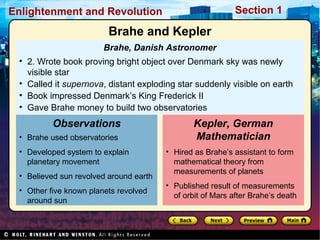
Brahe, Danish Astronomer
• 2. Wrote book proving bright object over Denmark sky was newly
visible star
• Called it supernova, distant exploding star suddenly visible on earth
• Book impressed Denmark’s King Frederick II
• Gave Brahe money to build two observatories
• Brahe used observatories
• Developed system to explain
planetary movement
• Believed sun revolved around earth
• Other five known planets revolved
around sun
Observations
• Hired as Brahe’s assistant to form
mathematical theory from
measurements of planets
• Published result of measurements
of orbit of Mars after Brahe’s death
Kepler, German
Mathematician
Brahe and Kepler
Section 1Enlightenment and Revolution
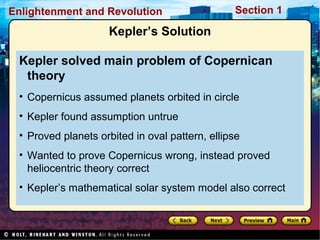
Kepler’s Solution
Kepler solved main problem of Copernican
theory
• Copernicus assumed planets orbited in circle
• Kepler found assumption untrue
• Proved planets orbited in oval pattern, ellipse
• Wanted to prove Copernicus wrong, instead proved
heliocentric theory correct
• Kepler’s mathematical solar system model also correct
Section 1Enlightenment and Revolution
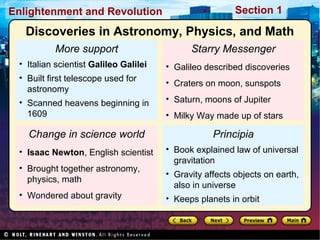
More support
• Italian scientist Galileo Galilei
• Built first telescope used for
astronomy
• Scanned heavens beginning in
1609
Change in science world
• Isaac Newton, English scientist
• Brought together astronomy,
physics, math
• Wondered about gravity
Starry Messenger
• Galileo described discoveries
• Craters on moon, sunspots
• Saturn, moons of Jupiter
• Milky Way made up of stars
Principia
• Book explained law of universal
gravitation
• Gravity affects objects on earth,
also in universe
• Keeps planets in orbit
Discoveries in Astronomy, Physics, and Math
Section 1Enlightenment and Revolution
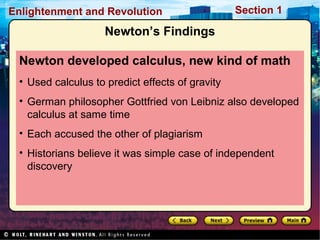
Newton’s Findings
Newton developed calculus, new kind of math
• Used calculus to predict effects of gravity
• German philosopher Gottfried von Leibniz also developed
calculus at same time
• Each accused the other of plagiarism
• Historians believe it was simple case of independent
discovery
Section 1Enlightenment and Revolution
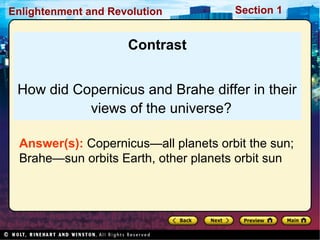
Contrast
How did Copernicus and Brahe differ in their
views of the universe?
Answer(s): Copernicus—all planets orbit the sun;
Brahe—sun orbits Earth, other planets orbit sun
Section 1Enlightenment and Revolution
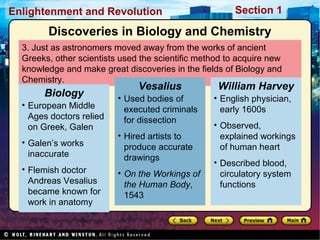
3. Just as astronomers moved away from the works of ancient
Greeks, other scientists used the scientific method to acquire new
knowledge and make great discoveries in the fields of Biology and
Chemistry.
• European Middle
Ages doctors relied
on Greek, Galen
• Galen’s works
inaccurate
• Flemish doctor
Andreas Vesalius
became known for
work in anatomy
Biology • Used bodies of
executed criminals
for dissection
• Hired artists to
produce accurate
drawings
• On the Workings of
the Human Body,
1543
Vesalius
• English physician,
early 1600s
• Observed,
explained workings
of human heart
• Described blood,
circulatory system
functions
William Harvey
Discoveries in Biology and Chemistry
Section 1Enlightenment and Revolution
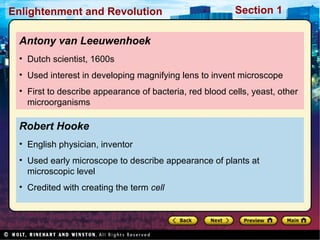
Robert Hooke
• English physician, inventor
• Used early microscope to describe appearance of plants at
microscopic level
• Credited with creating the term cell
Antony van Leeuwenhoek
• Dutch scientist, 1600s
• Used interest in developing magnifying lens to invent microscope
• First to describe appearance of bacteria, red blood cells, yeast, other
microorganisms
Section 1Enlightenment and Revolution
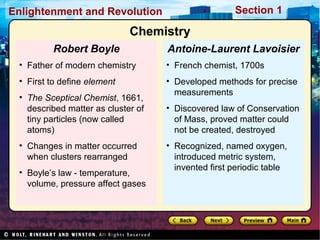
• French chemist, 1700s
• Developed methods for precise
measurements
• Discovered law of Conservation
of Mass, proved matter could
not be created, destroyed
• Recognized, named oxygen,
introduced metric system,
invented first periodic table
Antoine-Laurent Lavoisier
• Father of modern chemistry
• First to define element
• The Sceptical Chemist, 1661,
described matter as cluster of
tiny particles (now called
atoms)
• Changes in matter occurred
when clusters rearranged
• Boyle’s law - temperature,
volume, pressure affect gases
Robert Boyle
Chemistry
Section 1Enlightenment and Revolution
Summarize
What were the major contributions made in
biology and chemistry?
Answer(s): importance of anatomy and
dissection; function of blood and circulatory
system; invention of microscope; discovery of
certain laws of matter
Section 1Enlightenment and Revolution
The church feared reason as an enemy of faith, but eventually began to
embrace some of the achievements of the Scientific Revolution.
As science assumed greater significance, the question of the role of
the Roman Catholic Church in a changing culture became important.
While the church opposed the views of many scientists, it benefited
from new discoveries that made Renaissance art and architecture
possible.
• Church most powerful institution
in Europe, Middle Ages
• Primary resource for
knowledge, learning
• Cathedral schools, universities
trained people to run the church
Science and the Church
Science and Society
• Most scientists did not want to
challenge role of Christianity
• Church explained world through
inspiration, revealed truth
• Science explained world
through logical reasoning
Conflicts
Section 1Enlightenment and Revolution
Galileo’s Theories
• Brought him into direct conflict with the church
• Church leaders pressured him not to support ideas of Copernicus
• Dialogue concerning Two Chief World Systems, 1632, showed support
House Arrest
• Galileo stated would not use Copernican theory in work
• Received lenient sentence in return
• Pope ordered Galileo under house arrest, where he spent rest of life
Trial
• Pope Urban VII ordered Galileo to Rome to stand trial before Inquisition
• Church wanted to stamp out heresy, or dissenting views
• Trial held, April 1633
Science and the Church
Section 1Enlightenment and Revolution
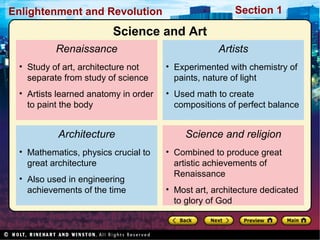
Renaissance
• Study of art, architecture not
separate from study of science
• Artists learned anatomy in order
to paint the body
Architecture
• Mathematics, physics crucial to
great architecture
• Also used in engineering
achievements of the time
Artists
• Experimented with chemistry of
paints, nature of light
• Used math to create
compositions of perfect balance
Science and religion
• Combined to produce great
artistic achievements of
Renaissance
• Most art, architecture dedicated
to glory of God
Science and Art
Section 1Enlightenment and Revolution
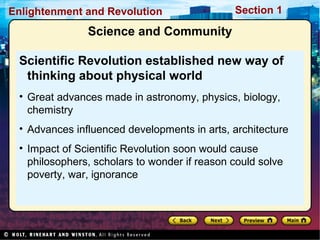
Science and Community
Scientific Revolution established new way of
thinking about physical world
• Great advances made in astronomy, physics, biology,
chemistry
• Advances influenced developments in arts, architecture
• Impact of Scientific Revolution soon would cause
philosophers, scholars to wonder if reason could solve
poverty, war, ignorance
Section 1Enlightenment and Revolution
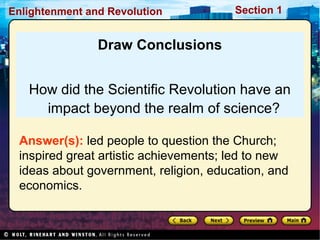
Draw Conclusions
How did the Scientific Revolution have an
impact beyond the realm of science?
Answer(s): led people to question the Church;
inspired great artistic achievements; led to new
ideas about government, religion, education, and
economics.

World History Ch. 19 Section 1 Notes

  • 1.
  • 2.
    Section 1Enlightenment andRevolution Preview • Starting Points Map: European Centers of Learning • Main Idea / Reading Focus • Dawn of Modern Science • Quick Facts: The Scientific Method • Discoveries in Astronomy, Physics, and Math The Scientific Revolution
  • 3.
    Section 1Enlightenment andRevolution Preview, continued • Discoveries in Biology and Chemistry • Science and Society • Faces of History: Galileo Galilei • Quick Facts: Causes and Effects of the Scientific Revolution The Scientific Revolution
  • 4.
    Section 1Enlightenment andRevolution Click the icon to play Listen to History audio. Click the icon below to connect to the Interactive Maps.
  • 5.
    Section 1Enlightenment andRevolution Reading Focus • What changes led to the dawn of modern science? • What discoveries occurred in astronomy, physics, and math during the Scientific Revolution? • How did early scientists advance knowledge in biology and chemistry? • How did scientific ideas move beyond the realm of science and affect society? Main Idea 1. New ways of thinking led to remarkable discoveries during the Scientific Revolution. The Scientific Revolution
  • 6.
    Section 1Enlightenment andRevolution Some Middle Ages scholars sought answers about the natural world from the church. In the mid-1500s, others began to think in new ways. • Scholars relied on traditional authorities for beliefs about structure of universe • Geocentric theory, Aristotle – Earth center of universe – Sun, moon, planets revolved around sun • Ideas upheld by church, accepted authority for European intellectuals The Old View • Scholars began to challenge traditional authorities, 1500s • Scientific Revolution, new way of thinking • Posed theories, developed procedures to test ideas • Why open to new ideas? – Exploration – New lands, new people, new animals New Viewpoints Dawn of Modern Science
  • 7.
    Section 1Enlightenment andRevolution Dawn of Modern Science Ancient scholars could provide no information about new lands, people, animals • Age of Exploration led scientists to study natural world more closely • Other things to be discovered, things unknown to ancients • Navigators needed more accurate instruments, geographic knowledge • Scientists examined natural world, found it did not match ancient beliefs
  • 8.
    Section 1Enlightenment andRevolution • Francis Bacon, experimentation to gain scientific knowledge • Rene Descartes, reason key • Believed everything should be doubted until proved by reason • Relied on math, logic • Ideas of both continue to influence modern scientific methods Scientific Method Scholars • Scientific Method • Identify problem • Form hypothesis • Perform experiments to test hypothesis • Record results • Analyze results, form conclusion New Approach to Investigation The Scientific Method
  • 9.
  • 10.
    Section 1Enlightenment andRevolution Find the Main Idea What was the Scientific Revolution? Answer(s): a new way of thinking about the natural world that challenged traditional views and instead relied upon experimentation
  • 11.
    Section 1Enlightenment andRevolution Early scientists • Made significant contributions in astronomy, physics and math • Began to explain complexities of solar system, limits of physical world • Nicolaus Copernicus, Polish astronomer, among first Copernicus’ theory • Idea of earth orbiting sun was not completely new • Copernicus developed detailed mathematical explanation of process • Was first scientist to create complete model of solar system Copernicus • Found geocentric theory of movement of sun, moon, planets not accurate • Concluded sun, not earth, near center of solar system • Heliocentric theory, earth revolves around sun Discoveries in Astronomy, Physics, and Math
  • 12.
    Section 1Enlightenment andRevolution Weaknesses of theory • Mathematical formulas did not predict positions of planets well • Copernicus did not want to be ridiculed for weaknesses • Died 1543 after work published, other scientists expanded on ideas On the Revolutions of the Heavenly Spheres • Copernicus’ famous book not published until last year of his life • Knew church would oppose work • Work contradicted teachings of church
  • 13.
    Section 1Enlightenment andRevolution Brahe, Danish Astronomer • 2. Wrote book proving bright object over Denmark sky was newly visible star • Called it supernova, distant exploding star suddenly visible on earth • Book impressed Denmark’s King Frederick II • Gave Brahe money to build two observatories • Brahe used observatories • Developed system to explain planetary movement • Believed sun revolved around earth • Other five known planets revolved around sun Observations • Hired as Brahe’s assistant to form mathematical theory from measurements of planets • Published result of measurements of orbit of Mars after Brahe’s death Kepler, German Mathematician Brahe and Kepler
  • 14.
    Section 1Enlightenment andRevolution Kepler’s Solution Kepler solved main problem of Copernican theory • Copernicus assumed planets orbited in circle • Kepler found assumption untrue • Proved planets orbited in oval pattern, ellipse • Wanted to prove Copernicus wrong, instead proved heliocentric theory correct • Kepler’s mathematical solar system model also correct
  • 15.
    Section 1Enlightenment andRevolution More support • Italian scientist Galileo Galilei • Built first telescope used for astronomy • Scanned heavens beginning in 1609 Change in science world • Isaac Newton, English scientist • Brought together astronomy, physics, math • Wondered about gravity Starry Messenger • Galileo described discoveries • Craters on moon, sunspots • Saturn, moons of Jupiter • Milky Way made up of stars Principia • Book explained law of universal gravitation • Gravity affects objects on earth, also in universe • Keeps planets in orbit Discoveries in Astronomy, Physics, and Math
  • 16.
    Section 1Enlightenment andRevolution Newton’s Findings Newton developed calculus, new kind of math • Used calculus to predict effects of gravity • German philosopher Gottfried von Leibniz also developed calculus at same time • Each accused the other of plagiarism • Historians believe it was simple case of independent discovery
  • 17.
    Section 1Enlightenment andRevolution Contrast How did Copernicus and Brahe differ in their views of the universe? Answer(s): Copernicus—all planets orbit the sun; Brahe—sun orbits Earth, other planets orbit sun
  • 18.
    Section 1Enlightenment andRevolution 3. Just as astronomers moved away from the works of ancient Greeks, other scientists used the scientific method to acquire new knowledge and make great discoveries in the fields of Biology and Chemistry. • European Middle Ages doctors relied on Greek, Galen • Galen’s works inaccurate • Flemish doctor Andreas Vesalius became known for work in anatomy Biology • Used bodies of executed criminals for dissection • Hired artists to produce accurate drawings • On the Workings of the Human Body, 1543 Vesalius • English physician, early 1600s • Observed, explained workings of human heart • Described blood, circulatory system functions William Harvey Discoveries in Biology and Chemistry
  • 19.
    Section 1Enlightenment andRevolution Robert Hooke • English physician, inventor • Used early microscope to describe appearance of plants at microscopic level • Credited with creating the term cell Antony van Leeuwenhoek • Dutch scientist, 1600s • Used interest in developing magnifying lens to invent microscope • First to describe appearance of bacteria, red blood cells, yeast, other microorganisms
  • 20.
    Section 1Enlightenment andRevolution • French chemist, 1700s • Developed methods for precise measurements • Discovered law of Conservation of Mass, proved matter could not be created, destroyed • Recognized, named oxygen, introduced metric system, invented first periodic table Antoine-Laurent Lavoisier • Father of modern chemistry • First to define element • The Sceptical Chemist, 1661, described matter as cluster of tiny particles (now called atoms) • Changes in matter occurred when clusters rearranged • Boyle’s law - temperature, volume, pressure affect gases Robert Boyle Chemistry
  • 21.
    Section 1Enlightenment andRevolution Summarize What were the major contributions made in biology and chemistry? Answer(s): importance of anatomy and dissection; function of blood and circulatory system; invention of microscope; discovery of certain laws of matter
  • 22.
    Section 1Enlightenment andRevolution The church feared reason as an enemy of faith, but eventually began to embrace some of the achievements of the Scientific Revolution. As science assumed greater significance, the question of the role of the Roman Catholic Church in a changing culture became important. While the church opposed the views of many scientists, it benefited from new discoveries that made Renaissance art and architecture possible. • Church most powerful institution in Europe, Middle Ages • Primary resource for knowledge, learning • Cathedral schools, universities trained people to run the church Science and the Church Science and Society • Most scientists did not want to challenge role of Christianity • Church explained world through inspiration, revealed truth • Science explained world through logical reasoning Conflicts
  • 23.
    Section 1Enlightenment andRevolution Galileo’s Theories • Brought him into direct conflict with the church • Church leaders pressured him not to support ideas of Copernicus • Dialogue concerning Two Chief World Systems, 1632, showed support House Arrest • Galileo stated would not use Copernican theory in work • Received lenient sentence in return • Pope ordered Galileo under house arrest, where he spent rest of life Trial • Pope Urban VII ordered Galileo to Rome to stand trial before Inquisition • Church wanted to stamp out heresy, or dissenting views • Trial held, April 1633 Science and the Church
  • 24.
  • 25.
    Section 1Enlightenment andRevolution Renaissance • Study of art, architecture not separate from study of science • Artists learned anatomy in order to paint the body Architecture • Mathematics, physics crucial to great architecture • Also used in engineering achievements of the time Artists • Experimented with chemistry of paints, nature of light • Used math to create compositions of perfect balance Science and religion • Combined to produce great artistic achievements of Renaissance • Most art, architecture dedicated to glory of God Science and Art
  • 26.
    Section 1Enlightenment andRevolution Science and Community Scientific Revolution established new way of thinking about physical world • Great advances made in astronomy, physics, biology, chemistry • Advances influenced developments in arts, architecture • Impact of Scientific Revolution soon would cause philosophers, scholars to wonder if reason could solve poverty, war, ignorance
  • 27.
  • 28.
    Section 1Enlightenment andRevolution Draw Conclusions How did the Scientific Revolution have an impact beyond the realm of science? Answer(s): led people to question the Church; inspired great artistic achievements; led to new ideas about government, religion, education, and economics.