22.1 The Scientific22.1 The Scientific
RevolutionRevolution
In the mid-1500s, scientists beginIn the mid-1500s, scientists begin
to question accepted beliefs andto question accepted beliefs and
make new theories based onmake new theories based on
experimentationexperimentation
The Roots of Modern ScienceThe Roots of Modern Science
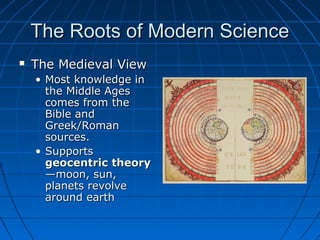
 The Medieval ViewThe Medieval View
• Most knowledge inMost knowledge in
the Middle Agesthe Middle Ages
comes from thecomes from the
Bible andBible and
Greek/RomanGreek/Roman
sources.sources.
• SupportsSupports
geocentricgeocentric theorytheory
—moon, sun,—moon, sun,
planets revolveplanets revolve
around eartharound earth
The Roots of Modern ScienceThe Roots of Modern Science
 A New Way of ThinkingA New Way of Thinking
• Renaissance prompts new ways ofRenaissance prompts new ways of
thinking (1300-1600)thinking (1300-1600)
• Scientific Revolution—new way ofScientific Revolution—new way of
viewing the natural world—based onviewing the natural world—based on
observation and inquiryobservation and inquiry
• New discoveries, overseas explorationNew discoveries, overseas exploration
open up thinkingopen up thinking
• Scholars make new developments inScholars make new developments in
astronomy and mathematics.astronomy and mathematics.
A Revolutionary Model of the UniverseA Revolutionary Model of the Universe
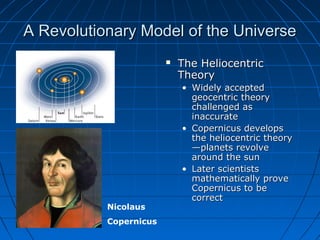
 The HeliocentricThe Heliocentric
TheoryTheory
• Widely acceptedWidely accepted
geocentric theorygeocentric theory
challenged aschallenged as
inaccurateinaccurate
• Copernicus developsCopernicus develops
the heliocentric theorythe heliocentric theory
—planets revolve—planets revolve
around the sunaround the sun
• Later scientistsLater scientists
mathematically provemathematically prove
Copernicus to beCopernicus to be
correctcorrect
Nicolaus
Copernicus
A Revolutionary Model of the UniverseA Revolutionary Model of the Universe
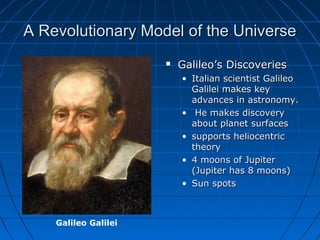
 Galileo’s DiscoveriesGalileo’s Discoveries
• Italian scientist GalileoItalian scientist Galileo
Galilei makes keyGalilei makes key
advances in astronomy.advances in astronomy.
• He makes discoveryHe makes discovery
about planet surfacesabout planet surfaces
• supports heliocentricsupports heliocentric
theorytheory
• 4 moons of Jupiter4 moons of Jupiter
(Jupiter has 8 moons)(Jupiter has 8 moons)
• Sun spotsSun spots
Galileo Galilei
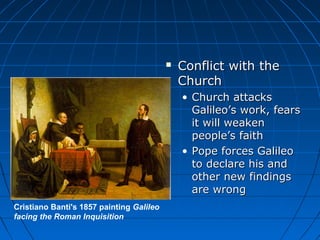
 Conflict with theConflict with the
ChurchChurch
• Church attacksChurch attacks
Galileo’s work, fearsGalileo’s work, fears
it will weakenit will weaken
people’s faithpeople’s faith
• Pope forces GalileoPope forces Galileo
to declare his andto declare his and
other new findingsother new findings
are wrongare wrong
Cristiano Banti's 1857 painting Galileo
facing the Roman Inquisition
The Scientific MethodThe Scientific Method
 A Logical ApproachA Logical Approach
• Revolution in thinking leads to development ofRevolution in thinking leads to development of
scientific method—a series of steps for formingscientific method—a series of steps for forming
and testing scientific theoriesand testing scientific theories
 Bacon and DescartesBacon and Descartes
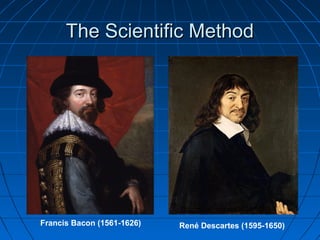
• Thinkers Bacon and Descartes help to createThinkers Bacon and Descartes help to create
scientific methodscientific method
• Bacon urges scientists to experiment beforeBacon urges scientists to experiment before
drawing conclusionsdrawing conclusions
• Descartes advocates using logic and math toDescartes advocates using logic and math to
reason out basic truthsreason out basic truths
The Scientific MethodThe Scientific Method
Francis Bacon (1561-1626) René Descartes (1595-1650)
Newton Explains the Law of GravityNewton Explains the Law of Gravity
 Newton’s TheoriesNewton’s Theories
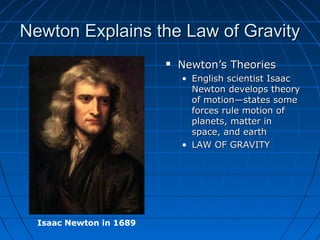
• English scientist IsaacEnglish scientist Isaac
Newton develops theoryNewton develops theory
of motion—states someof motion—states some
forces rule motion offorces rule motion of
planets, matter inplanets, matter in
space, and earthspace, and earth
• LAW OF GRAVITYLAW OF GRAVITY
Isaac Newton in 1689
Newton Explains the Law of GravityNewton Explains the Law of Gravity
 Newton’s TheoriesNewton’s Theories
(continued)(continued)
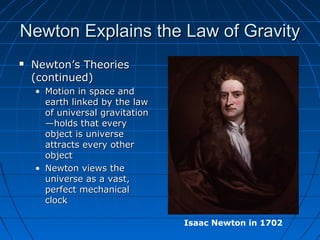
• Motion in space andMotion in space and
earth linked by the lawearth linked by the law
of universal gravitationof universal gravitation
—holds that every—holds that every
object is universeobject is universe
attracts every otherattracts every other
objectobject
• Newton views theNewton views the
universe as a vast,universe as a vast,
perfect mechanicalperfect mechanical
clockclock
Isaac Newton in 1702
The Scientific Revolution SpreadsThe Scientific Revolution Spreads
 ScientificScientific
InstrumentsInstruments
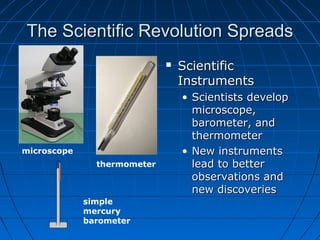
• Scientists developScientists develop
microscope,microscope,
barometer, andbarometer, and
thermometerthermometer
• New instrumentsNew instruments
lead to betterlead to better
observations andobservations and
new discoveriesnew discoveries
microscope
thermometer
simple
mercury
barometer
The Scientific Revolution SpreadsThe Scientific Revolution Spreads
 Medicine and theMedicine and the
Human BodyHuman Body
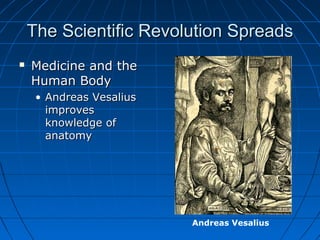
• Andreas VesaliusAndreas Vesalius
improvesimproves
knowledge ofknowledge of
anatomyanatomy
Andreas Vesalius
The Scientific Revolution SpreadsThe Scientific Revolution Spreads
 Medicine and theMedicine and the
Human BodyHuman Body
(continued)(continued)
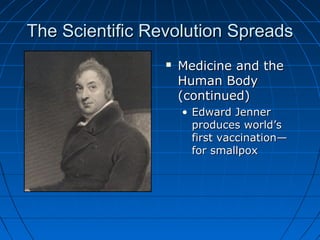
• Edward JennerEdward Jenner
produces world’sproduces world’s
first vaccination—first vaccination—
for smallpoxfor smallpox
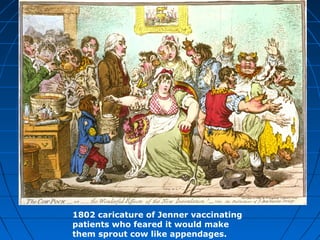
1802 caricature of Jenner vaccinating
patients who feared it would make
them sprout cow like appendages.
The Scientific Revolution SpreadsThe Scientific Revolution Spreads
 Discoveries inDiscoveries in
ChemistryChemistry
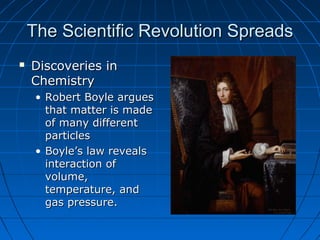
• Robert Boyle arguesRobert Boyle argues
that matter is madethat matter is made
of many differentof many different
particlesparticles
• Boyle’s law revealsBoyle’s law reveals
interaction ofinteraction of
volume,volume,
temperature, andtemperature, and
gas pressure.gas pressure.

22.1 the scientific revolution

  • 1.
    22.1 The Scientific22.1The Scientific RevolutionRevolution In the mid-1500s, scientists beginIn the mid-1500s, scientists begin to question accepted beliefs andto question accepted beliefs and make new theories based onmake new theories based on experimentationexperimentation
  • 2.
    The Roots ofModern ScienceThe Roots of Modern Science  The Medieval ViewThe Medieval View • Most knowledge inMost knowledge in the Middle Agesthe Middle Ages comes from thecomes from the Bible andBible and Greek/RomanGreek/Roman sources.sources. • SupportsSupports geocentricgeocentric theorytheory —moon, sun,—moon, sun, planets revolveplanets revolve around eartharound earth
  • 3.
    The Roots ofModern ScienceThe Roots of Modern Science  A New Way of ThinkingA New Way of Thinking • Renaissance prompts new ways ofRenaissance prompts new ways of thinking (1300-1600)thinking (1300-1600) • Scientific Revolution—new way ofScientific Revolution—new way of viewing the natural world—based onviewing the natural world—based on observation and inquiryobservation and inquiry • New discoveries, overseas explorationNew discoveries, overseas exploration open up thinkingopen up thinking • Scholars make new developments inScholars make new developments in astronomy and mathematics.astronomy and mathematics.
  • 4.
    A Revolutionary Modelof the UniverseA Revolutionary Model of the Universe  The HeliocentricThe Heliocentric TheoryTheory • Widely acceptedWidely accepted geocentric theorygeocentric theory challenged aschallenged as inaccurateinaccurate • Copernicus developsCopernicus develops the heliocentric theorythe heliocentric theory —planets revolve—planets revolve around the sunaround the sun • Later scientistsLater scientists mathematically provemathematically prove Copernicus to beCopernicus to be correctcorrect Nicolaus Copernicus
  • 5.
    A Revolutionary Modelof the UniverseA Revolutionary Model of the Universe  Galileo’s DiscoveriesGalileo’s Discoveries • Italian scientist GalileoItalian scientist Galileo Galilei makes keyGalilei makes key advances in astronomy.advances in astronomy. • He makes discoveryHe makes discovery about planet surfacesabout planet surfaces • supports heliocentricsupports heliocentric theorytheory • 4 moons of Jupiter4 moons of Jupiter (Jupiter has 8 moons)(Jupiter has 8 moons) • Sun spotsSun spots Galileo Galilei
  • 6.
     Conflict withtheConflict with the ChurchChurch • Church attacksChurch attacks Galileo’s work, fearsGalileo’s work, fears it will weakenit will weaken people’s faithpeople’s faith • Pope forces GalileoPope forces Galileo to declare his andto declare his and other new findingsother new findings are wrongare wrong Cristiano Banti's 1857 painting Galileo facing the Roman Inquisition
  • 7.
    The Scientific MethodTheScientific Method  A Logical ApproachA Logical Approach • Revolution in thinking leads to development ofRevolution in thinking leads to development of scientific method—a series of steps for formingscientific method—a series of steps for forming and testing scientific theoriesand testing scientific theories  Bacon and DescartesBacon and Descartes • Thinkers Bacon and Descartes help to createThinkers Bacon and Descartes help to create scientific methodscientific method • Bacon urges scientists to experiment beforeBacon urges scientists to experiment before drawing conclusionsdrawing conclusions • Descartes advocates using logic and math toDescartes advocates using logic and math to reason out basic truthsreason out basic truths
  • 8.
    The Scientific MethodTheScientific Method Francis Bacon (1561-1626) René Descartes (1595-1650)
  • 9.
    Newton Explains theLaw of GravityNewton Explains the Law of Gravity  Newton’s TheoriesNewton’s Theories • English scientist IsaacEnglish scientist Isaac Newton develops theoryNewton develops theory of motion—states someof motion—states some forces rule motion offorces rule motion of planets, matter inplanets, matter in space, and earthspace, and earth • LAW OF GRAVITYLAW OF GRAVITY Isaac Newton in 1689
  • 10.
    Newton Explains theLaw of GravityNewton Explains the Law of Gravity  Newton’s TheoriesNewton’s Theories (continued)(continued) • Motion in space andMotion in space and earth linked by the lawearth linked by the law of universal gravitationof universal gravitation —holds that every—holds that every object is universeobject is universe attracts every otherattracts every other objectobject • Newton views theNewton views the universe as a vast,universe as a vast, perfect mechanicalperfect mechanical clockclock Isaac Newton in 1702
  • 11.
    The Scientific RevolutionSpreadsThe Scientific Revolution Spreads  ScientificScientific InstrumentsInstruments • Scientists developScientists develop microscope,microscope, barometer, andbarometer, and thermometerthermometer • New instrumentsNew instruments lead to betterlead to better observations andobservations and new discoveriesnew discoveries microscope thermometer simple mercury barometer
  • 12.
    The Scientific RevolutionSpreadsThe Scientific Revolution Spreads  Medicine and theMedicine and the Human BodyHuman Body • Andreas VesaliusAndreas Vesalius improvesimproves knowledge ofknowledge of anatomyanatomy Andreas Vesalius
  • 13.
    The Scientific RevolutionSpreadsThe Scientific Revolution Spreads  Medicine and theMedicine and the Human BodyHuman Body (continued)(continued) • Edward JennerEdward Jenner produces world’sproduces world’s first vaccination—first vaccination— for smallpoxfor smallpox
  • 14.
    1802 caricature ofJenner vaccinating patients who feared it would make them sprout cow like appendages.
  • 15.
    The Scientific RevolutionSpreadsThe Scientific Revolution Spreads  Discoveries inDiscoveries in ChemistryChemistry • Robert Boyle arguesRobert Boyle argues that matter is madethat matter is made of many differentof many different particlesparticles • Boyle’s law revealsBoyle’s law reveals interaction ofinteraction of volume,volume, temperature, andtemperature, and gas pressure.gas pressure.