Precursor of Modern Science
The ScientificThe Scientific
RevolutionRevolution
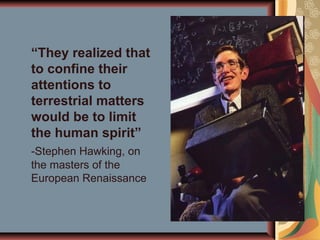
“They realized that
to confine their
attentions to
terrestrial matters
would be to limit
the human spirit”
-Stephen Hawking, on
the masters of the
European Renaissance
Symptoms of a Stagnant Europe
• Renaissance Europe was overwhelmed with a general doctrinal
passivity
• Little change to scientific knowledge accrued over the Middle
Ages (500-1350 AD)
• Lack of experimentation and scientific inquiry; more emphasis
placed on Greco-Roman teachings
• Catholic Church perpetuated what it called “absolute truths”,
which were scientific theorems derived from the work of
Aristotle and Ptolemy, through the educational institutions of
the time
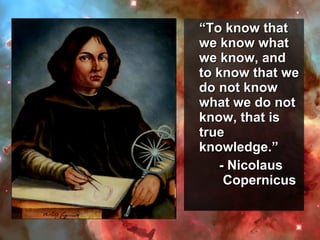
““To know thatTo know that
we know whatwe know what
we know, andwe know, and
to know that weto know that we
do not knowdo not know
what we do notwhat we do not
know, that isknow, that is
truetrue
knowledge.”knowledge.”
- Nicolaus- Nicolaus
CopernicusCopernicus
Nicolaus CopernicusNicolaus Copernicus
1473-1543
• Was the first to postulate heliocentric cosmology, or the
idea that the Earth was not located in the center of our
Universe
• He instead proposed that planets rotated about the Sun
• Widely considered to be the founder of Astronomy
• Some of the greatest works that Copernicus produced were
the treatise De Revolutionibus Orbium Coelestium (On the
Revolutions of the Celestial Spheres, 1543) and his
manuscript Commentariolus (Little Commentary)
• Copernicus was castigated because of his radical ideas,
which he lacked the evidence and means to support
himself with
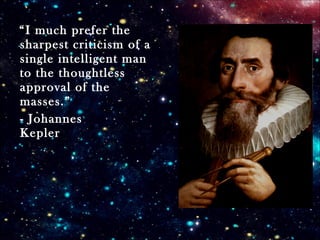
“I much prefer the
sharpest criticism of a
single intelligent man
to the thoughtless
approval of the
masses.”
- Johannes
Kepler
Johannes KeplerJohannes Kepler
Father of Planetary Motion - 1571-1630
• Renowned for his “celestial mechanics”, based upon how he believed
that Earth and the other planets travel about the sun in elliptical orbits
• Made grand contributions to the fields of optics, integral calculus and
geometry
• Created three laws through which planetary motion could be
calculated:
– 1st
Law of Ellipses
– 2nd
Law of Equal Areas
– 3rd
Law of Harmony
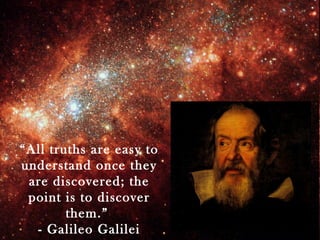
“All truths are easy to
understand once they
are discovered; the
point is to discover
them.”
- Galileo Galilei
Galileo Galilei
1564-1642
 Was an early supporter of experimentation and empiricism
 Rose to prominence within the field of mathematics to earn
his place at the University of Pisa, where he would make
many of his famed scientific discoveries
 Made heavy contributions to the fields of physics, creating
branches of mechanical engineering like kinematics and
dynamics and authoring the Law of Inertia
 After observing the orbital patterns of the moons of
Jupiter, Galileo became a champion of the Copernican idea
of a heliocentric universe
 After publishing his Dialogue Concerning the Two Chief
World Systems in 1632, Galileo was accused of heresy
and was forced to renounce his views. He spent the
remainder of his life under house arrest
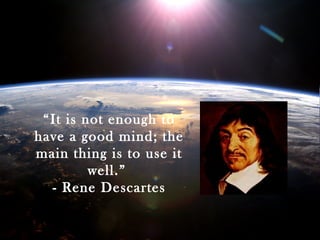
“It is not enough to
have a good mind; the
main thing is to use it
well.”
- Rene Descartes
• Though he was considered a failure of a scientist, Descartes
still holds his place as one of the greatest intellectual minds of
the Scientific Revolution
• Closely associated with the Renaissance philosophical
movement, Descartes was an advocate for rationalism and
deductive reasoning (Cogito ergo sum)
• Perhaps his greatest achievements were in the field of
mathematics, where he linked geometry with algebra
• Was a pioneer of metaphysics, a branch of cognitive physics
focused on the nature of existence and the universe (mind
versus matter)
• Descartes was one of the most influential figures of this time
period; his scientific, mathematic and philosophical
achievements became the foundation on which Newton would
build on
Rene DescartesRene Descartes
1596-16501596-1650
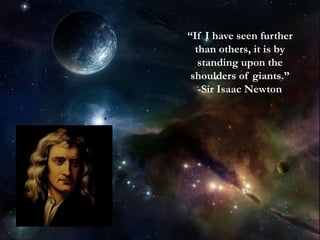
“If I have seen further
than others, it is by
standing upon the
shoulders of giants.”
-Sir Isaac Newton
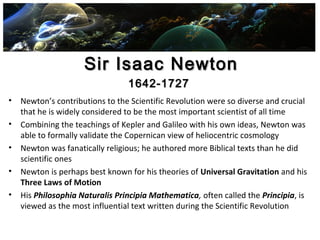
Sir Isaac NewtonSir Isaac Newton
• Newton’s contributions to the Scientific Revolution were so diverse and crucial
that he is widely considered to be the most important scientist of all time
• Combining the teachings of Kepler and Galileo with his own ideas, Newton was
able to formally validate the Copernican view of heliocentric cosmology
• Newton was fanatically religious; he authored more Biblical texts than he did
scientific ones
• Newton is perhaps best known for his theories of Universal Gravitation and his
Three Laws of Motion
• His Philosophia Naturalis Principia Mathematica, often called the Principia, is
viewed as the most influential text written during the Scientific Revolution
1642-17271642-1727
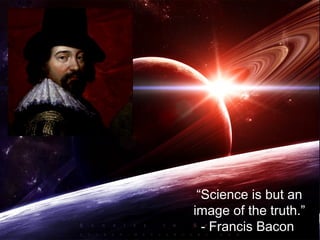
“Science is but an
image of the truth.”
- Francis Bacon
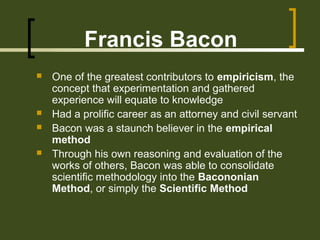
Francis Bacon
 One of the greatest contributors to empiricism, the
concept that experimentation and gathered
experience will equate to knowledge
 Had a prolific career as an attorney and civil servant
 Bacon was a staunch believer in the empirical
method
 Through his own reasoning and evaluation of the
works of others, Bacon was able to consolidate
scientific methodology into the Bacononian
Method, or simply the Scientific Method
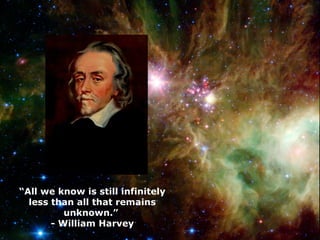
“All we know is still infinitely
less than all that remains
unknown.”
- William Harvey
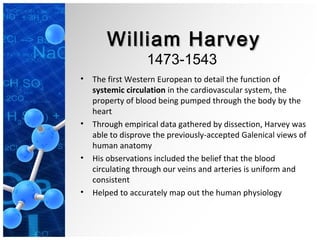
William HarveyWilliam Harvey
1473-1543
• The first Western European to detail the function of
systemic circulation in the cardiovascular system, the
property of blood being pumped through the body by the
heart
• Through empirical data gathered by dissection, Harvey was
able to disprove the previously-accepted Galenical views of
human anatomy
• His observations included the belief that the blood
circulating through our veins and arteries is uniform and
consistent
• Helped to accurately map out the human physiology
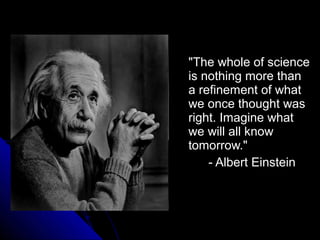
"The whole of science"The whole of science
is nothing more thanis nothing more than
a refinement of whata refinement of what
we once thought waswe once thought was
right. Imagine whatright. Imagine what
we will all knowwe will all know
tomorrow."tomorrow."
- Albert Einstein- Albert Einstein

The scientific revolution

  • 1.
    Precursor of ModernScience The ScientificThe Scientific RevolutionRevolution
  • 2.
    “They realized that toconfine their attentions to terrestrial matters would be to limit the human spirit” -Stephen Hawking, on the masters of the European Renaissance
  • 3.
    Symptoms of aStagnant Europe • Renaissance Europe was overwhelmed with a general doctrinal passivity • Little change to scientific knowledge accrued over the Middle Ages (500-1350 AD) • Lack of experimentation and scientific inquiry; more emphasis placed on Greco-Roman teachings • Catholic Church perpetuated what it called “absolute truths”, which were scientific theorems derived from the work of Aristotle and Ptolemy, through the educational institutions of the time
  • 4.
    ““To know thatToknow that we know whatwe know what we know, andwe know, and to know that weto know that we do not knowdo not know what we do notwhat we do not know, that isknow, that is truetrue knowledge.”knowledge.” - Nicolaus- Nicolaus CopernicusCopernicus
  • 5.
    Nicolaus CopernicusNicolaus Copernicus 1473-1543 •Was the first to postulate heliocentric cosmology, or the idea that the Earth was not located in the center of our Universe • He instead proposed that planets rotated about the Sun • Widely considered to be the founder of Astronomy • Some of the greatest works that Copernicus produced were the treatise De Revolutionibus Orbium Coelestium (On the Revolutions of the Celestial Spheres, 1543) and his manuscript Commentariolus (Little Commentary) • Copernicus was castigated because of his radical ideas, which he lacked the evidence and means to support himself with
  • 6.
    “I much preferthe sharpest criticism of a single intelligent man to the thoughtless approval of the masses.” - Johannes Kepler
  • 7.
    Johannes KeplerJohannes Kepler Fatherof Planetary Motion - 1571-1630 • Renowned for his “celestial mechanics”, based upon how he believed that Earth and the other planets travel about the sun in elliptical orbits • Made grand contributions to the fields of optics, integral calculus and geometry • Created three laws through which planetary motion could be calculated: – 1st Law of Ellipses – 2nd Law of Equal Areas – 3rd Law of Harmony
  • 8.
    “All truths areeasy to understand once they are discovered; the point is to discover them.” - Galileo Galilei
  • 9.
    Galileo Galilei 1564-1642  Wasan early supporter of experimentation and empiricism  Rose to prominence within the field of mathematics to earn his place at the University of Pisa, where he would make many of his famed scientific discoveries  Made heavy contributions to the fields of physics, creating branches of mechanical engineering like kinematics and dynamics and authoring the Law of Inertia  After observing the orbital patterns of the moons of Jupiter, Galileo became a champion of the Copernican idea of a heliocentric universe  After publishing his Dialogue Concerning the Two Chief World Systems in 1632, Galileo was accused of heresy and was forced to renounce his views. He spent the remainder of his life under house arrest
  • 10.
    “It is notenough to have a good mind; the main thing is to use it well.” - Rene Descartes
  • 11.
    • Though hewas considered a failure of a scientist, Descartes still holds his place as one of the greatest intellectual minds of the Scientific Revolution • Closely associated with the Renaissance philosophical movement, Descartes was an advocate for rationalism and deductive reasoning (Cogito ergo sum) • Perhaps his greatest achievements were in the field of mathematics, where he linked geometry with algebra • Was a pioneer of metaphysics, a branch of cognitive physics focused on the nature of existence and the universe (mind versus matter) • Descartes was one of the most influential figures of this time period; his scientific, mathematic and philosophical achievements became the foundation on which Newton would build on Rene DescartesRene Descartes 1596-16501596-1650
  • 12.
    “If I haveseen further than others, it is by standing upon the shoulders of giants.” -Sir Isaac Newton
  • 13.
    Sir Isaac NewtonSirIsaac Newton • Newton’s contributions to the Scientific Revolution were so diverse and crucial that he is widely considered to be the most important scientist of all time • Combining the teachings of Kepler and Galileo with his own ideas, Newton was able to formally validate the Copernican view of heliocentric cosmology • Newton was fanatically religious; he authored more Biblical texts than he did scientific ones • Newton is perhaps best known for his theories of Universal Gravitation and his Three Laws of Motion • His Philosophia Naturalis Principia Mathematica, often called the Principia, is viewed as the most influential text written during the Scientific Revolution 1642-17271642-1727
  • 14.
    “Science is butan image of the truth.” - Francis Bacon
  • 15.
    Francis Bacon  Oneof the greatest contributors to empiricism, the concept that experimentation and gathered experience will equate to knowledge  Had a prolific career as an attorney and civil servant  Bacon was a staunch believer in the empirical method  Through his own reasoning and evaluation of the works of others, Bacon was able to consolidate scientific methodology into the Bacononian Method, or simply the Scientific Method
  • 16.
    “All we knowis still infinitely less than all that remains unknown.” - William Harvey
  • 17.
    William HarveyWilliam Harvey 1473-1543 •The first Western European to detail the function of systemic circulation in the cardiovascular system, the property of blood being pumped through the body by the heart • Through empirical data gathered by dissection, Harvey was able to disprove the previously-accepted Galenical views of human anatomy • His observations included the belief that the blood circulating through our veins and arteries is uniform and consistent • Helped to accurately map out the human physiology
  • 18.
    "The whole ofscience"The whole of science is nothing more thanis nothing more than a refinement of whata refinement of what we once thought waswe once thought was right. Imagine whatright. Imagine what we will all knowwe will all know tomorrow."tomorrow." - Albert Einstein- Albert Einstein