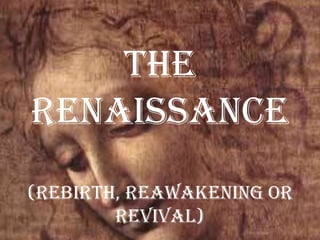
The Renaissance(rebirth, reawakening or revival)
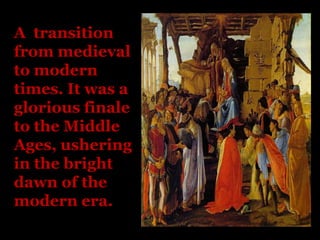
A  transition from medieval to modern times. It was a glorious finale to the Middle Ages, ushering in the bright dawn of the modern era.
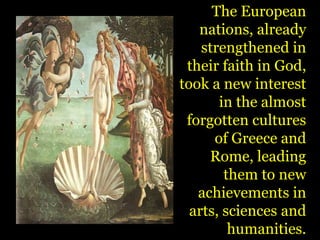
The European nations, already strengthened in their faith in God, took a new interest in the almost forgotten cultures of Greece and Rome, leading them to new achievements in arts, sciences and humanities.
Italy, Birthplace of the Renaissance
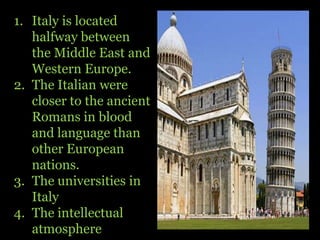
Italy is located halfway between the Middle East and Western Europe.The Italian were closer to the ancient Romans in blood and language than other European nations.The universities in ItalyThe intellectual atmosphere
Humanism(14th century)Latin humanitasmeaning “culture”
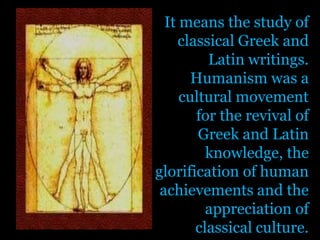
It means the study of classical Greek and Latin writings. Humanism was a cultural movement for the revival of Greek and Latin knowledge, the glorification of human achievements and the appreciation of classical culture.
Great Patrons of Humanism
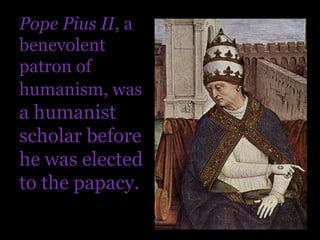
Pope Pius II, a benevolent patron of humanism, was a humanist scholar before he was elected to the papacy.
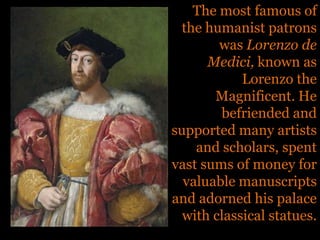
The most famous of the humanist patrons was Lorenzo de Medici, known as Lorenzo the Magnificent. He befriended and supported many artists and scholars, spent vast sums of money for valuable manuscripts and adorned his palace with classical statues.
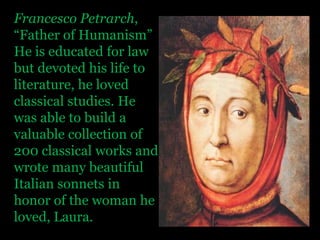
Francesco Petrarch, “Father of Humanism” He is educated for law but devoted his life to literature, he loved classical studies. He was able to build a valuable collection of 200 classical works and wrote many beautiful Italian sonnets in honor of the woman he loved, Laura.
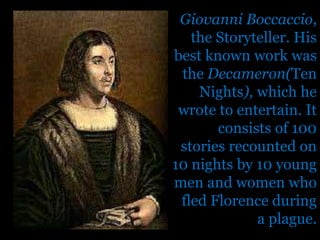
Giovanni Boccaccio, the Storyteller. His best known work was the Decameron(Ten Nights), which he wrote to entertain. It consists of 100 stories recounted on 10 nights by 10 young men and women who fled Florence during a plague.
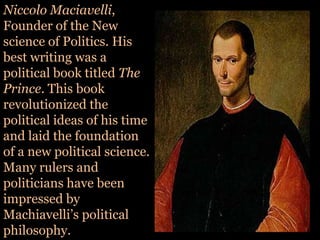
NiccoloMaciavelli, Founder of the New science of Politics. His best writing was a political book titled The Prince. This book revolutionized the political ideas of his time and laid the foundation of a new political science. Many rulers and politicians have been impressed by Machiavelli’s political philosophy.
Spread of Renaissance Humanism
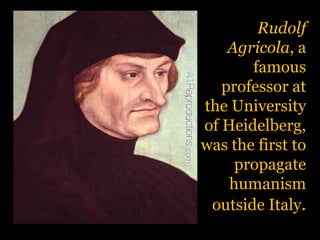
Rudolf Agricola, a famous professor at the University of Heidelberg, was the first to propagate humanism outside Italy.
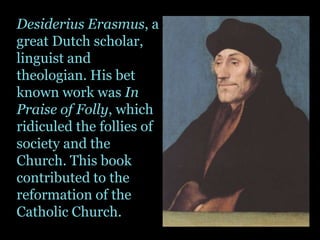
Desiderius Erasmus, a great Dutch scholar, linguist and theologian. His bet known work was In Praise of Folly, which ridiculed the follies of society and the Church. This book contributed to the reformation of the Catholic Church.
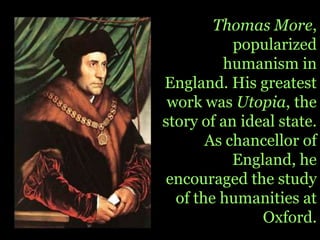
Thomas More, popularized humanism in England. His greatest work was Utopia, the story of an ideal state. As chancellor of England, he encouraged the study of the humanities at Oxford.
Humanist influence of the renaissance education
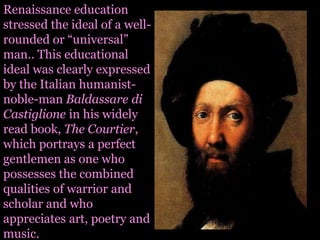
Renaissance education stressed the ideal of a well-rounded or “universal” man.. This educational ideal was clearly expressed by the Italian humanist-noble-man Baldassaredi Castiglione in his widely read book, The Courtier, which portrays a perfect gentlemen as one who possesses the combined qualities of warrior and scholar and who appreciates art, poetry and music.
The Rise of Libraries
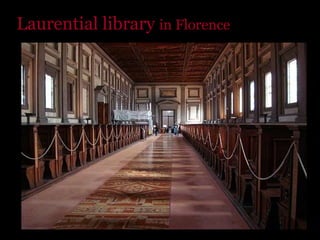
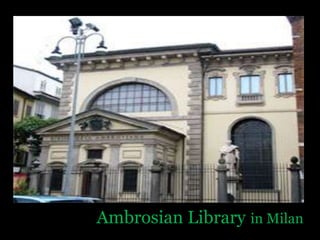
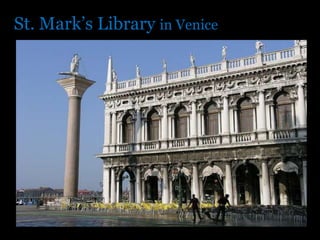
The humanistic movement inspired popes, kings, merchant-princes and scholars to build libraries. Famous among these libraries till the present time are:
Laurential library in Florence
Ambrosian Libraryin Milan
St. Mark’s Library in Venice
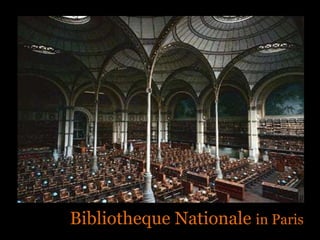
BibliothequeNationalein Paris
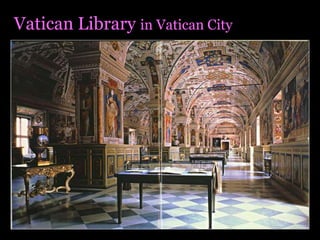
Vatican Library in Vatican City
Renaissance Painting and artists
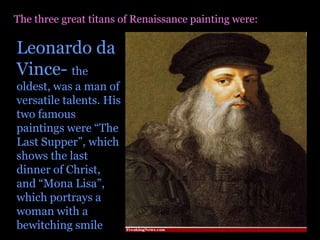
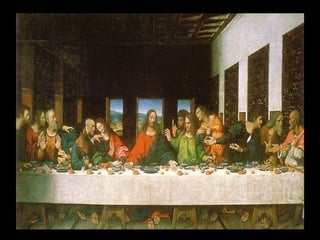
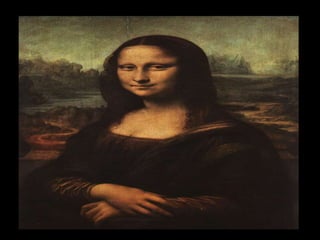
The three great titans of Renaissance painting were:Leonardo da Vince- the oldest, was a man of versatile talents. His two famous paintings were “The Last Supper”, which shows the last dinner of Christ, and “Mona Lisa”, which portrays a woman with a bewitching smile
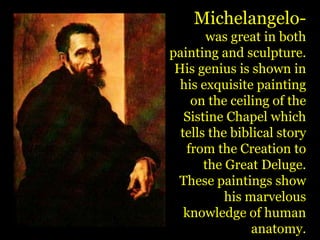
Michelangelo- was great in both painting and sculpture. His genius is shown in his exquisite painting on the ceiling of the Sistine Chapel which tells the biblical story  from the Creation to the Great Deluge. These paintings show his marvelous knowledge of human anatomy.
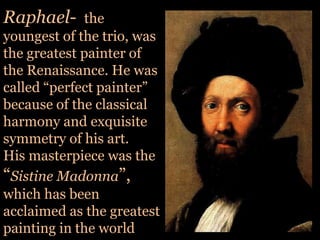
Raphael-  the youngest of the trio, was the greatest painter of the Renaissance. He was called “perfect painter” because of the classical harmony and exquisite symmetry of his art. His masterpiece was the “Sistine Madonna”, which has been acclaimed as the greatest painting in the world
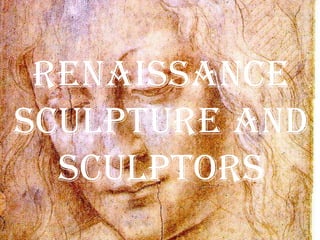
Renaissance Sculpture and sculptors
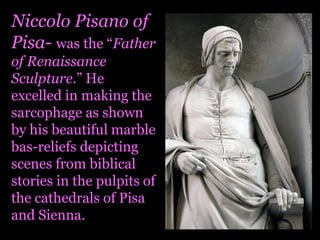
Niccolo Pisano of Pisa- was the “Father of Renaissance Sculpture.” He excelled in making the sarcophage as shown by his beautiful marble bas-reliefs depicting scenes from biblical stories in the pulpits of the cathedrals of Pisa and Sienna.
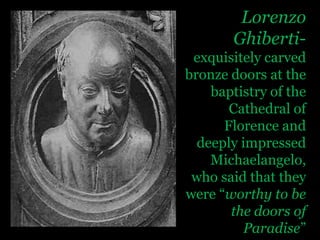
Lorenzo Ghiberti- exquisitely carved bronze doors at the baptistry of the Cathedral of Florence and deeply impressed Michaelangelo, who said that they were “worthy to be the doors of Paradise”
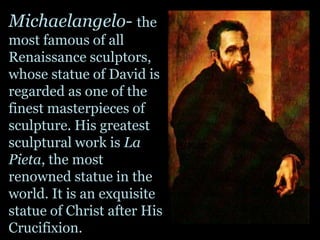
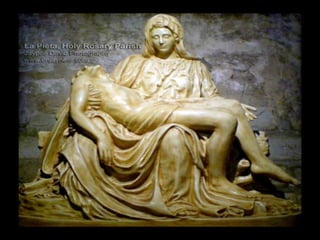
Michaelangelo- the most famous of all Renaissance sculptors, whose statue of David is regarded as one of the finest masterpieces of sculpture. His greatest sculptural work is La Pieta, the most renowned statue in the world. It is an exquisite statue of Christ after His Crucifixion.
Renaissance architecture and architects
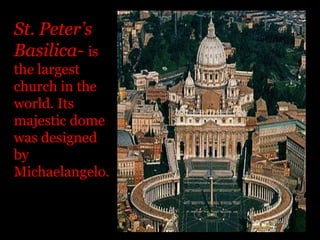
St. Peter’s Basilica- is the largest church in the world. Its majestic dome was designed by Michaelangelo.
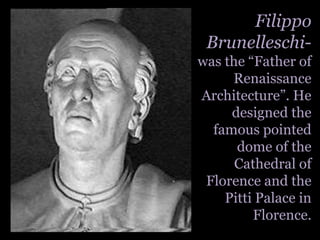
Filippo Brunelleschi- was the “Father of Renaissance Architecture”. He designed the famous pointed dome of the Cathedral of Florence and the Pitti Palace in Florence.
Renaissance Music
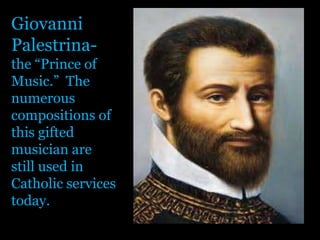
Giovanni Palestrina- the “Prince of Music.”  The numerous compositions of this gifted musician are still used in Catholic services today.
Oratorio- one type of written music. A religious drama set to musicThe Renaissance also gave birth to two forms of secular music:The madrigal, a composition of two or more voices accompanied by several instrumentsThe ayre, a composition for solo voice accompanied by a flute
Effects of the Renaissance
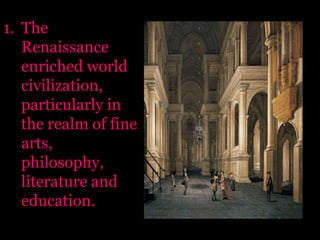
The Renaissance enriched world civilization, particularly in the realm of fine arts, philosophy, literature and education.
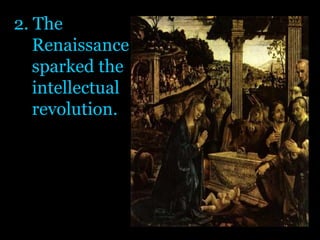
2. The Renaissance  sparked the intellectual revolution.
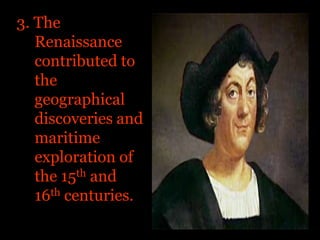
3. The Renaissance contributed to the geographical discoveries and maritime exploration of the 15th and 16th centuries.
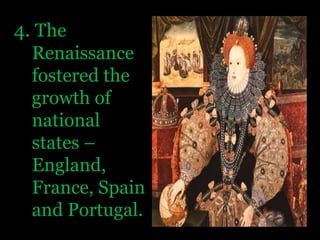
4. The Renaissance fostered the growth of national states – England, France, Spain and Portugal.
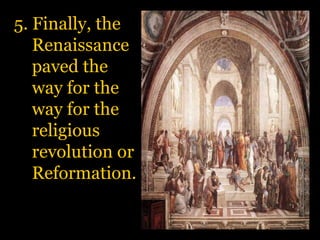
5. Finally, the Renaissance paved the way for the way for the religious revolution or Reformation.
The end

The renaissance

  • 1.
  • 2.
    A transitionfrom medieval to modern times. It was a glorious finale to the Middle Ages, ushering in the bright dawn of the modern era.
  • 3.
    The European nations,already strengthened in their faith in God, took a new interest in the almost forgotten cultures of Greece and Rome, leading them to new achievements in arts, sciences and humanities.
  • 4.
    Italy, Birthplace ofthe Renaissance
  • 5.
    Italy is locatedhalfway between the Middle East and Western Europe.The Italian were closer to the ancient Romans in blood and language than other European nations.The universities in ItalyThe intellectual atmosphere
  • 6.
  • 7.
    It means thestudy of classical Greek and Latin writings. Humanism was a cultural movement for the revival of Greek and Latin knowledge, the glorification of human achievements and the appreciation of classical culture.
  • 8.
  • 9.
    Pope Pius II,a benevolent patron of humanism, was a humanist scholar before he was elected to the papacy.
  • 10.
    The most famousof the humanist patrons was Lorenzo de Medici, known as Lorenzo the Magnificent. He befriended and supported many artists and scholars, spent vast sums of money for valuable manuscripts and adorned his palace with classical statues.
  • 11.
    Francesco Petrarch, “Fatherof Humanism” He is educated for law but devoted his life to literature, he loved classical studies. He was able to build a valuable collection of 200 classical works and wrote many beautiful Italian sonnets in honor of the woman he loved, Laura.
  • 12.
    Giovanni Boccaccio, theStoryteller. His best known work was the Decameron(Ten Nights), which he wrote to entertain. It consists of 100 stories recounted on 10 nights by 10 young men and women who fled Florence during a plague.
  • 13.
    NiccoloMaciavelli, Founder ofthe New science of Politics. His best writing was a political book titled The Prince. This book revolutionized the political ideas of his time and laid the foundation of a new political science. Many rulers and politicians have been impressed by Machiavelli’s political philosophy.
  • 14.
  • 15.
    Rudolf Agricola, afamous professor at the University of Heidelberg, was the first to propagate humanism outside Italy.
  • 16.
    Desiderius Erasmus, agreat Dutch scholar, linguist and theologian. His bet known work was In Praise of Folly, which ridiculed the follies of society and the Church. This book contributed to the reformation of the Catholic Church.
  • 17.
    Thomas More, popularizedhumanism in England. His greatest work was Utopia, the story of an ideal state. As chancellor of England, he encouraged the study of the humanities at Oxford.
  • 18.
    Humanist influence ofthe renaissance education
  • 19.
    Renaissance education stressedthe ideal of a well-rounded or “universal” man.. This educational ideal was clearly expressed by the Italian humanist-noble-man Baldassaredi Castiglione in his widely read book, The Courtier, which portrays a perfect gentlemen as one who possesses the combined qualities of warrior and scholar and who appreciates art, poetry and music.
  • 20.
    The Rise ofLibraries
  • 21.
    The humanistic movementinspired popes, kings, merchant-princes and scholars to build libraries. Famous among these libraries till the present time are:
  • 22.
  • 23.
  • 24.
  • 25.
  • 26.
    Vatican Library inVatican City
  • 27.
  • 28.
    The three greattitans of Renaissance painting were:Leonardo da Vince- the oldest, was a man of versatile talents. His two famous paintings were “The Last Supper”, which shows the last dinner of Christ, and “Mona Lisa”, which portrays a woman with a bewitching smile
  • 31.
    Michelangelo- was greatin both painting and sculpture. His genius is shown in his exquisite painting on the ceiling of the Sistine Chapel which tells the biblical story from the Creation to the Great Deluge. These paintings show his marvelous knowledge of human anatomy.
  • 32.
    Raphael- theyoungest of the trio, was the greatest painter of the Renaissance. He was called “perfect painter” because of the classical harmony and exquisite symmetry of his art. His masterpiece was the “Sistine Madonna”, which has been acclaimed as the greatest painting in the world
  • 33.
  • 34.
    Niccolo Pisano ofPisa- was the “Father of Renaissance Sculpture.” He excelled in making the sarcophage as shown by his beautiful marble bas-reliefs depicting scenes from biblical stories in the pulpits of the cathedrals of Pisa and Sienna.
  • 35.
    Lorenzo Ghiberti- exquisitelycarved bronze doors at the baptistry of the Cathedral of Florence and deeply impressed Michaelangelo, who said that they were “worthy to be the doors of Paradise”
  • 36.
    Michaelangelo- the mostfamous of all Renaissance sculptors, whose statue of David is regarded as one of the finest masterpieces of sculpture. His greatest sculptural work is La Pieta, the most renowned statue in the world. It is an exquisite statue of Christ after His Crucifixion.
  • 38.
  • 39.
    St. Peter’s Basilica-is the largest church in the world. Its majestic dome was designed by Michaelangelo.
  • 40.
    Filippo Brunelleschi- wasthe “Father of Renaissance Architecture”. He designed the famous pointed dome of the Cathedral of Florence and the Pitti Palace in Florence.
  • 41.
  • 42.
    Giovanni Palestrina- the“Prince of Music.” The numerous compositions of this gifted musician are still used in Catholic services today.
  • 43.
    Oratorio- one typeof written music. A religious drama set to musicThe Renaissance also gave birth to two forms of secular music:The madrigal, a composition of two or more voices accompanied by several instrumentsThe ayre, a composition for solo voice accompanied by a flute
  • 44.
    Effects of theRenaissance
  • 45.
    The Renaissance enrichedworld civilization, particularly in the realm of fine arts, philosophy, literature and education.
  • 46.
    2. The Renaissance sparked the intellectual revolution.
  • 47.
    3. The Renaissancecontributed to the geographical discoveries and maritime exploration of the 15th and 16th centuries.
  • 48.
    4. The Renaissancefostered the growth of national states – England, France, Spain and Portugal.
  • 49.
    5. Finally, theRenaissance paved the way for the way for the religious revolution or Reformation.
  • 50.