The
Renaissance
Presented by : Group 1
The Italian Renaissance
► Renaissance

 rebirth
► Italian Renaissance  rebirth of ancient
Greek & Roman worlds
► Characteristics
 Secular Urban society (City-states)
 Age of Recovery
 New view of human ability & worth
Origins of the Renaissance
► European

trade with Asia increased during
the 1300s.
► 2. Italian merchants organized much of this
trade.
► 3. Trade cities in Italy grew wealthy.
► 4. They competed to create works that
would increase the prestige of their cities.
Genoa

Venice

Milan
Origins of the Renaissance
► 5.

(cont)

Florence became a center for
banking, art, culture, and literature.
► 6. Cosimo de’ Medici wanted to make
Florence the most beautiful city.
► 7. The Renaissance began in Italy and
spread throughout Europe.
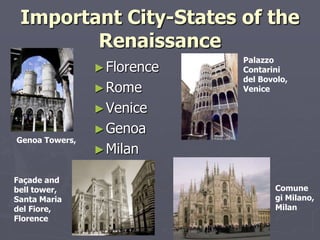
Important City-States of the
Renaissance
► Florence

► Rome

Palazzo
Contarini
del Bovolo,
Venice

► Venice
Genoa Towers,

Façade and
bell tower,
Santa Maria
del Fiore,
Florence

► Genoa
► Milan
Comune
gi Milano,
Milan
Italian City States – Not yet the nation of ITALY

Each Italian
city-state had
its own wealthy
ruler.
Italian Trade Routes – Notice the impact on Italy
Florence
► Center

of art, literature,
and culture.
► Florence became
wealthy from the
manufacturing of wool.
► Later Florence became
the banking center of
Italy.
► The Medici family were
the greatest bankers in
Florence.
Florence
► The

Renaissance
started in Florence
and spread
throughout Europe.
► Competition between
the Italian city-states
led to advances in
literature,
architecture, art,
music, science, and
education.
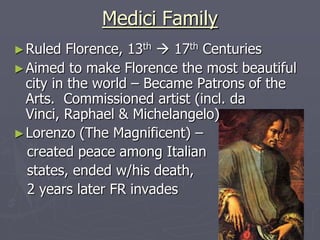
Medici Family
► Ruled

Florence, 13th  17th Centuries
► Aimed to make Florence the most beautiful
city in the world – Became Patrons of the
Arts. Commissioned artist (incl. da
Vinci, Raphael & Michelangelo)
► Lorenzo (The Magnificent) –
created peace among Italian
states, ended w/his death,
2 years later FR invades
Rome
► Home

of the Catholic
Church
► Popes commissioned
famous artists and
architects to beautify
Rome. Michelangelo,
Raphael, and Botticelli
all produced major
works in Rome.
Rome
popes employed the best artists
and architects of the Renaissance to build and
decorate the most opulent churches in in the world.
► Michelangelo designed the finest example of
Renaissance architecture in Rome, the Piazza del
► The

Campidoglio (bottom left). He also designed the
dome of St. Peter’s Basilica (bottom right).
Venice
► Venice

was the wealthiest citystate of the Renaissance.
► It was a port city on the
Mediterranean.
► Venice maintained hundreds of
merchant ships and warships,
and thousands of sailors.
Genoa
► Genoa

is located on the
Mediterranean.
► Genoa was one of two
main port cities in Italy
during the Renaissance.
► Genoa was one of the
wealthiest city-states of
the Renaissance.
► Dominated trade in the
Mediterranean
Genoa
Harbor
► Milan

dominated the inland
trade routes because it was the
gateway to Italy from the north.
► Milan is the site of Santa Maria
delle Grazie, the cathedral where
Leonardo da Vinci painted The
Last Supper in the dining hall.

Milan
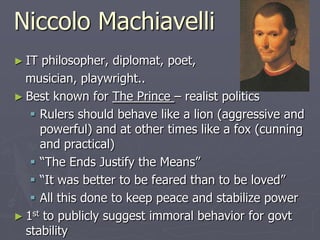
Niccolo Machiavelli
► IT

philosopher, diplomat, poet,
musician, playwright..
► Best known for The Prince – realist politics
 Rulers should behave like a lion (aggressive and
powerful) and at other times like a fox (cunning
and practical)
 “The Ends Justify the Means”
 “It was better to be feared than to be loved”
 All this done to keep peace and stabilize power
► 1st to publicly suggest immoral behavior for govt
stability
Renaissance Society
► Strict

Class society

 Nobility – most powerful, but smallest group
►Strict

rules and expectations
►Born not made or earned

 Townspeople
►Wide

range of wealth, from rich to poor
►Provide goods & services

 Peasants – weakest, but largest group
►More

freedoms as serfdom decreased
►Mainly lived in rural areas, so were least impacted by
Renaissance
The Intellectual and Artistic
Renaissance
Italian Renaissance Humanism
► Stressed

that man was the center of the universe
and had dignity and value
► Humanism – intellectual movement based on the
classics
 Study – grammar, rhetoric (debate), poetry,
philosophy & history (the Humanities)
► Ren Educations – based on humanism
 Goal – create complete citizens
► Vernacular Literature – written in common lang
 Dante, Chaucer, Pizan
Petrarch: “Father of Humanism”
► Petrarch

was a scholar and
poet who was responsible for
the recovery of manuscripts
and works of Greek and
Roman writers.
► He traveled throughout Europe
recovering manuscripts of
Cicero and other Roman
authors that had been lost in
monastery libraries.
► Petrarch, like other writers of
the time, wrote in Latin.

Francesco
Petrarch
Dante Alighieri
► “Father

of the Italian
Language”
► Wrote The Divine Comedy.
► The

Divine Comedy is
considered one of the greatest

works of Italian and world
literature.
► Dante was first to write in the
vernacular, the language used
in everyday life. Until his time,
all European literature was
written in Latin.

Dante
Alighieri
Insert scanned table
The Artistic Renaissance in
Italy
► Rome

became the center of Renaissance art in the
1500s.
 Pope Alexander VI: most notorious of the
Renaissances popes; spent huge sums on art
patronage.
► 3 Masters of the High Renaissance
 Leonardo da Vinci
 Michelangelo
 Raphael
► Sculpture & Architecture are include in Renaissance
Art, both drew from Greek & Roman influenences
New Artistic Techniques
► Fresco

–
watercolor on
fresh plaster
► Law of
Perspective
► Study of human
anatomy
► GOAL – imitate
nature

From Michelangelo’s Sketch Book
Remember these guys?
Leonardo

Raphael

Michelangelo
Donatelo
Leonardo da Vinci
► Master

of realism &
perspective
► Studied human
anatomy (cadavers)
to be as accurate as
possible
► Sculptor, painter, as
tronomer, inventor
– a true
“Renaissance Man”
Leonardo da Vinci
The Last Supper

A page from one of da Vinci’s
notebooks, he “coded” his work
by writing backwards. He could
read it, but most other people
would need a mirror to read it.
Raphael Santi
►1

of the top Renaissance painters
► Especially known for his “Madonna's” –
paintings of Mary the mother of Jesus
► A major artist in the Vatican

Madonna
of the
Meadows
Madonna del
Granduca
Raphael Santi
School of
Athens fresco in
the
Apostolic
Palace in
the Vatican.
Thought to
be
Raphael’s
masterpiece
.
Raphael Santi

The bracketed names are the contemporary characters from whom Raphael is thought
to have drawn his likenesses. 6: Pythagoras? 7: Alexander the Great? 12: Socrates?
13: Heraclitus (Michelangelo) 14: Plato holding the Timaeus (Leonardo da Vinci)
15: Aristotle holding the Ethics? 16: Diogenes of Sinope? 17: 18: Euclid or Archimedes
with students 20: Ptolemy? R: Apelles (Raphael)
Michelangelo Buonarroti
► Painter,

sculptor and architect
► Most famous for work in Vatican City
Vatican City
St. Peter’s Bascillica
(large domed building) –
designed by Michelangelo
(St. Peter’s Square –
designed by Bernini)
Michelangelo
Well known for his frescoes in the Sistine Chapel.
The ceiling illustrates the stories of the Book of
Genesis

The Creation of Adam

The Last Judgement
On the Alter Wall of the
Sistine Chapel.
Michelangelo, the sculptor
The Pieta –
marble statue
of a crucified
Jesus being
held by his
mother Mary.
In St. Peter’s
Basilica.
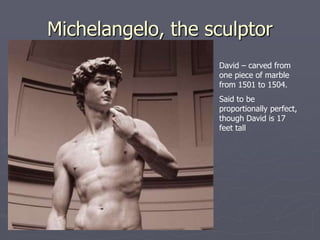
Michelangelo, the sculptor
David – carved from
one piece of marble
from 1501 to 1504.
Said to be
proportionally perfect,
though David is 17
feet tall
Architecture
Architectural design returns
to the classical styles of
Rome and Greece.
► Public buildings, homes and
villas are designed using
Greek and Roman
architectural styles.
► Renaissance buildings
feature columns, domes, and
vaulted ceilings.
► Brunelleschi designs the first
domed building.
► Perspective becomes
important in architecture.
►
Brunelleschi
The Basilica di
Santa Maria
del Fiore,
Florence, also
called the
Duomo.
Donato Bramante
St. Peter’s Basilica
in Vatican City.
Started in 1506;
Completed in 1626.
The Printing Press
Johannes Gutenberg was a
German goldsmith and printer.
► Gutenberg was the first to
develop movable type. This
allowed for mass production of
books.
► Gutenberg’s invention
revolutionized book-making in
Europe.
► Gutenberg was the key figure
in spreading the Renaissance.
► His invention of movable type
is still considered the most
important invention in history.
►
IMPACT
► Much

easier to
publish books
► Increased literacy
► 1450-1500, 20 million
books printed
covering 35,000
topics
► Vernacular Literature
– written in common
language
 Dante, Chaucer, Shak
espeare
Writers of the Renaissance
► With

the printing press. books become more
affordable and more people (mostly wealthy)
learn to read
► Dante, Petrarch and Machiavelli were all
important writers of the time
► But there were more…
New Words Abound…
Alligator
Critical
Equivocal
Eyeball
Eyesore
Gloomy

Laughingstock
Lonely
Luggage
Manager
Puke
Torture

Worthless
Zany

But where did they come from?
William Shakespeare
► Shakespeare

is considered the
greatest writer and dramatist of
all time.
► Shakespeare wrote Romeo and

“All the world’s a stage,
and all the men and
women merely players
there, they have their exits
and their entrances, and
one man in his time plays
many parts….”
William Shakespeare

Juliet, Merchant of Venice, Julius
Caesar, A Midsummer’s Night
Dream, Henry IV, Henry V, Much
Ado About Nothing, Twelfth
Night, Hamlet and more.

► Shakespeare

wrote 38 plays, 154
sonnets, two narrative
poems, and other poems.
Shakespeare
► William








Shakespeare (1564-1616)– Elizabethan era
Greatest of English Renaissance authors
His work reflected the Renaissance ideas of classical
Greek and Roman culture, individualism and
humanism
Wrote comedies, tragedies, histories and sonnets
Known for the “timelessness” of his work
Close to 300 movies and TV adaptations have been
made of Shakespeare’s work (e.g. Ten Things I
Hate About You, a rendition of The Taming of the
Shrew)
Contributions of the Renaissance
► Invention

of the Gutenberg Press
► The banking industry
► Exploration, colonization of world
► Expansion of trade
► Humanism, individual is the center of the universe
► Reintroduction of Greek and Roman knowledge
and philosophy
► Gateway to modern art forms
► Expansion of Greek and Roman architecture and
sculpture
► Increased scientific knowledge, and desire to know
more
Quiz!
1 - 4. Give the 4 important cities that helped widen the
idea of the Renaissance
► 5. What is the meaning of renaissance
► 6. It is the home of the Catholic Church
► 7. The wealthiest city-state of the renaissance
► 8. They are the weakest but largest group
► 9. He is the Father of Humanism
► 10. He is the father of the Italian language
► 11 – 12. Give 2 famous artworks by Leonardo da Vinci
► 13 – 14. 2 famous artworks by Michelangelo
► 15. Give one more famous renaissance painter
►

Arts group 1

  • 1.
  • 2.
    The Italian Renaissance ►Renaissance  rebirth ► Italian Renaissance  rebirth of ancient Greek & Roman worlds ► Characteristics  Secular Urban society (City-states)  Age of Recovery  New view of human ability & worth
  • 3.
    Origins of theRenaissance ► European trade with Asia increased during the 1300s. ► 2. Italian merchants organized much of this trade. ► 3. Trade cities in Italy grew wealthy. ► 4. They competed to create works that would increase the prestige of their cities. Genoa Venice Milan
  • 4.
    Origins of theRenaissance ► 5. (cont) Florence became a center for banking, art, culture, and literature. ► 6. Cosimo de’ Medici wanted to make Florence the most beautiful city. ► 7. The Renaissance began in Italy and spread throughout Europe.
  • 5.
    Important City-States ofthe Renaissance ► Florence ► Rome Palazzo Contarini del Bovolo, Venice ► Venice Genoa Towers, Façade and bell tower, Santa Maria del Fiore, Florence ► Genoa ► Milan Comune gi Milano, Milan
  • 6.
    Italian City States– Not yet the nation of ITALY Each Italian city-state had its own wealthy ruler. Italian Trade Routes – Notice the impact on Italy
  • 7.
    Florence ► Center of art,literature, and culture. ► Florence became wealthy from the manufacturing of wool. ► Later Florence became the banking center of Italy. ► The Medici family were the greatest bankers in Florence.
  • 8.
    Florence ► The Renaissance started inFlorence and spread throughout Europe. ► Competition between the Italian city-states led to advances in literature, architecture, art, music, science, and education.
  • 9.
    Medici Family ► Ruled Florence,13th  17th Centuries ► Aimed to make Florence the most beautiful city in the world – Became Patrons of the Arts. Commissioned artist (incl. da Vinci, Raphael & Michelangelo) ► Lorenzo (The Magnificent) – created peace among Italian states, ended w/his death, 2 years later FR invades
  • 10.
    Rome ► Home of theCatholic Church ► Popes commissioned famous artists and architects to beautify Rome. Michelangelo, Raphael, and Botticelli all produced major works in Rome.
  • 11.
    Rome popes employed thebest artists and architects of the Renaissance to build and decorate the most opulent churches in in the world. ► Michelangelo designed the finest example of Renaissance architecture in Rome, the Piazza del ► The Campidoglio (bottom left). He also designed the dome of St. Peter’s Basilica (bottom right).
  • 12.
    Venice ► Venice was thewealthiest citystate of the Renaissance. ► It was a port city on the Mediterranean. ► Venice maintained hundreds of merchant ships and warships, and thousands of sailors.
  • 13.
    Genoa ► Genoa is locatedon the Mediterranean. ► Genoa was one of two main port cities in Italy during the Renaissance. ► Genoa was one of the wealthiest city-states of the Renaissance. ► Dominated trade in the Mediterranean Genoa Harbor
  • 14.
    ► Milan dominated theinland trade routes because it was the gateway to Italy from the north. ► Milan is the site of Santa Maria delle Grazie, the cathedral where Leonardo da Vinci painted The Last Supper in the dining hall. Milan
  • 15.
    Niccolo Machiavelli ► IT philosopher,diplomat, poet, musician, playwright.. ► Best known for The Prince – realist politics  Rulers should behave like a lion (aggressive and powerful) and at other times like a fox (cunning and practical)  “The Ends Justify the Means”  “It was better to be feared than to be loved”  All this done to keep peace and stabilize power ► 1st to publicly suggest immoral behavior for govt stability
  • 16.
    Renaissance Society ► Strict Classsociety  Nobility – most powerful, but smallest group ►Strict rules and expectations ►Born not made or earned  Townspeople ►Wide range of wealth, from rich to poor ►Provide goods & services  Peasants – weakest, but largest group ►More freedoms as serfdom decreased ►Mainly lived in rural areas, so were least impacted by Renaissance
  • 17.
    The Intellectual andArtistic Renaissance
  • 18.
    Italian Renaissance Humanism ►Stressed that man was the center of the universe and had dignity and value ► Humanism – intellectual movement based on the classics  Study – grammar, rhetoric (debate), poetry, philosophy & history (the Humanities) ► Ren Educations – based on humanism  Goal – create complete citizens ► Vernacular Literature – written in common lang  Dante, Chaucer, Pizan
  • 19.
    Petrarch: “Father ofHumanism” ► Petrarch was a scholar and poet who was responsible for the recovery of manuscripts and works of Greek and Roman writers. ► He traveled throughout Europe recovering manuscripts of Cicero and other Roman authors that had been lost in monastery libraries. ► Petrarch, like other writers of the time, wrote in Latin. Francesco Petrarch
  • 20.
    Dante Alighieri ► “Father ofthe Italian Language” ► Wrote The Divine Comedy. ► The Divine Comedy is considered one of the greatest works of Italian and world literature. ► Dante was first to write in the vernacular, the language used in everyday life. Until his time, all European literature was written in Latin. Dante Alighieri
  • 21.
  • 22.
    The Artistic Renaissancein Italy ► Rome became the center of Renaissance art in the 1500s.  Pope Alexander VI: most notorious of the Renaissances popes; spent huge sums on art patronage. ► 3 Masters of the High Renaissance  Leonardo da Vinci  Michelangelo  Raphael ► Sculpture & Architecture are include in Renaissance Art, both drew from Greek & Roman influenences
  • 23.
    New Artistic Techniques ►Fresco – watercolor on fresh plaster ► Law of Perspective ► Study of human anatomy ► GOAL – imitate nature From Michelangelo’s Sketch Book
  • 24.
  • 25.
    Leonardo da Vinci ►Master of realism & perspective ► Studied human anatomy (cadavers) to be as accurate as possible ► Sculptor, painter, as tronomer, inventor – a true “Renaissance Man”
  • 26.
    Leonardo da Vinci TheLast Supper A page from one of da Vinci’s notebooks, he “coded” his work by writing backwards. He could read it, but most other people would need a mirror to read it.
  • 27.
    Raphael Santi ►1 of thetop Renaissance painters ► Especially known for his “Madonna's” – paintings of Mary the mother of Jesus ► A major artist in the Vatican Madonna of the Meadows Madonna del Granduca
  • 28.
    Raphael Santi School of Athensfresco in the Apostolic Palace in the Vatican. Thought to be Raphael’s masterpiece .
  • 29.
    Raphael Santi The bracketednames are the contemporary characters from whom Raphael is thought to have drawn his likenesses. 6: Pythagoras? 7: Alexander the Great? 12: Socrates? 13: Heraclitus (Michelangelo) 14: Plato holding the Timaeus (Leonardo da Vinci) 15: Aristotle holding the Ethics? 16: Diogenes of Sinope? 17: 18: Euclid or Archimedes with students 20: Ptolemy? R: Apelles (Raphael)
  • 30.
    Michelangelo Buonarroti ► Painter, sculptorand architect ► Most famous for work in Vatican City Vatican City St. Peter’s Bascillica (large domed building) – designed by Michelangelo (St. Peter’s Square – designed by Bernini)
  • 31.
    Michelangelo Well known forhis frescoes in the Sistine Chapel. The ceiling illustrates the stories of the Book of Genesis The Creation of Adam The Last Judgement On the Alter Wall of the Sistine Chapel.
  • 32.
    Michelangelo, the sculptor ThePieta – marble statue of a crucified Jesus being held by his mother Mary. In St. Peter’s Basilica.
  • 33.
    Michelangelo, the sculptor David– carved from one piece of marble from 1501 to 1504. Said to be proportionally perfect, though David is 17 feet tall
  • 34.
    Architecture Architectural design returns tothe classical styles of Rome and Greece. ► Public buildings, homes and villas are designed using Greek and Roman architectural styles. ► Renaissance buildings feature columns, domes, and vaulted ceilings. ► Brunelleschi designs the first domed building. ► Perspective becomes important in architecture. ►
  • 35.
    Brunelleschi The Basilica di SantaMaria del Fiore, Florence, also called the Duomo.
  • 36.
    Donato Bramante St. Peter’sBasilica in Vatican City. Started in 1506; Completed in 1626.
  • 37.
    The Printing Press JohannesGutenberg was a German goldsmith and printer. ► Gutenberg was the first to develop movable type. This allowed for mass production of books. ► Gutenberg’s invention revolutionized book-making in Europe. ► Gutenberg was the key figure in spreading the Renaissance. ► His invention of movable type is still considered the most important invention in history. ►
  • 38.
    IMPACT ► Much easier to publishbooks ► Increased literacy ► 1450-1500, 20 million books printed covering 35,000 topics ► Vernacular Literature – written in common language  Dante, Chaucer, Shak espeare
  • 39.
    Writers of theRenaissance ► With the printing press. books become more affordable and more people (mostly wealthy) learn to read ► Dante, Petrarch and Machiavelli were all important writers of the time ► But there were more…
  • 40.
  • 41.
    William Shakespeare ► Shakespeare isconsidered the greatest writer and dramatist of all time. ► Shakespeare wrote Romeo and “All the world’s a stage, and all the men and women merely players there, they have their exits and their entrances, and one man in his time plays many parts….” William Shakespeare Juliet, Merchant of Venice, Julius Caesar, A Midsummer’s Night Dream, Henry IV, Henry V, Much Ado About Nothing, Twelfth Night, Hamlet and more. ► Shakespeare wrote 38 plays, 154 sonnets, two narrative poems, and other poems.
  • 42.
    Shakespeare ► William      Shakespeare (1564-1616)–Elizabethan era Greatest of English Renaissance authors His work reflected the Renaissance ideas of classical Greek and Roman culture, individualism and humanism Wrote comedies, tragedies, histories and sonnets Known for the “timelessness” of his work Close to 300 movies and TV adaptations have been made of Shakespeare’s work (e.g. Ten Things I Hate About You, a rendition of The Taming of the Shrew)
  • 43.
    Contributions of theRenaissance ► Invention of the Gutenberg Press ► The banking industry ► Exploration, colonization of world ► Expansion of trade ► Humanism, individual is the center of the universe ► Reintroduction of Greek and Roman knowledge and philosophy ► Gateway to modern art forms ► Expansion of Greek and Roman architecture and sculpture ► Increased scientific knowledge, and desire to know more
  • 44.
    Quiz! 1 - 4.Give the 4 important cities that helped widen the idea of the Renaissance ► 5. What is the meaning of renaissance ► 6. It is the home of the Catholic Church ► 7. The wealthiest city-state of the renaissance ► 8. They are the weakest but largest group ► 9. He is the Father of Humanism ► 10. He is the father of the Italian language ► 11 – 12. Give 2 famous artworks by Leonardo da Vinci ► 13 – 14. 2 famous artworks by Michelangelo ► 15. Give one more famous renaissance painter ►