The Scientific Revolution
Late 1300s-1500s:
Renaissance and Reformation 
rediscovery of ancient learning and challenges to traditional thinking
+
Late 1400s-1600s:
Age of Exploration  discovery of new lands, people, flora, and fauna
=
Mid-1500s-1700s:
New explanations of nature  Scientific Revolution
Heliocentric Theory
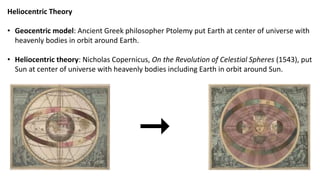
• Geocentric model: Ancient Greek philosopher Ptolemy put Earth at center of universe with
heavenly bodies in orbit around Earth.
• Heliocentric theory: Nicholas Copernicus, On the Revolution of Celestial Spheres (1543), put
Sun at center of universe with heavenly bodies including Earth in orbit around Sun.

Heliocentric Theory
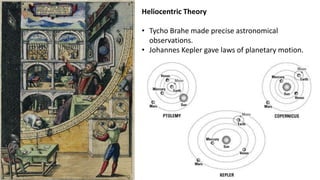
• Tycho Brahe made precise astronomical
observations.
• Johannes Kepler gave laws of planetary motion.
Heliocentric Theory
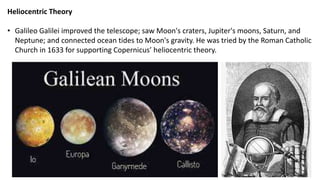
• Galileo Galilei improved the telescope; saw Moon's craters, Jupiter's moons, Saturn, and
Neptune; and connected ocean tides to Moon's gravity. He was tried by the Roman Catholic
Church in 1633 for supporting Copernicus’ heliocentric theory.
Newtonian Cosmology
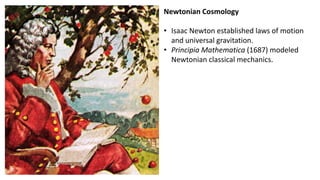
• Isaac Newton established laws of motion
and universal gravitation.
• Principia Mathematica (1687) modeled
Newtonian classical mechanics.
Newtonian Cosmology
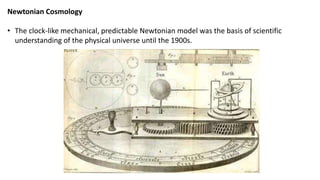
• The clock-like mechanical, predictable Newtonian model was the basis of scientific
understanding of the physical universe until the 1900s.
Newtonian Cosmology
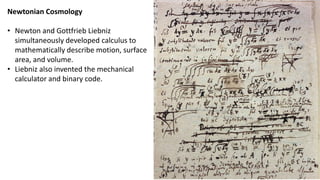
• Newton and Gottfrieb Liebniz
simultaneously developed calculus to
mathematically describe motion, surface
area, and volume.
• Liebniz also invented the mechanical
calculator and binary code.
Scientific Method
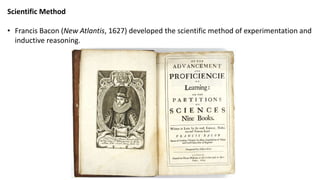
• Francis Bacon (New Atlantis, 1627) developed the scientific method of experimentation and
inductive reasoning.
Scientific Method
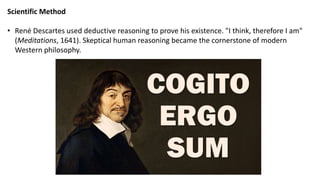
• René Descartes used deductive reasoning to prove his existence. "I think, therefore I am"
(Meditations, 1641). Skeptical human reasoning became the cornerstone of modern
Western philosophy.
Scientific Method
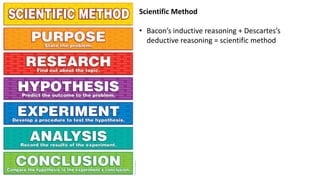
• Bacon’s inductive reasoning + Descartes’s
deductive reasoning = scientific method
Scientific Method
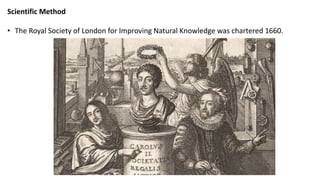
• The Royal Society of London for Improving Natural Knowledge was chartered 1660.
Scientific Method
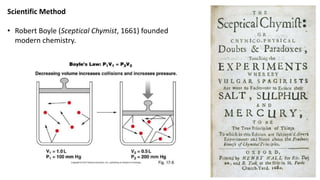
• Robert Boyle (Sceptical Chymist, 1661) founded
modern chemistry.
Scientific Method
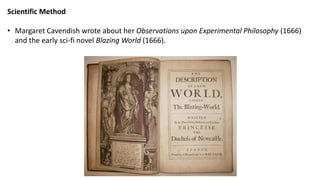
• Margaret Cavendish wrote about her Observations upon Experimental Philosophy (1666)
and the early sci-fi novel Blazing World (1666).
Renaissance-Era Medical Advances
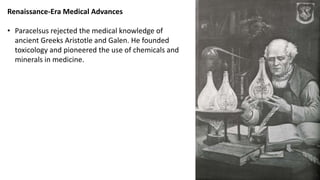
• Paracelsus rejected the medical knowledge of
ancient Greeks Aristotle and Galen. He founded
toxicology and pioneered the use of chemicals and
minerals in medicine.
Renaissance-Era Medical Advances
• Andreas Vesalius conducted dissections to produce the well-illustrated anatomy book
On the Fabric of the Human Body (1543) and was court physician to Charles V.
Renaissance-Era Medical Advances
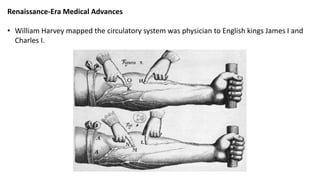
• William Harvey mapped the circulatory system was physician to English kings James I and
Charles I.
Renaissance-Era Medical Advances
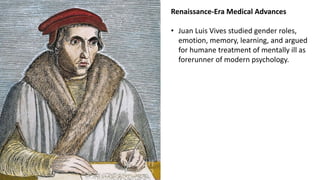
• Juan Luis Vives studied gender roles,
emotion, memory, learning, and argued
for humane treatment of mentally ill as
forerunner of modern psychology.
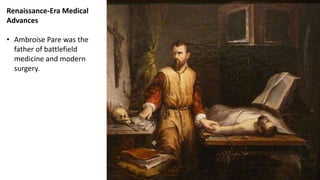
Renaissance-Era Medical
Advances
• Ambroise Pare was the
father of battlefield
medicine and modern
surgery.
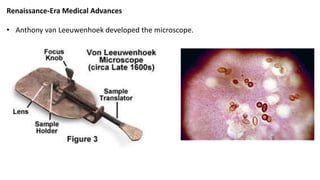
Renaissance-Era Medical Advances
• Anthony van Leeuwenhoek developed the microscope.
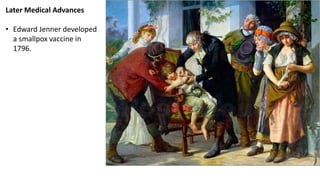
Later Medical Advances
• Edward Jenner developed
a smallpox vaccine in
1796.

The scientific revolution

  • 1.
    The Scientific Revolution Late1300s-1500s: Renaissance and Reformation  rediscovery of ancient learning and challenges to traditional thinking + Late 1400s-1600s: Age of Exploration  discovery of new lands, people, flora, and fauna = Mid-1500s-1700s: New explanations of nature  Scientific Revolution
  • 2.
    Heliocentric Theory • Geocentricmodel: Ancient Greek philosopher Ptolemy put Earth at center of universe with heavenly bodies in orbit around Earth. • Heliocentric theory: Nicholas Copernicus, On the Revolution of Celestial Spheres (1543), put Sun at center of universe with heavenly bodies including Earth in orbit around Sun. 
  • 3.
    Heliocentric Theory • TychoBrahe made precise astronomical observations. • Johannes Kepler gave laws of planetary motion.
  • 4.
    Heliocentric Theory • GalileoGalilei improved the telescope; saw Moon's craters, Jupiter's moons, Saturn, and Neptune; and connected ocean tides to Moon's gravity. He was tried by the Roman Catholic Church in 1633 for supporting Copernicus’ heliocentric theory.
  • 5.
    Newtonian Cosmology • IsaacNewton established laws of motion and universal gravitation. • Principia Mathematica (1687) modeled Newtonian classical mechanics.
  • 6.
    Newtonian Cosmology • Theclock-like mechanical, predictable Newtonian model was the basis of scientific understanding of the physical universe until the 1900s.
  • 7.
    Newtonian Cosmology • Newtonand Gottfrieb Liebniz simultaneously developed calculus to mathematically describe motion, surface area, and volume. • Liebniz also invented the mechanical calculator and binary code.
  • 8.
    Scientific Method • FrancisBacon (New Atlantis, 1627) developed the scientific method of experimentation and inductive reasoning.
  • 9.
    Scientific Method • RenéDescartes used deductive reasoning to prove his existence. "I think, therefore I am" (Meditations, 1641). Skeptical human reasoning became the cornerstone of modern Western philosophy.
  • 10.
    Scientific Method • Bacon’sinductive reasoning + Descartes’s deductive reasoning = scientific method
  • 11.
    Scientific Method • TheRoyal Society of London for Improving Natural Knowledge was chartered 1660.
  • 12.
    Scientific Method • RobertBoyle (Sceptical Chymist, 1661) founded modern chemistry.
  • 13.
    Scientific Method • MargaretCavendish wrote about her Observations upon Experimental Philosophy (1666) and the early sci-fi novel Blazing World (1666).
  • 14.
    Renaissance-Era Medical Advances •Paracelsus rejected the medical knowledge of ancient Greeks Aristotle and Galen. He founded toxicology and pioneered the use of chemicals and minerals in medicine.
  • 15.
    Renaissance-Era Medical Advances •Andreas Vesalius conducted dissections to produce the well-illustrated anatomy book On the Fabric of the Human Body (1543) and was court physician to Charles V.
  • 16.
    Renaissance-Era Medical Advances •William Harvey mapped the circulatory system was physician to English kings James I and Charles I.
  • 17.
    Renaissance-Era Medical Advances •Juan Luis Vives studied gender roles, emotion, memory, learning, and argued for humane treatment of mentally ill as forerunner of modern psychology.
  • 18.
    Renaissance-Era Medical Advances • AmbroisePare was the father of battlefield medicine and modern surgery.
  • 19.
    Renaissance-Era Medical Advances •Anthony van Leeuwenhoek developed the microscope.
  • 20.
    Later Medical Advances •Edward Jenner developed a smallpox vaccine in 1796.