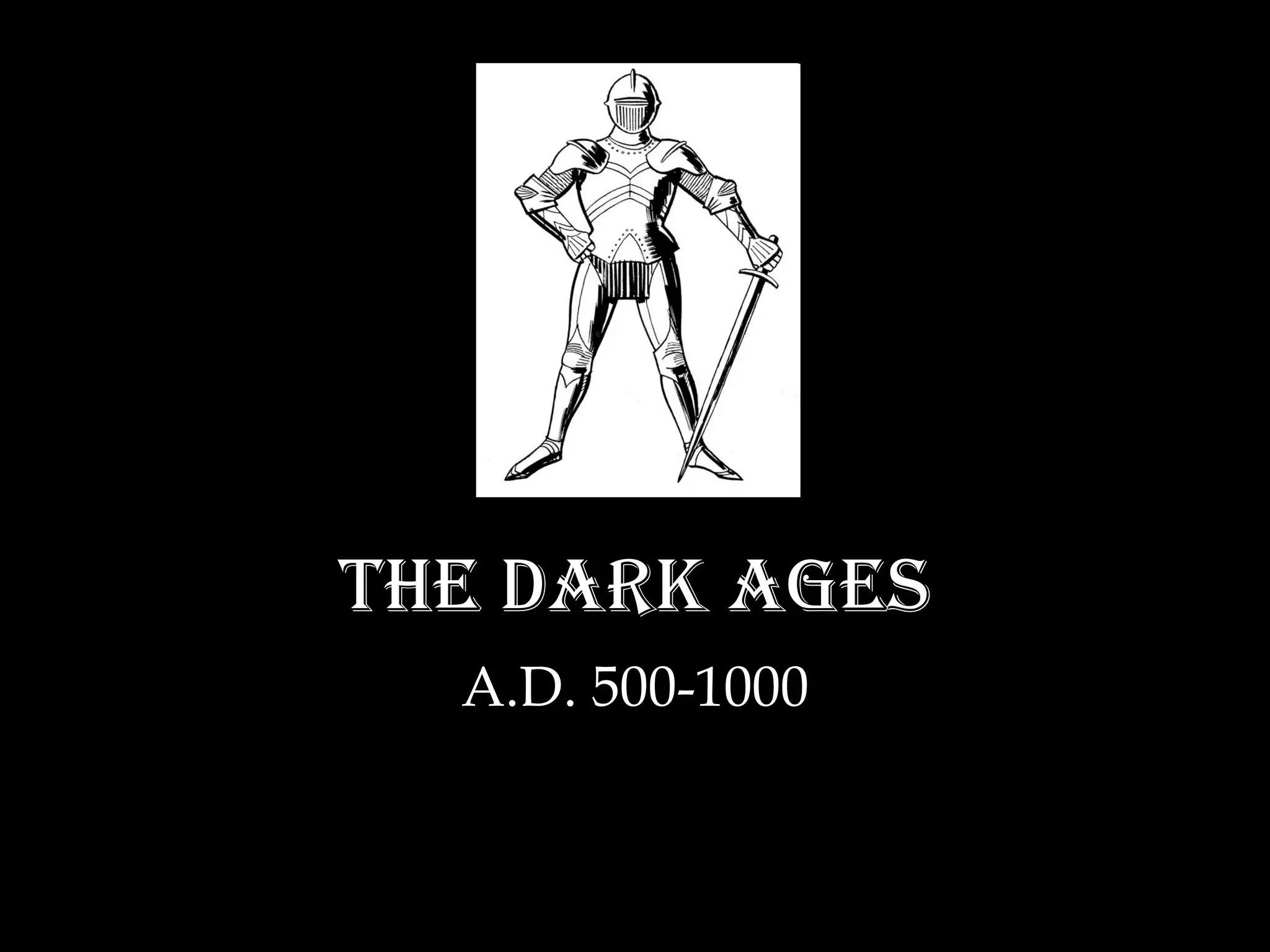
The Dark Ages A.D. 500-1000
Dates and such The “Middle Ages” go from about 500 AD to 1500 AD. 1 st  half = Dark Ages 2 nd  half = High Middle Ages Adjective form = Medieval
“ Dark”? The name comes from the smug Renaissance humanists who wanted to highlight the period’s lack of culture, arts, economic development, political growth, and such. A mix of magic, fear, fantasy, brutality, and ignorance. 1000 AD is a major turning point and begins Europe’s upward arch to the modern age.
The Fall of Rome Bad rulers spent far too much money Couldn’t support the lifestyle the Empire was accustomed to. = Cities fell apart = Unsafe conditions  (looting, thieves on the road) = Less trading = Less exchange of ideas/culture = Smaller kingdoms started to take over farther parts of Empire
The Fall of Rome By 500 AD the Roman Empire’s infrastructure collapses. = Bye-bye stability! Bandits, barbarians, and wild animals roam the countryside Crops unplanted Schools closed Roads crumbled Cities looted Locals fled to the countryside  (hilltops are easier to defend!)
The Rise of Christianity/Paganism Remember Constantine?  (the first Christian Roman Emperor) As Rome fell, Christianity rose in the south. In the north, people reverted to pagan ways (worshiping trees and woodland spirits and such) Viking and Magyar invasions further paganized northern Europe.
The Vikings From Scandinavia Were farmers, fishermen, and craftsmen. With a growing population and a lack of arable land, they traveled south to find greener pastures. Built ships and swept through and across Europe (even reached America!), trading and raiding and spreading their pagan ways.
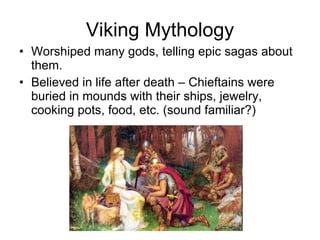
Viking Mythology Worshiped many gods, telling epic sagas about them. Believed in life after death – Chieftains were buried in mounds with their ships, jewelry, cooking pots, food, etc. (sound familiar?)
Days of the Week Monday – Moon’s Day Tuesday – Tyr’s Day  (Norse god of defense) In Rome = dies Martis (Mar’s Day) Wednesday – Woden’s Day  (Odin, Norse chief god) In Rome = dies Mercurii Thursday – Thor’s Day  (Norse god of Thunder) In Rome = dies Jovis Friday – Freya’s Day  (Odin’s wife) In Rome = dies Veneris Saturday – Saturn’s Day  (kept the Roman!) Sunday – Sun’s Day
Back to Europe –  “Normal” Life People lived in small mud and wood huts Farming For warmth, they slept with their animals Wore the same homespun clothes all year A bad harvest = a death sentences for an isolated community “ Wise elders” might be in their 30s.
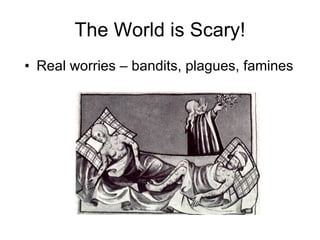
The World is Scary! Real worries – bandits, plagues, famines
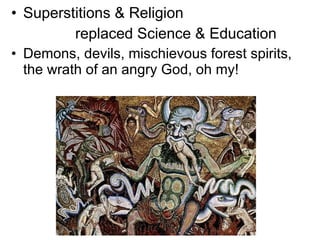
Superstitions & Religion  replaced Science & Education Demons, devils, mischievous forest spirits, the wrath of an angry God, oh my!
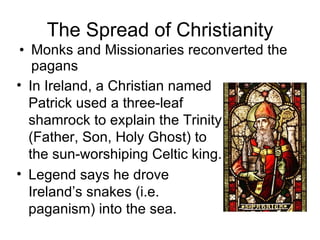
The Spread of Christianity Monks and Missionaries reconverted the pagans In Ireland, a Christian named Patrick used a three-leaf shamrock to explain the Trinity (Father, Son, Holy Ghost) to the sun-worshiping Celtic king.  Legend says he drove Ireland’s snakes (i.e. paganism) into the sea.
Even though the Christian Church took on pagan elements (Christmas trees, etc.), it became a spiritual castle – a refuge from the chaos of the Dark Ages. The Church dominated all aspects of Medieval life: A sin = a crime   Pope took on the Roman Emperor’s title ( Pontifex Maximus ) Tithes = Taxes, etc.  The Bible = the final word on all things scientific, economic, social, political, etc. The afterlife matters more than life on earth
Christians took tithing seriously (gave land to the Church in exchange for years or prayers for their soul) = Church has lots of money! Invested in huge church buildings, ornately decorated. Churches // castles (fortresses, glory) Political, religious, and recreational town centers Took the layout from the Roman court =  Basilica
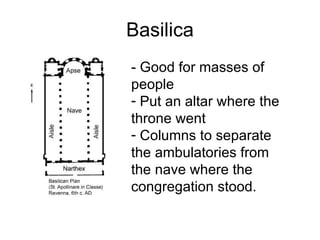
Basilica - Good for masses of people Put an altar where the throne went Columns to separate the ambulatories from the nave where the congregation stood.
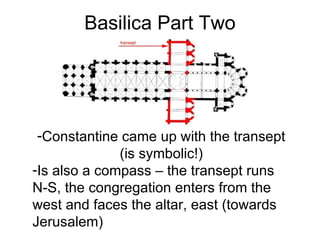
Basilica Part Two Constantine came up with the transept (is symbolic!) Is also a compass – the transept runs N-S, the congregation enters from the west and faces the altar, east (towards Jerusalem)
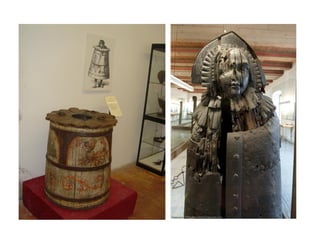
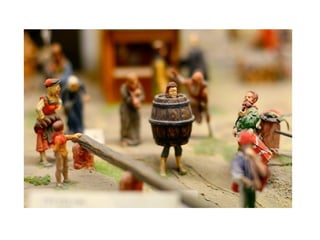
Trial by Ordeal Ordeal of Hot Water - the accused dips his hand in a kettle of boiling water and retrieve a stone. The water had to be about boiling, and the depth from which the stone had to be retrieved was up to the wrist for one accusation, and up to the elbow for three. The ordeal would take place in the church, with several in attendance, purified and praying God to reveal the truth. Afterwards, the hand was bound and examined after three days to see whether it was healing or festering. Ordeal of the Millstone - with a millstone round the neck, the accused would be thrown into a river/lake.  Supposedly, the guilty would sink "The cruel pagans cast him [Quirinus, bishop of the church of Sissek] into a river with a millstone tied to his neck, and when he had fallen into the waters he was long supported on the surface by a divine miracle, and the waters did not suck him down since the weight of crime did not press upon him."
More Ordeals Ordeal of the Cross  - the accuser had to undergo the ordeal together with the accused. They stood on either side of a cross and stretched out their hands horizontally. The one to first lower his arms lost. This ordeal was prescribed by Charlemagne in 779 and again in 806.  Ordeal of the Bread  - Franconian law prescribed that an accused was to be given dry bread and cheese blessed by a priest. If he choked on the food, he was considered guilty. Ordeal of the Turf  - An Icelandic ordeal tradition involves the accused walking under a piece of turf. If the turf falls on the accused's head, the accused person is pronounced guilty.
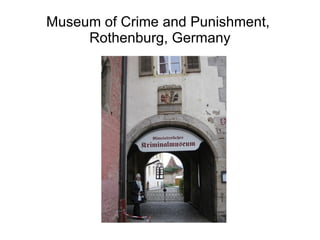
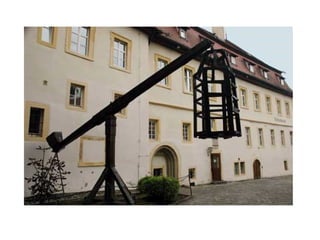
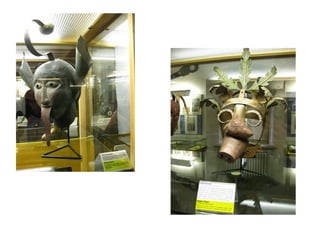
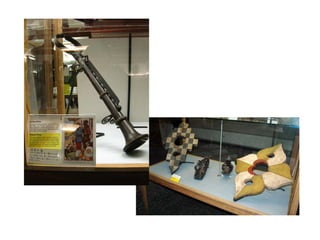
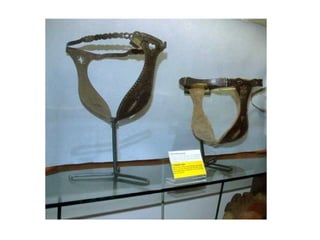
Museum of Crime and Punishment,  Rothenburg, Germany


Monasteries 529 AD – a pivotal year.  Plato’s Academy in Athens closed (after 900 years!) and Benedict created the highly influential Benedictine monastic order (a group of monks committed to similar religious aims) Benedict = father of Western Monasticism & the first great European/Patron Saint of Europe
Monks & Monasteries 529 AD – a pivotal year.  Plato’s Academy in Athens closed (after 900 years!) and Benedict created the highly influential Benedictine monastic order (a group of monks committed to similar religious aims) Benedict = father of Western Monasticism & the first great European/Patron Saint of Europe
Monks Would… Plant gardens, grind grain, chop wood Chant Meditate Study Pray Copy manuscripts – They were Human Xerox machines
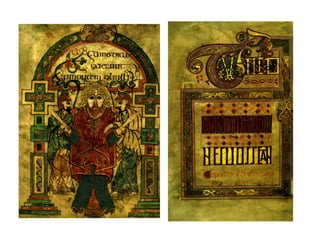
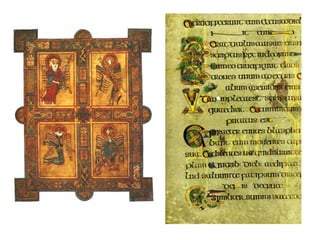
Manuscripts Monks would translate and hand copy ancient texts They would decorate title pages and chapter headings with calligraphy, designs, and cartoons  =  Illuminated Manuscripts
Book of Kells ~800 AD Irish monks translated the first four books of the New Testament into Latin and inked and illustrated it on the skins of 185 calves. Currently on display at Trinity College in Dublin.
Book of Kells ~800 AD (Video –  Making Vellum ) (Video –  The Secret of Kells ) (Video –  Museum Explanation ) (Video –  Beatle’s Version )


The Dark Ages

  • 1.
    The Dark AgesA.D. 500-1000
  • 2.
    Dates and suchThe “Middle Ages” go from about 500 AD to 1500 AD. 1 st half = Dark Ages 2 nd half = High Middle Ages Adjective form = Medieval
  • 3.
    “ Dark”? Thename comes from the smug Renaissance humanists who wanted to highlight the period’s lack of culture, arts, economic development, political growth, and such. A mix of magic, fear, fantasy, brutality, and ignorance. 1000 AD is a major turning point and begins Europe’s upward arch to the modern age.
  • 4.
    The Fall ofRome Bad rulers spent far too much money Couldn’t support the lifestyle the Empire was accustomed to. = Cities fell apart = Unsafe conditions (looting, thieves on the road) = Less trading = Less exchange of ideas/culture = Smaller kingdoms started to take over farther parts of Empire
  • 5.
    The Fall ofRome By 500 AD the Roman Empire’s infrastructure collapses. = Bye-bye stability! Bandits, barbarians, and wild animals roam the countryside Crops unplanted Schools closed Roads crumbled Cities looted Locals fled to the countryside (hilltops are easier to defend!)
  • 6.
    The Rise ofChristianity/Paganism Remember Constantine? (the first Christian Roman Emperor) As Rome fell, Christianity rose in the south. In the north, people reverted to pagan ways (worshiping trees and woodland spirits and such) Viking and Magyar invasions further paganized northern Europe.
  • 7.
    The Vikings FromScandinavia Were farmers, fishermen, and craftsmen. With a growing population and a lack of arable land, they traveled south to find greener pastures. Built ships and swept through and across Europe (even reached America!), trading and raiding and spreading their pagan ways.
  • 8.
    Viking Mythology Worshipedmany gods, telling epic sagas about them. Believed in life after death – Chieftains were buried in mounds with their ships, jewelry, cooking pots, food, etc. (sound familiar?)
  • 9.
    Days of theWeek Monday – Moon’s Day Tuesday – Tyr’s Day (Norse god of defense) In Rome = dies Martis (Mar’s Day) Wednesday – Woden’s Day (Odin, Norse chief god) In Rome = dies Mercurii Thursday – Thor’s Day (Norse god of Thunder) In Rome = dies Jovis Friday – Freya’s Day (Odin’s wife) In Rome = dies Veneris Saturday – Saturn’s Day (kept the Roman!) Sunday – Sun’s Day
  • 10.
    Back to Europe– “Normal” Life People lived in small mud and wood huts Farming For warmth, they slept with their animals Wore the same homespun clothes all year A bad harvest = a death sentences for an isolated community “ Wise elders” might be in their 30s.
  • 11.
    The World isScary! Real worries – bandits, plagues, famines
  • 12.
    Superstitions & Religion replaced Science & Education Demons, devils, mischievous forest spirits, the wrath of an angry God, oh my!
  • 13.
    The Spread ofChristianity Monks and Missionaries reconverted the pagans In Ireland, a Christian named Patrick used a three-leaf shamrock to explain the Trinity (Father, Son, Holy Ghost) to the sun-worshiping Celtic king. Legend says he drove Ireland’s snakes (i.e. paganism) into the sea.
  • 14.
    Even though theChristian Church took on pagan elements (Christmas trees, etc.), it became a spiritual castle – a refuge from the chaos of the Dark Ages. The Church dominated all aspects of Medieval life: A sin = a crime Pope took on the Roman Emperor’s title ( Pontifex Maximus ) Tithes = Taxes, etc. The Bible = the final word on all things scientific, economic, social, political, etc. The afterlife matters more than life on earth
  • 15.
    Christians took tithingseriously (gave land to the Church in exchange for years or prayers for their soul) = Church has lots of money! Invested in huge church buildings, ornately decorated. Churches // castles (fortresses, glory) Political, religious, and recreational town centers Took the layout from the Roman court = Basilica
  • 16.
    Basilica - Goodfor masses of people Put an altar where the throne went Columns to separate the ambulatories from the nave where the congregation stood.
  • 17.
    Basilica Part TwoConstantine came up with the transept (is symbolic!) Is also a compass – the transept runs N-S, the congregation enters from the west and faces the altar, east (towards Jerusalem)
  • 18.
    Trial by OrdealOrdeal of Hot Water - the accused dips his hand in a kettle of boiling water and retrieve a stone. The water had to be about boiling, and the depth from which the stone had to be retrieved was up to the wrist for one accusation, and up to the elbow for three. The ordeal would take place in the church, with several in attendance, purified and praying God to reveal the truth. Afterwards, the hand was bound and examined after three days to see whether it was healing or festering. Ordeal of the Millstone - with a millstone round the neck, the accused would be thrown into a river/lake. Supposedly, the guilty would sink "The cruel pagans cast him [Quirinus, bishop of the church of Sissek] into a river with a millstone tied to his neck, and when he had fallen into the waters he was long supported on the surface by a divine miracle, and the waters did not suck him down since the weight of crime did not press upon him."
  • 19.
    More Ordeals Ordealof the Cross - the accuser had to undergo the ordeal together with the accused. They stood on either side of a cross and stretched out their hands horizontally. The one to first lower his arms lost. This ordeal was prescribed by Charlemagne in 779 and again in 806. Ordeal of the Bread - Franconian law prescribed that an accused was to be given dry bread and cheese blessed by a priest. If he choked on the food, he was considered guilty. Ordeal of the Turf - An Icelandic ordeal tradition involves the accused walking under a piece of turf. If the turf falls on the accused's head, the accused person is pronounced guilty.
  • 20.
    Museum of Crimeand Punishment, Rothenburg, Germany
  • 21.
  • 22.
  • 23.
  • 24.
  • 25.
  • 26.
  • 27.
    Monasteries 529 AD– a pivotal year. Plato’s Academy in Athens closed (after 900 years!) and Benedict created the highly influential Benedictine monastic order (a group of monks committed to similar religious aims) Benedict = father of Western Monasticism & the first great European/Patron Saint of Europe
  • 28.
    Monks & Monasteries529 AD – a pivotal year. Plato’s Academy in Athens closed (after 900 years!) and Benedict created the highly influential Benedictine monastic order (a group of monks committed to similar religious aims) Benedict = father of Western Monasticism & the first great European/Patron Saint of Europe
  • 29.
    Monks Would… Plantgardens, grind grain, chop wood Chant Meditate Study Pray Copy manuscripts – They were Human Xerox machines
  • 30.
    Manuscripts Monks wouldtranslate and hand copy ancient texts They would decorate title pages and chapter headings with calligraphy, designs, and cartoons = Illuminated Manuscripts
  • 31.
    Book of Kells~800 AD Irish monks translated the first four books of the New Testament into Latin and inked and illustrated it on the skins of 185 calves. Currently on display at Trinity College in Dublin.
  • 32.
    Book of Kells~800 AD (Video – Making Vellum ) (Video – The Secret of Kells ) (Video – Museum Explanation ) (Video – Beatle’s Version )
  • 33.
  • 34.