The Scientific Revolution
A New World View
What Was the Scientific
Revolution?
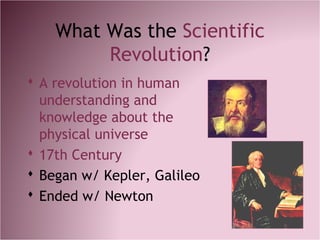
 A revolution in human
understanding and
knowledge about the
physical universe
 17th Century
 Began w/ Kepler, Galileo
 Ended w/ Newton
“Science” Before the SR
 Based on reasoning
 Experimental
method or
observation - not
used
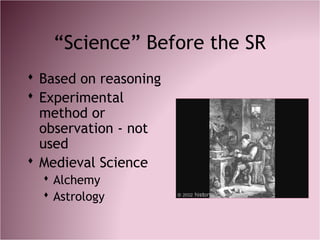
 Medieval Science
 Alchemy
 Astrology
Creating a New Worldview
 Hallmarks of SR
 Questioning of old knowledge &
assumptions
 Gradual replacement of religious &
superstitious presumptions
 Gradual rise of science & reason
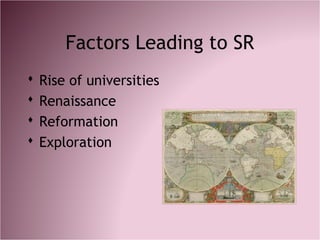
Factors Leading to SR
 Rise of universities
 Renaissance
 Reformation
 Exploration
Astronomy & Physics
 Work with the person next to you and
diagram the Universe as we know it
today
 Be as accurate as possible
 You have 2 minutes…
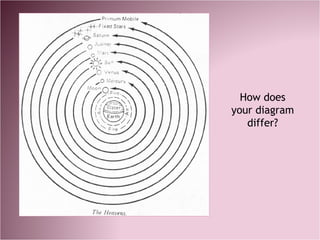
How does
your diagram
differ?
Astronomy & Physics
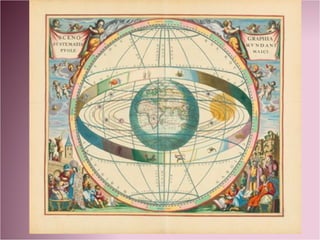
 Prior to SR - Ptolemaic System
prevailed
 Geocentric Universe
 Earth is at center
 Remains fixed while the heavens move
around it
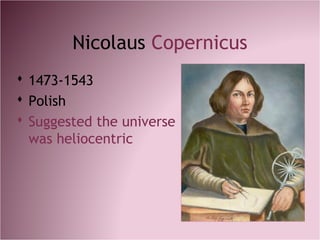
Nicolaus Copernicus
 1473-1543
 Polish
 Suggested the universe
was heliocentric
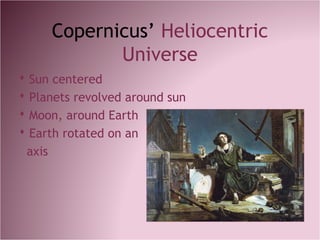
Copernicus’ Heliocentric
Universe
 Sun centered
 Planets revolved around sun
 Moon, around Earth
 Earth rotated on an
axis
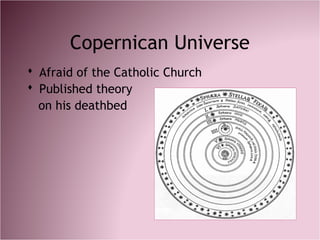
Copernican Universe
 Afraid of the Catholic Church
 Published theory
on his deathbed
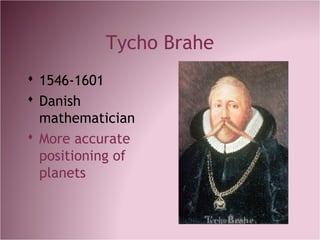
Tycho Brahe
 1546-1601
 Danish
mathematician
 More accurate
positioning of
planets
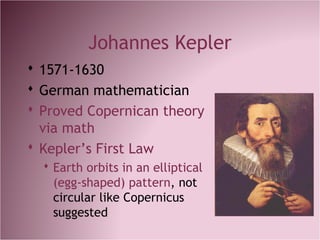
Johannes Kepler
 1571-1630
 German mathematician
 Proved Copernican theory
via math
 Kepler’s First Law
 Earth orbits in an elliptical
(egg-shaped) pattern, not
circular like Copernicus
suggested
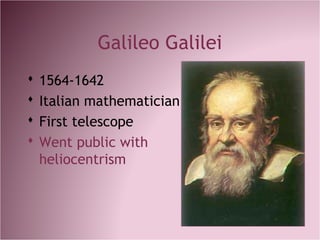
Galileo Galilei
 1564-1642
 Italian mathematician
 First telescope
 Went public with
heliocentrism
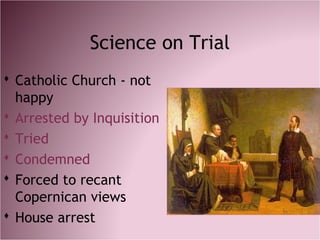
Science on Trial
 Catholic Church - not
happy
 Arrested by Inquisition
 Tried
 Condemned
 Forced to recant
Copernican views
 House arrest
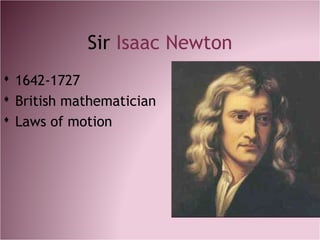
Sir Isaac Newton
 1642-1727
 British mathematician
 Laws of motion
Universal Law of Gravity
 Explains why planets continue an
elliptical orbit around sun
 Mathematical in nature
 States that every object in the
universe is attracted to every other
object by a force called gravity
Medicine
 Better
understanding of
anatomy &
physiology
 Microscope invented
Chemistry
 Robert Boyle
 Boyle’s Law (properties of
gasses)
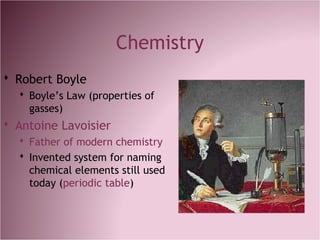
 Antoine Lavoisier
 Father of modern chemistry
 Invented system for naming
chemical elements still used
today (periodic table)
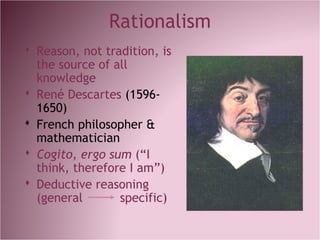
Rationalism
 Reason, not tradition, is
the source of all
knowledge
 René Descartes (1596-
1650)
 French philosopher &
mathematician
 Cogito, ergo sum (“I
think, therefore I am”)
 Deductive reasoning
(general specific)
Empiricism
 The belief that experience is the only
true source of knowledge
 Huge shift toward empiricism in the SR
 Led to development of the Scientific
Method
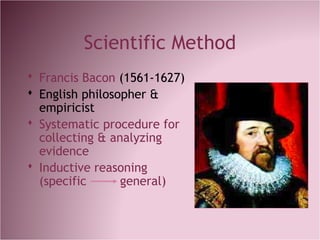
Scientific Method
 Francis Bacon (1561-1627)
 English philosopher &
empiricist
 Systematic procedure for
collecting & analyzing
evidence
 Inductive reasoning
(specific general)
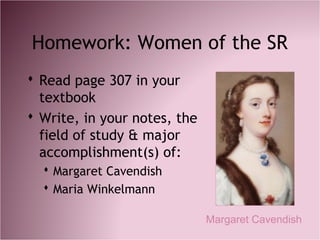
Homework: Women of the SR
 Read page 307 in your
textbook
 Write, in your notes, the
field of study & major
accomplishment(s) of:
 Margaret Cavendish
 Maria Winkelmann
Margaret Cavendish
Homework
 Read “Opposing Viewpoints: Faith vs.
Science” on pg. 305
 Answer the DBQs using BOTH:
 Facts from class
 The primary sources given

Scientific Revolution

  • 1.
  • 2.
    What Was theScientific Revolution?  A revolution in human understanding and knowledge about the physical universe  17th Century  Began w/ Kepler, Galileo  Ended w/ Newton
  • 3.
    “Science” Before theSR  Based on reasoning  Experimental method or observation - not used  Medieval Science  Alchemy  Astrology
  • 4.
    Creating a NewWorldview  Hallmarks of SR  Questioning of old knowledge & assumptions  Gradual replacement of religious & superstitious presumptions  Gradual rise of science & reason
  • 5.
    Factors Leading toSR  Rise of universities  Renaissance  Reformation  Exploration
  • 6.
    Astronomy & Physics Work with the person next to you and diagram the Universe as we know it today  Be as accurate as possible  You have 2 minutes…
  • 7.
  • 8.
    Astronomy & Physics Prior to SR - Ptolemaic System prevailed  Geocentric Universe  Earth is at center  Remains fixed while the heavens move around it
  • 10.
    Nicolaus Copernicus  1473-1543 Polish  Suggested the universe was heliocentric
  • 11.
    Copernicus’ Heliocentric Universe  Suncentered  Planets revolved around sun  Moon, around Earth  Earth rotated on an axis
  • 12.
    Copernican Universe  Afraidof the Catholic Church  Published theory on his deathbed
  • 13.
    Tycho Brahe  1546-1601 Danish mathematician  More accurate positioning of planets
  • 14.
    Johannes Kepler  1571-1630 German mathematician  Proved Copernican theory via math  Kepler’s First Law  Earth orbits in an elliptical (egg-shaped) pattern, not circular like Copernicus suggested
  • 15.
    Galileo Galilei  1564-1642 Italian mathematician  First telescope  Went public with heliocentrism
  • 16.
    Science on Trial Catholic Church - not happy  Arrested by Inquisition  Tried  Condemned  Forced to recant Copernican views  House arrest
  • 17.
    Sir Isaac Newton 1642-1727  British mathematician  Laws of motion
  • 18.
    Universal Law ofGravity  Explains why planets continue an elliptical orbit around sun  Mathematical in nature  States that every object in the universe is attracted to every other object by a force called gravity
  • 19.
    Medicine  Better understanding of anatomy& physiology  Microscope invented
  • 20.
    Chemistry  Robert Boyle Boyle’s Law (properties of gasses)  Antoine Lavoisier  Father of modern chemistry  Invented system for naming chemical elements still used today (periodic table)
  • 21.
    Rationalism  Reason, nottradition, is the source of all knowledge  René Descartes (1596- 1650)  French philosopher & mathematician  Cogito, ergo sum (“I think, therefore I am”)  Deductive reasoning (general specific)
  • 22.
    Empiricism  The beliefthat experience is the only true source of knowledge  Huge shift toward empiricism in the SR  Led to development of the Scientific Method
  • 23.
    Scientific Method  FrancisBacon (1561-1627)  English philosopher & empiricist  Systematic procedure for collecting & analyzing evidence  Inductive reasoning (specific general)
  • 24.
    Homework: Women ofthe SR  Read page 307 in your textbook  Write, in your notes, the field of study & major accomplishment(s) of:  Margaret Cavendish  Maria Winkelmann Margaret Cavendish
  • 26.
    Homework  Read “OpposingViewpoints: Faith vs. Science” on pg. 305  Answer the DBQs using BOTH:  Facts from class  The primary sources given