
Early Medieval Art


                     1
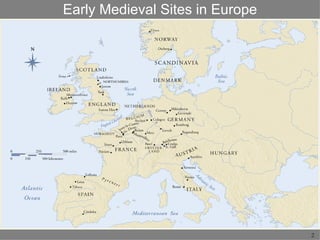
Early Medieval Sites in Europe


                                 2
Goals
• Understand the distinctive artistic traditions of the
  European peoples after the fall of the Roman Empire.
• Understand the chronological placement of this period
  following the fall of the western Roman Empire in the
  fourth century but preceding the Romanesque period
   of the 11th century.
• Know the different types of art, media, and their
  respective cultures.
• Appreciate the role of Christian monks in preserving
  and creating art
• Trace influences of medieval art styles.
• Examine the secular and religious architectural forms
   in the early Middle Ages.
                                                          3
Northern European Art
• Understand the artistic, technical and stylistic
  traditions of the northern European peoples.
• Know the different types of art and the respective
  cultures associated with the Merovingians, Anglo-
  Saxons, and Vikings.
• Examine the artistic traditions applied to a variety
  of media, such as wood, stone, and metal.


                                                         4
Merovingian and Saxon Art

• Understand the artistic, technical and stylistic
  traditions.

• Know the different types of art and the respective
  cultures associated with the Merovingians and
  Saxons.


                                                       5
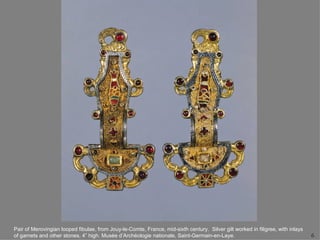
Pair of Merovingian looped fibulae, from Jouy-le-Comte, France, mid-sixth century. Silver gilt worked in filigree, with inlays
of garnets and other stones, 4” high. Musée d’Archéologie nationale, Saint-Germain-en-Laye.                                      6
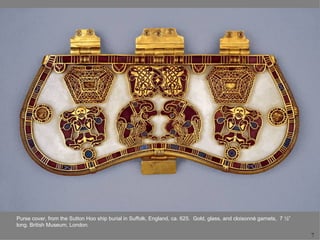
Purse cover, from the Sutton Hoo ship burial in Suffolk, England, ca. 625. Gold, glass, and cloisonné garnets, 7 ½”
long. British Museum, London.
                                                                                                                      7
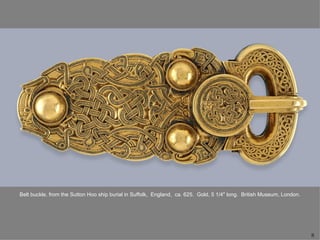
Belt buckle, from the Sutton Hoo ship burial in Suffolk, England, ca. 625. Gold, 5 1/4" long. British Museum, London.


                                                                                                                        8
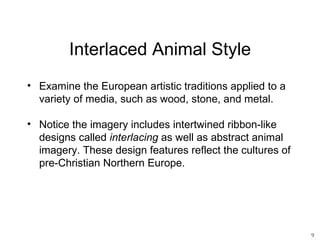
Interlaced Animal Style
• Examine the European artistic traditions applied to a
  variety of media, such as wood, stone, and metal.

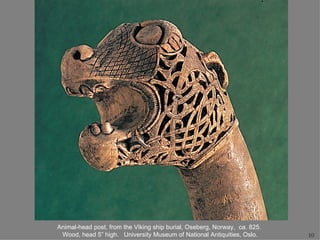
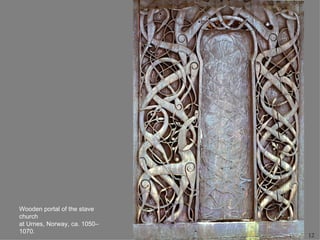
• Notice the imagery includes intertwined ribbon-like
  designs called interlacing as well as abstract animal
  imagery. These design features reflect the cultures of
  pre-Christian Northern Europe.


                                                           9
Animal-head post, from the Viking ship burial, Oseberg, Norway, ca. 825.
 Wood, head 5” high. University Museum of National Antiquities, Oslo.      10
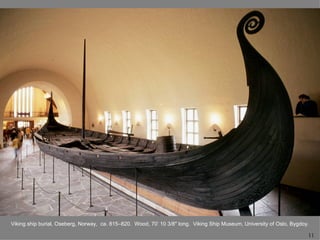
Viking ship burial, Oseberg, Norway, ca. 815–820. Wood, 70’ 10 3/8" long. Viking Ship Museum, University of Oslo, Bygdoy.

                                                                                                                        11
Wooden portal of the stave
church
at Urnes, Norway, ca. 1050–
1070.
                              12
Hiberno-Saxon Art (6th - 10th centuries)
• Understand the Saxon artistic influence in the British
  Isles.
• Understand the early influence of Christianity and the
  ways in which indigenous art forms serve the cause
  of Christianity.
• Describe the specific art elements and principles of
  design applied to the illuminated manuscripts, Celtic
  crosses and other objects.
• Observe the continuation of interlacing and abstract
  animal imagery. Why did art used for Christian
  purposes retain these qualities?


                                                           13
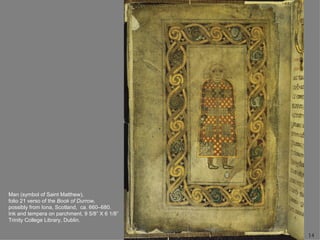
Man (symbol of Saint Matthew),
folio 21 verso of the Book of Durrow,
possibly from Iona, Scotland, ca. 660–680.
Ink and tempera on parchment, 9 5/8” X 6 1/8”
Trinity College Library, Dublin.

                                                14
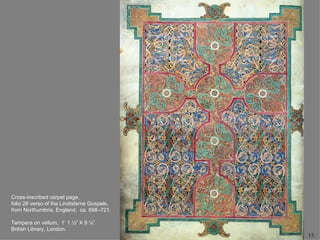
Cross-inscribed carpet page,
folio 26 verso of the Lindisfarne Gospels,
from Northumbria, England, ca. 698–721.

Tempera on vellum, 1’ 1 ½” X 9 ¼”.
British Library, London.
                                             15
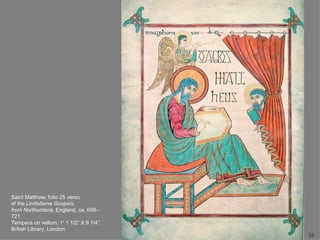
Saint Matthew, folio 25 verso
of the Lindisfarne Gospels,
from Northumbria, England, ca. 698–
721.
Tempera on vellum, 1’ 1 1/2” X 9 1/4”.
British Library, London.
                                         16
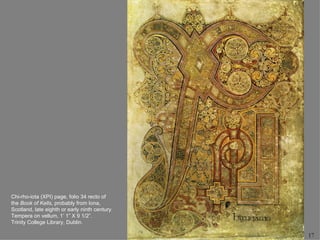
Chi-rho-iota (XPI) page, folio 34 recto of
the Book of Kells, probably from Iona,
Scotland, late eighth or early ninth century.
Tempera on vellum, 1’ 1” X 9 1/2”.
Trinity College Library, Dublin.

                                                17
Medieval Christian Monks
• Understand the role of Christian monks in preserving
  and creating illuminated manuscripts in scriptoria

• Examine the layout of a medieval monastery


                                                         18
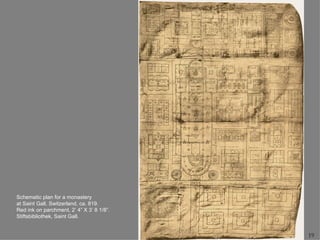
Schematic plan for a monastery
at Saint Gall, Switzerland, ca. 819.
Red ink on parchment, 2’ 4” X 3’ 8 1/8”.
Stiftsbibliothek, Saint Gall.


                                           19
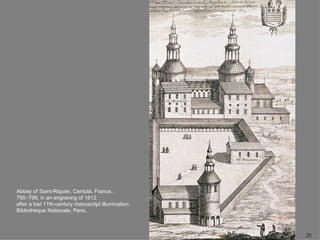
Abbey of Saint-Riquier, Centula, France,
790–799, in an engraving of 1612
after a lost 11th-century manuscript illumination.
Bibliothèque Nationale, Paris.


                                                     20
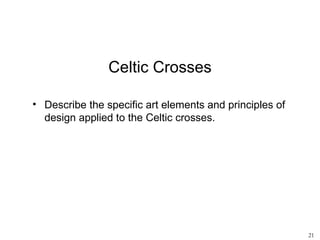
Celtic Crosses

• Describe the specific art elements and principles of
  design applied to the Celtic crosses.


                                                         21
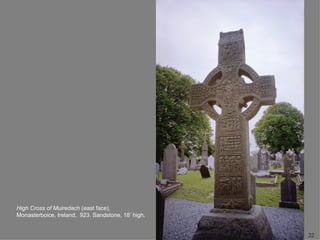
High Cross of Muiredach (east face),
Monasterboice, Ireland, 923. Sandstone, 18’ high.


                                                    22
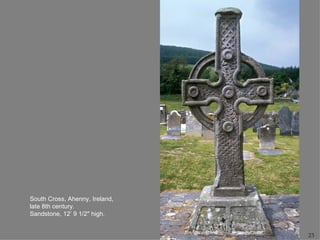
South Cross, Ahenny, Ireland,
late 8th century.
Sandstone, 12’ 9 1/2" high.


                                23
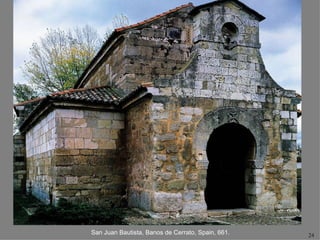
San Juan Bautista, Banos de Cerrato, Spain, 661.   24
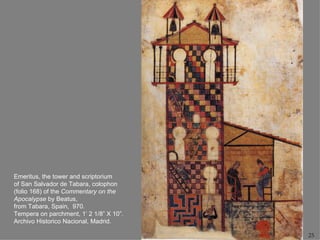
Emeritus, the tower and scriptorium
of San Salvador de Tabara, colophon
(folio 168) of the Commentary on the
Apocalypse by Beatus,
from Tabara, Spain, 970.
Tempera on parchment, 1’ 2 1/8” X 10”.
Archivo Historico Nacional, Madrid.

                                         25
Carolingian Art
    (9th century – present day France & Germany)


• Understand the political and religious influences on
  art and architecture during the Carolingian period.
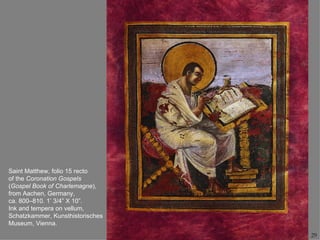
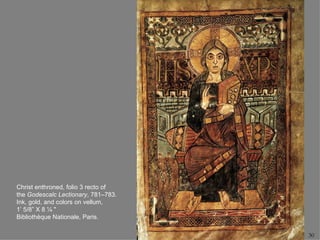
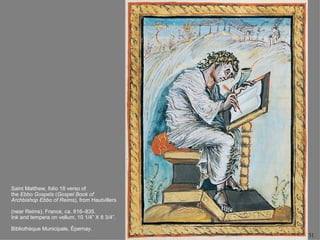
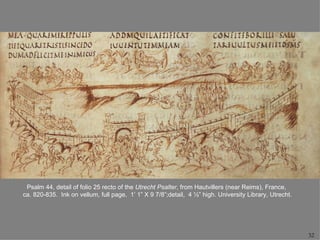
• Understand the ‘revival of learning’ and the art of the
  book as a result of Charlemagne’s interests.
• Examine the secular and religious architectural forms
  in the Carolingian period.


                                                            26
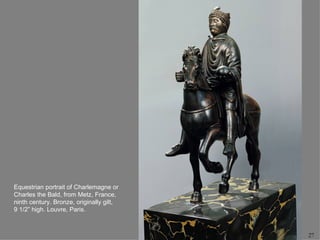
Equestrian portrait of Charlemagne or
Charles the Bald, from Metz, France,
ninth century. Bronze, originally gilt,
9 1/2” high. Louvre, Paris.


                                          27
The Carolingian Renovation

• Observe how Charlemagne’s empire revived Roman
  art and architectural forms. Why did he desire to do
  this?
• Understand the ‘revival of learning’ and the art of the
  book.


                                                            28
Saint Matthew, folio 15 recto
of the Coronation Gospels
(Gospel Book of Charlemagne),
from Aachen, Germany,
ca. 800–810. 1’ 3/4” X 10”.
Ink and tempera on vellum,
Schatzkammer, Kunsthistorisches
Museum, Vienna.
                                  29
Christ enthroned, folio 3 recto of
the Godescalc Lectionary, 781–783.
Ink, gold, and colors on vellum,
1’ 5/8” X 8 ¼ "
Bibliothèque Nationale, Paris.

                                     30
Saint Matthew, folio 18 verso of
the Ebbo Gospels (Gospel Book of
Archbishop Ebbo of Reims), from Hautvillers

(near Reims), France, ca. 816–835.
Ink and tempera on vellum, 10 1/4” X 8 3/4”.

Bibliothèque Municipale, Épernay.
                                               31
Psalm 44, detail of folio 25 recto of the Utrecht Psalter, from Hautvillers (near Reims), France,
ca. 820-835. Ink on vellum, full page, 1’ 1” X 9 7/8”;detail, 4 ½” high. University Library, Utrecht.


                                                                                                        32
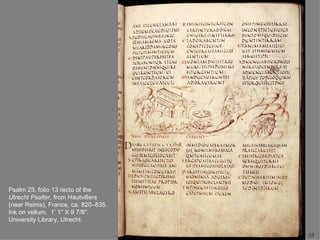
Psalm 23, folio 13 recto of the
Utrecht Psalter, from Hautvillers
(near Reims), France, ca. 820–835.
Ink on vellum, 1’ 1" X 9 7/8".
University Library, Utrecht.

                                     33
Art of Charlemagne’s Court

• Examine the gold and jeweled secular and religious
  court art under Charlemagne and his successors.


                                                       34
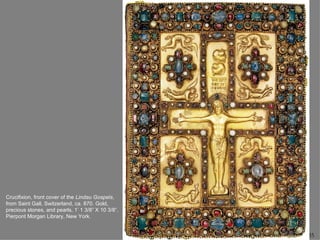
Crucifixion, front cover of the Lindau Gospels,
from Saint Gall, Switzerland, ca. 870. Gold,
precious stones, and pearls, 1’ 1 3/8” X 10 3/8”.
Pierpont Morgan Library, New York.


                                                    35
Carolingian Architecture

• Examine the secular and religious architectural forms
  in the Carolingian period.


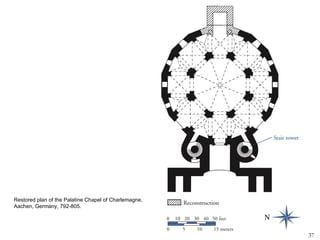
                                                          36
Restored plan of the Palatine Chapel of Charlemagne,
Aachen, Germany, 792-805.


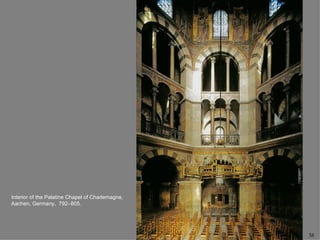
                                                       37
Interior of the Palatine Chapel of Charlemagne,
Aachen, Germany, 792–805.


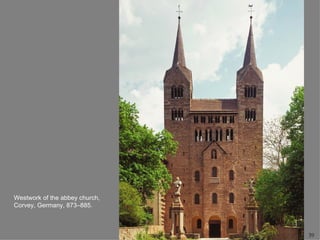
                                                  38
Westwork of the abbey church,
Corvey, Germany, 873–885.


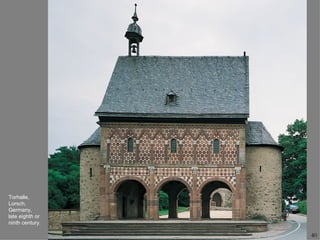
                                39
Torhalle,
Lorsch,
Germany,
late eighth or
ninth century.

                 40
Ottonian Art
           (10th century Germany)
• Examine the architecture associated with the
  Ottonians, its formal origins and its later influence.
• Understand the architectural and free standing
  sculptural traditions of the Ottonians.
• Compare and contrast Ottonian and Carolingian art
• Examine the styles of the Ottonian illuminated
  manuscripts.


                                                           41
Architecture of the Ottonians

• Examine the architecture, its formal origins and
  its later influence.


                                                     42
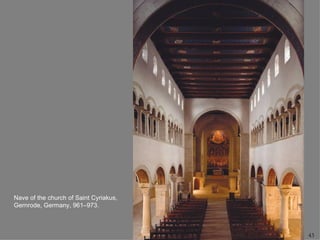
Nave of the church of Saint Cyriakus,
Gernrode, Germany, 961–973.


                                        43
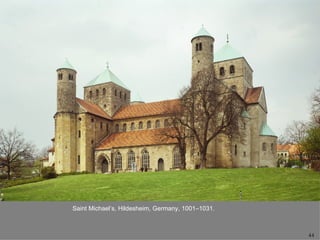
Saint Michael’s, Hildesheim, Germany, 1001–1031.


                                                   44
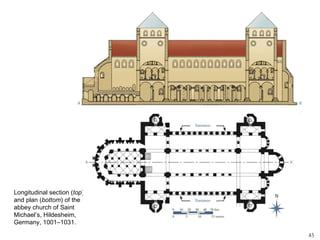
Longitudinal section (top)
and plan (bottom) of the
abbey church of Saint
Michael’s, Hildesheim,
Germany, 1001–1031.

                             45
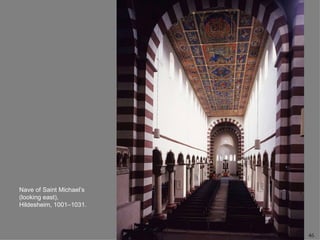
Nave of Saint Michael’s
(looking east),
Hildesheim, 1001–1031.


                          46
Ottonian Sculpture

• Understand the architectural sculpture associated
  with St. Michael’s at Hildesheim, Germany.

• Examine the free standing sculptural traditions of the
  Ottonians.


                                                           47
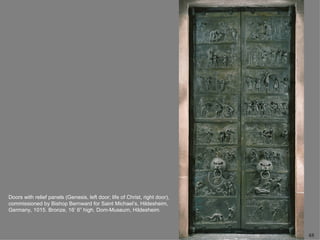
Doors with relief panels (Genesis, left door; life of Christ, right door),
commissioned by Bishop Bernward for Saint Michael’s, Hildesheim,
Germany, 1015. Bronze, 16’ 6” high. Dom-Museum, Hildesheim.


                                                                             48
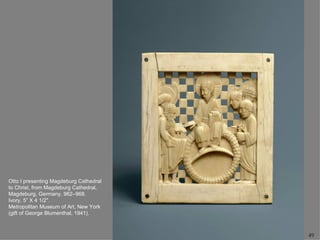
Otto I presenting Magdeburg Cathedral
to Christ, from Magdeburg Cathedral,
Magdeburg, Germany, 962–968.
Ivory, 5” X 4 1/2".
Metropolitan Museum of Art, New York
(gift of George Blumenthal, 1941).


                                        49
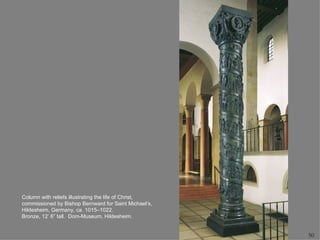
Column with reliefs illustrating the life of Christ,
commissioned by Bishop Bernward for Saint Michael’s,
Hildesheim, Germany, ca. 1015–1022.
Bronze, 12’ 6” tall. Dom-Museum, Hildesheim.


                                                       50
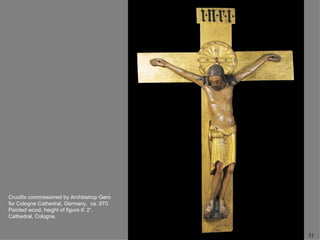
Crucifix commissioned by Archbishop Gero
for Cologne Cathedral, Germany, ca. 970.
Painted wood, height of figure 6’ 2”.
Cathedral, Cologne.


                                           51
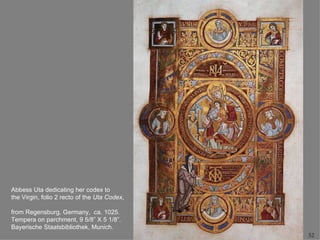
Abbess Uta dedicating her codex to
the Virgin, folio 2 recto of the Uta Codex,

from Regensburg, Germany, ca. 1025.
Tempera on parchment, 9 5/8” X 5 1/8”.
Bayerische Staatsbibliothek, Munich.
                                              52
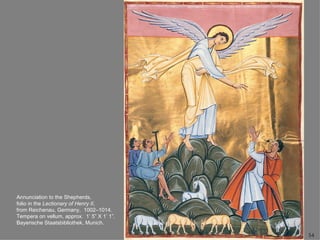
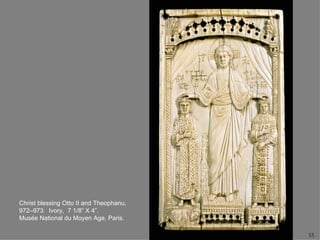
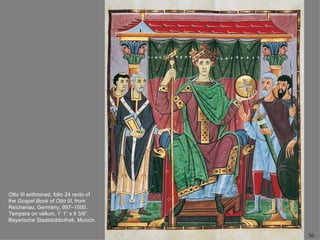
Ottonian Illuminated Manuscripts

• Examine the appearance of the Ottonian illuminated
  manuscripts.
• Notice the golden backgrounds and linear figural
  styles in Ottonian illuminated manuscripts –
  Ottonian leaders developed significant contacts with
  the Byzantine empire.


                                                         53
Annunciation to the Shepherds,
folio in the Lectionary of Henry II,
from Reichenau, Germany, 1002–1014.
Tempera on vellum, approx. 1’ 5” X 1’ 1”.
Bayerische Staatsbibliothek, Munich.

                                            54
Christ blessing Otto II and Theophanu,
972–973. Ivory, 7 1/8” X 4”.
Musée National du Moyen Age, Paris.

                                         55
Otto III enthroned, folio 24 recto of
the Gospel Book of Otto III, from
Reichenau, Germany, 997–1000.
Tempera on vellum, 1’ 1” x 9 3/8”.
Bayerische Staatsbibliothek, Munich.

                                        56
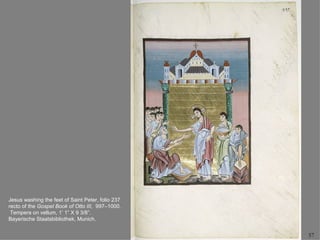
Jesus washing the feet of Saint Peter, folio 237
recto of the Gospel Book of Otto III, 997–1000.
 Tempera on vellum, 1’ 1” X 9 3/8”.
Bayerische Staatsbibliothek, Munich.


                                                   57
Discussion Questions
 In what ways did medieval European art and
  architecture depart from classical Roman art and
  architecture? Did any of the civilizations retain
  characteristics of Roman art and architecture?
  Explain.

 Compare the three major manuscript styles that
  developed in the Middle Ages.

 What previous styles of art influenced medieval
  European art?


                                                      58
Sources
• Kleiner, Fred. Gardner’s Art Through the Ages,
       The Western Tradition, 13th ed., Cengage

• Janson. History of Art. Pearson Prentice Hall
Gary Freeman

gary@garyfreemanart.com


 garyfreemanart.com
  garyfreemanart.com
 onlineartcenter.com
  onlineartcenter.com

Early Medieval Art

  • 1.
  • 2.
  • 3.
    Goals • Understand thedistinctive artistic traditions of the European peoples after the fall of the Roman Empire. • Understand the chronological placement of this period following the fall of the western Roman Empire in the fourth century but preceding the Romanesque period of the 11th century. • Know the different types of art, media, and their respective cultures. • Appreciate the role of Christian monks in preserving and creating art • Trace influences of medieval art styles. • Examine the secular and religious architectural forms in the early Middle Ages. 3
  • 4.
    Northern European Art •Understand the artistic, technical and stylistic traditions of the northern European peoples. • Know the different types of art and the respective cultures associated with the Merovingians, Anglo- Saxons, and Vikings. • Examine the artistic traditions applied to a variety of media, such as wood, stone, and metal. 4
  • 5.
    Merovingian and SaxonArt • Understand the artistic, technical and stylistic traditions. • Know the different types of art and the respective cultures associated with the Merovingians and Saxons. 5
  • 6.
    Pair of Merovingianlooped fibulae, from Jouy-le-Comte, France, mid-sixth century. Silver gilt worked in filigree, with inlays of garnets and other stones, 4” high. Musée d’Archéologie nationale, Saint-Germain-en-Laye. 6
  • 7.
    Purse cover, fromthe Sutton Hoo ship burial in Suffolk, England, ca. 625. Gold, glass, and cloisonné garnets, 7 ½” long. British Museum, London. 7
  • 8.
    Belt buckle, fromthe Sutton Hoo ship burial in Suffolk, England, ca. 625. Gold, 5 1/4" long. British Museum, London. 8
  • 9.
    Interlaced Animal Style •Examine the European artistic traditions applied to a variety of media, such as wood, stone, and metal. • Notice the imagery includes intertwined ribbon-like designs called interlacing as well as abstract animal imagery. These design features reflect the cultures of pre-Christian Northern Europe. 9
  • 10.
    Animal-head post, fromthe Viking ship burial, Oseberg, Norway, ca. 825. Wood, head 5” high. University Museum of National Antiquities, Oslo. 10
  • 11.
    Viking ship burial,Oseberg, Norway, ca. 815–820. Wood, 70’ 10 3/8" long. Viking Ship Museum, University of Oslo, Bygdoy. 11
  • 12.
    Wooden portal ofthe stave church at Urnes, Norway, ca. 1050– 1070. 12
  • 13.
    Hiberno-Saxon Art (6th- 10th centuries) • Understand the Saxon artistic influence in the British Isles. • Understand the early influence of Christianity and the ways in which indigenous art forms serve the cause of Christianity. • Describe the specific art elements and principles of design applied to the illuminated manuscripts, Celtic crosses and other objects. • Observe the continuation of interlacing and abstract animal imagery. Why did art used for Christian purposes retain these qualities? 13
  • 14.
    Man (symbol ofSaint Matthew), folio 21 verso of the Book of Durrow, possibly from Iona, Scotland, ca. 660–680. Ink and tempera on parchment, 9 5/8” X 6 1/8” Trinity College Library, Dublin. 14
  • 15.
    Cross-inscribed carpet page, folio26 verso of the Lindisfarne Gospels, from Northumbria, England, ca. 698–721. Tempera on vellum, 1’ 1 ½” X 9 ¼”. British Library, London. 15
  • 16.
    Saint Matthew, folio25 verso of the Lindisfarne Gospels, from Northumbria, England, ca. 698– 721. Tempera on vellum, 1’ 1 1/2” X 9 1/4”. British Library, London. 16
  • 17.
    Chi-rho-iota (XPI) page,folio 34 recto of the Book of Kells, probably from Iona, Scotland, late eighth or early ninth century. Tempera on vellum, 1’ 1” X 9 1/2”. Trinity College Library, Dublin. 17
  • 18.
    Medieval Christian Monks •Understand the role of Christian monks in preserving and creating illuminated manuscripts in scriptoria • Examine the layout of a medieval monastery 18
  • 19.
    Schematic plan fora monastery at Saint Gall, Switzerland, ca. 819. Red ink on parchment, 2’ 4” X 3’ 8 1/8”. Stiftsbibliothek, Saint Gall. 19
  • 20.
    Abbey of Saint-Riquier,Centula, France, 790–799, in an engraving of 1612 after a lost 11th-century manuscript illumination. Bibliothèque Nationale, Paris. 20
  • 21.
    Celtic Crosses • Describethe specific art elements and principles of design applied to the Celtic crosses. 21
  • 22.
    High Cross ofMuiredach (east face), Monasterboice, Ireland, 923. Sandstone, 18’ high. 22
  • 23.
    South Cross, Ahenny,Ireland, late 8th century. Sandstone, 12’ 9 1/2" high. 23
  • 24.
    San Juan Bautista,Banos de Cerrato, Spain, 661. 24
  • 25.
    Emeritus, the towerand scriptorium of San Salvador de Tabara, colophon (folio 168) of the Commentary on the Apocalypse by Beatus, from Tabara, Spain, 970. Tempera on parchment, 1’ 2 1/8” X 10”. Archivo Historico Nacional, Madrid. 25
  • 26.
    Carolingian Art (9th century – present day France & Germany) • Understand the political and religious influences on art and architecture during the Carolingian period. • Understand the ‘revival of learning’ and the art of the book as a result of Charlemagne’s interests. • Examine the secular and religious architectural forms in the Carolingian period. 26
  • 27.
    Equestrian portrait ofCharlemagne or Charles the Bald, from Metz, France, ninth century. Bronze, originally gilt, 9 1/2” high. Louvre, Paris. 27
  • 28.
    The Carolingian Renovation •Observe how Charlemagne’s empire revived Roman art and architectural forms. Why did he desire to do this? • Understand the ‘revival of learning’ and the art of the book. 28
  • 29.
    Saint Matthew, folio15 recto of the Coronation Gospels (Gospel Book of Charlemagne), from Aachen, Germany, ca. 800–810. 1’ 3/4” X 10”. Ink and tempera on vellum, Schatzkammer, Kunsthistorisches Museum, Vienna. 29
  • 30.
    Christ enthroned, folio3 recto of the Godescalc Lectionary, 781–783. Ink, gold, and colors on vellum, 1’ 5/8” X 8 ¼ " Bibliothèque Nationale, Paris. 30
  • 31.
    Saint Matthew, folio18 verso of the Ebbo Gospels (Gospel Book of Archbishop Ebbo of Reims), from Hautvillers (near Reims), France, ca. 816–835. Ink and tempera on vellum, 10 1/4” X 8 3/4”. Bibliothèque Municipale, Épernay. 31
  • 32.
    Psalm 44, detailof folio 25 recto of the Utrecht Psalter, from Hautvillers (near Reims), France, ca. 820-835. Ink on vellum, full page, 1’ 1” X 9 7/8”;detail, 4 ½” high. University Library, Utrecht. 32
  • 33.
    Psalm 23, folio13 recto of the Utrecht Psalter, from Hautvillers (near Reims), France, ca. 820–835. Ink on vellum, 1’ 1" X 9 7/8". University Library, Utrecht. 33
  • 34.
    Art of Charlemagne’sCourt • Examine the gold and jeweled secular and religious court art under Charlemagne and his successors. 34
  • 35.
    Crucifixion, front coverof the Lindau Gospels, from Saint Gall, Switzerland, ca. 870. Gold, precious stones, and pearls, 1’ 1 3/8” X 10 3/8”. Pierpont Morgan Library, New York. 35
  • 36.
    Carolingian Architecture • Examinethe secular and religious architectural forms in the Carolingian period. 36
  • 37.
    Restored plan ofthe Palatine Chapel of Charlemagne, Aachen, Germany, 792-805. 37
  • 38.
    Interior of thePalatine Chapel of Charlemagne, Aachen, Germany, 792–805. 38
  • 39.
    Westwork of theabbey church, Corvey, Germany, 873–885. 39
  • 40.
  • 41.
    Ottonian Art (10th century Germany) • Examine the architecture associated with the Ottonians, its formal origins and its later influence. • Understand the architectural and free standing sculptural traditions of the Ottonians. • Compare and contrast Ottonian and Carolingian art • Examine the styles of the Ottonian illuminated manuscripts. 41
  • 42.
    Architecture of theOttonians • Examine the architecture, its formal origins and its later influence. 42
  • 43.
    Nave of thechurch of Saint Cyriakus, Gernrode, Germany, 961–973. 43
  • 44.
    Saint Michael’s, Hildesheim,Germany, 1001–1031. 44
  • 45.
    Longitudinal section (top) andplan (bottom) of the abbey church of Saint Michael’s, Hildesheim, Germany, 1001–1031. 45
  • 46.
    Nave of SaintMichael’s (looking east), Hildesheim, 1001–1031. 46
  • 47.
    Ottonian Sculpture • Understandthe architectural sculpture associated with St. Michael’s at Hildesheim, Germany. • Examine the free standing sculptural traditions of the Ottonians. 47
  • 48.
    Doors with reliefpanels (Genesis, left door; life of Christ, right door), commissioned by Bishop Bernward for Saint Michael’s, Hildesheim, Germany, 1015. Bronze, 16’ 6” high. Dom-Museum, Hildesheim. 48
  • 49.
    Otto I presentingMagdeburg Cathedral to Christ, from Magdeburg Cathedral, Magdeburg, Germany, 962–968. Ivory, 5” X 4 1/2". Metropolitan Museum of Art, New York (gift of George Blumenthal, 1941). 49
  • 50.
    Column with reliefsillustrating the life of Christ, commissioned by Bishop Bernward for Saint Michael’s, Hildesheim, Germany, ca. 1015–1022. Bronze, 12’ 6” tall. Dom-Museum, Hildesheim. 50
  • 51.
    Crucifix commissioned byArchbishop Gero for Cologne Cathedral, Germany, ca. 970. Painted wood, height of figure 6’ 2”. Cathedral, Cologne. 51
  • 52.
    Abbess Uta dedicatingher codex to the Virgin, folio 2 recto of the Uta Codex, from Regensburg, Germany, ca. 1025. Tempera on parchment, 9 5/8” X 5 1/8”. Bayerische Staatsbibliothek, Munich. 52
  • 53.
    Ottonian Illuminated Manuscripts •Examine the appearance of the Ottonian illuminated manuscripts. • Notice the golden backgrounds and linear figural styles in Ottonian illuminated manuscripts – Ottonian leaders developed significant contacts with the Byzantine empire. 53
  • 54.
    Annunciation to theShepherds, folio in the Lectionary of Henry II, from Reichenau, Germany, 1002–1014. Tempera on vellum, approx. 1’ 5” X 1’ 1”. Bayerische Staatsbibliothek, Munich. 54
  • 55.
    Christ blessing OttoII and Theophanu, 972–973. Ivory, 7 1/8” X 4”. Musée National du Moyen Age, Paris. 55
  • 56.
    Otto III enthroned,folio 24 recto of the Gospel Book of Otto III, from Reichenau, Germany, 997–1000. Tempera on vellum, 1’ 1” x 9 3/8”. Bayerische Staatsbibliothek, Munich. 56
  • 57.
    Jesus washing thefeet of Saint Peter, folio 237 recto of the Gospel Book of Otto III, 997–1000. Tempera on vellum, 1’ 1” X 9 3/8”. Bayerische Staatsbibliothek, Munich. 57
  • 58.
    Discussion Questions  Inwhat ways did medieval European art and architecture depart from classical Roman art and architecture? Did any of the civilizations retain characteristics of Roman art and architecture? Explain.  Compare the three major manuscript styles that developed in the Middle Ages.  What previous styles of art influenced medieval European art? 58
  • 59.
    Sources • Kleiner, Fred.Gardner’s Art Through the Ages, The Western Tradition, 13th ed., Cengage • Janson. History of Art. Pearson Prentice Hall
  • 60.
    Gary Freeman gary@garyfreemanart.com gary@garyfreemanart.com garyfreemanart.com garyfreemanart.com onlineartcenter.com onlineartcenter.com