International Islamic University , Islamabad
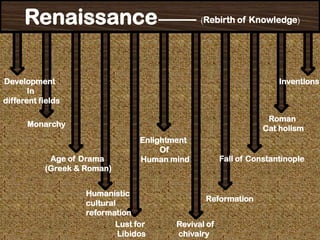
Renaissance                               (Rebirth of Knowledge)


Development                                                           Inventions
       In
different fields

                                                                   Roman
      Monarchy
                                                                  Cat holism
                                  Enlightment
                                       Of
            Age of Drama          Human mind           Fall of Constantinople
           (Greek & Roman)


                    Humanistic
                                                 Reformation
                    cultural
                    reformation
                            Lust for      Revival of
                             Libidos      chivalry
-


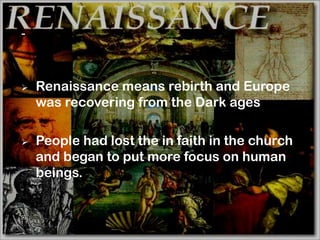
   Renaissance means rebirth and Europe
    was recovering from the Dark ages

   People had lost the in faith in the church
    and began to put more focus on human
    beings.



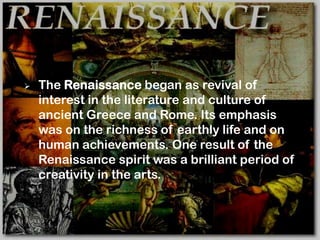
   The Renaissance began as revival of
    interest in the literature and culture of
    ancient Greece and Rome. Its emphasis
    was on the richness of earthly life and on
    human achievements. One result of the
    Renaissance spirit was a brilliant period of
    creativity in the arts.
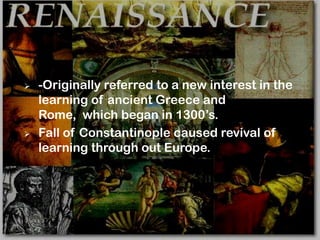
   -Originally referred to a new interest in the
    learning of ancient Greece and
    Rome, which began in 1300’s.
   Fall of Constantinople caused revival of
    learning through out Europe.
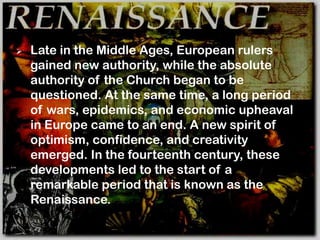
   Late in the Middle Ages, European rulers
    gained new authority, while the absolute
    authority of the Church began to be
    questioned. At the same time, a long period
    of wars, epidemics, and economic upheaval
    in Europe came to an end. A new spirit of
    optimism, confidence, and creativity
    emerged. In the fourteenth century, these
    developments led to the start of a
    remarkable period that is known as the
    Renaissance.
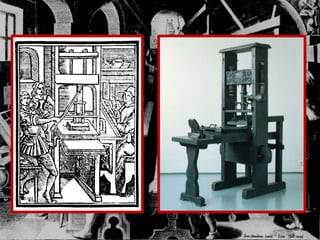
   1455
   Moveable type printing
   Developed in Germany
   Associated with Gutenberg
   1456 the first Gutenberg Bible was
    printed
   Printing press allowed for the spread of
    knowledge and ideas throughout Europe
   The idea of quantification developed
   The universe came to be conceived in more
    quantifiable terms (measurable terms)
   Allowed for more precise measurements
   Changed the focus of daily life which had
    been guided by the rhythms of the Church
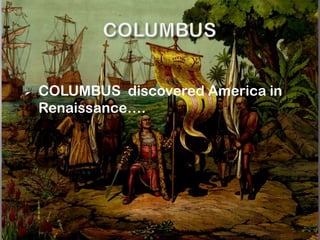
   COLUMBUS discovered America in
    Renaissance….
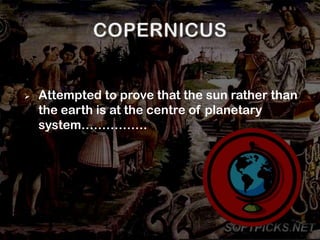
   Attempted to prove that the sun rather than
    the earth is at the centre of planetary
    system…………….
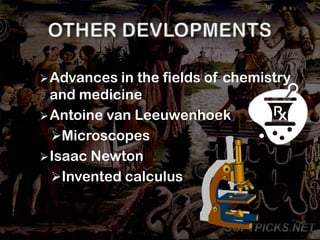
 Advances in the fields of chemistry
  and medicine
 Antoine van Leeuwenhoek
  Microscopes
 Isaac Newton
  Invented calculus
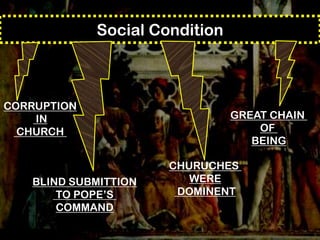
Social Condition


CORRUPTION
    IN                          GREAT CHAIN
  CHURCH                            OF
                                   BEING

                      CHURUCHES
   BLIND SUBMITTION      WERE
       TO POPE’S       DOMINENT
       COMMAND
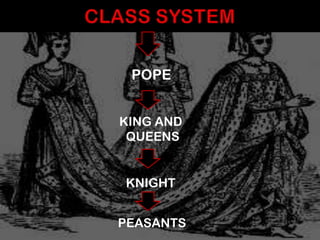
POPE


KING AND
 QUEENS


KNIGHT


PEASANTS
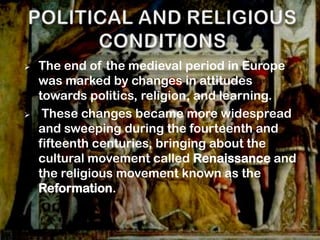
   The end of the medieval period in Europe
    was marked by changes in attitudes
    towards politics, religion, and learning.
    These changes became more widespread
    and sweeping during the fourteenth and
    fifteenth centuries, bringing about the
    cultural movement called Renaissance and
    the religious movement known as the
    Reformation.
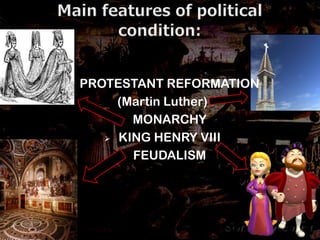
   PROTESTANT REFORMATION
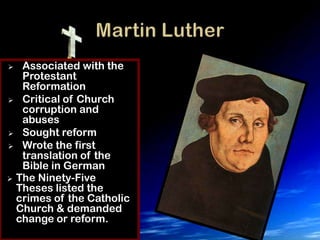
         (Martin Luther)
          MONARCHY

        KING HENRY VIII

          FEUDALISM
  Associated with the
   Protestant
   Reformation
 Critical of Church
   corruption and
   abuses
 Sought reform
 Wrote the first
   translation of the
   Bible in German
 The Ninety-Five
  Theses listed the
  crimes of the Catholic
  Church & demanded
  change or reform.
   The series of events that led to the split of
                       the
    Church & the creation of this new group
        became known As the Protestant
                   Reformation

      The church is not a social ladder
      

where some people are more important than
                 others.
   All the jobs in the church are equally
    important. The jobs were called Vocations.
   The Lutherans called their leaders
    ministers instead of priests.
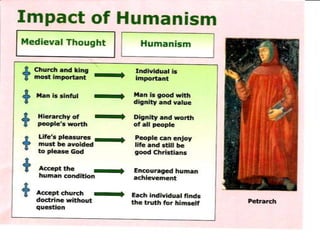
   Man was centre of attention…….
   Renaissance Artists embraced some of the
      ideals of Greece and Rome in their art
   They wanted their subjects to be realistic
     and focused on humanity and emotion
          New Techniques also emerged
Frescos: Painting done on wet plaster
became popular because it gave depth to
             the paintings
   Sculpture emphasized realism and the
                human form
   Architecture reached new heights of
                   design
   Literature is the expression of human
    life ,emotions and feelings through
    the medium of language.
    It is defined as the imaginative
    reconstruction of Human life.
DRAMA


GENRE OF LITERATURE
   It is a literary composition involving
    conflict, actions, crisis and atmosphere
    designed to be acted by players on a stage
    before an audience.
   Important plays:
    Ralph Roister Doister by Nicholas
    Udall(comedy).
   Grummer Gurton’s needle by John Still
    (comedy).
   Gorbuduc by Thomas Sackville (tragedy).
   Romeo and Juliet, Hamlet, As you like
    it, Macbeth are the famous plays by William
    Shakespeare.
   The Silent Woman, The Alchemist are the
    comedies by Ben Johnson.
   Dr. Faustus by Christopher Marlowe
    (Tragedy).
   It is a composition that evokes emotion and
    imagination by the use of vivid, intense
    language, usually arranged in a pattern of
    words or lines with a regularly repeated
    accent or stress.
   Edmund Spenser wrote Faerie Queene,
    Shepherd’s Calendar, Amoretti,
    Epithalamion.
   Diver’s Doth Use and To rail or jest by
    Thomas Wyatt.
   My Lute Awake and They Flee from me by
    Sir Walter Raleigh.
   The Divine Comedy by Dante Alighori.
   The word is derived from the Latin prosa or
    proversa oratio, ‘straight forward
    discourse’. Thus a direct unadorned form
    of language, written or spoken in ordinary
    usage.
   Praise of Folly by Erasmus.
   Utopia by Sir Thomas More.
   Elizabethan age
   Age of Shakespeare
   Age of Drama
   Age of Enlightment
   Renaissance means the revival of learning
    and it denotes in its broadest sense the
    gradual enlightment of the human mind
    after the darkness of the Middle Ages.
    Religion was dominant in this era so most
    of the literary work was mainly depicting
    religious themes.
RENAISSANCE COMPLETE PRESENTATION

RENAISSANCE COMPLETE PRESENTATION

  • 2.
  • 3.
    Renaissance (Rebirth of Knowledge) Development Inventions In different fields Roman Monarchy Cat holism Enlightment Of Age of Drama Human mind Fall of Constantinople (Greek & Roman) Humanistic Reformation cultural reformation Lust for Revival of Libidos chivalry
  • 5.
    -  Renaissance means rebirth and Europe was recovering from the Dark ages  People had lost the in faith in the church and began to put more focus on human beings. 
  • 6.
    The Renaissance began as revival of interest in the literature and culture of ancient Greece and Rome. Its emphasis was on the richness of earthly life and on human achievements. One result of the Renaissance spirit was a brilliant period of creativity in the arts.
  • 7.
    -Originally referred to a new interest in the learning of ancient Greece and Rome, which began in 1300’s.  Fall of Constantinople caused revival of learning through out Europe.
  • 8.
    Late in the Middle Ages, European rulers gained new authority, while the absolute authority of the Church began to be questioned. At the same time, a long period of wars, epidemics, and economic upheaval in Europe came to an end. A new spirit of optimism, confidence, and creativity emerged. In the fourteenth century, these developments led to the start of a remarkable period that is known as the Renaissance.
  • 10.
    1455  Moveable type printing  Developed in Germany  Associated with Gutenberg  1456 the first Gutenberg Bible was printed  Printing press allowed for the spread of knowledge and ideas throughout Europe
  • 12.
    The idea of quantification developed  The universe came to be conceived in more quantifiable terms (measurable terms)  Allowed for more precise measurements  Changed the focus of daily life which had been guided by the rhythms of the Church
  • 14.
    COLUMBUS discovered America in Renaissance….
  • 15.
    Attempted to prove that the sun rather than the earth is at the centre of planetary system…………….
  • 16.
     Advances inthe fields of chemistry and medicine  Antoine van Leeuwenhoek Microscopes  Isaac Newton Invented calculus
  • 17.
    Social Condition CORRUPTION IN GREAT CHAIN CHURCH OF BEING CHURUCHES BLIND SUBMITTION WERE TO POPE’S DOMINENT COMMAND
  • 18.
  • 19.
    The end of the medieval period in Europe was marked by changes in attitudes towards politics, religion, and learning.  These changes became more widespread and sweeping during the fourteenth and fifteenth centuries, bringing about the cultural movement called Renaissance and the religious movement known as the Reformation.
  • 20.
    PROTESTANT REFORMATION (Martin Luther)  MONARCHY  KING HENRY VIII  FEUDALISM
  • 21.
     Associatedwith the Protestant Reformation  Critical of Church corruption and abuses  Sought reform  Wrote the first translation of the Bible in German  The Ninety-Five Theses listed the crimes of the Catholic Church & demanded change or reform.
  • 24.
    The series of events that led to the split of the Church & the creation of this new group became known As the Protestant Reformation The church is not a social ladder  where some people are more important than others.

  • 25.
    All the jobs in the church are equally important. The jobs were called Vocations.  The Lutherans called their leaders ministers instead of priests.
  • 26.
    Man was centre of attention…….
  • 28.
    Renaissance Artists embraced some of the ideals of Greece and Rome in their art  They wanted their subjects to be realistic and focused on humanity and emotion  New Techniques also emerged
  • 29.
    Frescos: Painting doneon wet plaster became popular because it gave depth to the paintings  Sculpture emphasized realism and the human form  Architecture reached new heights of design
  • 30.
    Literature is the expression of human life ,emotions and feelings through the medium of language.  It is defined as the imaginative reconstruction of Human life.
  • 31.
  • 32.
    It is a literary composition involving conflict, actions, crisis and atmosphere designed to be acted by players on a stage before an audience.  Important plays:  Ralph Roister Doister by Nicholas Udall(comedy).  Grummer Gurton’s needle by John Still (comedy).
  • 33.
    Gorbuduc by Thomas Sackville (tragedy).  Romeo and Juliet, Hamlet, As you like it, Macbeth are the famous plays by William Shakespeare.  The Silent Woman, The Alchemist are the comedies by Ben Johnson.  Dr. Faustus by Christopher Marlowe (Tragedy).
  • 34.
    It is a composition that evokes emotion and imagination by the use of vivid, intense language, usually arranged in a pattern of words or lines with a regularly repeated accent or stress.  Edmund Spenser wrote Faerie Queene, Shepherd’s Calendar, Amoretti, Epithalamion.
  • 35.
    Diver’s Doth Use and To rail or jest by Thomas Wyatt.  My Lute Awake and They Flee from me by Sir Walter Raleigh.  The Divine Comedy by Dante Alighori.
  • 36.
    The word is derived from the Latin prosa or proversa oratio, ‘straight forward discourse’. Thus a direct unadorned form of language, written or spoken in ordinary usage.  Praise of Folly by Erasmus.  Utopia by Sir Thomas More.
  • 37.
    Elizabethan age  Age of Shakespeare  Age of Drama  Age of Enlightment
  • 38.
    Renaissance means the revival of learning and it denotes in its broadest sense the gradual enlightment of the human mind after the darkness of the Middle Ages.  Religion was dominant in this era so most of the literary work was mainly depicting religious themes.