ACTION-REACTION
Joy U. Fulgar
THIRD LAW OF MOTION:
NEWTON’S
INTERACTIONS PRODUCE FORCES
•FORCE is a push or pull.
•The forces exerted by two objects on each other
are often called an action-reaction force pair.
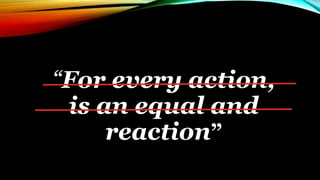
“For every action,
is an equal and
reaction”
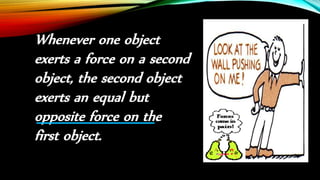
Whenever one object
exerts a force on a second
object, the second object
exerts an equal but
opposite force on the
first object.
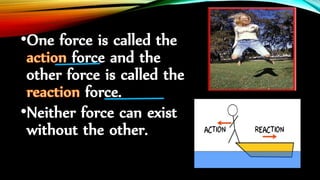
•One force is called the
force and the
other force is called the
force.
•Neither force can exist
without the other.
IDENTIFYING ACTION & REACTION
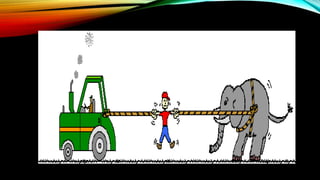
•Object A exerts a force on Object
B
then in reverse
Object B exerts a force on object
A
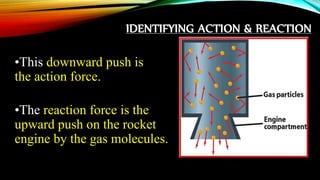
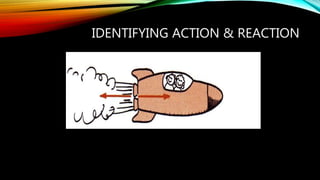
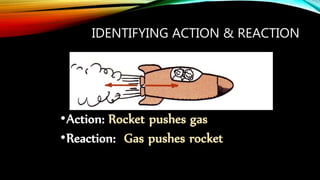
•The reaction force is the
upward push on the rocket
engine by the gas molecules.
•This downward push is
the action force.
IDENTIFYING ACTION & REACTION
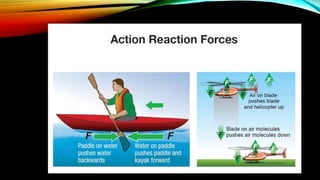
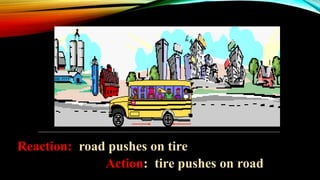
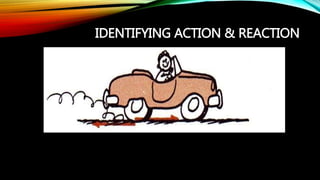
Action: tire pushes on road
Reaction: road pushes on tire
IDENTIFYING ACTION & REACTION
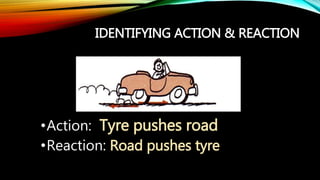
•Action: Tyre pushes road
•Reaction: Road pushes tyre
IDENTIFYING ACTION & REACTION
•Action: Rocket pushes gas
•Reaction: Gas pushes rocket
ACTION AND REACTION ON
DIFFERENT MASSES
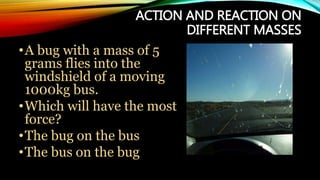
•A bug with a mass of 5
grams flies into the
windshield of a moving
1000kg bus.
•Which will have the most
force?
•The bug on the bus
•The bus on the bug
ACTION AND REACTION ON
DIFFERENT MASSES
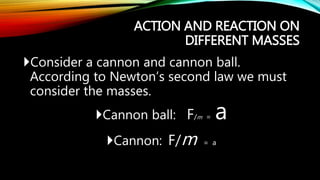
Consider a cannon and cannon ball.
According to Newton’s second law we must
consider the masses.
Cannon ball: F/m = a
Cannon: F/m = a
THINK!
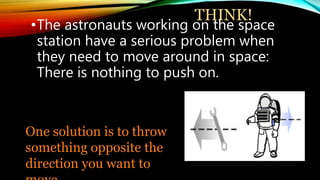
•The astronauts working on the space
station have a serious problem when
they need to move around in space:
There is nothing to push on.
One solution is to throw
something opposite the
direction you want to
WHY DON'T ACTION & REACTION
FORCES CANCEL?
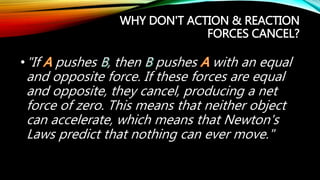
•"If pushes , then pushes with an equal
and opposite force. If these forces are equal
and opposite, they cancel, producing a net
force of zero. This means that neither object
can accelerate, which means that Newton's
Laws predict that nothing can ever move."
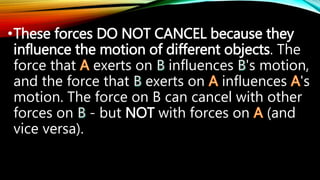
•These forces DO NOT CANCEL because they
influence the motion of different objects. The
force that exerts on influences 's motion,
and the force that exerts on influences 's
motion. The force on B can cancel with other
forces on - but NOT with forces on (and
vice versa).
REFERENCES:
• Amrita.olabs.co.in,. (2012). Newton's Third law of Motion. Retrieved from December
2015, from amrita.olabs.co.in/?sub=1&brch=1&sim=105&cnt=1
• http://physics.stackexchange.com/questions/103814/action-and-reaction-pair-
problem
• Newton's Third Law of Motion (2010). Retrieved from
• http://www.4physics.com/phy_demo/newton/newton_3.htm
• https://www.grc.nasa.gov/www/k-12/WindTunnel/Activities/third_law_motion.html

Law of interaction

  • 1.
    ACTION-REACTION Joy U. Fulgar THIRDLAW OF MOTION: NEWTON’S
  • 2.
    INTERACTIONS PRODUCE FORCES •FORCEis a push or pull. •The forces exerted by two objects on each other are often called an action-reaction force pair.
  • 3.
    “For every action, isan equal and reaction”
  • 4.
    Whenever one object exertsa force on a second object, the second object exerts an equal but opposite force on the first object.
  • 5.
    •One force iscalled the force and the other force is called the force. •Neither force can exist without the other.
  • 6.
    IDENTIFYING ACTION &REACTION •Object A exerts a force on Object B then in reverse Object B exerts a force on object A
  • 7.
    •The reaction forceis the upward push on the rocket engine by the gas molecules. •This downward push is the action force. IDENTIFYING ACTION & REACTION
  • 9.
    Action: tire pusheson road Reaction: road pushes on tire
  • 10.
  • 11.
    IDENTIFYING ACTION &REACTION •Action: Tyre pushes road •Reaction: Road pushes tyre
  • 12.
  • 13.
    IDENTIFYING ACTION &REACTION •Action: Rocket pushes gas •Reaction: Gas pushes rocket
  • 15.
    ACTION AND REACTIONON DIFFERENT MASSES •A bug with a mass of 5 grams flies into the windshield of a moving 1000kg bus. •Which will have the most force? •The bug on the bus •The bus on the bug
  • 16.
    ACTION AND REACTIONON DIFFERENT MASSES Consider a cannon and cannon ball. According to Newton’s second law we must consider the masses. Cannon ball: F/m = a Cannon: F/m = a
  • 17.
    THINK! •The astronauts workingon the space station have a serious problem when they need to move around in space: There is nothing to push on. One solution is to throw something opposite the direction you want to
  • 18.
    WHY DON'T ACTION& REACTION FORCES CANCEL? •"If pushes , then pushes with an equal and opposite force. If these forces are equal and opposite, they cancel, producing a net force of zero. This means that neither object can accelerate, which means that Newton's Laws predict that nothing can ever move."
  • 19.
    •These forces DONOT CANCEL because they influence the motion of different objects. The force that exerts on influences 's motion, and the force that exerts on influences 's motion. The force on B can cancel with other forces on - but NOT with forces on (and vice versa).
  • 20.
    REFERENCES: • Amrita.olabs.co.in,. (2012).Newton's Third law of Motion. Retrieved from December 2015, from amrita.olabs.co.in/?sub=1&brch=1&sim=105&cnt=1 • http://physics.stackexchange.com/questions/103814/action-and-reaction-pair- problem • Newton's Third Law of Motion (2010). Retrieved from • http://www.4physics.com/phy_demo/newton/newton_3.htm • https://www.grc.nasa.gov/www/k-12/WindTunnel/Activities/third_law_motion.html