Copyright © Clara Kim 2007. All rights reserved.
Renaissance
• Means
REBIRTH
• Rebirth of art
and learning
• Began in
northern Italy
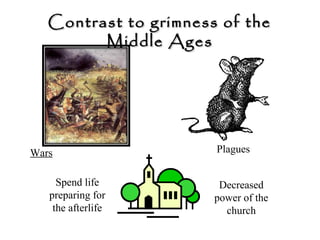
Contrast to grimness of theContrast to grimness of the
Middle AgesMiddle Ages
Wars Plagues
Spend life
preparing for
the afterlife
Decreased
power of the
church
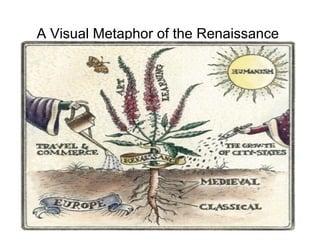
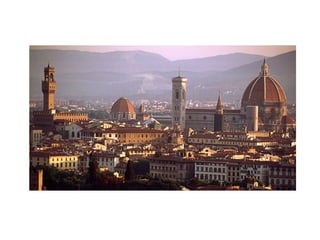
A Visual Metaphor of the Renaissance
What was the Renaissance?
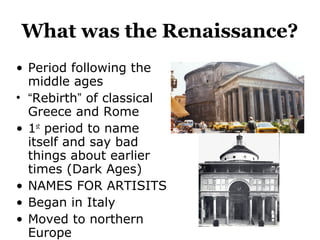
• Period following the
middle ages
• “Rebirth” of classical
Greece and Rome
• 1st
period to name
itself and say bad
things about earlier
times (Dark Ages)
• NAMES FOR ARTISITS
• Began in Italy
• Moved to northern
Europe
Economic Foundations
• Increased demand for
Middle Eastern products
• Encouraged the use of
credit and banking
• Letters of credit
expanded supply of
money and sped up
trade.
• New accounting and
bookkeeping practices
used Arabic numerals
Objectives
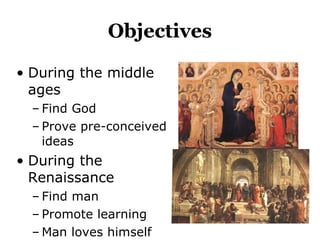
• During the middle
ages
– Find God
– Prove pre-conceived
ideas
• During the
Renaissance
– Find man
– Promote learning
– Man loves himself
Causes of the Italian
Renaissance
• Crusades
• Control of Mediterranean Trade
Major Italian Cities
.
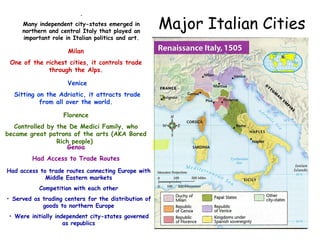
Many independent city-states emerged in
northern and central Italy that played an
important role in Italian politics and art.
MilanMilan VeniceVenice
FlorenceFlorence
Milan
One of the richest cities, it controls trade
through the Alps.
Venice
Sitting on the Adriatic, it attracts trade
from all over the world.
Florence
Controlled by the De Medici Family, who
became great patrons of the arts (AKA Bored
Rich people)
Genoa
Genoa
Had Access to Trade Routes
Had access to trade routes connecting Europe with
Middle Eastern markets
Competition with each other
• Served as trading centers for the distribution of
goods to northern Europe
• Were initially independent city-states governed
as republics
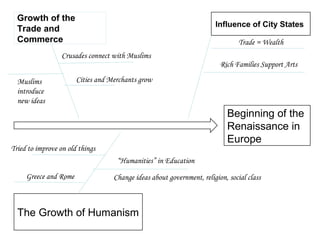
Beginning of the
Renaissance in
Europe
Growth of the
Trade and
Commerce
Crusades connect with Muslims
Muslims
introduce
new ideas
Cities and Merchants grow
Influence of City States
Trade = Wealth
Rich Families Support Arts
The Growth of Humanism
Greece and Rome Change ideas about government, religion, social class
Tried to improve on old things
“Humanities” in Education
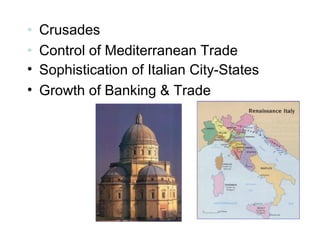
• Sophistication of Italian City-States
• Growth of Banking & Trade
• Crusades
• Control of Mediterranean Trade
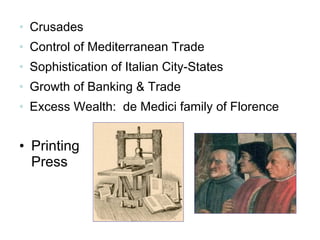
• Printing
Press
• Crusades
• Control of Mediterranean Trade
• Sophistication of Italian City-States
• Growth of Banking & Trade
• Excess Wealth: de Medici family of Florence
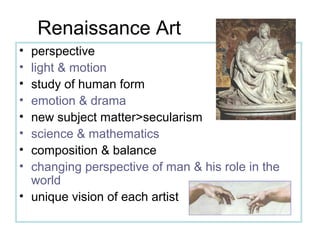
Renaissance Art
• perspective
• light & motion
• study of human form
• emotion & drama
• new subject matter>secularism
• science & mathematics
• composition & balance
• changing perspective of man & his role in the
world
• unique vision of each artist
Effects of the Renaissance
• Advances in Science & Technology led to the
European Exploration of the World
• Secularism led to the Protestant Reformation
• Humanism encouraged the growth of
Democracy & the Fight for Human Rights
• Role of Women in Society Improved
• Renaissance Art led to the Age of Classical
Music and Art in Europe
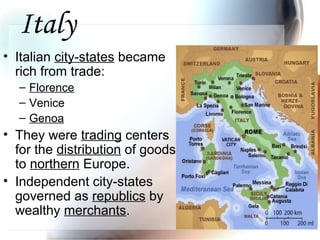
Italy
• Italian city-states became
rich from trade:
– Florence
– Venice
– Genoa
• They were trading centers
for the distribution of goods
to northern Europe.
• Independent city-states
governed as republics by
wealthy merchants.
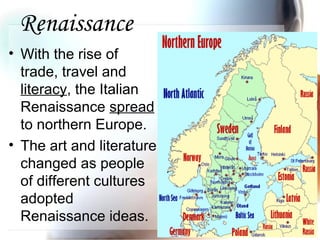
Renaissance
• With the rise of
trade, travel and
literacy, the Italian
Renaissance spread
to northern Europe.
• The art and literature
changed as people
of different cultures
adopted
Renaissance ideas.
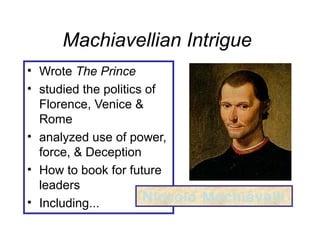
Machiavellian Intrigue
• Wrote The Prince
• studied the politics of
Florence, Venice &
Rome
• analyzed use of power,
force, & Deception
• How to book for future
leaders
• Including... Niccolo Machiavelli
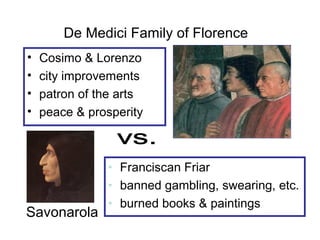
De Medici Family of Florence
• Cosimo & Lorenzo
• city improvements
• patron of the arts
• peace & prosperity
Savonarola
• Franciscan Friar
• banned gambling, swearing, etc.
• burned books & paintings
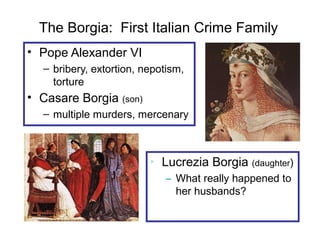
The Borgia: First Italian Crime Family
• Pope Alexander VI
– bribery, extortion, nepotism,
torture
• Casare Borgia (son)
– multiple murders, mercenary
• Lucrezia Borgia (daughter)
– What really happened to
her husbands?
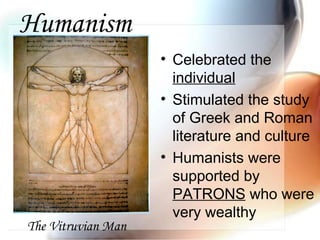
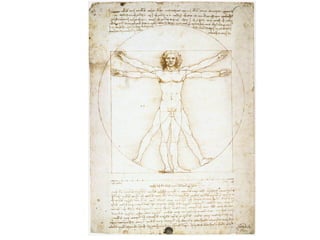
Humanism
• Celebrated the
individual
• Stimulated the study
of Greek and Roman
literature and culture
• Humanists were
supported by
PATRONS who were
very wealthy
The Vitruvian Man
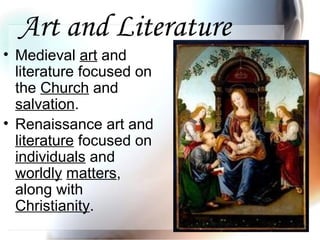
Art and Literature
• Medieval art and
literature focused on
the Church and
salvation.
• Renaissance art and
literature focused on
individuals and
worldly matters,
along with
Christianity.
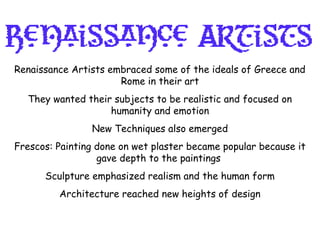
Renaissance Artists embraced some of the ideals of Greece and
Rome in their art
They wanted their subjects to be realistic and focused on
humanity and emotion
New Techniques also emerged
Frescos: Painting done on wet plaster became popular because it
gave depth to the paintings
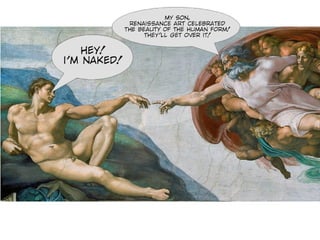
Sculpture emphasized realism and the human form
Architecture reached new heights of design
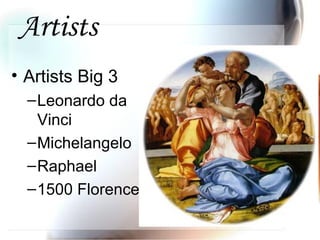
Artists
• Artists Big 3
–Leonardo da
Vinci
–Michelangelo
–Raphael
–1500 Florence
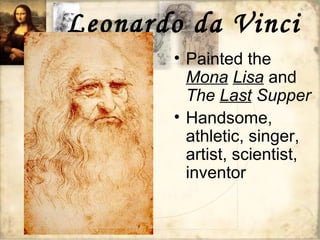
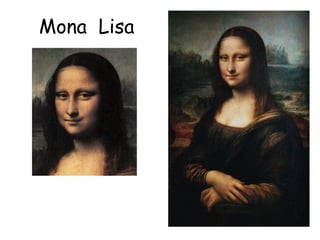
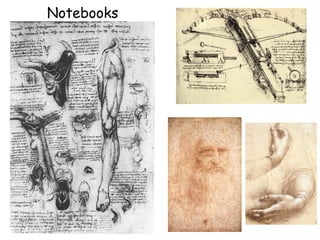
Leonardo da Vinci
• Painted the
Mona Lisa and
The Last Supper
• Handsome,
athletic, singer,
artist, scientist,
inventor
Mona Lisa
Notebooks
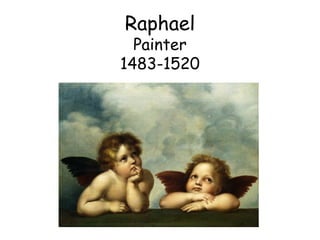
Raphael
Painter
1483-1520
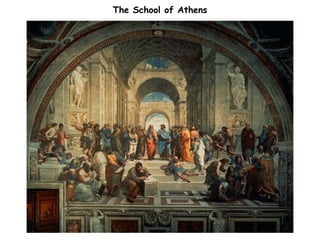
The School of Athens
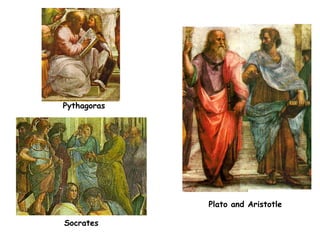
Pythagoras
Socrates
Plato and Aristotle
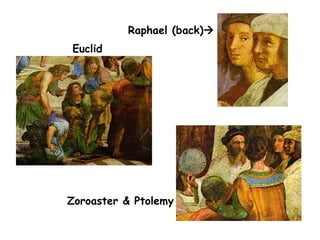
Euclid
Zoroaster & Ptolemy
Raphael (back)
Michelangelo
• Painted the
ceiling of the
Sistine Chapel
and sculpted
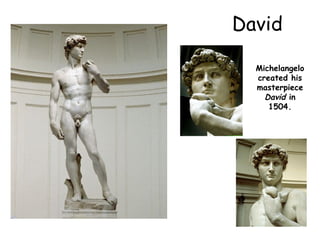
David
• Sculptor,
painter,
architect, poet
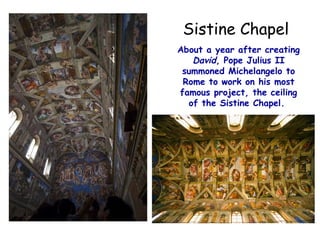
The Sistine Chapel
Ceiling
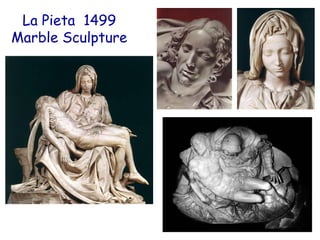
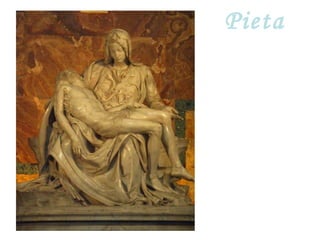
Pieta
David
Michelangelo
created his
masterpiece
David in
1504.
Sistine Chapel
About a year after creating
David, Pope Julius II
summoned Michelangelo to
Rome to work on his most
famous project, the ceiling
of the Sistine Chapel.
La Pieta 1499
Marble Sculpture
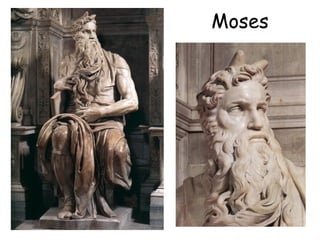
Moses
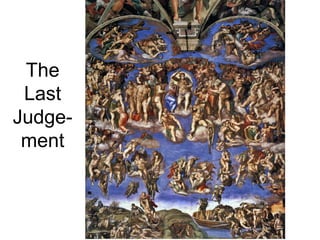
The
Last
Judge-
ment
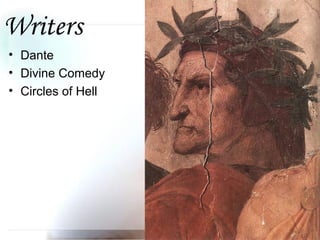
Writers
• Dante
• Divine Comedy
• Circles of Hell
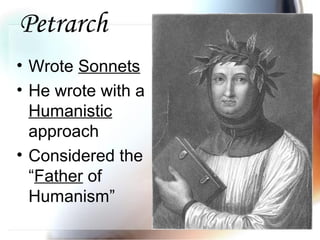
Petrarch
• Wrote Sonnets
• He wrote with a
Humanistic
approach
• Considered the
“Father of
Humanism”
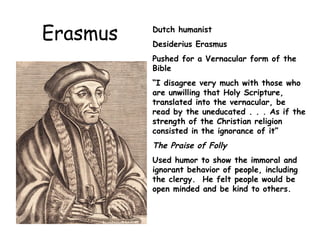
Erasmus Dutch humanist
Desiderius Erasmus
Pushed for a Vernacular form of the
Bible
“I disagree very much with those who
are unwilling that Holy Scripture,
translated into the vernacular, be
read by the uneducated . . . As if the
strength of the Christian religion
consisted in the ignorance of it”
The Praise of Folly
Used humor to show the immoral and
ignorant behavior of people, including
the clergy. He felt people would be
open minded and be kind to others.
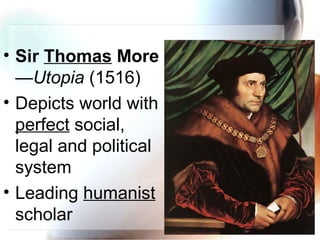
• Sir Thomas More
—Utopia (1516)
• Depicts world with
perfect social,
legal and political
system
• Leading humanist
scholar
Pictures Cited
• Slide 1 – http://renaissance.duelingmodems.com/art/renaissance-head3.gif
• Slide 2 – http://www.leftfield-online.co.uk/images/discography/scan/renaissance.jpg
• Slide 3 – http://content.answers.com/main/content/wp/en/thumb/a/ac/300px-Madonna_of_the_Harpies.jpg
• Slide 4 – http://www.alberta-canada.com/export/graphics/images/italy_map.jpg
• Slide 5 – http://niccolomachiavelli.worldhistoryblogs.com/files/2007/10/machiavellis_portrait.jpg
• Slide 6 – http://www.english-heritage.org.uk/upload/img_200/madonna_rangershouse.jpg
• Slide 7 – http://www.navigo.com/wm/paint/auth/michelangelo/michelangelo.tondo-doni.jpg
• Slide 8 – http://z.about.com/d/atheism/1/0/N/e/LeonardoSelfPortrait.jpg
• Slide 9 – http://www.latifm.com/artists/image/da-vinci-leonardo-mona-
lisa.jpg,http://www.penwith.co.uk/artofeurope/leonardo_da_vinci_last_supper.jpg
• Slide 10 – http://www.shoshone.k12.id.us/renaissance/images/michel.jpg
• Slide 11 – http://studentorganizations.missouristate.edu/TAK/downloads/michelangelo1.jpg
• Slide 12 –
http://www.pbs.org/wgbh/cultureshock/flashpoints/visualarts/images/david_big.jpg,http://www.rome.info/pictur
es/art/michelangelo/michelangelo_pieta.jpg
• Slide 13 – http://www.gutenberg.org/files/17650/17650-h/images/01large.jpg
• Slide 14 – http://www.artspecialist.co.uk/images/Vetruvian%20Man_Clare%20Vaux.JPG
• Slide 15 – http://www.sverigeturism.se/smorgasbord/smorgasbord/image/first/scandinavia.gif
• Slide 16 – http://www.piney.com/Erasmus.gif
• Slide 17 – http://www.wf-f.org/WFFResource/StThomasMore.jpg

The renaissance ppt

  • 1.
    Copyright © ClaraKim 2007. All rights reserved.
  • 2.
    Renaissance • Means REBIRTH • Rebirthof art and learning • Began in northern Italy
  • 3.
    Contrast to grimnessof theContrast to grimness of the Middle AgesMiddle Ages Wars Plagues Spend life preparing for the afterlife Decreased power of the church
  • 4.
    A Visual Metaphorof the Renaissance
  • 5.
    What was theRenaissance? • Period following the middle ages • “Rebirth” of classical Greece and Rome • 1st period to name itself and say bad things about earlier times (Dark Ages) • NAMES FOR ARTISITS • Began in Italy • Moved to northern Europe
  • 6.
    Economic Foundations • Increaseddemand for Middle Eastern products • Encouraged the use of credit and banking • Letters of credit expanded supply of money and sped up trade. • New accounting and bookkeeping practices used Arabic numerals
  • 7.
    Objectives • During themiddle ages – Find God – Prove pre-conceived ideas • During the Renaissance – Find man – Promote learning – Man loves himself
  • 8.
    Causes of theItalian Renaissance • Crusades • Control of Mediterranean Trade
  • 9.
    Major Italian Cities . Manyindependent city-states emerged in northern and central Italy that played an important role in Italian politics and art. MilanMilan VeniceVenice FlorenceFlorence Milan One of the richest cities, it controls trade through the Alps. Venice Sitting on the Adriatic, it attracts trade from all over the world. Florence Controlled by the De Medici Family, who became great patrons of the arts (AKA Bored Rich people) Genoa Genoa Had Access to Trade Routes Had access to trade routes connecting Europe with Middle Eastern markets Competition with each other • Served as trading centers for the distribution of goods to northern Europe • Were initially independent city-states governed as republics
  • 10.
    Beginning of the Renaissancein Europe Growth of the Trade and Commerce Crusades connect with Muslims Muslims introduce new ideas Cities and Merchants grow Influence of City States Trade = Wealth Rich Families Support Arts The Growth of Humanism Greece and Rome Change ideas about government, religion, social class Tried to improve on old things “Humanities” in Education
  • 11.
    • Sophistication ofItalian City-States • Growth of Banking & Trade • Crusades • Control of Mediterranean Trade
  • 12.
    • Printing Press • Crusades •Control of Mediterranean Trade • Sophistication of Italian City-States • Growth of Banking & Trade • Excess Wealth: de Medici family of Florence
  • 13.
    Renaissance Art • perspective •light & motion • study of human form • emotion & drama • new subject matter>secularism • science & mathematics • composition & balance • changing perspective of man & his role in the world • unique vision of each artist
  • 14.
    Effects of theRenaissance • Advances in Science & Technology led to the European Exploration of the World • Secularism led to the Protestant Reformation • Humanism encouraged the growth of Democracy & the Fight for Human Rights • Role of Women in Society Improved • Renaissance Art led to the Age of Classical Music and Art in Europe
  • 16.
    Italy • Italian city-statesbecame rich from trade: – Florence – Venice – Genoa • They were trading centers for the distribution of goods to northern Europe. • Independent city-states governed as republics by wealthy merchants.
  • 17.
    Renaissance • With therise of trade, travel and literacy, the Italian Renaissance spread to northern Europe. • The art and literature changed as people of different cultures adopted Renaissance ideas.
  • 18.
    Machiavellian Intrigue • WroteThe Prince • studied the politics of Florence, Venice & Rome • analyzed use of power, force, & Deception • How to book for future leaders • Including... Niccolo Machiavelli
  • 19.
    De Medici Familyof Florence • Cosimo & Lorenzo • city improvements • patron of the arts • peace & prosperity Savonarola • Franciscan Friar • banned gambling, swearing, etc. • burned books & paintings
  • 20.
    The Borgia: FirstItalian Crime Family • Pope Alexander VI – bribery, extortion, nepotism, torture • Casare Borgia (son) – multiple murders, mercenary • Lucrezia Borgia (daughter) – What really happened to her husbands?
  • 21.
    Humanism • Celebrated the individual •Stimulated the study of Greek and Roman literature and culture • Humanists were supported by PATRONS who were very wealthy The Vitruvian Man
  • 22.
    Art and Literature •Medieval art and literature focused on the Church and salvation. • Renaissance art and literature focused on individuals and worldly matters, along with Christianity.
  • 23.
    Renaissance Artists embracedsome of the ideals of Greece and Rome in their art They wanted their subjects to be realistic and focused on humanity and emotion New Techniques also emerged Frescos: Painting done on wet plaster became popular because it gave depth to the paintings Sculpture emphasized realism and the human form Architecture reached new heights of design
  • 25.
    Artists • Artists Big3 –Leonardo da Vinci –Michelangelo –Raphael –1500 Florence
  • 26.
    Leonardo da Vinci •Painted the Mona Lisa and The Last Supper • Handsome, athletic, singer, artist, scientist, inventor
  • 27.
  • 30.
  • 31.
  • 32.
  • 33.
  • 34.
  • 35.
    Michelangelo • Painted the ceilingof the Sistine Chapel and sculpted David • Sculptor, painter, architect, poet
  • 36.
  • 37.
  • 38.
  • 39.
    Sistine Chapel About ayear after creating David, Pope Julius II summoned Michelangelo to Rome to work on his most famous project, the ceiling of the Sistine Chapel.
  • 40.
  • 41.
  • 42.
  • 43.
    Writers • Dante • DivineComedy • Circles of Hell
  • 44.
    Petrarch • Wrote Sonnets •He wrote with a Humanistic approach • Considered the “Father of Humanism”
  • 45.
    Erasmus Dutch humanist DesideriusErasmus Pushed for a Vernacular form of the Bible “I disagree very much with those who are unwilling that Holy Scripture, translated into the vernacular, be read by the uneducated . . . As if the strength of the Christian religion consisted in the ignorance of it” The Praise of Folly Used humor to show the immoral and ignorant behavior of people, including the clergy. He felt people would be open minded and be kind to others.
  • 46.
    • Sir ThomasMore —Utopia (1516) • Depicts world with perfect social, legal and political system • Leading humanist scholar
  • 47.
    Pictures Cited • Slide1 – http://renaissance.duelingmodems.com/art/renaissance-head3.gif • Slide 2 – http://www.leftfield-online.co.uk/images/discography/scan/renaissance.jpg • Slide 3 – http://content.answers.com/main/content/wp/en/thumb/a/ac/300px-Madonna_of_the_Harpies.jpg • Slide 4 – http://www.alberta-canada.com/export/graphics/images/italy_map.jpg • Slide 5 – http://niccolomachiavelli.worldhistoryblogs.com/files/2007/10/machiavellis_portrait.jpg • Slide 6 – http://www.english-heritage.org.uk/upload/img_200/madonna_rangershouse.jpg • Slide 7 – http://www.navigo.com/wm/paint/auth/michelangelo/michelangelo.tondo-doni.jpg • Slide 8 – http://z.about.com/d/atheism/1/0/N/e/LeonardoSelfPortrait.jpg • Slide 9 – http://www.latifm.com/artists/image/da-vinci-leonardo-mona- lisa.jpg,http://www.penwith.co.uk/artofeurope/leonardo_da_vinci_last_supper.jpg • Slide 10 – http://www.shoshone.k12.id.us/renaissance/images/michel.jpg • Slide 11 – http://studentorganizations.missouristate.edu/TAK/downloads/michelangelo1.jpg • Slide 12 – http://www.pbs.org/wgbh/cultureshock/flashpoints/visualarts/images/david_big.jpg,http://www.rome.info/pictur es/art/michelangelo/michelangelo_pieta.jpg • Slide 13 – http://www.gutenberg.org/files/17650/17650-h/images/01large.jpg • Slide 14 – http://www.artspecialist.co.uk/images/Vetruvian%20Man_Clare%20Vaux.JPG • Slide 15 – http://www.sverigeturism.se/smorgasbord/smorgasbord/image/first/scandinavia.gif • Slide 16 – http://www.piney.com/Erasmus.gif • Slide 17 – http://www.wf-f.org/WFFResource/StThomasMore.jpg