Dr. Rakhesh Singh Kshetrimayum
1. Introduction
Dr. Rakhesh Singh Kshetrimayum
2/20/20131 Electromagnetic FieldTheory by R. S. Kshetrimayum
1.1 Electromagnetic theory in a nutshell
Electromagnetic field theory is the study of fields produced
by electric charges at
rest or
in motion
Electromagnetic theory can be divided into three sub-
divisions
2/20/2013Electromagnetic FieldTheory by R. S. Kshetrimayum2
divisions
electrostatics,
magnetostatic and
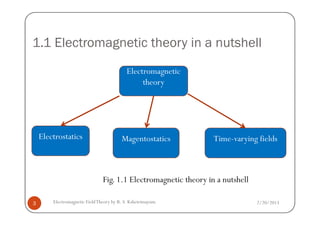
time-varying fields as depicted in Fig. 1.1
depending on whether the charge which is the source of
electromagnetic field is at rest or motion
1.1 Electromagnetic theory in a nutshell
Electromagnetic
theory
2/20/2013Electromagnetic FieldTheory by R. S. Kshetrimayum3
Electrostatics Magentostatics Time-varying fields
Fig. 1.1 Electromagnetic theory in a nutshell
1.1 Electromagnetic theory in a nutshell
Electrostatic fields are produced by static electric charges
Magnetostatic fields are produced by electric charges moving
with uniform velocity also known as direct current
Time-varying fields are produced by accelerated or
decelerated charges or time-varying currents or alternating
2/20/2013Electromagnetic FieldTheory by R. S. Kshetrimayum4
decelerated charges or time-varying currents or alternating
currents
An accelerated or decelerated charge also produces radiation
1.2 Computational electromagnetics
Computational electromagnetics (CEM) is an
interdisciplinary field where
we apply numerical methods and
use computers
to solve
2/20/2013Electromagnetic FieldTheory by R. S. Kshetrimayum5
to solve
practical
and real-life electromagnetic problems
which usually do not have simple analytical solutions
1.2 Computational electromagnetics
1.2.1Why do we need Computational electromagnetics?
Maxwell’s equations along with
the electromagnetic boundary conditions
describe any kind of electromagnetic phenomenon in nature
excluding quantum mechanics
2/20/2013Electromagnetic FieldTheory by R. S. Kshetrimayum6
excluding quantum mechanics
Due to the linearity of the four Maxwell’s equations in the
differential forms,
it may appear rather easy to solve them analytically
1.2 Computational electromagnetics
But the boundary and interface conditions make them hard to
solve analytically for many practical electromagnetic
engineering problems
Hence one has to resort to use
experimental,
2/20/2013Electromagnetic FieldTheory by R. S. Kshetrimayum7
experimental,
approximate or
computational methods
to solve them
1.2 Computational electromagnetics
An advantage of this is that it is possible to simulate a
device/experiment/phenomenon
any number of times
as per our requirements
In that way,
2/20/2013Electromagnetic FieldTheory by R. S. Kshetrimayum8
In that way,
we can try to achieve the best or optimal result
before actually doing the experiments
Sometime experiments are dangerous to perform
1.2 Computational electromagnetics
1.2.2 Computational electromagnetics in a nutshell
For any computational solution in Computational
electromagnetics,
it is necessary to develop the required equations and
solve them using a computer also known as equation solvers
2/20/2013Electromagnetic FieldTheory by R. S. Kshetrimayum9
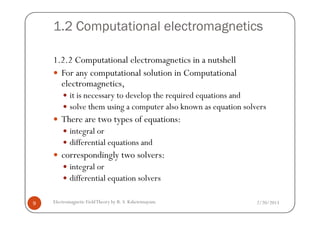
There are two types of equations:
integral or
differential equations and
correspondingly two solvers:
integral or
differential equation solvers
1.2 Computational electromagnetics
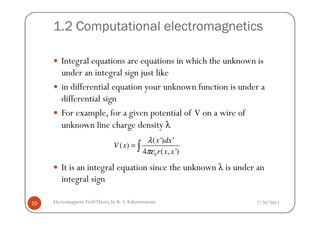
Integral equations are equations in which the unknown is
under an integral sign just like
in differential equation your unknown function is under a
differential sign
For example, for a given potential of V on a wire of
2/20/2013Electromagnetic FieldTheory by R. S. Kshetrimayum10
For example, for a given potential of V on a wire of
unknown line charge density λ
It is an integral equation since the unknown λ is under an
integral sign
0
( ') '
( )
4 ( , ')
x dx
V x
r x x
λ
πε
= ∫
1.2 Computational electromagnetics
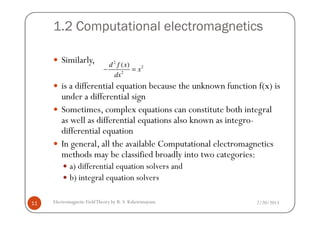
Similarly,
is a differential equation because the unknown function f(x) is
under a differential sign
Sometimes, complex equations can constitute both integral
2
2
2
( )d f x
x
dx
− =
2/20/2013Electromagnetic FieldTheory by R. S. Kshetrimayum11
Sometimes, complex equations can constitute both integral
as well as differential equations also known as integro-
differential equation
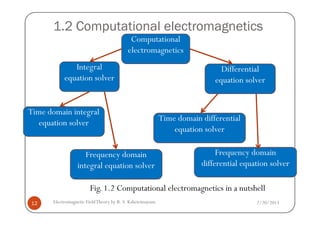
In general, all the available Computational electromagnetics
methods may be classified broadly into two categories:
a) differential equation solvers and
b) integral equation solvers
1.2 Computational electromagnetics
Computational
electromagnetics
Integral
equation solver
Time domain integral
Differential
equation solver
2/20/2013Electromagnetic FieldTheory by R. S. Kshetrimayum12
Time domain integral
equation solver
Frequency domain
integral equation solver
Fig. 1.2 Computational electromagnetics in a nutshell
Time domain differential
equation solver
Frequency domain
differential equation solver
1.2 Computational electromagnetics
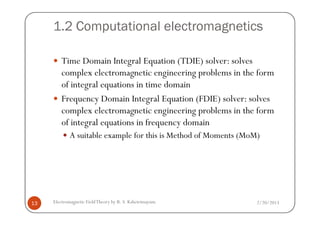
Time Domain Integral Equation (TDIE) solver: solves
complex electromagnetic engineering problems in the form
of integral equations in time domain
Frequency Domain Integral Equation (FDIE) solver: solves
complex electromagnetic engineering problems in the form
2/20/2013Electromagnetic FieldTheory by R. S. Kshetrimayum13
complex electromagnetic engineering problems in the form
of integral equations in frequency domain
A suitable example for this is Method of Moments (MoM)
1.2 Computational electromagnetics
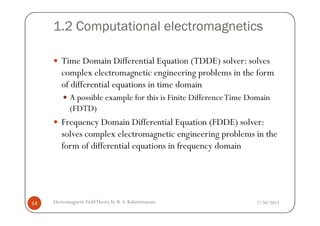
Time Domain Differential Equation (TDDE) solver: solves
complex electromagnetic engineering problems in the form
of differential equations in time domain
A possible example for this is Finite DifferenceTime Domain
(FDTD)
2/20/2013Electromagnetic FieldTheory by R. S. Kshetrimayum14
(FDTD)
Frequency Domain Differential Equation (FDDE) solver:
solves complex electromagnetic engineering problems in the
form of differential equations in frequency domain
1.3 General curvilinear coordinate system
1.3.1 Coordinate systems
Note that it is possible to develop one general expressions
also known as general curvilinear coordinate system for
divergence,
curl and
2/20/2013Electromagnetic FieldTheory by R. S. Kshetrimayum15
curl and
other vector operations
of the three orthogonal coordinate systems viz.
Rectangular,
Cylindrical and
Spherical coordinate systems
1.3 General curvilinear coordinate system
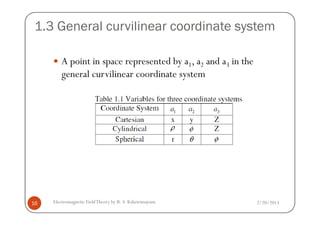
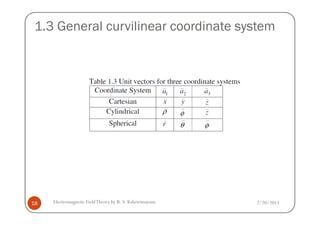
A point in space represented by a1, a2 and a3 in the
general curvilinear coordinate system
2/20/2013Electromagnetic FieldTheory by R. S. Kshetrimayum16
1.3 General curvilinear coordinate system
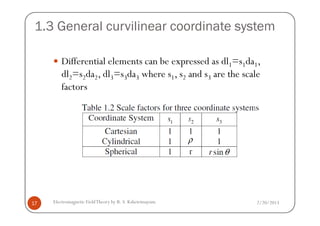
Differential elements can be expressed as dl1=s1da1,
dl2=s2da2, dl3=s3da3 where s1, s2 and s3 are the scale
factors
2/20/2013Electromagnetic FieldTheory by R. S. Kshetrimayum17
1.3 General curvilinear coordinate system
2/20/2013Electromagnetic FieldTheory by R. S. Kshetrimayum18
1.3 General curvilinear coordinate system
θ
θ
ˆr
ˆz
ˆφ
2/20/2013Electromagnetic FieldTheory by R. S. Kshetrimayum19
ρ
φ
θ
ˆθ
ˆx
ˆy
φ θ
ˆρ
(a) (b)
1.3 General curvilinear coordinate system
ˆφ
ˆyˆz
θ
ˆrˆz
2/20/2013Electromagnetic FieldTheory by R. S. Kshetrimayum20
ˆρφ
ˆx
ˆθ
ˆφ ˆρ
(c) (d)
1.3 General curvilinear coordinate system
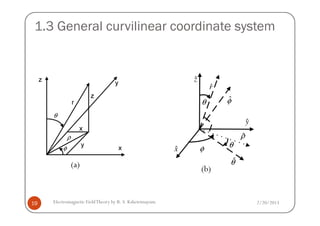
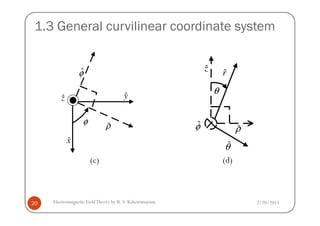
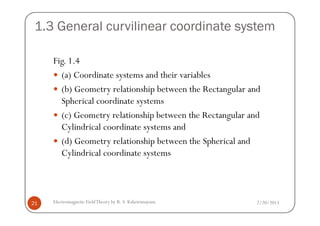
Fig. 1.4
(a) Coordinate systems and their variables
(b) Geometry relationship between the Rectangular and
Spherical coordinate systems
(c) Geometry relationship between the Rectangular and
2/20/2013Electromagnetic FieldTheory by R. S. Kshetrimayum21
(c) Geometry relationship between the Rectangular and
Cylindrical coordinate systems and
(d) Geometry relationship between the Spherical and
Cylindrical coordinate systems
1.3 General curvilinear coordinate system
1.3.2 Direction cosines
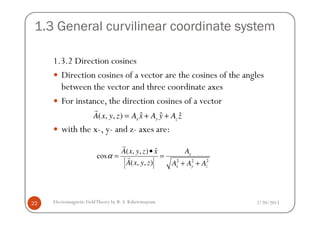
Direction cosines of a vector are the cosines of the angles
between the vector and three coordinate axes
For instance, the direction cosines of a vector
ˆ ˆ ˆ( , , )A x y z A x A y A z= + +
r
2/20/2013Electromagnetic FieldTheory by R. S. Kshetrimayum22
with the x-, y- and z- axes are:
ˆ ˆ ˆ( , , ) x y zA x y z A x A y A z= + +
2 2 2
ˆ( , , )
cos
( , , )
x
x y z
AA x y z x
A x y z A A A
α
•
= =
+ +
r
r
1.3 General curvilinear coordinate system
2 2 2
ˆ( , , )
cos
( , , )
y
x y z
AA x y z y
A x y z A A A
β
•
= =
+ +
r
r
2 2 2
ˆ( , , )
cos
( , , )
z
x y z
AA x y z z
A x y z A A A
γ
•
= =
+ +
r
r
2/20/2013Electromagnetic FieldTheory by R. S. Kshetrimayum23
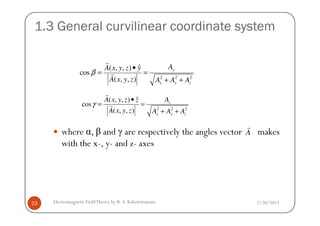
where α, β and γ are respectively the angles vector makes
with the x-, y- and z- axes
( , , ) x y z
A x y z A A A+ +
A
r
1.3 General curvilinear coordinate system
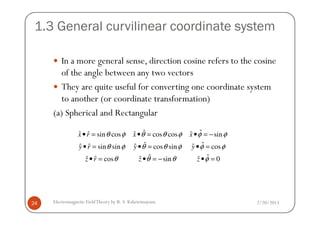
In a more general sense, direction cosine refers to the cosine
of the angle between any two vectors
They are quite useful for converting one coordinate system
to another (or coordinate transformation)
(a) Spherical and Rectangular
2/20/2013Electromagnetic FieldTheory by R. S. Kshetrimayum24
(a) Spherical and Rectangular
ˆ ˆˆ ˆ ˆ ˆsin cos cos cos sin
ˆ ˆˆ ˆ ˆ ˆsin sin cos sin cos
ˆ ˆˆˆ ˆ ˆcos sin 0
x r x x
y r y y
z r z z
θ φ θ θ φ φ φ
θ φ θ θ φ φ φ
θ θ θ φ
• = • = • = −
• = • = • =
• = • = − • =
1.3 General curvilinear coordinate system
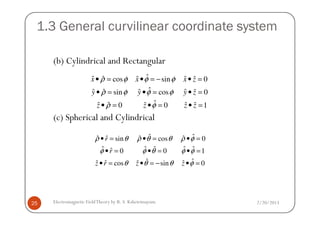
(b) Cylindrical and Rectangular
(c) Spherical and Cylindrical
ˆˆˆ ˆ ˆ ˆcos sin 0
ˆˆˆ ˆ ˆ ˆsin cos 0
ˆˆˆ ˆ ˆ ˆ0 0 1
x x x z
y y y z
z z z z
ρ φ φ φ
ρ φ φ φ
ρ φ
• = • = − • =
• = • = • =
• = • = • =
2/20/2013Electromagnetic FieldTheory by R. S. Kshetrimayum25
(c) Spherical and Cylindrical
ˆ ˆˆ ˆ ˆˆ sin cos 0
ˆ ˆ ˆ ˆ ˆˆ 0 0 1
ˆ ˆˆˆ ˆ ˆcos sin 0
r
r
z r z z
ρ θ ρ θ θ ρ φ
φ φ θ φ φ
θ θ θ φ
• = • = • =
• = • = • =
• = • = − • =
1.3 General curvilinear coordinate system
1.3.3 Coordinate transformations
(a) Spherical to Rectangular and vice versa
( ) [ ] ( )
sin cos cos cos sin
sin sin cos sin cos , , , ,
x r
y sr
A A
A A A x y z T A rθ
θ φ θ φ φ
θ φ θ φ φ θ φ
   − 
    = ⇒ =    
   
r r
2/20/2013Electromagnetic FieldTheory by R. S. Kshetrimayum26
( ) [ ] ( )
cos sin 0
y sr
z
AA
θ
φθ θ
    
    −    
sin cos sin sin cos
cos cos cos sin sin
sin cos 0
xr
y
z
AA
A A
A A
θ
φ
θ φ θ φ θ
θ φ θ φ θ
φ φ
    
    = −    
    −    
1.3 General curvilinear coordinate system
(b) Cylindrical to Rectangular and vice versa
( ) [ ] ( )
cos sin 0
sin cos 0 , , , ,
0 0 1
x
y cr
zz
AA
A A A x y z T A z
AA
ρ
φ
φ φ
φ φ ρ φ
   − 
    = ⇒ =    
        
r r
2/20/2013Electromagnetic FieldTheory by R. S. Kshetrimayum27
cos sin 0
sin cos 0
0 0 1
x
y
z z
A A
A A
A A
ρ
φ
φ φ
φ φ
    
    = −    
        
1.3 General curvilinear coordinate system
(c) Spherical to Cylindrical and vice versa
( ) [ ] ( )
sin cos 0
0 0 1 , , , ,
cos sin 0
r
sc
z
A A
A A A z T A r
AA
ρ
φ θ
φ
θ θ
ρ φ θ φ
θ θ
    
    = ⇒ =    
    −    
r r
2/20/2013Electromagnetic FieldTheory by R. S. Kshetrimayum28
sin 0 cos
cos 0 sin
0 1 0
r
z
AA
A A
A A
ρ
θ φ
φ
θ θ
θ θ
    
    = −    
        
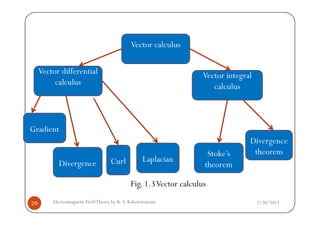
Vector calculus
Vector differential
calculus
Vector integral
calculus
2/20/2013Electromagnetic FieldTheory by R. S. Kshetrimayum29
Gradient
Divergence
Fig. 1.3Vector calculus
Curl Laplacian
Divergence
theoremStoke’s
theorem
1.4 Vector differential calculus
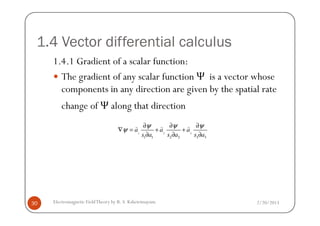
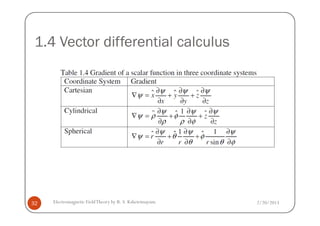
1.4.1 Gradient of a scalar function:
The gradient of any scalar function Ψ is a vector whose
components in any direction are given by the spatial rate
change of Ψ along that direction
2/20/2013Electromagnetic FieldTheory by R. S. Kshetrimayum30
1 2 3
1 1 2 2 3 3
a a a
s a s a s a
ψ ψ ψ
ψ
∂ ∂ ∂
∇ = + +
∂ ∂ ∂
) ) )
1.4 Vector differential calculus
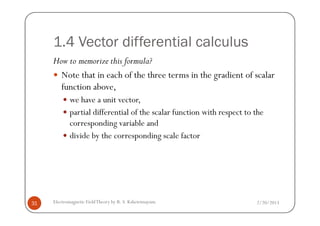
How to memorize this formula?
Note that in each of the three terms in the gradient of scalar
function above,
we have a unit vector,
partial differential of the scalar function with respect to the
2/20/2013Electromagnetic FieldTheory by R. S. Kshetrimayum31
partial differential of the scalar function with respect to the
corresponding variable and
divide by the corresponding scale factor
1.4 Vector differential calculus
2/20/2013Electromagnetic FieldTheory by R. S. Kshetrimayum32
1.4 Vector differential calculus
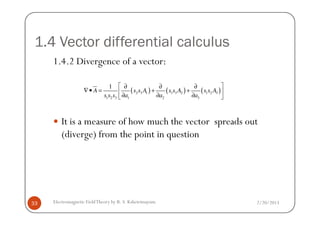
1.4.2 Divergence of a vector:
( ) ( ) ( )2 3 1 1 3 2 1 2 3
1 2 3 1 2 3
1
A s s A s s A s s A
s s s a a a
 ∂ ∂ ∂
∇• = + + 
∂ ∂ ∂ 
2/20/2013Electromagnetic FieldTheory by R. S. Kshetrimayum33
It is a measure of how much the vector spreads out
(diverge) from the point in question
1.4 Vector differential calculus
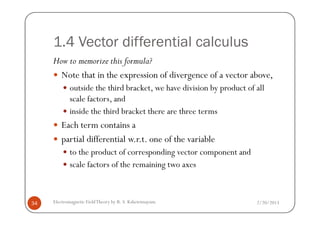
How to memorize this formula?
Note that in the expression of divergence of a vector above,
outside the third bracket, we have division by product of all
scale factors, and
inside the third bracket there are three terms
2/20/2013Electromagnetic FieldTheory by R. S. Kshetrimayum34
inside the third bracket there are three terms
Each term contains a
partial differential w.r.t. one of the variable
to the product of corresponding vector component and
scale factors of the remaining two axes
1.4 Vector differential calculus
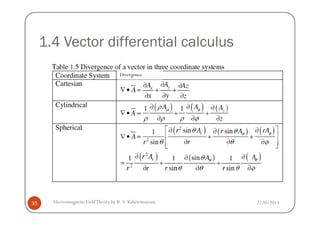
Divergence
2/20/2013Electromagnetic FieldTheory by R. S. Kshetrimayum35
1.4 Vector differential calculus
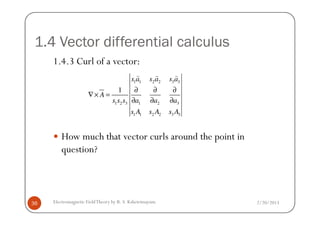
1.4.3 Curl of a vector:
1 1 2 2 3 3
1 2 3 1 2 3
1 1 2 2 3 3
1
s a s a s a
A
s s s a a a
s A s A s A
∂ ∂ ∂
∇× =
∂ ∂ ∂
) ) )
2/20/2013Electromagnetic FieldTheory by R. S. Kshetrimayum36
How much that vector curls around the point in
question?
1 1 2 2 3 3s A s A s A
1.4 Vector differential calculus
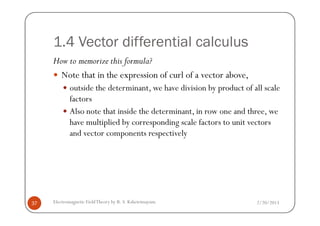
How to memorize this formula?
Note that in the expression of curl of a vector above,
outside the determinant, we have division by product of all scale
factors
Also note that inside the determinant, in row one and three, we
2/20/2013Electromagnetic FieldTheory by R. S. Kshetrimayum37
Also note that inside the determinant, in row one and three, we
have multiplied by corresponding scale factors to unit vectors
and vector components respectively
1.4 Vector differential calculus
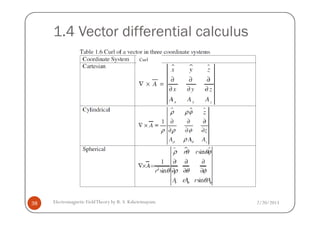
Curl
2/20/2013Electromagnetic FieldTheory by R. S. Kshetrimayum38
1.4 Vector differential calculus
2/20/2013Electromagnetic FieldTheory by R. S. Kshetrimayum39
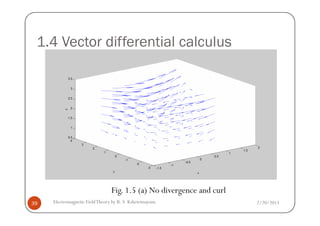
Fig. 1.5 (a) No divergence and curl
1.4 Vector differential calculus
2/20/2013Electromagnetic FieldTheory by R. S. Kshetrimayum40
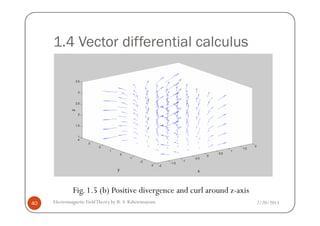
Fig. 1.5 (b) Positive divergence and curl around z-axis
1.4 Vector differential calculus
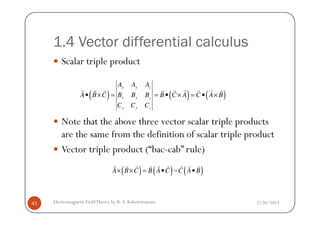
Scalar triple product
( ) ( ) ( )
x y z
x y z
x y z
A A A
A B C B B B B C A C A B
C C C
• × = = • × = • ×
r r r r r rr r r
2/20/2013Electromagnetic FieldTheory by R. S. Kshetrimayum41
Note that the above three vector scalar triple products
are the same from the definition of scalar triple product
Vector triple product (“bac-cab” rule)
( ) ( ) ( )A B C B A C C A B× × = • − •
r r r r r rr r r
1.4 Vector differential calculus
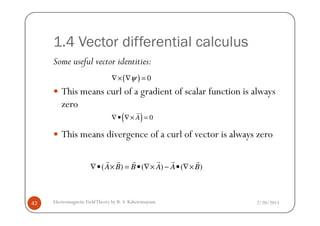
Some useful vector identities:
This means curl of a gradient of scalar function is always
zero
( ) 0ψ∇× ∇ =
( )∇ • ∇× =
r
2/20/2013Electromagnetic FieldTheory by R. S. Kshetrimayum42
This means divergence of a curl of vector is always zero
( ) 0A∇ • ∇× =
r
( ) ( ) ( )A B B A A B∇• × = • ∇× − • ∇×
r r rr r r
1.4 Vector differential calculus
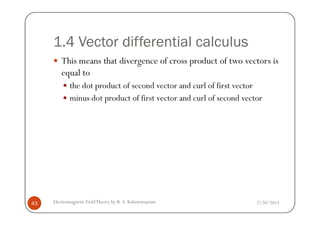
This means that divergence of cross product of two vectors is
equal to
the dot product of second vector and curl of first vector
minus dot product of first vector and curl of second vector
2/20/2013Electromagnetic FieldTheory by R. S. Kshetrimayum43
1.4 Vector differential calculus
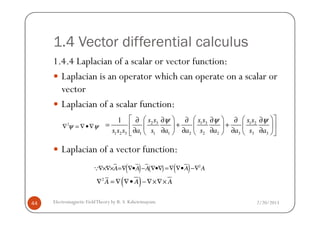
1.4.4 Laplacian of a scalar or vector function:
Laplacian is an operator which can operate on a scalar or
vector
Laplacian of a scalar function:
2/20/2013Electromagnetic FieldTheory by R. S. Kshetrimayum44
Laplacian of a vector function:
2
ψ ψ∇ = ∇•∇
2 3 1 3 1 2
1 2 3 1 1 1 2 2 2 3 3 3
1 s s s s s s
s s s a s a a s a a s a
ψ ψ ψ     ∂ ∂ ∂ ∂ ∂ ∂
= + +     
∂ ∂ ∂ ∂ ∂ ∂      
( ) ( )A A A∇×∇× =∇ ∇• − ∇•∇Q ( ) 2
A A=∇ ∇• −∇
( )2
A A A∇ = ∇ ∇• −∇×∇×
1.4 Vector differential calculus
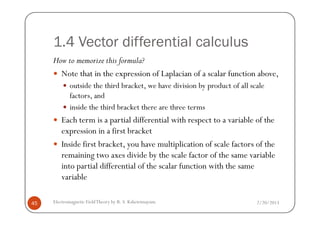
How to memorize this formula?
Note that in the expression of Laplacian of a scalar function above,
outside the third bracket, we have division by product of all scale
factors, and
inside the third bracket there are three terms
2/20/2013Electromagnetic FieldTheory by R. S. Kshetrimayum45
Each term is a partial differential with respect to a variable of the
expression in a first bracket
Inside first bracket, you have multiplication of scale factors of the
remaining two axes divide by the scale factor of the same variable
into partial differential of the scalar function with the same
variable
1.4 Vector differential calculus
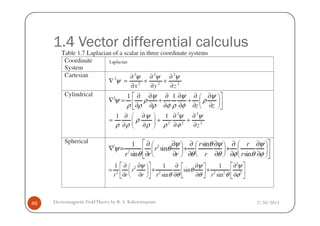
Laplacian
2/20/2013Electromagnetic FieldTheory by R. S. Kshetrimayum46
1.5 Vector integral calculus
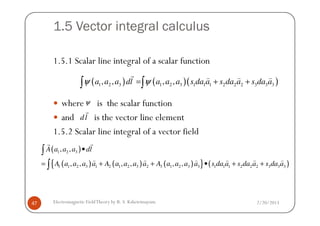
1.5.1 Scalar line integral of a scalar function
where is the scalar function
and is the vector line element
( ) ( )( )1 2 3 1 2 3 1 1 1 2 2 2 3 3 3, , , ,a a a dl a a a s da a s da a s da aψ ψ= + +∫ ∫
r ) ) )
ψ
dl
r
2/20/2013Electromagnetic FieldTheory by R. S. Kshetrimayum47
and is the vector line element
1.5.2 Scalar line integral of a vector field
dl
r
( )
( ) ( ) ( ){ } ( )
1 2 3
1 1 2 3 1 2 1 2 3 2 3 1 2 3 3 1 1 1 2 2 2 3 3 3
, ,
, , , , , ,
A a a a dl
A a a a a A a a a a A a a a a s da a s da a s da a
•
= + + • + +
∫
∫
rr
) ) ) ) ) )
1.5 Vector integral calculus
where is the vector field and
and is the vector line element
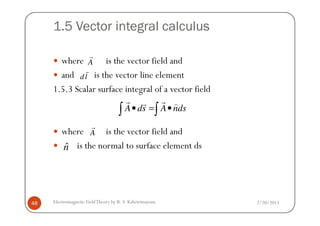
1.5.3 Scalar surface integral of a vector field
A ds A nds• = •∫ ∫
r rr )
A
r
dl
r
2/20/2013Electromagnetic FieldTheory by R. S. Kshetrimayum48
where is the vector field and
is the normal to surface element ds
A ds A nds• = •∫ ∫
A
r
ˆn
1.5 Vector integral calculus
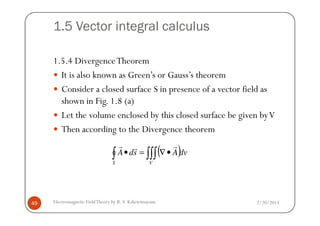
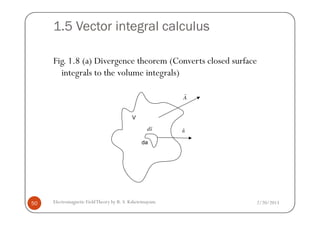
1.5.4 DivergenceTheorem
It is also known as Green’s or Gauss’s theorem
Consider a closed surface S in presence of a vector field as
shown in Fig. 1.8 (a)
Let the volume enclosed by this closed surface be given byV
2/20/2013Electromagnetic FieldTheory by R. S. Kshetrimayum49
Let the volume enclosed by this closed surface be given byV
Then according to the Divergence theorem
( )dvAsdA
S V
∫ ∫∫∫ •∇=•
rrr
1.5 Vector integral calculus
Fig. 1.8 (a) Divergence theorem (Converts closed surface
integrals to the volume integrals)
A
r
2/20/2013Electromagnetic FieldTheory by R. S. Kshetrimayum50
V
ˆnds
r
da
1.5 Vector integral calculus
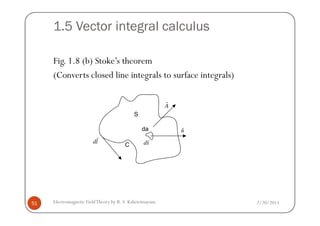
Fig. 1.8 (b) Stoke’s theorem
(Converts closed line integrals to surface integrals)
A
r
S
2/20/2013Electromagnetic FieldTheory by R. S. Kshetrimayum51
S
C
da ˆn
dl
r
ds
r
1.5 Vector integral calculus
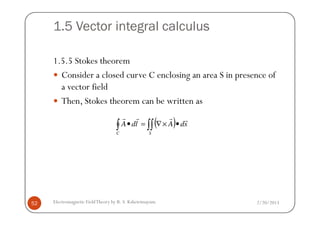
1.5.5 Stokes theorem
Consider a closed curve C enclosing an area S in presence of
a vector field
Then, Stokes theorem can be written as
2/20/2013Electromagnetic FieldTheory by R. S. Kshetrimayum52
( )∫ ∫∫ •×∇=•
C S
sdAldA
rrrr
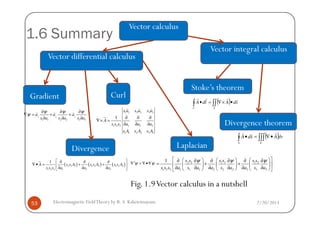
1.6 Summary
Vector calculus
Vector differential calculus
Gradient
Vector integral calculus
Curl
Stoke’s theorem
( )∫ ∫∫ •×∇=•
C S
sdAldA
rrrr
a a a
ψ ψ ψ
ψ
∂ ∂ ∂
∇ = + +
) ) ) 1 1 2 2 3 3s a s a s a
) ) )
2/20/2013Electromagnetic FieldTheory by R. S. Kshetrimayum53
Divergence
Fig. 1.9Vector calculus in a nutshell
Laplacian
Divergence theorem
( )dvAsdA
S V
∫ ∫∫∫ •∇=•
rrr
1 2 3
1 1 2 2 3 3
a a a
s a s a s a
ψ ψ ψ
ψ
∂ ∂ ∂
∇ = + +
∂ ∂ ∂
) ) )
( ) ( ) ( )2 3 1 1 3 2 1 2 3
1 2 3 1 2 3
1
A s s A s s A s s A
s s s a a a
 ∂ ∂ ∂
∇• = + + 
∂ ∂ ∂ 
1 1 2 2 3 3
1 2 3 1 2 3
1 1 2 2 3 3
1
s a s a s a
A
s s s a a a
s A s A s A
∂ ∂ ∂
∇× =
∂ ∂ ∂
2 3 1 3 1 2
1 2 3 1 1 1 2 2 2 3 3 3
1 s s s s s s
s s s a s a a s a a s a
ψ ψ ψ     ∂ ∂ ∂ ∂ ∂ ∂
= + +     
∂ ∂ ∂ ∂ ∂ ∂      
2
ψ ψ∇ = ∇•∇

1 slides

  • 1.
    Dr. Rakhesh SinghKshetrimayum 1. Introduction Dr. Rakhesh Singh Kshetrimayum 2/20/20131 Electromagnetic FieldTheory by R. S. Kshetrimayum
  • 2.
    1.1 Electromagnetic theoryin a nutshell Electromagnetic field theory is the study of fields produced by electric charges at rest or in motion Electromagnetic theory can be divided into three sub- divisions 2/20/2013Electromagnetic FieldTheory by R. S. Kshetrimayum2 divisions electrostatics, magnetostatic and time-varying fields as depicted in Fig. 1.1 depending on whether the charge which is the source of electromagnetic field is at rest or motion
  • 3.
    1.1 Electromagnetic theoryin a nutshell Electromagnetic theory 2/20/2013Electromagnetic FieldTheory by R. S. Kshetrimayum3 Electrostatics Magentostatics Time-varying fields Fig. 1.1 Electromagnetic theory in a nutshell
  • 4.
    1.1 Electromagnetic theoryin a nutshell Electrostatic fields are produced by static electric charges Magnetostatic fields are produced by electric charges moving with uniform velocity also known as direct current Time-varying fields are produced by accelerated or decelerated charges or time-varying currents or alternating 2/20/2013Electromagnetic FieldTheory by R. S. Kshetrimayum4 decelerated charges or time-varying currents or alternating currents An accelerated or decelerated charge also produces radiation
  • 5.
    1.2 Computational electromagnetics Computationalelectromagnetics (CEM) is an interdisciplinary field where we apply numerical methods and use computers to solve 2/20/2013Electromagnetic FieldTheory by R. S. Kshetrimayum5 to solve practical and real-life electromagnetic problems which usually do not have simple analytical solutions
  • 6.
    1.2 Computational electromagnetics 1.2.1Whydo we need Computational electromagnetics? Maxwell’s equations along with the electromagnetic boundary conditions describe any kind of electromagnetic phenomenon in nature excluding quantum mechanics 2/20/2013Electromagnetic FieldTheory by R. S. Kshetrimayum6 excluding quantum mechanics Due to the linearity of the four Maxwell’s equations in the differential forms, it may appear rather easy to solve them analytically
  • 7.
    1.2 Computational electromagnetics Butthe boundary and interface conditions make them hard to solve analytically for many practical electromagnetic engineering problems Hence one has to resort to use experimental, 2/20/2013Electromagnetic FieldTheory by R. S. Kshetrimayum7 experimental, approximate or computational methods to solve them
  • 8.
    1.2 Computational electromagnetics Anadvantage of this is that it is possible to simulate a device/experiment/phenomenon any number of times as per our requirements In that way, 2/20/2013Electromagnetic FieldTheory by R. S. Kshetrimayum8 In that way, we can try to achieve the best or optimal result before actually doing the experiments Sometime experiments are dangerous to perform
  • 9.
    1.2 Computational electromagnetics 1.2.2Computational electromagnetics in a nutshell For any computational solution in Computational electromagnetics, it is necessary to develop the required equations and solve them using a computer also known as equation solvers 2/20/2013Electromagnetic FieldTheory by R. S. Kshetrimayum9 There are two types of equations: integral or differential equations and correspondingly two solvers: integral or differential equation solvers
  • 10.
    1.2 Computational electromagnetics Integralequations are equations in which the unknown is under an integral sign just like in differential equation your unknown function is under a differential sign For example, for a given potential of V on a wire of 2/20/2013Electromagnetic FieldTheory by R. S. Kshetrimayum10 For example, for a given potential of V on a wire of unknown line charge density λ It is an integral equation since the unknown λ is under an integral sign 0 ( ') ' ( ) 4 ( , ') x dx V x r x x λ πε = ∫
  • 11.
    1.2 Computational electromagnetics Similarly, isa differential equation because the unknown function f(x) is under a differential sign Sometimes, complex equations can constitute both integral 2 2 2 ( )d f x x dx − = 2/20/2013Electromagnetic FieldTheory by R. S. Kshetrimayum11 Sometimes, complex equations can constitute both integral as well as differential equations also known as integro- differential equation In general, all the available Computational electromagnetics methods may be classified broadly into two categories: a) differential equation solvers and b) integral equation solvers
  • 12.
    1.2 Computational electromagnetics Computational electromagnetics Integral equationsolver Time domain integral Differential equation solver 2/20/2013Electromagnetic FieldTheory by R. S. Kshetrimayum12 Time domain integral equation solver Frequency domain integral equation solver Fig. 1.2 Computational electromagnetics in a nutshell Time domain differential equation solver Frequency domain differential equation solver
  • 13.
    1.2 Computational electromagnetics TimeDomain Integral Equation (TDIE) solver: solves complex electromagnetic engineering problems in the form of integral equations in time domain Frequency Domain Integral Equation (FDIE) solver: solves complex electromagnetic engineering problems in the form 2/20/2013Electromagnetic FieldTheory by R. S. Kshetrimayum13 complex electromagnetic engineering problems in the form of integral equations in frequency domain A suitable example for this is Method of Moments (MoM)
  • 14.
    1.2 Computational electromagnetics TimeDomain Differential Equation (TDDE) solver: solves complex electromagnetic engineering problems in the form of differential equations in time domain A possible example for this is Finite DifferenceTime Domain (FDTD) 2/20/2013Electromagnetic FieldTheory by R. S. Kshetrimayum14 (FDTD) Frequency Domain Differential Equation (FDDE) solver: solves complex electromagnetic engineering problems in the form of differential equations in frequency domain
  • 15.
    1.3 General curvilinearcoordinate system 1.3.1 Coordinate systems Note that it is possible to develop one general expressions also known as general curvilinear coordinate system for divergence, curl and 2/20/2013Electromagnetic FieldTheory by R. S. Kshetrimayum15 curl and other vector operations of the three orthogonal coordinate systems viz. Rectangular, Cylindrical and Spherical coordinate systems
  • 16.
    1.3 General curvilinearcoordinate system A point in space represented by a1, a2 and a3 in the general curvilinear coordinate system 2/20/2013Electromagnetic FieldTheory by R. S. Kshetrimayum16
  • 17.
    1.3 General curvilinearcoordinate system Differential elements can be expressed as dl1=s1da1, dl2=s2da2, dl3=s3da3 where s1, s2 and s3 are the scale factors 2/20/2013Electromagnetic FieldTheory by R. S. Kshetrimayum17
  • 18.
    1.3 General curvilinearcoordinate system 2/20/2013Electromagnetic FieldTheory by R. S. Kshetrimayum18
  • 19.
    1.3 General curvilinearcoordinate system θ θ ˆr ˆz ˆφ 2/20/2013Electromagnetic FieldTheory by R. S. Kshetrimayum19 ρ φ θ ˆθ ˆx ˆy φ θ ˆρ (a) (b)
  • 20.
    1.3 General curvilinearcoordinate system ˆφ ˆyˆz θ ˆrˆz 2/20/2013Electromagnetic FieldTheory by R. S. Kshetrimayum20 ˆρφ ˆx ˆθ ˆφ ˆρ (c) (d)
  • 21.
    1.3 General curvilinearcoordinate system Fig. 1.4 (a) Coordinate systems and their variables (b) Geometry relationship between the Rectangular and Spherical coordinate systems (c) Geometry relationship between the Rectangular and 2/20/2013Electromagnetic FieldTheory by R. S. Kshetrimayum21 (c) Geometry relationship between the Rectangular and Cylindrical coordinate systems and (d) Geometry relationship between the Spherical and Cylindrical coordinate systems
  • 22.
    1.3 General curvilinearcoordinate system 1.3.2 Direction cosines Direction cosines of a vector are the cosines of the angles between the vector and three coordinate axes For instance, the direction cosines of a vector ˆ ˆ ˆ( , , )A x y z A x A y A z= + + r 2/20/2013Electromagnetic FieldTheory by R. S. Kshetrimayum22 with the x-, y- and z- axes are: ˆ ˆ ˆ( , , ) x y zA x y z A x A y A z= + + 2 2 2 ˆ( , , ) cos ( , , ) x x y z AA x y z x A x y z A A A α • = = + + r r
  • 23.
    1.3 General curvilinearcoordinate system 2 2 2 ˆ( , , ) cos ( , , ) y x y z AA x y z y A x y z A A A β • = = + + r r 2 2 2 ˆ( , , ) cos ( , , ) z x y z AA x y z z A x y z A A A γ • = = + + r r 2/20/2013Electromagnetic FieldTheory by R. S. Kshetrimayum23 where α, β and γ are respectively the angles vector makes with the x-, y- and z- axes ( , , ) x y z A x y z A A A+ + A r
  • 24.
    1.3 General curvilinearcoordinate system In a more general sense, direction cosine refers to the cosine of the angle between any two vectors They are quite useful for converting one coordinate system to another (or coordinate transformation) (a) Spherical and Rectangular 2/20/2013Electromagnetic FieldTheory by R. S. Kshetrimayum24 (a) Spherical and Rectangular ˆ ˆˆ ˆ ˆ ˆsin cos cos cos sin ˆ ˆˆ ˆ ˆ ˆsin sin cos sin cos ˆ ˆˆˆ ˆ ˆcos sin 0 x r x x y r y y z r z z θ φ θ θ φ φ φ θ φ θ θ φ φ φ θ θ θ φ • = • = • = − • = • = • = • = • = − • =
  • 25.
    1.3 General curvilinearcoordinate system (b) Cylindrical and Rectangular (c) Spherical and Cylindrical ˆˆˆ ˆ ˆ ˆcos sin 0 ˆˆˆ ˆ ˆ ˆsin cos 0 ˆˆˆ ˆ ˆ ˆ0 0 1 x x x z y y y z z z z z ρ φ φ φ ρ φ φ φ ρ φ • = • = − • = • = • = • = • = • = • = 2/20/2013Electromagnetic FieldTheory by R. S. Kshetrimayum25 (c) Spherical and Cylindrical ˆ ˆˆ ˆ ˆˆ sin cos 0 ˆ ˆ ˆ ˆ ˆˆ 0 0 1 ˆ ˆˆˆ ˆ ˆcos sin 0 r r z r z z ρ θ ρ θ θ ρ φ φ φ θ φ φ θ θ θ φ • = • = • = • = • = • = • = • = − • =
  • 26.
    1.3 General curvilinearcoordinate system 1.3.3 Coordinate transformations (a) Spherical to Rectangular and vice versa ( ) [ ] ( ) sin cos cos cos sin sin sin cos sin cos , , , , x r y sr A A A A A x y z T A rθ θ φ θ φ φ θ φ θ φ φ θ φ    −      = ⇒ =         r r 2/20/2013Electromagnetic FieldTheory by R. S. Kshetrimayum26 ( ) [ ] ( ) cos sin 0 y sr z AA θ φθ θ          −     sin cos sin sin cos cos cos cos sin sin sin cos 0 xr y z AA A A A A θ φ θ φ θ φ θ θ φ θ φ θ φ φ          = −         −    
  • 27.
    1.3 General curvilinearcoordinate system (b) Cylindrical to Rectangular and vice versa ( ) [ ] ( ) cos sin 0 sin cos 0 , , , , 0 0 1 x y cr zz AA A A A x y z T A z AA ρ φ φ φ φ φ ρ φ    −      = ⇒ =              r r 2/20/2013Electromagnetic FieldTheory by R. S. Kshetrimayum27 cos sin 0 sin cos 0 0 0 1 x y z z A A A A A A ρ φ φ φ φ φ          = −             
  • 28.
    1.3 General curvilinearcoordinate system (c) Spherical to Cylindrical and vice versa ( ) [ ] ( ) sin cos 0 0 0 1 , , , , cos sin 0 r sc z A A A A A z T A r AA ρ φ θ φ θ θ ρ φ θ φ θ θ          = ⇒ =         −     r r 2/20/2013Electromagnetic FieldTheory by R. S. Kshetrimayum28 sin 0 cos cos 0 sin 0 1 0 r z AA A A A A ρ θ φ φ θ θ θ θ          = −             
  • 29.
    Vector calculus Vector differential calculus Vectorintegral calculus 2/20/2013Electromagnetic FieldTheory by R. S. Kshetrimayum29 Gradient Divergence Fig. 1.3Vector calculus Curl Laplacian Divergence theoremStoke’s theorem
  • 30.
    1.4 Vector differentialcalculus 1.4.1 Gradient of a scalar function: The gradient of any scalar function Ψ is a vector whose components in any direction are given by the spatial rate change of Ψ along that direction 2/20/2013Electromagnetic FieldTheory by R. S. Kshetrimayum30 1 2 3 1 1 2 2 3 3 a a a s a s a s a ψ ψ ψ ψ ∂ ∂ ∂ ∇ = + + ∂ ∂ ∂ ) ) )
  • 31.
    1.4 Vector differentialcalculus How to memorize this formula? Note that in each of the three terms in the gradient of scalar function above, we have a unit vector, partial differential of the scalar function with respect to the 2/20/2013Electromagnetic FieldTheory by R. S. Kshetrimayum31 partial differential of the scalar function with respect to the corresponding variable and divide by the corresponding scale factor
  • 32.
    1.4 Vector differentialcalculus 2/20/2013Electromagnetic FieldTheory by R. S. Kshetrimayum32
  • 33.
    1.4 Vector differentialcalculus 1.4.2 Divergence of a vector: ( ) ( ) ( )2 3 1 1 3 2 1 2 3 1 2 3 1 2 3 1 A s s A s s A s s A s s s a a a  ∂ ∂ ∂ ∇• = + +  ∂ ∂ ∂  2/20/2013Electromagnetic FieldTheory by R. S. Kshetrimayum33 It is a measure of how much the vector spreads out (diverge) from the point in question
  • 34.
    1.4 Vector differentialcalculus How to memorize this formula? Note that in the expression of divergence of a vector above, outside the third bracket, we have division by product of all scale factors, and inside the third bracket there are three terms 2/20/2013Electromagnetic FieldTheory by R. S. Kshetrimayum34 inside the third bracket there are three terms Each term contains a partial differential w.r.t. one of the variable to the product of corresponding vector component and scale factors of the remaining two axes
  • 35.
    1.4 Vector differentialcalculus Divergence 2/20/2013Electromagnetic FieldTheory by R. S. Kshetrimayum35
  • 36.
    1.4 Vector differentialcalculus 1.4.3 Curl of a vector: 1 1 2 2 3 3 1 2 3 1 2 3 1 1 2 2 3 3 1 s a s a s a A s s s a a a s A s A s A ∂ ∂ ∂ ∇× = ∂ ∂ ∂ ) ) ) 2/20/2013Electromagnetic FieldTheory by R. S. Kshetrimayum36 How much that vector curls around the point in question? 1 1 2 2 3 3s A s A s A
  • 37.
    1.4 Vector differentialcalculus How to memorize this formula? Note that in the expression of curl of a vector above, outside the determinant, we have division by product of all scale factors Also note that inside the determinant, in row one and three, we 2/20/2013Electromagnetic FieldTheory by R. S. Kshetrimayum37 Also note that inside the determinant, in row one and three, we have multiplied by corresponding scale factors to unit vectors and vector components respectively
  • 38.
    1.4 Vector differentialcalculus Curl 2/20/2013Electromagnetic FieldTheory by R. S. Kshetrimayum38
  • 39.
    1.4 Vector differentialcalculus 2/20/2013Electromagnetic FieldTheory by R. S. Kshetrimayum39 Fig. 1.5 (a) No divergence and curl
  • 40.
    1.4 Vector differentialcalculus 2/20/2013Electromagnetic FieldTheory by R. S. Kshetrimayum40 Fig. 1.5 (b) Positive divergence and curl around z-axis
  • 41.
    1.4 Vector differentialcalculus Scalar triple product ( ) ( ) ( ) x y z x y z x y z A A A A B C B B B B C A C A B C C C • × = = • × = • × r r r r r rr r r 2/20/2013Electromagnetic FieldTheory by R. S. Kshetrimayum41 Note that the above three vector scalar triple products are the same from the definition of scalar triple product Vector triple product (“bac-cab” rule) ( ) ( ) ( )A B C B A C C A B× × = • − • r r r r r rr r r
  • 42.
    1.4 Vector differentialcalculus Some useful vector identities: This means curl of a gradient of scalar function is always zero ( ) 0ψ∇× ∇ = ( )∇ • ∇× = r 2/20/2013Electromagnetic FieldTheory by R. S. Kshetrimayum42 This means divergence of a curl of vector is always zero ( ) 0A∇ • ∇× = r ( ) ( ) ( )A B B A A B∇• × = • ∇× − • ∇× r r rr r r
  • 43.
    1.4 Vector differentialcalculus This means that divergence of cross product of two vectors is equal to the dot product of second vector and curl of first vector minus dot product of first vector and curl of second vector 2/20/2013Electromagnetic FieldTheory by R. S. Kshetrimayum43
  • 44.
    1.4 Vector differentialcalculus 1.4.4 Laplacian of a scalar or vector function: Laplacian is an operator which can operate on a scalar or vector Laplacian of a scalar function: 2/20/2013Electromagnetic FieldTheory by R. S. Kshetrimayum44 Laplacian of a vector function: 2 ψ ψ∇ = ∇•∇ 2 3 1 3 1 2 1 2 3 1 1 1 2 2 2 3 3 3 1 s s s s s s s s s a s a a s a a s a ψ ψ ψ     ∂ ∂ ∂ ∂ ∂ ∂ = + +      ∂ ∂ ∂ ∂ ∂ ∂       ( ) ( )A A A∇×∇× =∇ ∇• − ∇•∇Q ( ) 2 A A=∇ ∇• −∇ ( )2 A A A∇ = ∇ ∇• −∇×∇×
  • 45.
    1.4 Vector differentialcalculus How to memorize this formula? Note that in the expression of Laplacian of a scalar function above, outside the third bracket, we have division by product of all scale factors, and inside the third bracket there are three terms 2/20/2013Electromagnetic FieldTheory by R. S. Kshetrimayum45 Each term is a partial differential with respect to a variable of the expression in a first bracket Inside first bracket, you have multiplication of scale factors of the remaining two axes divide by the scale factor of the same variable into partial differential of the scalar function with the same variable
  • 46.
    1.4 Vector differentialcalculus Laplacian 2/20/2013Electromagnetic FieldTheory by R. S. Kshetrimayum46
  • 47.
    1.5 Vector integralcalculus 1.5.1 Scalar line integral of a scalar function where is the scalar function and is the vector line element ( ) ( )( )1 2 3 1 2 3 1 1 1 2 2 2 3 3 3, , , ,a a a dl a a a s da a s da a s da aψ ψ= + +∫ ∫ r ) ) ) ψ dl r 2/20/2013Electromagnetic FieldTheory by R. S. Kshetrimayum47 and is the vector line element 1.5.2 Scalar line integral of a vector field dl r ( ) ( ) ( ) ( ){ } ( ) 1 2 3 1 1 2 3 1 2 1 2 3 2 3 1 2 3 3 1 1 1 2 2 2 3 3 3 , , , , , , , , A a a a dl A a a a a A a a a a A a a a a s da a s da a s da a • = + + • + + ∫ ∫ rr ) ) ) ) ) )
  • 48.
    1.5 Vector integralcalculus where is the vector field and and is the vector line element 1.5.3 Scalar surface integral of a vector field A ds A nds• = •∫ ∫ r rr ) A r dl r 2/20/2013Electromagnetic FieldTheory by R. S. Kshetrimayum48 where is the vector field and is the normal to surface element ds A ds A nds• = •∫ ∫ A r ˆn
  • 49.
    1.5 Vector integralcalculus 1.5.4 DivergenceTheorem It is also known as Green’s or Gauss’s theorem Consider a closed surface S in presence of a vector field as shown in Fig. 1.8 (a) Let the volume enclosed by this closed surface be given byV 2/20/2013Electromagnetic FieldTheory by R. S. Kshetrimayum49 Let the volume enclosed by this closed surface be given byV Then according to the Divergence theorem ( )dvAsdA S V ∫ ∫∫∫ •∇=• rrr
  • 50.
    1.5 Vector integralcalculus Fig. 1.8 (a) Divergence theorem (Converts closed surface integrals to the volume integrals) A r 2/20/2013Electromagnetic FieldTheory by R. S. Kshetrimayum50 V ˆnds r da
  • 51.
    1.5 Vector integralcalculus Fig. 1.8 (b) Stoke’s theorem (Converts closed line integrals to surface integrals) A r S 2/20/2013Electromagnetic FieldTheory by R. S. Kshetrimayum51 S C da ˆn dl r ds r
  • 52.
    1.5 Vector integralcalculus 1.5.5 Stokes theorem Consider a closed curve C enclosing an area S in presence of a vector field Then, Stokes theorem can be written as 2/20/2013Electromagnetic FieldTheory by R. S. Kshetrimayum52 ( )∫ ∫∫ •×∇=• C S sdAldA rrrr
  • 53.
    1.6 Summary Vector calculus Vectordifferential calculus Gradient Vector integral calculus Curl Stoke’s theorem ( )∫ ∫∫ •×∇=• C S sdAldA rrrr a a a ψ ψ ψ ψ ∂ ∂ ∂ ∇ = + + ) ) ) 1 1 2 2 3 3s a s a s a ) ) ) 2/20/2013Electromagnetic FieldTheory by R. S. Kshetrimayum53 Divergence Fig. 1.9Vector calculus in a nutshell Laplacian Divergence theorem ( )dvAsdA S V ∫ ∫∫∫ •∇=• rrr 1 2 3 1 1 2 2 3 3 a a a s a s a s a ψ ψ ψ ψ ∂ ∂ ∂ ∇ = + + ∂ ∂ ∂ ) ) ) ( ) ( ) ( )2 3 1 1 3 2 1 2 3 1 2 3 1 2 3 1 A s s A s s A s s A s s s a a a  ∂ ∂ ∂ ∇• = + +  ∂ ∂ ∂  1 1 2 2 3 3 1 2 3 1 2 3 1 1 2 2 3 3 1 s a s a s a A s s s a a a s A s A s A ∂ ∂ ∂ ∇× = ∂ ∂ ∂ 2 3 1 3 1 2 1 2 3 1 1 1 2 2 2 3 3 3 1 s s s s s s s s s a s a a s a a s a ψ ψ ψ     ∂ ∂ ∂ ∂ ∂ ∂ = + +      ∂ ∂ ∂ ∂ ∂ ∂       2 ψ ψ∇ = ∇•∇