G.H. Patel College of Engineering and
Technology
Subject: Field Theory
Name Enrollment no.
Champaneria Dhvanil J. 150113109004
Chauhan Nisarg D. 150113109005
Jadav Prashant 150113109009
Limbani Milan P. 150113109011
Divergence Theorem
 The Divergence Theorem
In this section, we will learn about:
The Divergence Theorem for simple solid regions,
and its applications in electric fields and fluid flow.
 INTRODUCTION
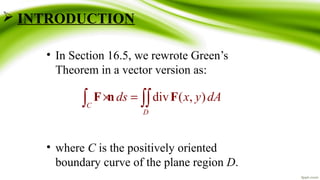
• In Section 16.5, we rewrote Green’s
Theorem in a vector version as:
• where C is the positively oriented
boundary curve of the plane region D.
div ( , )
C
D
ds x y dA× =∫ ∫∫F n F
 INTRODUCTION
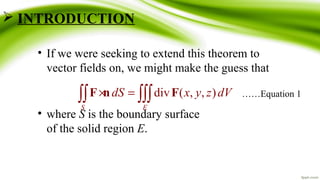
• If we were seeking to extend this theorem to
vector fields on, we might make the guess that
• where S is the boundary surface
of the solid region E.
div ( , , )
S E
dS x y z dV× =∫∫ ∫∫∫F n F ……Equation 1
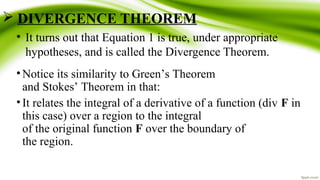
 DIVERGENCE THEOREM
• It turns out that Equation 1 is true, under appropriate
hypotheses, and is called the Divergence Theorem.
•Notice its similarity to Green’s Theorem
and Stokes’ Theorem in that:
•It relates the integral of a derivative of a function (div F in
this case) over a region to the integral
of the original function F over the boundary of
the region.
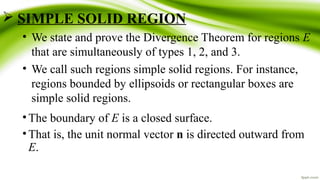
 SIMPLE SOLID REGION
• We state and prove the Divergence Theorem for regions E
that are simultaneously of types 1, 2, and 3.
• We call such regions simple solid regions. For instance,
regions bounded by ellipsoids or rectangular boxes are
simple solid regions.
•The boundary of E is a closed surface.
•That is, the unit normal vector n is directed outward from
E.
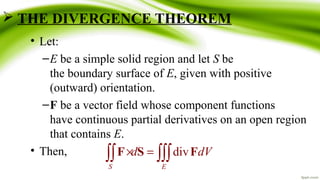
 THE DIVERGENCE THEOREM
• Let:
–E be a simple solid region and let S be
the boundary surface of E, given with positive
(outward) orientation.
–F be a vector field whose component functions
have continuous partial derivatives on an open region
that contains E.
• Then, div
S E
d dV× =∫∫ ∫∫∫F S F
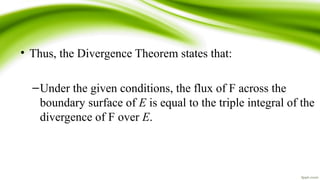
• Thus, the Divergence Theorem states that:
–Under the given conditions, the flux of F across the
boundary surface of E is equal to the triple integral of the
divergence of F over E.
 THE DIVERGENCE THEOREM
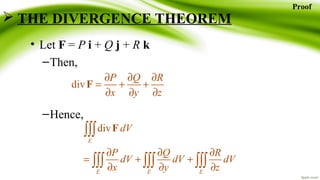
• Let F = P i + Q j + R k
–Then,
–Hence,
div
P Q R
x y z
∂ ∂ ∂
= + +
∂ ∂ ∂
F
Proof
div
E
E E E
dV
P Q R
dV dV dV
x y z
∂ ∂ ∂
= + +
∂ ∂ ∂
∫∫∫
∫∫∫ ∫∫∫ ∫∫∫
F
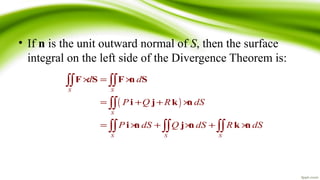
• If n is the unit outward normal of S, then the surface
integral on the left side of the Divergence Theorem is:
( )
S S
S
S S S
d d
P Q R dS
P dS Q dS R dS
× = ×
= + + ×
= × + × + ×
∫∫ ∫∫
∫∫
∫∫ ∫∫ ∫∫
F S F n S
i j k n
i n j n k n
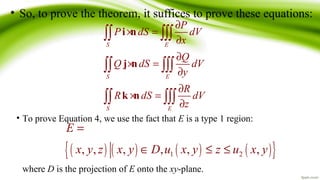
• So, to prove the theorem, it suffices to prove these equations:
S E
S E
S E
P
P dS dV
x
Q
Q dS dV
y
R
R dS dV
z
∂
× =
∂
∂
× =
∂
∂
× =
∂
∫∫ ∫∫∫
∫∫ ∫∫∫
∫∫ ∫∫∫
i n
j n
k n
• To prove Equation 4, we use the fact that E is a type 1 region:
where D is the projection of E onto the xy-plane.
( ) ( ) ( ) ( ){ }1 2, , , , , ,
E
x y z x y D u x y z u x y
=
∈ ≤ ≤
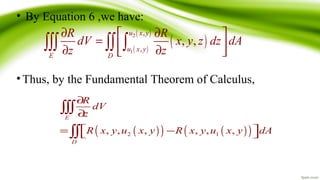
• By Equation 6 ,we have:
( )( )
( )2
1
,
,
, ,
u x y
u x y
E D
R R
dV x y z dz dA
z z
∂ ∂ 
=  ∂ ∂ 
∫∫∫ ∫∫ ∫
•Thus, by the Fundamental Theorem of Calculus,
( )( ) ( )( )2 1, , , , , ,
E
D
R
dV
z
R x y u x y R x y u x y dA
∂
∂
 = − 
∫∫∫
∫∫
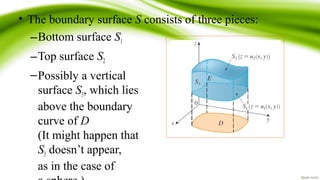
• The boundary surface S consists of three pieces:
–Bottom surface S1
–Top surface S2
–Possibly a vertical
surface S3, which lies
above the boundary
curve of D
(It might happen that
S3 doesn’t appear,
as in the case of
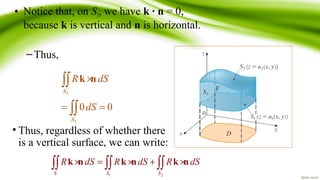
• Notice that, on S3, we have k ∙ n = 0,
because k is vertical and n is horizontal.
–Thus,
3
3
0 0
S
S
R dS
dS
×
= =
∫∫
∫∫
k n
• Thus, regardless of whether there
is a vertical surface, we can write:
1 2S S S
R dS R dS R dS× = × + ×∫∫ ∫∫ ∫∫k n k n k n
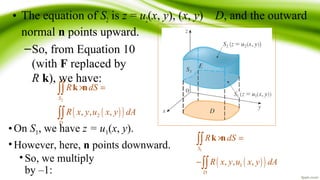
• The equation of S2 is z = u2(x, y), (x, y) D, and the outward
normal n points upward.
–So, from Equation 10
(with F replaced by
R k), we have:
( )( )
2
2, , ,
S
D
R dS
R x y u x y dA
× =∫∫
∫∫
k n
•On S1, we have z = u1(x, y).
•However, here, n points downward.
• So, we multiply
by –1:
( )( )
1
1, , ,
S
D
R dS
R x y u x y dA
× =
−
∫∫
∫∫
k n
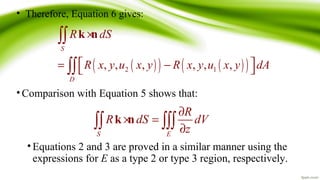
• Therefore, Equation 6 gives:
( )( ) ( )( )2 1, , , , , ,
S
D
R dS
R x y u x y R x y u x y dA
×
 = − 
∫∫
∫∫
k n
•Comparison with Equation 5 shows that:
•Equations 2 and 3 are proved in a similar manner using the
expressions for E as a type 2 or type 3 region, respectively.
S E
R
R dS dV
z
∂
× =
∂∫∫ ∫∫∫k n
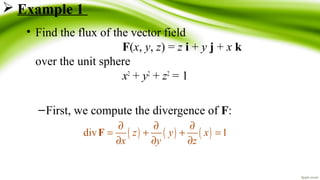
• Find the flux of the vector field
F(x, y, z) = z i + y j + x k
over the unit sphere
x2
+ y2
+ z2
= 1
–First, we compute the divergence of F:
 Example 1
( ) ( ) ( )div 1z y x
x y z
∂ ∂ ∂
= + + =
∂ ∂ ∂
F
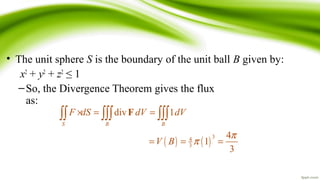
• The unit sphere S is the boundary of the unit ball B given by:
x2
+ y2
+ z2
≤ 1
–So, the Divergence Theorem gives the flux
as:
( ) ( )
34
3
div 1
4
1
3
S B B
F dS dV dV
V B
π
π
× = =
= = =
∫∫ ∫∫∫ ∫∫∫F
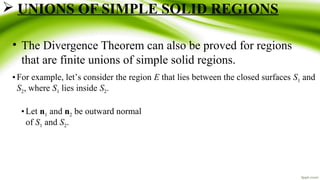
 UNIONS OF SIMPLE SOLID REGIONS
• The Divergence Theorem can also be proved for regions
that are finite unions of simple solid regions.
•For example, let’s consider the region E that lies between the closed surfaces S1 and
S2, where S1 lies inside S2.
•Let n1 and n2 be outward normal
of S1 and S2.
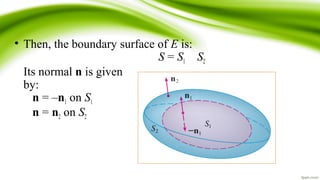
• Then, the boundary surface of E is:
S = S1 S2
Its normal n is given
by:
n = –n1 on S1
n = n2 on S2
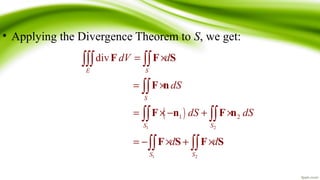
• Applying the Divergence Theorem to S, we get:
( )
1 2
1 2
1 2
div
E S
S
S S
S S
dV d
dS
dS dS
d d
= ×
= ×
= × − + ×
= − × + ×
∫∫∫ ∫∫
∫∫
∫∫ ∫∫
∫∫ ∫∫
F F S
F n
F n F n
F S F S
Thank you…..

Divrgence theorem with example

  • 1.
    G.H. Patel Collegeof Engineering and Technology Subject: Field Theory Name Enrollment no. Champaneria Dhvanil J. 150113109004 Chauhan Nisarg D. 150113109005 Jadav Prashant 150113109009 Limbani Milan P. 150113109011
  • 2.
  • 3.
     The DivergenceTheorem In this section, we will learn about: The Divergence Theorem for simple solid regions, and its applications in electric fields and fluid flow.
  • 4.
     INTRODUCTION • InSection 16.5, we rewrote Green’s Theorem in a vector version as: • where C is the positively oriented boundary curve of the plane region D. div ( , ) C D ds x y dA× =∫ ∫∫F n F
  • 5.
     INTRODUCTION • Ifwe were seeking to extend this theorem to vector fields on, we might make the guess that • where S is the boundary surface of the solid region E. div ( , , ) S E dS x y z dV× =∫∫ ∫∫∫F n F ……Equation 1
  • 6.
     DIVERGENCE THEOREM •It turns out that Equation 1 is true, under appropriate hypotheses, and is called the Divergence Theorem. •Notice its similarity to Green’s Theorem and Stokes’ Theorem in that: •It relates the integral of a derivative of a function (div F in this case) over a region to the integral of the original function F over the boundary of the region.
  • 7.
     SIMPLE SOLIDREGION • We state and prove the Divergence Theorem for regions E that are simultaneously of types 1, 2, and 3. • We call such regions simple solid regions. For instance, regions bounded by ellipsoids or rectangular boxes are simple solid regions. •The boundary of E is a closed surface. •That is, the unit normal vector n is directed outward from E.
  • 8.
     THE DIVERGENCETHEOREM • Let: –E be a simple solid region and let S be the boundary surface of E, given with positive (outward) orientation. –F be a vector field whose component functions have continuous partial derivatives on an open region that contains E. • Then, div S E d dV× =∫∫ ∫∫∫F S F
  • 9.
    • Thus, theDivergence Theorem states that: –Under the given conditions, the flux of F across the boundary surface of E is equal to the triple integral of the divergence of F over E.
  • 10.
     THE DIVERGENCETHEOREM • Let F = P i + Q j + R k –Then, –Hence, div P Q R x y z ∂ ∂ ∂ = + + ∂ ∂ ∂ F Proof div E E E E dV P Q R dV dV dV x y z ∂ ∂ ∂ = + + ∂ ∂ ∂ ∫∫∫ ∫∫∫ ∫∫∫ ∫∫∫ F
  • 11.
    • If nis the unit outward normal of S, then the surface integral on the left side of the Divergence Theorem is: ( ) S S S S S S d d P Q R dS P dS Q dS R dS × = × = + + × = × + × + × ∫∫ ∫∫ ∫∫ ∫∫ ∫∫ ∫∫ F S F n S i j k n i n j n k n
  • 12.
    • So, toprove the theorem, it suffices to prove these equations: S E S E S E P P dS dV x Q Q dS dV y R R dS dV z ∂ × = ∂ ∂ × = ∂ ∂ × = ∂ ∫∫ ∫∫∫ ∫∫ ∫∫∫ ∫∫ ∫∫∫ i n j n k n • To prove Equation 4, we use the fact that E is a type 1 region: where D is the projection of E onto the xy-plane. ( ) ( ) ( ) ( ){ }1 2, , , , , , E x y z x y D u x y z u x y = ∈ ≤ ≤
  • 13.
    • By Equation6 ,we have: ( )( ) ( )2 1 , , , , u x y u x y E D R R dV x y z dz dA z z ∂ ∂  =  ∂ ∂  ∫∫∫ ∫∫ ∫ •Thus, by the Fundamental Theorem of Calculus, ( )( ) ( )( )2 1, , , , , , E D R dV z R x y u x y R x y u x y dA ∂ ∂  = −  ∫∫∫ ∫∫
  • 14.
    • The boundarysurface S consists of three pieces: –Bottom surface S1 –Top surface S2 –Possibly a vertical surface S3, which lies above the boundary curve of D (It might happen that S3 doesn’t appear, as in the case of
  • 15.
    • Notice that,on S3, we have k ∙ n = 0, because k is vertical and n is horizontal. –Thus, 3 3 0 0 S S R dS dS × = = ∫∫ ∫∫ k n • Thus, regardless of whether there is a vertical surface, we can write: 1 2S S S R dS R dS R dS× = × + ×∫∫ ∫∫ ∫∫k n k n k n
  • 16.
    • The equationof S2 is z = u2(x, y), (x, y) D, and the outward normal n points upward. –So, from Equation 10 (with F replaced by R k), we have: ( )( ) 2 2, , , S D R dS R x y u x y dA × =∫∫ ∫∫ k n •On S1, we have z = u1(x, y). •However, here, n points downward. • So, we multiply by –1: ( )( ) 1 1, , , S D R dS R x y u x y dA × = − ∫∫ ∫∫ k n
  • 17.
    • Therefore, Equation6 gives: ( )( ) ( )( )2 1, , , , , , S D R dS R x y u x y R x y u x y dA ×  = −  ∫∫ ∫∫ k n •Comparison with Equation 5 shows that: •Equations 2 and 3 are proved in a similar manner using the expressions for E as a type 2 or type 3 region, respectively. S E R R dS dV z ∂ × = ∂∫∫ ∫∫∫k n
  • 18.
    • Find theflux of the vector field F(x, y, z) = z i + y j + x k over the unit sphere x2 + y2 + z2 = 1 –First, we compute the divergence of F:  Example 1 ( ) ( ) ( )div 1z y x x y z ∂ ∂ ∂ = + + = ∂ ∂ ∂ F
  • 19.
    • The unitsphere S is the boundary of the unit ball B given by: x2 + y2 + z2 ≤ 1 –So, the Divergence Theorem gives the flux as: ( ) ( ) 34 3 div 1 4 1 3 S B B F dS dV dV V B π π × = = = = = ∫∫ ∫∫∫ ∫∫∫F
  • 20.
     UNIONS OFSIMPLE SOLID REGIONS • The Divergence Theorem can also be proved for regions that are finite unions of simple solid regions. •For example, let’s consider the region E that lies between the closed surfaces S1 and S2, where S1 lies inside S2. •Let n1 and n2 be outward normal of S1 and S2.
  • 21.
    • Then, theboundary surface of E is: S = S1 S2 Its normal n is given by: n = –n1 on S1 n = n2 on S2
  • 22.
    • Applying theDivergence Theorem to S, we get: ( ) 1 2 1 2 1 2 div E S S S S S S dV d dS dS dS d d = × = × = × − + × = − × + × ∫∫∫ ∫∫ ∫∫ ∫∫ ∫∫ ∫∫ ∫∫ F F S F n F n F n F S F S
  • 23.