SCALARS
&
VECTORS
What
is Scalar?
Length of a car is 4.5 m
physical quantity magnitude
Mass of gold bar is 1 kg
physical quantity magnitude
Time is 12.76 s
Temperature is 36.8 °C
physical quantity magnitude
A scalar is a physical quantity that
has only a magnitude.
Examples:
• Mass
• Length
• Time
• Temperature
• Volume
• Density
What
is Vector?
California North
Carolina
Position of California from North Carolina is 3600 km
in west
physical quantity magnitude
direction
Displacement from USA to China is 11600 km
in east
physical quantity magnitude
direction
USA China
A vector is a physical quantity that has
both a magnitude and a direction.
Examples:
• Position
• Displacement
• Velocity
• Acceleration
• Momentum
• Force
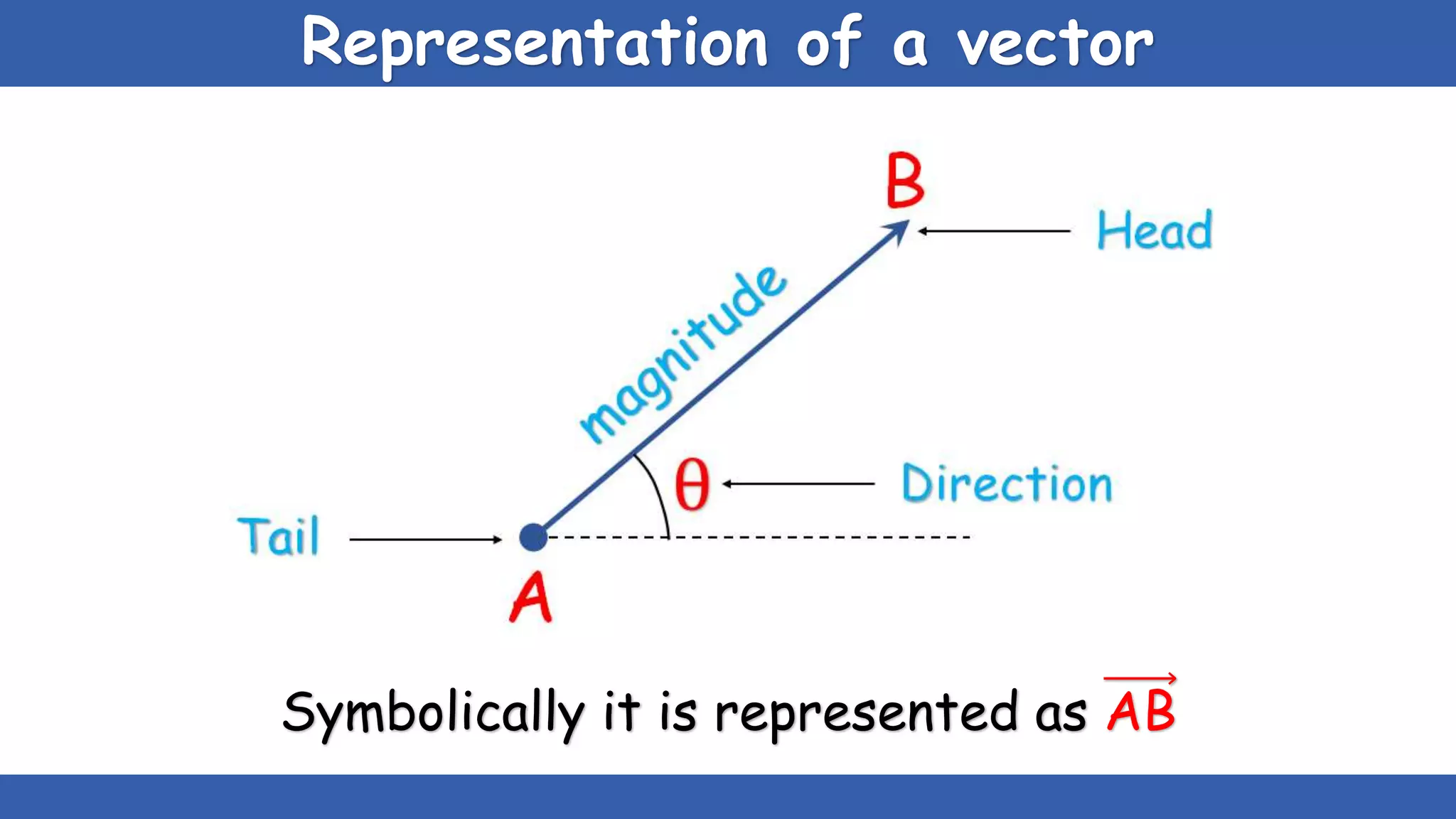
Representation of a vector
Symbolically it is represented as AB
Representation of a vector
They are also represented by a single capital
letter with an arrow above it.
PBA
Representation of a vector
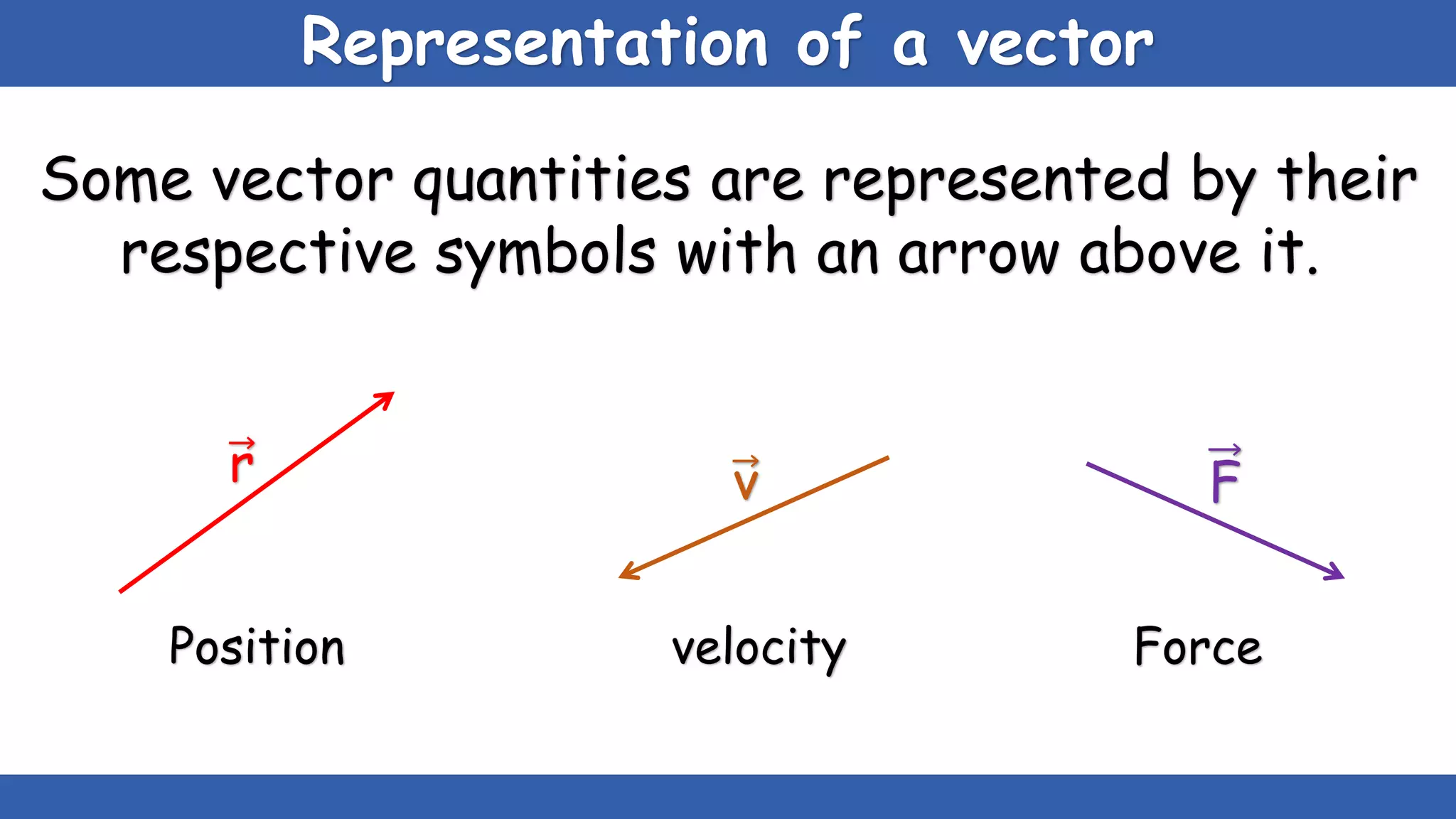
Some vector quantities are represented by their
respective symbols with an arrow above it.
Fvr
Position velocity Force
Types
of Vectors
(on the basis of orientation)
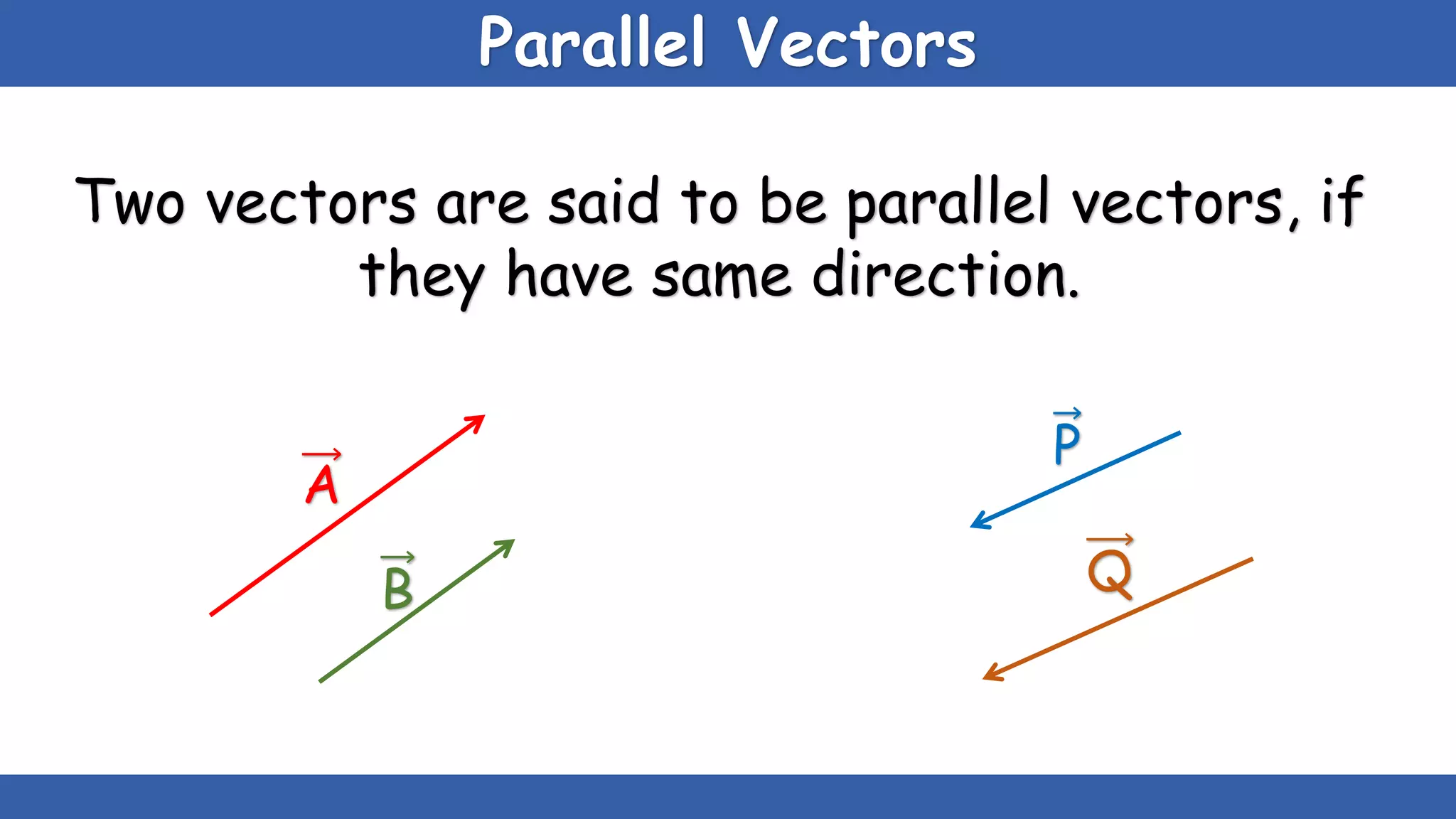
Parallel Vectors
Two vectors are said to be parallel vectors, if
they have same direction.
A
P
QB
Equal Vectors
Two parallel vectors are said to be equal vectors,
if they have same magnitude.
A
B
P
Q
A = B P = Q
Anti-parallel Vectors
Two vectors are said to be anti-parallel vectors,
if they are in opposite directions.
A
P
QB
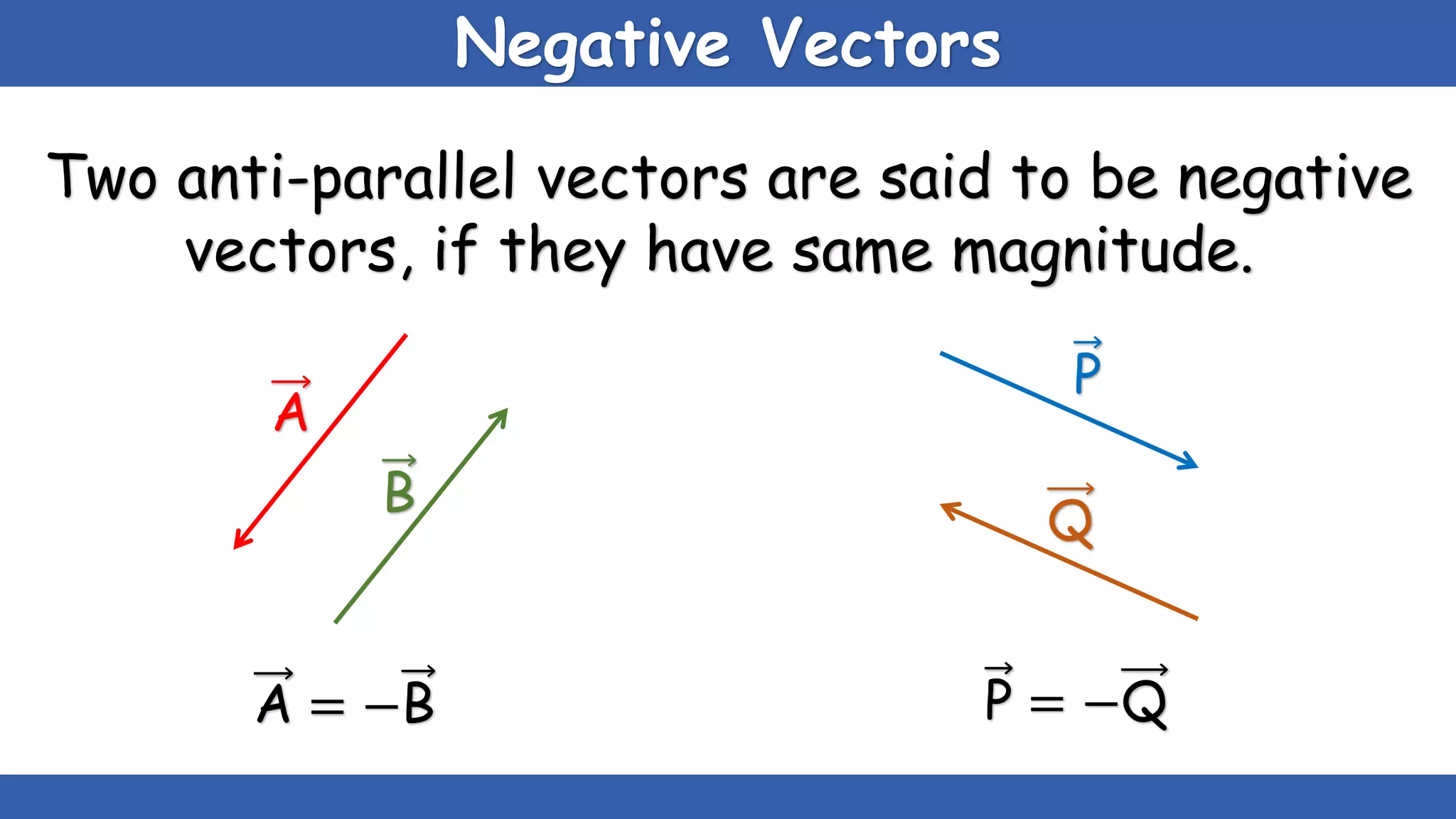
Negative Vectors
Two anti-parallel vectors are said to be negative
vectors, if they have same magnitude.
A
B
P
Q
A = −B P = −Q
Collinear Vectors
Two vectors are said to be collinear vectors,
if they act along a same line.
A
B
P
Q
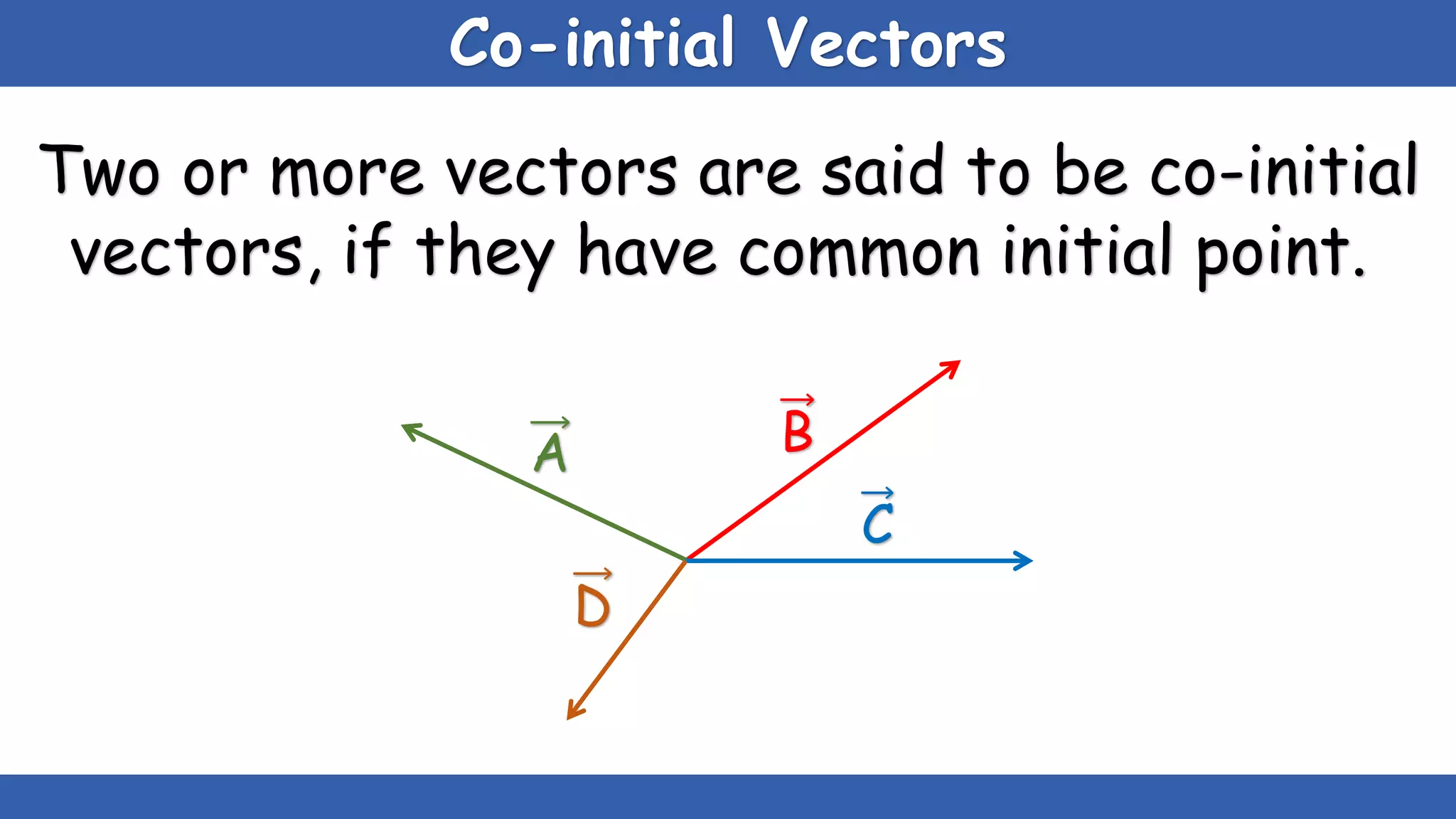
Co-initial Vectors
Two or more vectors are said to be co-initial
vectors, if they have common initial point.
BA
C
D
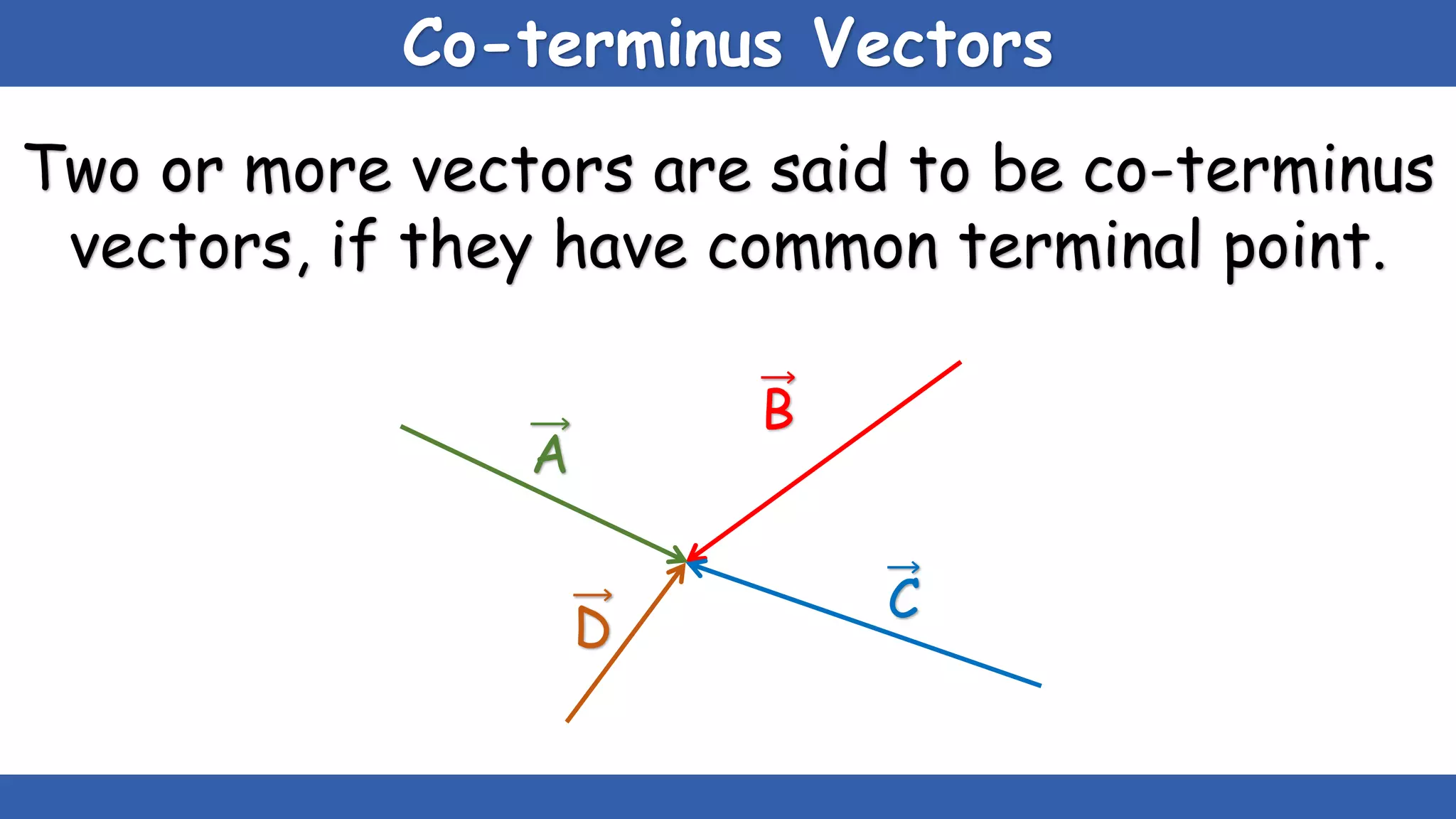
Co-terminus Vectors
Two or more vectors are said to be co-terminus
vectors, if they have common terminal point.
B
A
C
D
Coplanar Vectors
Three or more vectors are said to be coplanar
vectors, if they lie in the same plane.
A
B D
C
Non-coplanar Vectors
Three or more vectors are said to be non-coplanar
vectors, if they are distributed in space.
B
C
A
Types
of Vectors
(on the basis of effect)
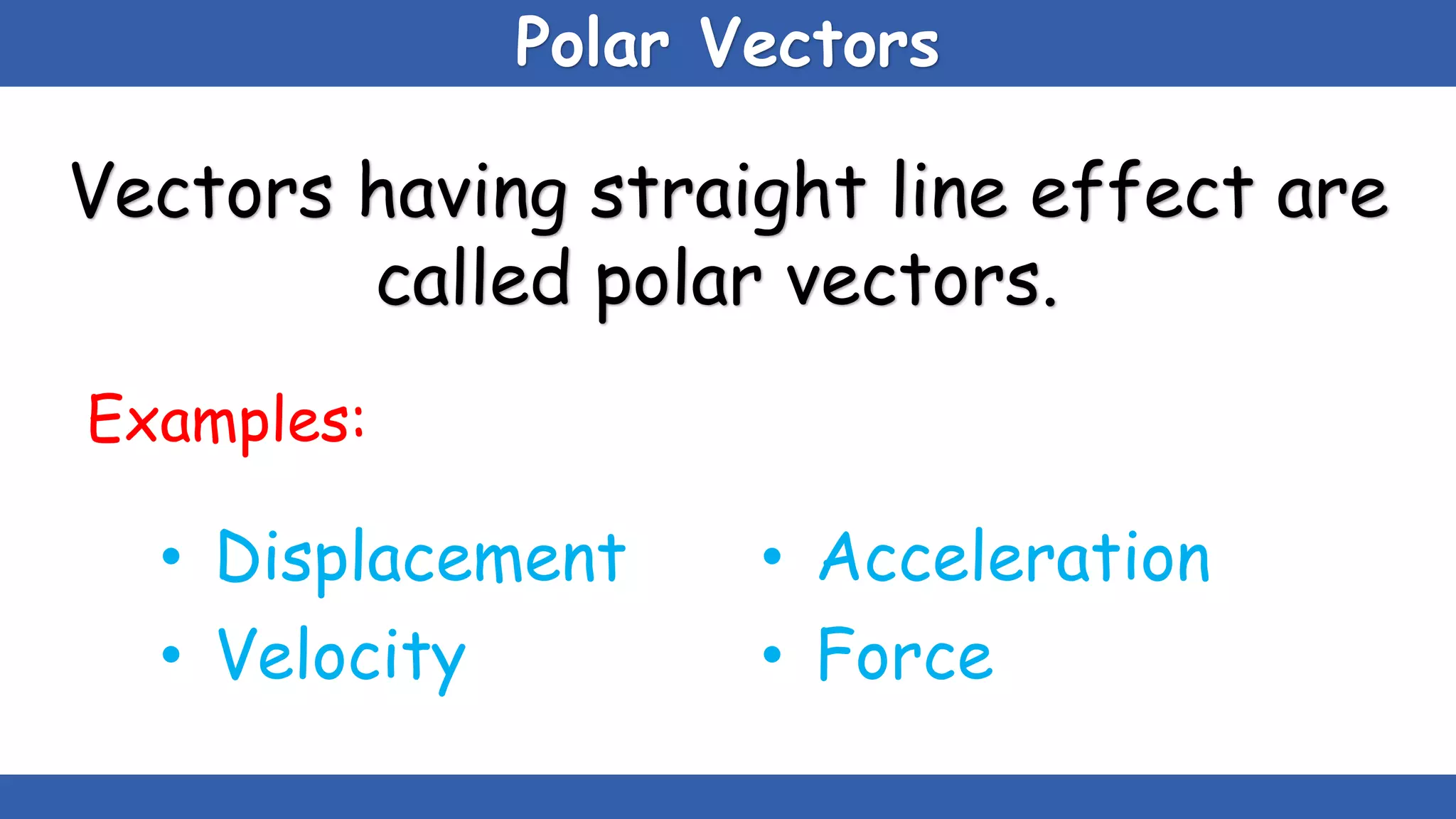
Polar Vectors
Vectors having straight line effect are
called polar vectors.
Examples:
• Displacement
• Velocity
• Acceleration
• Force
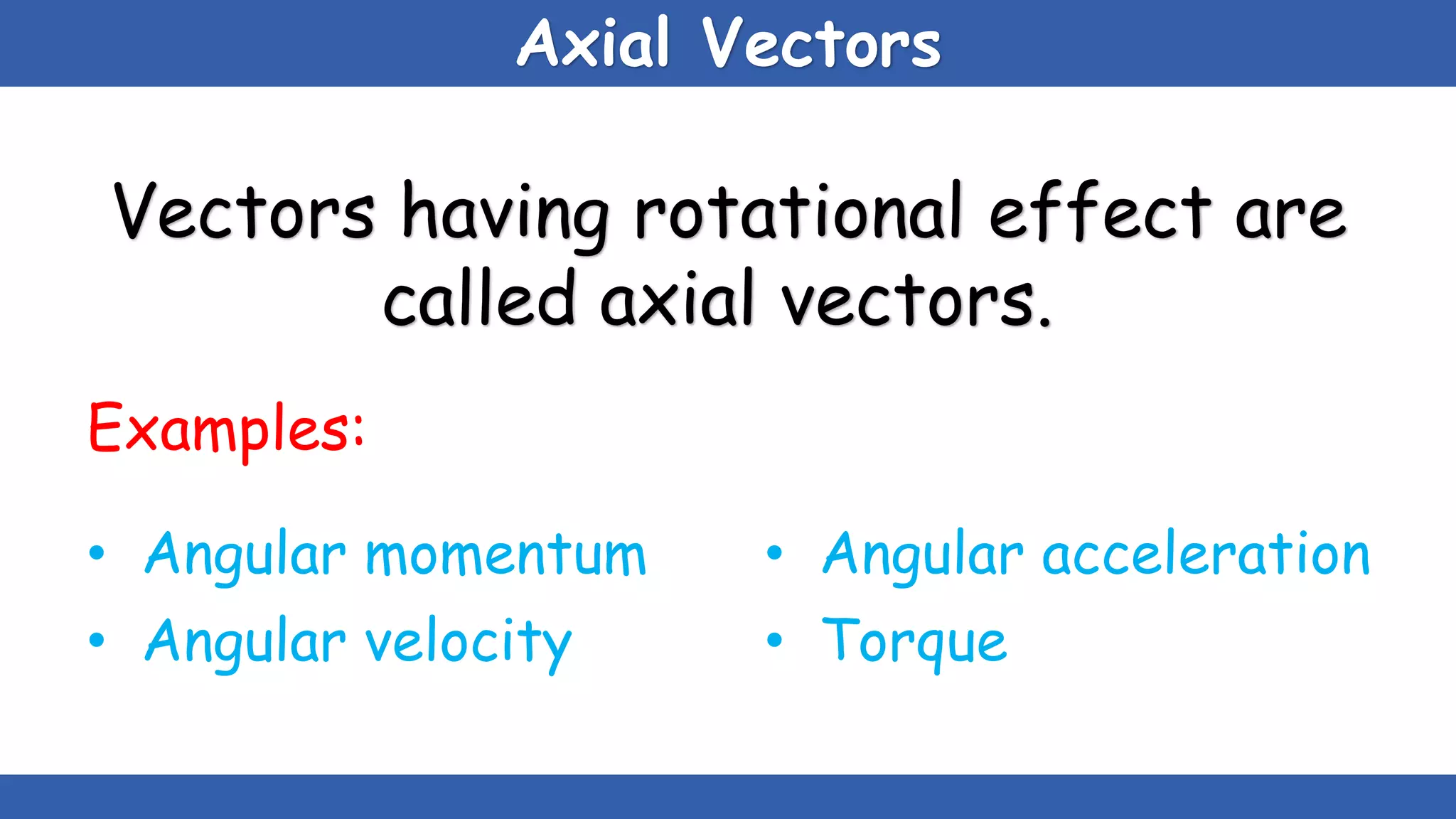
Axial Vectors
Vectors having rotational effect are
called axial vectors.
Examples:
• Angular momentum
• Angular velocity
• Angular acceleration
• Torque
Vector
Addition
(Geometrical Method)
Triangle Law
A
B
A
B
C
C = A + B
Parallelogram Law
A B
A B
A B
B A
C
C = A + B
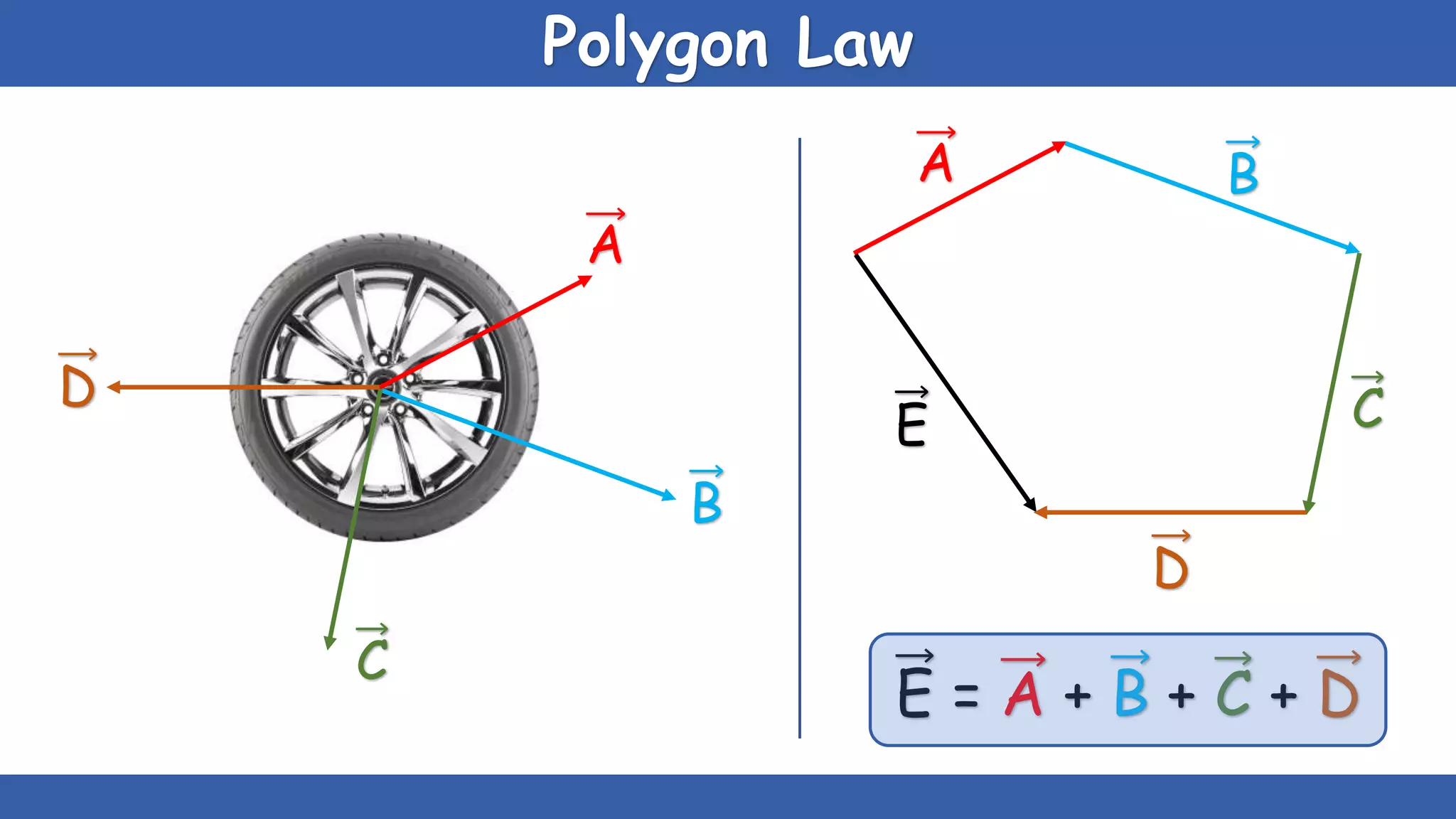
Polygon Law
A
B
D
C
A B
C
D
E
E = A + B + C + D
Commutative Property
A
BB
A
C
C
Therefore, addition of vectors obey commutative law.
C = A + B = B + A
Associative Property
B
A
C
Therefore, addition of vectors obey associative law.
D = (A + B) + C = A + (B + C)
D
B
A
C
D
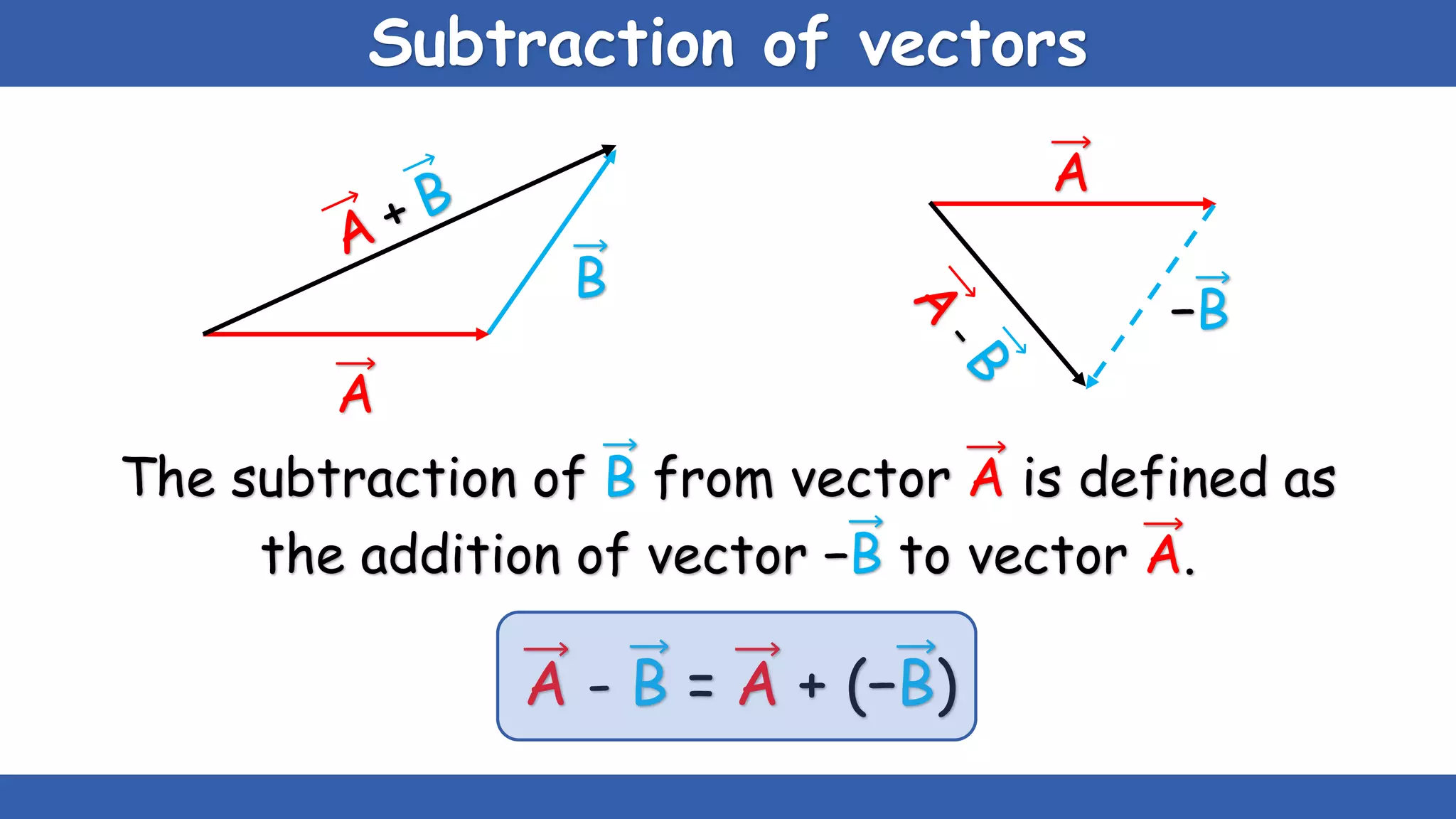
Subtraction of vectors
B
A
−B
A
The subtraction of B from vector A is defined as
the addition of vector −B to vector A.
A - B = A + (−B)
Vector
Addition
(Analytical Method)
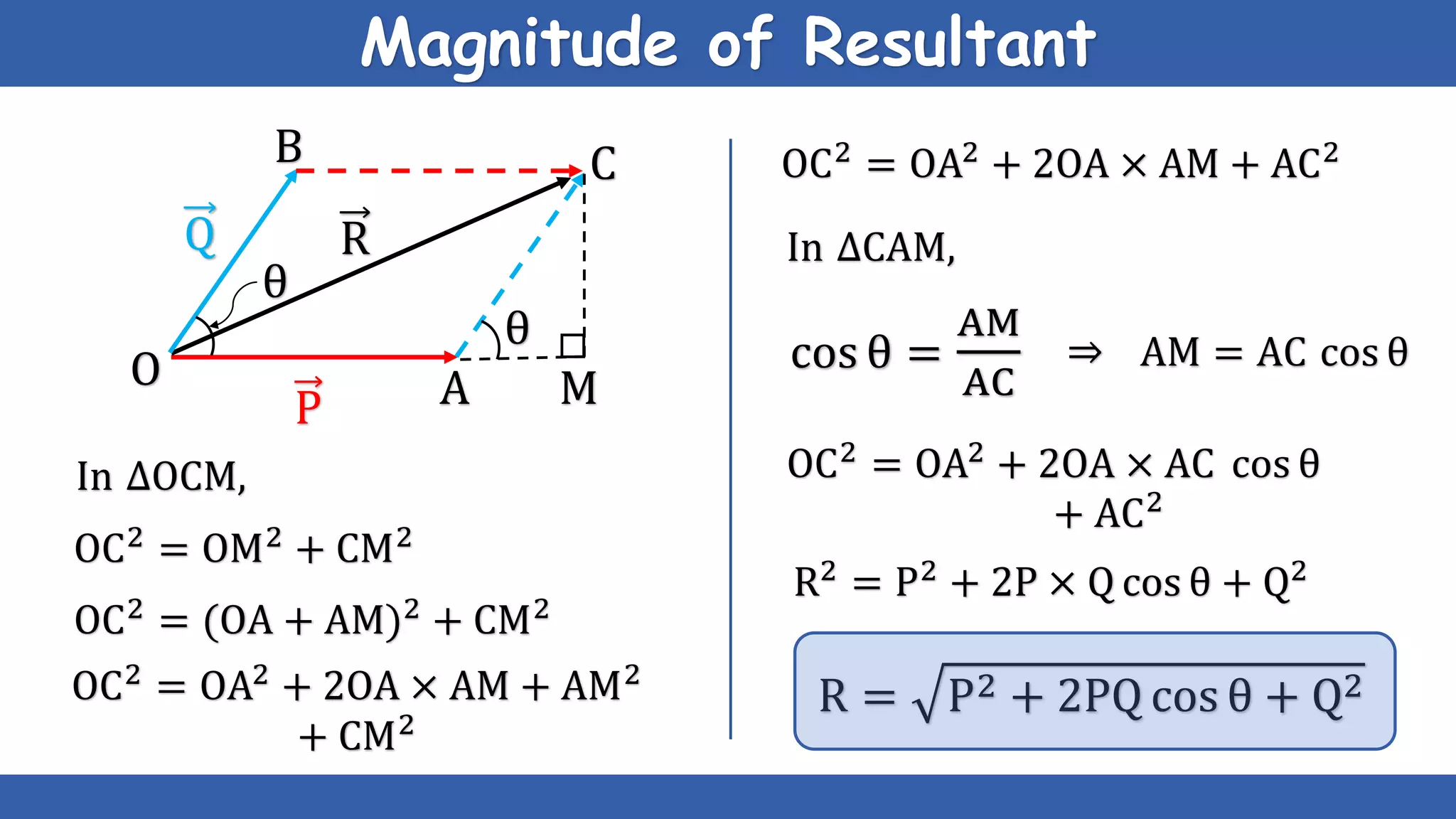
Magnitude of Resultant
P
O
B
A
C
Q R
M
θ
θ cos θ =
AM
AC
AM = AC cos θ⇒
In ∆CAM,
OC2 = OM2 + CM2
OC2
= (OA + AM)2
+ CM2
OC2 = OA2 + 2OA × AM + AM2
+ CM2
OC2 = OA2 + 2OA × AM + AC2
R2 = P2 + 2P × Q cos θ + Q2
In ∆OCM,
R = P2 + 2PQ cos θ + Q2
OC2
= OA2
+ 2OA × AC cos θ
+ AC2
Direction of Resultant
P
O A
C
Q R
M
α θ
In ∆CAM,
cos θ =
AM
AC
AM = AC cos θ⇒
sin θ =
CM
AC
CM = AC sin θ⇒
In ∆OCM,
tan α =
CM
OM
tan α =
CM
OA+AM
tan α =
AC sin θ
OA+AC cos θ
tan α =
Q sin θ
P + Q cos θ
B
Case I – Vectors are parallel ( 𝛉 = 𝟎°)
P Q R
R = P2 + 2PQ cos 0° + Q2
R = P2 + 2PQ + Q2
R = (P + Q)2
+ =
Magnitude: Direction:
R = P + Q
tan α =
Q sin 0°
P + Q cos 0°
tan α =
0
P + Q
= 0
α = 0°
Case II – Vectors are perpendicular (𝛉 = 𝟗𝟎°)
P Q
R
R = P2 + 2PQ cos 90° + Q2
R = P2 + 0 + Q2
+ =
Magnitude: Direction:
tan α =
Q sin 90°
P + Q cos 90°
=
Q
P + 0
α = tan−1
Q
P
P
Q
R = P2 + Q2
α
Case III – Vectors are anti-parallel (𝛉 = 𝟏𝟖𝟎°)
P Q R
R = P2 + 2PQ cos 180° + Q2
R = P2 − 2PQ + Q2
R = (P − Q)2
− =
Magnitude: Direction:
R = P − Q
tan α =
Q sin 180°
P + Q cos 180°
= 0
α = 0°If P > Q:
If P < Q: α = 180°
Unit vectors
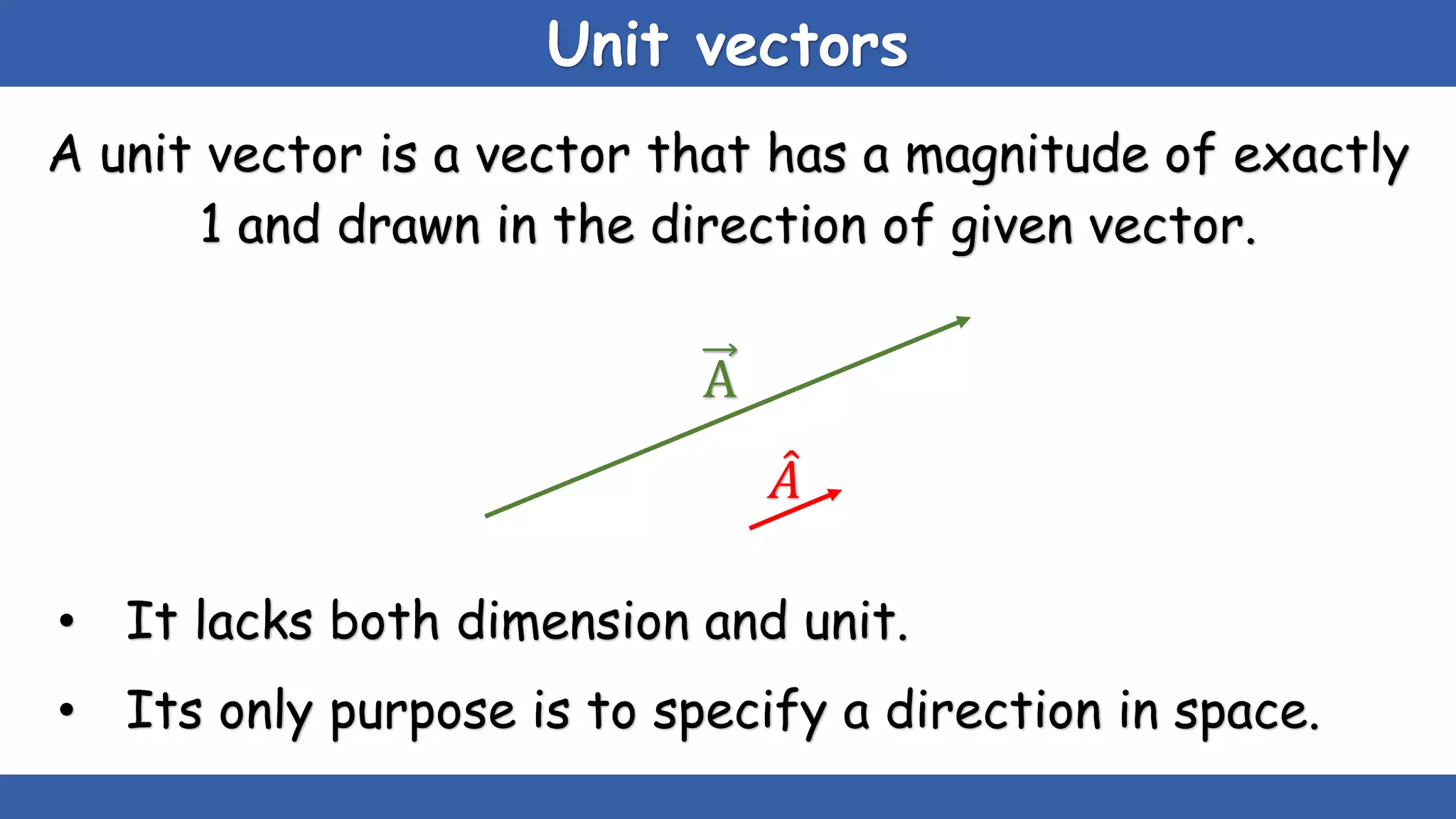
A unit vector is a vector that has a magnitude of exactly
1 and drawn in the direction of given vector.
• It lacks both dimension and unit.
• Its only purpose is to specify a direction in space.
A
𝐴
• A given vector can be expressed as a product of
its magnitude and a unit vector.
• For example A may be represented as,
A = A 𝐴
Unit vectors
A = magnitude of A
𝐴 = unit vector along A
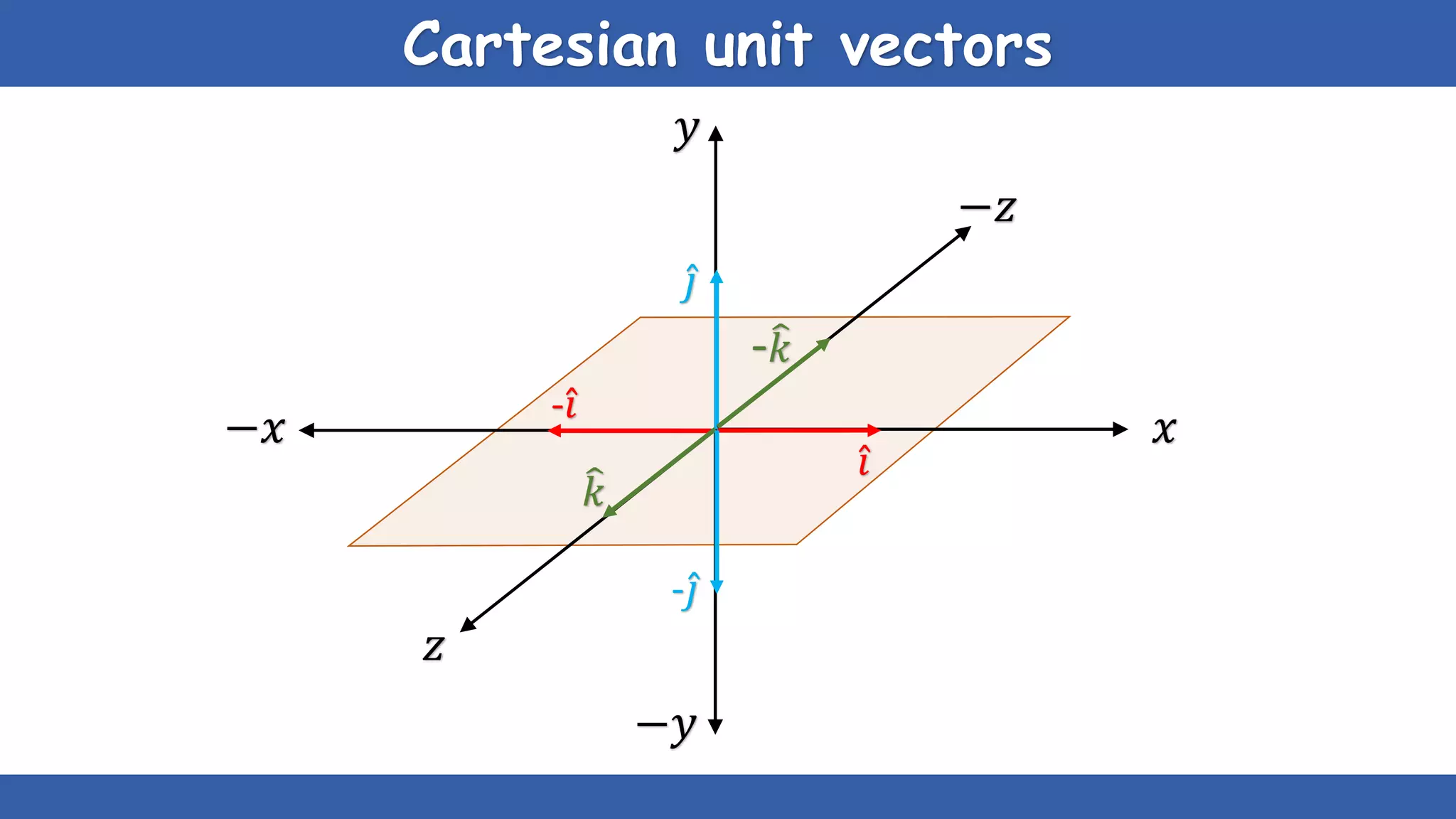
Cartesian unit vectors
𝑥
𝑦
𝑧
𝑖
𝑗
𝑘
−𝑦
−𝑥
−𝑧
- 𝑖
- 𝑗
- 𝑘
Resolution of a Vector
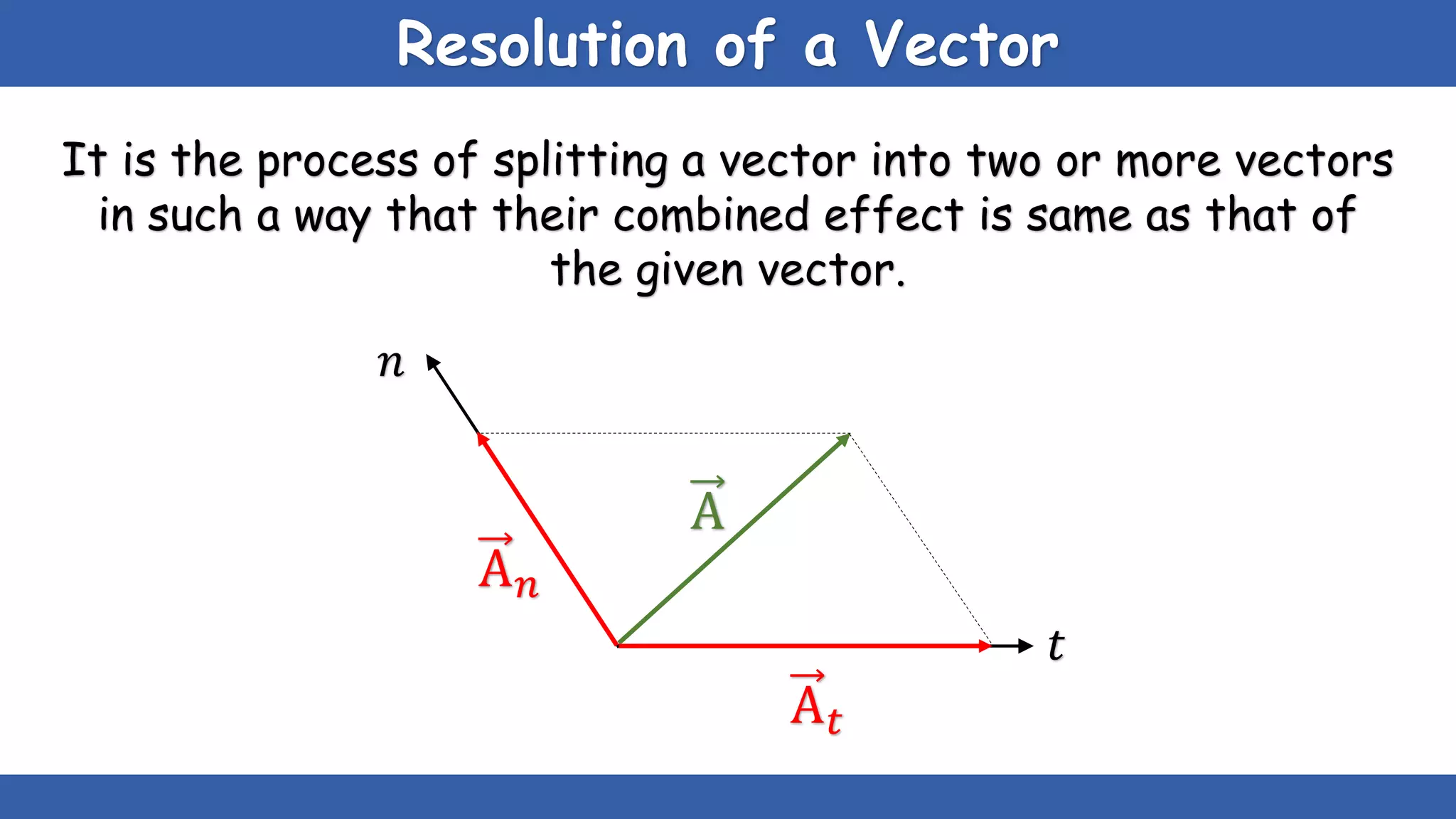
It is the process of splitting a vector into two or more vectors
in such a way that their combined effect is same as that of
the given vector.
𝑡
𝑛
A 𝑡
A 𝑛
A
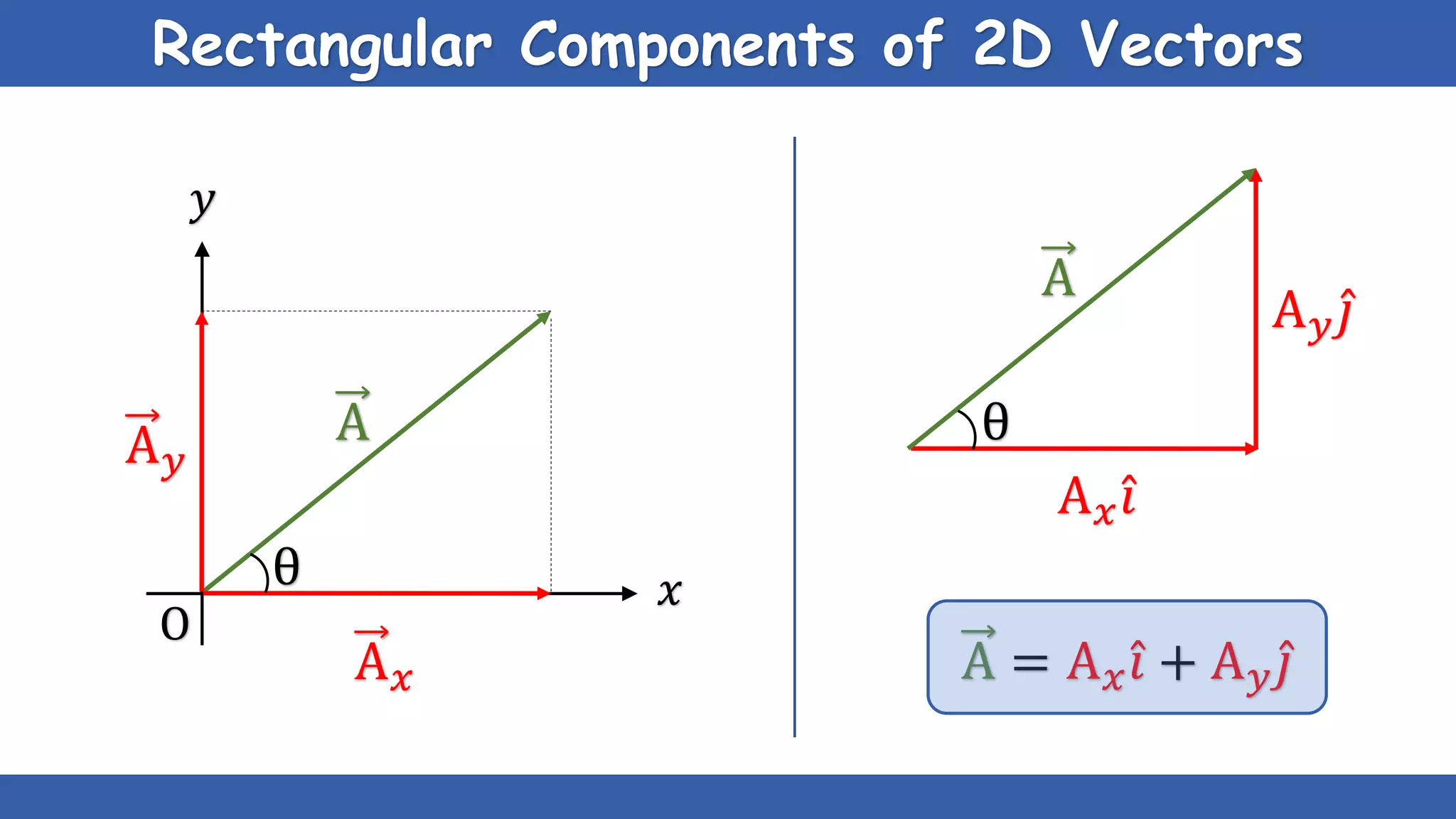
Rectangular Components of 2D Vectors
A
A 𝑥
A 𝑦
O
𝑥
𝑦
A
A = A 𝑥 𝑖 + A 𝑦 𝑗
θ
θ
A 𝑥 𝑖
A 𝑦 𝑗
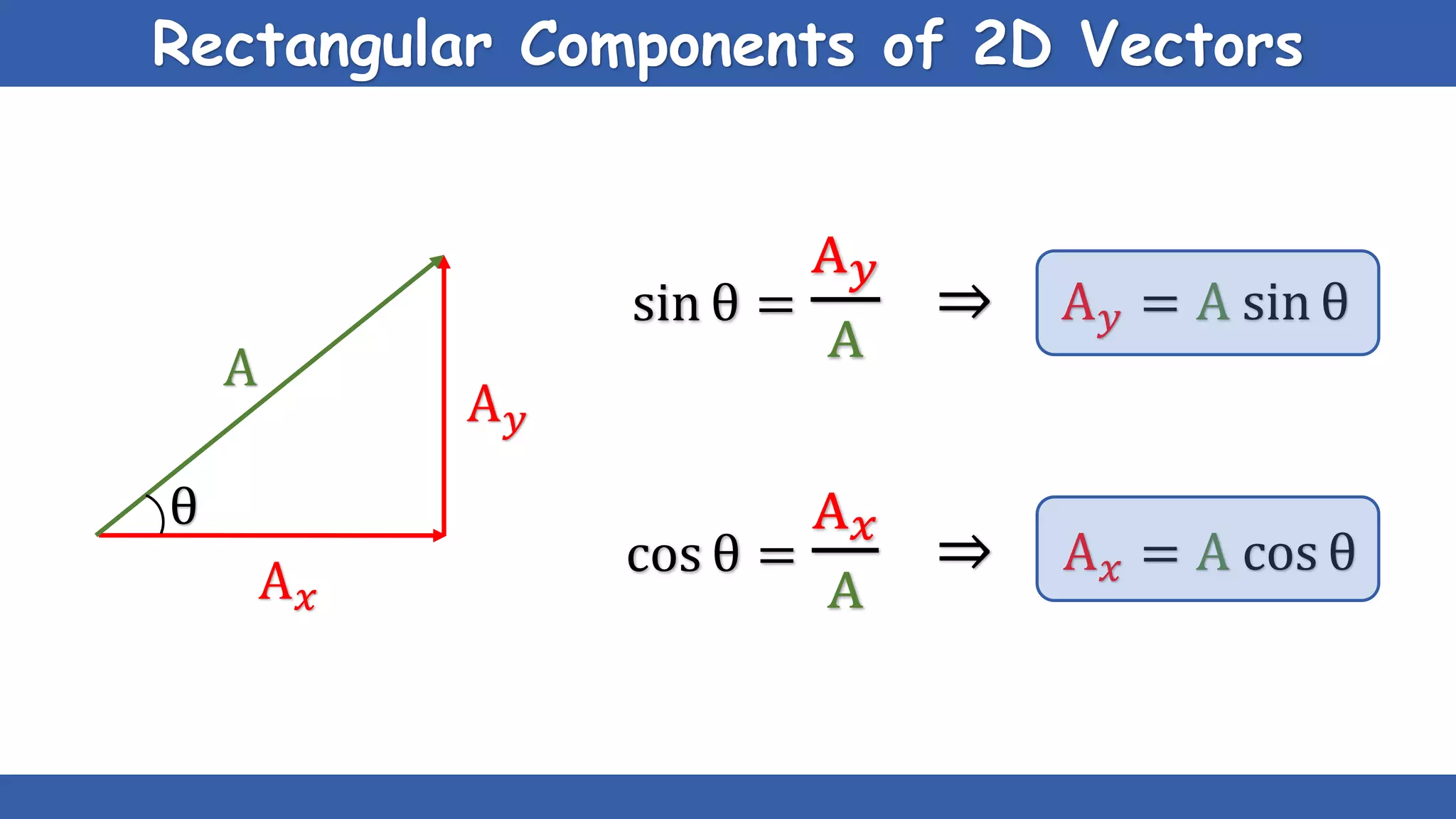
A
A 𝑥
A 𝑦
θ
sin θ =
A 𝑦
A
cos θ =
A 𝑥
A
A 𝑦 = A sin θ
A 𝑥 = A cos θ
⇒
⇒
Rectangular Components of 2D Vectors
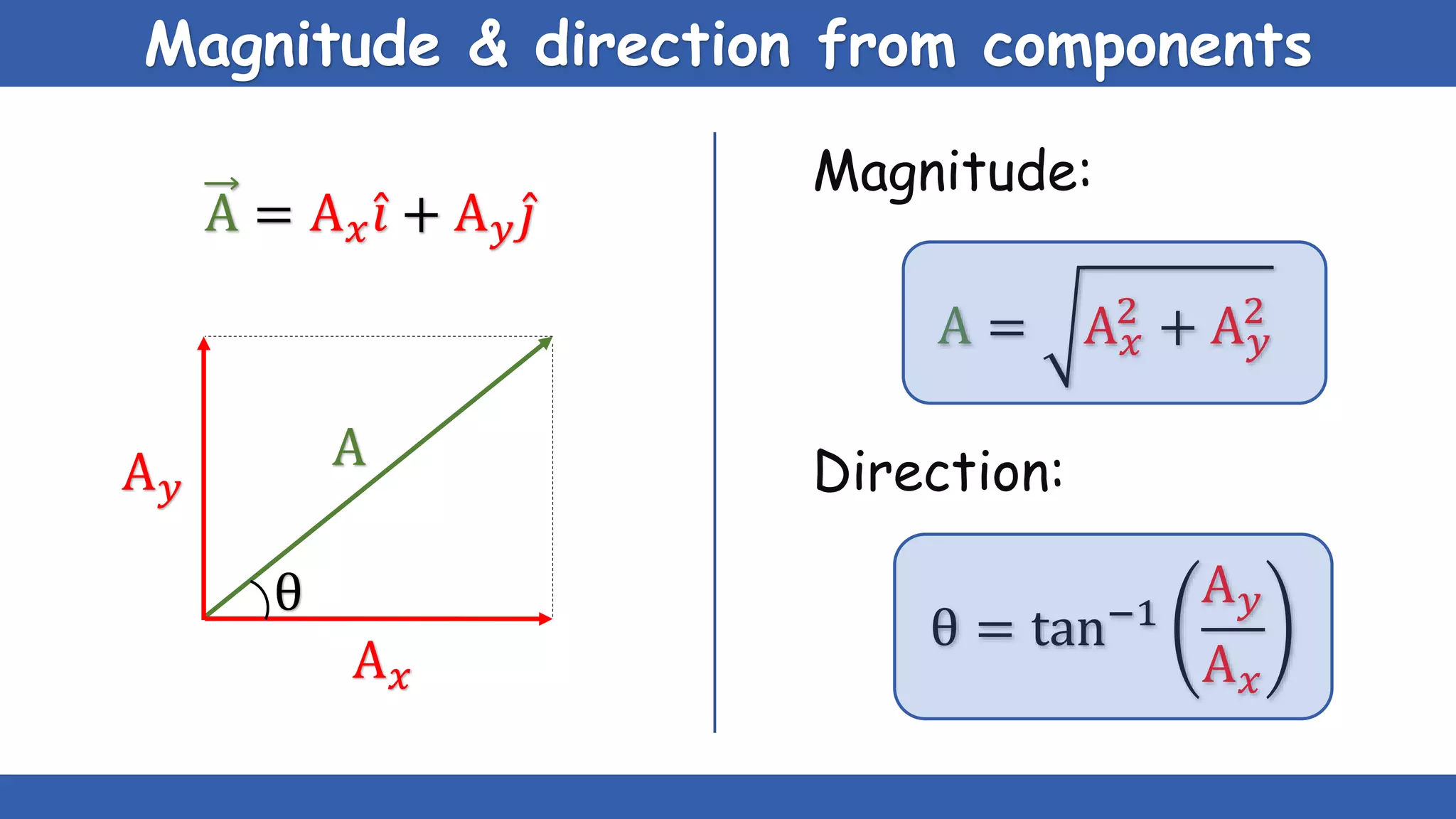
Magnitude & direction from components
A = A 𝑥 𝑖 + A 𝑦 𝑗
A = A 𝑥
2
+ A 𝑦
2
Magnitude:
Direction:
θ = tan−1
A 𝑦
A 𝑥
θ
A 𝑥
A 𝑦
A
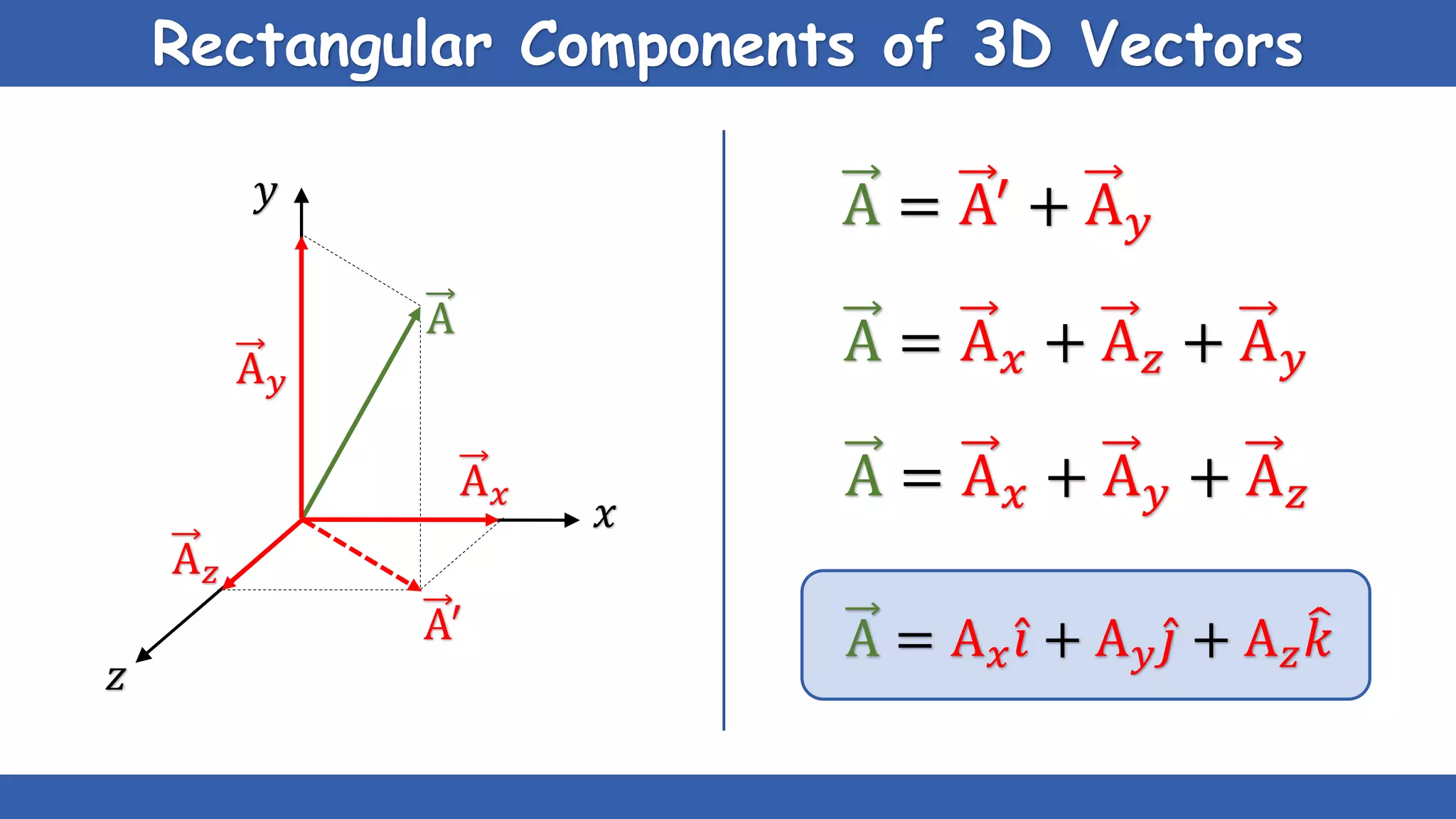
Rectangular Components of 3D Vectors
𝑥
𝑧
𝑦
A
A 𝑦
A′
A 𝑧
A 𝑥
A = A′
+ A 𝑦
A = A 𝑥 + A 𝑧 + A 𝑦
A = A 𝑥 + A 𝑦 + A 𝑧
A = A 𝑥 𝑖 + A 𝑦 𝑗 + A 𝑧 𝑘
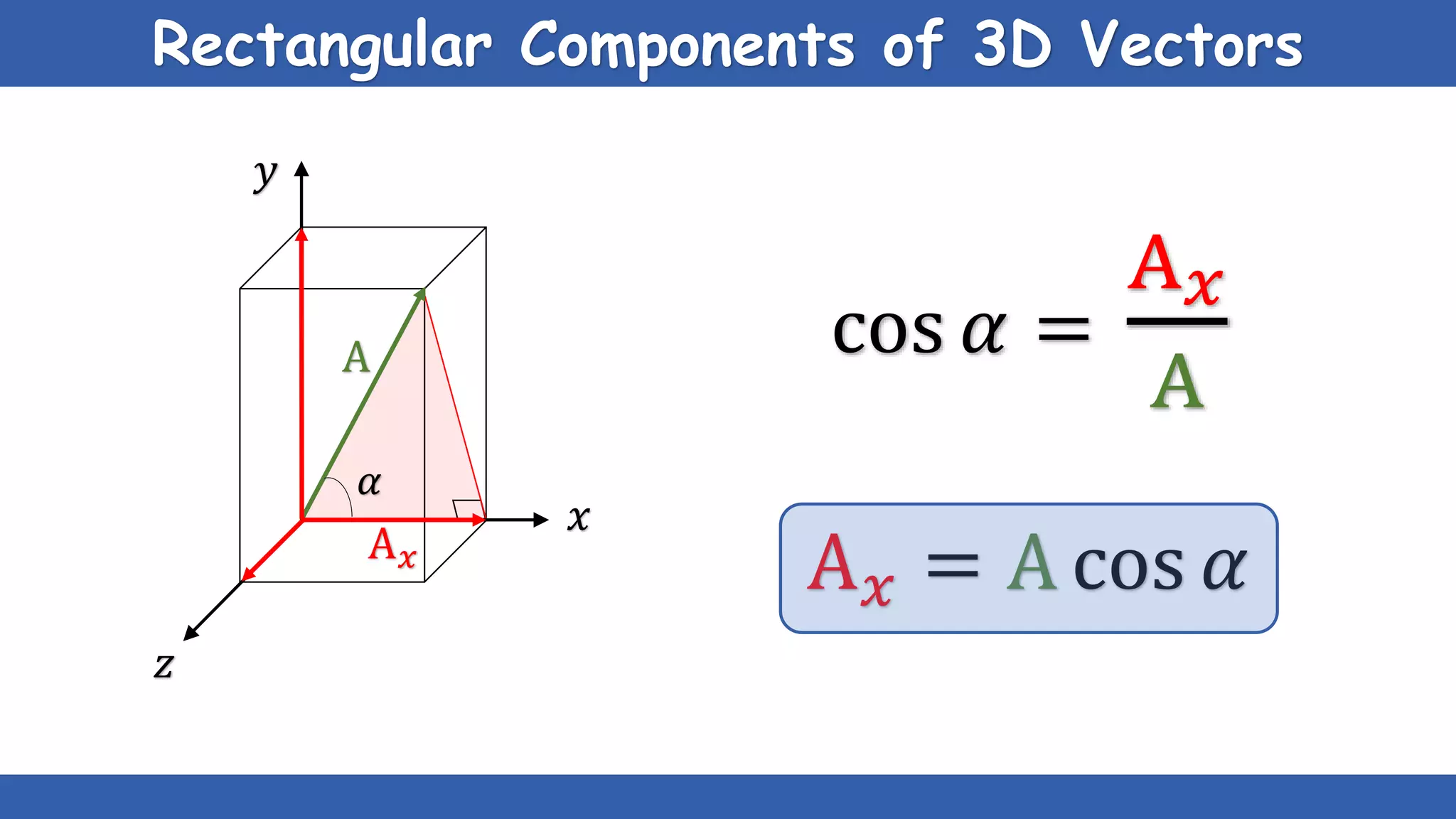
Rectangular Components of 3D Vectors
𝑥
𝑧
𝑦
𝛼
A
A 𝑥
cos 𝛼 =
A 𝑥
A
A 𝑥 = A cos 𝛼
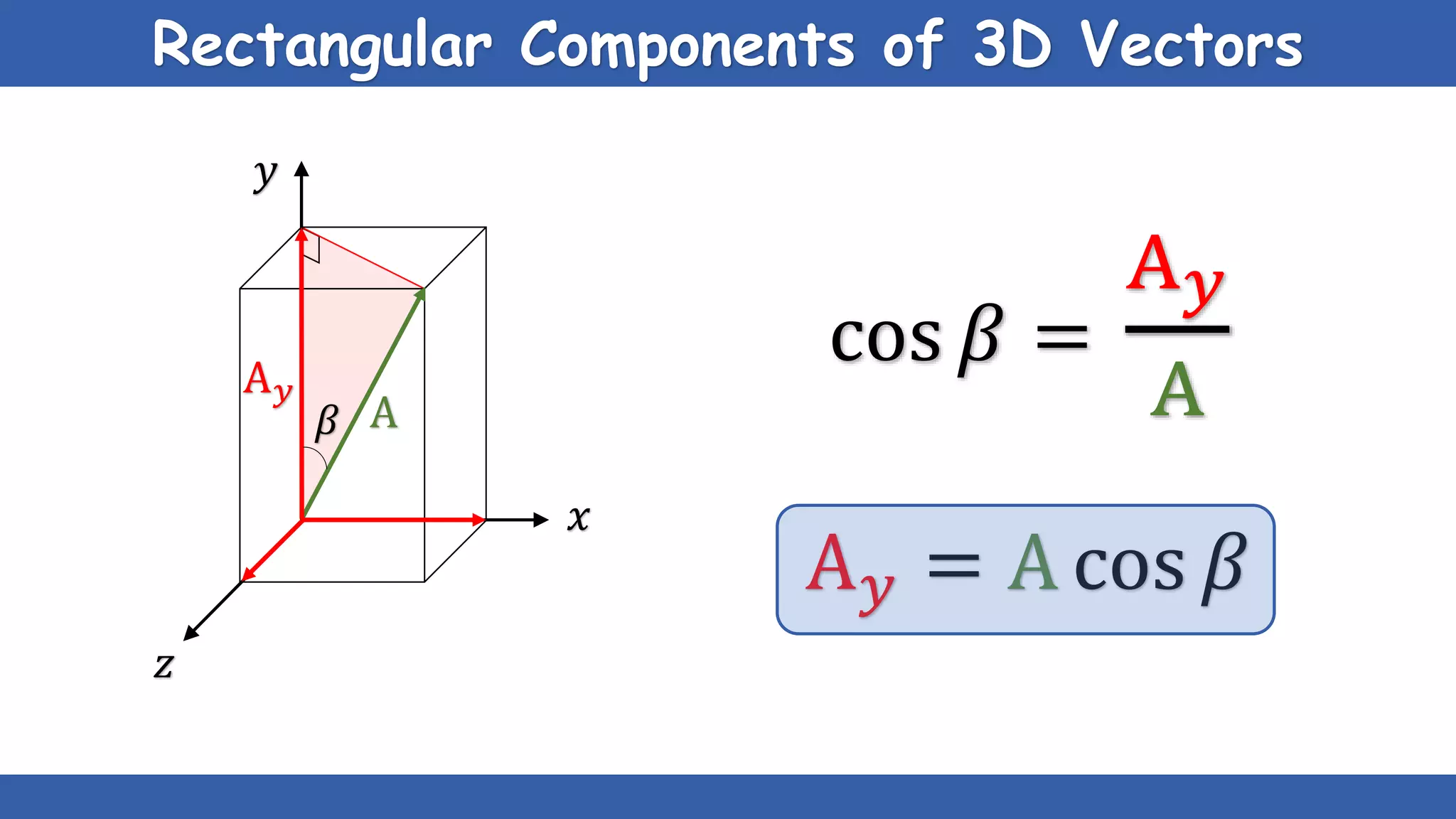
Rectangular Components of 3D Vectors
𝑥
𝑧
𝑦
A
A 𝑦
𝛽
cos 𝛽 =
A 𝑦
A
A 𝑦 = A cos 𝛽
Rectangular Components of 3D Vectors
𝑥
𝑧
𝑦
A
A 𝑧
𝛾
cos 𝛾 =
A 𝑧
A
A 𝑧 = A cos 𝛾
Magnitude & direction from components
A = A 𝑥 𝑖 + A 𝑦 𝑗 + A 𝑧 𝑘
A = A 𝑥
2
+ A 𝑦
2
+ A 𝑧
2
Magnitude:
Direction:
𝛼 = cos−1
A 𝑥
A
𝛽 = cos−1
A 𝑦
A
𝛾 = cos−1
A 𝑧
A
A
A 𝑧
𝛾
𝛽
𝛼
A 𝑥
A 𝑦
Adding vectors by components
A = A 𝑥 𝑖 + A 𝑦 𝑗 + A 𝑧 𝑘
B = B 𝑥 𝑖 + B 𝑦 𝑗 + B 𝑧 𝑘
Let us have
then
R = A + B
R = A 𝑥 𝑖 + A 𝑦 𝑗 + A 𝑧 𝑘
+ B 𝑥 𝑖 + B 𝑦 𝑗 + B 𝑧 𝑘
R = (A 𝑥 + B 𝑥) 𝑖 + (A 𝑦 + B 𝑦) 𝑗
+ (A 𝑧 + B 𝑧) 𝑘
R 𝑥 𝑖 + R 𝑦 𝑗 + R 𝑧 𝑘 = (A 𝑥+B 𝑥) 𝑖
+ (A 𝑦+B 𝑦) 𝑗 + (A 𝑧+B 𝑧) 𝑘
R 𝑥 = (A 𝑥 + B 𝑥)
R 𝑦 = (A 𝑦 + B 𝑦)
R 𝑧 = (A 𝑧 + B 𝑧)
Multiplying
vectors
Multiplying a vector by a scalar
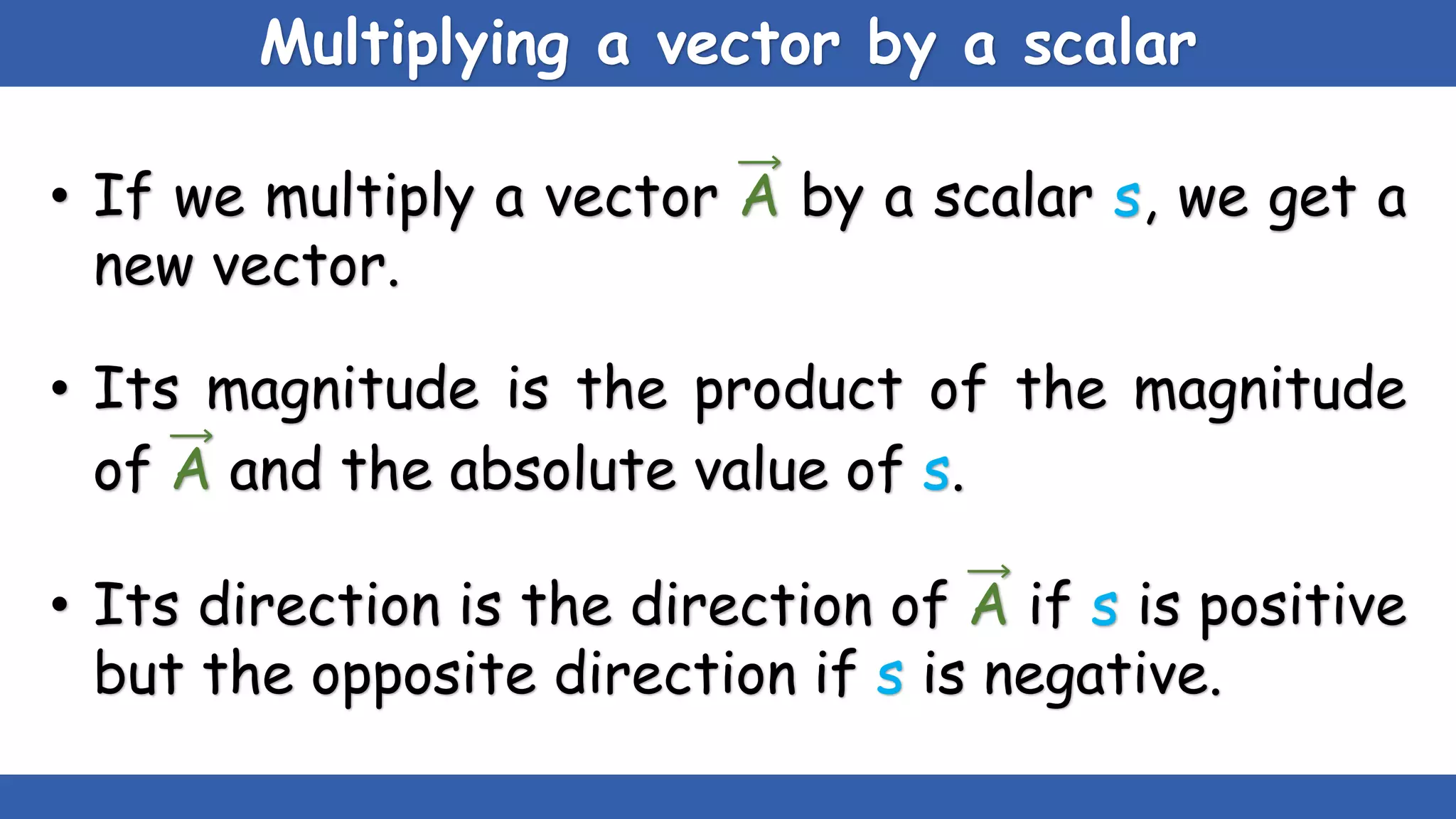
• If we multiply a vector A by a scalar s, we get a
new vector.
• Its magnitude is the product of the magnitude
of A and the absolute value of s.
• Its direction is the direction of A if s is positive
but the opposite direction if s is negative.
Multiplying a vector by a scalar
If s is positive:
A
2A
If s is negative:
A
−3A
Multiplying a vector by a vector
• There are two ways to multiply a vector by a
vector:
• The first way produces a scalar quantity and
called as scalar product (dot product).
• The second way produces a vector quantity and
called as vector product (cross product).
Scalar product
A
B
θ
A ∙ B = AB cos θ
Examples of scalar product
W = F ∙ s
W = Fs cos θ
W = work done
F = force
s = displacement
P = F ∙ v
P = Fv cos θ
P = power
F = force
v = velocity
Geometrical meaning of Scalar dot product
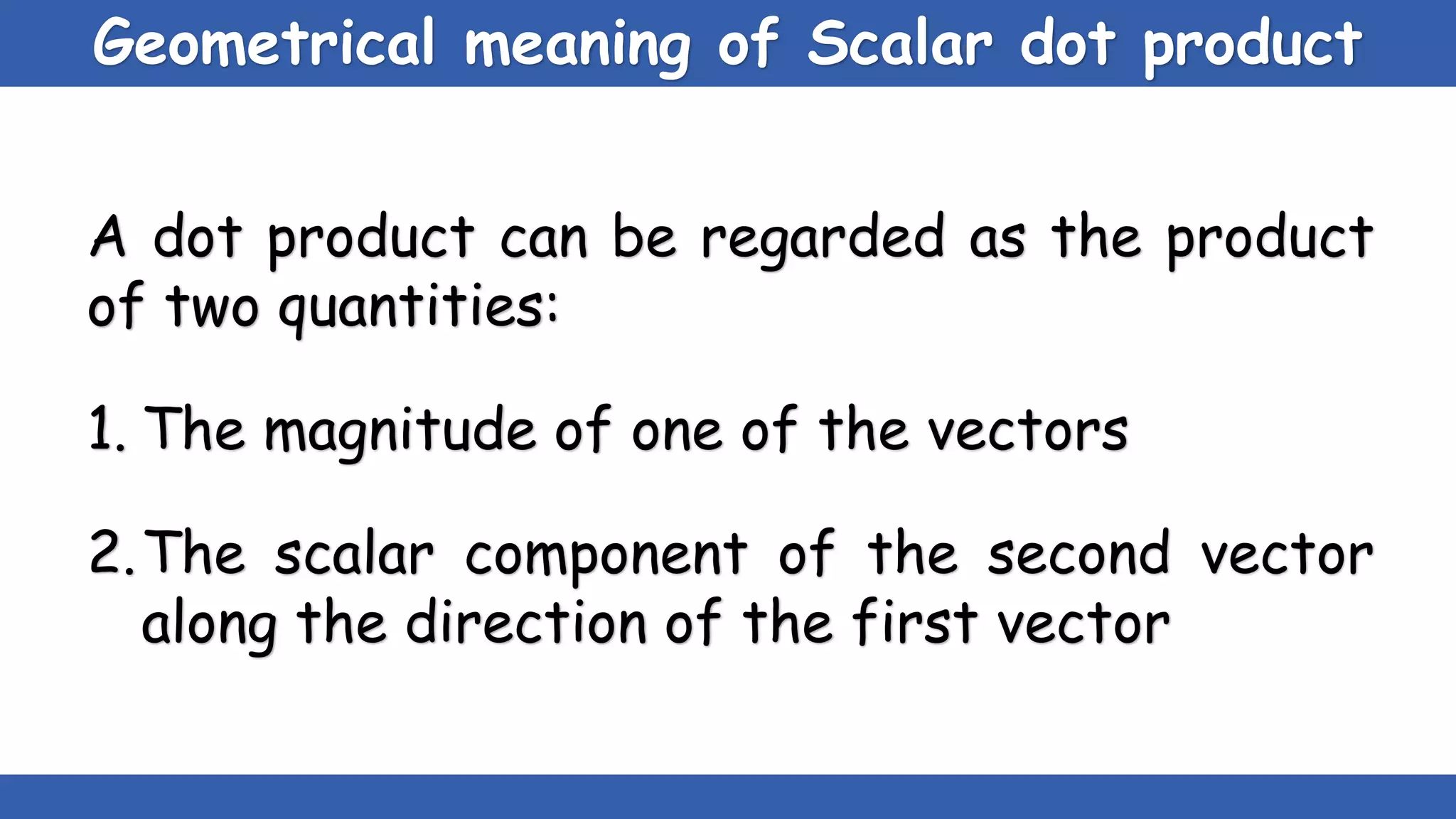
A dot product can be regarded as the product
of two quantities:
1. The magnitude of one of the vectors
2.The scalar component of the second vector
along the direction of the first vector
Geometrical meaning of Scalar product
θ
A ∙ B = A(B cos θ) A ∙ B = (A cos θ)B
A
θ
A
A cos θ
B
B
Properties of Scalar product
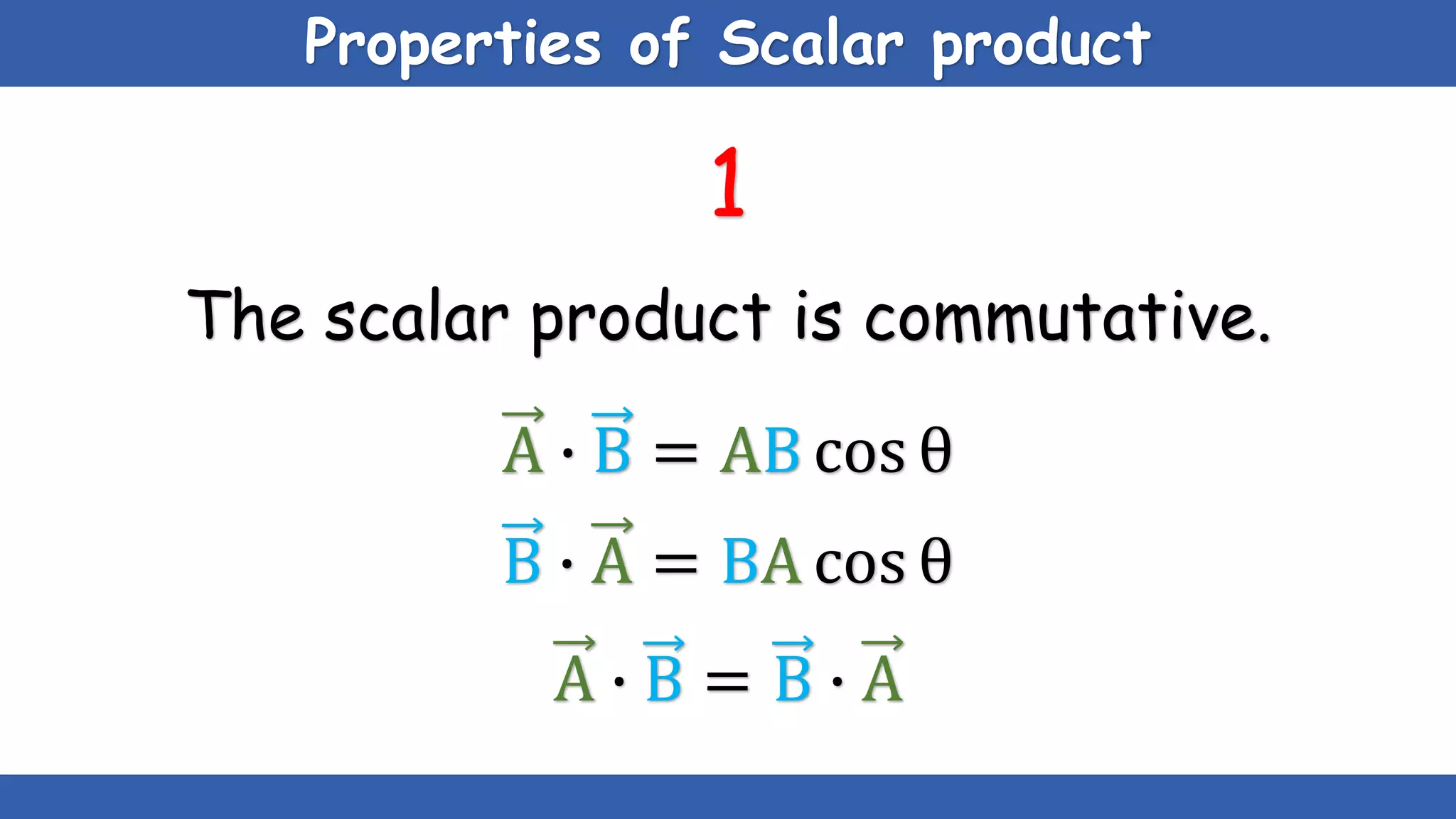
1
The scalar product is commutative.
A ∙ B = AB cos θ
B ∙ A = BA cos θ
A ∙ B = B ∙ A
Properties of Scalar product
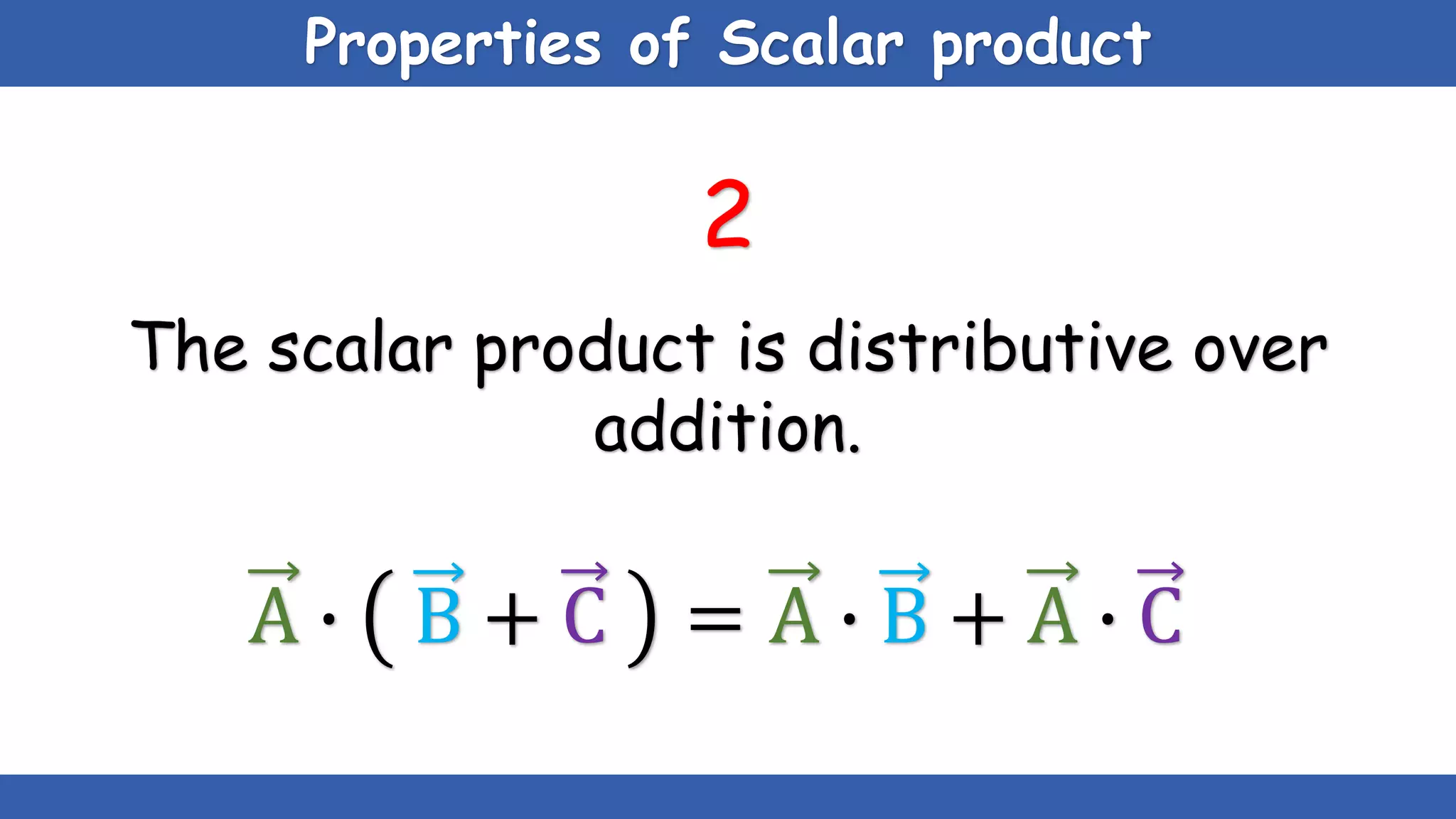
2
The scalar product is distributive over
addition.
A ∙ B + C = A ∙ B + A ∙ C
Properties of Scalar product
3
The scalar product of two perpendicular
vectors is zero.
A ∙ B = AB cos 90 °
A ∙ B = 0
Properties of Scalar product
4
The scalar product of two parallel vectors
is maximum positive.
A ∙ B = AB cos 0 °
A ∙ B = AB
Properties of Scalar product
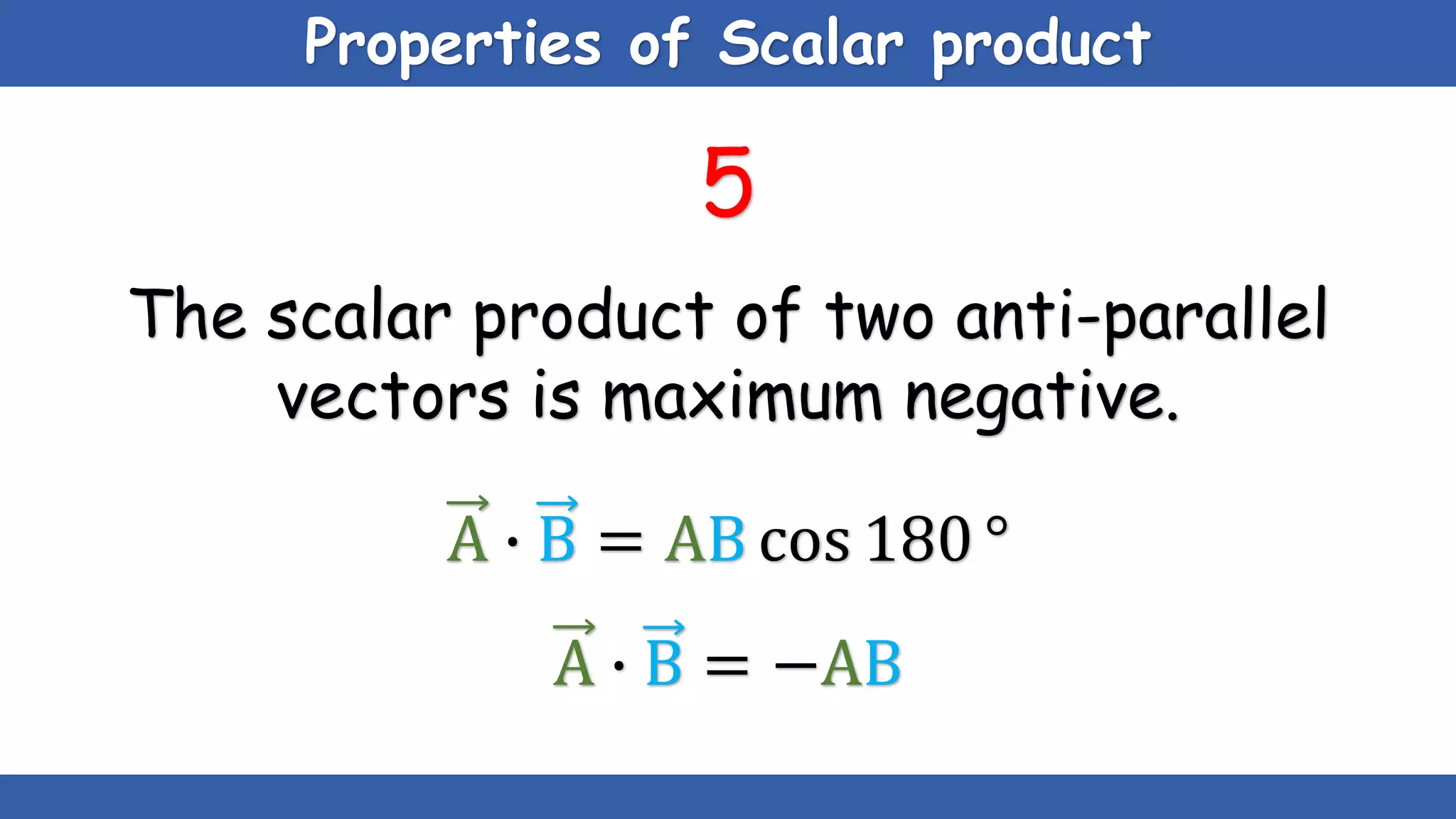
5
The scalar product of two anti-parallel
vectors is maximum negative.
A ∙ B = AB cos 180 °
A ∙ B = −AB
Properties of Scalar product
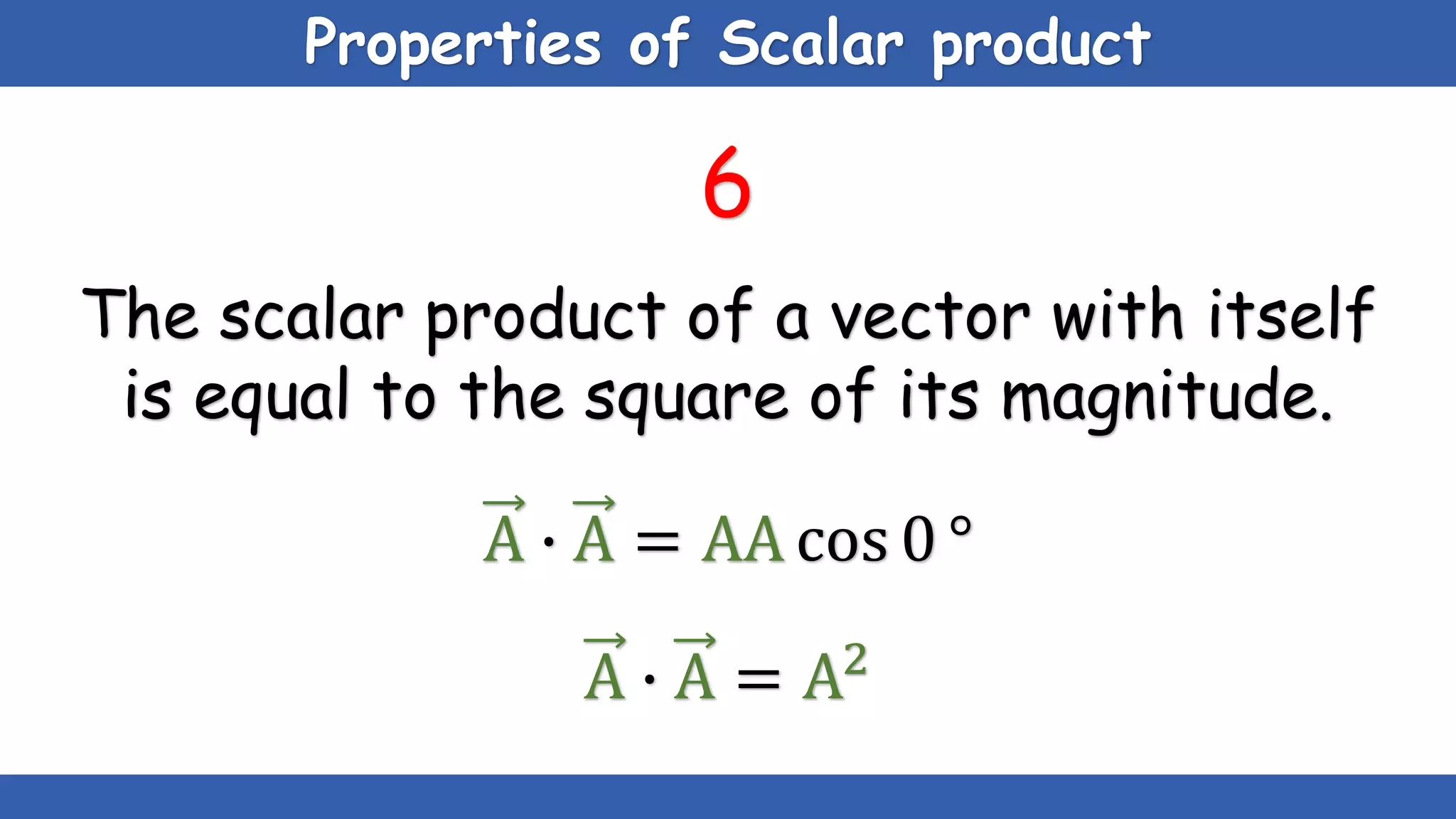
6
The scalar product of a vector with itself
is equal to the square of its magnitude.
A ∙ A = AA cos 0 °
A ∙ A = A2
Properties of Scalar product
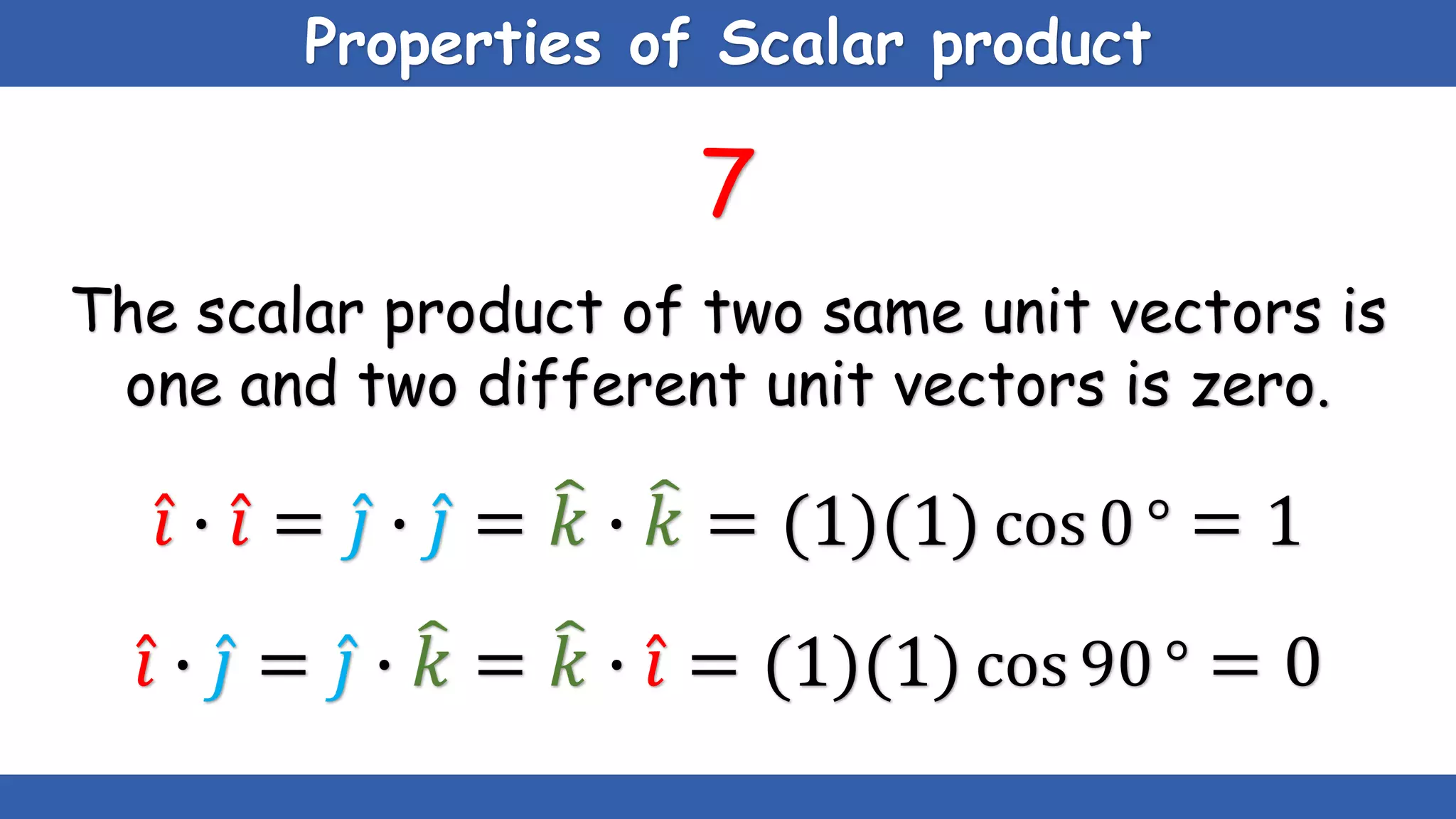
7
The scalar product of two same unit vectors is
one and two different unit vectors is zero.
𝑖 ∙ 𝑖 = 𝑗 ∙ 𝑗 = 𝑘 ∙ 𝑘 = (1)(1) cos 0 ° = 1
𝑖 ∙ 𝑗 = 𝑗 ∙ 𝑘 = 𝑘 ∙ 𝑖 = (1)(1) cos 90 ° = 0
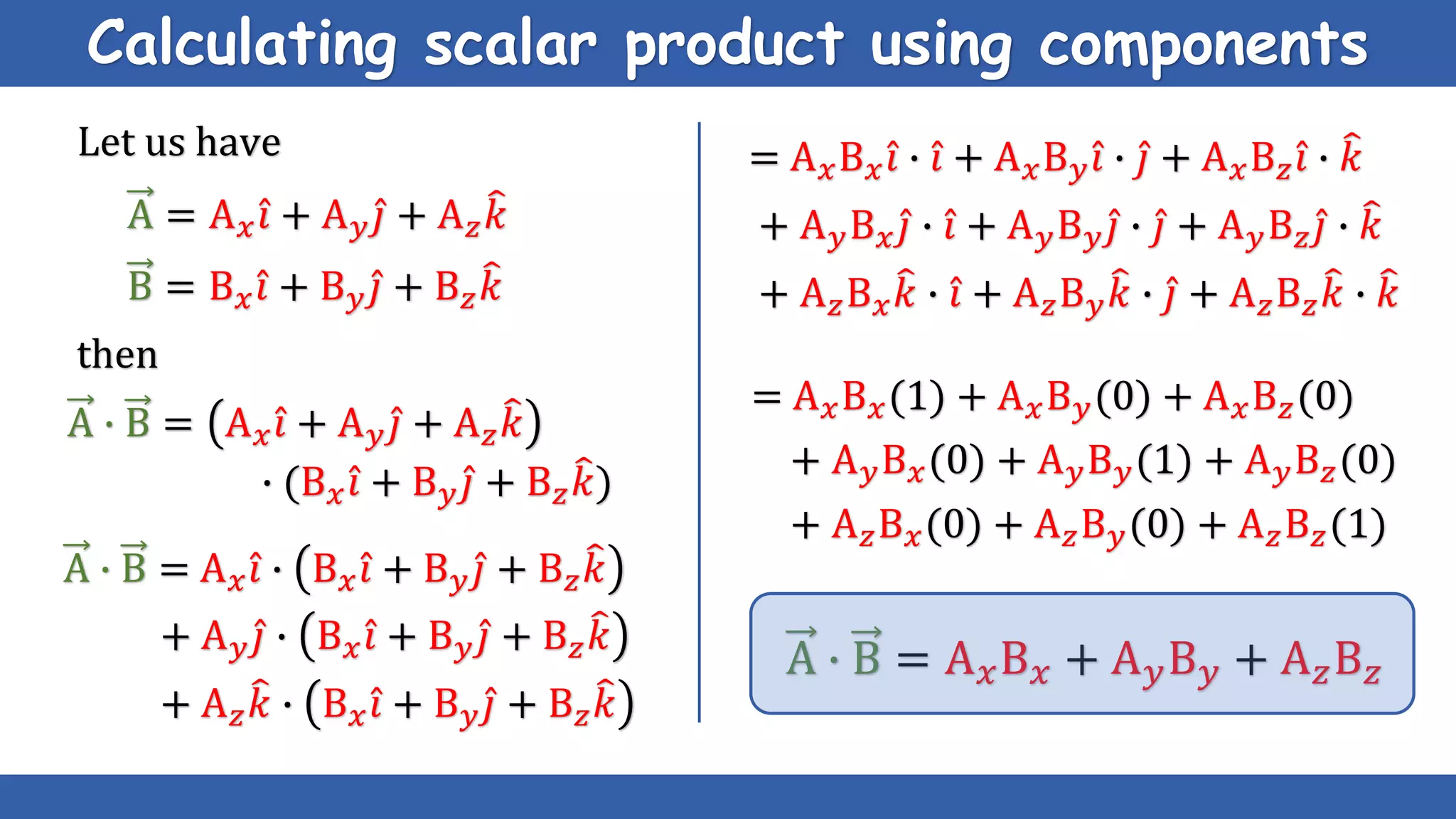
Calculating scalar product using components
A = A 𝑥 𝑖 + A 𝑦 𝑗 + A 𝑧 𝑘
B = B 𝑥 𝑖 + B 𝑦 𝑗 + B 𝑧 𝑘
Let us have
then
A ∙ B = A 𝑥 𝑖 + A 𝑦 𝑗 + A 𝑧 𝑘
∙ (B 𝑥 𝑖 + B 𝑦 𝑗 + B 𝑧 𝑘)
A ∙ B = A 𝑥 𝑖 ∙ B 𝑥 𝑖 + B 𝑦 𝑗 + B 𝑧 𝑘
+ A 𝑦 𝑗 ∙ B 𝑥 𝑖 + B 𝑦 𝑗 + B 𝑧 𝑘
+ A 𝑧 𝑘 ∙ B 𝑥 𝑖 + B 𝑦 𝑗 + B 𝑧 𝑘
= A 𝑥B 𝑥 𝑖 ∙ 𝑖 + A 𝑥B 𝑦 𝑖 ∙ 𝑗 + A 𝑥B 𝑧 𝑖 ∙ 𝑘
+ A 𝑦B 𝑥 𝑗 ∙ 𝑖 + A 𝑦B 𝑦 𝑗 ∙ 𝑗 + A 𝑦B 𝑧 𝑗 ∙ 𝑘
+ A 𝑧B 𝑥 𝑘 ∙ 𝑖 + A 𝑧B 𝑦 𝑘 ∙ 𝑗 + A 𝑧B 𝑧 𝑘 ∙ 𝑘
= A 𝑥B 𝑥(1) + A 𝑥B 𝑦(0) + A 𝑥B 𝑧(0)
+ A 𝑦B 𝑥(0) + A 𝑦B 𝑦(1) + A 𝑦B 𝑧(0)
+ A 𝑧B 𝑥(0) + A 𝑧B 𝑦(0) + A 𝑧B 𝑧(1)
A ∙ B = A 𝑥B 𝑥 + A 𝑦B 𝑦 + A 𝑧B 𝑧
Vector product
A
B
θ
A × B = AB sin θ 𝑛 = C
Right hand rule
A
B
C
θ
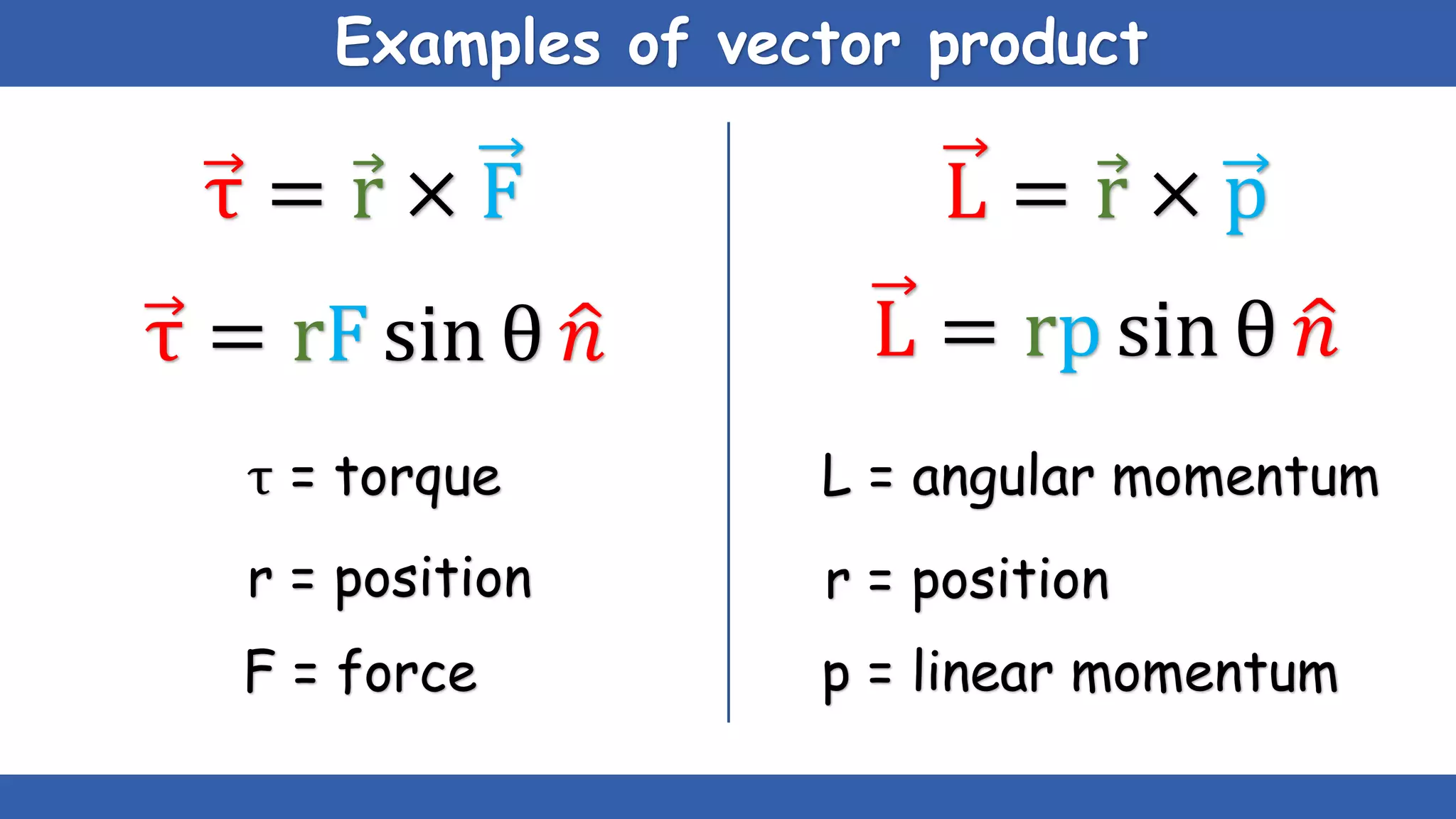
Examples of vector product
τ = r × F
τ = rF sin θ 𝑛
τ = torque
r = position
F = force
L = r × p
L = rp sin θ 𝑛
L = angular momentum
r = position
p = linear momentum
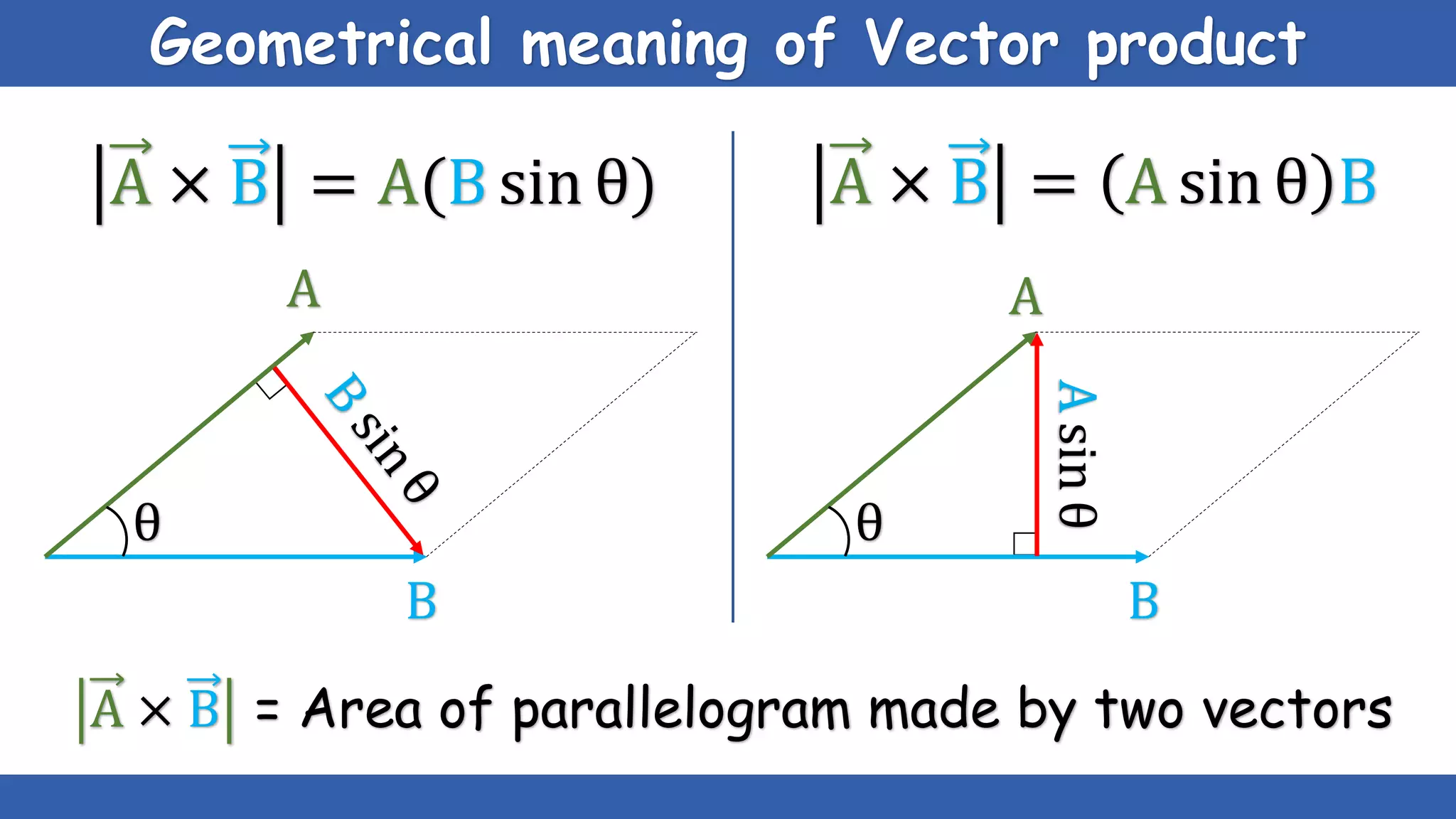
Geometrical meaning of Vector product
θ
A × B = A(B sin θ)
A
B
A × B = A sin θ B
θ
A
B
Asinθ
A × B = Area of parallelogram made by two vectors
Properties of Vector product
1
The vector product is anti-commutative.
A × B = AB sin θ 𝑛
B × A = BA sin θ (− 𝑛) = −AB sin θ 𝑛
A × B ≠ B × A
Properties of Vector product
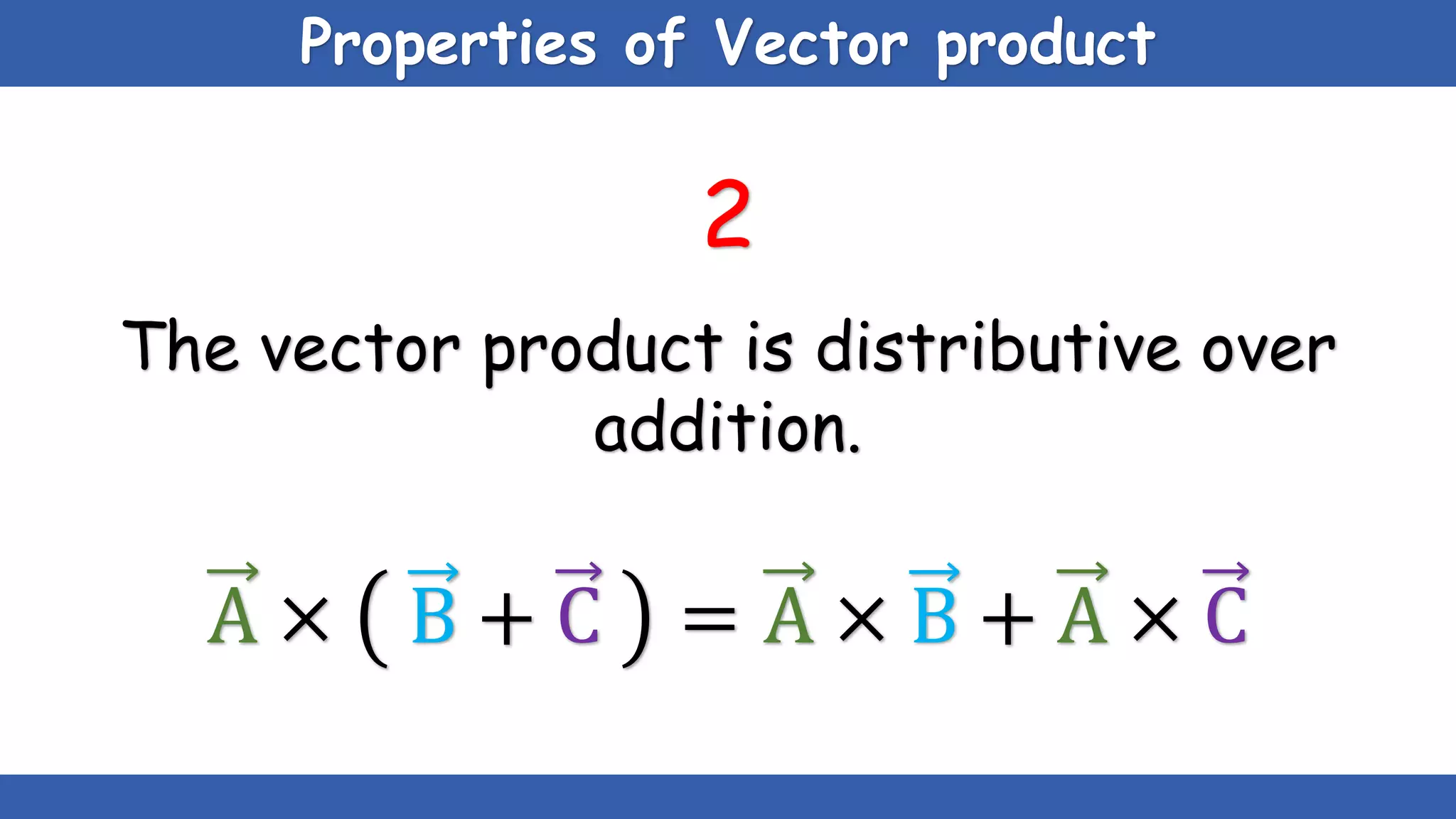
2
The vector product is distributive over
addition.
A × B + C = A × B + A × C
Properties of Vector product
3
The magnitude of the vector product of two
perpendicular vectors is maximum.
A × B = AB sin 90 °
A × B = AB
Properties of Vector product
4
The vector product of two parallel vectors
is a null vector.
A × B = AB sin 0 ° 𝑛
A × B = 0
Properties of Vector product
5
The vector product of two anti-parallel
vectors is a null vector.
A × B = AB sin 180 ° 𝑛
A × B = 0
Properties of Vector product
6
The vector product of a vector with itself
is a null vector.
A × A = AA sin 0 ° 𝑛
A × A = 0
Properties of Vector product
7
The vector product of two same unit
vectors is a null vector.
𝑖 × 𝑖 = 𝑗 × 𝑗 = 𝑘 × 𝑘
= (1)(1) sin 0 ° 𝑛 = 0
Properties of Vector product
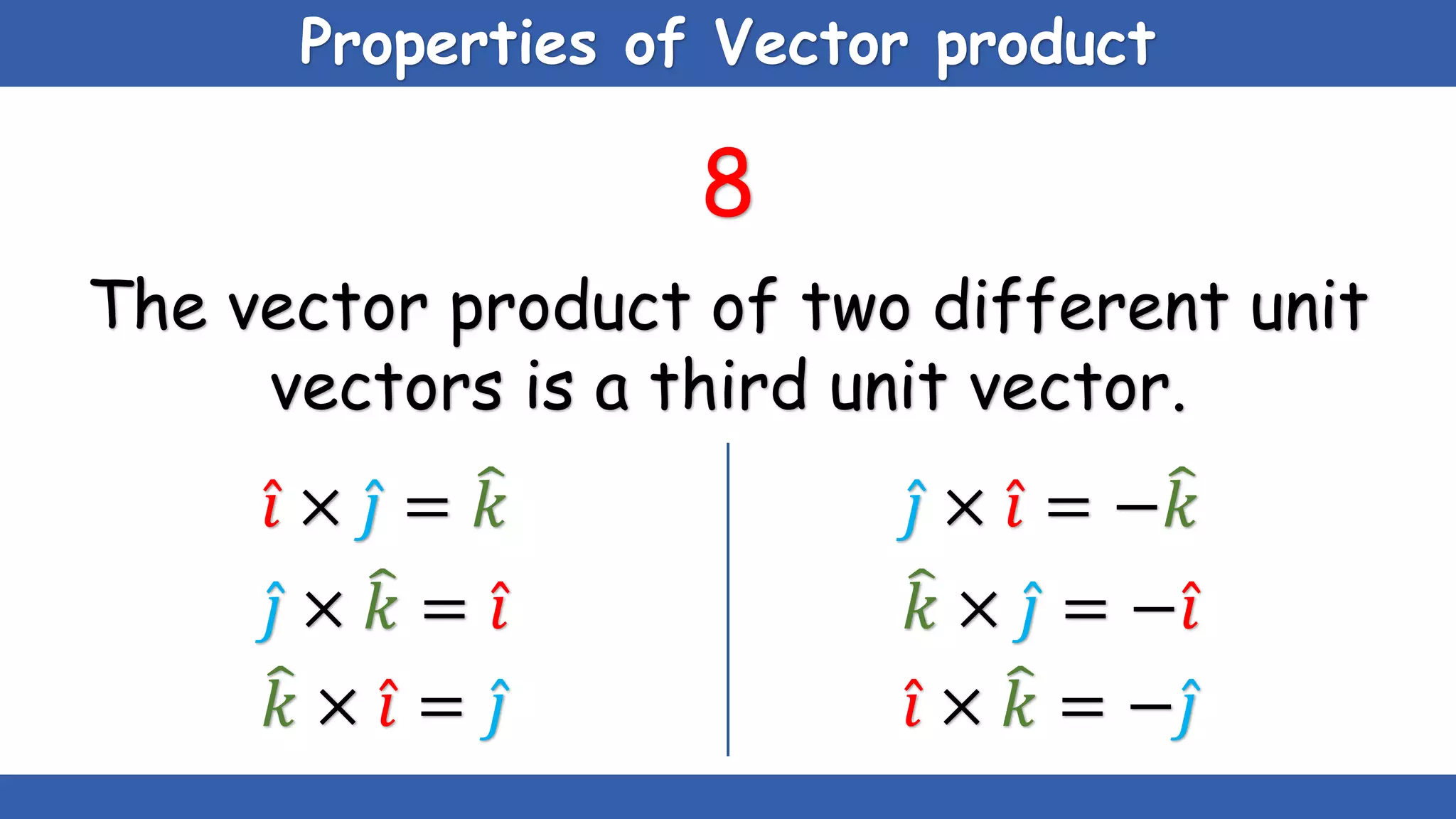
8
The vector product of two different unit
vectors is a third unit vector.
𝑖 × 𝑗 = 𝑘
𝑗 × 𝑘 = 𝑖
𝑘 × 𝑖 = 𝑗
𝑗 × 𝑖 = − 𝑘
𝑘 × 𝑗 = − 𝑖
𝑖 × 𝑘 = − 𝑗
Aid to memory
Calculating vector product using components
A = A 𝑥 𝑖 + A 𝑦 𝑗 + A 𝑧 𝑘
B = B 𝑥 𝑖 + B 𝑦 𝑗 + B 𝑧 𝑘
Let us have
then
A × B = A 𝑥 𝑖 + A 𝑦 𝑗 + A 𝑧 𝑘
× B 𝑥 𝑖 + B 𝑦 𝑗 + B 𝑧 𝑘
A × B = A 𝑥 𝑖 × B 𝑥 𝑖 + B 𝑦 𝑗 + B 𝑧 𝑘
+ A 𝑦 𝑗 × B 𝑥 𝑖 + B 𝑦 𝑗 + B 𝑧 𝑘
+ A 𝑧 𝑘 × B 𝑥 𝑖 + B 𝑦 𝑗 + B 𝑧 𝑘
= A 𝑥B 𝑥 𝑖 × 𝑖 + A 𝑥B 𝑦 𝑖 × 𝑗 + A 𝑥B 𝑧 𝑖 × 𝑘
+ A 𝑦B 𝑥 𝑗 × 𝑖 + A 𝑦B 𝑦 𝑗 × 𝑗 + A 𝑦B 𝑧 𝑗 × 𝑘
+ A 𝑧B 𝑥 𝑘 × 𝑖 + A 𝑧B 𝑦 𝑘 × 𝑗 + A 𝑧B 𝑧 𝑘 × 𝑘
= A 𝑥B 𝑥(0) + A 𝑥B 𝑦( 𝑘) + A 𝑥B 𝑧(− 𝑗)
+ A 𝑦B 𝑥(− 𝑘) + A 𝑦B 𝑦(0) + A 𝑦B 𝑧( 𝑖)
+ A 𝑧B 𝑥( 𝑗) + A 𝑧B 𝑦(− 𝑖) + A 𝑧B 𝑧(0)
= A 𝑦B 𝑧 𝑖 − A 𝑧B 𝑦 𝑖 + A 𝑧B 𝑥 𝑗
− A 𝑥B 𝑧( 𝑗) + A 𝑥B 𝑦( 𝑘) − A 𝑦B 𝑥( 𝑘)
Calculating vector product using components
A × B = 𝑖 A 𝑦B 𝑧 − A 𝑧B 𝑦 − 𝑗 A 𝑥B 𝑧 − A 𝑧B 𝑥
+ 𝑘 (A 𝑥B 𝑦 − A 𝑦B 𝑥)
A × B =
𝑖 𝑗 𝑘
A 𝑥 A 𝑦 A 𝑧
B 𝑥 B 𝑦 B 𝑧
Thank
you

Scalars & vectors

  • 1.
  • 2.
  • 3.
    Length of acar is 4.5 m physical quantity magnitude
  • 4.
    Mass of goldbar is 1 kg physical quantity magnitude
  • 5.
  • 6.
    Temperature is 36.8°C physical quantity magnitude
  • 7.
    A scalar isa physical quantity that has only a magnitude. Examples: • Mass • Length • Time • Temperature • Volume • Density
  • 8.
  • 9.
    California North Carolina Position ofCalifornia from North Carolina is 3600 km in west physical quantity magnitude direction
  • 10.
    Displacement from USAto China is 11600 km in east physical quantity magnitude direction USA China
  • 11.
    A vector isa physical quantity that has both a magnitude and a direction. Examples: • Position • Displacement • Velocity • Acceleration • Momentum • Force
  • 12.
    Representation of avector Symbolically it is represented as AB
  • 13.
    Representation of avector They are also represented by a single capital letter with an arrow above it. PBA
  • 14.
    Representation of avector Some vector quantities are represented by their respective symbols with an arrow above it. Fvr Position velocity Force
  • 15.
    Types of Vectors (on thebasis of orientation)
  • 16.
    Parallel Vectors Two vectorsare said to be parallel vectors, if they have same direction. A P QB
  • 17.
    Equal Vectors Two parallelvectors are said to be equal vectors, if they have same magnitude. A B P Q A = B P = Q
  • 18.
    Anti-parallel Vectors Two vectorsare said to be anti-parallel vectors, if they are in opposite directions. A P QB
  • 19.
    Negative Vectors Two anti-parallelvectors are said to be negative vectors, if they have same magnitude. A B P Q A = −B P = −Q
  • 20.
    Collinear Vectors Two vectorsare said to be collinear vectors, if they act along a same line. A B P Q
  • 21.
    Co-initial Vectors Two ormore vectors are said to be co-initial vectors, if they have common initial point. BA C D
  • 22.
    Co-terminus Vectors Two ormore vectors are said to be co-terminus vectors, if they have common terminal point. B A C D
  • 23.
    Coplanar Vectors Three ormore vectors are said to be coplanar vectors, if they lie in the same plane. A B D C
  • 24.
    Non-coplanar Vectors Three ormore vectors are said to be non-coplanar vectors, if they are distributed in space. B C A
  • 25.
    Types of Vectors (on thebasis of effect)
  • 26.
    Polar Vectors Vectors havingstraight line effect are called polar vectors. Examples: • Displacement • Velocity • Acceleration • Force
  • 27.
    Axial Vectors Vectors havingrotational effect are called axial vectors. Examples: • Angular momentum • Angular velocity • Angular acceleration • Torque
  • 28.
  • 29.
  • 30.
    Parallelogram Law A B AB A B B A C C = A + B
  • 31.
  • 32.
    Commutative Property A BB A C C Therefore, additionof vectors obey commutative law. C = A + B = B + A
  • 33.
    Associative Property B A C Therefore, additionof vectors obey associative law. D = (A + B) + C = A + (B + C) D B A C D
  • 34.
    Subtraction of vectors B A −B A Thesubtraction of B from vector A is defined as the addition of vector −B to vector A. A - B = A + (−B)
  • 35.
  • 36.
    Magnitude of Resultant P O B A C QR M θ θ cos θ = AM AC AM = AC cos θ⇒ In ∆CAM, OC2 = OM2 + CM2 OC2 = (OA + AM)2 + CM2 OC2 = OA2 + 2OA × AM + AM2 + CM2 OC2 = OA2 + 2OA × AM + AC2 R2 = P2 + 2P × Q cos θ + Q2 In ∆OCM, R = P2 + 2PQ cos θ + Q2 OC2 = OA2 + 2OA × AC cos θ + AC2
  • 37.
    Direction of Resultant P OA C Q R M α θ In ∆CAM, cos θ = AM AC AM = AC cos θ⇒ sin θ = CM AC CM = AC sin θ⇒ In ∆OCM, tan α = CM OM tan α = CM OA+AM tan α = AC sin θ OA+AC cos θ tan α = Q sin θ P + Q cos θ B
  • 38.
    Case I –Vectors are parallel ( 𝛉 = 𝟎°) P Q R R = P2 + 2PQ cos 0° + Q2 R = P2 + 2PQ + Q2 R = (P + Q)2 + = Magnitude: Direction: R = P + Q tan α = Q sin 0° P + Q cos 0° tan α = 0 P + Q = 0 α = 0°
  • 39.
    Case II –Vectors are perpendicular (𝛉 = 𝟗𝟎°) P Q R R = P2 + 2PQ cos 90° + Q2 R = P2 + 0 + Q2 + = Magnitude: Direction: tan α = Q sin 90° P + Q cos 90° = Q P + 0 α = tan−1 Q P P Q R = P2 + Q2 α
  • 40.
    Case III –Vectors are anti-parallel (𝛉 = 𝟏𝟖𝟎°) P Q R R = P2 + 2PQ cos 180° + Q2 R = P2 − 2PQ + Q2 R = (P − Q)2 − = Magnitude: Direction: R = P − Q tan α = Q sin 180° P + Q cos 180° = 0 α = 0°If P > Q: If P < Q: α = 180°
  • 41.
    Unit vectors A unitvector is a vector that has a magnitude of exactly 1 and drawn in the direction of given vector. • It lacks both dimension and unit. • Its only purpose is to specify a direction in space. A 𝐴
  • 42.
    • A givenvector can be expressed as a product of its magnitude and a unit vector. • For example A may be represented as, A = A 𝐴 Unit vectors A = magnitude of A 𝐴 = unit vector along A
  • 43.
  • 44.
    Resolution of aVector It is the process of splitting a vector into two or more vectors in such a way that their combined effect is same as that of the given vector. 𝑡 𝑛 A 𝑡 A 𝑛 A
  • 45.
    Rectangular Components of2D Vectors A A 𝑥 A 𝑦 O 𝑥 𝑦 A A = A 𝑥 𝑖 + A 𝑦 𝑗 θ θ A 𝑥 𝑖 A 𝑦 𝑗
  • 46.
    A A 𝑥 A 𝑦 θ sinθ = A 𝑦 A cos θ = A 𝑥 A A 𝑦 = A sin θ A 𝑥 = A cos θ ⇒ ⇒ Rectangular Components of 2D Vectors
  • 47.
    Magnitude & directionfrom components A = A 𝑥 𝑖 + A 𝑦 𝑗 A = A 𝑥 2 + A 𝑦 2 Magnitude: Direction: θ = tan−1 A 𝑦 A 𝑥 θ A 𝑥 A 𝑦 A
  • 48.
    Rectangular Components of3D Vectors 𝑥 𝑧 𝑦 A A 𝑦 A′ A 𝑧 A 𝑥 A = A′ + A 𝑦 A = A 𝑥 + A 𝑧 + A 𝑦 A = A 𝑥 + A 𝑦 + A 𝑧 A = A 𝑥 𝑖 + A 𝑦 𝑗 + A 𝑧 𝑘
  • 49.
    Rectangular Components of3D Vectors 𝑥 𝑧 𝑦 𝛼 A A 𝑥 cos 𝛼 = A 𝑥 A A 𝑥 = A cos 𝛼
  • 50.
    Rectangular Components of3D Vectors 𝑥 𝑧 𝑦 A A 𝑦 𝛽 cos 𝛽 = A 𝑦 A A 𝑦 = A cos 𝛽
  • 51.
    Rectangular Components of3D Vectors 𝑥 𝑧 𝑦 A A 𝑧 𝛾 cos 𝛾 = A 𝑧 A A 𝑧 = A cos 𝛾
  • 52.
    Magnitude & directionfrom components A = A 𝑥 𝑖 + A 𝑦 𝑗 + A 𝑧 𝑘 A = A 𝑥 2 + A 𝑦 2 + A 𝑧 2 Magnitude: Direction: 𝛼 = cos−1 A 𝑥 A 𝛽 = cos−1 A 𝑦 A 𝛾 = cos−1 A 𝑧 A A A 𝑧 𝛾 𝛽 𝛼 A 𝑥 A 𝑦
  • 53.
    Adding vectors bycomponents A = A 𝑥 𝑖 + A 𝑦 𝑗 + A 𝑧 𝑘 B = B 𝑥 𝑖 + B 𝑦 𝑗 + B 𝑧 𝑘 Let us have then R = A + B R = A 𝑥 𝑖 + A 𝑦 𝑗 + A 𝑧 𝑘 + B 𝑥 𝑖 + B 𝑦 𝑗 + B 𝑧 𝑘 R = (A 𝑥 + B 𝑥) 𝑖 + (A 𝑦 + B 𝑦) 𝑗 + (A 𝑧 + B 𝑧) 𝑘 R 𝑥 𝑖 + R 𝑦 𝑗 + R 𝑧 𝑘 = (A 𝑥+B 𝑥) 𝑖 + (A 𝑦+B 𝑦) 𝑗 + (A 𝑧+B 𝑧) 𝑘 R 𝑥 = (A 𝑥 + B 𝑥) R 𝑦 = (A 𝑦 + B 𝑦) R 𝑧 = (A 𝑧 + B 𝑧)
  • 54.
  • 55.
    Multiplying a vectorby a scalar • If we multiply a vector A by a scalar s, we get a new vector. • Its magnitude is the product of the magnitude of A and the absolute value of s. • Its direction is the direction of A if s is positive but the opposite direction if s is negative.
  • 56.
    Multiplying a vectorby a scalar If s is positive: A 2A If s is negative: A −3A
  • 57.
    Multiplying a vectorby a vector • There are two ways to multiply a vector by a vector: • The first way produces a scalar quantity and called as scalar product (dot product). • The second way produces a vector quantity and called as vector product (cross product).
  • 58.
  • 59.
    Examples of scalarproduct W = F ∙ s W = Fs cos θ W = work done F = force s = displacement P = F ∙ v P = Fv cos θ P = power F = force v = velocity
  • 60.
    Geometrical meaning ofScalar dot product A dot product can be regarded as the product of two quantities: 1. The magnitude of one of the vectors 2.The scalar component of the second vector along the direction of the first vector
  • 61.
    Geometrical meaning ofScalar product θ A ∙ B = A(B cos θ) A ∙ B = (A cos θ)B A θ A A cos θ B B
  • 62.
    Properties of Scalarproduct 1 The scalar product is commutative. A ∙ B = AB cos θ B ∙ A = BA cos θ A ∙ B = B ∙ A
  • 63.
    Properties of Scalarproduct 2 The scalar product is distributive over addition. A ∙ B + C = A ∙ B + A ∙ C
  • 64.
    Properties of Scalarproduct 3 The scalar product of two perpendicular vectors is zero. A ∙ B = AB cos 90 ° A ∙ B = 0
  • 65.
    Properties of Scalarproduct 4 The scalar product of two parallel vectors is maximum positive. A ∙ B = AB cos 0 ° A ∙ B = AB
  • 66.
    Properties of Scalarproduct 5 The scalar product of two anti-parallel vectors is maximum negative. A ∙ B = AB cos 180 ° A ∙ B = −AB
  • 67.
    Properties of Scalarproduct 6 The scalar product of a vector with itself is equal to the square of its magnitude. A ∙ A = AA cos 0 ° A ∙ A = A2
  • 68.
    Properties of Scalarproduct 7 The scalar product of two same unit vectors is one and two different unit vectors is zero. 𝑖 ∙ 𝑖 = 𝑗 ∙ 𝑗 = 𝑘 ∙ 𝑘 = (1)(1) cos 0 ° = 1 𝑖 ∙ 𝑗 = 𝑗 ∙ 𝑘 = 𝑘 ∙ 𝑖 = (1)(1) cos 90 ° = 0
  • 69.
    Calculating scalar productusing components A = A 𝑥 𝑖 + A 𝑦 𝑗 + A 𝑧 𝑘 B = B 𝑥 𝑖 + B 𝑦 𝑗 + B 𝑧 𝑘 Let us have then A ∙ B = A 𝑥 𝑖 + A 𝑦 𝑗 + A 𝑧 𝑘 ∙ (B 𝑥 𝑖 + B 𝑦 𝑗 + B 𝑧 𝑘) A ∙ B = A 𝑥 𝑖 ∙ B 𝑥 𝑖 + B 𝑦 𝑗 + B 𝑧 𝑘 + A 𝑦 𝑗 ∙ B 𝑥 𝑖 + B 𝑦 𝑗 + B 𝑧 𝑘 + A 𝑧 𝑘 ∙ B 𝑥 𝑖 + B 𝑦 𝑗 + B 𝑧 𝑘 = A 𝑥B 𝑥 𝑖 ∙ 𝑖 + A 𝑥B 𝑦 𝑖 ∙ 𝑗 + A 𝑥B 𝑧 𝑖 ∙ 𝑘 + A 𝑦B 𝑥 𝑗 ∙ 𝑖 + A 𝑦B 𝑦 𝑗 ∙ 𝑗 + A 𝑦B 𝑧 𝑗 ∙ 𝑘 + A 𝑧B 𝑥 𝑘 ∙ 𝑖 + A 𝑧B 𝑦 𝑘 ∙ 𝑗 + A 𝑧B 𝑧 𝑘 ∙ 𝑘 = A 𝑥B 𝑥(1) + A 𝑥B 𝑦(0) + A 𝑥B 𝑧(0) + A 𝑦B 𝑥(0) + A 𝑦B 𝑦(1) + A 𝑦B 𝑧(0) + A 𝑧B 𝑥(0) + A 𝑧B 𝑦(0) + A 𝑧B 𝑧(1) A ∙ B = A 𝑥B 𝑥 + A 𝑦B 𝑦 + A 𝑧B 𝑧
  • 70.
    Vector product A B θ A ×B = AB sin θ 𝑛 = C
  • 71.
  • 72.
    Examples of vectorproduct τ = r × F τ = rF sin θ 𝑛 τ = torque r = position F = force L = r × p L = rp sin θ 𝑛 L = angular momentum r = position p = linear momentum
  • 73.
    Geometrical meaning ofVector product θ A × B = A(B sin θ) A B A × B = A sin θ B θ A B Asinθ A × B = Area of parallelogram made by two vectors
  • 74.
    Properties of Vectorproduct 1 The vector product is anti-commutative. A × B = AB sin θ 𝑛 B × A = BA sin θ (− 𝑛) = −AB sin θ 𝑛 A × B ≠ B × A
  • 75.
    Properties of Vectorproduct 2 The vector product is distributive over addition. A × B + C = A × B + A × C
  • 76.
    Properties of Vectorproduct 3 The magnitude of the vector product of two perpendicular vectors is maximum. A × B = AB sin 90 ° A × B = AB
  • 77.
    Properties of Vectorproduct 4 The vector product of two parallel vectors is a null vector. A × B = AB sin 0 ° 𝑛 A × B = 0
  • 78.
    Properties of Vectorproduct 5 The vector product of two anti-parallel vectors is a null vector. A × B = AB sin 180 ° 𝑛 A × B = 0
  • 79.
    Properties of Vectorproduct 6 The vector product of a vector with itself is a null vector. A × A = AA sin 0 ° 𝑛 A × A = 0
  • 80.
    Properties of Vectorproduct 7 The vector product of two same unit vectors is a null vector. 𝑖 × 𝑖 = 𝑗 × 𝑗 = 𝑘 × 𝑘 = (1)(1) sin 0 ° 𝑛 = 0
  • 81.
    Properties of Vectorproduct 8 The vector product of two different unit vectors is a third unit vector. 𝑖 × 𝑗 = 𝑘 𝑗 × 𝑘 = 𝑖 𝑘 × 𝑖 = 𝑗 𝑗 × 𝑖 = − 𝑘 𝑘 × 𝑗 = − 𝑖 𝑖 × 𝑘 = − 𝑗
  • 82.
  • 83.
    Calculating vector productusing components A = A 𝑥 𝑖 + A 𝑦 𝑗 + A 𝑧 𝑘 B = B 𝑥 𝑖 + B 𝑦 𝑗 + B 𝑧 𝑘 Let us have then A × B = A 𝑥 𝑖 + A 𝑦 𝑗 + A 𝑧 𝑘 × B 𝑥 𝑖 + B 𝑦 𝑗 + B 𝑧 𝑘 A × B = A 𝑥 𝑖 × B 𝑥 𝑖 + B 𝑦 𝑗 + B 𝑧 𝑘 + A 𝑦 𝑗 × B 𝑥 𝑖 + B 𝑦 𝑗 + B 𝑧 𝑘 + A 𝑧 𝑘 × B 𝑥 𝑖 + B 𝑦 𝑗 + B 𝑧 𝑘 = A 𝑥B 𝑥 𝑖 × 𝑖 + A 𝑥B 𝑦 𝑖 × 𝑗 + A 𝑥B 𝑧 𝑖 × 𝑘 + A 𝑦B 𝑥 𝑗 × 𝑖 + A 𝑦B 𝑦 𝑗 × 𝑗 + A 𝑦B 𝑧 𝑗 × 𝑘 + A 𝑧B 𝑥 𝑘 × 𝑖 + A 𝑧B 𝑦 𝑘 × 𝑗 + A 𝑧B 𝑧 𝑘 × 𝑘 = A 𝑥B 𝑥(0) + A 𝑥B 𝑦( 𝑘) + A 𝑥B 𝑧(− 𝑗) + A 𝑦B 𝑥(− 𝑘) + A 𝑦B 𝑦(0) + A 𝑦B 𝑧( 𝑖) + A 𝑧B 𝑥( 𝑗) + A 𝑧B 𝑦(− 𝑖) + A 𝑧B 𝑧(0) = A 𝑦B 𝑧 𝑖 − A 𝑧B 𝑦 𝑖 + A 𝑧B 𝑥 𝑗 − A 𝑥B 𝑧( 𝑗) + A 𝑥B 𝑦( 𝑘) − A 𝑦B 𝑥( 𝑘)
  • 84.
    Calculating vector productusing components A × B = 𝑖 A 𝑦B 𝑧 − A 𝑧B 𝑦 − 𝑗 A 𝑥B 𝑧 − A 𝑧B 𝑥 + 𝑘 (A 𝑥B 𝑦 − A 𝑦B 𝑥) A × B = 𝑖 𝑗 𝑘 A 𝑥 A 𝑦 A 𝑧 B 𝑥 B 𝑦 B 𝑧
  • 85.