RESULTANT OF
PERPENDICULAR VECTOR
GRADE 11
PRESENTED BY: SEANEGO JK
14 May 2020
RECAP
• What are scalar and vector quantities and what
are their examples?
RESULTANT OF PERPENDICULAR VECTOR
• Vector is a physical quantity with both direction and magnitude( e.g.: force,
velocity, displacement etc.)
• A scalar is a physical quantity with only the magnitude ( e.g.: mass, time,
temperature etc.)
PROPERTIES OF VECTORS
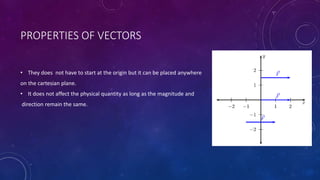
• They does not have to start at the origin but it can be placed anywhere
on the cartesian plane.
• It does not affect the physical quantity as long as the magnitude and
direction remain the same.
REPRESENTING THE RESULTANT OF CO-LINEAR
FORCES/VECTORS
• Two persons are lifting a heavy box by pulling it upwards using two ropes. The total vertical pulling force is the
combined pulling force of the two men
• A vector is represented by arrows drawn to scale
• There are different ways of indicating direction of a vector
a) Points of a compass
b) 2. Bearing: the angle is measured in a clockwise direction from a south to north base line. This vertical base
line is taken a 0°.
c) The angle made to a given direction or point of reference ( e.g. 50° east of north or 50° E of N)
• Displacement – a straight line drawn from the starting point to the ending point indicating both magnitude
and directions
• Resultant-(R) (vector sum) of a number of vectors is that single vectors which will have the same effect as the
original vectors acting together
PHET SIMULATION
• https://phet.colorado.edu/sims/html/vector-addition/latest/vector-addition_en.html
METHODS TO CALCULATE RESULTANT OF TWO
FORCES
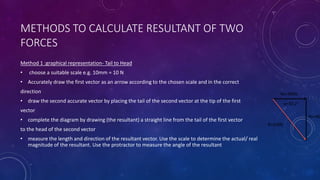
Method 1 :graphical representation- Tail to Head
• choose a suitable scale e.g. 10mm = 10 N
• Accurately draw the first vector as an arrow according to the chosen scale and in the correct
direction
• draw the second accurate vector by placing the tail of the second vector at the tip of the first
vector
• complete the diagram by drawing (the resultant) a straight line from the tail of the first vector
to the head of the second vector
• measure the length and direction of the resultant vector. Use the scale to determine the actual/ real
magnitude of the resultant. Use the protractor to measure the angle of the resultant
Rx=300N
Ry=40
R=500N
α=50.2°
DEMONSTRATION OF METHOD 1:
HTTPS://WWW.YOUTUBE.COM/WATCH?V=2EJSNXYNWVU
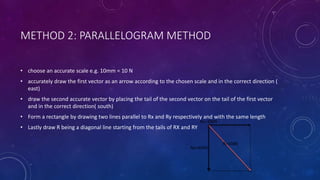
METHOD 2: PARALLELOGRAM METHOD
• choose an accurate scale e.g. 10mm = 10 N
• accurately draw the first vector as an arrow according to the chosen scale and in the correct direction (
east)
• draw the second accurate vector by placing the tail of the second vector on the tail of the first vector
and in the correct direction( south)
• Form a rectangle by drawing two lines parallel to Rx and Ry respectively and with the same length
• Lastly draw R being a diagonal line starting from the tails of RX and RY
Ry=400N
Rx=300N
R=500N
DEMONSTRATION OF METHOD 2
HTTPS://WWW.YOUTUBE.COM/WATCH?V=RQFYBU5KVJK
SUMMARY OF THE LESSON
• vectors do not have to start at the origin
• use arrows, compass, bearings and point of reference for vector direction
• we can use tail-to-head and parallelogram method to find resultant vector
ACTIVITY
• Two forces are applied to an object : 3 N to the right and 5 N downwards. Sketch the forces on the
Cartesian plane and draw the resultant force using these methods
• 1. Tail to head method
• 2. Parallelogram method

Resultant of Perpendicular Vector

  • 1.
    RESULTANT OF PERPENDICULAR VECTOR GRADE11 PRESENTED BY: SEANEGO JK 14 May 2020
  • 2.
    RECAP • What arescalar and vector quantities and what are their examples?
  • 3.
    RESULTANT OF PERPENDICULARVECTOR • Vector is a physical quantity with both direction and magnitude( e.g.: force, velocity, displacement etc.) • A scalar is a physical quantity with only the magnitude ( e.g.: mass, time, temperature etc.)
  • 4.
    PROPERTIES OF VECTORS •They does not have to start at the origin but it can be placed anywhere on the cartesian plane. • It does not affect the physical quantity as long as the magnitude and direction remain the same.
  • 5.
    REPRESENTING THE RESULTANTOF CO-LINEAR FORCES/VECTORS • Two persons are lifting a heavy box by pulling it upwards using two ropes. The total vertical pulling force is the combined pulling force of the two men • A vector is represented by arrows drawn to scale • There are different ways of indicating direction of a vector a) Points of a compass b) 2. Bearing: the angle is measured in a clockwise direction from a south to north base line. This vertical base line is taken a 0°. c) The angle made to a given direction or point of reference ( e.g. 50° east of north or 50° E of N) • Displacement – a straight line drawn from the starting point to the ending point indicating both magnitude and directions • Resultant-(R) (vector sum) of a number of vectors is that single vectors which will have the same effect as the original vectors acting together
  • 6.
  • 7.
    METHODS TO CALCULATERESULTANT OF TWO FORCES Method 1 :graphical representation- Tail to Head • choose a suitable scale e.g. 10mm = 10 N • Accurately draw the first vector as an arrow according to the chosen scale and in the correct direction • draw the second accurate vector by placing the tail of the second vector at the tip of the first vector • complete the diagram by drawing (the resultant) a straight line from the tail of the first vector to the head of the second vector • measure the length and direction of the resultant vector. Use the scale to determine the actual/ real magnitude of the resultant. Use the protractor to measure the angle of the resultant Rx=300N Ry=40 R=500N α=50.2°
  • 8.
    DEMONSTRATION OF METHOD1: HTTPS://WWW.YOUTUBE.COM/WATCH?V=2EJSNXYNWVU
  • 9.
    METHOD 2: PARALLELOGRAMMETHOD • choose an accurate scale e.g. 10mm = 10 N • accurately draw the first vector as an arrow according to the chosen scale and in the correct direction ( east) • draw the second accurate vector by placing the tail of the second vector on the tail of the first vector and in the correct direction( south) • Form a rectangle by drawing two lines parallel to Rx and Ry respectively and with the same length • Lastly draw R being a diagonal line starting from the tails of RX and RY Ry=400N Rx=300N R=500N
  • 10.
    DEMONSTRATION OF METHOD2 HTTPS://WWW.YOUTUBE.COM/WATCH?V=RQFYBU5KVJK
  • 11.
    SUMMARY OF THELESSON • vectors do not have to start at the origin • use arrows, compass, bearings and point of reference for vector direction • we can use tail-to-head and parallelogram method to find resultant vector
  • 12.
    ACTIVITY • Two forcesare applied to an object : 3 N to the right and 5 N downwards. Sketch the forces on the Cartesian plane and draw the resultant force using these methods • 1. Tail to head method • 2. Parallelogram method