Introduction
• In this chapter you will learn about Vectors
• You will have seen vectors at GCSE level, this
chapter focuses on using them to solve problems
involving SUVAT equations and forces
• Sometimes using vectors offers an easier
alternative to regular methods
• Vectors are used in video games in the movement of
characters and by engineers in the design of
buildings, bridges and other structures
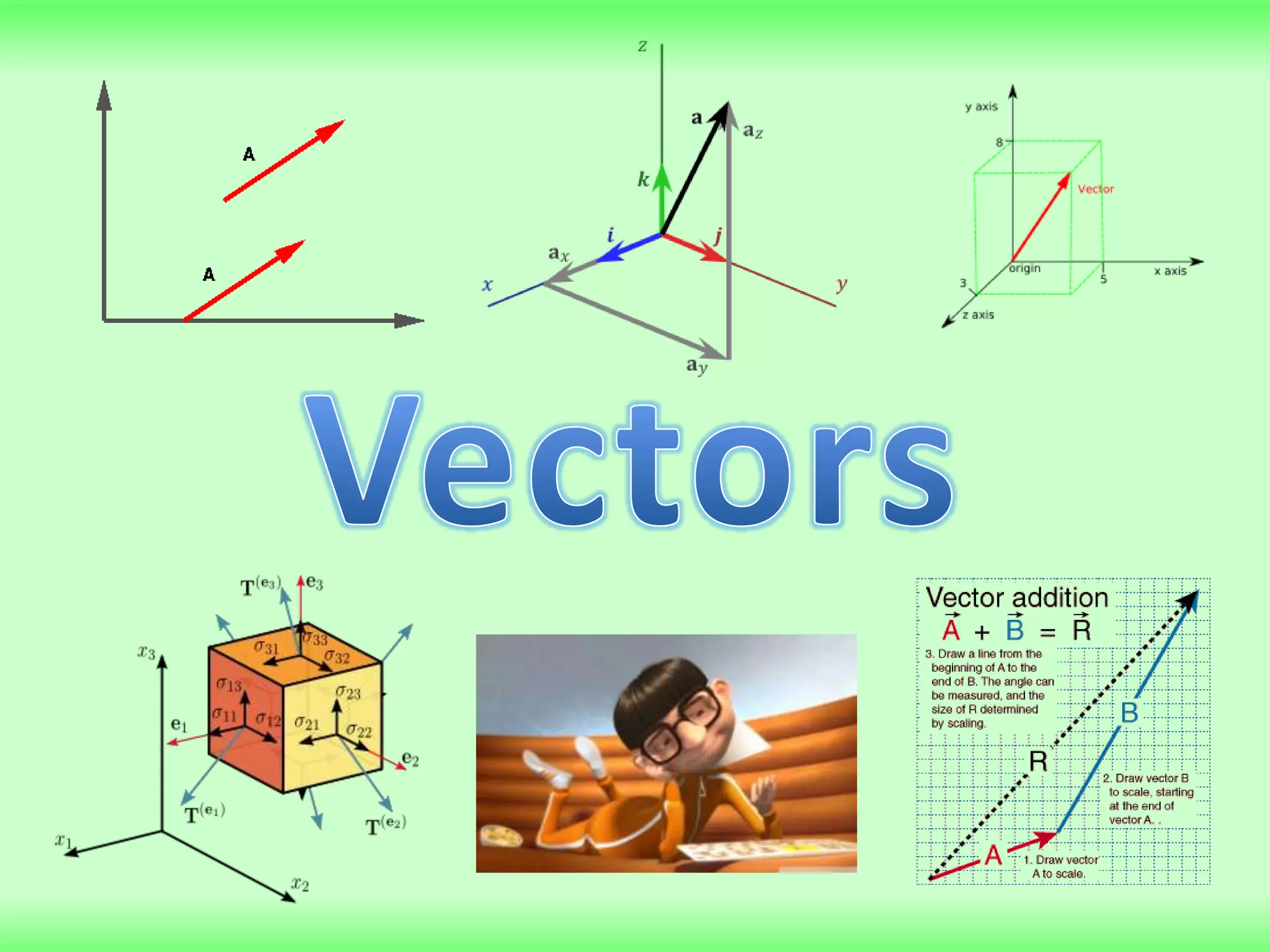
Vectors
You can use vectors to describe
displacements
A vector has both direction and magnitude
For example:
 An object is moving north at 20ms-1
 A horizontal force of 7N
 An object has moved 5m to the left
These are all vectors. A scalar quantity would
be something such as:
A force of 10N
(It is scalar since it has no direction)
6A
Vectors
have both
direction
and
magnitude!
Vectors
You can use vectors to describe
displacements
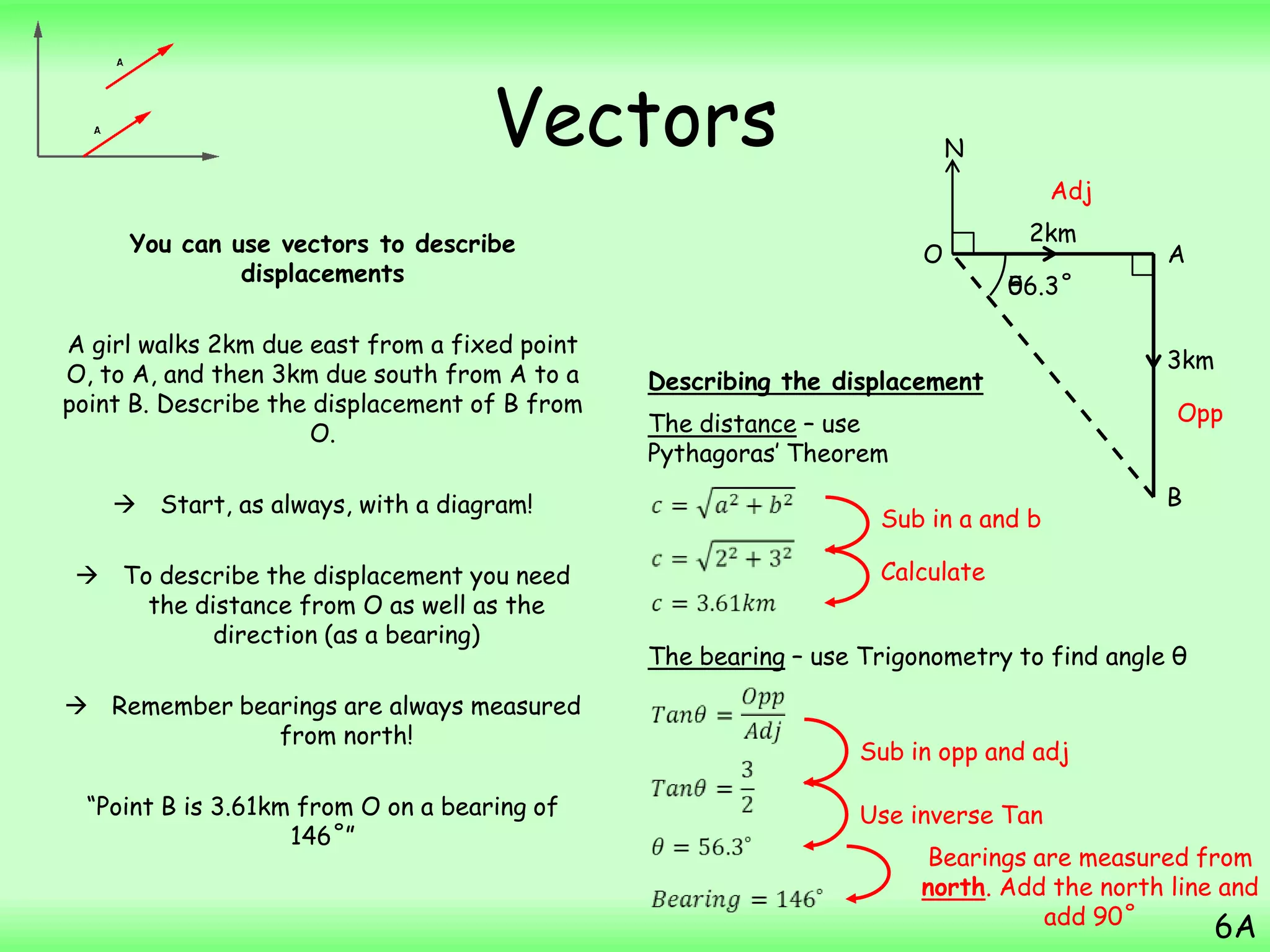
A girl walks 2km due east from a fixed point
O, to A, and then 3km due south from A to a
point B. Describe the displacement of B from
O.
 Start, as always, with a diagram!
 To describe the displacement you need
the distance from O as well as the
direction (as a bearing)
 Remember bearings are always measured
from north!
“Point B is 3.61km from O on a bearing of
146˚”
6A
2km
3km
O A
B
θ
N
Describing the displacement
The distance – use
Pythagoras‟ Theorem
The bearing – use Trigonometry to find angle θ
Sub in a and b
Calculate
Sub in opp and adj
Use inverse Tan
Bearings are measured from
north. Add the north line and
add 90˚
Opp
Adj
56.3˚
Vectors
You can use vectors to describe
displacements
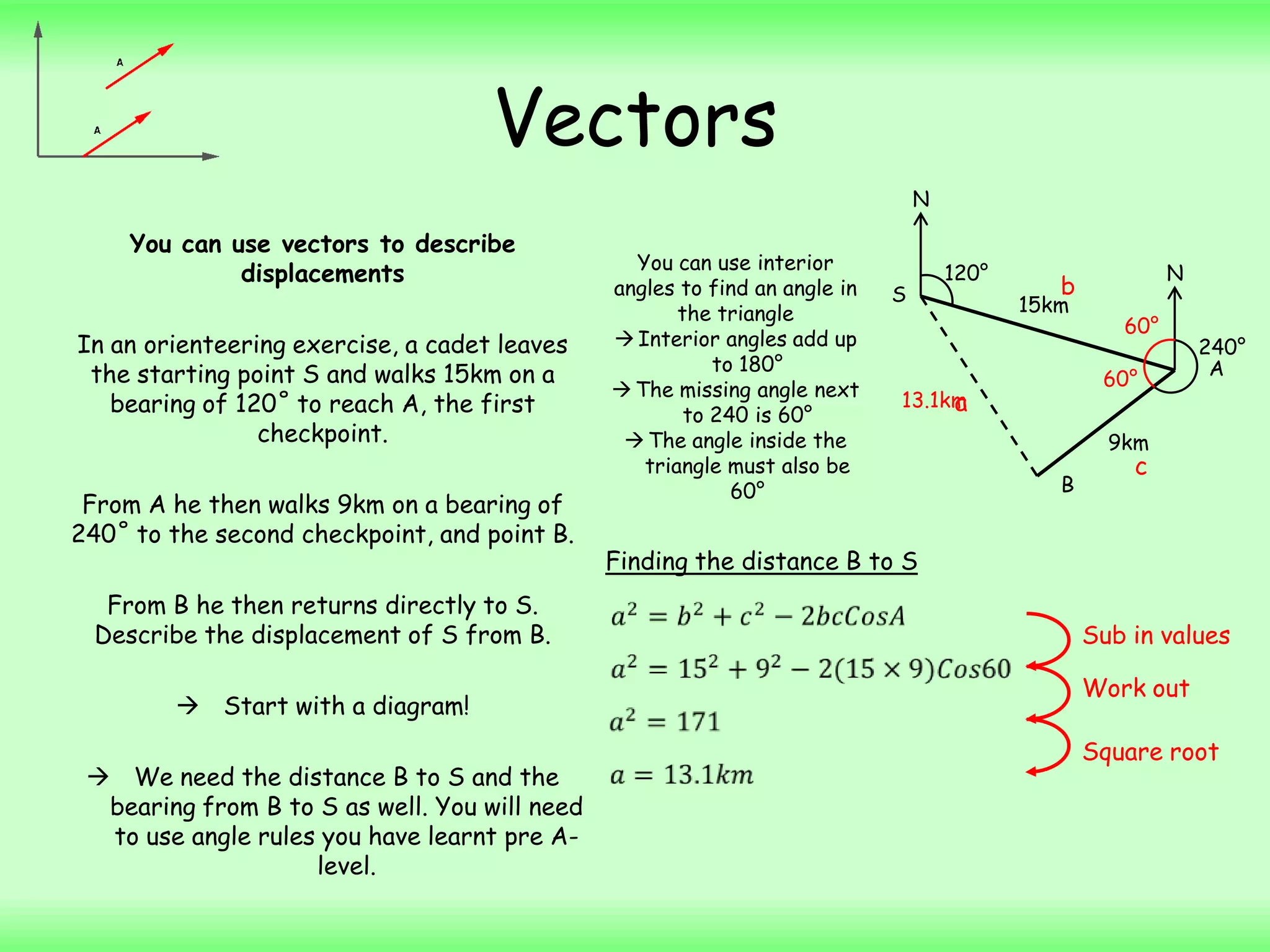
In an orienteering exercise, a cadet leaves
the starting point S and walks 15km on a
bearing of 120˚ to reach A, the first
checkpoint.
From A he then walks 9km on a bearing of
240˚ to the second checkpoint, and point B.
From B he then returns directly to S.
Describe the displacement of S from B.
 Start with a diagram!
 We need the distance B to S and the
bearing from B to S as well. You will need
to use angle rules you have learnt pre A-
level.
N
N
S
A
B
15km
9km
120°
240°
You can use interior
angles to find an angle in
the triangle
 Interior angles add up
to 180°
 The missing angle next
to 240 is 60°
 The angle inside the
triangle must also be
60°
60°
60°
Finding the distance B to S
Sub in values
a
b
c
Work out
Square root
13.1km
Vectors
You can use vectors to describe
displacements
In an orienteering exercise, a cadet leaves
the starting point S and walks 15km on a
bearing of 120˚ to reach A, the first
checkpoint.
From A he then walks 9km on a bearing of
240˚ to the second checkpoint, and point B.
From B he then returns directly to S.
Describe the displacement of S from B.
 Start with a diagram!
 We need the distance B to S and the
bearing from B to S as well. You will need
to use angle rules you have learnt pre A-
level.
N
N
S
A
B
15km
9km
120°
240°
60°
60°
13.1km
N
θ
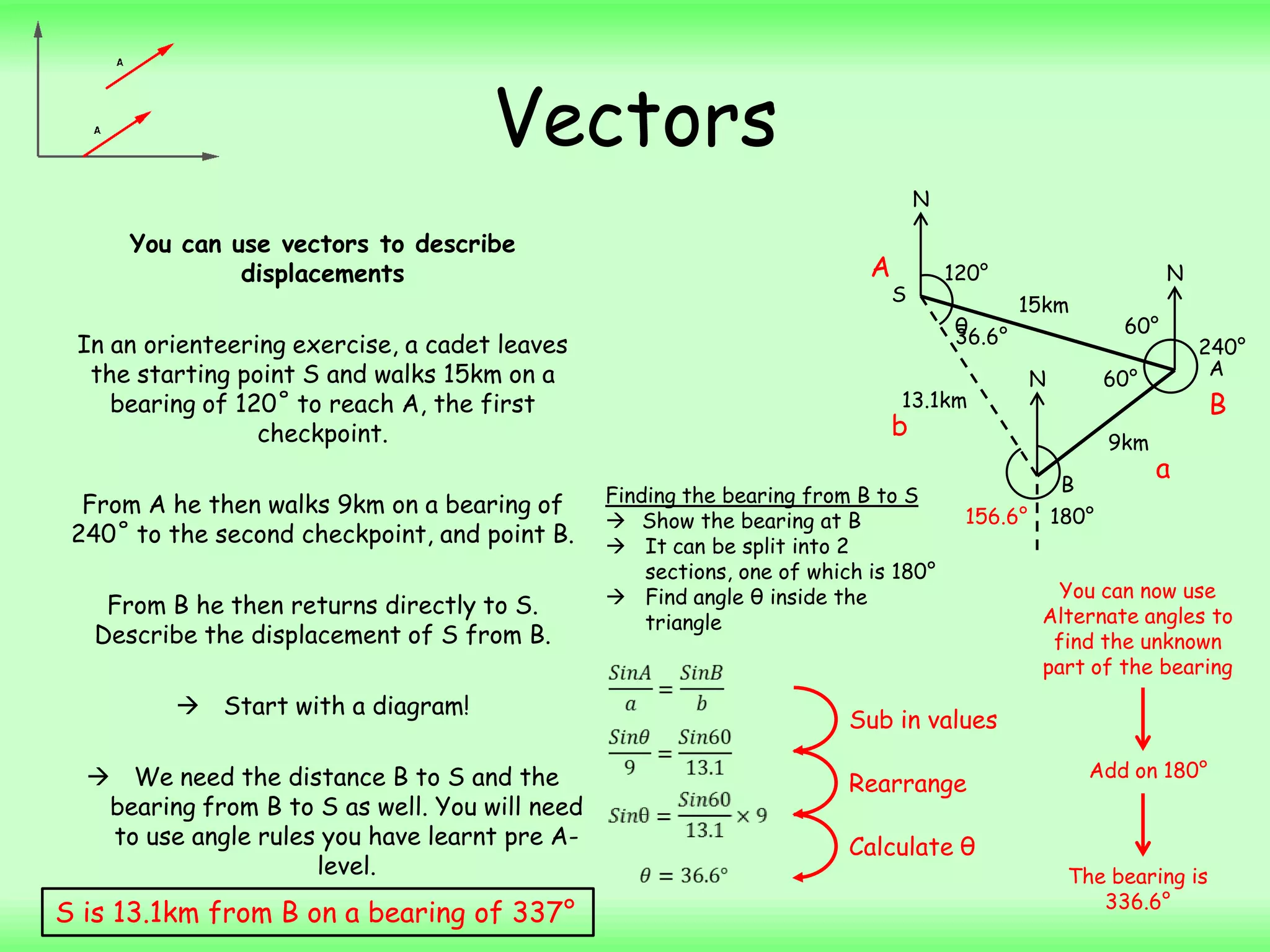
Finding the bearing from B to S
 Show the bearing at B
 It can be split into 2
sections, one of which is 180°
 Find angle θ inside the
triangle
Sub in values
Rearrange
Calculate θ
156.6° 180°
You can now use
Alternate angles to
find the unknown
part of the bearing
Add on 180°
The bearing is
336.6°
S is 13.1km from B on a bearing of 337°
A
a
b
B
36.6°
Vectors
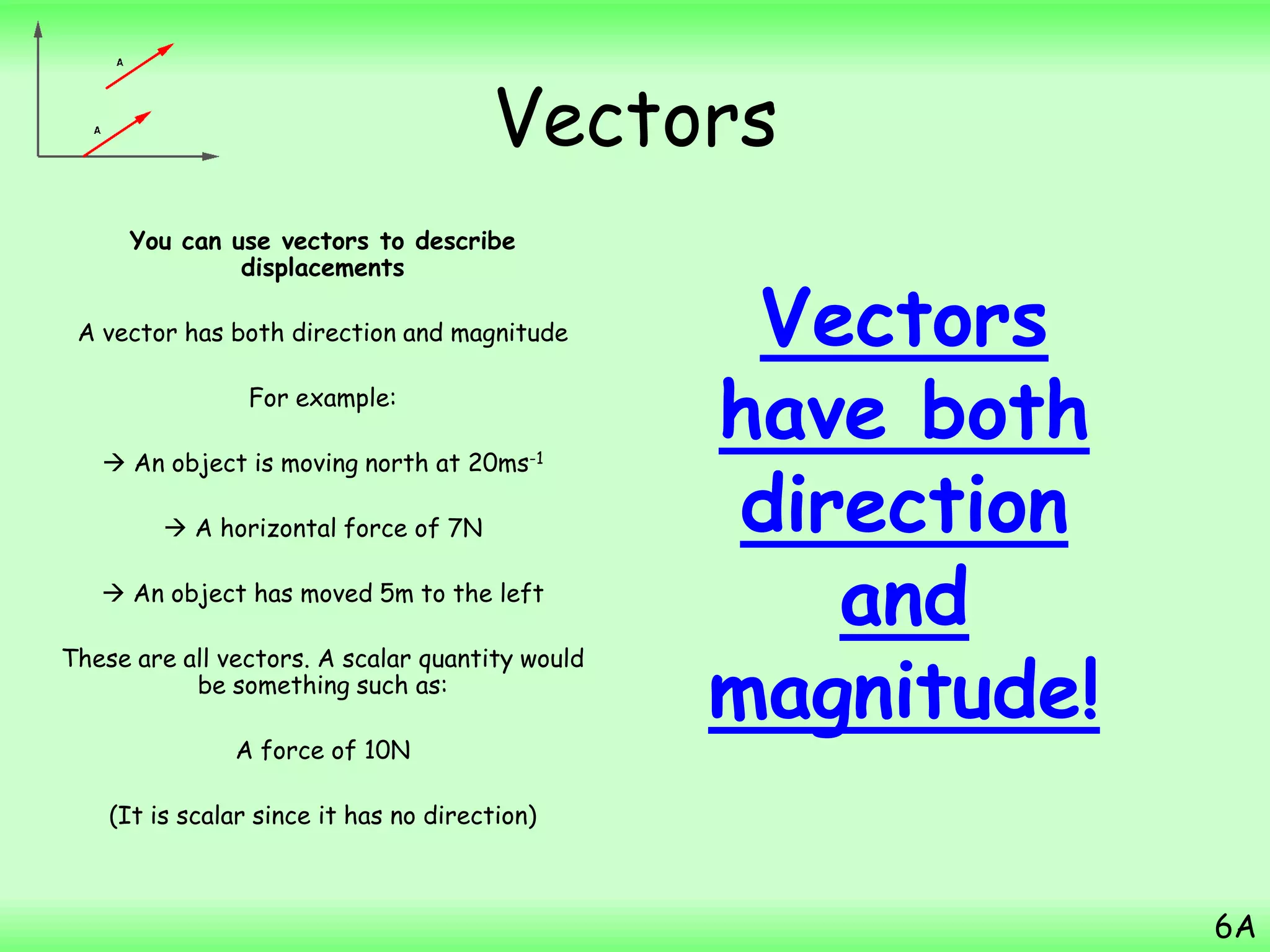
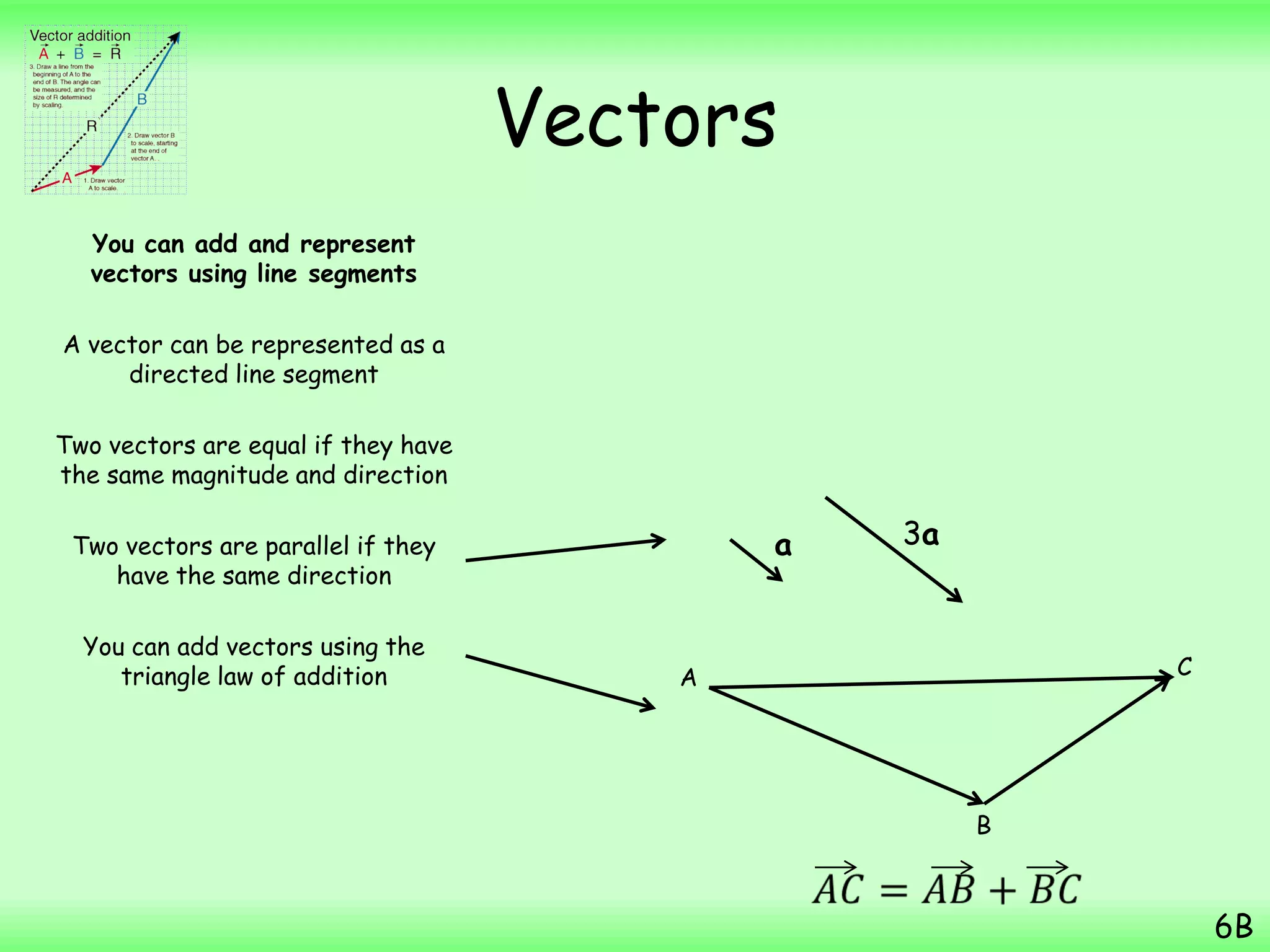
You can add and represent
vectors using line segments
A vector can be represented as a
directed line segment
Two vectors are equal if they have
the same magnitude and direction
Two vectors are parallel if they
have the same direction
You can add vectors using the
triangle law of addition
6B
A C
B
a 3a
Vectors
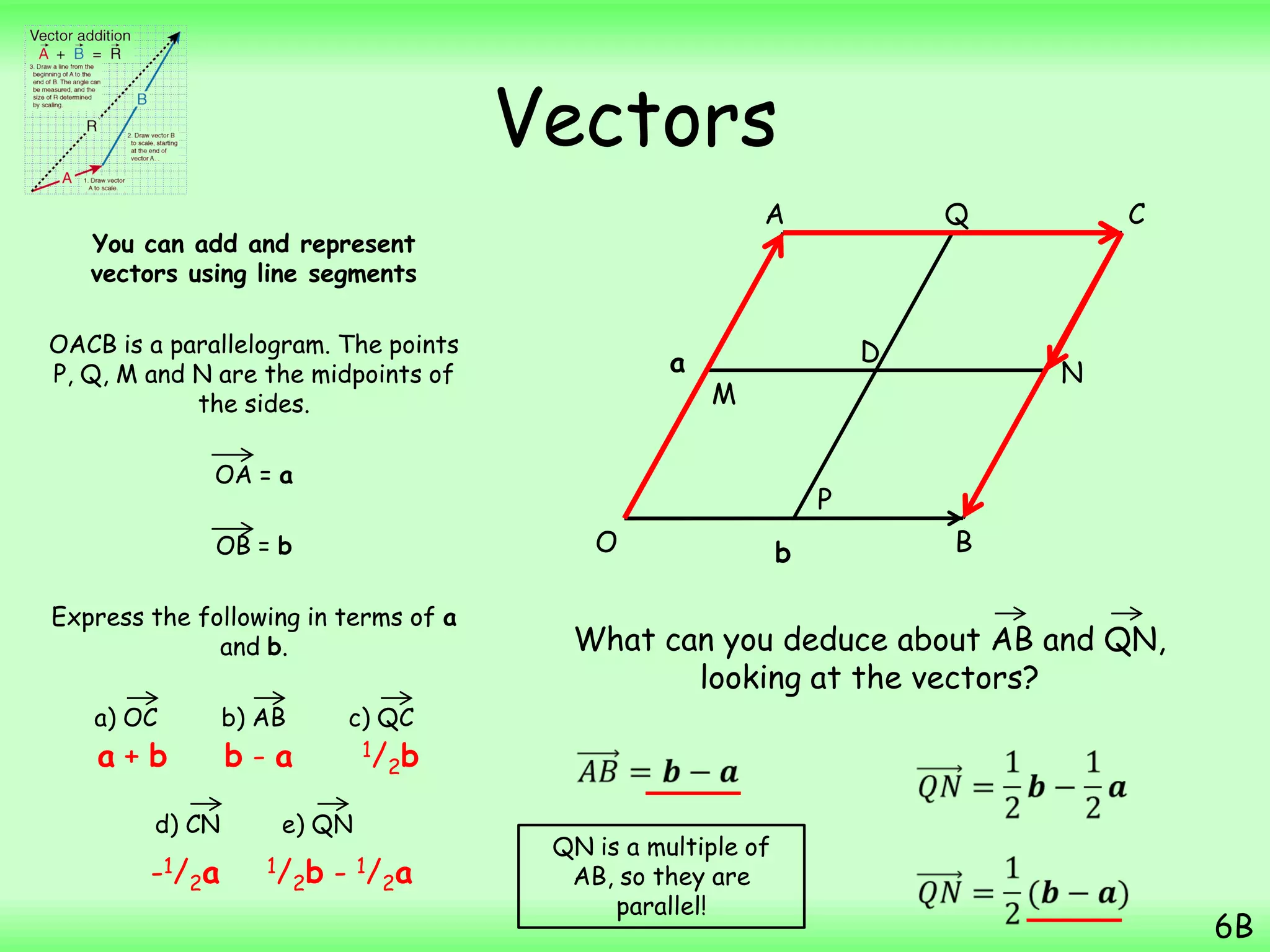
You can add and represent
vectors using line segments
OACB is a parallelogram. The points
P, Q, M and N are the midpoints of
the sides.
OA = a
OB = b
Express the following in terms of a
and b.
a) OC b) AB c) QC
d) CN e) QN
6B
M
B
P
O
N
D
QA C
b
a
a + b b - a 1/2b
-1/2a 1/2b - 1/2a
What can you deduce about AB and QN,
looking at the vectors?
QN is a multiple of
AB, so they are
parallel!
Vectors
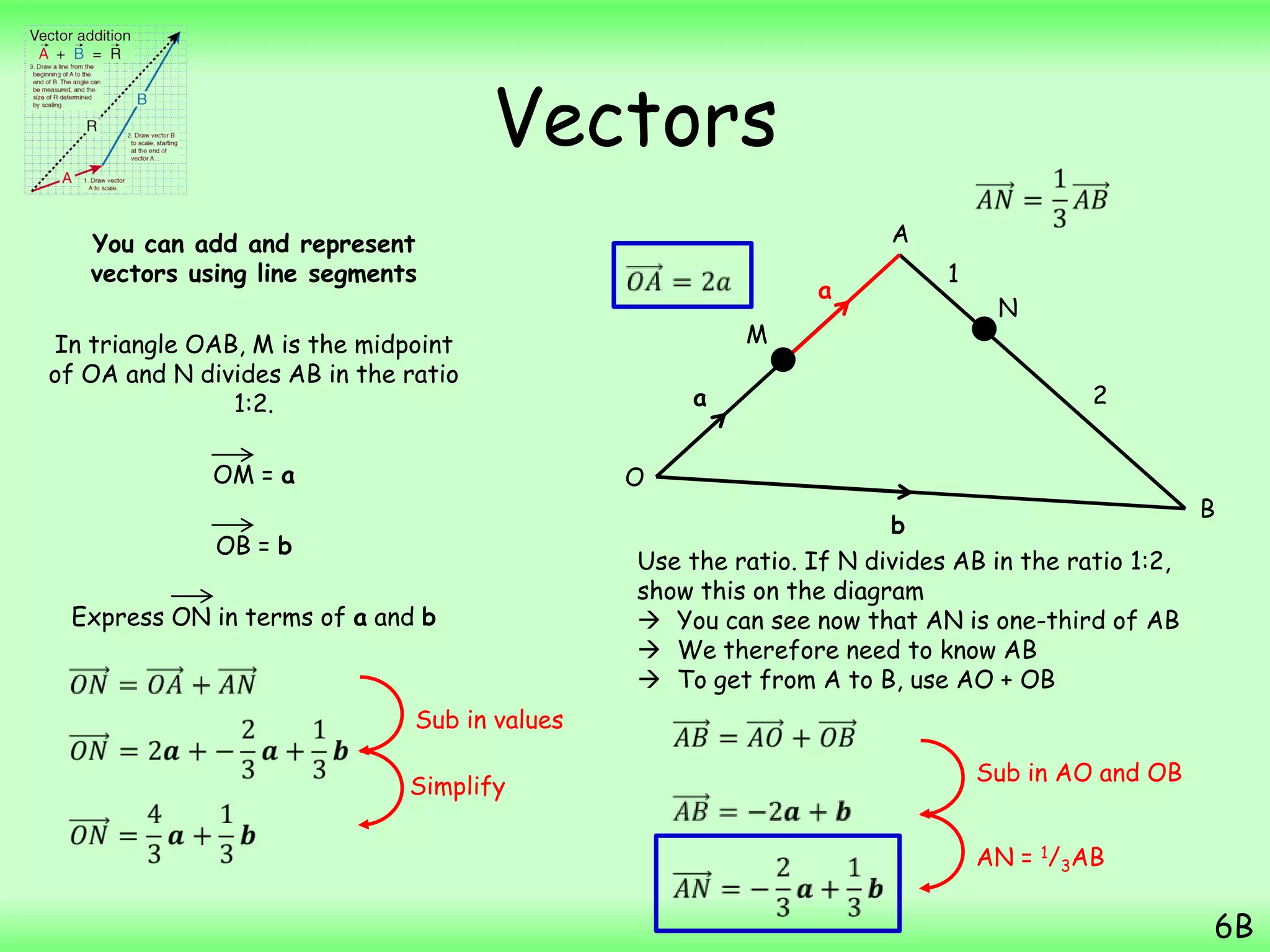
You can add and represent
vectors using line segments
In triangle OAB, M is the midpoint
of OA and N divides AB in the ratio
1:2.
OM = a
OB = b
Express ON in terms of a and b
6B
A
B
O
M
N
a
b
a
1
2
Use the ratio. If N divides AB in the ratio 1:2,
show this on the diagram
 You can see now that AN is one-third of AB
 We therefore need to know AB
 To get from A to B, use AO + OB
Sub in AO and OB
AN = 1/3AB
Sub in values
Simplify
Vectors
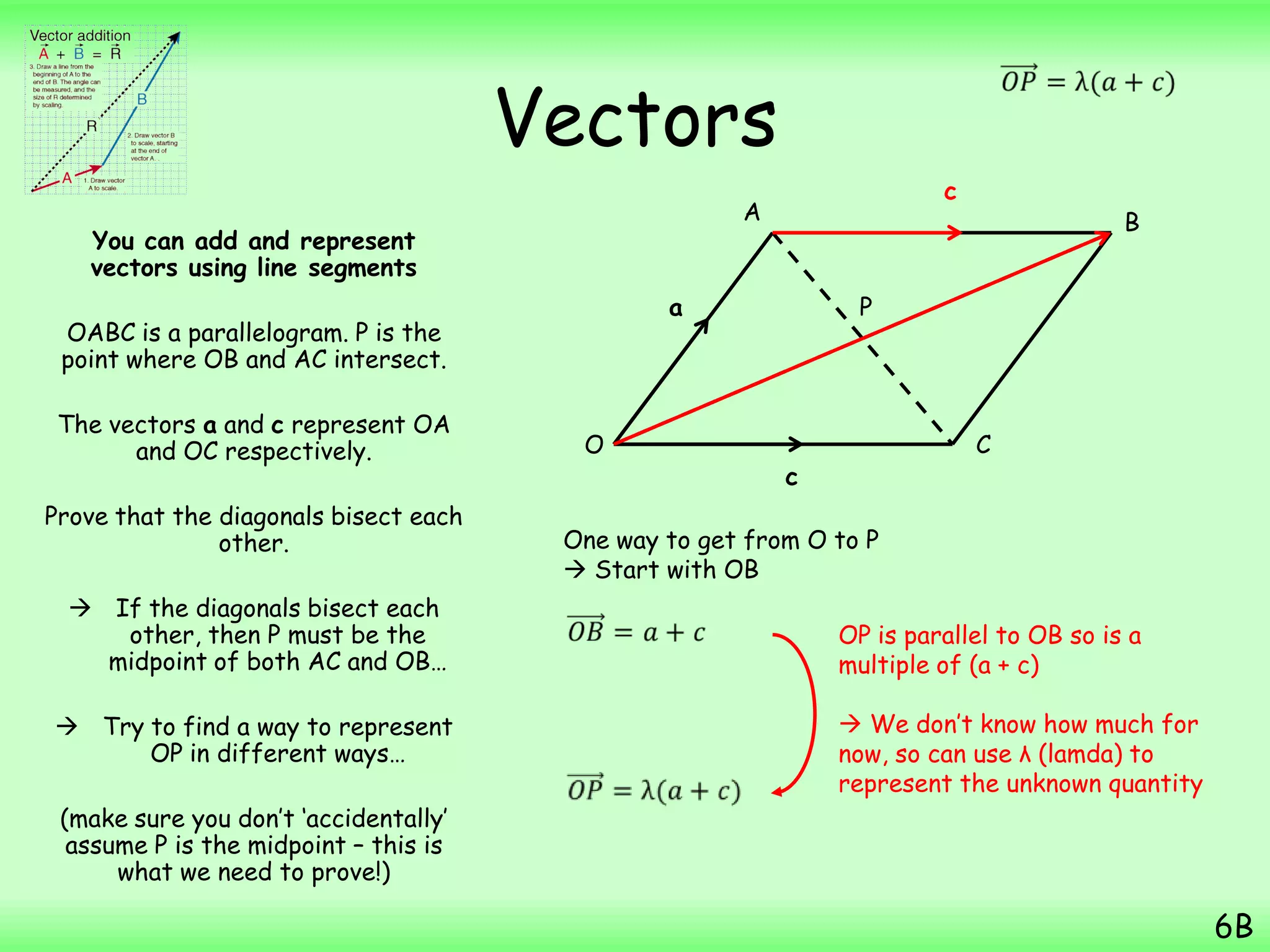
You can add and represent
vectors using line segments
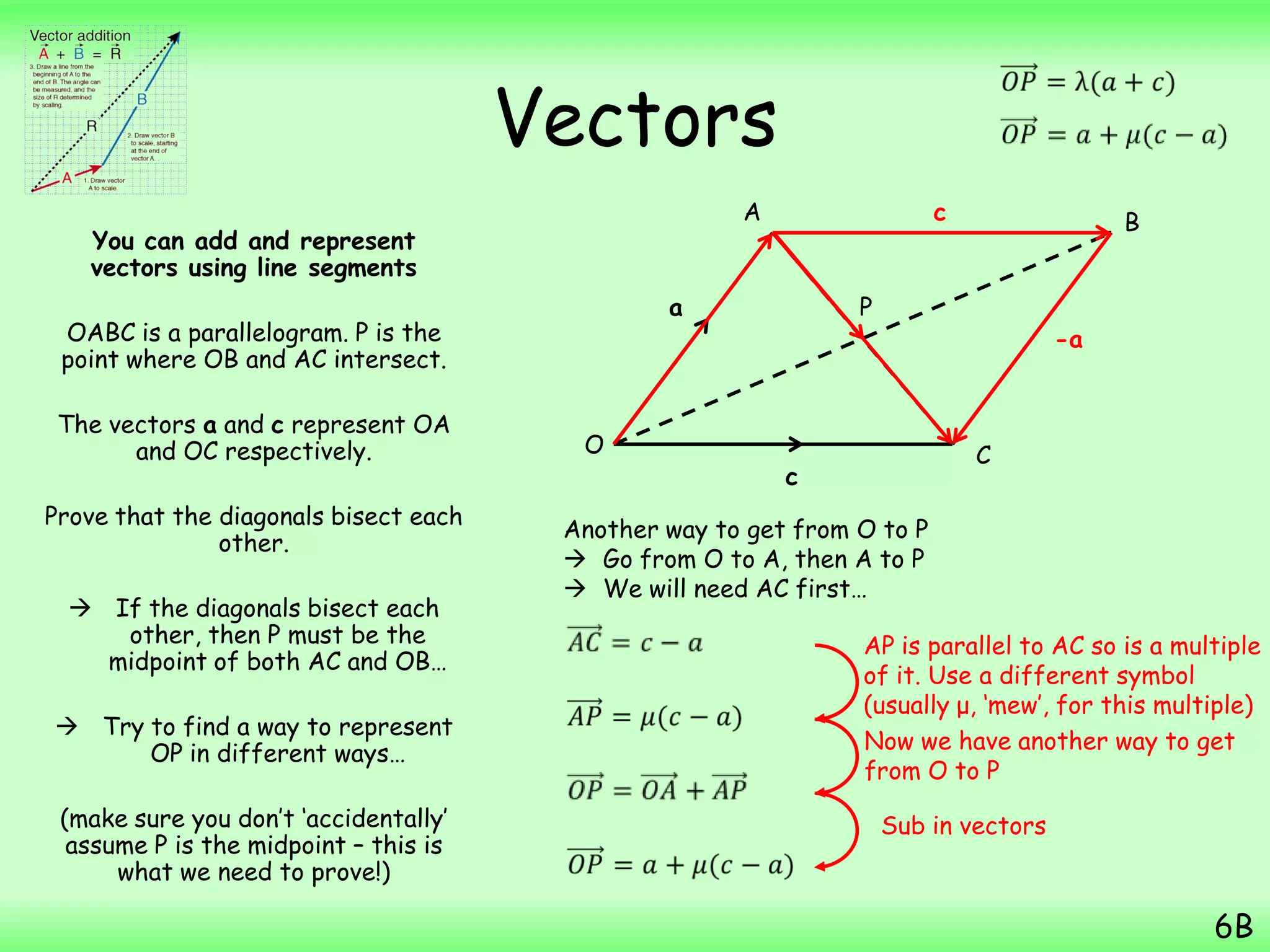
OABC is a parallelogram. P is the
point where OB and AC intersect.
The vectors a and c represent OA
and OC respectively.
Prove that the diagonals bisect each
other.
 If the diagonals bisect each
other, then P must be the
midpoint of both AC and OB…
 Try to find a way to represent
OP in different ways…
(make sure you don‟t „accidentally‟
assume P is the midpoint – this is
what we need to prove!)
6B
P
O
A B
C
a
c
One way to get from O to P
 Start with OB
OP is parallel to OB so is a
multiple of (a + c)
 We don‟t know how much for
now, so can use λ (lamda) to
represent the unknown quantity
c
Vectors
You can add and represent
vectors using line segments
OABC is a parallelogram. P is the
point where OB and AC intersect.
The vectors a and c represent OA
and OC respectively.
Prove that the diagonals bisect each
other.
 If the diagonals bisect each
other, then P must be the
midpoint of both AC and OB…
 Try to find a way to represent
OP in different ways…
(make sure you don‟t „accidentally‟
assume P is the midpoint – this is
what we need to prove!)
6B
P
O
A B
C
a
c
Another way to get from O to P
 Go from O to A, then A to P
 We will need AC first…
c
-a
AP is parallel to AC so is a multiple
of it. Use a different symbol
(usually μ, „mew‟, for this multiple)
Now we have another way to get
from O to P
Sub in vectors
Vectors
You can add and represent
vectors using line segments
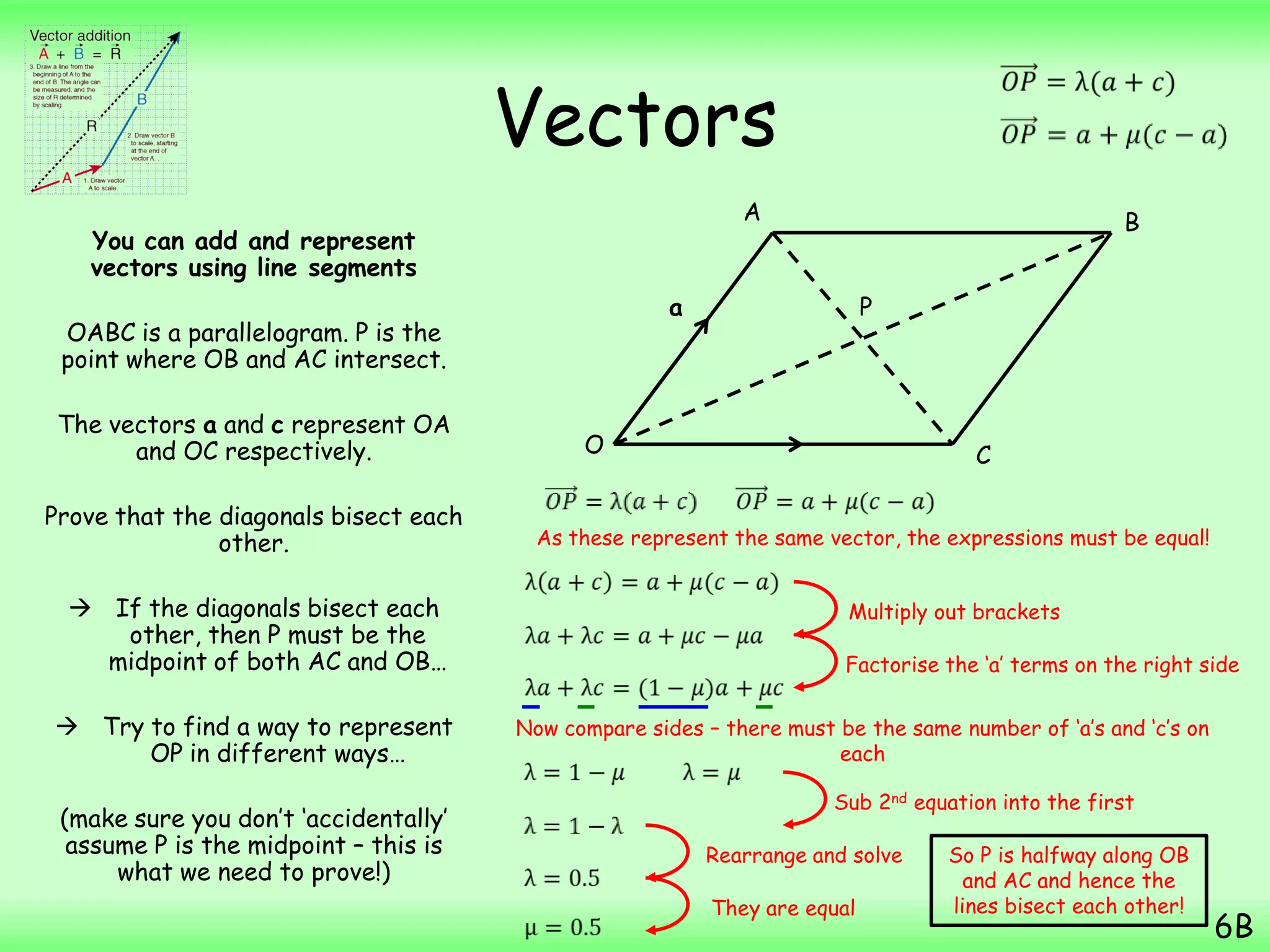
OABC is a parallelogram. P is the
point where OB and AC intersect.
The vectors a and c represent OA
and OC respectively.
Prove that the diagonals bisect each
other.
 If the diagonals bisect each
other, then P must be the
midpoint of both AC and OB…
 Try to find a way to represent
OP in different ways…
(make sure you don‟t „accidentally‟
assume P is the midpoint – this is
what we need to prove!)
6B
P
O
A B
C
a
As these represent the same vector, the expressions must be equal!
Multiply out brackets
Factorise the „a‟ terms on the right side
Now compare sides – there must be the same number of „a‟s and „c‟s on
each
Sub 2nd equation into the first
They are equal
Rearrange and solve So P is halfway along OB
and AC and hence the
lines bisect each other!
Vectors
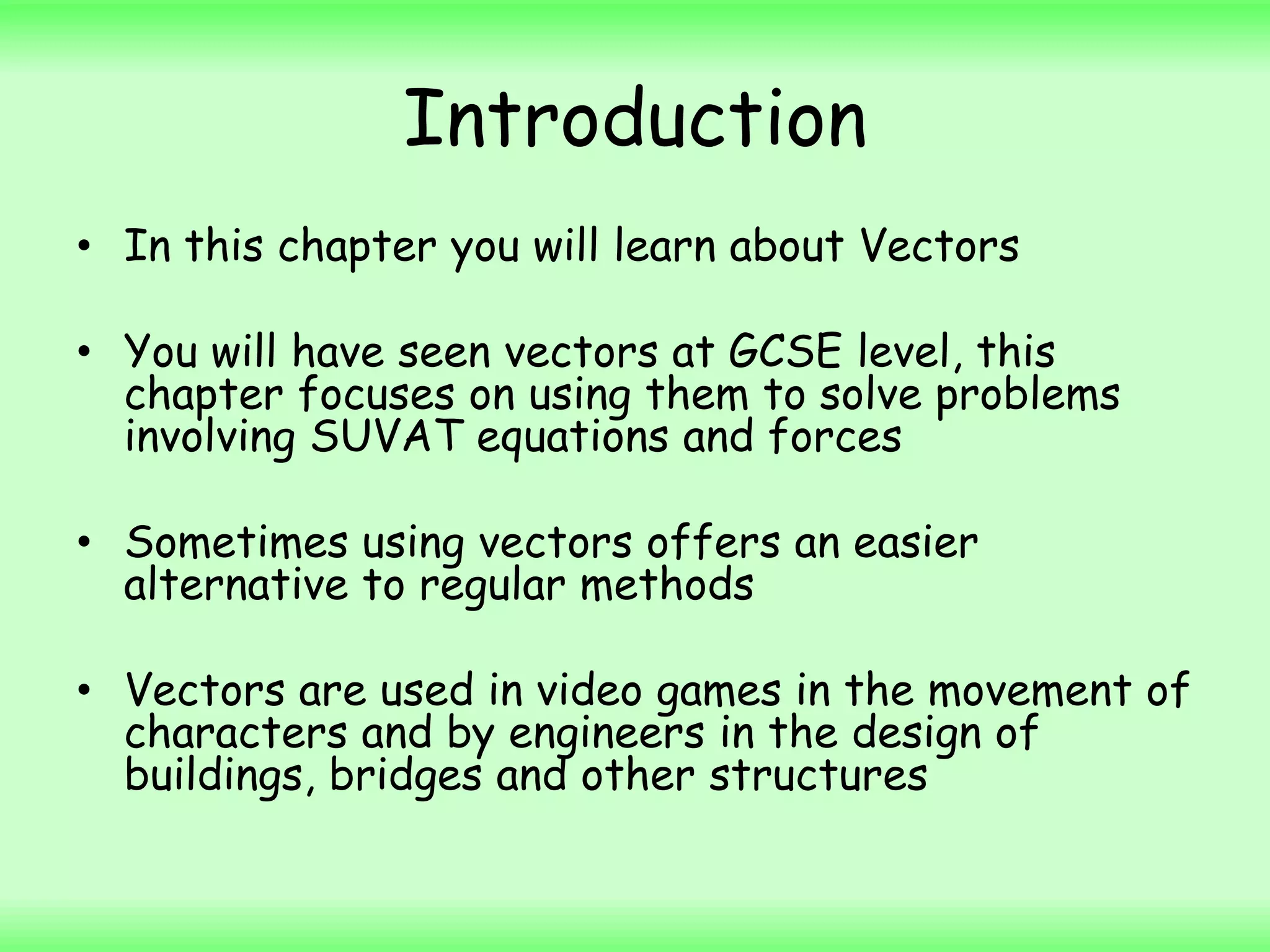
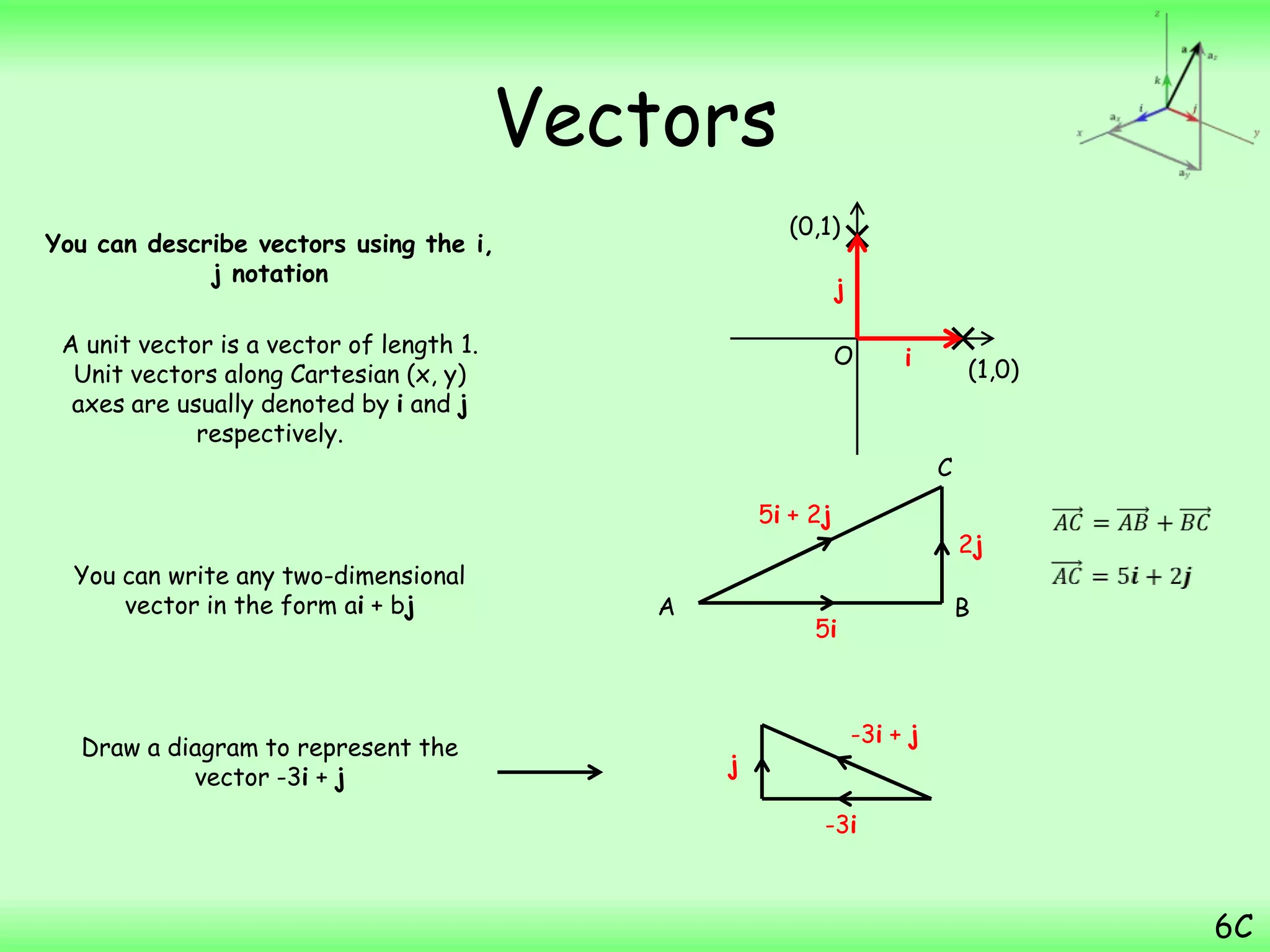
You can describe vectors using the i,
j notation
A unit vector is a vector of length 1.
Unit vectors along Cartesian (x, y)
axes are usually denoted by i and j
respectively.
You can write any two-dimensional
vector in the form ai + bj
Draw a diagram to represent the
vector -3i + j
6C
O
(0,1)
(1,0)
j
i
A B
C
5i
2j
5i + 2j
-3i
j
-3i + j
Vectors
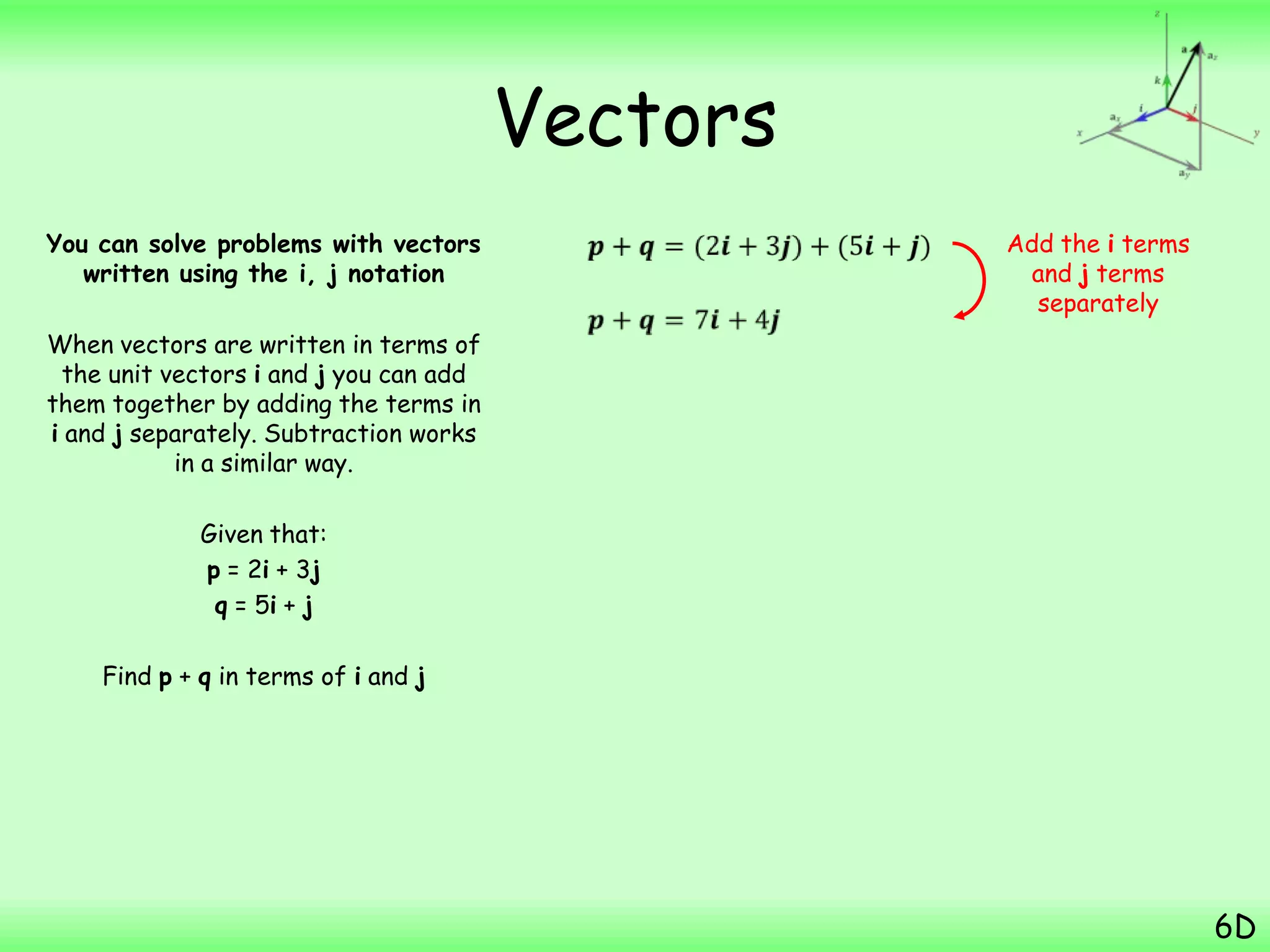
You can solve problems with vectors
written using the i, j notation
When vectors are written in terms of
the unit vectors i and j you can add
them together by adding the terms in
i and j separately. Subtraction works
in a similar way.
Given that:
p = 2i + 3j
q = 5i + j
Find p + q in terms of i and j
6D
Add the i terms
and j terms
separately
Vectors
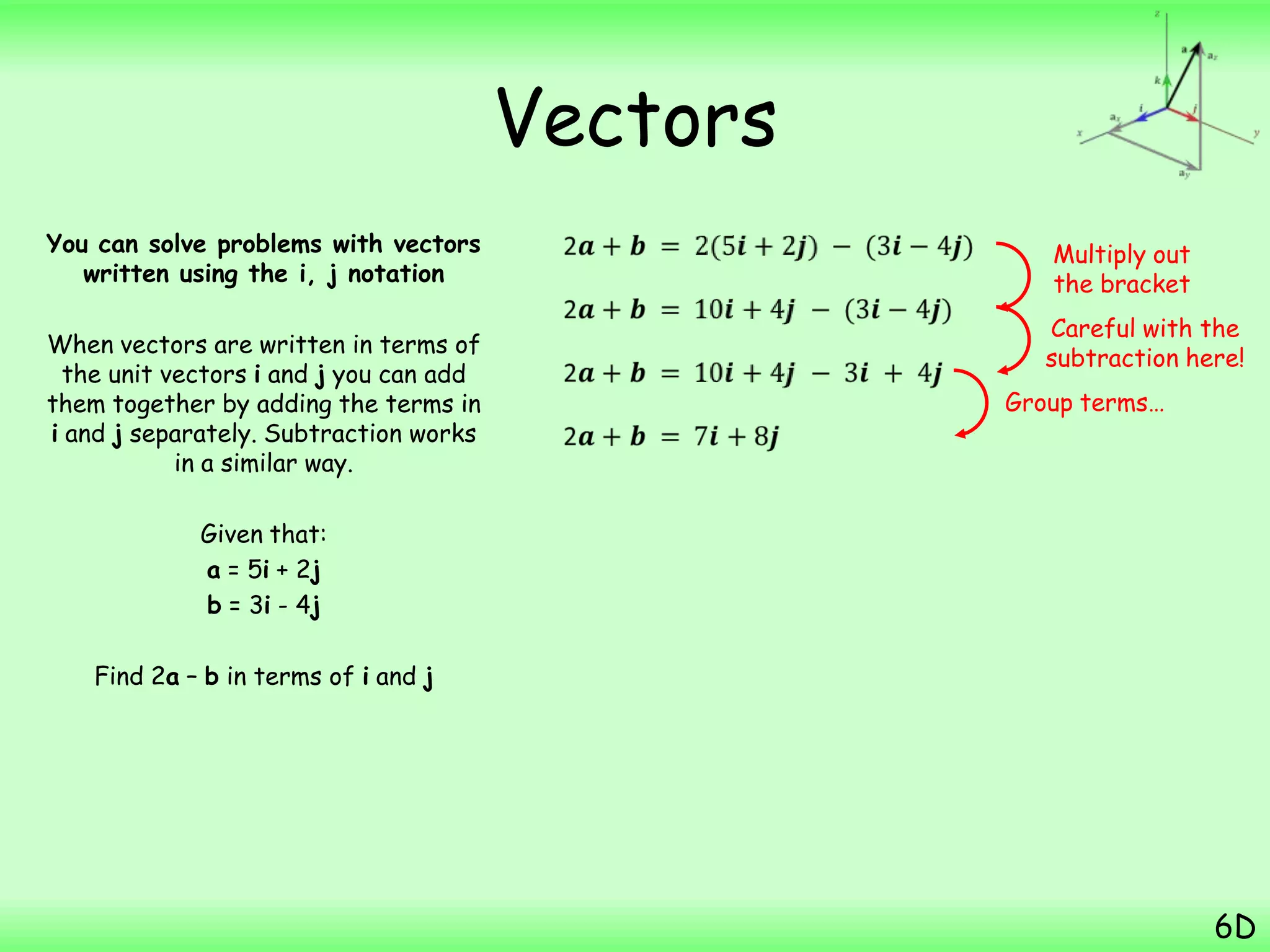
You can solve problems with vectors
written using the i, j notation
When vectors are written in terms of
the unit vectors i and j you can add
them together by adding the terms in
i and j separately. Subtraction works
in a similar way.
Given that:
a = 5i + 2j
b = 3i - 4j
Find 2a – b in terms of i and j
6D
Multiply out
the bracket
Careful with the
subtraction here!
Group terms…
Vectors
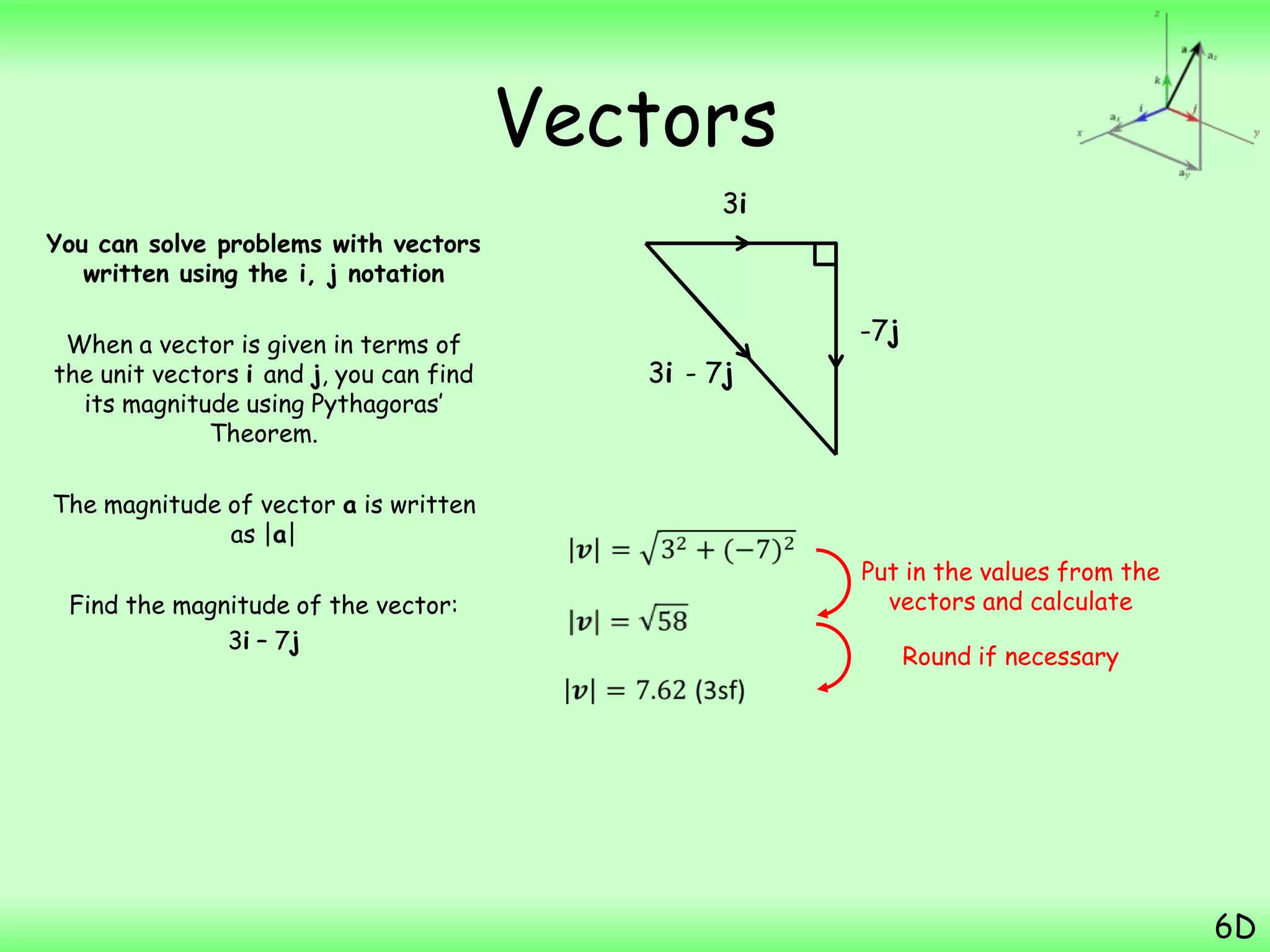
You can solve problems with vectors
written using the i, j notation
When a vector is given in terms of
the unit vectors i and j, you can find
its magnitude using Pythagoras‟
Theorem.
The magnitude of vector a is written
as |a|
Find the magnitude of the vector:
3i – 7j
6D
3i
-7j
3i - 7j
Put in the values from the
vectors and calculate
Round if necessary
Vectors
You can solve problems with vectors
written using the i, j notation
You can also use trigonometry to find
an angle between a vector and the
axes
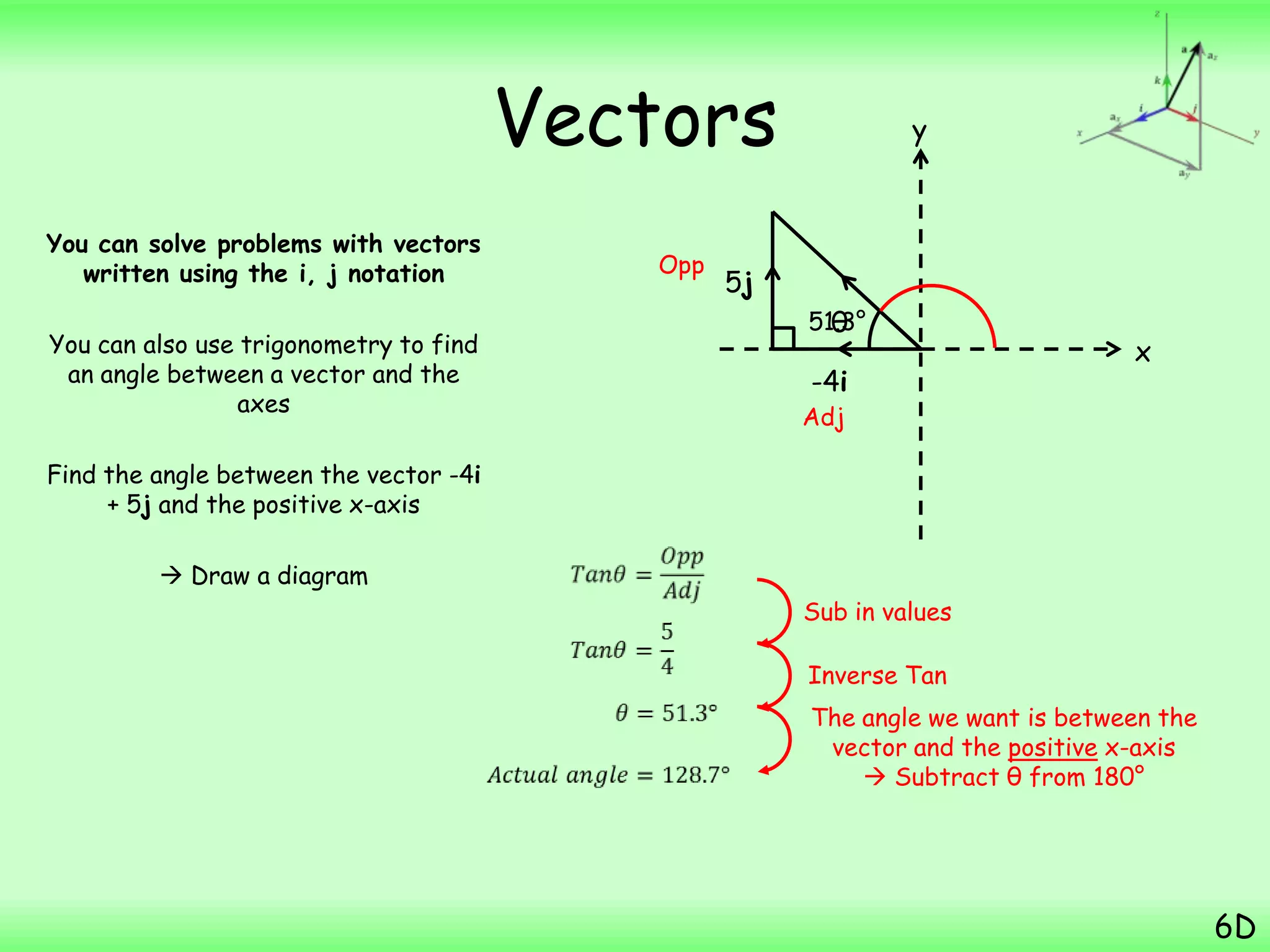
Find the angle between the vector -4i
+ 5j and the positive x-axis
 Draw a diagram
6D
-4i
x
θ
5j
y
Opp
Adj
Sub in values
Inverse Tan
The angle we want is between the
vector and the positive x-axis
 Subtract θ from 180°
51.3°
Vectors
You can solve problems with vectors
written using the i, j notation
Given that:
a = 3i - j
b = i + j
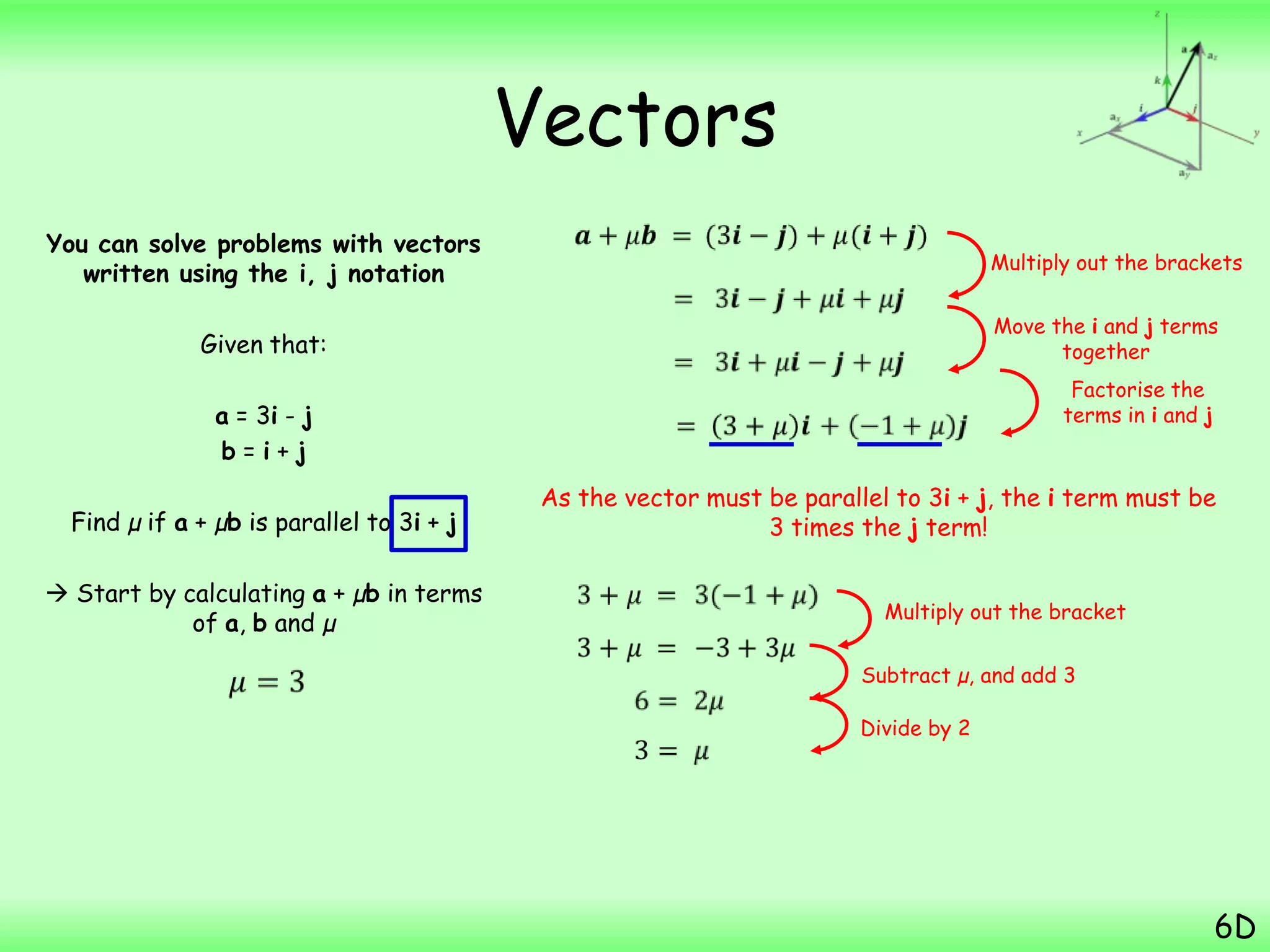
Find µ if a + µb is parallel to 3i + j
 Start by calculating a + µb in terms
of a, b and µ
6D
As the vector must be parallel to 3i + j, the i term must be
3 times the j term!
Multiply out the brackets
Divide by 2
Move the i and j terms
together
Factorise the
terms in i and j
Multiply out the bracket
Subtract µ, and add 3
Vectors
You can solve problems with vectors
written using the i, j notation
Given that:
a = 3i - j
b = i + j
Find µ if a + µb is parallel to 3i + j
 Start by calculating a + µb in terms
of a, b and µ
6D
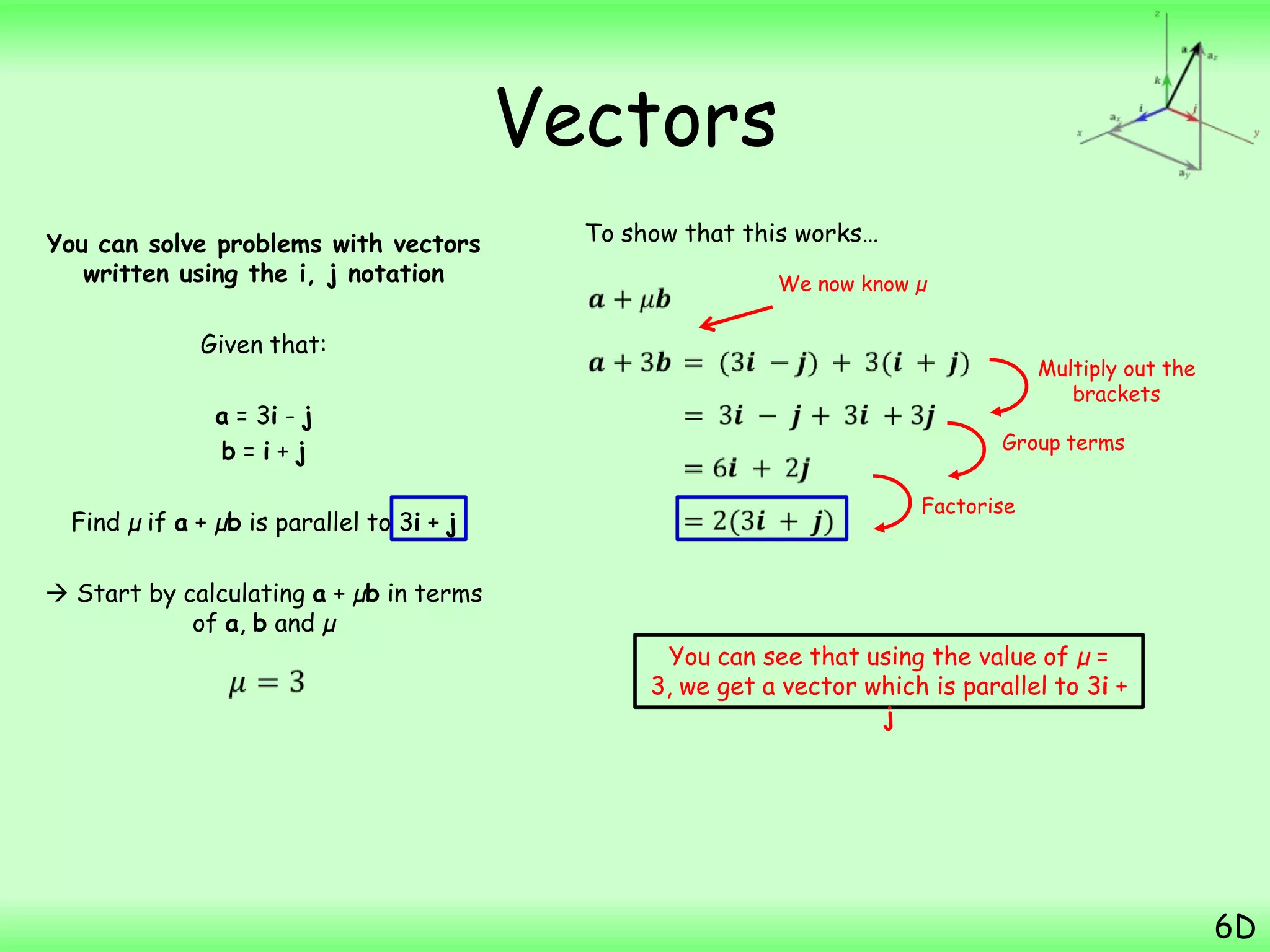
To show that this works…
Multiply out the
brackets
We now know µ
Group terms
Factorise
You can see that using the value of µ =
3, we get a vector which is parallel to 3i +
j
Vectors
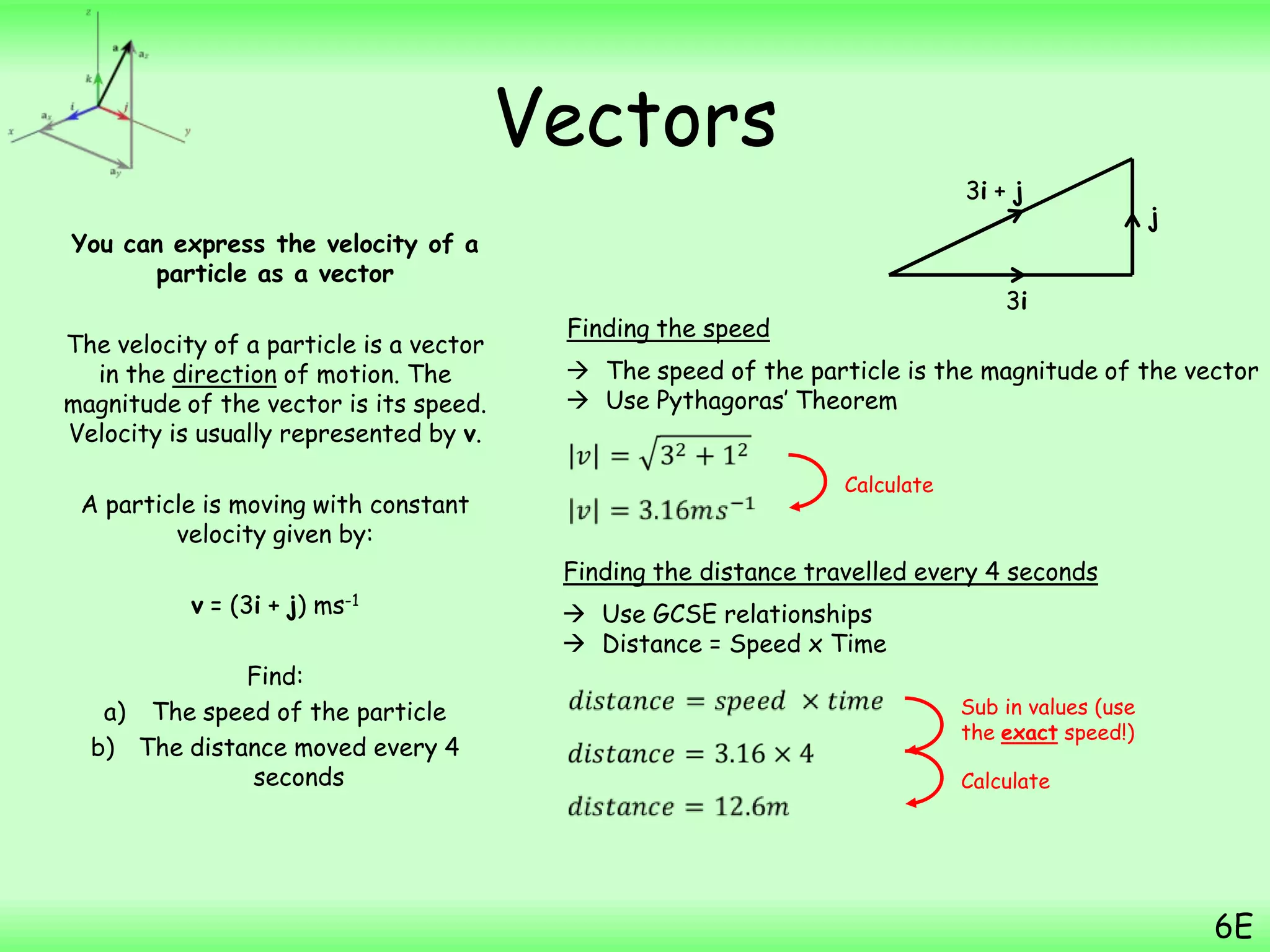
You can express the velocity of a
particle as a vector
The velocity of a particle is a vector
in the direction of motion. The
magnitude of the vector is its speed.
Velocity is usually represented by v.
A particle is moving with constant
velocity given by:
v = (3i + j) ms-1
Find:
a) The speed of the particle
b) The distance moved every 4
seconds
6E
Finding the speed
 The speed of the particle is the magnitude of the vector
 Use Pythagoras‟ Theorem
3i
j
3i + j
Finding the distance travelled every 4 seconds
 Use GCSE relationships
 Distance = Speed x Time
Sub in values (use
the exact speed!)
Calculate
Calculate
Vectors
You can solve problems involving
velocity, time, mass and forces (as
in earlier chapters) by using vector
notation
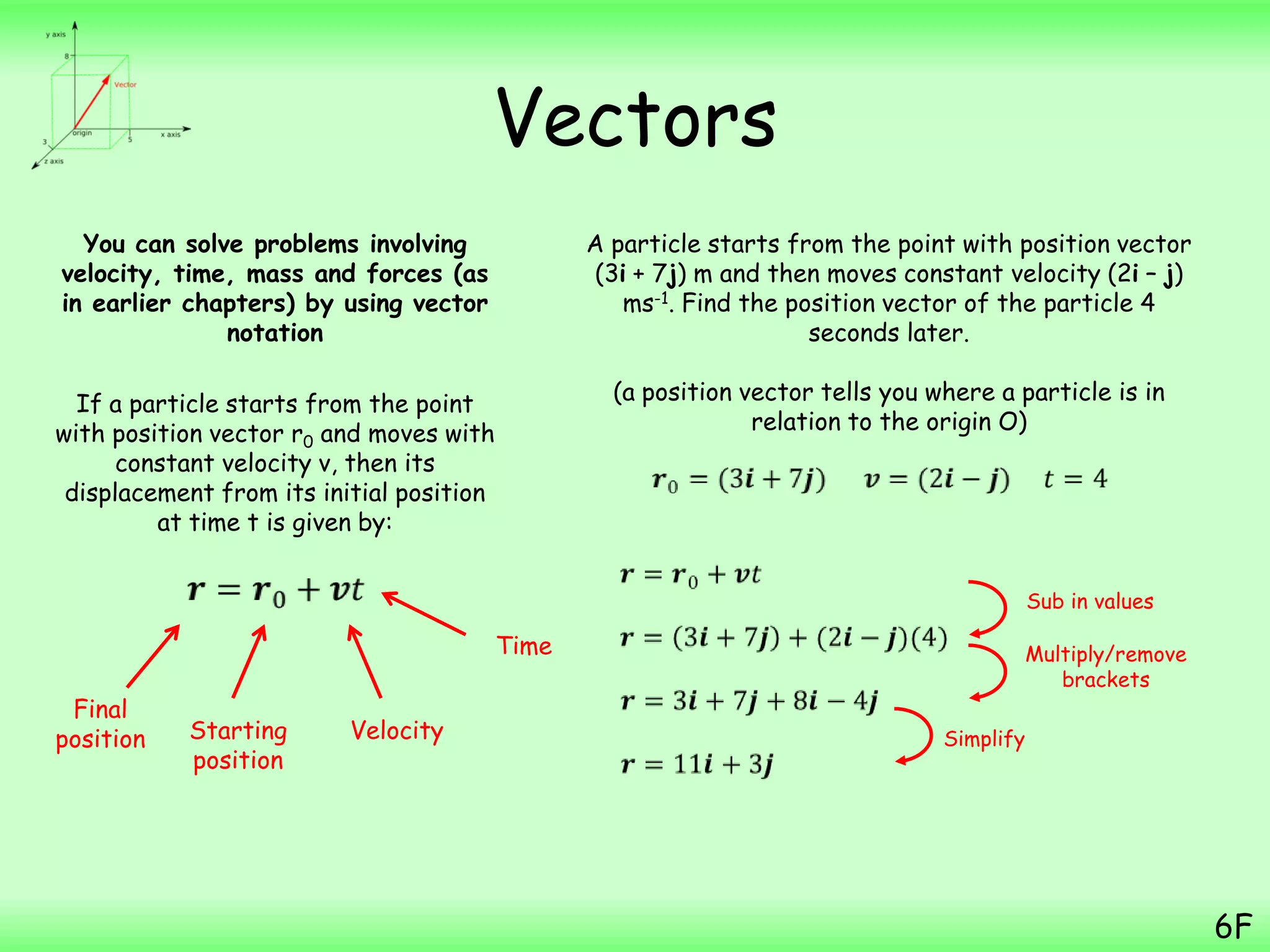
If a particle starts from the point
with position vector r0 and moves with
constant velocity v, then its
displacement from its initial position
at time t is given by:
6F
Final
position Starting
position
Velocity
Time
A particle starts from the point with position vector
(3i + 7j) m and then moves constant velocity (2i – j)
ms-1. Find the position vector of the particle 4
seconds later.
(a position vector tells you where a particle is in
relation to the origin O)
Sub in values
Multiply/remove
brackets
Simplify
Vectors
You can solve problems involving
velocity, time, mass and forces (as
in earlier chapters) by using vector
notation
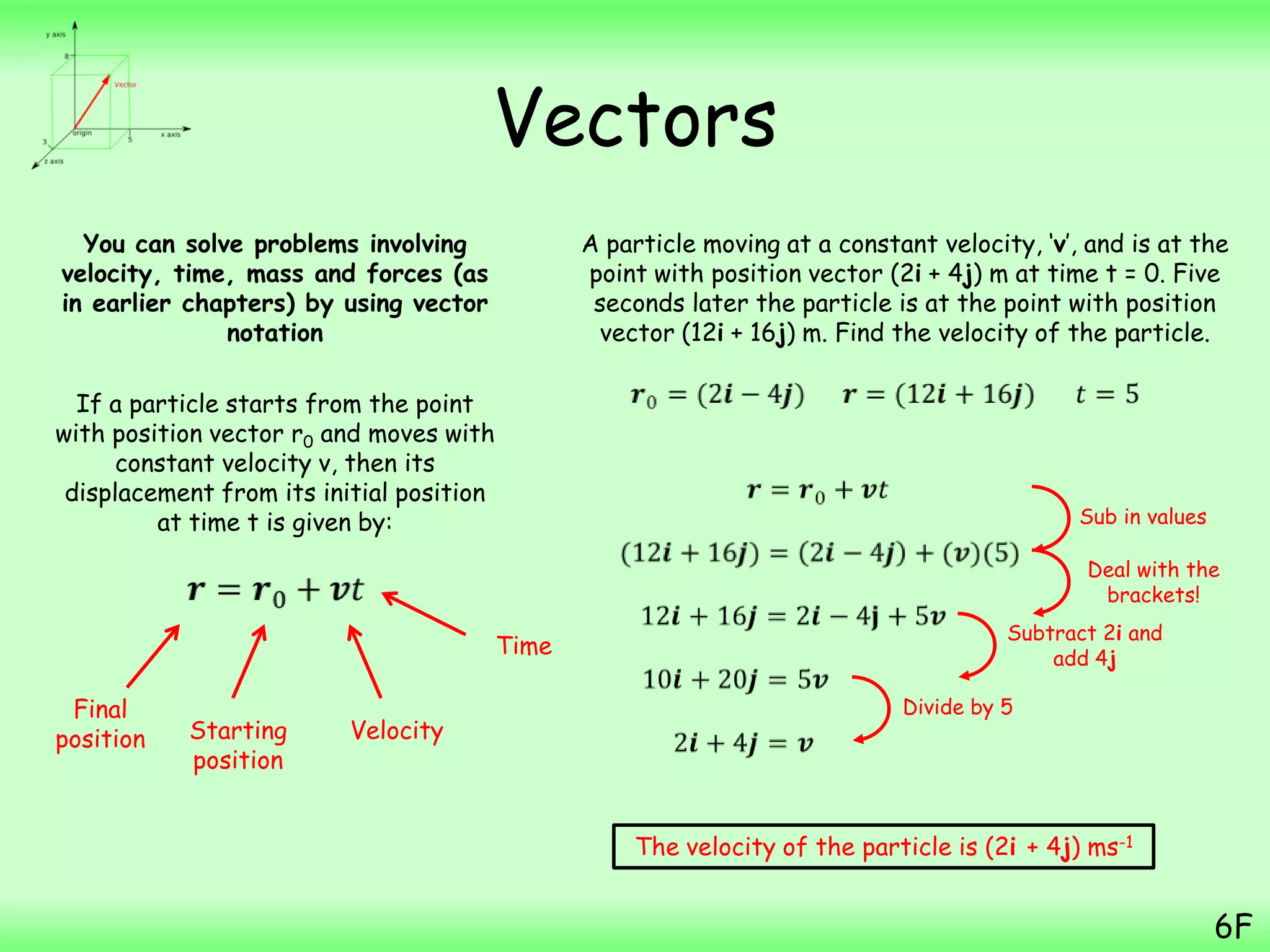
If a particle starts from the point
with position vector r0 and moves with
constant velocity v, then its
displacement from its initial position
at time t is given by:
6F
Final
position Starting
position
Velocity
Time
A particle moving at a constant velocity, „v‟, and is at the
point with position vector (2i + 4j) m at time t = 0. Five
seconds later the particle is at the point with position
vector (12i + 16j) m. Find the velocity of the particle.
Sub in values
The velocity of the particle is (2i + 4j) ms-1
Deal with the
brackets!
Subtract 2i and
add 4j
Divide by 5
Vectors
You can solve problems involving
velocity, time, mass and forces (as in
earlier chapters) by using vector
notation
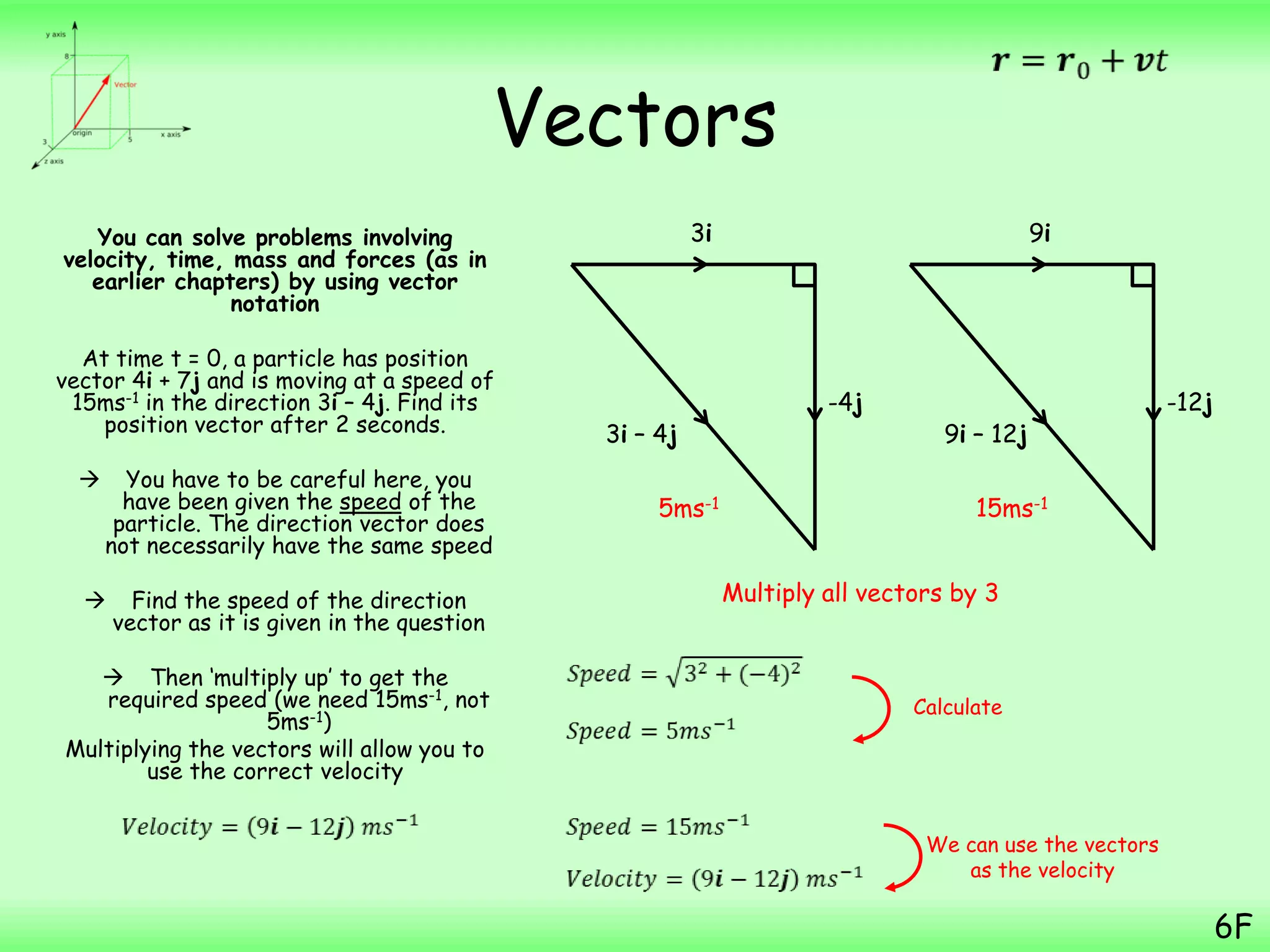
At time t = 0, a particle has position
vector 4i + 7j and is moving at a speed of
15ms-1 in the direction 3i – 4j. Find its
position vector after 2 seconds.
 You have to be careful here, you
have been given the speed of the
particle. The direction vector does
not necessarily have the same speed
 Find the speed of the direction
vector as it is given in the question
 Then „multiply up‟ to get the
required speed (we need 15ms-1, not
5ms-1)
Multiplying the vectors will allow you to
use the correct velocity
6F
3i
-4j
3i – 4j
9i
-12j
9i – 12j
5ms-1 15ms-1
Multiply all vectors by 3
Calculate
We can use the vectors
as the velocity
Vectors
You can solve problems involving
velocity, time, mass and forces (as in
earlier chapters) by using vector
notation
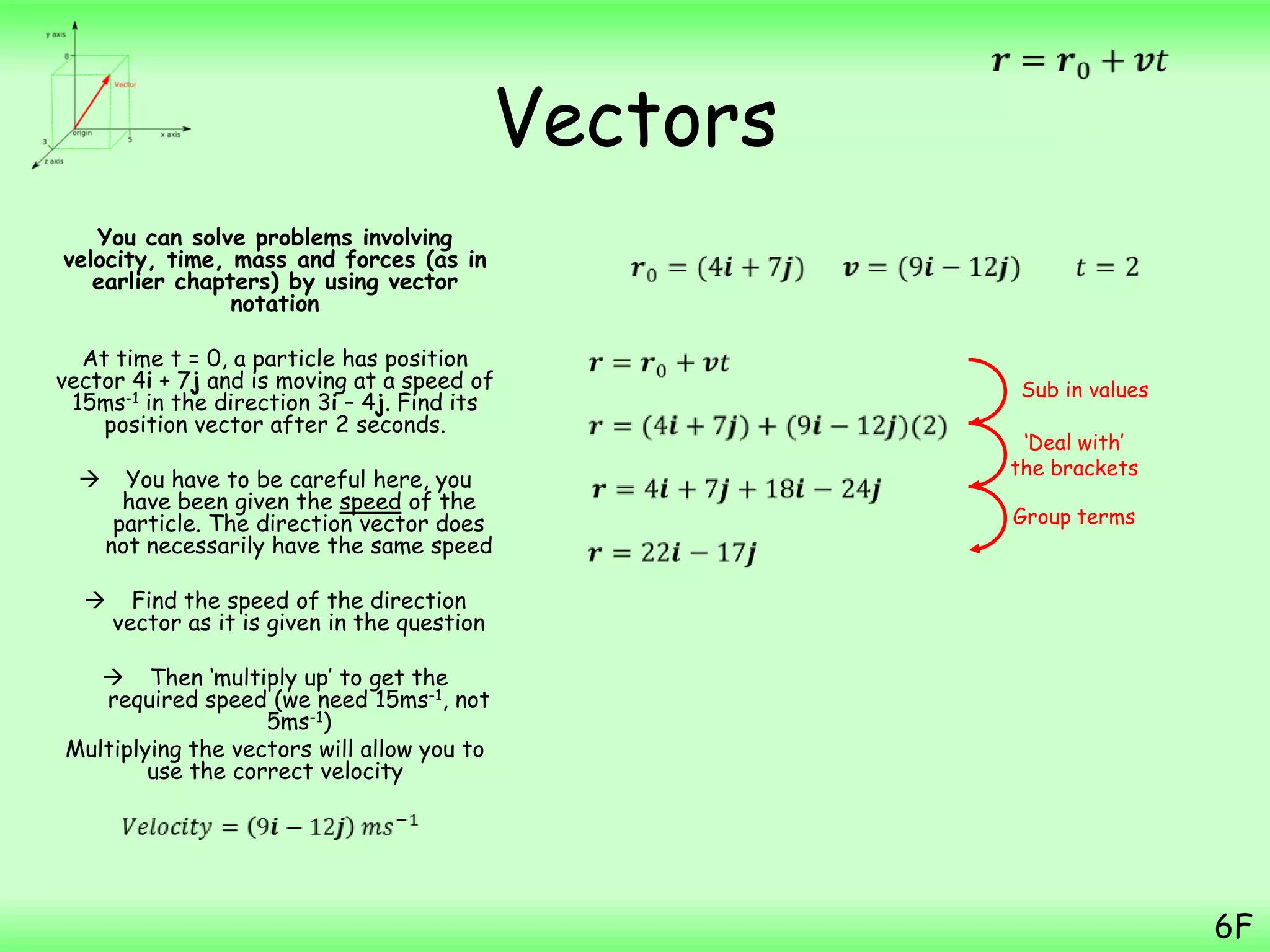
At time t = 0, a particle has position
vector 4i + 7j and is moving at a speed of
15ms-1 in the direction 3i – 4j. Find its
position vector after 2 seconds.
 You have to be careful here, you
have been given the speed of the
particle. The direction vector does
not necessarily have the same speed
 Find the speed of the direction
vector as it is given in the question
 Then „multiply up‟ to get the
required speed (we need 15ms-1, not
5ms-1)
Multiplying the vectors will allow you to
use the correct velocity
6F
Sub in values
„Deal with‟
the brackets
Group terms
Vectors
You can solve problems involving
velocity, time, mass and forces (as
in earlier chapters) by using vector
notation
You can also solve problems involving
acceleration by using:
v = u + at
Where v, u and a are all given in
vector form.
Particle P has velocity (-3i + j) ms-1 at
time t = 0. The particle moves along
with constant acceleration a = (2i +
3j) ms-2. Find the speed of the
particle after 3 seconds.
6F
Sub in values
„Deal with‟
the brackets
Group terms
Remember this is the velocity, not the speed!
Calculate!
Vectors
You can solve problems involving
velocity, time, mass and forces (as
in earlier chapters) by using vector
notation
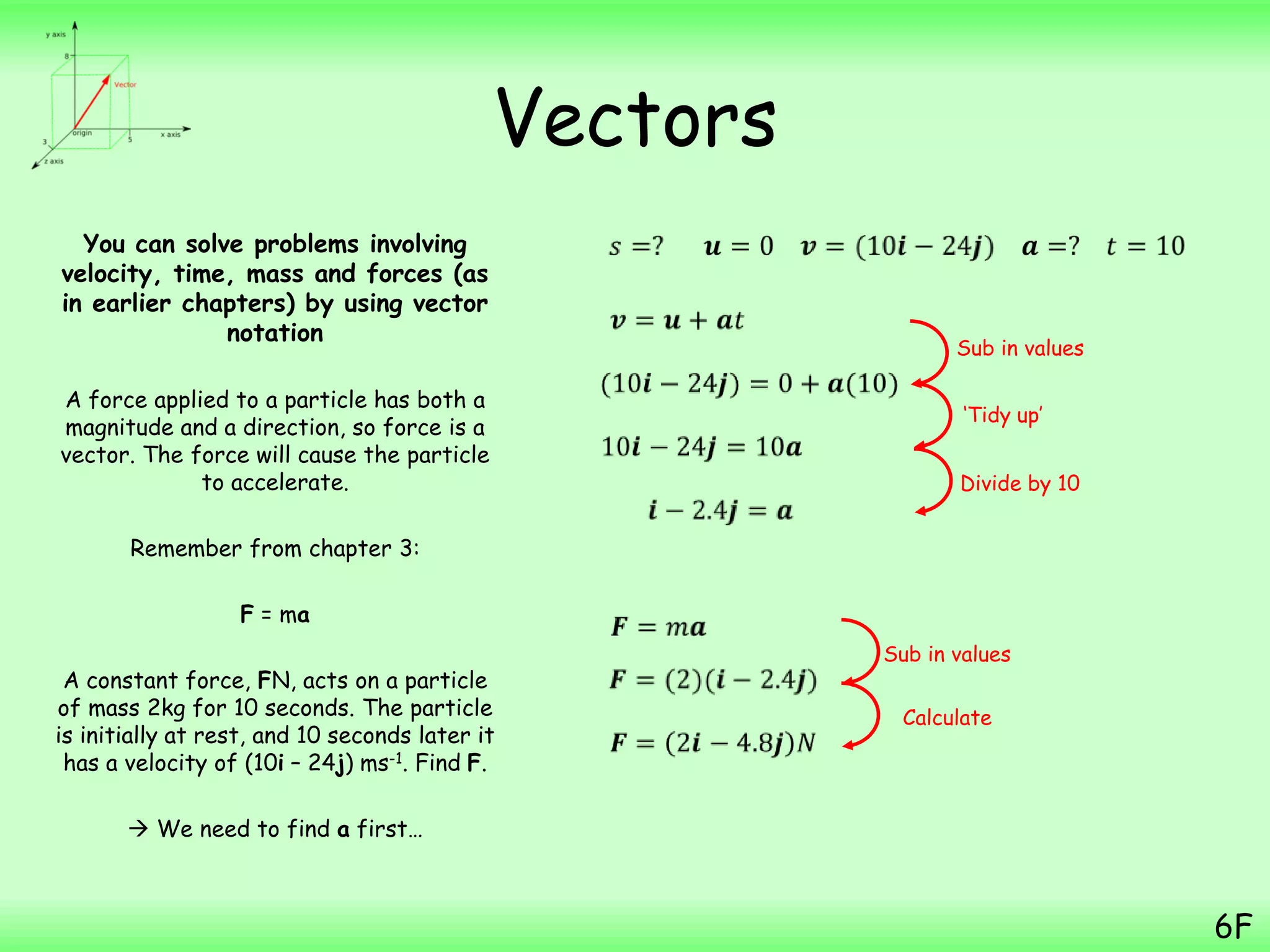
A force applied to a particle has both a
magnitude and a direction, so force is a
vector. The force will cause the particle
to accelerate.
Remember from chapter 3:
F = ma
A constant force, FN, acts on a particle
of mass 2kg for 10 seconds. The particle
is initially at rest, and 10 seconds later it
has a velocity of (10i – 24j) ms-1. Find F.
 We need to find a first…
6F
Sub in values
„Tidy up‟
Divide by 10
Sub in values
Calculate
Vectors
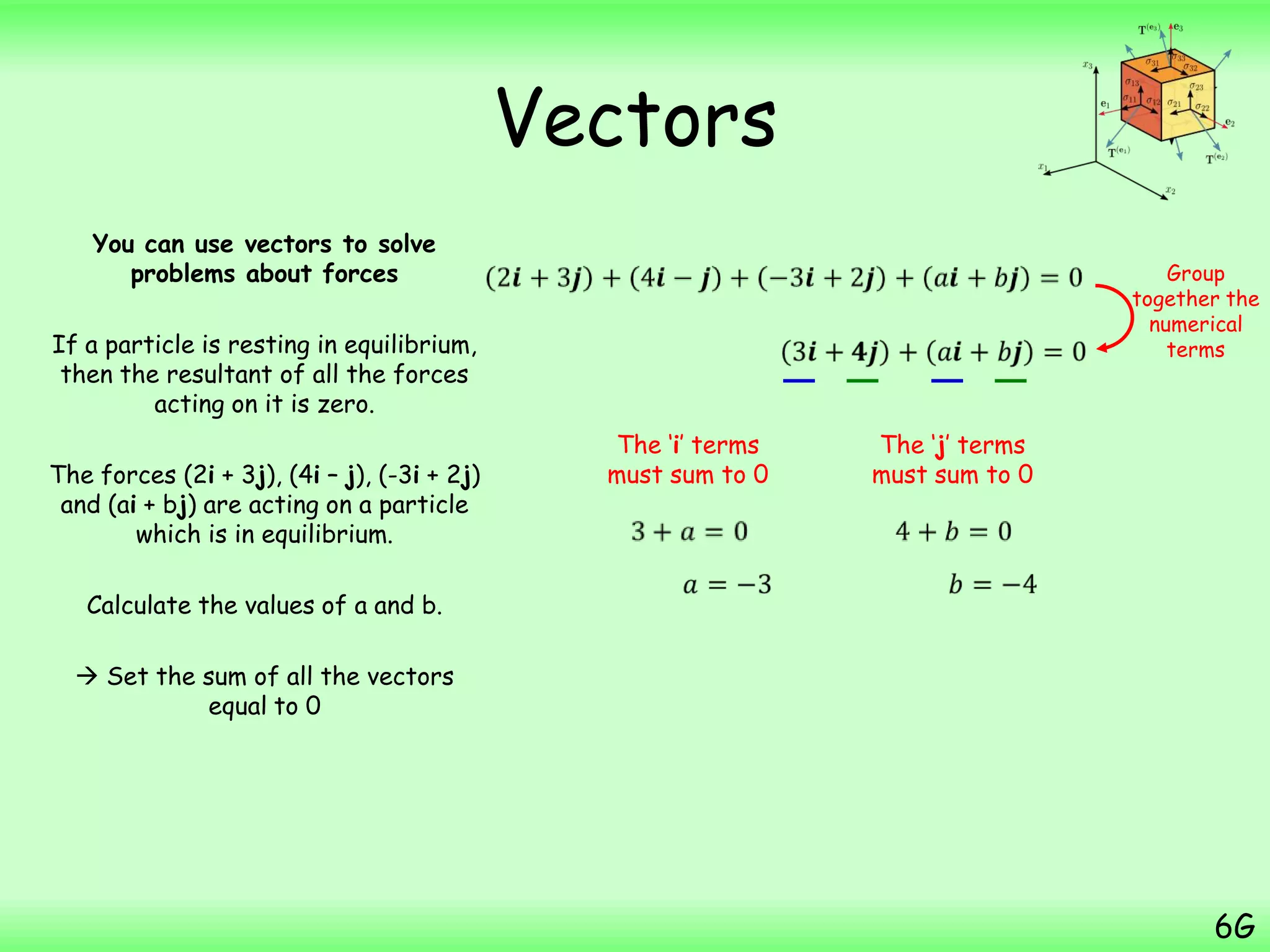
You can use vectors to solve
problems about forces
If a particle is resting in equilibrium,
then the resultant of all the forces
acting on it is zero.
The forces (2i + 3j), (4i – j), (-3i + 2j)
and (ai + bj) are acting on a particle
which is in equilibrium.
Calculate the values of a and b.
 Set the sum of all the vectors
equal to 0
6G
Group
together the
numerical
terms
The „i‟ terms
must sum to 0
The „j‟ terms
must sum to 0
Vectors
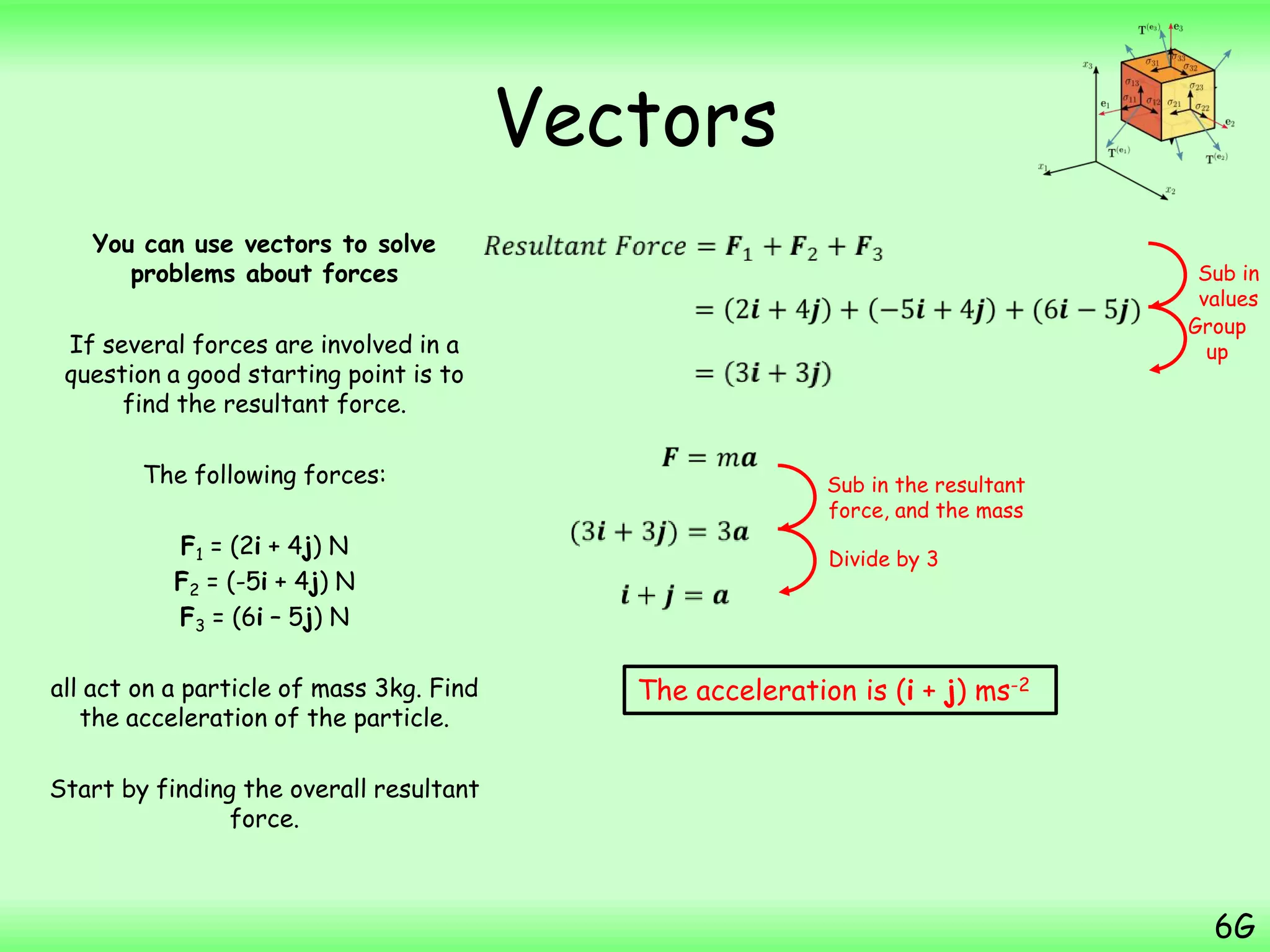
You can use vectors to solve
problems about forces
If several forces are involved in a
question a good starting point is to
find the resultant force.
The following forces:
F1 = (2i + 4j) N
F2 = (-5i + 4j) N
F3 = (6i – 5j) N
all act on a particle of mass 3kg. Find
the acceleration of the particle.
Start by finding the overall resultant
force.
6G
The acceleration is (i + j) ms-2
Sub in
values
Group
up
Sub in the resultant
force, and the mass
Divide by 3
Vectors
You can use vectors to solve problems
about forces
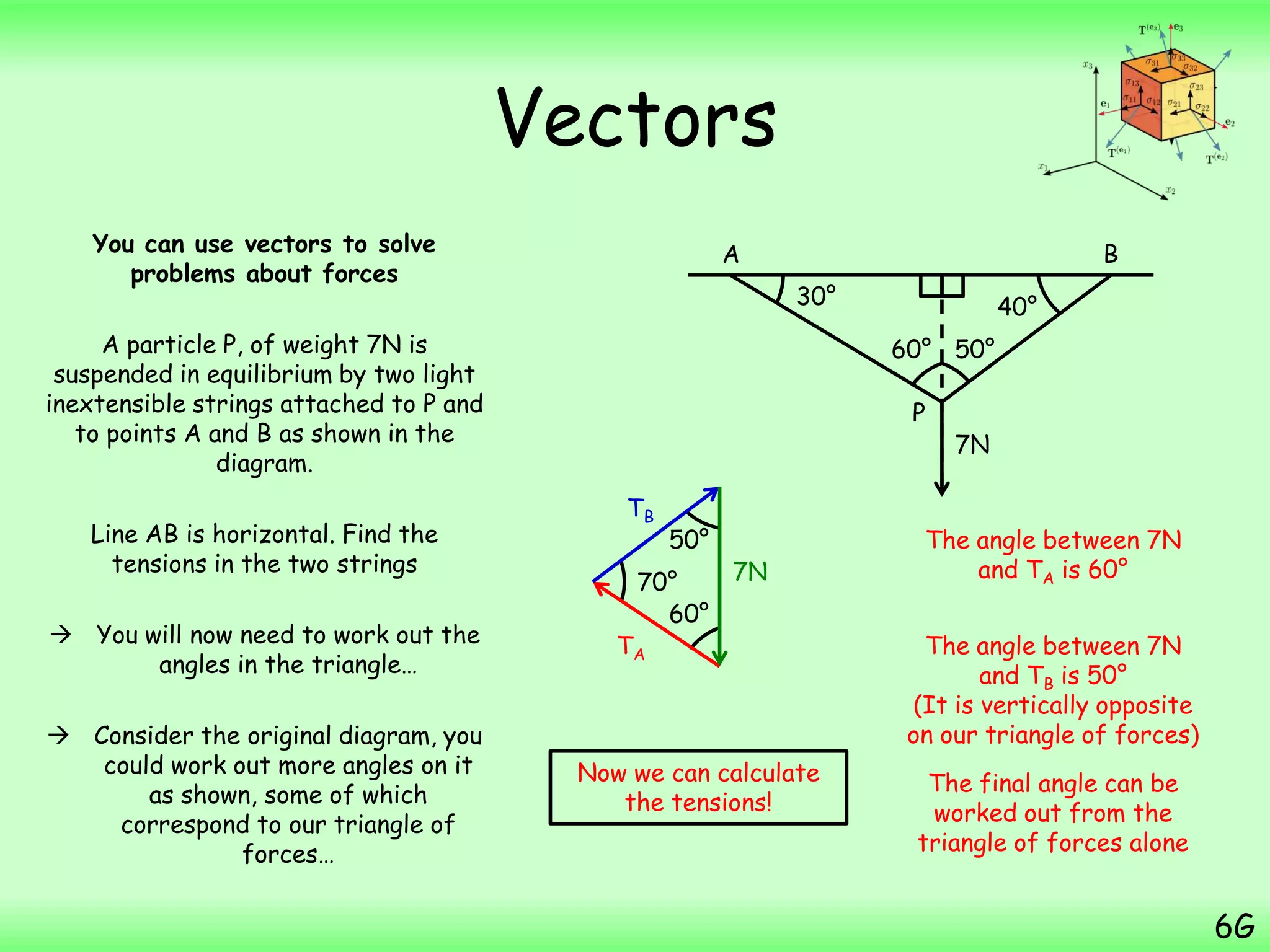
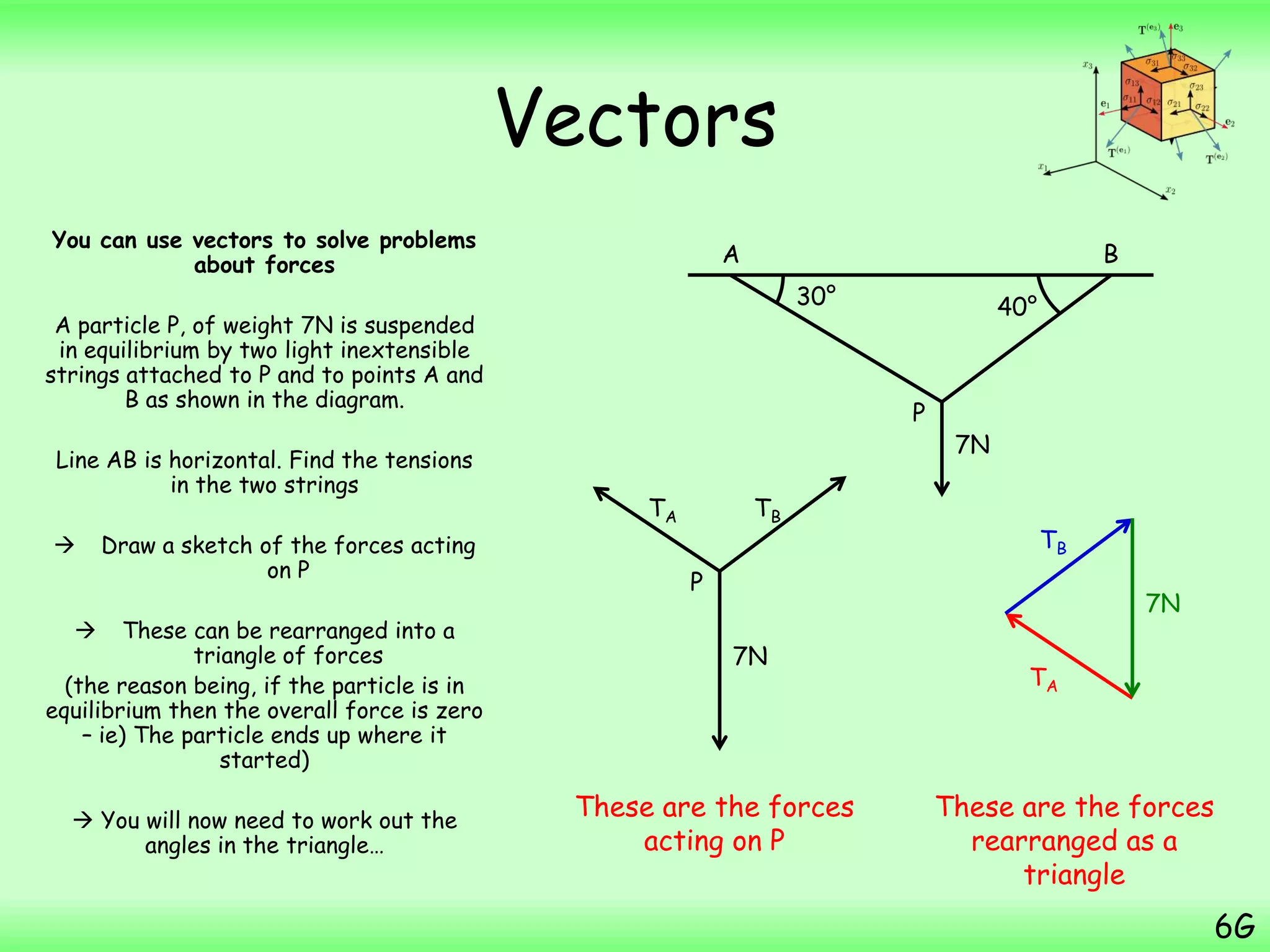
A particle P, of weight 7N is suspended
in equilibrium by two light inextensible
strings attached to P and to points A and
B as shown in the diagram.
Line AB is horizontal. Find the tensions
in the two strings
 Draw a sketch of the forces acting
on P
 These can be rearranged into a
triangle of forces
(the reason being, if the particle is in
equilibrium then the overall force is zero
– ie) The particle ends up where it
started)
 You will now need to work out the
angles in the triangle…
6G
A B
P
30° 40°
P
TA TB
7N
TA
TB
7N
These are the forces
acting on P
These are the forces
rearranged as a
triangle
7N
Vectors
You can use vectors to solve
problems about forces
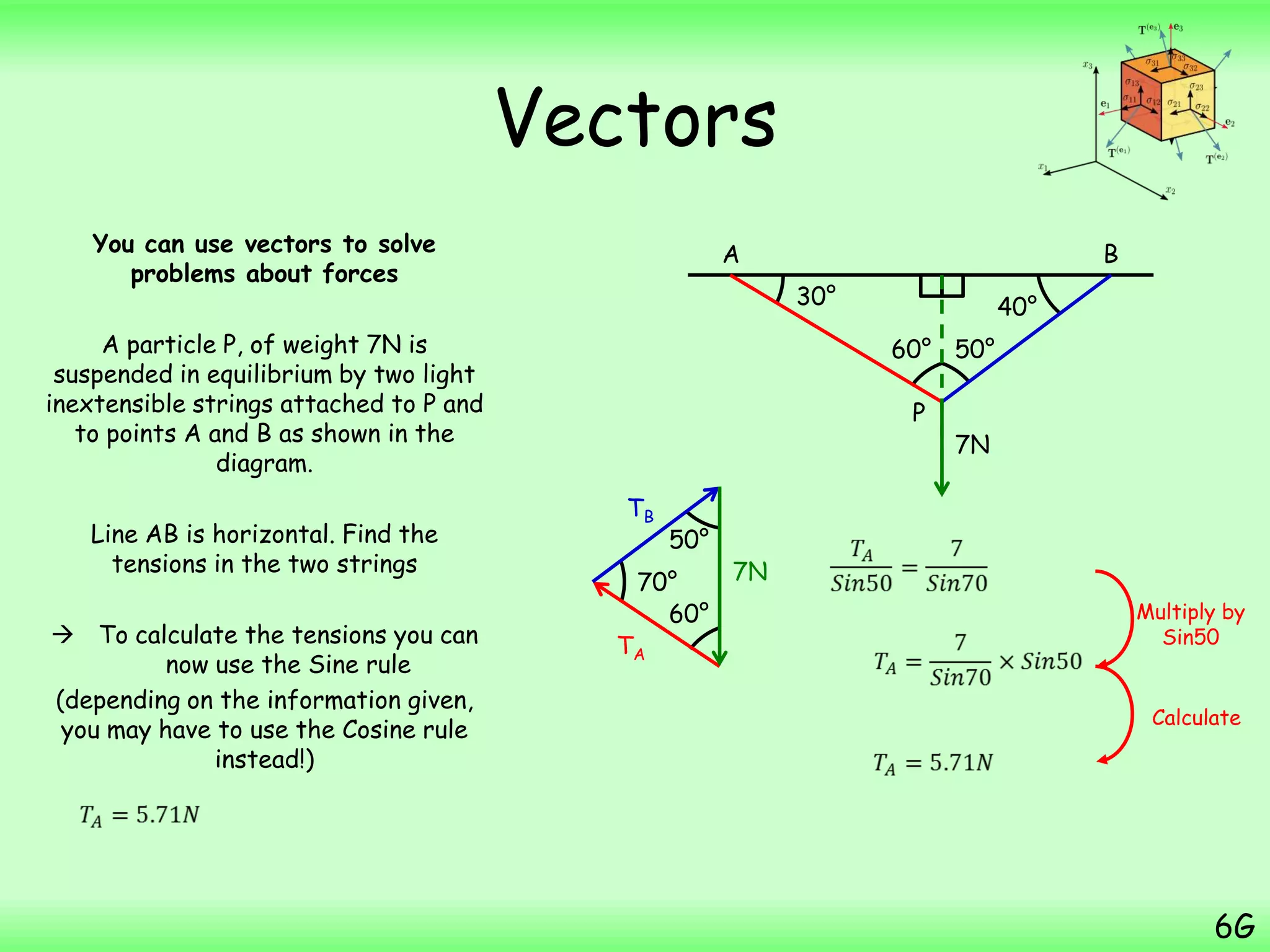
A particle P, of weight 7N is
suspended in equilibrium by two light
inextensible strings attached to P and
to points A and B as shown in the
diagram.
Line AB is horizontal. Find the
tensions in the two strings
 You will now need to work out the
angles in the triangle…
 Consider the original diagram, you
could work out more angles on it
as shown, some of which
correspond to our triangle of
forces…
6G
TA
TB
7N
The angle between 7N
and TA is 60°
A B
P
30° 40°
7N
50°60°
60°
50°
70°
The angle between 7N
and TB is 50°
(It is vertically opposite
on our triangle of forces)
The final angle can be
worked out from the
triangle of forces alone
Now we can calculate
the tensions!
Vectors
You can use vectors to solve
problems about forces
A particle P, of weight 7N is
suspended in equilibrium by two light
inextensible strings attached to P and
to points A and B as shown in the
diagram.
Line AB is horizontal. Find the
tensions in the two strings
 To calculate the tensions you can
now use the Sine rule
(depending on the information given,
you may have to use the Cosine rule
instead!)
6G
TA
TB
7N
A B
P
30° 40°
7N
50°60°
60°
50°
70°
Multiply by
Sin50
Calculate
Vectors
You can use vectors to solve
problems about forces
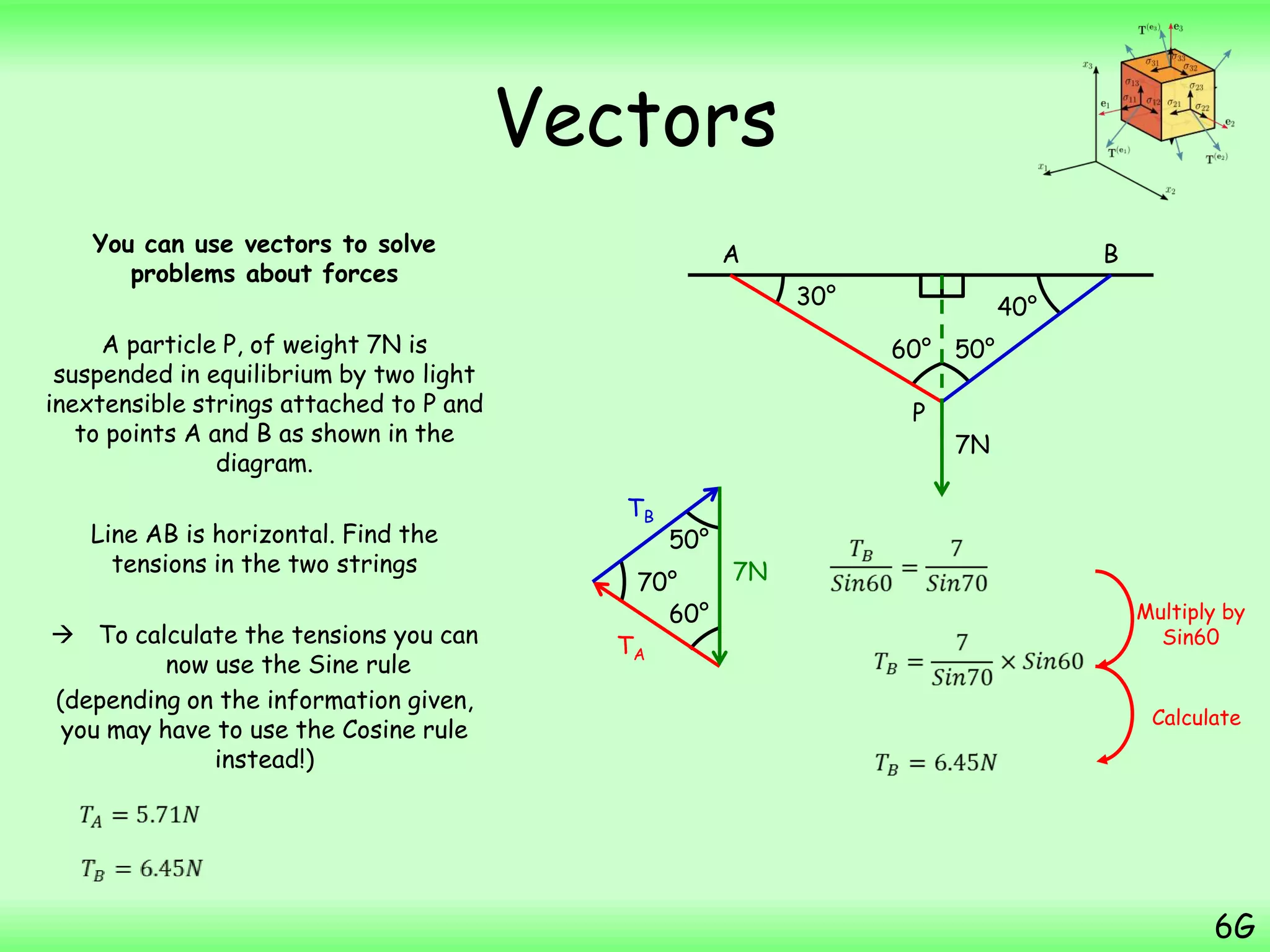
A particle P, of weight 7N is
suspended in equilibrium by two light
inextensible strings attached to P and
to points A and B as shown in the
diagram.
Line AB is horizontal. Find the
tensions in the two strings
 To calculate the tensions you can
now use the Sine rule
(depending on the information given,
you may have to use the Cosine rule
instead!)
6G
TA
TB
7N
A B
P
30° 40°
7N
50°60°
60°
50°
70°
Multiply by
Sin60
Calculate
Vectors
You need to be able to solve worded
problems in practical contexts
The mixed exercise in this chapter is very
important as it contains questions in context,
the type of which are often on exam papers
6H
Vectors
You need to be able to solve worded
problems in practical contexts
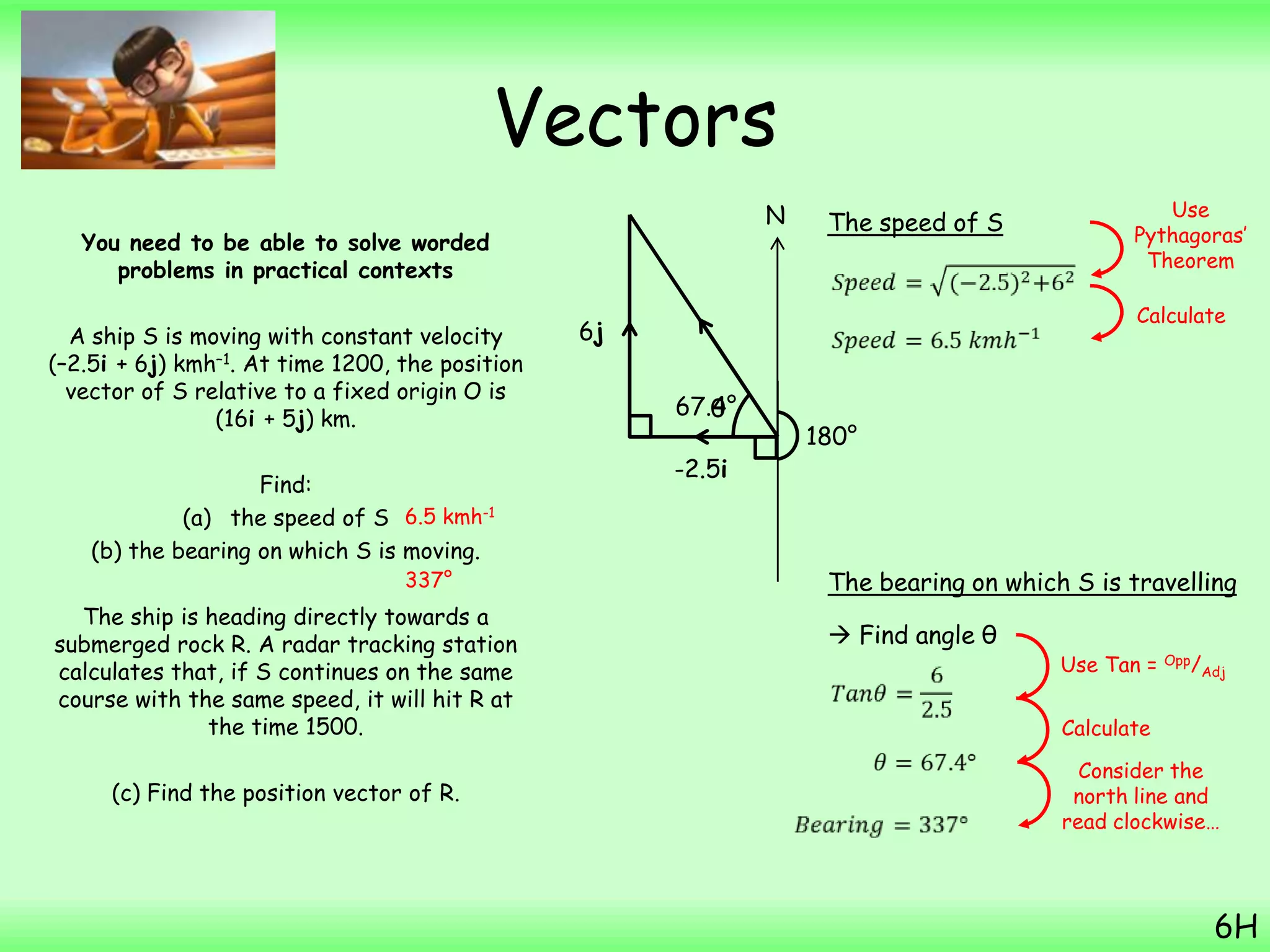
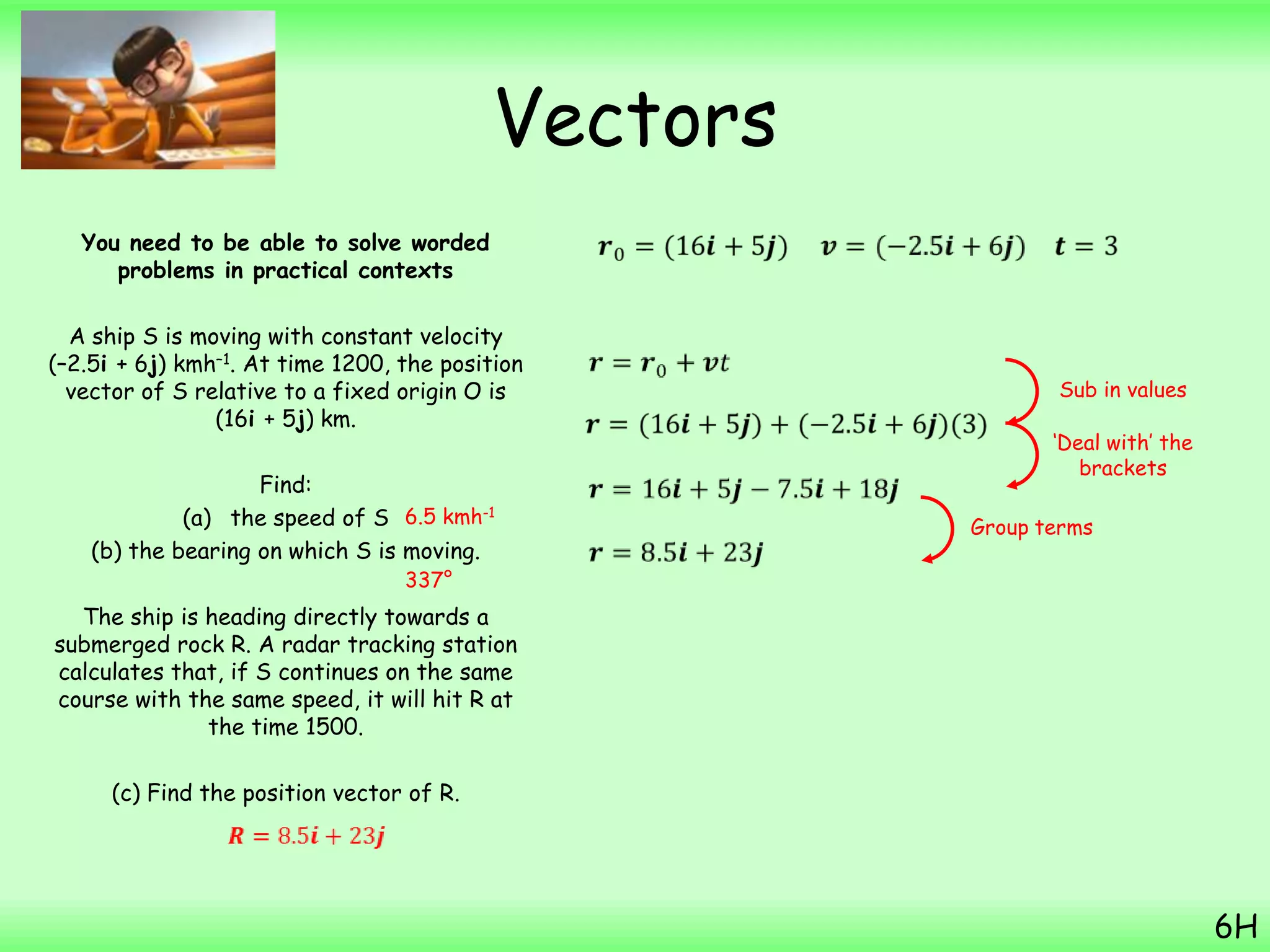
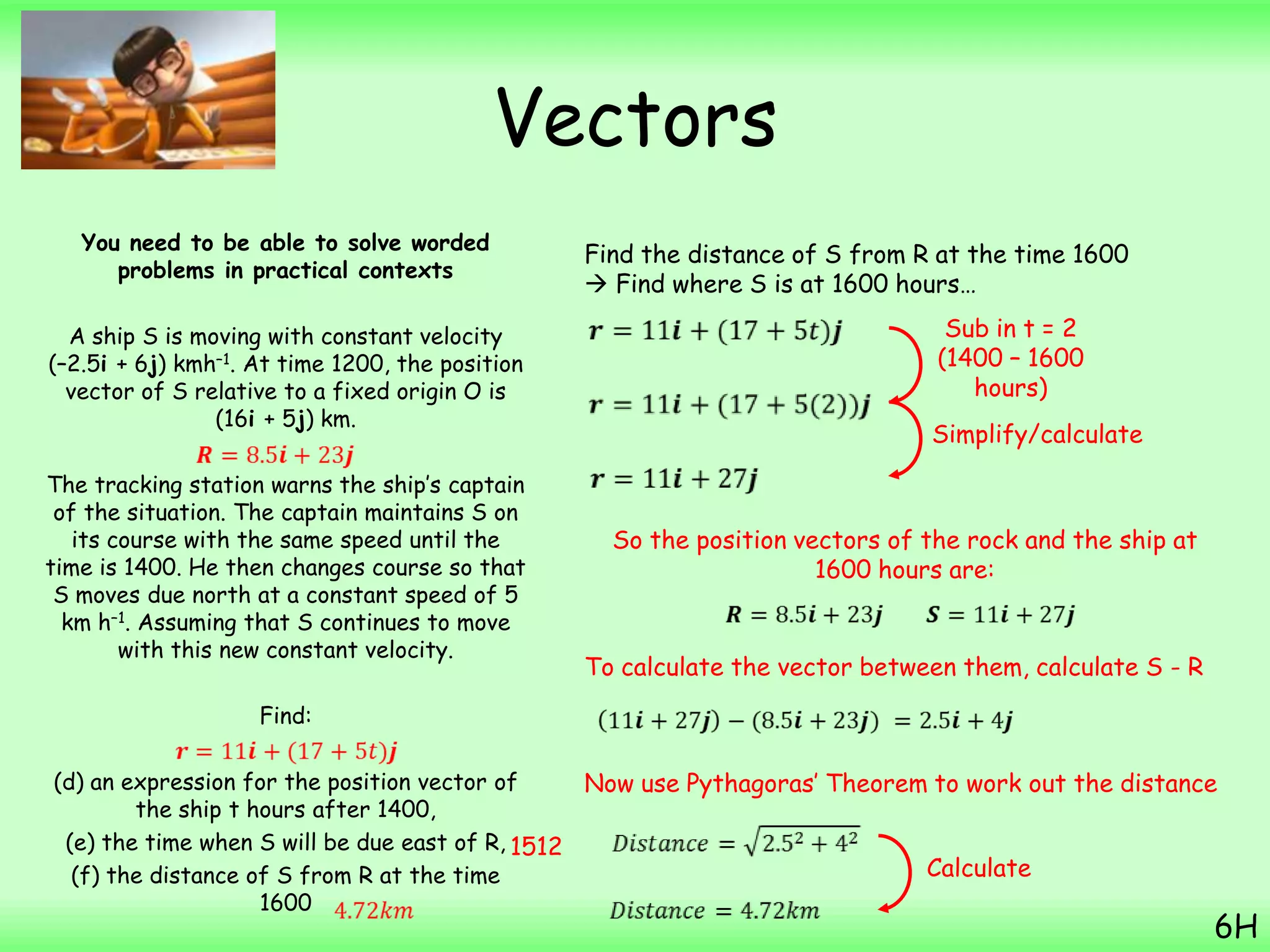
A ship S is moving with constant velocity
(–2.5i + 6j) kmh–1. At time 1200, the position
vector of S relative to a fixed origin O is
(16i + 5j) km.
Find:
(a) the speed of S
(b) the bearing on which S is moving.
The ship is heading directly towards a
submerged rock R. A radar tracking station
calculates that, if S continues on the same
course with the same speed, it will hit R at
the time 1500.
(c) Find the position vector of R.
6H
-2.5i
6j
The speed of S
Use
Pythagoras‟
Theorem
Calculate
6.5 kmh-1
N
θ
180°
The bearing on which S is travelling
 Find angle θ
Use Tan = Opp/Adj
Calculate
Consider the
north line and
read clockwise…
337°
67.4°
Vectors
You need to be able to solve worded
problems in practical contexts
A ship S is moving with constant velocity
(–2.5i + 6j) kmh–1. At time 1200, the position
vector of S relative to a fixed origin O is
(16i + 5j) km.
Find:
(a) the speed of S
(b) the bearing on which S is moving.
The ship is heading directly towards a
submerged rock R. A radar tracking station
calculates that, if S continues on the same
course with the same speed, it will hit R at
the time 1500.
(c) Find the position vector of R.
6H
6.5 kmh-1
337°
Sub in values
„Deal with‟ the
brackets
Group terms
Vectors
You need to be able to solve worded
problems in practical contexts
A ship S is moving with constant velocity
(–2.5i + 6j) kmh–1. At time 1200, the position
vector of S relative to a fixed origin O is
(16i + 5j) km.
The tracking station warns the ship‟s captain
of the situation. The captain maintains S on
its course with the same speed until the
time is 1400. He then changes course so that
S moves due north at a constant speed of 5
km h–1. Assuming that S continues to move
with this new constant velocity.
Find:
(d) an expression for the position vector of
the ship t hours after 1400,
(e) the time when S will be due east of R,
(f) the distance of S from R at the time
1600
6H
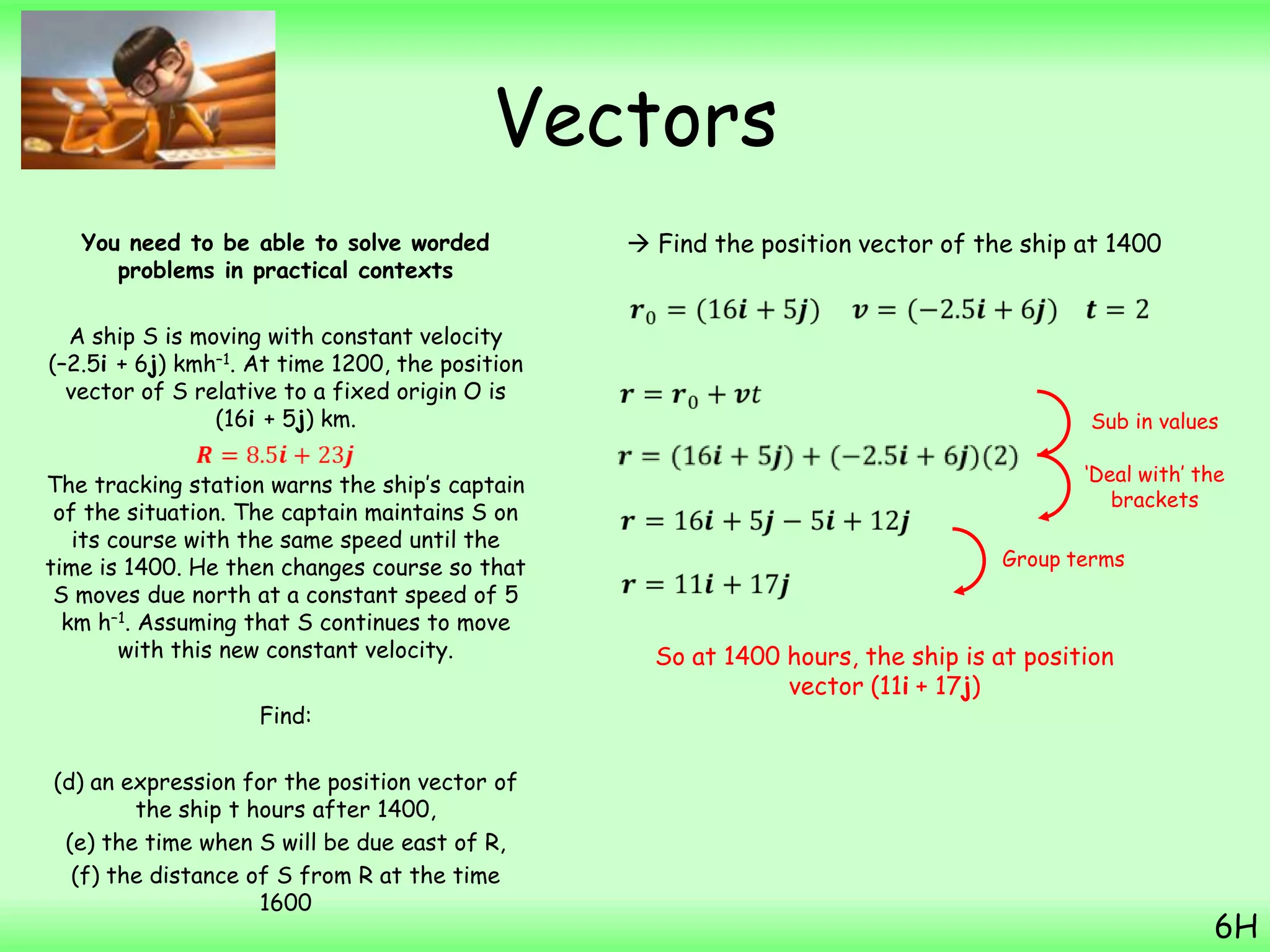
 Find the position vector of the ship at 1400
Sub in values
„Deal with‟ the
brackets
Group terms
So at 1400 hours, the ship is at position
vector (11i + 17j)
Vectors
You need to be able to solve worded
problems in practical contexts
A ship S is moving with constant velocity
(–2.5i + 6j) kmh–1. At time 1200, the position
vector of S relative to a fixed origin O is
(16i + 5j) km.
The tracking station warns the ship‟s captain
of the situation. The captain maintains S on
its course with the same speed until the
time is 1400. He then changes course so that
S moves due north at a constant speed of 5
km h–1. Assuming that S continues to move
with this new constant velocity.
Find:
(d) an expression for the position vector of
the ship t hours after 1400,
(e) the time when S will be due east of R,
(f) the distance of S from R at the time
1600
6H
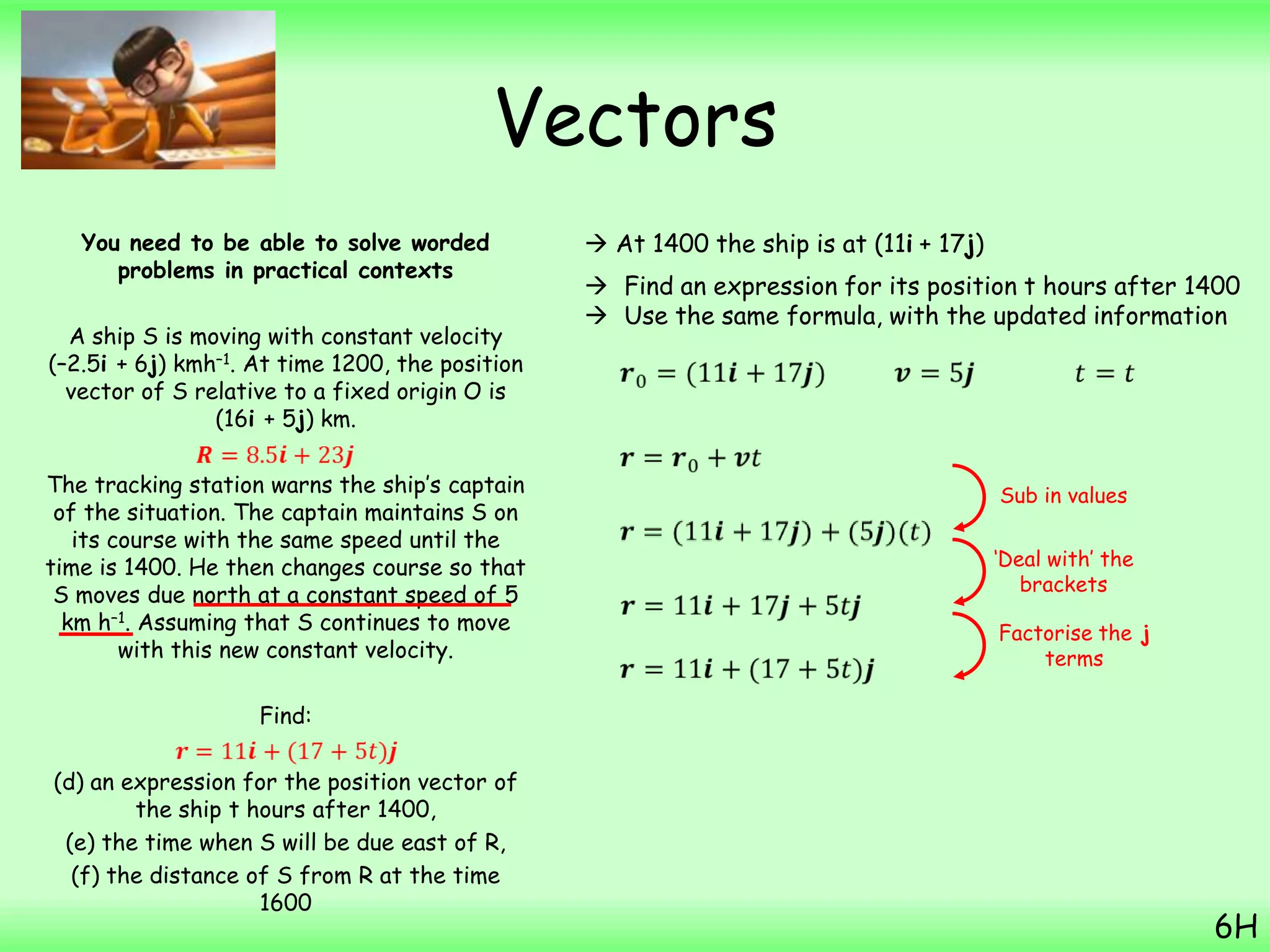
 At 1400 the ship is at (11i + 17j)
 Find an expression for its position t hours after 1400
 Use the same formula, with the updated information
Sub in values
„Deal with‟ the
brackets
Factorise the j
terms
Vectors
You need to be able to solve worded
problems in practical contexts
A ship S is moving with constant velocity
(–2.5i + 6j) kmh–1. At time 1200, the position
vector of S relative to a fixed origin O is
(16i + 5j) km.
The tracking station warns the ship‟s captain
of the situation. The captain maintains S on
its course with the same speed until the
time is 1400. He then changes course so that
S moves due north at a constant speed of 5
km h–1. Assuming that S continues to move
with this new constant velocity.
Find:
(d) an expression for the position vector of
the ship t hours after 1400,
(e) the time when S will be due east of R,
(f) the distance of S from R at the time
1600
6H
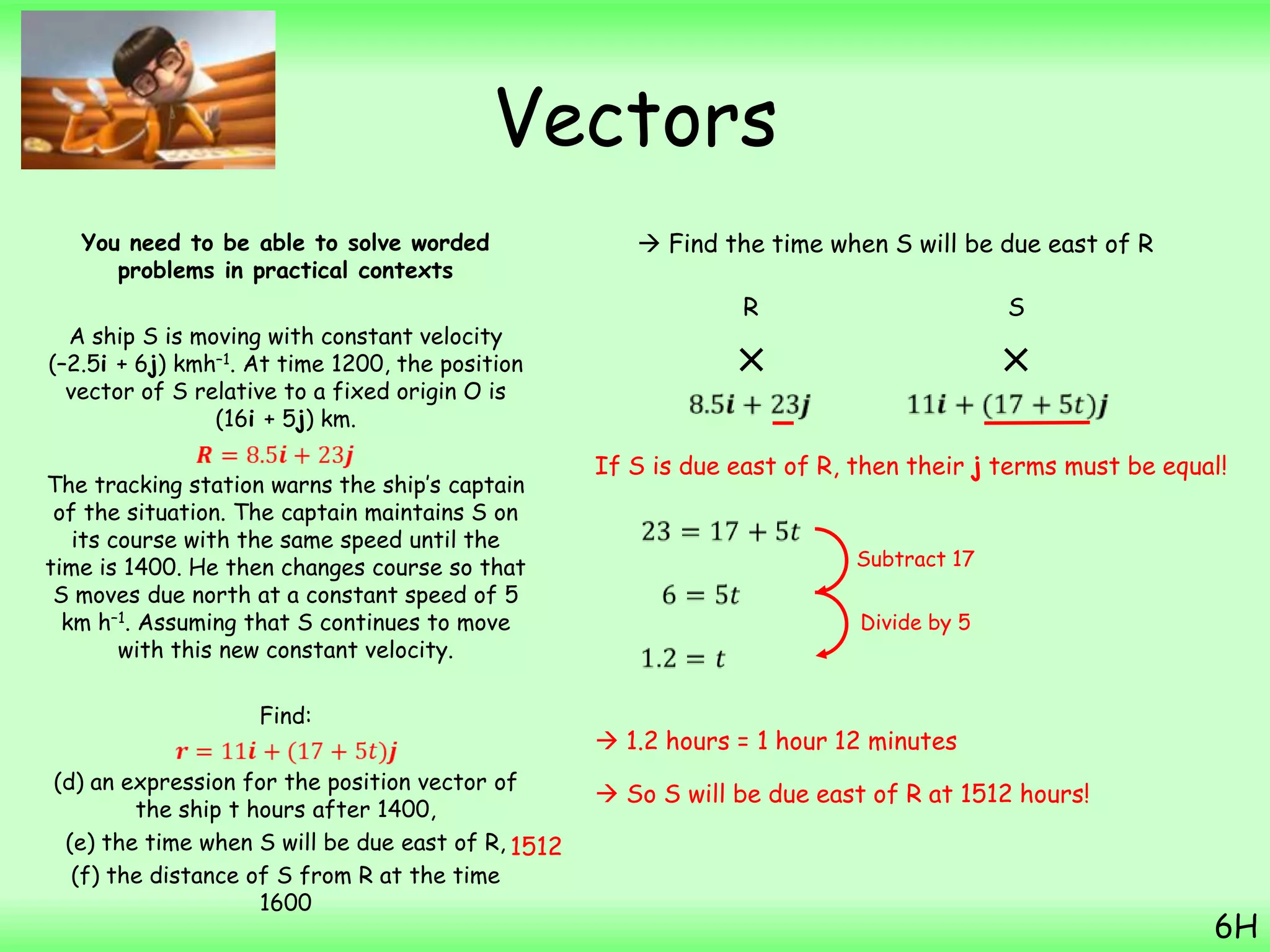
 Find the time when S will be due east of R
R S
If S is due east of R, then their j terms must be equal!
Subtract 17
Divide by 5
 1.2 hours = 1 hour 12 minutes
 So S will be due east of R at 1512 hours!
1512
Vectors
You need to be able to solve worded
problems in practical contexts
A ship S is moving with constant velocity
(–2.5i + 6j) kmh–1. At time 1200, the position
vector of S relative to a fixed origin O is
(16i + 5j) km.
The tracking station warns the ship‟s captain
of the situation. The captain maintains S on
its course with the same speed until the
time is 1400. He then changes course so that
S moves due north at a constant speed of 5
km h–1. Assuming that S continues to move
with this new constant velocity.
Find:
(d) an expression for the position vector of
the ship t hours after 1400,
(e) the time when S will be due east of R,
(f) the distance of S from R at the time
1600
6H
1512
Find the distance of S from R at the time 1600
 Find where S is at 1600 hours…
Sub in t = 2
(1400 – 1600
hours)
Simplify/calculate
So the position vectors of the rock and the ship at
1600 hours are:
To calculate the vector between them, calculate S - R
Calculate
Now use Pythagoras‟ Theorem to work out the distance
Summary
• We have seen how to use vectors in
problems involving forces and SUVAT
equations
• We have also seen how to answer multi-
part worded questions
• It is essential you practice the mixed
exercise in this chapter

vectors

  • 2.
    Introduction • In thischapter you will learn about Vectors • You will have seen vectors at GCSE level, this chapter focuses on using them to solve problems involving SUVAT equations and forces • Sometimes using vectors offers an easier alternative to regular methods • Vectors are used in video games in the movement of characters and by engineers in the design of buildings, bridges and other structures
  • 4.
    Vectors You can usevectors to describe displacements A vector has both direction and magnitude For example:  An object is moving north at 20ms-1  A horizontal force of 7N  An object has moved 5m to the left These are all vectors. A scalar quantity would be something such as: A force of 10N (It is scalar since it has no direction) 6A Vectors have both direction and magnitude!
  • 5.
    Vectors You can usevectors to describe displacements A girl walks 2km due east from a fixed point O, to A, and then 3km due south from A to a point B. Describe the displacement of B from O.  Start, as always, with a diagram!  To describe the displacement you need the distance from O as well as the direction (as a bearing)  Remember bearings are always measured from north! “Point B is 3.61km from O on a bearing of 146˚” 6A 2km 3km O A B θ N Describing the displacement The distance – use Pythagoras‟ Theorem The bearing – use Trigonometry to find angle θ Sub in a and b Calculate Sub in opp and adj Use inverse Tan Bearings are measured from north. Add the north line and add 90˚ Opp Adj 56.3˚
  • 6.
    Vectors You can usevectors to describe displacements In an orienteering exercise, a cadet leaves the starting point S and walks 15km on a bearing of 120˚ to reach A, the first checkpoint. From A he then walks 9km on a bearing of 240˚ to the second checkpoint, and point B. From B he then returns directly to S. Describe the displacement of S from B.  Start with a diagram!  We need the distance B to S and the bearing from B to S as well. You will need to use angle rules you have learnt pre A- level. N N S A B 15km 9km 120° 240° You can use interior angles to find an angle in the triangle  Interior angles add up to 180°  The missing angle next to 240 is 60°  The angle inside the triangle must also be 60° 60° 60° Finding the distance B to S Sub in values a b c Work out Square root 13.1km
  • 7.
    Vectors You can usevectors to describe displacements In an orienteering exercise, a cadet leaves the starting point S and walks 15km on a bearing of 120˚ to reach A, the first checkpoint. From A he then walks 9km on a bearing of 240˚ to the second checkpoint, and point B. From B he then returns directly to S. Describe the displacement of S from B.  Start with a diagram!  We need the distance B to S and the bearing from B to S as well. You will need to use angle rules you have learnt pre A- level. N N S A B 15km 9km 120° 240° 60° 60° 13.1km N θ Finding the bearing from B to S  Show the bearing at B  It can be split into 2 sections, one of which is 180°  Find angle θ inside the triangle Sub in values Rearrange Calculate θ 156.6° 180° You can now use Alternate angles to find the unknown part of the bearing Add on 180° The bearing is 336.6° S is 13.1km from B on a bearing of 337° A a b B 36.6°
  • 9.
    Vectors You can addand represent vectors using line segments A vector can be represented as a directed line segment Two vectors are equal if they have the same magnitude and direction Two vectors are parallel if they have the same direction You can add vectors using the triangle law of addition 6B A C B a 3a
  • 10.
    Vectors You can addand represent vectors using line segments OACB is a parallelogram. The points P, Q, M and N are the midpoints of the sides. OA = a OB = b Express the following in terms of a and b. a) OC b) AB c) QC d) CN e) QN 6B M B P O N D QA C b a a + b b - a 1/2b -1/2a 1/2b - 1/2a What can you deduce about AB and QN, looking at the vectors? QN is a multiple of AB, so they are parallel!
  • 11.
    Vectors You can addand represent vectors using line segments In triangle OAB, M is the midpoint of OA and N divides AB in the ratio 1:2. OM = a OB = b Express ON in terms of a and b 6B A B O M N a b a 1 2 Use the ratio. If N divides AB in the ratio 1:2, show this on the diagram  You can see now that AN is one-third of AB  We therefore need to know AB  To get from A to B, use AO + OB Sub in AO and OB AN = 1/3AB Sub in values Simplify
  • 12.
    Vectors You can addand represent vectors using line segments OABC is a parallelogram. P is the point where OB and AC intersect. The vectors a and c represent OA and OC respectively. Prove that the diagonals bisect each other.  If the diagonals bisect each other, then P must be the midpoint of both AC and OB…  Try to find a way to represent OP in different ways… (make sure you don‟t „accidentally‟ assume P is the midpoint – this is what we need to prove!) 6B P O A B C a c One way to get from O to P  Start with OB OP is parallel to OB so is a multiple of (a + c)  We don‟t know how much for now, so can use λ (lamda) to represent the unknown quantity c
  • 13.
    Vectors You can addand represent vectors using line segments OABC is a parallelogram. P is the point where OB and AC intersect. The vectors a and c represent OA and OC respectively. Prove that the diagonals bisect each other.  If the diagonals bisect each other, then P must be the midpoint of both AC and OB…  Try to find a way to represent OP in different ways… (make sure you don‟t „accidentally‟ assume P is the midpoint – this is what we need to prove!) 6B P O A B C a c Another way to get from O to P  Go from O to A, then A to P  We will need AC first… c -a AP is parallel to AC so is a multiple of it. Use a different symbol (usually μ, „mew‟, for this multiple) Now we have another way to get from O to P Sub in vectors
  • 14.
    Vectors You can addand represent vectors using line segments OABC is a parallelogram. P is the point where OB and AC intersect. The vectors a and c represent OA and OC respectively. Prove that the diagonals bisect each other.  If the diagonals bisect each other, then P must be the midpoint of both AC and OB…  Try to find a way to represent OP in different ways… (make sure you don‟t „accidentally‟ assume P is the midpoint – this is what we need to prove!) 6B P O A B C a As these represent the same vector, the expressions must be equal! Multiply out brackets Factorise the „a‟ terms on the right side Now compare sides – there must be the same number of „a‟s and „c‟s on each Sub 2nd equation into the first They are equal Rearrange and solve So P is halfway along OB and AC and hence the lines bisect each other!
  • 16.
    Vectors You can describevectors using the i, j notation A unit vector is a vector of length 1. Unit vectors along Cartesian (x, y) axes are usually denoted by i and j respectively. You can write any two-dimensional vector in the form ai + bj Draw a diagram to represent the vector -3i + j 6C O (0,1) (1,0) j i A B C 5i 2j 5i + 2j -3i j -3i + j
  • 18.
    Vectors You can solveproblems with vectors written using the i, j notation When vectors are written in terms of the unit vectors i and j you can add them together by adding the terms in i and j separately. Subtraction works in a similar way. Given that: p = 2i + 3j q = 5i + j Find p + q in terms of i and j 6D Add the i terms and j terms separately
  • 19.
    Vectors You can solveproblems with vectors written using the i, j notation When vectors are written in terms of the unit vectors i and j you can add them together by adding the terms in i and j separately. Subtraction works in a similar way. Given that: a = 5i + 2j b = 3i - 4j Find 2a – b in terms of i and j 6D Multiply out the bracket Careful with the subtraction here! Group terms…
  • 20.
    Vectors You can solveproblems with vectors written using the i, j notation When a vector is given in terms of the unit vectors i and j, you can find its magnitude using Pythagoras‟ Theorem. The magnitude of vector a is written as |a| Find the magnitude of the vector: 3i – 7j 6D 3i -7j 3i - 7j Put in the values from the vectors and calculate Round if necessary
  • 21.
    Vectors You can solveproblems with vectors written using the i, j notation You can also use trigonometry to find an angle between a vector and the axes Find the angle between the vector -4i + 5j and the positive x-axis  Draw a diagram 6D -4i x θ 5j y Opp Adj Sub in values Inverse Tan The angle we want is between the vector and the positive x-axis  Subtract θ from 180° 51.3°
  • 22.
    Vectors You can solveproblems with vectors written using the i, j notation Given that: a = 3i - j b = i + j Find µ if a + µb is parallel to 3i + j  Start by calculating a + µb in terms of a, b and µ 6D As the vector must be parallel to 3i + j, the i term must be 3 times the j term! Multiply out the brackets Divide by 2 Move the i and j terms together Factorise the terms in i and j Multiply out the bracket Subtract µ, and add 3
  • 23.
    Vectors You can solveproblems with vectors written using the i, j notation Given that: a = 3i - j b = i + j Find µ if a + µb is parallel to 3i + j  Start by calculating a + µb in terms of a, b and µ 6D To show that this works… Multiply out the brackets We now know µ Group terms Factorise You can see that using the value of µ = 3, we get a vector which is parallel to 3i + j
  • 25.
    Vectors You can expressthe velocity of a particle as a vector The velocity of a particle is a vector in the direction of motion. The magnitude of the vector is its speed. Velocity is usually represented by v. A particle is moving with constant velocity given by: v = (3i + j) ms-1 Find: a) The speed of the particle b) The distance moved every 4 seconds 6E Finding the speed  The speed of the particle is the magnitude of the vector  Use Pythagoras‟ Theorem 3i j 3i + j Finding the distance travelled every 4 seconds  Use GCSE relationships  Distance = Speed x Time Sub in values (use the exact speed!) Calculate Calculate
  • 27.
    Vectors You can solveproblems involving velocity, time, mass and forces (as in earlier chapters) by using vector notation If a particle starts from the point with position vector r0 and moves with constant velocity v, then its displacement from its initial position at time t is given by: 6F Final position Starting position Velocity Time A particle starts from the point with position vector (3i + 7j) m and then moves constant velocity (2i – j) ms-1. Find the position vector of the particle 4 seconds later. (a position vector tells you where a particle is in relation to the origin O) Sub in values Multiply/remove brackets Simplify
  • 28.
    Vectors You can solveproblems involving velocity, time, mass and forces (as in earlier chapters) by using vector notation If a particle starts from the point with position vector r0 and moves with constant velocity v, then its displacement from its initial position at time t is given by: 6F Final position Starting position Velocity Time A particle moving at a constant velocity, „v‟, and is at the point with position vector (2i + 4j) m at time t = 0. Five seconds later the particle is at the point with position vector (12i + 16j) m. Find the velocity of the particle. Sub in values The velocity of the particle is (2i + 4j) ms-1 Deal with the brackets! Subtract 2i and add 4j Divide by 5
  • 29.
    Vectors You can solveproblems involving velocity, time, mass and forces (as in earlier chapters) by using vector notation At time t = 0, a particle has position vector 4i + 7j and is moving at a speed of 15ms-1 in the direction 3i – 4j. Find its position vector after 2 seconds.  You have to be careful here, you have been given the speed of the particle. The direction vector does not necessarily have the same speed  Find the speed of the direction vector as it is given in the question  Then „multiply up‟ to get the required speed (we need 15ms-1, not 5ms-1) Multiplying the vectors will allow you to use the correct velocity 6F 3i -4j 3i – 4j 9i -12j 9i – 12j 5ms-1 15ms-1 Multiply all vectors by 3 Calculate We can use the vectors as the velocity
  • 30.
    Vectors You can solveproblems involving velocity, time, mass and forces (as in earlier chapters) by using vector notation At time t = 0, a particle has position vector 4i + 7j and is moving at a speed of 15ms-1 in the direction 3i – 4j. Find its position vector after 2 seconds.  You have to be careful here, you have been given the speed of the particle. The direction vector does not necessarily have the same speed  Find the speed of the direction vector as it is given in the question  Then „multiply up‟ to get the required speed (we need 15ms-1, not 5ms-1) Multiplying the vectors will allow you to use the correct velocity 6F Sub in values „Deal with‟ the brackets Group terms
  • 31.
    Vectors You can solveproblems involving velocity, time, mass and forces (as in earlier chapters) by using vector notation You can also solve problems involving acceleration by using: v = u + at Where v, u and a are all given in vector form. Particle P has velocity (-3i + j) ms-1 at time t = 0. The particle moves along with constant acceleration a = (2i + 3j) ms-2. Find the speed of the particle after 3 seconds. 6F Sub in values „Deal with‟ the brackets Group terms Remember this is the velocity, not the speed! Calculate!
  • 32.
    Vectors You can solveproblems involving velocity, time, mass and forces (as in earlier chapters) by using vector notation A force applied to a particle has both a magnitude and a direction, so force is a vector. The force will cause the particle to accelerate. Remember from chapter 3: F = ma A constant force, FN, acts on a particle of mass 2kg for 10 seconds. The particle is initially at rest, and 10 seconds later it has a velocity of (10i – 24j) ms-1. Find F.  We need to find a first… 6F Sub in values „Tidy up‟ Divide by 10 Sub in values Calculate
  • 34.
    Vectors You can usevectors to solve problems about forces If a particle is resting in equilibrium, then the resultant of all the forces acting on it is zero. The forces (2i + 3j), (4i – j), (-3i + 2j) and (ai + bj) are acting on a particle which is in equilibrium. Calculate the values of a and b.  Set the sum of all the vectors equal to 0 6G Group together the numerical terms The „i‟ terms must sum to 0 The „j‟ terms must sum to 0
  • 35.
    Vectors You can usevectors to solve problems about forces If several forces are involved in a question a good starting point is to find the resultant force. The following forces: F1 = (2i + 4j) N F2 = (-5i + 4j) N F3 = (6i – 5j) N all act on a particle of mass 3kg. Find the acceleration of the particle. Start by finding the overall resultant force. 6G The acceleration is (i + j) ms-2 Sub in values Group up Sub in the resultant force, and the mass Divide by 3
  • 36.
    Vectors You can usevectors to solve problems about forces A particle P, of weight 7N is suspended in equilibrium by two light inextensible strings attached to P and to points A and B as shown in the diagram. Line AB is horizontal. Find the tensions in the two strings  Draw a sketch of the forces acting on P  These can be rearranged into a triangle of forces (the reason being, if the particle is in equilibrium then the overall force is zero – ie) The particle ends up where it started)  You will now need to work out the angles in the triangle… 6G A B P 30° 40° P TA TB 7N TA TB 7N These are the forces acting on P These are the forces rearranged as a triangle 7N
  • 37.
    Vectors You can usevectors to solve problems about forces A particle P, of weight 7N is suspended in equilibrium by two light inextensible strings attached to P and to points A and B as shown in the diagram. Line AB is horizontal. Find the tensions in the two strings  You will now need to work out the angles in the triangle…  Consider the original diagram, you could work out more angles on it as shown, some of which correspond to our triangle of forces… 6G TA TB 7N The angle between 7N and TA is 60° A B P 30° 40° 7N 50°60° 60° 50° 70° The angle between 7N and TB is 50° (It is vertically opposite on our triangle of forces) The final angle can be worked out from the triangle of forces alone Now we can calculate the tensions!
  • 38.
    Vectors You can usevectors to solve problems about forces A particle P, of weight 7N is suspended in equilibrium by two light inextensible strings attached to P and to points A and B as shown in the diagram. Line AB is horizontal. Find the tensions in the two strings  To calculate the tensions you can now use the Sine rule (depending on the information given, you may have to use the Cosine rule instead!) 6G TA TB 7N A B P 30° 40° 7N 50°60° 60° 50° 70° Multiply by Sin50 Calculate
  • 39.
    Vectors You can usevectors to solve problems about forces A particle P, of weight 7N is suspended in equilibrium by two light inextensible strings attached to P and to points A and B as shown in the diagram. Line AB is horizontal. Find the tensions in the two strings  To calculate the tensions you can now use the Sine rule (depending on the information given, you may have to use the Cosine rule instead!) 6G TA TB 7N A B P 30° 40° 7N 50°60° 60° 50° 70° Multiply by Sin60 Calculate
  • 41.
    Vectors You need tobe able to solve worded problems in practical contexts The mixed exercise in this chapter is very important as it contains questions in context, the type of which are often on exam papers 6H
  • 42.
    Vectors You need tobe able to solve worded problems in practical contexts A ship S is moving with constant velocity (–2.5i + 6j) kmh–1. At time 1200, the position vector of S relative to a fixed origin O is (16i + 5j) km. Find: (a) the speed of S (b) the bearing on which S is moving. The ship is heading directly towards a submerged rock R. A radar tracking station calculates that, if S continues on the same course with the same speed, it will hit R at the time 1500. (c) Find the position vector of R. 6H -2.5i 6j The speed of S Use Pythagoras‟ Theorem Calculate 6.5 kmh-1 N θ 180° The bearing on which S is travelling  Find angle θ Use Tan = Opp/Adj Calculate Consider the north line and read clockwise… 337° 67.4°
  • 43.
    Vectors You need tobe able to solve worded problems in practical contexts A ship S is moving with constant velocity (–2.5i + 6j) kmh–1. At time 1200, the position vector of S relative to a fixed origin O is (16i + 5j) km. Find: (a) the speed of S (b) the bearing on which S is moving. The ship is heading directly towards a submerged rock R. A radar tracking station calculates that, if S continues on the same course with the same speed, it will hit R at the time 1500. (c) Find the position vector of R. 6H 6.5 kmh-1 337° Sub in values „Deal with‟ the brackets Group terms
  • 44.
    Vectors You need tobe able to solve worded problems in practical contexts A ship S is moving with constant velocity (–2.5i + 6j) kmh–1. At time 1200, the position vector of S relative to a fixed origin O is (16i + 5j) km. The tracking station warns the ship‟s captain of the situation. The captain maintains S on its course with the same speed until the time is 1400. He then changes course so that S moves due north at a constant speed of 5 km h–1. Assuming that S continues to move with this new constant velocity. Find: (d) an expression for the position vector of the ship t hours after 1400, (e) the time when S will be due east of R, (f) the distance of S from R at the time 1600 6H  Find the position vector of the ship at 1400 Sub in values „Deal with‟ the brackets Group terms So at 1400 hours, the ship is at position vector (11i + 17j)
  • 45.
    Vectors You need tobe able to solve worded problems in practical contexts A ship S is moving with constant velocity (–2.5i + 6j) kmh–1. At time 1200, the position vector of S relative to a fixed origin O is (16i + 5j) km. The tracking station warns the ship‟s captain of the situation. The captain maintains S on its course with the same speed until the time is 1400. He then changes course so that S moves due north at a constant speed of 5 km h–1. Assuming that S continues to move with this new constant velocity. Find: (d) an expression for the position vector of the ship t hours after 1400, (e) the time when S will be due east of R, (f) the distance of S from R at the time 1600 6H  At 1400 the ship is at (11i + 17j)  Find an expression for its position t hours after 1400  Use the same formula, with the updated information Sub in values „Deal with‟ the brackets Factorise the j terms
  • 46.
    Vectors You need tobe able to solve worded problems in practical contexts A ship S is moving with constant velocity (–2.5i + 6j) kmh–1. At time 1200, the position vector of S relative to a fixed origin O is (16i + 5j) km. The tracking station warns the ship‟s captain of the situation. The captain maintains S on its course with the same speed until the time is 1400. He then changes course so that S moves due north at a constant speed of 5 km h–1. Assuming that S continues to move with this new constant velocity. Find: (d) an expression for the position vector of the ship t hours after 1400, (e) the time when S will be due east of R, (f) the distance of S from R at the time 1600 6H  Find the time when S will be due east of R R S If S is due east of R, then their j terms must be equal! Subtract 17 Divide by 5  1.2 hours = 1 hour 12 minutes  So S will be due east of R at 1512 hours! 1512
  • 47.
    Vectors You need tobe able to solve worded problems in practical contexts A ship S is moving with constant velocity (–2.5i + 6j) kmh–1. At time 1200, the position vector of S relative to a fixed origin O is (16i + 5j) km. The tracking station warns the ship‟s captain of the situation. The captain maintains S on its course with the same speed until the time is 1400. He then changes course so that S moves due north at a constant speed of 5 km h–1. Assuming that S continues to move with this new constant velocity. Find: (d) an expression for the position vector of the ship t hours after 1400, (e) the time when S will be due east of R, (f) the distance of S from R at the time 1600 6H 1512 Find the distance of S from R at the time 1600  Find where S is at 1600 hours… Sub in t = 2 (1400 – 1600 hours) Simplify/calculate So the position vectors of the rock and the ship at 1600 hours are: To calculate the vector between them, calculate S - R Calculate Now use Pythagoras‟ Theorem to work out the distance
  • 48.
    Summary • We haveseen how to use vectors in problems involving forces and SUVAT equations • We have also seen how to answer multi- part worded questions • It is essential you practice the mixed exercise in this chapter