Speed, Velocity,
Acceleration
Jerome A. Bigael
Speed
Speed is a measure of how fast a body moves.
It is a scalar quantity.
2 Types of Speed in Kinematics
Average speed
Instantaneous speed
Average speed
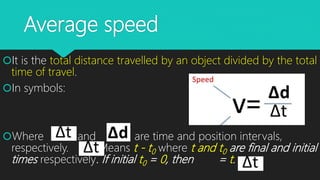
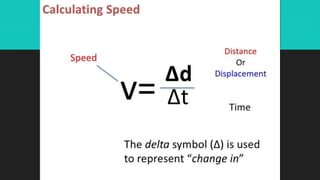
It is the total distance travelled by an object divided by the total
time of travel.
In symbols:
Where and are time and position intervals,
respectively. Means t - t0 where t and t0 are final and initial
times respectively. If initial t0 = 0, then = t.
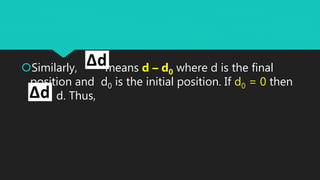
Similarly, means d – d0 where d is the final
position and d0 is the initial position. If d0 = 0 then
= d. Thus,
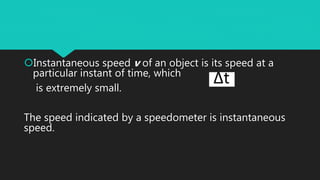
Instantaneous speed v of an object is its speed at a
particular instant of time, which
is extremely small.
The speed indicated by a speedometer is instantaneous
speed.
Velocity (v)
It is a measure of the speed and direction to which the
body is moving. Thus, it is a vector quantity.
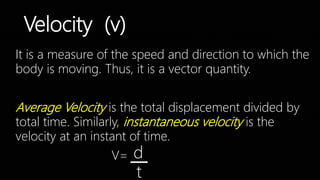
Average Velocity is the total displacement divided by
total time. Similarly, instantaneous velocity is the
velocity at an instant of time.
V= d
t
Answer the following:
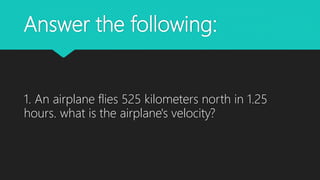
1. An airplane flies 525 kilometers north in 1.25
hours. what is the airplane's velocity?
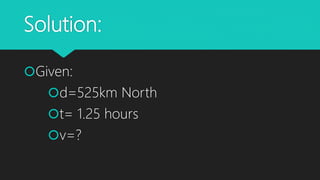
Solution:
Given:
d=525km North
t= 1.25 hours
v=?
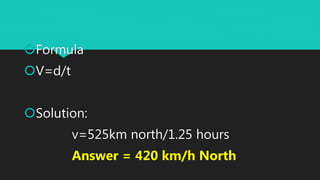
Formula
V=d/t
Solution:
v=525km north/1.25 hours
Answer = 420 km/h North
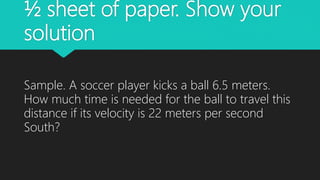
½ sheet of paper. Show your
solution
Sample. A soccer player kicks a ball 6.5 meters.
How much time is needed for the ball to travel this
distance if its velocity is 22 meters per second
South?
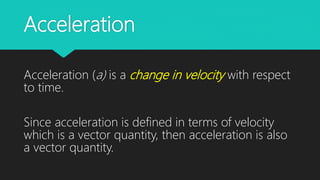
Acceleration
Acceleration (a) is a change in velocity with respect
to time.
Since acceleration is defined in terms of velocity
which is a vector quantity, then acceleration is also
a vector quantity.
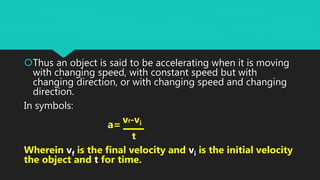
Thus an object is said to be accelerating when it is moving
with changing speed, with constant speed but with
changing direction, or with changing speed and changing
direction.
In symbols:
vf-vi
t
Wherein vf is the final velocity and vi is the initial velocity
the object and t for time.
a=
Calculating acceleration involves dividing velocity
by time — or in terms of units, dividing meters
per second [m/s] by second [s].
Dividing distance by time twice is the same as
dividing distance by the square of time. Thus
the SI unit of acceleration is the meter
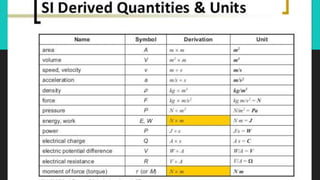
per second squared. ( m/s2)
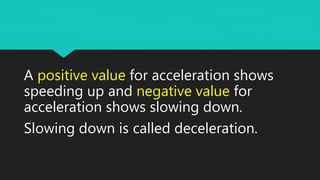
A positive value for acceleration shows
speeding up and negative value for
acceleration shows slowing down.
Slowing down is called deceleration.
Sample Problem
A skater increases her velocity from 2.0 m/s to 10
m/s in 3.0 seconds. What is the skater’s
acceleration?
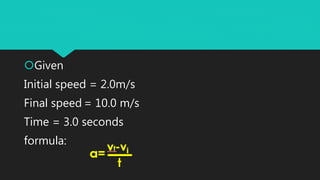
Given
Initial speed = 2.0m/s
Final speed = 10.0 m/s
Time = 3.0 seconds
formula:
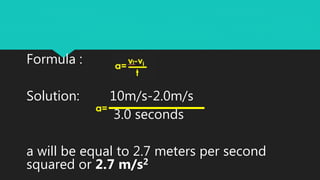
Formula :
Solution: 10m/s-2.0m/s
3.0 seconds
a will be equal to 2.7 meters per second
squared or 2.7 m/s2
Practice: ½ sheet of paper
A motorcycle’s speed increases from 75
m/s to 210 m/s in 5 seconds. What is the
acceleration of this helicopter?

Speed, Velocity and Acceleration

  • 1.
  • 2.
    Speed Speed is ameasure of how fast a body moves. It is a scalar quantity.
  • 3.
    2 Types ofSpeed in Kinematics Average speed Instantaneous speed
  • 4.
    Average speed It isthe total distance travelled by an object divided by the total time of travel. In symbols: Where and are time and position intervals, respectively. Means t - t0 where t and t0 are final and initial times respectively. If initial t0 = 0, then = t.
  • 6.
    Similarly, means d– d0 where d is the final position and d0 is the initial position. If d0 = 0 then = d. Thus,
  • 7.
    Instantaneous speed vof an object is its speed at a particular instant of time, which is extremely small. The speed indicated by a speedometer is instantaneous speed.
  • 8.
    Velocity (v) It isa measure of the speed and direction to which the body is moving. Thus, it is a vector quantity. Average Velocity is the total displacement divided by total time. Similarly, instantaneous velocity is the velocity at an instant of time. V= d t
  • 10.
    Answer the following: 1.An airplane flies 525 kilometers north in 1.25 hours. what is the airplane's velocity?
  • 11.
  • 12.
  • 13.
    ½ sheet ofpaper. Show your solution Sample. A soccer player kicks a ball 6.5 meters. How much time is needed for the ball to travel this distance if its velocity is 22 meters per second South?
  • 14.
    Acceleration Acceleration (a) isa change in velocity with respect to time. Since acceleration is defined in terms of velocity which is a vector quantity, then acceleration is also a vector quantity.
  • 15.
    Thus an objectis said to be accelerating when it is moving with changing speed, with constant speed but with changing direction, or with changing speed and changing direction. In symbols: vf-vi t Wherein vf is the final velocity and vi is the initial velocity the object and t for time. a=
  • 16.
    Calculating acceleration involvesdividing velocity by time — or in terms of units, dividing meters per second [m/s] by second [s]. Dividing distance by time twice is the same as dividing distance by the square of time. Thus the SI unit of acceleration is the meter per second squared. ( m/s2)
  • 17.
    A positive valuefor acceleration shows speeding up and negative value for acceleration shows slowing down. Slowing down is called deceleration.
  • 18.
    Sample Problem A skaterincreases her velocity from 2.0 m/s to 10 m/s in 3.0 seconds. What is the skater’s acceleration?
  • 19.
    Given Initial speed =2.0m/s Final speed = 10.0 m/s Time = 3.0 seconds formula:
  • 20.
    Formula : Solution: 10m/s-2.0m/s 3.0seconds a will be equal to 2.7 meters per second squared or 2.7 m/s2
  • 21.
    Practice: ½ sheetof paper A motorcycle’s speed increases from 75 m/s to 210 m/s in 5 seconds. What is the acceleration of this helicopter?