11
Hardik MistryHardik Mistry
L M college of pharmacyL M college of pharmacy
Pharmaceutical chemistry dept.Pharmaceutical chemistry dept.
22
SOLVENTSOLVENT
It is the component of the reaction system that
seldom appear in our equation , but that is
nearly always present.
33
Importance of the solventImportance of the solvent
The presence of the solvent can speed up or slow
down the reaction by a factor 1020
Change from the one solvent to another can bring
about millionfold change in reaction rate.
Solvent effect is more powerful than any other factors
like steric factor,polarity factor or symphoric factor.
44
Solute molecules and ions do not exist in the solution
as nacked particles but always solvated and each
dissolved particles is a cluster of solvent molecules.
55
Any solvent cluster help to make up the structure and
determine their stabilities which help us to predict the
chemical behavior of the structure.
Through the secondary bonding ,solvent help us to
determining the shape of the of large molecules like
protein and nucleic acids and inturn their biological
activities.
66
Secondary bondingSecondary bonding
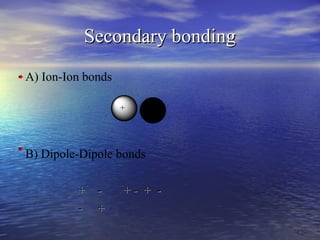
A) Ion-Ion bonds
B) Dipole-Dipole bonds
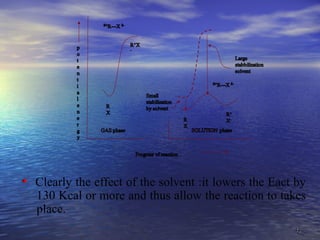
+ - + - + -+ - + - + -
- +- +
+ _
77
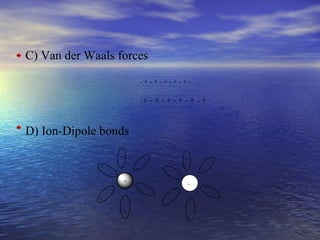
C) Van der Waals forces
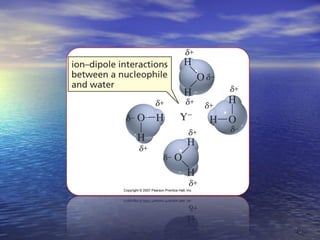
D) Ion-Dipole bonds
+ - + - + - + - + - +
- + - + - + - + - + -
+
+
+
+
+
+
+
_
_
_
_
_
_
_
+ _
_
_
_
+
_
+
+
+
+
_
88
99
Role of solvent inRole of solvent in
SOLUBILITYSOLUBILITY
1) Non ionic solute:
Solubility of it depends upon their polarity and in
particular their ability to form hydrogen bond.
1010
“Like dissolves like “ apply here
Example : hydrocarbons dissolve in benzene while alkyl
halide dissolve in solvent like chloroform or carbon
tetrachloride.
1111
In case of alcohol , it composite alkane-like alkyl group
and water like hyroxyl group.
Hydroxyl group is polar with high electronegativity of
oxygen element.
So alcohols are soluble in other hydroxyl compounds like
water.
1212
2) Ionic solutes.
Here the forces holding together an ionic lattice are
powerful, and to break them ,energy is supplied by the
formation of the ion-dipole bonds and the solvent.
1313
To dissolve ionic compounds
- solvent must be highly polar
- it must have high dielectric constant
Means it must be good insulator to lower the
attraction between oppositely charged Ions once they
are solvated.
1414
Water is the universal and most superior solvent due to
its polarity and high Dielectric constant.
Solvating power(the ability to form strong bonds to
dissolved ions) is very important and so there are other
liquids having large dipole moments and high
Dielectric constant are still poor solvent.
1515
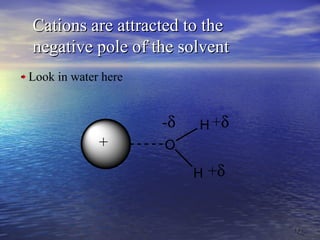
Cations are attracted to theCations are attracted to the
negative pole of the solventnegative pole of the solvent
Look in water here
O
H
H
+δ
+δ
-δ
+
1616
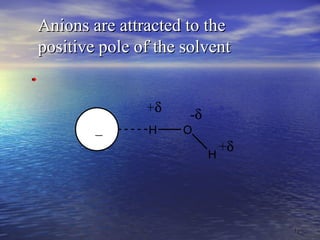
Anions are attracted to theAnions are attracted to the
positive pole of the solventpositive pole of the solvent
H O
H
_
+δ
-δ
+δ
1717
1919
Types of the solventTypes of the solvent
1) Protic solvent
solvents containing hydrogen that is attached to the
oxygen and nitrogen and hence acidic enough to form
hydrogen bond.
Example: water and methanol
2020
Other protic solvents solvate ions in the same manner as
that water does:
Cations: through unshared pairs
Anions: through hydrogen bonding
2121
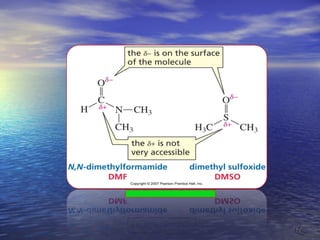
2) Aprotic solvents
solvents with moderately high dielectric constant
and do not contain acidic hydrogen.
Example: DMSO,DMF,HMPT
2222
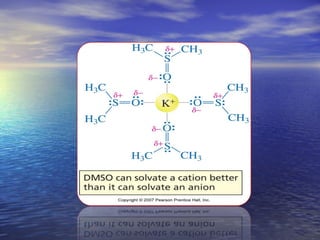
The aprotic solvents dissolve ionic compounds, but
they cannot form hydrogen bond to anions as in
protic solvents.
Aprotic solvents are highly polar and thus they
dissolve ionic compounds through their solvation of
the cations.
2323
Selection of the solventSelection of the solvent
Example: water and methanol
Water dissolves ionic compounds very well but poor
for organic one
while non polar solvents dissolves organic compounds
but poor for inorganic salts.
2424
Alcohol ,particularly smaller ones like methanol and
ethanol due to their alkyl group dissolve non polar
organic compounds and due to their hydroxyl group
dissolve polar compounds.
2525
Problem with alcoholProblem with alcohol
Water and alcohol are protic solvents and through the
hydrogen bonding they solvates the anions strongly
so they stabilizes the anions and lower their
reactivity and so weakens its basicity and nucleophilic
power.
2626
So we require aprotic solvent
and reaction that ,in protic solvent proceed slowly
at high temperature to give low yields may be found
,In aprotic solvent, to proceed rapidly often at room
temperature-to give high yields.
2727
Role of solvent in SRole of solvent in SNN1 reaction1 reaction
Here one substrate reacts faster than another chiefly
because of a lower Eact .
In SN1, for example the difference in rate between
tertiary and secondary substrate corrosponds to a
difference in Eact of about 15 kcal.
C CH3
CH3
H3C
Br
+ OH-
C CH3
CH3
H3C
OH
+ Br-
Rate= k[RBr]
2828
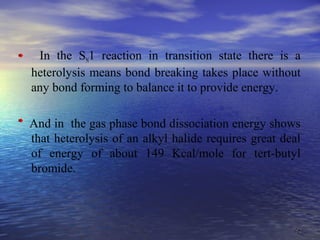
In the SN1 reaction in transition state there is a
heterolysis means bond breaking takes place without
any bond forming to balance it to provide energy.
And in the gas phase bond dissociation energy shows
that heterolysis of an alkyl halide requires great deal
of energy of about 149 Kcal/mole for tert-butyl
bromide.
2929
Where does this great amount of energy comes from?Where does this great amount of energy comes from?
This great amount of energy comes from formation of
the many bonds: bonds between the ions produced
and solvent.
The ions are not generated as the naked particles but
they are generated as the solvated ions.
3030
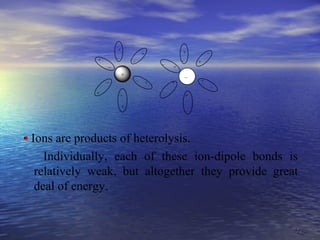
Ions are products of heterolysis.
Individually, each of these ion-dipole bonds is
relatively weak, but altogether they provide great
deal of energy.
+
+
+
+
+
+
+
_
_
_
_
_
_
_
+ _
_
_
_
+
_
+
+
+
+
_
3131
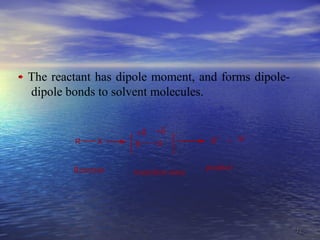
The reactant has dipole moment, and forms dipole-
dipole bonds to solvent molecules.
R R XX R+
+ X-+δ −δ
Reactant transition state
product
3232
Transition state has great dipole moment than reactant
and can form strong dipole-dipole bonds to the
solvent.
The solvent thus stabilizes the transition state more
than it does the reactant, lowers the Eact and speeds up
the reaction.
3333
Clearly the effect of the solvent :it lowers the Eact by
130 Kcal or more and thus allow the reaction to takes
place.
3434
Kinds of the solvent that is best for SKinds of the solvent that is best for SNN1 reaction1 reaction
More polar solvent, the stronger the ion-dipole
moment.
So the SN1 reaction of neutral substrates in water
than ethanol. they go faster in 20% ethanol than
80% ethanol.
3535
Role of solvent in SRole of solvent in SNN2 reaction2 reaction
SN2 reaction: reaction between alkyl halide and hydroxyl ion
Most of the energy needed to break the bond to the leaving
group is supplied by the making of the bond to the
nucleophile. in attach by OH-
, C-X bond is being broken
and simultaneously C-O bond is being formed.
CH3Br + OH- CH3OH + Br-
Rate = k [CH3OH] [OH-
]
3636
Among the protic solvents, ionizing power is highest
for those solvent which can form most stronger
hydrogen bond among all of them.
example:- 2,2,2 tri fluoroethanol
- formic acid
- trifluoroacetic acid
3737
Solvents which speeds up the SN1 reaction enormously
slows down the SN2 reaction by the factor 1020
!
The alkyl halide has dipole moment and forms weak
dipole-dipole bonds with the solvent. hydroxyl ion
has fully negative charge and forms very powerful
ion-dipole bond to the solvent.
3838
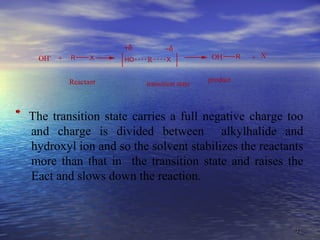
The transition state carries a full negative charge too
and charge is divided between alkylhalide and
hydroxyl ion and so the solvent stabilizes the reactants
more than that in the transition state and raises the
Eact and slows down the reaction.
R R XX OH + X-
−δ
Reactant transition state
product
OH-
+ HO
+δ
R
3939
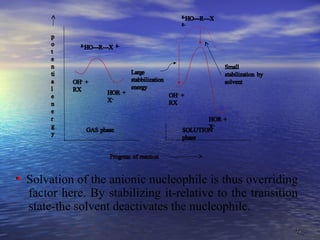
Solvation of the anionic nucleophile is thus overriding
factor here. By stabilizing it-relative to the transition
state-the solvent deactivates the nucleophile.
4040
Kinds of the solvent that is best for SKinds of the solvent that is best for SNN22
reactionreaction
The greater the polarity slower the SN2 reaction.
SN2 reaction in the solvents like dimethyl sulphoxide
(DMSO), dimethylformamide (DMF) or
hexamethylphosphorotriamide (HMPT) go millions
times faster than in alcohol or alcohol-water mixture.
4141
The SThe SNN2 reaction:2 reaction:
Phase transfer catalysisPhase transfer catalysis
Example:
The reaction of an alkyl halide with sodium cynide to
yield alkyl cynide (nitrile).
Traditional way is to use solvent which dissolves both
reagents.
4242
Consider solution of alkyl halide in nonpolar organic
solvent and a solution of sodiumcynide in water.
Then
The solvents are immisible, two separate layers and
on heating also no reaction takes place.
4343
On the addition of small amount of quaternary
ammonium salt to the reaction mixture, alkyl halide
and cynide still seperated in its own phase-react
rapidly and give high yield of the nitrile.
This type of the reaction is called as the phase
transfer catalysis.
4444
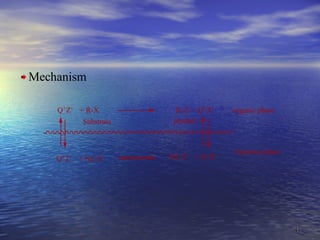
Mechanism
Q+
Z-
+ R-X R-Z + Q+
X-
Substrate product
organic phase
Q+
Z-
+ Na+
X- Na+
Z-
+ Q+
X- Aqueous phase
4545
Ions of the alkyl halides are in the organic phase while
cynide ions are in the aqueous phase.
Q+
ion carry cynide ion from aqueous to organic phase
and reaction of alkyl halide and cynide ion takes
place and form alkyl cynide.
And Q+
carry halide displaced from alkylhalide back to
the aqueous phase.

Role Of Solvent

  • 1.
    11 Hardik MistryHardik Mistry LM college of pharmacyL M college of pharmacy Pharmaceutical chemistry dept.Pharmaceutical chemistry dept.
  • 2.
    22 SOLVENTSOLVENT It is thecomponent of the reaction system that seldom appear in our equation , but that is nearly always present.
  • 3.
    33 Importance of thesolventImportance of the solvent The presence of the solvent can speed up or slow down the reaction by a factor 1020 Change from the one solvent to another can bring about millionfold change in reaction rate. Solvent effect is more powerful than any other factors like steric factor,polarity factor or symphoric factor.
  • 4.
    44 Solute molecules andions do not exist in the solution as nacked particles but always solvated and each dissolved particles is a cluster of solvent molecules.
  • 5.
    55 Any solvent clusterhelp to make up the structure and determine their stabilities which help us to predict the chemical behavior of the structure. Through the secondary bonding ,solvent help us to determining the shape of the of large molecules like protein and nucleic acids and inturn their biological activities.
  • 6.
    66 Secondary bondingSecondary bonding A)Ion-Ion bonds B) Dipole-Dipole bonds + - + - + -+ - + - + - - +- + + _
  • 7.
    77 C) Van derWaals forces D) Ion-Dipole bonds + - + - + - + - + - + - + - + - + - + - + - + + + + + + + _ _ _ _ _ _ _ + _ _ _ _ + _ + + + + _
  • 8.
  • 9.
    99 Role of solventinRole of solvent in SOLUBILITYSOLUBILITY 1) Non ionic solute: Solubility of it depends upon their polarity and in particular their ability to form hydrogen bond.
  • 10.
    1010 “Like dissolves like“ apply here Example : hydrocarbons dissolve in benzene while alkyl halide dissolve in solvent like chloroform or carbon tetrachloride.
  • 11.
    1111 In case ofalcohol , it composite alkane-like alkyl group and water like hyroxyl group. Hydroxyl group is polar with high electronegativity of oxygen element. So alcohols are soluble in other hydroxyl compounds like water.
  • 12.
    1212 2) Ionic solutes. Herethe forces holding together an ionic lattice are powerful, and to break them ,energy is supplied by the formation of the ion-dipole bonds and the solvent.
  • 13.
    1313 To dissolve ioniccompounds - solvent must be highly polar - it must have high dielectric constant Means it must be good insulator to lower the attraction between oppositely charged Ions once they are solvated.
  • 14.
    1414 Water is theuniversal and most superior solvent due to its polarity and high Dielectric constant. Solvating power(the ability to form strong bonds to dissolved ions) is very important and so there are other liquids having large dipole moments and high Dielectric constant are still poor solvent.
  • 15.
    1515 Cations are attractedto theCations are attracted to the negative pole of the solventnegative pole of the solvent Look in water here O H H +δ +δ -δ +
  • 16.
    1616 Anions are attractedto theAnions are attracted to the positive pole of the solventpositive pole of the solvent H O H _ +δ -δ +δ
  • 17.
  • 19.
    1919 Types of thesolventTypes of the solvent 1) Protic solvent solvents containing hydrogen that is attached to the oxygen and nitrogen and hence acidic enough to form hydrogen bond. Example: water and methanol
  • 20.
    2020 Other protic solventssolvate ions in the same manner as that water does: Cations: through unshared pairs Anions: through hydrogen bonding
  • 21.
    2121 2) Aprotic solvents solventswith moderately high dielectric constant and do not contain acidic hydrogen. Example: DMSO,DMF,HMPT
  • 22.
    2222 The aprotic solventsdissolve ionic compounds, but they cannot form hydrogen bond to anions as in protic solvents. Aprotic solvents are highly polar and thus they dissolve ionic compounds through their solvation of the cations.
  • 23.
    2323 Selection of thesolventSelection of the solvent Example: water and methanol Water dissolves ionic compounds very well but poor for organic one while non polar solvents dissolves organic compounds but poor for inorganic salts.
  • 24.
    2424 Alcohol ,particularly smallerones like methanol and ethanol due to their alkyl group dissolve non polar organic compounds and due to their hydroxyl group dissolve polar compounds.
  • 25.
    2525 Problem with alcoholProblemwith alcohol Water and alcohol are protic solvents and through the hydrogen bonding they solvates the anions strongly so they stabilizes the anions and lower their reactivity and so weakens its basicity and nucleophilic power.
  • 26.
    2626 So we requireaprotic solvent and reaction that ,in protic solvent proceed slowly at high temperature to give low yields may be found ,In aprotic solvent, to proceed rapidly often at room temperature-to give high yields.
  • 27.
    2727 Role of solventin SRole of solvent in SNN1 reaction1 reaction Here one substrate reacts faster than another chiefly because of a lower Eact . In SN1, for example the difference in rate between tertiary and secondary substrate corrosponds to a difference in Eact of about 15 kcal. C CH3 CH3 H3C Br + OH- C CH3 CH3 H3C OH + Br- Rate= k[RBr]
  • 28.
    2828 In the SN1reaction in transition state there is a heterolysis means bond breaking takes place without any bond forming to balance it to provide energy. And in the gas phase bond dissociation energy shows that heterolysis of an alkyl halide requires great deal of energy of about 149 Kcal/mole for tert-butyl bromide.
  • 29.
    2929 Where does thisgreat amount of energy comes from?Where does this great amount of energy comes from? This great amount of energy comes from formation of the many bonds: bonds between the ions produced and solvent. The ions are not generated as the naked particles but they are generated as the solvated ions.
  • 30.
    3030 Ions are productsof heterolysis. Individually, each of these ion-dipole bonds is relatively weak, but altogether they provide great deal of energy. + + + + + + + _ _ _ _ _ _ _ + _ _ _ _ + _ + + + + _
  • 31.
    3131 The reactant hasdipole moment, and forms dipole- dipole bonds to solvent molecules. R R XX R+ + X-+δ −δ Reactant transition state product
  • 32.
    3232 Transition state hasgreat dipole moment than reactant and can form strong dipole-dipole bonds to the solvent. The solvent thus stabilizes the transition state more than it does the reactant, lowers the Eact and speeds up the reaction.
  • 33.
    3333 Clearly the effectof the solvent :it lowers the Eact by 130 Kcal or more and thus allow the reaction to takes place.
  • 34.
    3434 Kinds of thesolvent that is best for SKinds of the solvent that is best for SNN1 reaction1 reaction More polar solvent, the stronger the ion-dipole moment. So the SN1 reaction of neutral substrates in water than ethanol. they go faster in 20% ethanol than 80% ethanol.
  • 35.
    3535 Role of solventin SRole of solvent in SNN2 reaction2 reaction SN2 reaction: reaction between alkyl halide and hydroxyl ion Most of the energy needed to break the bond to the leaving group is supplied by the making of the bond to the nucleophile. in attach by OH- , C-X bond is being broken and simultaneously C-O bond is being formed. CH3Br + OH- CH3OH + Br- Rate = k [CH3OH] [OH- ]
  • 36.
    3636 Among the proticsolvents, ionizing power is highest for those solvent which can form most stronger hydrogen bond among all of them. example:- 2,2,2 tri fluoroethanol - formic acid - trifluoroacetic acid
  • 37.
    3737 Solvents which speedsup the SN1 reaction enormously slows down the SN2 reaction by the factor 1020 ! The alkyl halide has dipole moment and forms weak dipole-dipole bonds with the solvent. hydroxyl ion has fully negative charge and forms very powerful ion-dipole bond to the solvent.
  • 38.
    3838 The transition statecarries a full negative charge too and charge is divided between alkylhalide and hydroxyl ion and so the solvent stabilizes the reactants more than that in the transition state and raises the Eact and slows down the reaction. R R XX OH + X- −δ Reactant transition state product OH- + HO +δ R
  • 39.
    3939 Solvation of theanionic nucleophile is thus overriding factor here. By stabilizing it-relative to the transition state-the solvent deactivates the nucleophile.
  • 40.
    4040 Kinds of thesolvent that is best for SKinds of the solvent that is best for SNN22 reactionreaction The greater the polarity slower the SN2 reaction. SN2 reaction in the solvents like dimethyl sulphoxide (DMSO), dimethylformamide (DMF) or hexamethylphosphorotriamide (HMPT) go millions times faster than in alcohol or alcohol-water mixture.
  • 41.
    4141 The SThe SNN2reaction:2 reaction: Phase transfer catalysisPhase transfer catalysis Example: The reaction of an alkyl halide with sodium cynide to yield alkyl cynide (nitrile). Traditional way is to use solvent which dissolves both reagents.
  • 42.
    4242 Consider solution ofalkyl halide in nonpolar organic solvent and a solution of sodiumcynide in water. Then The solvents are immisible, two separate layers and on heating also no reaction takes place.
  • 43.
    4343 On the additionof small amount of quaternary ammonium salt to the reaction mixture, alkyl halide and cynide still seperated in its own phase-react rapidly and give high yield of the nitrile. This type of the reaction is called as the phase transfer catalysis.
  • 44.
    4444 Mechanism Q+ Z- + R-X R-Z+ Q+ X- Substrate product organic phase Q+ Z- + Na+ X- Na+ Z- + Q+ X- Aqueous phase
  • 45.
    4545 Ions of thealkyl halides are in the organic phase while cynide ions are in the aqueous phase. Q+ ion carry cynide ion from aqueous to organic phase and reaction of alkyl halide and cynide ion takes place and form alkyl cynide. And Q+ carry halide displaced from alkylhalide back to the aqueous phase.