SAMPLING METHODS

    QUALITY SQUARE INDUSTRY


       Hardik Mistry
   QUALITY SQUARE INDUSTRY
Introduction


Sampling is the act, process, or technique of selecting a suitable
 sample, or a representative part of a population for the purpose
   of determining parameters or characteristics of the whole
                           populations.
Purpose
• Economy : taking a sample requires a fewer resources than a
  census.

• Timeliness : A sample may provide you with needed information
  quickly

• The large size of many populations : many populations about
  which inferences must be made are quite large

• Inaccessibility of some of the population : There are some
  populations that are so difficult to get access to that only a
  sample can be used
Cont….
• Destructiveness of the observation : Sometime the very act of
  observing the desired characteristic of a unit of the population
  destroys it for the intended

• Accuracy : A sample may be more accurate than a census. A
  sloppily conducted census can a provide less reliable
  information than a carefully obtained sample.
NATIONAL SURVEY On
                       Milk Adulteration 2011
• The FSSAI (Food safety and Standard Authority of India)
  regional offices of Chennai, Mumbai, Delhi, Guwahati and
  Kolkata, has conducted a nationwide survey and collected 1791
  samples of which 1226 had tested positive for milk adulteration.
• The reports suggest that most Indians are consuming detergents
  and other contaminants through milk.
• The first-of-its-kind snapshot survey had found that about 68.4
  percent of the samples carried detergents.
• Other contaminants were Urea, Starch, Glucose and Formalin.


  http://www.ahmedabadmirror.com/article/3/2012011420120114032756874a111b88d/%E2%80%98Milk-in-city-
  capital-unadulterated%E2%80%99.html?pageno=1
Cont….
• In Gujarat out of 100, 89 samples were found adulterated by
  FSSAI.
• 450 samples taken by the Gujarat government in Ahmedabad
  and Gandhinagar using an instant kit have tested negative for
  milk adulteration.
• The tests were conducted by Gujarat Food and Drugs Controller
  Authority (GFDCA). More tests will be carried out on 2,500
  samples sent from across the state at six laboratories


  http://news.outlookindia.com/items.aspx?artid=747300
Merits
• It saves time.

• It reduces cost of enquiry.

• It gives more reliable results.

• More detailed information can be obtained.

• It is convenient for administration.

• The method is scientific.

• It is only method when investigation is causing the destruction
  of the units examined.
Demerits
• It requires the services of expert investigators.

• If the survey is not properly planned, we may get misleading
  results.

• It requires better supervision, more sophisticated techniques for
  planning and execution.

• If the sample is not adequate, it may not indicate true
  characteristics of the population.
Bias and Errors in Sampling


A sample is expected to mirror the population from which it
comes, however, there is no guarantee that any sample will be
precisely representative of the population from which it comes.
Cont….
   There are two basic causes for sampling errors.

A. CHANCE
   That is the error that occurs just because of bad luck. This may
   result in untypical choices.

B. SAMPLING BIAS
   • Sampling bias is a tendency to favor the selection of units
     that have particular characteristics.
   • It is the error that results from solely from the manner in
     which the observations are made.
Cont….
                     UNINTENDED ERRORS
•   The manner in which the response is elicited
•   The social desirability of the persons surveyed
•   The purpose of the study
•   The personnel biases of the interviewers or survey writer.
Sampling Method
• A Sampling method means how a sample is selected from given
  population.

• The larger the number of units observed for data collection, the
  more representative is the sample of its population.

• The sampling method employed for selecting a sample is
  important in determining how closely the sample represents the
  population.
Sampling Methods

(A) Random sampling
     Simple random sampling
     Stratified random sampling

(B) Systemic sampling

(C) Multistage sampling

(D) Cluster sampling
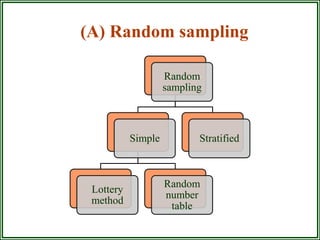
(A) Random sampling

                    Random
                    sampling


           Simple          Stratified


                    Random
 Lottery
                    number
 method
                     table
Simple random sampling

• In this method, the sample is being selected in such a way that
  each unit of the population has an equal chance of being
  included in sample.

• A simple random sample can be selected by two methods.
  (i) Lottery method
  (ii) Random number tables
(i) Lottery method
           Simplest method of selecting a random sample

 Suppose, we have 500 units in population and we wish to
  select 50 units out of them.
 So assign the numbers 1 to 500 units of population.
 Prepare slips bearing numbers 1 to 500.
 The slips should be homogeneous in shape, size, colour etc.
 These slips are shuffled and put in box.
 50 slips are selected.
 The units with the numbers on the slips selected will constitute
  a random sample.
(ii) Random number tables

• Used as device to choose samples which included in survey, a
  quality control inspection sample, or to assign experimental
  units to treatments such as assigning patients to drug
  treatments.

• It is most practical and inexpensive method of selecting a
  random sample.
Cont….
• This method has been constructed in such a way that each of the
  digits 0,1,2,…,9 appear with approximately the same frequency
  and independent of each other.
• Suppose, we want to select random sample of size 50 out of
  500,then give numbers 1 to 500 to the units of the population.
• Then, open any page of the random number table, select any row
  or any column and consider a three digit random number.
• If the random number is less than 500, say 237, then select the
  unit number 237 from population.
• If the random number is greater than 500, then ignore the
  number.
• The units selected constitute the random sample.
(B) Systemic sampling
• This technique is used when complete and up-to-date list of
  all units in the population is available.

• First unit is selected by method of random sampling and the
  remaining units are selected according to some predetermined
  pattern involving regular spacing of units.
Cont….
• Suppose there are 500 units in the population and we wish to
  select a sample size 10.
• Then we say that out of every 50(=500/10) units, we have to
  select one unit.
• Then select a random number from 1 to 50.
• Suppose the random number selected is 27, then the systemic
  sample will consist of the units bearing numbers 27, 77,
  127,… 477.
• It is useful only when complete and up to date frame is
  available and units are arranged in some specific order.
(C) Multistage sampling
• This method is useful in many large scale surveys where the
  preparation of the list of all units in the population is difficult.

• In this method, random selection is primary, intermediate and
  final (or the ultimate) units from a given population.
• Thus, the area of investigation is restricted to a small number
  of final units.
• This will reduce the cost compared with simple random
  sampling from the whole population.
Cont….
• Suppose a socio-economy survey is to be conducted in a state
  where complete list of all households is not available.

• In this case, select a random sample of some districts from the
  total districts of the state.
• Within the selected districts, select random samples of some
  talukas.
• Then from selected talukas, select random sample of some
  villages and finally random samples of households from the
  selected villages.
• This is a four stage sampling.
(D) Cluster sampling
• In this method, population from which sample is to be drawn
  is divided into number of groups or clusters each of which
  contain “sub-units.”

• The clusters may or may not have equal number of units.

• We select a random sample of some clusters from these
  clusters and then observe and measure, each and every unit in
  selected clusters.
Cont….
• Suppose, we are interested in obtaining the information about
  the income of the residents in a city, the whole city may be
  divided into N different blocks or localities (which form the
  clusters) and a simple random sample of n blocks (clusters) is
  drawn.

• The residents in the selected blocks constitute the cluster
  sample.
Sampling with and without
                 Replacement
• If we draw a ball from an urn containing balls numbered 1 to
  N, we have the choice of replacing or not replacing the ball
  into the urn before a second ball is drawn.
• In the first case the particular ball can be drawn again and
  again, whereas in the second case it can only be selected once.
• Sampling where each unit of the population may be chosen
  more than once is called as sampling with replacement, while
  if each unit cannot be chosen more than once it is called as
  sampling without replacement.
Sampling Plans
Single Sampling Plan
•   Inspect a sample “n” place from the lot “N”.

•   If the number of defects found in sample does not exceed “c”
    (accep. No.) the lot is accepted.

•   If the number of defects found in sample exceed the value “c”
    all the pieces in the reminder of lot inspected.
Double Sampling Plan
•   In this sampling : after test three conditions arises
•   Accept lot
•   Reject lot
•   No decision : in this case second sample is taken and the to
    combine result of both the sample and made final decision
Content Uniformity
                    I.P.2010 Capsule Content uniformity

•   Determine the content of active ingredient in each of 10 capsules taken at
    random using the method given in the monograph or by any other suitable
    analytical method of equivalent accuracy and precision.

•   The capsules comply with the test if not more than one of the individual
    values thus obtained is outside the limits 85 to 115 percent of the average
    value and none is outside the limits 75 to 125 percent.

•   If two or three individual values are outside the limits 85 to 115 percent of
    the average value repeat the determination using another 20 capsules.

•   The capsules comply with the test if in the total sample of 30 capsules not
    more than three individual values are outside the limit 85 to 115 percent and
    none is outside the limits 75 to 125 percent of the average value.
Sampling Plan is used for
•       In Starting materials
•       Finished products
•       Packaging materials


          Sampling Plan for Starting Materials
    •     “n- plan”

    •     “p- plan”

    •     “r- plan”
    WHO Technical Report Series, No. 929, 2005, Annex 4
    WHO guidelines for sampling of pharmaceutical products and related materials
1- The ‘n-plan’
•   Only used when material is consider uniform and from a
    recognized source.
     n=1+
•   N = sampling units in the consignment (e.g individual
    package, drum or container)
•   Calculate “n” (n = units to be sampled)
•   Select at random “n” units from N.
•   Take a sample from these units.
•   QC lab checks appearance + identify of each sample.
•   If results concordant => combine samples into a single final sample .
•   Take “analytical sample” for full testing
•   Keep the test as “retention sample.”
Cont..
Value of n, p or r                                Value of N

                          n plan                   p plan         r plan
        2                Up to 3                  Upto 25         Upto 2
        3                  4-6                     26 - 56         3-4
        4                 7-13                    57 - 100         5-7
        5                 14-20                   101 - 156        6 -11
        6                 21-30                   157 - 225       12 - 16
        7                 31-42                                   17 -22
        8                 43-56                                   23 - 28
        9                 57-72                                   29 - 36
       10                 73-90                                   37 - 44
                     e.g. N = 40 = > n =7 (units to be sampled)
II- The ‘p-plan’
•   May be used when material is consider uniform, from a
    recognized source and the main purpose is to test for identity.
•   p = 0.4
•   N = sampling units in the consignment (e.g individual
    package, drum or container)

•   Sample each of the N sampling units
•   QC lab checks appearance + identify of each sample.
•   If results concordant => p final samples are formed by appropriate pooling
•   Keep the p samples for retention (or full testing if required)
Cont..
Value of n, p or r                                         Value of N

                                  n plan                     p plan                  r plan
        2                         Up to 3                   Upto 25                  Upto 2
        3                           4-6                      26 - 56                  3-4
        4                          7-13                     57 - 100                  5-7
        5                          14-20                   101 - 156                  6 -11
        6                          21-30                   157 - 225                 12 - 16
        7                          31-42                                             17 -22
        8                          43-56                                             23 - 28
        9                          57-72                                             29 - 36
       10                          73-90                                             37 - 44
                     e.g. N = 40 = > p =3 ( final samples after testing + pooling)
III- The ‘r-plan’
•   May be used when material is consider non-uniform and/or
    obtained from a not well know source.
•   Can be used herbal medicinal products used as starting
    materials r = 1.5
•   N = sampling units in the consignment (e.g individual
    package, drum or container)

•   Sample each of the N sampling units
•   QC lab checks appearance + identify of each sample.
•   If results concordant => r final samples are randomly selected.
•   R Samples individually fully tested.
•   If results concordant = > combine the r samples for the retention sample.
Cont..
Value of n, p or r                                         Value of N

                                  n plan                     p plan                  r plan
        2                         Up to 3                   Upto 25                  Upto 2
        3                           4-6                      26 - 56                  3-4
        4                          7-13                     57 - 100                  5-7
        5                          14-20                   101 - 156                  6 -11
        6                          21-30                   157 - 225                 12 - 16
        7                          31-42                                             17 -22
        8                          43-56                                             23 - 28
        9                          57-72                                             29 - 36
       10                          73-90                                             37 - 44
                     e.g. N = 40 = > p =3 ( final samples after testing + pooling)
Sampling Plan for Finished Products
•   The minimum size of the samples to be taken is determined
    by the requirements of the analytical procedure used to test
    the product (tests of unit dosage forms for uniformity of
    weight, volume or content, or sterility tests can require a large
    number of samples).

•   Sampling and testing may be adjusted according to the
    experience with the source of the product, e.g. manufacturer
    or supplier.
Sampling Plan for Finished Products
                      &
             Packaging Material
5.2 Sampling plans for packaging materials should be based on
   defined sampling standards, for example, British Standard BS
   6001-1, ISO 2859.

5.3 As for packaging materials, sampling plans for finished
   products should be based on defined sampling standards such
   as BS 6001-1, ISO 2859 or ANSI/ASQCZ 1.4-1993. or
   ANSI/ASQCZ1.4-1993.
ISO 2859 or ANSI/ASQC Z 1.4-1993. BS 6001-1,
Conclusion
•   In conclusion, it can be said that using a sample in research
    saves mainly on money and time, if a suitable sampling
    strategy is used, appropriate sample size selected and
    necessary precautions taken to reduce on sampling and
    measurement errors, then a sample should yield valid and
    reliable information.
The only way to do great work is
To love what you do

SAMPLING METHODS

  • 1.
    SAMPLING METHODS QUALITY SQUARE INDUSTRY Hardik Mistry QUALITY SQUARE INDUSTRY
  • 2.
    Introduction Sampling is theact, process, or technique of selecting a suitable sample, or a representative part of a population for the purpose of determining parameters or characteristics of the whole populations.
  • 3.
    Purpose • Economy :taking a sample requires a fewer resources than a census. • Timeliness : A sample may provide you with needed information quickly • The large size of many populations : many populations about which inferences must be made are quite large • Inaccessibility of some of the population : There are some populations that are so difficult to get access to that only a sample can be used
  • 4.
    Cont…. • Destructiveness ofthe observation : Sometime the very act of observing the desired characteristic of a unit of the population destroys it for the intended • Accuracy : A sample may be more accurate than a census. A sloppily conducted census can a provide less reliable information than a carefully obtained sample.
  • 5.
    NATIONAL SURVEY On Milk Adulteration 2011 • The FSSAI (Food safety and Standard Authority of India) regional offices of Chennai, Mumbai, Delhi, Guwahati and Kolkata, has conducted a nationwide survey and collected 1791 samples of which 1226 had tested positive for milk adulteration. • The reports suggest that most Indians are consuming detergents and other contaminants through milk. • The first-of-its-kind snapshot survey had found that about 68.4 percent of the samples carried detergents. • Other contaminants were Urea, Starch, Glucose and Formalin. http://www.ahmedabadmirror.com/article/3/2012011420120114032756874a111b88d/%E2%80%98Milk-in-city- capital-unadulterated%E2%80%99.html?pageno=1
  • 6.
    Cont…. • In Gujaratout of 100, 89 samples were found adulterated by FSSAI. • 450 samples taken by the Gujarat government in Ahmedabad and Gandhinagar using an instant kit have tested negative for milk adulteration. • The tests were conducted by Gujarat Food and Drugs Controller Authority (GFDCA). More tests will be carried out on 2,500 samples sent from across the state at six laboratories http://news.outlookindia.com/items.aspx?artid=747300
  • 7.
    Merits • It savestime. • It reduces cost of enquiry. • It gives more reliable results. • More detailed information can be obtained. • It is convenient for administration. • The method is scientific. • It is only method when investigation is causing the destruction of the units examined.
  • 8.
    Demerits • It requiresthe services of expert investigators. • If the survey is not properly planned, we may get misleading results. • It requires better supervision, more sophisticated techniques for planning and execution. • If the sample is not adequate, it may not indicate true characteristics of the population.
  • 9.
    Bias and Errorsin Sampling A sample is expected to mirror the population from which it comes, however, there is no guarantee that any sample will be precisely representative of the population from which it comes.
  • 10.
    Cont…. There are two basic causes for sampling errors. A. CHANCE That is the error that occurs just because of bad luck. This may result in untypical choices. B. SAMPLING BIAS • Sampling bias is a tendency to favor the selection of units that have particular characteristics. • It is the error that results from solely from the manner in which the observations are made.
  • 11.
    Cont…. UNINTENDED ERRORS • The manner in which the response is elicited • The social desirability of the persons surveyed • The purpose of the study • The personnel biases of the interviewers or survey writer.
  • 12.
    Sampling Method • ASampling method means how a sample is selected from given population. • The larger the number of units observed for data collection, the more representative is the sample of its population. • The sampling method employed for selecting a sample is important in determining how closely the sample represents the population.
  • 13.
    Sampling Methods (A) Randomsampling  Simple random sampling  Stratified random sampling (B) Systemic sampling (C) Multistage sampling (D) Cluster sampling
  • 14.
    (A) Random sampling Random sampling Simple Stratified Random Lottery number method table
  • 15.
    Simple random sampling •In this method, the sample is being selected in such a way that each unit of the population has an equal chance of being included in sample. • A simple random sample can be selected by two methods. (i) Lottery method (ii) Random number tables
  • 16.
    (i) Lottery method Simplest method of selecting a random sample  Suppose, we have 500 units in population and we wish to select 50 units out of them.  So assign the numbers 1 to 500 units of population.  Prepare slips bearing numbers 1 to 500.  The slips should be homogeneous in shape, size, colour etc.  These slips are shuffled and put in box.  50 slips are selected.  The units with the numbers on the slips selected will constitute a random sample.
  • 17.
    (ii) Random numbertables • Used as device to choose samples which included in survey, a quality control inspection sample, or to assign experimental units to treatments such as assigning patients to drug treatments. • It is most practical and inexpensive method of selecting a random sample.
  • 18.
    Cont…. • This methodhas been constructed in such a way that each of the digits 0,1,2,…,9 appear with approximately the same frequency and independent of each other. • Suppose, we want to select random sample of size 50 out of 500,then give numbers 1 to 500 to the units of the population. • Then, open any page of the random number table, select any row or any column and consider a three digit random number. • If the random number is less than 500, say 237, then select the unit number 237 from population. • If the random number is greater than 500, then ignore the number. • The units selected constitute the random sample.
  • 19.
    (B) Systemic sampling •This technique is used when complete and up-to-date list of all units in the population is available. • First unit is selected by method of random sampling and the remaining units are selected according to some predetermined pattern involving regular spacing of units.
  • 20.
    Cont…. • Suppose thereare 500 units in the population and we wish to select a sample size 10. • Then we say that out of every 50(=500/10) units, we have to select one unit. • Then select a random number from 1 to 50. • Suppose the random number selected is 27, then the systemic sample will consist of the units bearing numbers 27, 77, 127,… 477. • It is useful only when complete and up to date frame is available and units are arranged in some specific order.
  • 21.
    (C) Multistage sampling •This method is useful in many large scale surveys where the preparation of the list of all units in the population is difficult. • In this method, random selection is primary, intermediate and final (or the ultimate) units from a given population. • Thus, the area of investigation is restricted to a small number of final units. • This will reduce the cost compared with simple random sampling from the whole population.
  • 22.
    Cont…. • Suppose asocio-economy survey is to be conducted in a state where complete list of all households is not available. • In this case, select a random sample of some districts from the total districts of the state. • Within the selected districts, select random samples of some talukas. • Then from selected talukas, select random sample of some villages and finally random samples of households from the selected villages. • This is a four stage sampling.
  • 23.
    (D) Cluster sampling •In this method, population from which sample is to be drawn is divided into number of groups or clusters each of which contain “sub-units.” • The clusters may or may not have equal number of units. • We select a random sample of some clusters from these clusters and then observe and measure, each and every unit in selected clusters.
  • 24.
    Cont…. • Suppose, weare interested in obtaining the information about the income of the residents in a city, the whole city may be divided into N different blocks or localities (which form the clusters) and a simple random sample of n blocks (clusters) is drawn. • The residents in the selected blocks constitute the cluster sample.
  • 25.
    Sampling with andwithout Replacement • If we draw a ball from an urn containing balls numbered 1 to N, we have the choice of replacing or not replacing the ball into the urn before a second ball is drawn. • In the first case the particular ball can be drawn again and again, whereas in the second case it can only be selected once. • Sampling where each unit of the population may be chosen more than once is called as sampling with replacement, while if each unit cannot be chosen more than once it is called as sampling without replacement.
  • 26.
  • 27.
    Single Sampling Plan • Inspect a sample “n” place from the lot “N”. • If the number of defects found in sample does not exceed “c” (accep. No.) the lot is accepted. • If the number of defects found in sample exceed the value “c” all the pieces in the reminder of lot inspected.
  • 28.
    Double Sampling Plan • In this sampling : after test three conditions arises • Accept lot • Reject lot • No decision : in this case second sample is taken and the to combine result of both the sample and made final decision
  • 29.
    Content Uniformity I.P.2010 Capsule Content uniformity • Determine the content of active ingredient in each of 10 capsules taken at random using the method given in the monograph or by any other suitable analytical method of equivalent accuracy and precision. • The capsules comply with the test if not more than one of the individual values thus obtained is outside the limits 85 to 115 percent of the average value and none is outside the limits 75 to 125 percent. • If two or three individual values are outside the limits 85 to 115 percent of the average value repeat the determination using another 20 capsules. • The capsules comply with the test if in the total sample of 30 capsules not more than three individual values are outside the limit 85 to 115 percent and none is outside the limits 75 to 125 percent of the average value.
  • 30.
    Sampling Plan isused for • In Starting materials • Finished products • Packaging materials Sampling Plan for Starting Materials • “n- plan” • “p- plan” • “r- plan” WHO Technical Report Series, No. 929, 2005, Annex 4 WHO guidelines for sampling of pharmaceutical products and related materials
  • 31.
    1- The ‘n-plan’ • Only used when material is consider uniform and from a recognized source. n=1+ • N = sampling units in the consignment (e.g individual package, drum or container) • Calculate “n” (n = units to be sampled) • Select at random “n” units from N. • Take a sample from these units. • QC lab checks appearance + identify of each sample. • If results concordant => combine samples into a single final sample . • Take “analytical sample” for full testing • Keep the test as “retention sample.”
  • 32.
    Cont.. Value of n,p or r Value of N n plan p plan r plan 2 Up to 3 Upto 25 Upto 2 3 4-6 26 - 56 3-4 4 7-13 57 - 100 5-7 5 14-20 101 - 156 6 -11 6 21-30 157 - 225 12 - 16 7 31-42 17 -22 8 43-56 23 - 28 9 57-72 29 - 36 10 73-90 37 - 44 e.g. N = 40 = > n =7 (units to be sampled)
  • 33.
    II- The ‘p-plan’ • May be used when material is consider uniform, from a recognized source and the main purpose is to test for identity. • p = 0.4 • N = sampling units in the consignment (e.g individual package, drum or container) • Sample each of the N sampling units • QC lab checks appearance + identify of each sample. • If results concordant => p final samples are formed by appropriate pooling • Keep the p samples for retention (or full testing if required)
  • 34.
    Cont.. Value of n,p or r Value of N n plan p plan r plan 2 Up to 3 Upto 25 Upto 2 3 4-6 26 - 56 3-4 4 7-13 57 - 100 5-7 5 14-20 101 - 156 6 -11 6 21-30 157 - 225 12 - 16 7 31-42 17 -22 8 43-56 23 - 28 9 57-72 29 - 36 10 73-90 37 - 44 e.g. N = 40 = > p =3 ( final samples after testing + pooling)
  • 35.
    III- The ‘r-plan’ • May be used when material is consider non-uniform and/or obtained from a not well know source. • Can be used herbal medicinal products used as starting materials r = 1.5 • N = sampling units in the consignment (e.g individual package, drum or container) • Sample each of the N sampling units • QC lab checks appearance + identify of each sample. • If results concordant => r final samples are randomly selected. • R Samples individually fully tested. • If results concordant = > combine the r samples for the retention sample.
  • 36.
    Cont.. Value of n,p or r Value of N n plan p plan r plan 2 Up to 3 Upto 25 Upto 2 3 4-6 26 - 56 3-4 4 7-13 57 - 100 5-7 5 14-20 101 - 156 6 -11 6 21-30 157 - 225 12 - 16 7 31-42 17 -22 8 43-56 23 - 28 9 57-72 29 - 36 10 73-90 37 - 44 e.g. N = 40 = > p =3 ( final samples after testing + pooling)
  • 37.
    Sampling Plan forFinished Products • The minimum size of the samples to be taken is determined by the requirements of the analytical procedure used to test the product (tests of unit dosage forms for uniformity of weight, volume or content, or sterility tests can require a large number of samples). • Sampling and testing may be adjusted according to the experience with the source of the product, e.g. manufacturer or supplier.
  • 38.
    Sampling Plan forFinished Products & Packaging Material 5.2 Sampling plans for packaging materials should be based on defined sampling standards, for example, British Standard BS 6001-1, ISO 2859. 5.3 As for packaging materials, sampling plans for finished products should be based on defined sampling standards such as BS 6001-1, ISO 2859 or ANSI/ASQCZ 1.4-1993. or ANSI/ASQCZ1.4-1993.
  • 39.
    ISO 2859 orANSI/ASQC Z 1.4-1993. BS 6001-1,
  • 40.
    Conclusion • In conclusion, it can be said that using a sample in research saves mainly on money and time, if a suitable sampling strategy is used, appropriate sample size selected and necessary precautions taken to reduce on sampling and measurement errors, then a sample should yield valid and reliable information.
  • 41.
    The only wayto do great work is To love what you do