Analytical Chemistry
COMPLEXOMETRIC TITRATIONS
General introduction
EDTA titrations
Advantages and limitations of EDTA as the titrant
Absolute and conditional formation constants of
Metal-EDTA complex
 Construction of Titration curve
Types of EDTA Titrations
Methods of increasing the selectivity of EDTA as a titrant
 Metallachromic indicators
 Theory Metallachromic indicators
Applications of Metallachromic indicators
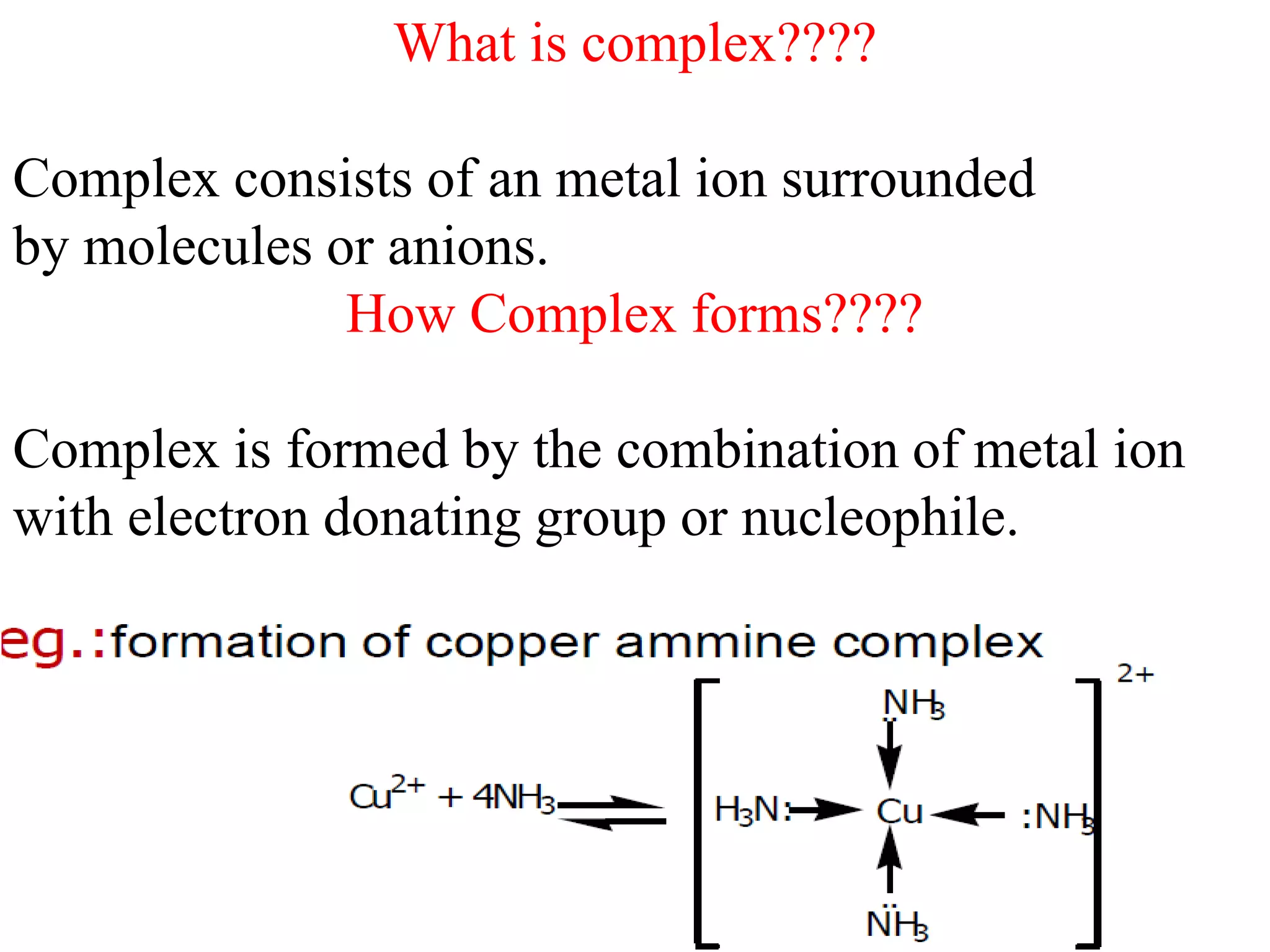
What is complex????
Complex consists of an metal ion surrounded
by molecules or anions.
How Complex forms????
Complex is formed by the combination of metal ion
with electron donating group or nucleophile.
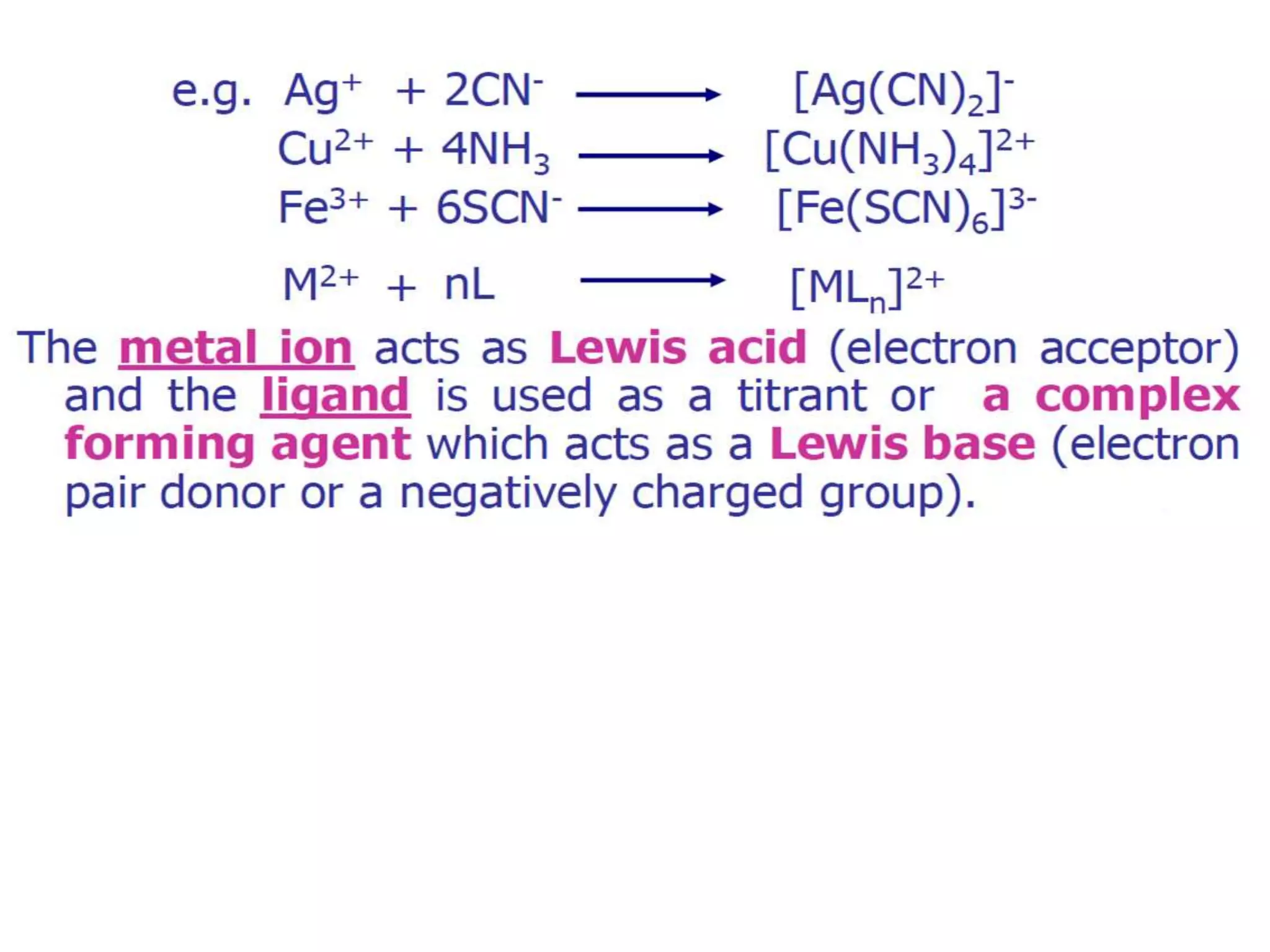
Complexes are compounds formed from
combination of metal ions with ligands
(complexing agents). A metal ionis an electron
deficient species while a ligand is an electron
rich, and thus, electron donating species. A
metal ion will thus accept electrons from a
ligand where coordination bonds are formed.
Electrons forming coordination bonds come
solely from ligands.
A ligand is called a monodentate if it donates a single
pair of electrons (like :NH3) while a bidentate ligand
(like ethylenediamine, :NH2CH2CH2H2N:) donates
two pairs of electrons. Ethylenediaminetetraacetic
acid (EDTA) is a hexadentate ligand. The ligand can
be as simple as ammonia which forms a complex with
Cu2+, for example, giving the complex Cu(NH3)4
2+.
When the ligand is a large organic molecule having two
or more of the complexing groups, like EDTA, the
ligand is called a chelating agent and the formed
complex, in this case, is called a chelate.
Complexometric Titrations:
 A complexometric titration is technique of volumetric analysis in
which a soluble, undissociated, stiochimetric complex is formed during
the addition of titrant to the sample solution.
 In Complexometric titration the formation of a colored complex is
used to indicate the end point of a titration.
 Complexometric titrations are particularly useful for the
determination of a mixture of different metal ions in solution.
 An indicator capable of producing an definite color change is
usually used to detect the end-point of the titration.
Which complexation reaction can be used as a volumetric
technique????
 The reaction which reaches equilibrium rapidly after each
portion of titrant is added.
 The reactions in which interfering situations do not arise.
e.g. The formation of several different complexes of the
metal ion with the titrant, during the titration process.
 The reaction in which a indicator is capable of locating
equivalence point with fair accuracy is available.
Complexation titrations are particularly useful for the
determination of a large number of metal ions in solution. In
practice, the use of EDTA as a titrant is well established in
such complexometric reactions.
EDTA Titrations:
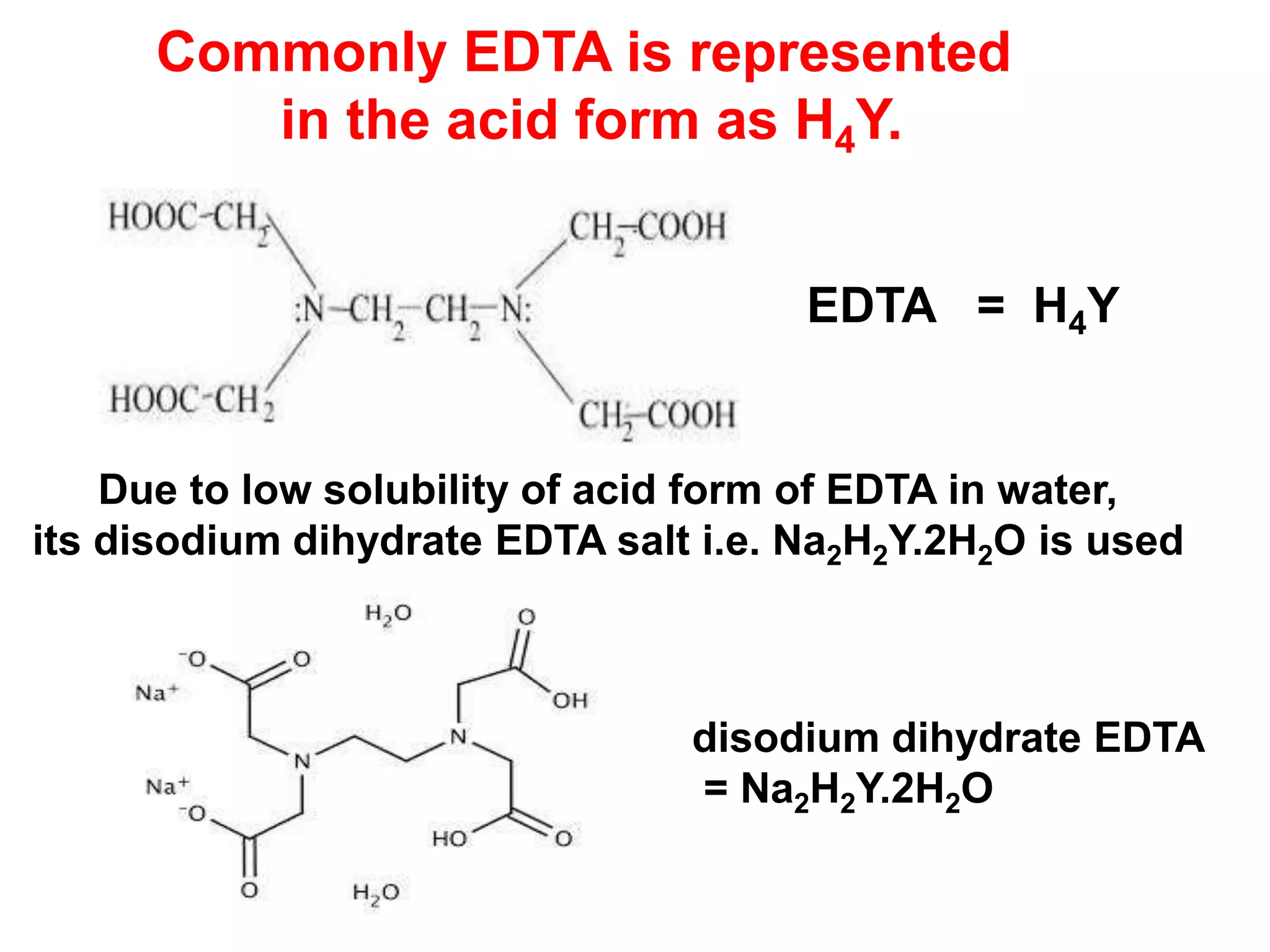
What is EDTA???
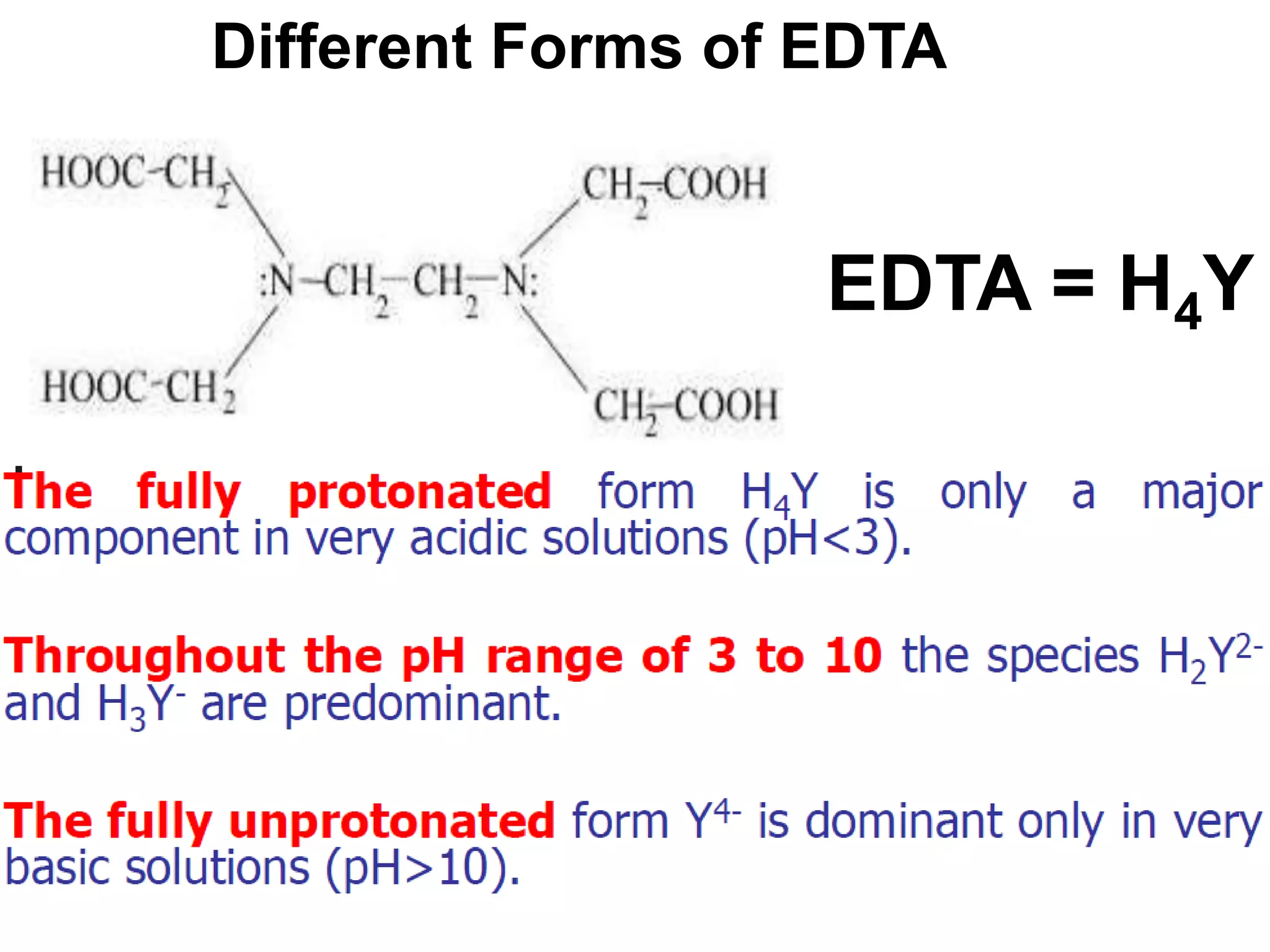
 EDTA is Ethylene Diamine Tetra Acetic acid.
It has four carboxyl groups and two amine groups.
Commonly EDTA is represented
in the acid form as H4Y.
EDTA = H4Y
Due to low solubility of acid form of EDTA in water,
its disodium dihydrate EDTA salt i.e. Na2H2Y.2H2O is used
disodium dihydrate EDTA
= Na2H2Y.2H2O
Different Forms of EDTA
EDTA = H4Y
EDTA has four carboxyl groups and two amine groups.
EDTA is polydenated ligand as it donate its six lone pairs of
electrons for the formation of coordinate covalent bonds with
metal cations to form Metal-EDTA complex.
Metal-EDTA complex
Stability of Metal-Ligand Complexes
The stability of complexes is influenced by a number of
factors related to the ligand and metal ions.
1. Nature of the metal ion: Small ions with high charges
lead to stronger complexes.
2. Nature of the ligand: The ligands forming chelates
impart extra stability (chelon effect). For example the
complex of nickel with a multidentate ligand is more
stable than the one formed with ammonia.
3. Basicity of the ligand: Greater basicity of the ligand
results in greater stability of the complex.
14
4. Size of chelate ring: The formation of five- or
six - membered rings provides the maximum
stability.
5. Number of metal chelate rings: The stability of
the complex is directly related to the number
of chelate rings formed between the ligand and
metal ion. Greater the number of such rings,
greater is the stability.
7. Steric effects: These also play an important
role in the stability of the complexes.
- EDTA titrations are carried out in buffered solution of
the metal ions to be estimated.
-The use of proper pH is important and is related to the
stability constant of a metal-EDTA complex.
- E.g. Alkaline pH is required for the metals having
low stability constant.
Low Alkaline to mild acidic pH is required for the metals
having high stability constant.
- The dissociation reactions of acid form EDTA, H4Y
are also pH dependant. pH is also an important criteria for
the proper functioning of the indicator substance.
Role of pH in EDTA titrations
Thus it is very important to maintain the pH during
the EDTA titrations
Advantages of EDTA as titrant:
1. ETDA form stable complex with various metal ions.
2. The complexation occurs in a single step and hence the
titration of the metal produce a sharp change in the metal ion
concentration at the equivalence point.
3. The Metal-EDTA complexes are all water soluble and hence
all studies can be performed in aqueous media.
4. EDTA forms 1:1 complex with all metal ions irrespective of
all charge on the metal ions. The stoichiometry is hence same
for all metal ions. The reaction can be represented as:
Mn+ + H2Y-2 + H2O MY(n-4) + 2H3O+
Limitations of EDTA as titrant:
1. Formation of insoluble hydroxides:
Many ETDA titrations are carried out under alkaline pH which
may lead to formation of insoluble hydroxides or basic salts that
may compete with the complexation process .
2. Lack of selectivity:
Since EDTA forms stable complexes with most of the metal ions,
it lacks selectivity if it is used to estimate a single metal cations
from a solution of mixture of metal ions.
Absolute formation constant
EDTA forms 1:1 complex with all metal ions irrespective of all
charge on the metal ions. The stoichiometry is hence same for all
metal ions. If fully unprotonated form of EDTA (Y-4) is react
with metal ion as follows:
M+n + Y-4 MY(n-4)+
KMY =
[MY(n-4)+]
[M+n] [Y-4]
Then absolute formation constant KMY is given as,
KMY is also referred as absolute stability constant. Higher the value
of KMY, higher is the stability of complex formed.
Metal Cation KMY Log KMY
Mg2+ 4.9 X 10⁸ 8.69
Ca2+ 5.0 X 10¹⁰ 10.70
Sr2+ 4.3 X 10⁸ 8.63
Ba2+ 5.8 X 10⁷ 7.76
Mn2+ 6.2 X 10¹³ 13.79
Fe2+ 2.1 X 10¹⁴ 14.33
Co2+ 2.0 X 10¹⁶ 16.31
Ni2+ 4.2 X 10¹⁸ 18.62
Cu2+ 6.3 X 10¹⁸ 18.80
Zn2+ 3.2 X 10¹⁶ 16.50
Cd2+ 2.9 X 10¹⁶ 16.46
Al3+ 1.3 X 10¹⁶ 16.13
Pb2+ 1.1 X 10¹⁸ 18.04
Hg3+ 6.3 X 10²¹ 21.80
Fe3+ 1.3 X 1025 25.1
V3+ 7.9 X 1025 25.9
Th4+ 1.6 X 10²³ 23.2
Group I
Titrated in
pH 8-11
Group II
Titrated in
pH 4-8
Group III
Titrated in
pH 1-4
Conditional formation constant
In absolute formation constant only fully unprotonated form of EDTA (Y-4) is taken
consideration. EDTA is tetra protonic acid. It is represented as H4Y. The four
different stages of dissociation of this tetra protonic acid can be represented as
follows:
H4Y H+ + H3Y-
Ka1 =
[H4Y]
[H+] [H3Y-]
Ka2 =
Ka3 =
Ka4 =
H3Y- H+ + H2Y-2
H2Y-2 H+ + HY-3
HY-3 H+ + Y- 4
[H+] [H2Y-2]
[H+] [HY-3]
[H+] [Y-4]
[H3Y-]
[H2Y-2]
[HY-3]
 Due to such important role of pH in complex formation with
EDTA , normally the solution of metal ions are buffered so that
the pH will remain constant.
 In this way the Conditional formation constant (K’MY) can be
estimated and it is possible to calculate and construct the titration
curve from which it is possible to judge the feasibility of the
Complexometric titration.
 Instrumental methods used for end point detection in
Complexometric titrations are : Spectrometric analysis,
Ampheromtric analysis, Potentiometric analysis
Metallochromic indicator
 The metallochromic indicators are organic compounds
which are capable of forming intensely coloured complex
with EDTA.
 This metal –indicator complex is weaker than the
Metal-EDTA complex and it has different colour than
uncomplexed indicator.
 During the course of titration, the metal ion from
metal –indicator complex is replaced to form Metal-EDTA
complex.
Requirement for Metal ion indicator
1. The colour must be sufficiently intense, so that a minimum
amount of indicator can be used.
2. The colour contrast between the indicator and Metal-indicator
complex should be readily observable.
3. The Metal-indicator complex should possess sufficient
stability to ensure a sharp colour change, however it should be
less stable than Metal-EDTA complex.
4. The change in equilibrium from metal-indicator complex to
the Metal-EDTA complex should be sharp and rapid.
5. The colour reaction of the indicator should be selective.
6. The indicator must be very sensitive to metal ions so that
the colour change occurs at near the equivalence point.
7. The indicator must be stable in the titration medium.
8. The indicator must be stable on storage also.
9. All the above requirements must be fulfilled in the pH
range in which the proposed titration is to carried out.
10. It should be commercially available in adequate purity.
Theory of metal ion indicators
The reaction corresponding to use of a metal ion indicator in an
EDTA titration can be represented as
M-In + EDTA M-EDTA + In
This reaction will take place only if the M-EDTA complex is more
stable than the M-In complex.
M + In M-In
Stability of the Metal-Indicator complex KIn, is given by the equation
KIn =
[M] [In]
[M-In]
Since, the indicator colour change also affected by the
hydrogen ion concentration, so it is convenient to define the
conditional indicator constant K’In which varies with pH.
For small the error, K’In > 104 and the ratio of conditional
formation constant of the metal-EDTA complex K’MY to
K’In should be of the order 104 to provide a good end point.
Examples Of metal ion
indicators
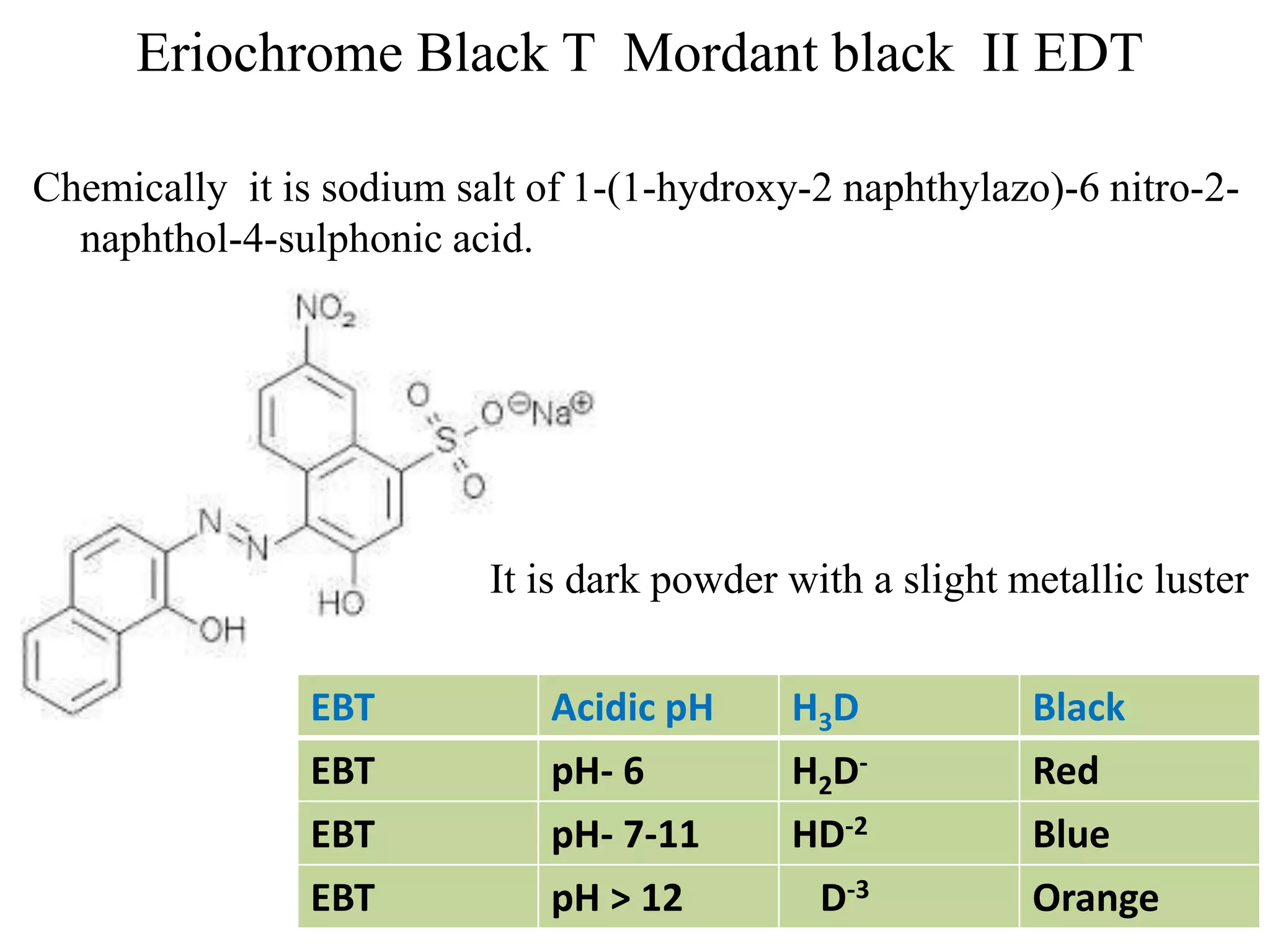
Eriochrome Black T Mordant black II EDT
Chemically it is sodium salt of 1-(1-hydroxy-2 naphthylazo)-6 nitro-2-
naphthol-4-sulphonic acid.
It is dark powder with a slight metallic luster
EBT Acidic pH H3D Black
EBT pH- 6 H2D- Red
EBT pH- 7-11 HD-2 Blue
EBT pH > 12 D-3 Orange
 EBT is used to estimate Mg, Zn, Mn, Cd, Hg, Pb, Cu,
Al, Fe, Ti, Co, Ni and Pt metal ions .
 The indicator is prepared by dissolving 0.2 gm of the
EBT powder in 15 ml of triethanolamine followed by the
addition of 5 ml of absolute alcohol
 Murexide is used to estimate Ca, Ni, Co, Zn, Cd, Cu
metal ions in EDTA titrations.
 The indicator is prepared by dissolving Merexide
powder in water. Aqueous solution of murexide is
unstable hence it must be prepared freshly.
Xylenol orange :
3,3′-Bis[N,N-bis(carboxymethyl)aminomethyl]-o-
cresolsulfonephthalein tetrasodium salt
Xylenol orange is used to estimate Bi, Cd, Pb, Sc,Th, Zn
metal ions in EDTA titrations.
O
N
HOOC
HOOC
HO
HO
SO3H
N
HOOC
HOOC
CH3
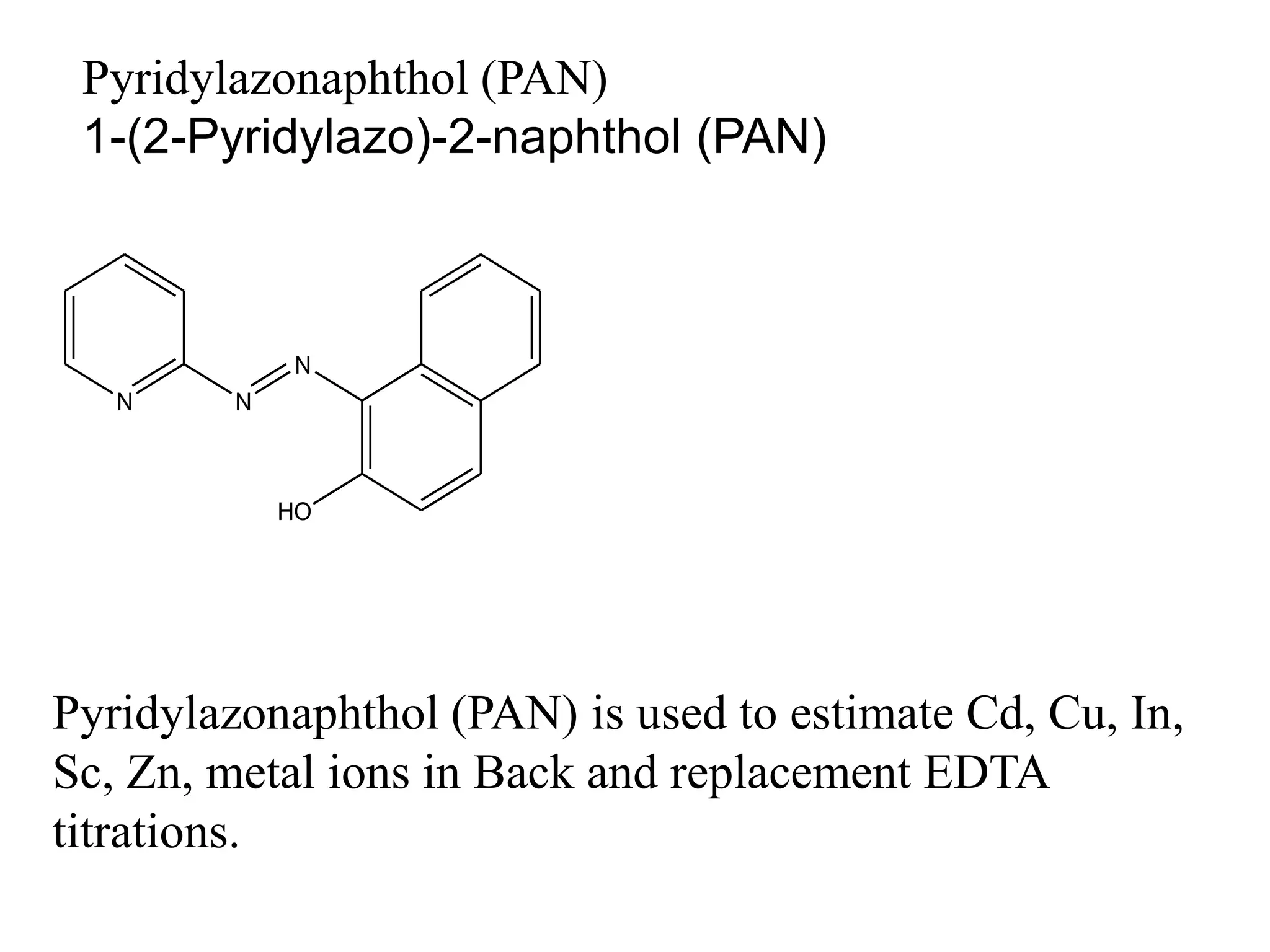
Pyridylazonaphthol (PAN)
1-(2-Pyridylazo)-2-naphthol (PAN)
Pyridylazonaphthol (PAN) is used to estimate Cd, Cu, In,
Sc, Zn, metal ions in Back and replacement EDTA
titrations.
N N
N
HO
EDTA Titrations
Direct
Titrations
Back
Titrations
Replacement/
Displacement/
Substitution
Titrations
Alkalimetric
Titrations
Indirect
Titrations
Types of EDTA Titrations:
Direct Titrations:
 This is a direct determination of a metal ion by adding
standard EDTA titrant to the sample solution.
Metal ion + EDTA [ Metal-EDTA ] complex
 The solution containing the metal ion is buffered to the desired
pH and titrated directly with standard EDTA solution.
 Some auxiliary complexing agent such as tartarate can be
added to prevent the prevent the precipitation of the hydroxide
of metal ion.
 Cu+2, Zn+2, and Ni+2 can be determine by using direct
titration method.
+
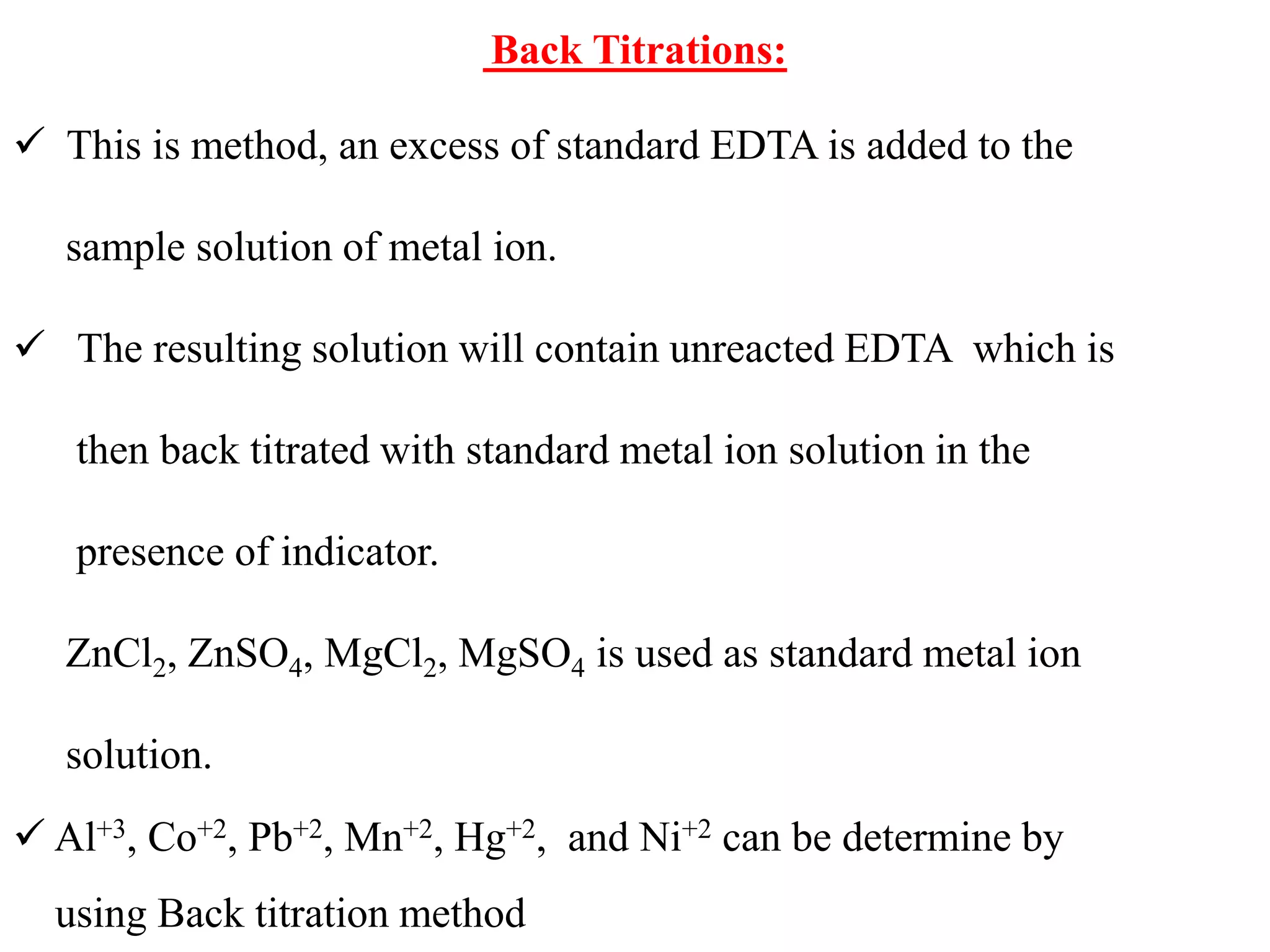
Back Titrations:
 This is method, an excess of standard EDTA is added to the
sample solution of metal ion.
 The resulting solution will contain unreacted EDTA which is
then back titrated with standard metal ion solution in the
presence of indicator.
ZnCl2, ZnSO4, MgCl2, MgSO4 is used as standard metal ion
solution.
 Al+3, Co+2, Pb+2, Mn+2, Hg+2, and Ni+2 can be determine by
using Back titration method
Replacement, Displacement or Substitutions Titrations:
 This is method, weak EDTA complex of another metal ion (M2)
is added to the solution of metal ion (M1) to be determined.
 Mg-EDTA & Zn-EDTA are frequently used weak EDTA complex
 The weaker metal EDTA complex is replaced with strong metal
EDTA complex.
 The equivalent amount of metal M2 freed from the weaker
complex can be titrated with standard EDTA solution.
 This method is useful for the determination of Ca+2 ion.
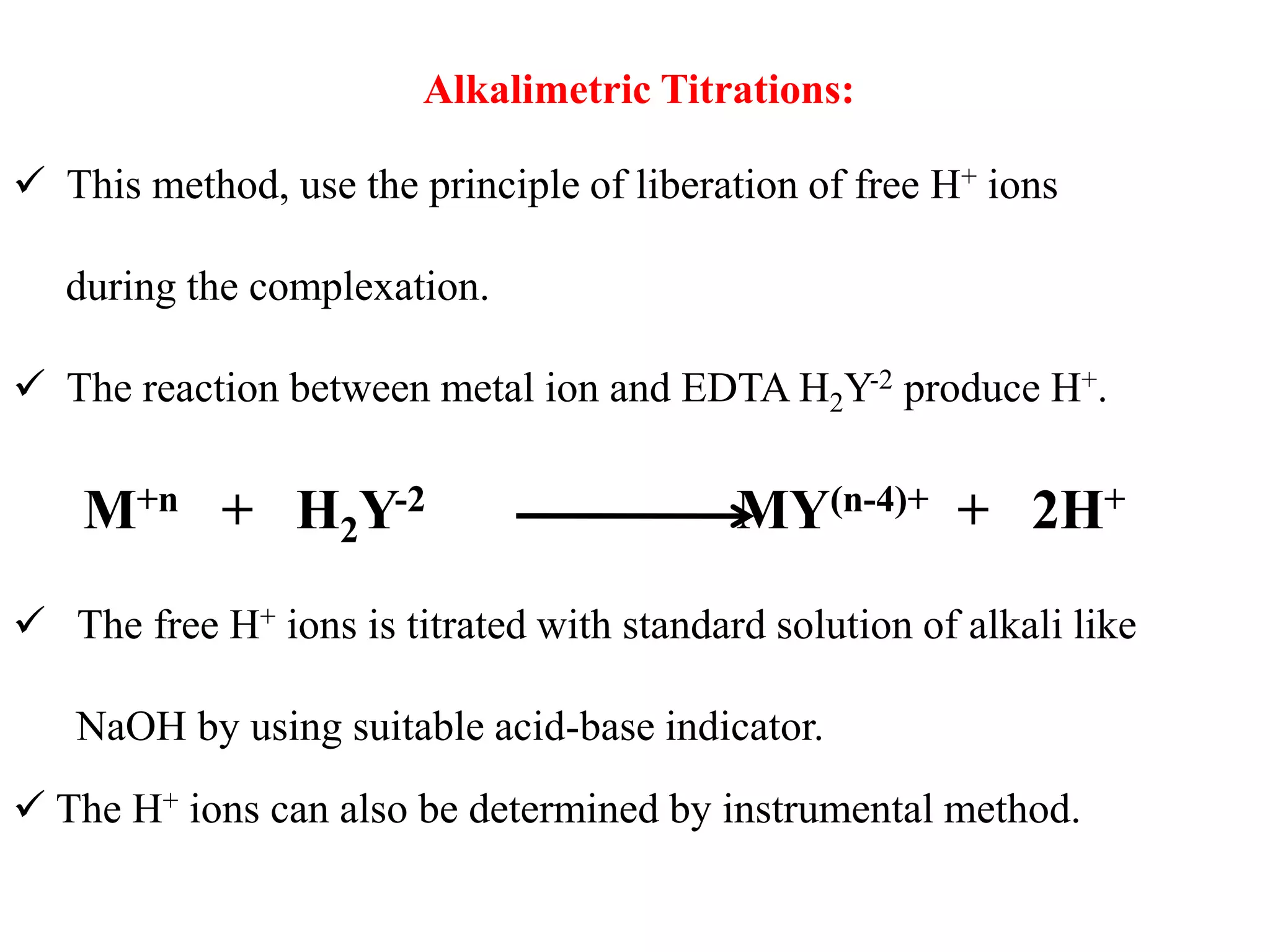
Alkalimetric Titrations:
 This method, use the principle of liberation of free H+ ions
during the complexation.
 The reaction between metal ion and EDTA H2Y-2 produce H+.
M+n + H2Y-2 MY(n-4)+ + 2H+
 The free H+ ions is titrated with standard solution of alkali like
NaOH by using suitable acid-base indicator.
 The H+ ions can also be determined by instrumental method.
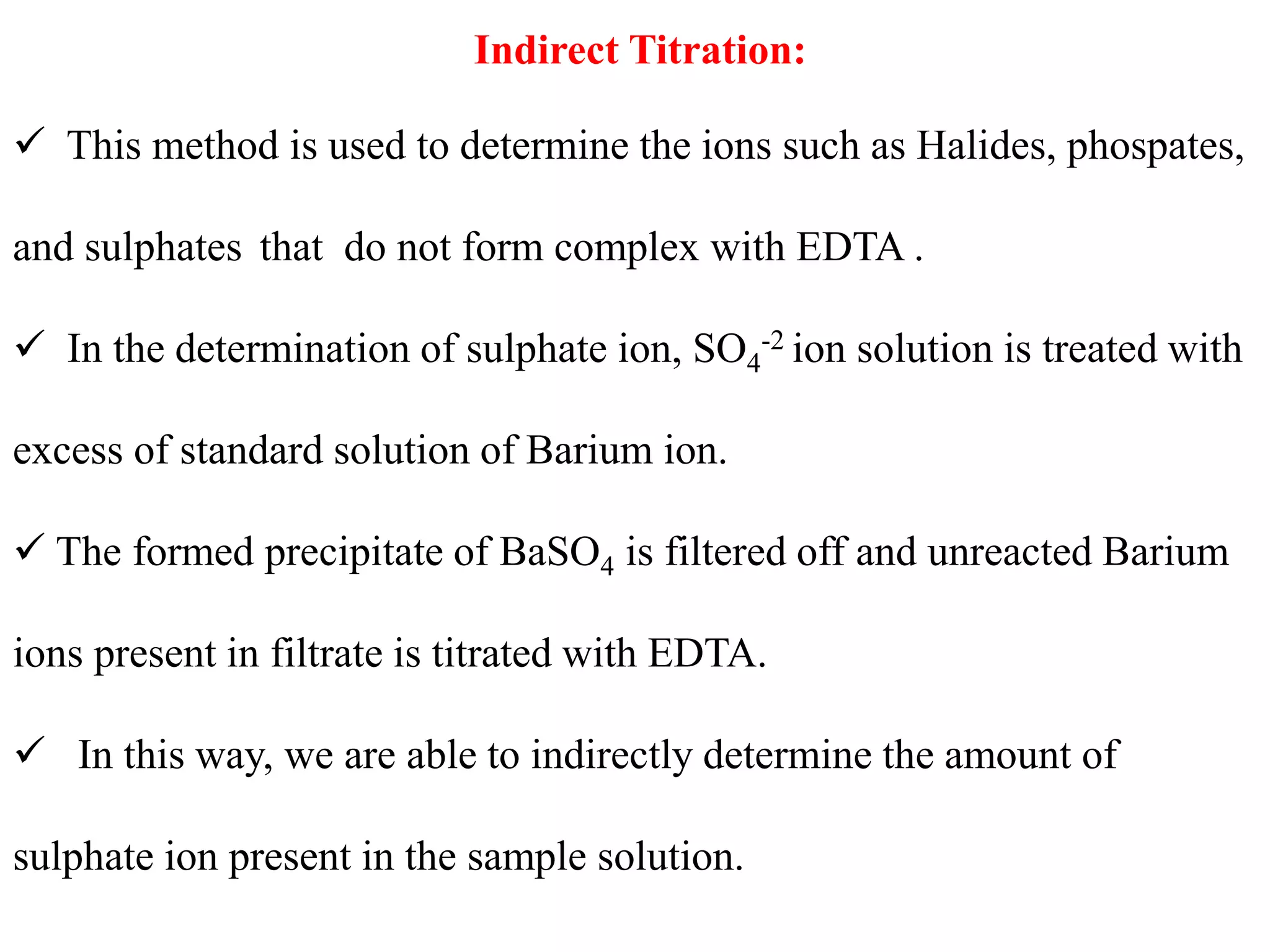
Indirect Titration:
 This method is used to determine the ions such as Halides, phospates,
and sulphates that do not form complex with EDTA .
 In the determination of sulphate ion, SO4
-2 ion solution is treated with
excess of standard solution of Barium ion.
 The formed precipitate of BaSO4 is filtered off and unreacted Barium
ions present in filtrate is titrated with EDTA.
 In this way, we are able to indirectly determine the amount of
sulphate ion present in the sample solution.
Methods
Chemical
Separation
pH
Control
Masking Unmasking Kinetic
Masking
Methods of increasing the
selectivity of EDTA as Titrations
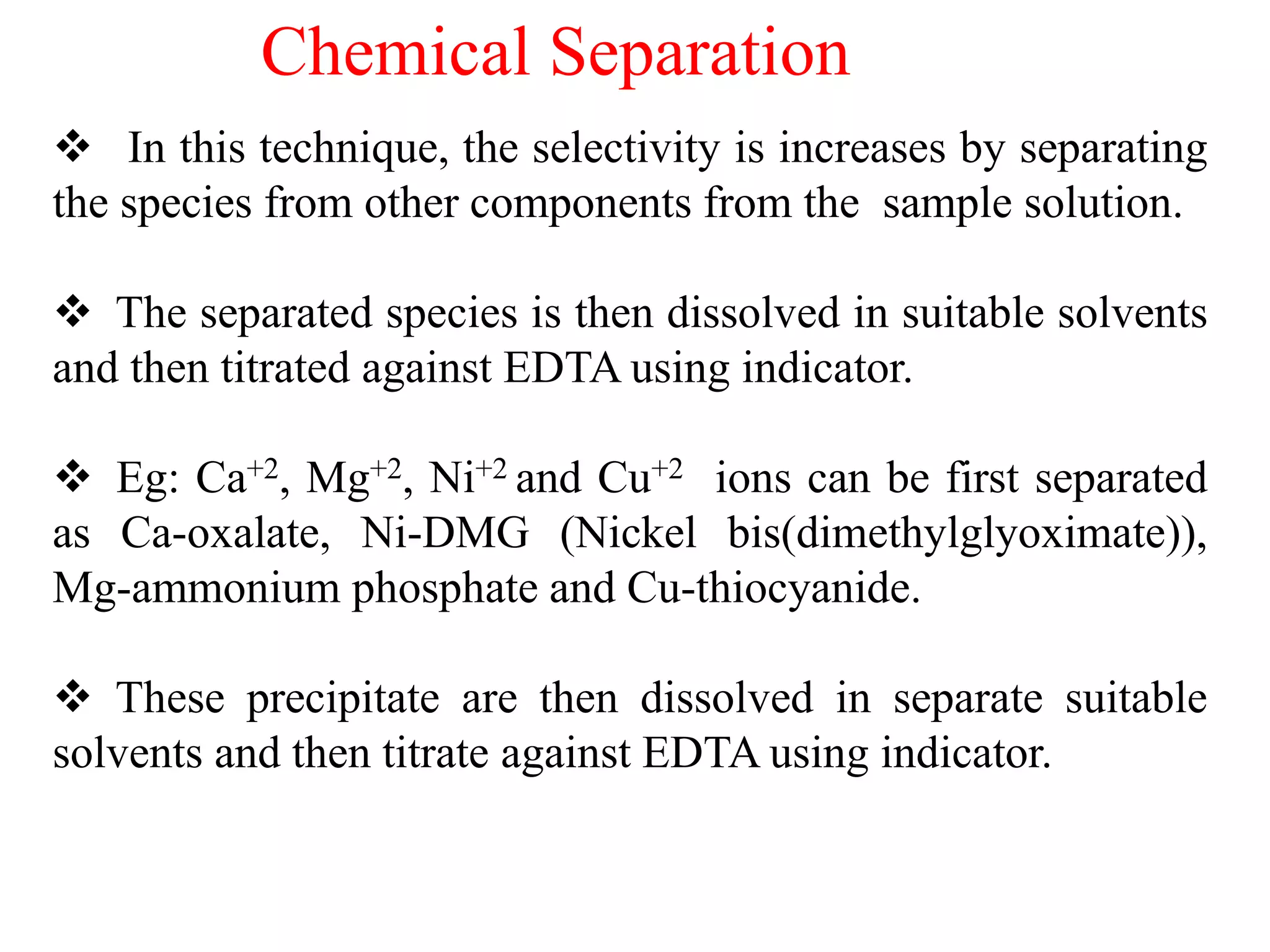
 In this technique, the selectivity is increases by separating
the species from other components from the sample solution.
 The separated species is then dissolved in suitable solvents
and then titrated against EDTA using indicator.
 Eg: Ca+2, Mg+2, Ni+2 and Cu+2 ions can be first separated
as Ca-oxalate, Ni-DMG (Nickel bis(dimethylglyoximate)),
Mg-ammonium phosphate and Cu-thiocyanide.
 These precipitate are then dissolved in separate suitable
solvents and then titrate against EDTA using indicator.
Chemical Separation
 In this technique, the selectivity is increases by controlling the
pH of the solution. That is depend on the hydrogen ion
concentration.
 So by adjusting the pH of the sample solution containing several
metal ions, it is possible to allow only a single species to react with
EDTA.
 E.g.: Ca+2 can be determined in the presence of Mg+2 in
strongly alkaline solution (pH < 10).
 Trivalent ions like Bi+3, Fe+3 can be selectively determined
from the solution of bivalent metal ions in strongly acidic solution
(pH ~ 2).
Control of acidity of pH of the solution
Use of masking and demasking agents:
Masking agents act either by precipitation or by
formation of complexes more stable than the
interfering ion-EDTA complex. Masking is a process
in which substance is prevented to take part in the
reaction without physical separation of it. he reagent
used in masking is known as masking agent
a) Masking by Precipitation
b) Masking by Complex formation
a) Masking by Precipitation: Many heavy metals e.g.- Co,
Cu and Pb, can be separated either in the form of insoluble
sulphides using Sodium sulphide, or as insoluble
complexes using thioacetamide.
These are filtered, decomposed and titrated with disodium
EDTA.
Other common precipitating agents are :
-sulphate for Pb and Ba,
-oxalate for Ca and Pb,
- fluoride for Ca, Mg and Pb,
- ferrocyanide for Zn and Cu,
- 8-hydroxy quinoline for many heavy metals.
Eg. Thioglycerol (CH2SH.CHOH.CH2OH) is used to mask
Cu by precipitation in the assay of lotions containing Cu
and Zn.
4. Potassium cyanide reacts with silver, copper, mercury,
iron, zinc, cadmium, cobalt and nickel ions to form
complexes in alkaline solution
5. Potassium iodide is used to mask the mercury(II) ion
as (HgI4)2- and is specific for mercury. It can be used in
the assay of mercury(II) chloride.
6.Tiron (disodium catechol-3,5-disulphonate) will mask
aluminium and titanium as colourless complexes. Iron
forms highly coloured complex
7. Triethanolamine [N(CH2.CH2.OH)3] forms a
colourless complex with aluminium, a yellow complex
with iron(III), the colour of which is almost discharged
by adding sodium hydroxide solution, and a green
manganese(III) complex
In this technique, the one of the cation is first masked
and remaining free cation is titrated with standard EDTA.
Then previously masked cation is damasked by using
suitable reagent to get free cation. This free cation is then
titrated by using standard EDTA.
Formaldehyde , chloral hydrate and methanol acetic acid
mixture (3:1): use to demask cyanide complexes of
cadmium and zinc
Use of Demasking
eg. Formaldehyde is used to damasked Zn-CN complex
[Zn(CN)4] + 4HCHO + 4H Zn+2 + 4HOCH2CN
(Hydroxy ACN)
 This free Zn+2 ion is then titrated by using standard EDTA.
 Thus it is possible to determine Zn in the presence of Ca.
 Some of the metal undergoes fast complexation some
of undergoes slow complexation with EDTA .
 Hence it is possible to titrate the metal ions which
undergoes fast complexation with EDTA in the presence of
those metal ions which undergoes slow complexation with
EDTA .
 eg. Fe+3 can be easily estimated in the presence of Cr+3,
because Cr+3 reacts slowly with EDTA to form complex as
compared to Fe+3.
Kinetic masking
- Applications of Complexometric Titrations
Complexometric titrations have been employed with success for
determination of various metals like Ca, Mg, Pb, Zn, Al, Fe, Mn, Cr
etc. in different formulations that are official in I.P., and also for the
determination of Hardness of water.
- Determination of Calcium in different formulations: Calcium can
be determined in almost every formulation by EDTA-titrations. e.g.-
Five membered heterocyclic rings are formed with EDTA, which are
stain-free, and thus highly stable.
Assay of CaCO3
Calcium Lactate tablets
Calcium Lactate injection
Calcium Gluconate
Calcium Gluconate injection
Calcium Gluconate tablet
- Determination of Magnesium: for the assay of Mg stearate and Mg
sulphate
- Determination of Hardness of Water: Water hardness due to Ca and
Mg is expressed as the amount of Ca and Mg ions in ppm. Actually,
the hardness is due to both Ca and Mg salts but he two are determined
together in the titration.
Titration curve for metal-EDTA titrations
In the Case of metal-EDTA titration, the EDTA is added to the
buffered solution of metal and pM is calculated by using
pM = -log10 [Mn+] during the titration. The obtained pM values is
plotted on Y-axis against the volume of EDTA solution added on x
axis. This curve give the point of inflexion at the equivalence point.
The curve of pM agaist volume of EDTA added is known as
Titration curve of metal-EDTA titrations.
Example: Titration curve of Ca+2 with EDTA
Absolute formation constant (KMY) for CaY-2 is 5.0 X 10¹⁰ and
α4 at pH 10 is 0.35.
K’MY = KMY . α4 = 5.0 X 1010 X 0.35 = 1.8 X 10¹⁰
Solution:
 Take 10 cm3 of 0.01 M ca+2 solution buffered at pH 10 and
titrate with 0.01 M EDTA solution.
 Calculate the pCa at different stages of titration such as,
1. At the start of the titration
2. After addition of 1.0 cm3 of titrant EDTA
3. At the equivalence point
4. After addition of 11.0 cm3 of titrant.
1. At start of Titration:
At start of Titration when no titrant EDTA is added to the
solution, only Ca+2 , will be present in the solution.
The concentration of Ca+2 can be given as,
[Ca+2] = 0.01
pCa = -log10 [Ca+2] = -log10 [0.01] = 2.0
pCa = 2.0
2.09
2. At the addition of 1.0 cm3 of titrant:
When 1.0 cm3 of titrant EDTA is added to the solution, 1.0 cm3
Ca+2 will react with EDTA and it will form complex. The 9.0
cm3 of Ca+2 will remained unreacted in the solution and total
volume of solution will become 11 cm3.
The concentration of Ca+2 present in the solution can be given
as,
[Ca+2] = 0.01 X 9
pCa = -log10 [Ca+2] = -log10 [0.0082] = 2.09
pCa = 2.09
11
= 0.0082 M
3. At the equivalence point: (when 10 Cm3 of EDTA is added)
When 10.0 cm3 of titrant EDTA is added to the solution, 10.0
cm3 Ca+2 will react with EDTA and it will form complex and
total volume of solution will become 20 cm3.
The concentration of Complex [CaY-2] present in the solution
can be given as,
[CaY-2] = 0.01 X 10
At equivalence point, concentration of Ca+2 will be equal to the
concentration of EDTA . As EDTA is present in its all form.
So the concentration of EDTA is given by CY
[Ca+2] = CY
20
= 0.005 M
Conditional formation constant (K’MY) for CaY-2 is 108 X 1010,
Now Conditional formation constant (K’MY) is
K’MY =
[Ca2+]. CY
[CaY-2]
= 1.8 X 10¹⁰
Since [Ca+2] = CY
K’MY =
[Ca2+]. [Ca+2]
[CaY-2]
= 1.8 X 10¹⁰
By substituting,
K’MY = 1.8 X 10¹⁰
[CaY-2] = 0.005
In the above equation and we can calculate the concentration
of [Ca2+]
[Ca2+] =
0.005
1.8 X 10¹⁰
1.8 X 1010 =
[Ca2+]2
0.005
5.2 X 10⁻⁷[Ca2+] =
pCa = -log10 [Ca+2] = -log10 [5.2 X 10⁻⁷] = 6.28
pCa = 6.28
4. After the addition of 11 Cm3 of EDTA:
When 11.0 cm3 of titrant EDTA is added to the solution, 10.0
cm3 Ca+2 will react with EDTA and it will form complex and
1.0 cm3 of EDTA will remain excess in the solution. Total
volume of solution will become 21 cm3.
The concentration of Complex [CaY-2] present in the solution can
be given as,
[CaY-2] = 0.01 X 10
21
= 4.76 X 10⁻³ M
The 1.0 cm3 of EDTA is excess,
concentration of excess of EDTA present in the solution can be
given as,
[Excess of EDTA] = 0.01 X 1
The concentration of EDTA in the solution given by CY
CY = 4.76 X 10⁻⁴ M
21
= 4.76 X 10⁻⁴ M
Conditional formation constant (K’MY) for CaY-2 is 1.8 X 10¹⁰,
Now Conditional formation constant (K’MY) is
K’MY =
[Ca2+]. CY
[CaY-2]
= 1.8 X 10¹⁰
By substituting,
K’MY = 1.8 X 10¹⁰
[CaY-2] = 4.76 X 10⁻³
[CY] = 4.76 X 10⁻⁴ M
In the above equation and we can calculate the concentration
of [Ca2+]
[Ca2+] =
4.76 X 10⁻³
1.8 X 1010 X 4.76 X10-4
1.8 X 1010 =
[Ca2+] X 4.76 X10⁻⁴
4.76 X 10⁻³
5.55 X 10⁻¹⁰[Ca2+] =
pCa = -log10 [Ca+2] = -log10 [5.55 X 10⁻¹⁰] = 9.26
pCa = 9.26
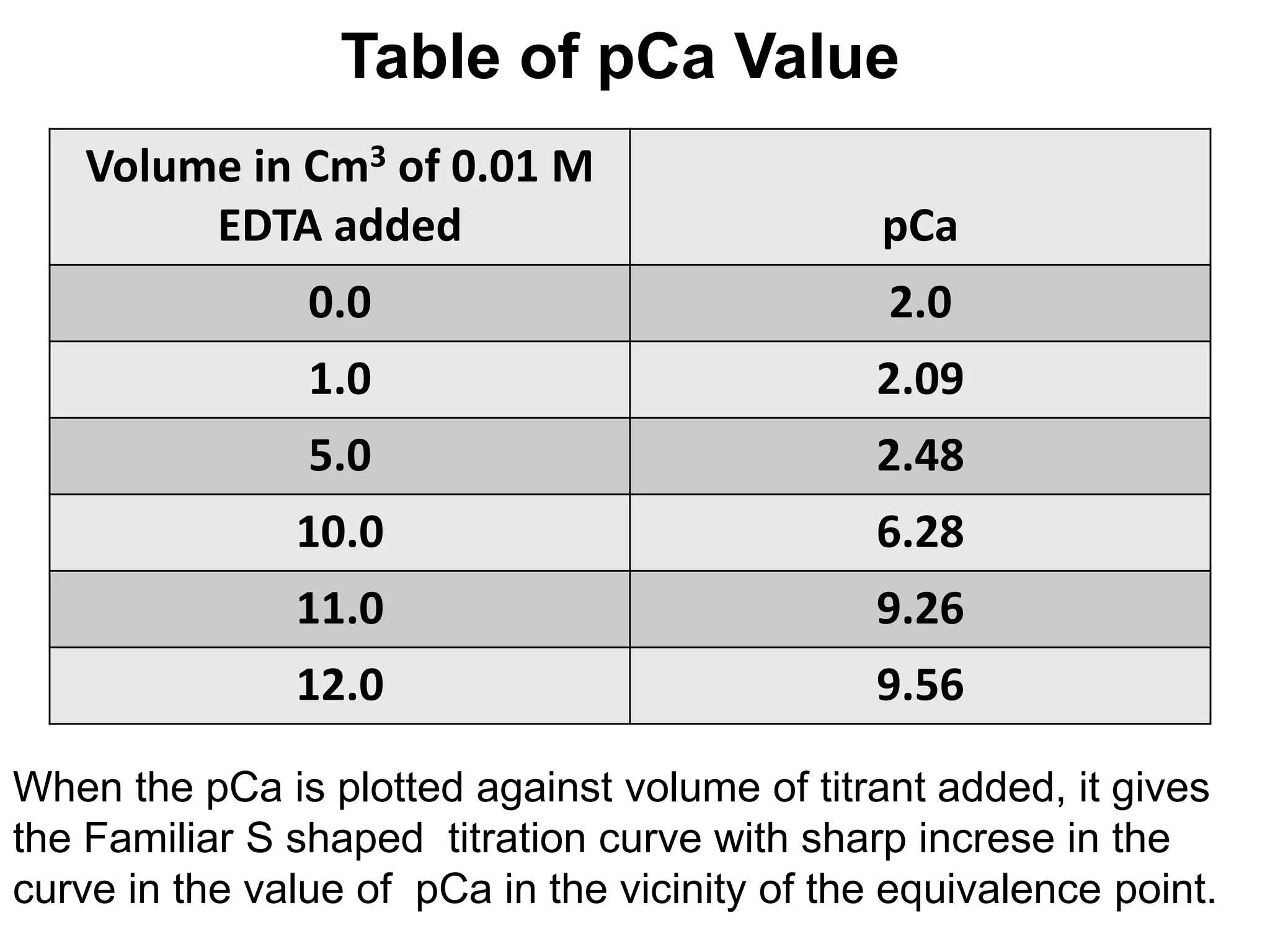
Table of pCa Value
Volume in Cm3 of 0.01 M
EDTA added pCa
0.0 2.0
1.0 2.09
5.0 2.48
10.0 6.28
11.0 9.26
12.0 9.56
When the pCa is plotted against volume of titrant added, it gives
the Familiar S shaped titration curve with sharp increse in the
curve in the value of pCa in the vicinity of the equivalence point.
pCa
Volume of 0.01 M EDTA added
Titration curve for Ca+2 - EDTA titrations

Complexometric titration 2019-20

  • 1.
  • 2.
    COMPLEXOMETRIC TITRATIONS General introduction EDTAtitrations Advantages and limitations of EDTA as the titrant Absolute and conditional formation constants of Metal-EDTA complex  Construction of Titration curve Types of EDTA Titrations Methods of increasing the selectivity of EDTA as a titrant  Metallachromic indicators  Theory Metallachromic indicators Applications of Metallachromic indicators
  • 3.
    What is complex???? Complexconsists of an metal ion surrounded by molecules or anions. How Complex forms???? Complex is formed by the combination of metal ion with electron donating group or nucleophile.
  • 4.
    Complexes are compoundsformed from combination of metal ions with ligands (complexing agents). A metal ionis an electron deficient species while a ligand is an electron rich, and thus, electron donating species. A metal ion will thus accept electrons from a ligand where coordination bonds are formed. Electrons forming coordination bonds come solely from ligands.
  • 5.
    A ligand iscalled a monodentate if it donates a single pair of electrons (like :NH3) while a bidentate ligand (like ethylenediamine, :NH2CH2CH2H2N:) donates two pairs of electrons. Ethylenediaminetetraacetic acid (EDTA) is a hexadentate ligand. The ligand can be as simple as ammonia which forms a complex with Cu2+, for example, giving the complex Cu(NH3)4 2+. When the ligand is a large organic molecule having two or more of the complexing groups, like EDTA, the ligand is called a chelating agent and the formed complex, in this case, is called a chelate.
  • 8.
    Complexometric Titrations:  Acomplexometric titration is technique of volumetric analysis in which a soluble, undissociated, stiochimetric complex is formed during the addition of titrant to the sample solution.  In Complexometric titration the formation of a colored complex is used to indicate the end point of a titration.  Complexometric titrations are particularly useful for the determination of a mixture of different metal ions in solution.  An indicator capable of producing an definite color change is usually used to detect the end-point of the titration.
  • 9.
    Which complexation reactioncan be used as a volumetric technique????  The reaction which reaches equilibrium rapidly after each portion of titrant is added.  The reactions in which interfering situations do not arise. e.g. The formation of several different complexes of the metal ion with the titrant, during the titration process.  The reaction in which a indicator is capable of locating equivalence point with fair accuracy is available. Complexation titrations are particularly useful for the determination of a large number of metal ions in solution. In practice, the use of EDTA as a titrant is well established in such complexometric reactions.
  • 10.
    EDTA Titrations: What isEDTA???  EDTA is Ethylene Diamine Tetra Acetic acid. It has four carboxyl groups and two amine groups.
  • 11.
    Commonly EDTA isrepresented in the acid form as H4Y. EDTA = H4Y Due to low solubility of acid form of EDTA in water, its disodium dihydrate EDTA salt i.e. Na2H2Y.2H2O is used disodium dihydrate EDTA = Na2H2Y.2H2O
  • 12.
    Different Forms ofEDTA EDTA = H4Y
  • 13.
    EDTA has fourcarboxyl groups and two amine groups. EDTA is polydenated ligand as it donate its six lone pairs of electrons for the formation of coordinate covalent bonds with metal cations to form Metal-EDTA complex. Metal-EDTA complex
  • 14.
    Stability of Metal-LigandComplexes The stability of complexes is influenced by a number of factors related to the ligand and metal ions. 1. Nature of the metal ion: Small ions with high charges lead to stronger complexes. 2. Nature of the ligand: The ligands forming chelates impart extra stability (chelon effect). For example the complex of nickel with a multidentate ligand is more stable than the one formed with ammonia. 3. Basicity of the ligand: Greater basicity of the ligand results in greater stability of the complex. 14
  • 15.
    4. Size ofchelate ring: The formation of five- or six - membered rings provides the maximum stability. 5. Number of metal chelate rings: The stability of the complex is directly related to the number of chelate rings formed between the ligand and metal ion. Greater the number of such rings, greater is the stability. 7. Steric effects: These also play an important role in the stability of the complexes.
  • 16.
    - EDTA titrationsare carried out in buffered solution of the metal ions to be estimated. -The use of proper pH is important and is related to the stability constant of a metal-EDTA complex. - E.g. Alkaline pH is required for the metals having low stability constant. Low Alkaline to mild acidic pH is required for the metals having high stability constant. - The dissociation reactions of acid form EDTA, H4Y are also pH dependant. pH is also an important criteria for the proper functioning of the indicator substance. Role of pH in EDTA titrations Thus it is very important to maintain the pH during the EDTA titrations
  • 17.
    Advantages of EDTAas titrant: 1. ETDA form stable complex with various metal ions. 2. The complexation occurs in a single step and hence the titration of the metal produce a sharp change in the metal ion concentration at the equivalence point. 3. The Metal-EDTA complexes are all water soluble and hence all studies can be performed in aqueous media. 4. EDTA forms 1:1 complex with all metal ions irrespective of all charge on the metal ions. The stoichiometry is hence same for all metal ions. The reaction can be represented as: Mn+ + H2Y-2 + H2O MY(n-4) + 2H3O+
  • 18.
    Limitations of EDTAas titrant: 1. Formation of insoluble hydroxides: Many ETDA titrations are carried out under alkaline pH which may lead to formation of insoluble hydroxides or basic salts that may compete with the complexation process . 2. Lack of selectivity: Since EDTA forms stable complexes with most of the metal ions, it lacks selectivity if it is used to estimate a single metal cations from a solution of mixture of metal ions.
  • 19.
    Absolute formation constant EDTAforms 1:1 complex with all metal ions irrespective of all charge on the metal ions. The stoichiometry is hence same for all metal ions. If fully unprotonated form of EDTA (Y-4) is react with metal ion as follows: M+n + Y-4 MY(n-4)+ KMY = [MY(n-4)+] [M+n] [Y-4] Then absolute formation constant KMY is given as, KMY is also referred as absolute stability constant. Higher the value of KMY, higher is the stability of complex formed.
  • 20.
    Metal Cation KMYLog KMY Mg2+ 4.9 X 10⁸ 8.69 Ca2+ 5.0 X 10¹⁰ 10.70 Sr2+ 4.3 X 10⁸ 8.63 Ba2+ 5.8 X 10⁷ 7.76 Mn2+ 6.2 X 10¹³ 13.79 Fe2+ 2.1 X 10¹⁴ 14.33 Co2+ 2.0 X 10¹⁶ 16.31 Ni2+ 4.2 X 10¹⁸ 18.62 Cu2+ 6.3 X 10¹⁸ 18.80 Zn2+ 3.2 X 10¹⁶ 16.50 Cd2+ 2.9 X 10¹⁶ 16.46 Al3+ 1.3 X 10¹⁶ 16.13 Pb2+ 1.1 X 10¹⁸ 18.04 Hg3+ 6.3 X 10²¹ 21.80 Fe3+ 1.3 X 1025 25.1 V3+ 7.9 X 1025 25.9 Th4+ 1.6 X 10²³ 23.2 Group I Titrated in pH 8-11 Group II Titrated in pH 4-8 Group III Titrated in pH 1-4
  • 21.
    Conditional formation constant Inabsolute formation constant only fully unprotonated form of EDTA (Y-4) is taken consideration. EDTA is tetra protonic acid. It is represented as H4Y. The four different stages of dissociation of this tetra protonic acid can be represented as follows: H4Y H+ + H3Y- Ka1 = [H4Y] [H+] [H3Y-] Ka2 = Ka3 = Ka4 = H3Y- H+ + H2Y-2 H2Y-2 H+ + HY-3 HY-3 H+ + Y- 4 [H+] [H2Y-2] [H+] [HY-3] [H+] [Y-4] [H3Y-] [H2Y-2] [HY-3]
  • 22.
     Due tosuch important role of pH in complex formation with EDTA , normally the solution of metal ions are buffered so that the pH will remain constant.  In this way the Conditional formation constant (K’MY) can be estimated and it is possible to calculate and construct the titration curve from which it is possible to judge the feasibility of the Complexometric titration.  Instrumental methods used for end point detection in Complexometric titrations are : Spectrometric analysis, Ampheromtric analysis, Potentiometric analysis
  • 23.
    Metallochromic indicator  Themetallochromic indicators are organic compounds which are capable of forming intensely coloured complex with EDTA.  This metal –indicator complex is weaker than the Metal-EDTA complex and it has different colour than uncomplexed indicator.  During the course of titration, the metal ion from metal –indicator complex is replaced to form Metal-EDTA complex.
  • 24.
    Requirement for Metalion indicator 1. The colour must be sufficiently intense, so that a minimum amount of indicator can be used. 2. The colour contrast between the indicator and Metal-indicator complex should be readily observable. 3. The Metal-indicator complex should possess sufficient stability to ensure a sharp colour change, however it should be less stable than Metal-EDTA complex. 4. The change in equilibrium from metal-indicator complex to the Metal-EDTA complex should be sharp and rapid.
  • 25.
    5. The colourreaction of the indicator should be selective. 6. The indicator must be very sensitive to metal ions so that the colour change occurs at near the equivalence point. 7. The indicator must be stable in the titration medium. 8. The indicator must be stable on storage also. 9. All the above requirements must be fulfilled in the pH range in which the proposed titration is to carried out. 10. It should be commercially available in adequate purity.
  • 26.
    Theory of metalion indicators The reaction corresponding to use of a metal ion indicator in an EDTA titration can be represented as M-In + EDTA M-EDTA + In This reaction will take place only if the M-EDTA complex is more stable than the M-In complex. M + In M-In Stability of the Metal-Indicator complex KIn, is given by the equation KIn = [M] [In] [M-In]
  • 27.
    Since, the indicatorcolour change also affected by the hydrogen ion concentration, so it is convenient to define the conditional indicator constant K’In which varies with pH. For small the error, K’In > 104 and the ratio of conditional formation constant of the metal-EDTA complex K’MY to K’In should be of the order 104 to provide a good end point.
  • 28.
    Examples Of metalion indicators
  • 30.
    Eriochrome Black TMordant black II EDT Chemically it is sodium salt of 1-(1-hydroxy-2 naphthylazo)-6 nitro-2- naphthol-4-sulphonic acid. It is dark powder with a slight metallic luster EBT Acidic pH H3D Black EBT pH- 6 H2D- Red EBT pH- 7-11 HD-2 Blue EBT pH > 12 D-3 Orange
  • 31.
     EBT isused to estimate Mg, Zn, Mn, Cd, Hg, Pb, Cu, Al, Fe, Ti, Co, Ni and Pt metal ions .  The indicator is prepared by dissolving 0.2 gm of the EBT powder in 15 ml of triethanolamine followed by the addition of 5 ml of absolute alcohol
  • 32.
     Murexide isused to estimate Ca, Ni, Co, Zn, Cd, Cu metal ions in EDTA titrations.  The indicator is prepared by dissolving Merexide powder in water. Aqueous solution of murexide is unstable hence it must be prepared freshly.
  • 33.
    Xylenol orange : 3,3′-Bis[N,N-bis(carboxymethyl)aminomethyl]-o- cresolsulfonephthaleintetrasodium salt Xylenol orange is used to estimate Bi, Cd, Pb, Sc,Th, Zn metal ions in EDTA titrations. O N HOOC HOOC HO HO SO3H N HOOC HOOC CH3
  • 34.
    Pyridylazonaphthol (PAN) 1-(2-Pyridylazo)-2-naphthol (PAN) Pyridylazonaphthol(PAN) is used to estimate Cd, Cu, In, Sc, Zn, metal ions in Back and replacement EDTA titrations. N N N HO
  • 35.
  • 36.
    Direct Titrations:  Thisis a direct determination of a metal ion by adding standard EDTA titrant to the sample solution. Metal ion + EDTA [ Metal-EDTA ] complex  The solution containing the metal ion is buffered to the desired pH and titrated directly with standard EDTA solution.  Some auxiliary complexing agent such as tartarate can be added to prevent the prevent the precipitation of the hydroxide of metal ion.  Cu+2, Zn+2, and Ni+2 can be determine by using direct titration method. +
  • 37.
    Back Titrations:  Thisis method, an excess of standard EDTA is added to the sample solution of metal ion.  The resulting solution will contain unreacted EDTA which is then back titrated with standard metal ion solution in the presence of indicator. ZnCl2, ZnSO4, MgCl2, MgSO4 is used as standard metal ion solution.  Al+3, Co+2, Pb+2, Mn+2, Hg+2, and Ni+2 can be determine by using Back titration method
  • 38.
    Replacement, Displacement orSubstitutions Titrations:  This is method, weak EDTA complex of another metal ion (M2) is added to the solution of metal ion (M1) to be determined.  Mg-EDTA & Zn-EDTA are frequently used weak EDTA complex  The weaker metal EDTA complex is replaced with strong metal EDTA complex.  The equivalent amount of metal M2 freed from the weaker complex can be titrated with standard EDTA solution.  This method is useful for the determination of Ca+2 ion.
  • 39.
    Alkalimetric Titrations:  Thismethod, use the principle of liberation of free H+ ions during the complexation.  The reaction between metal ion and EDTA H2Y-2 produce H+. M+n + H2Y-2 MY(n-4)+ + 2H+  The free H+ ions is titrated with standard solution of alkali like NaOH by using suitable acid-base indicator.  The H+ ions can also be determined by instrumental method.
  • 40.
    Indirect Titration:  Thismethod is used to determine the ions such as Halides, phospates, and sulphates that do not form complex with EDTA .  In the determination of sulphate ion, SO4 -2 ion solution is treated with excess of standard solution of Barium ion.  The formed precipitate of BaSO4 is filtered off and unreacted Barium ions present in filtrate is titrated with EDTA.  In this way, we are able to indirectly determine the amount of sulphate ion present in the sample solution.
  • 41.
  • 42.
     In thistechnique, the selectivity is increases by separating the species from other components from the sample solution.  The separated species is then dissolved in suitable solvents and then titrated against EDTA using indicator.  Eg: Ca+2, Mg+2, Ni+2 and Cu+2 ions can be first separated as Ca-oxalate, Ni-DMG (Nickel bis(dimethylglyoximate)), Mg-ammonium phosphate and Cu-thiocyanide.  These precipitate are then dissolved in separate suitable solvents and then titrate against EDTA using indicator. Chemical Separation
  • 43.
     In thistechnique, the selectivity is increases by controlling the pH of the solution. That is depend on the hydrogen ion concentration.  So by adjusting the pH of the sample solution containing several metal ions, it is possible to allow only a single species to react with EDTA.  E.g.: Ca+2 can be determined in the presence of Mg+2 in strongly alkaline solution (pH < 10).  Trivalent ions like Bi+3, Fe+3 can be selectively determined from the solution of bivalent metal ions in strongly acidic solution (pH ~ 2). Control of acidity of pH of the solution
  • 44.
    Use of maskingand demasking agents: Masking agents act either by precipitation or by formation of complexes more stable than the interfering ion-EDTA complex. Masking is a process in which substance is prevented to take part in the reaction without physical separation of it. he reagent used in masking is known as masking agent a) Masking by Precipitation b) Masking by Complex formation
  • 45.
    a) Masking byPrecipitation: Many heavy metals e.g.- Co, Cu and Pb, can be separated either in the form of insoluble sulphides using Sodium sulphide, or as insoluble complexes using thioacetamide. These are filtered, decomposed and titrated with disodium EDTA. Other common precipitating agents are : -sulphate for Pb and Ba, -oxalate for Ca and Pb, - fluoride for Ca, Mg and Pb, - ferrocyanide for Zn and Cu, - 8-hydroxy quinoline for many heavy metals. Eg. Thioglycerol (CH2SH.CHOH.CH2OH) is used to mask Cu by precipitation in the assay of lotions containing Cu and Zn.
  • 46.
    4. Potassium cyanidereacts with silver, copper, mercury, iron, zinc, cadmium, cobalt and nickel ions to form complexes in alkaline solution 5. Potassium iodide is used to mask the mercury(II) ion as (HgI4)2- and is specific for mercury. It can be used in the assay of mercury(II) chloride. 6.Tiron (disodium catechol-3,5-disulphonate) will mask aluminium and titanium as colourless complexes. Iron forms highly coloured complex 7. Triethanolamine [N(CH2.CH2.OH)3] forms a colourless complex with aluminium, a yellow complex with iron(III), the colour of which is almost discharged by adding sodium hydroxide solution, and a green manganese(III) complex
  • 47.
    In this technique,the one of the cation is first masked and remaining free cation is titrated with standard EDTA. Then previously masked cation is damasked by using suitable reagent to get free cation. This free cation is then titrated by using standard EDTA. Formaldehyde , chloral hydrate and methanol acetic acid mixture (3:1): use to demask cyanide complexes of cadmium and zinc Use of Demasking
  • 48.
    eg. Formaldehyde isused to damasked Zn-CN complex [Zn(CN)4] + 4HCHO + 4H Zn+2 + 4HOCH2CN (Hydroxy ACN)  This free Zn+2 ion is then titrated by using standard EDTA.  Thus it is possible to determine Zn in the presence of Ca.
  • 49.
     Some ofthe metal undergoes fast complexation some of undergoes slow complexation with EDTA .  Hence it is possible to titrate the metal ions which undergoes fast complexation with EDTA in the presence of those metal ions which undergoes slow complexation with EDTA .  eg. Fe+3 can be easily estimated in the presence of Cr+3, because Cr+3 reacts slowly with EDTA to form complex as compared to Fe+3. Kinetic masking
  • 50.
    - Applications ofComplexometric Titrations Complexometric titrations have been employed with success for determination of various metals like Ca, Mg, Pb, Zn, Al, Fe, Mn, Cr etc. in different formulations that are official in I.P., and also for the determination of Hardness of water. - Determination of Calcium in different formulations: Calcium can be determined in almost every formulation by EDTA-titrations. e.g.- Five membered heterocyclic rings are formed with EDTA, which are stain-free, and thus highly stable.
  • 51.
    Assay of CaCO3 CalciumLactate tablets Calcium Lactate injection Calcium Gluconate Calcium Gluconate injection Calcium Gluconate tablet - Determination of Magnesium: for the assay of Mg stearate and Mg sulphate - Determination of Hardness of Water: Water hardness due to Ca and Mg is expressed as the amount of Ca and Mg ions in ppm. Actually, the hardness is due to both Ca and Mg salts but he two are determined together in the titration.
  • 52.
    Titration curve formetal-EDTA titrations In the Case of metal-EDTA titration, the EDTA is added to the buffered solution of metal and pM is calculated by using pM = -log10 [Mn+] during the titration. The obtained pM values is plotted on Y-axis against the volume of EDTA solution added on x axis. This curve give the point of inflexion at the equivalence point. The curve of pM agaist volume of EDTA added is known as Titration curve of metal-EDTA titrations. Example: Titration curve of Ca+2 with EDTA
  • 53.
    Example: Titration curveof Ca+2 with EDTA Absolute formation constant (KMY) for CaY-2 is 5.0 X 10¹⁰ and α4 at pH 10 is 0.35. K’MY = KMY . α4 = 5.0 X 1010 X 0.35 = 1.8 X 10¹⁰ Solution:  Take 10 cm3 of 0.01 M ca+2 solution buffered at pH 10 and titrate with 0.01 M EDTA solution.  Calculate the pCa at different stages of titration such as, 1. At the start of the titration 2. After addition of 1.0 cm3 of titrant EDTA 3. At the equivalence point 4. After addition of 11.0 cm3 of titrant.
  • 54.
    1. At startof Titration: At start of Titration when no titrant EDTA is added to the solution, only Ca+2 , will be present in the solution. The concentration of Ca+2 can be given as, [Ca+2] = 0.01 pCa = -log10 [Ca+2] = -log10 [0.01] = 2.0 pCa = 2.0 2.09
  • 55.
    2. At theaddition of 1.0 cm3 of titrant: When 1.0 cm3 of titrant EDTA is added to the solution, 1.0 cm3 Ca+2 will react with EDTA and it will form complex. The 9.0 cm3 of Ca+2 will remained unreacted in the solution and total volume of solution will become 11 cm3. The concentration of Ca+2 present in the solution can be given as, [Ca+2] = 0.01 X 9 pCa = -log10 [Ca+2] = -log10 [0.0082] = 2.09 pCa = 2.09 11 = 0.0082 M
  • 56.
    3. At theequivalence point: (when 10 Cm3 of EDTA is added) When 10.0 cm3 of titrant EDTA is added to the solution, 10.0 cm3 Ca+2 will react with EDTA and it will form complex and total volume of solution will become 20 cm3. The concentration of Complex [CaY-2] present in the solution can be given as, [CaY-2] = 0.01 X 10 At equivalence point, concentration of Ca+2 will be equal to the concentration of EDTA . As EDTA is present in its all form. So the concentration of EDTA is given by CY [Ca+2] = CY 20 = 0.005 M
  • 57.
    Conditional formation constant(K’MY) for CaY-2 is 108 X 1010, Now Conditional formation constant (K’MY) is K’MY = [Ca2+]. CY [CaY-2] = 1.8 X 10¹⁰ Since [Ca+2] = CY K’MY = [Ca2+]. [Ca+2] [CaY-2] = 1.8 X 10¹⁰ By substituting, K’MY = 1.8 X 10¹⁰ [CaY-2] = 0.005 In the above equation and we can calculate the concentration of [Ca2+]
  • 58.
    [Ca2+] = 0.005 1.8 X10¹⁰ 1.8 X 1010 = [Ca2+]2 0.005 5.2 X 10⁻⁷[Ca2+] = pCa = -log10 [Ca+2] = -log10 [5.2 X 10⁻⁷] = 6.28 pCa = 6.28
  • 59.
    4. After theaddition of 11 Cm3 of EDTA: When 11.0 cm3 of titrant EDTA is added to the solution, 10.0 cm3 Ca+2 will react with EDTA and it will form complex and 1.0 cm3 of EDTA will remain excess in the solution. Total volume of solution will become 21 cm3. The concentration of Complex [CaY-2] present in the solution can be given as, [CaY-2] = 0.01 X 10 21 = 4.76 X 10⁻³ M
  • 60.
    The 1.0 cm3of EDTA is excess, concentration of excess of EDTA present in the solution can be given as, [Excess of EDTA] = 0.01 X 1 The concentration of EDTA in the solution given by CY CY = 4.76 X 10⁻⁴ M 21 = 4.76 X 10⁻⁴ M
  • 61.
    Conditional formation constant(K’MY) for CaY-2 is 1.8 X 10¹⁰, Now Conditional formation constant (K’MY) is K’MY = [Ca2+]. CY [CaY-2] = 1.8 X 10¹⁰ By substituting, K’MY = 1.8 X 10¹⁰ [CaY-2] = 4.76 X 10⁻³ [CY] = 4.76 X 10⁻⁴ M In the above equation and we can calculate the concentration of [Ca2+]
  • 62.
    [Ca2+] = 4.76 X10⁻³ 1.8 X 1010 X 4.76 X10-4 1.8 X 1010 = [Ca2+] X 4.76 X10⁻⁴ 4.76 X 10⁻³ 5.55 X 10⁻¹⁰[Ca2+] = pCa = -log10 [Ca+2] = -log10 [5.55 X 10⁻¹⁰] = 9.26 pCa = 9.26
  • 63.
    Table of pCaValue Volume in Cm3 of 0.01 M EDTA added pCa 0.0 2.0 1.0 2.09 5.0 2.48 10.0 6.28 11.0 9.26 12.0 9.56 When the pCa is plotted against volume of titrant added, it gives the Familiar S shaped titration curve with sharp increse in the curve in the value of pCa in the vicinity of the equivalence point.
  • 64.
    pCa Volume of 0.01M EDTA added Titration curve for Ca+2 - EDTA titrations

Editor's Notes

  • #16 Steric effects are nonbonding interactions that influence the shape and reactivity of ions and molecules. Steric effects complement electronic effects, which usually dictate shape and reactivity