AROMATICITY
Made by : GARVIT TUNWAL
M.Sc. Chemistry Sem.- 1
CONTENTS :
What is resonance ?
 Aromaticity introduction
Criteria for compound to be Aromatic
Hukel’ s law
Benzenoid and non benzenoid compounds
Aromatic compound
 Anti- Aromatic compound
 Non aromatic compound
What is resonance ?
• It involve delocalization of ∏ –electron ,lone pair of electron and
unpaired electron.
• If all the properties of a molecule can not be explained by single
structure or even sometimes more than one structure possible for the
molecule explain explained different properties of the molecule is
known as resonance.
• More than one structure possible for the molecule are called resonating
structure ,canonical structure or contributing structure
Introduction aromaticity
Aroma =specific odour
Originally the term aromaticity was used to described unique property of benzene
and other benenoid compound
It is used to described the chemical and physical properties of benzene
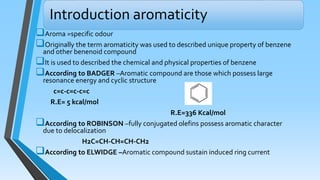
According to BADGER –Aromatic compound are those which possess large
resonance energy and cyclic structure
c=c-c=c-c=c
R.E= 5 kcal/mol
R.E=336 Kcal/mol
According to ROBINSON –fully conjugated olefins possess aromatic character
due to delocalization
H2C=CH-CH=CH-CH2
According to ELWIDGE –Aromatic compound sustain induced ring current
What is aromaticity ?
• Aromaticity is defined as a property of the conjugated cycloalkenes
which enhances the stability of a molecule due to the delocalization
of electrons present in the π-π orbitals.
• Aromaticity is a characteristic in which any planar system in which
there is complete delocalization of ∏ electron in the ring, and the
system contain 4n+2 ∏ electrons in the ring is called aromatic.
• Example : Benzene, naphthalene, anthracene etc.
Properties
• Aromatic compounds are cyclic structure in which each ring atom is a
participant in pi-bond
• Aromatic compound are conjugated
• Aromatic compound are generally non polar and immiscible with water .as
they often unreactive .they are useful as solvent for other non polar
compound
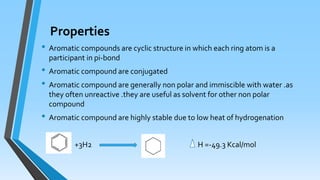
• Aromatic compound are highly stable due to low heat of hydrogenation
+3H2 H =-49.3 Kcal/mol
• The term aromaticity is used to describe aromatic compound
properties
• Highly stable
• Undergoes electrophilic substitution reaction rather than addition
reaction .
• The C-C bond length (1.39 .A) and double (1.34A) bond.
Criteria for compound to be aromatic
1. Molecule should be cyclic.
2. In the ring all atom has unhybrid p-orbital
3. Molecule should planar
4. Delocalization of electron over the complete ring (resonance )
5. Follow the huckel rule (4n+2) pi electrons
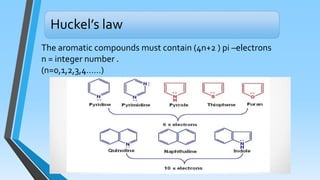
Huckel’s law
The aromatic compounds must contain (4n+2 ) pi –electrons
n = integer number .
(n=0,1,2,3,4……)
10 ∏ electron system
• 3 geometrical possible isomers of [10] annulenes all cis, mono trans and cis-trans-cis-cis-
trans, have been prepared as crystalline solid at -800 c.
Fig:2
Fig:3
Fig 4
• In fig.2 where fig is fused with 2-2 benzene rings in such a way that no
canonical form can be written in which both benzene rings have 6e- the
aromaticity is reduced by annulation and molecule rapidly converts to
more stable structure 5 in which both benzene ring can be fully aromatic
• Delta of perimeter proton at 6.9 to 7.38 pm and bridge protons are at
0.58 thus aromatic.
• All can be prepared, stable, give aromatic substitution reaction, diatropic.
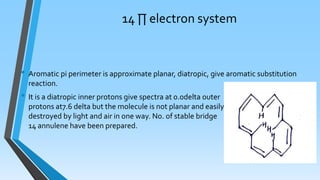
14 ∏ electron system
• Aromatic pi perimeter is approximate planar, diatropic, give aromatic substitution
reaction.
• It is a diatropic inner protons give spectra at 0.0delta outer
protons at7.6 delta but the molecule is not planar and easily
destroyed by light and air in one way. No. of stable bridge
14 annulene have been prepared.
Example of 14 ∏ electron system
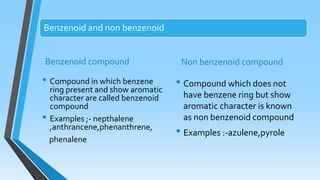
Benzenoid and non benzenoid
Benzenoid compound
• Compound in which benzene
ring present and show aromatic
character are called benzenoid
compound
• Examples ;- nepthalene
,anthrancene,phenanthrene,
phenalene
Non benzenoid compound
• Compound which does not
have benzene ring but show
aromatic character is known
as non benzenoid compound
• Examples :-azulene,pyrole
Anti aromaticity
• A compound which is destabilized by a closed loop of electrons
• Creteria for anti aromaticity
1. Cyclic compound
2. Planar structure
3. Delocalisation of pi –electron over the complete ring (resonance)
4. No.of delocalization electron =4n π electrons (where
n=1,2,3,4…)
Example of anti aromaticity (4 π electron )
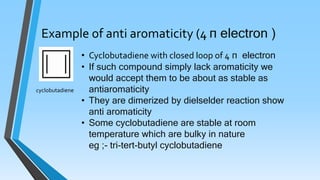
• Cyclobutadiene with closed loop of 4 π electron
• If such compound simply lack aromaticity we
would accept them to be about as stable as
antiaromaticity
• They are dimerized by dielselder reaction show
anti aromaticity
• Some cyclobutadiene are stable at room
temperature which are bulky in nature
eg ;- tri-tert-butyl cyclobutadiene
cyclobutadiene
Non aromatic
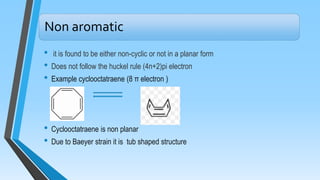
• it is found to be either non-cyclic or not in a planar form
• Does not follow the huckel rule (4n+2)pi electron
• Example cyclooctatraene (8 π electron )
• Cyclooctatraene is non planar
• Due to Baeyer strain it is tub shaped structure
Refrences
₋ Organic reactions and their mechanism-P.S.KALSI
₋ Advance organic chemistry (pragati prakshan )
₋ March organic chemistry by jerry march
Aromaticity

Aromaticity

  • 1.
    AROMATICITY Made by :GARVIT TUNWAL M.Sc. Chemistry Sem.- 1
  • 2.
    CONTENTS : What isresonance ?  Aromaticity introduction Criteria for compound to be Aromatic Hukel’ s law Benzenoid and non benzenoid compounds Aromatic compound  Anti- Aromatic compound  Non aromatic compound
  • 3.
    What is resonance? • It involve delocalization of ∏ –electron ,lone pair of electron and unpaired electron. • If all the properties of a molecule can not be explained by single structure or even sometimes more than one structure possible for the molecule explain explained different properties of the molecule is known as resonance. • More than one structure possible for the molecule are called resonating structure ,canonical structure or contributing structure
  • 4.
    Introduction aromaticity Aroma =specificodour Originally the term aromaticity was used to described unique property of benzene and other benenoid compound It is used to described the chemical and physical properties of benzene According to BADGER –Aromatic compound are those which possess large resonance energy and cyclic structure c=c-c=c-c=c R.E= 5 kcal/mol R.E=336 Kcal/mol According to ROBINSON –fully conjugated olefins possess aromatic character due to delocalization H2C=CH-CH=CH-CH2 According to ELWIDGE –Aromatic compound sustain induced ring current
  • 5.
    What is aromaticity? • Aromaticity is defined as a property of the conjugated cycloalkenes which enhances the stability of a molecule due to the delocalization of electrons present in the π-π orbitals. • Aromaticity is a characteristic in which any planar system in which there is complete delocalization of ∏ electron in the ring, and the system contain 4n+2 ∏ electrons in the ring is called aromatic. • Example : Benzene, naphthalene, anthracene etc.
  • 6.
    Properties • Aromatic compoundsare cyclic structure in which each ring atom is a participant in pi-bond • Aromatic compound are conjugated • Aromatic compound are generally non polar and immiscible with water .as they often unreactive .they are useful as solvent for other non polar compound • Aromatic compound are highly stable due to low heat of hydrogenation +3H2 H =-49.3 Kcal/mol
  • 7.
    • The termaromaticity is used to describe aromatic compound properties • Highly stable • Undergoes electrophilic substitution reaction rather than addition reaction . • The C-C bond length (1.39 .A) and double (1.34A) bond.
  • 8.
    Criteria for compoundto be aromatic 1. Molecule should be cyclic. 2. In the ring all atom has unhybrid p-orbital 3. Molecule should planar 4. Delocalization of electron over the complete ring (resonance ) 5. Follow the huckel rule (4n+2) pi electrons
  • 9.
    Huckel’s law The aromaticcompounds must contain (4n+2 ) pi –electrons n = integer number . (n=0,1,2,3,4……)
  • 10.
    10 ∏ electronsystem • 3 geometrical possible isomers of [10] annulenes all cis, mono trans and cis-trans-cis-cis- trans, have been prepared as crystalline solid at -800 c. Fig:2 Fig:3 Fig 4
  • 11.
    • In fig.2where fig is fused with 2-2 benzene rings in such a way that no canonical form can be written in which both benzene rings have 6e- the aromaticity is reduced by annulation and molecule rapidly converts to more stable structure 5 in which both benzene ring can be fully aromatic • Delta of perimeter proton at 6.9 to 7.38 pm and bridge protons are at 0.58 thus aromatic. • All can be prepared, stable, give aromatic substitution reaction, diatropic.
  • 12.
    14 ∏ electronsystem • Aromatic pi perimeter is approximate planar, diatropic, give aromatic substitution reaction. • It is a diatropic inner protons give spectra at 0.0delta outer protons at7.6 delta but the molecule is not planar and easily destroyed by light and air in one way. No. of stable bridge 14 annulene have been prepared.
  • 13.
    Example of 14∏ electron system
  • 14.
    Benzenoid and nonbenzenoid Benzenoid compound • Compound in which benzene ring present and show aromatic character are called benzenoid compound • Examples ;- nepthalene ,anthrancene,phenanthrene, phenalene Non benzenoid compound • Compound which does not have benzene ring but show aromatic character is known as non benzenoid compound • Examples :-azulene,pyrole
  • 15.
    Anti aromaticity • Acompound which is destabilized by a closed loop of electrons • Creteria for anti aromaticity 1. Cyclic compound 2. Planar structure 3. Delocalisation of pi –electron over the complete ring (resonance) 4. No.of delocalization electron =4n π electrons (where n=1,2,3,4…)
  • 16.
    Example of antiaromaticity (4 π electron ) • Cyclobutadiene with closed loop of 4 π electron • If such compound simply lack aromaticity we would accept them to be about as stable as antiaromaticity • They are dimerized by dielselder reaction show anti aromaticity • Some cyclobutadiene are stable at room temperature which are bulky in nature eg ;- tri-tert-butyl cyclobutadiene cyclobutadiene
  • 17.
    Non aromatic • itis found to be either non-cyclic or not in a planar form • Does not follow the huckel rule (4n+2)pi electron • Example cyclooctatraene (8 π electron ) • Cyclooctatraene is non planar • Due to Baeyer strain it is tub shaped structure
  • 18.
    Refrences ₋ Organic reactionsand their mechanism-P.S.KALSI ₋ Advance organic chemistry (pragati prakshan ) ₋ March organic chemistry by jerry march