-Naveen Kadian
M.Pharm. First Year
Department of Pharma
Chemistry
 Introduction
 Basis
 Importance
 Classification
• Homogeneous catalysis
 Mechanism
 Example
• Heterogeneous catalysis
 Mechanism
 Examples
 Promoters
 Catalytic Poisoning
 Autocatalysis
 Enzyme catalysis
• Enzymes
 References
Catalyst: -
The substances that alter the rate of a reaction but
itself remains chemically unchanged at the end of the
reaction is called a Catalyst.
The process is called Catalysis.
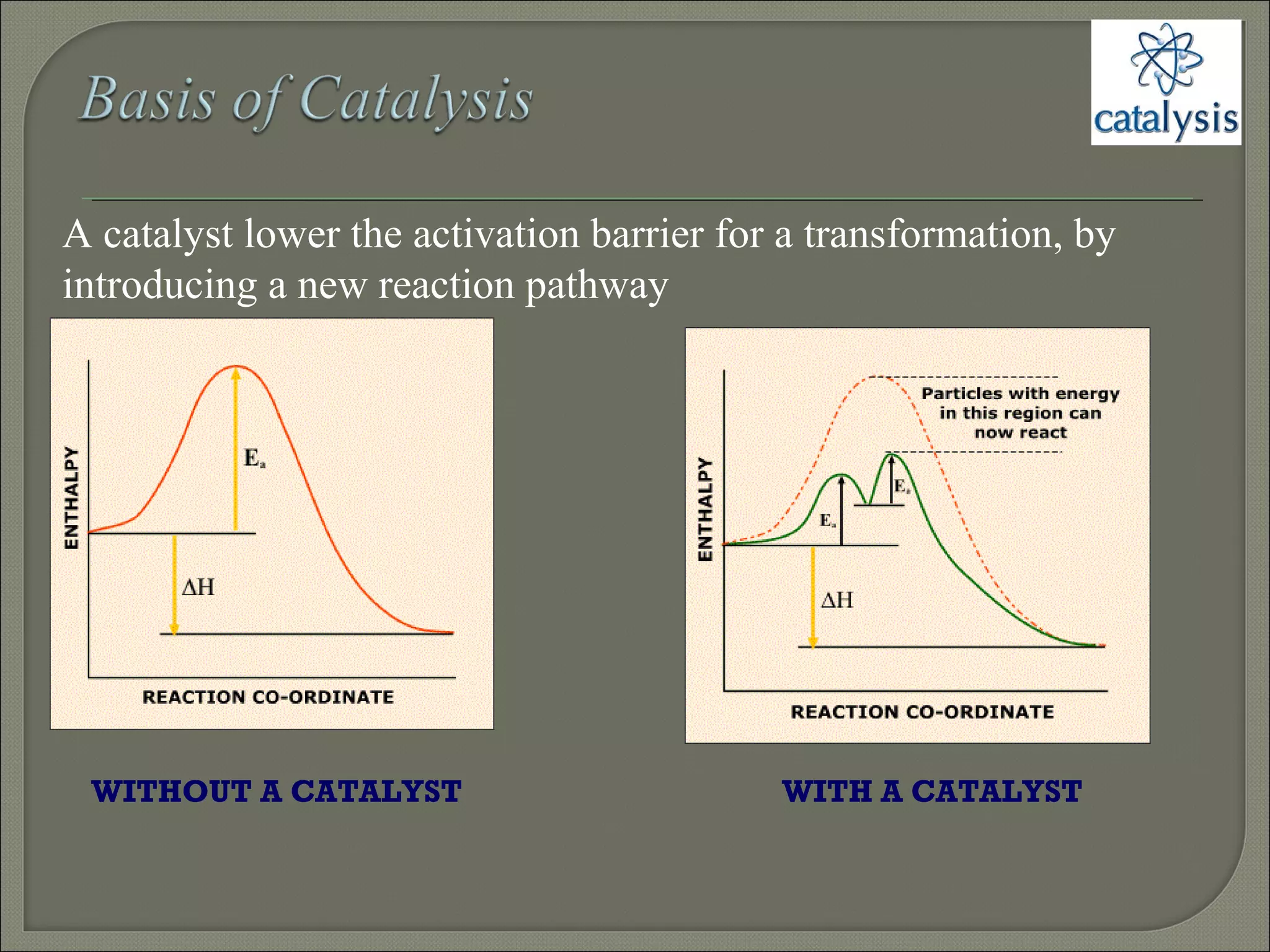
WITHOUT A CATALYST WITH A CATALYST
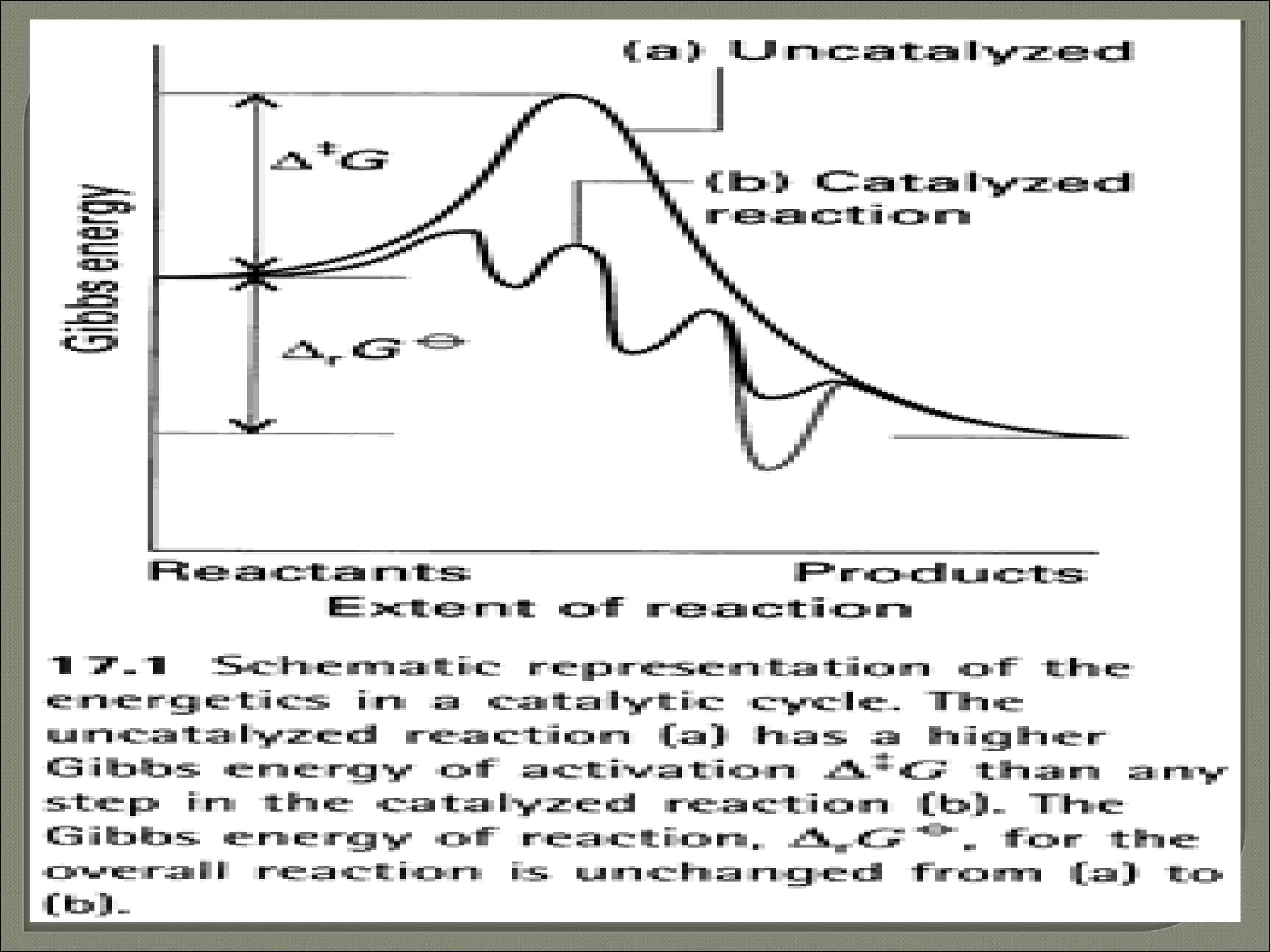
A catalyst lower the activation barrier for a transformation, by
introducing a new reaction pathway
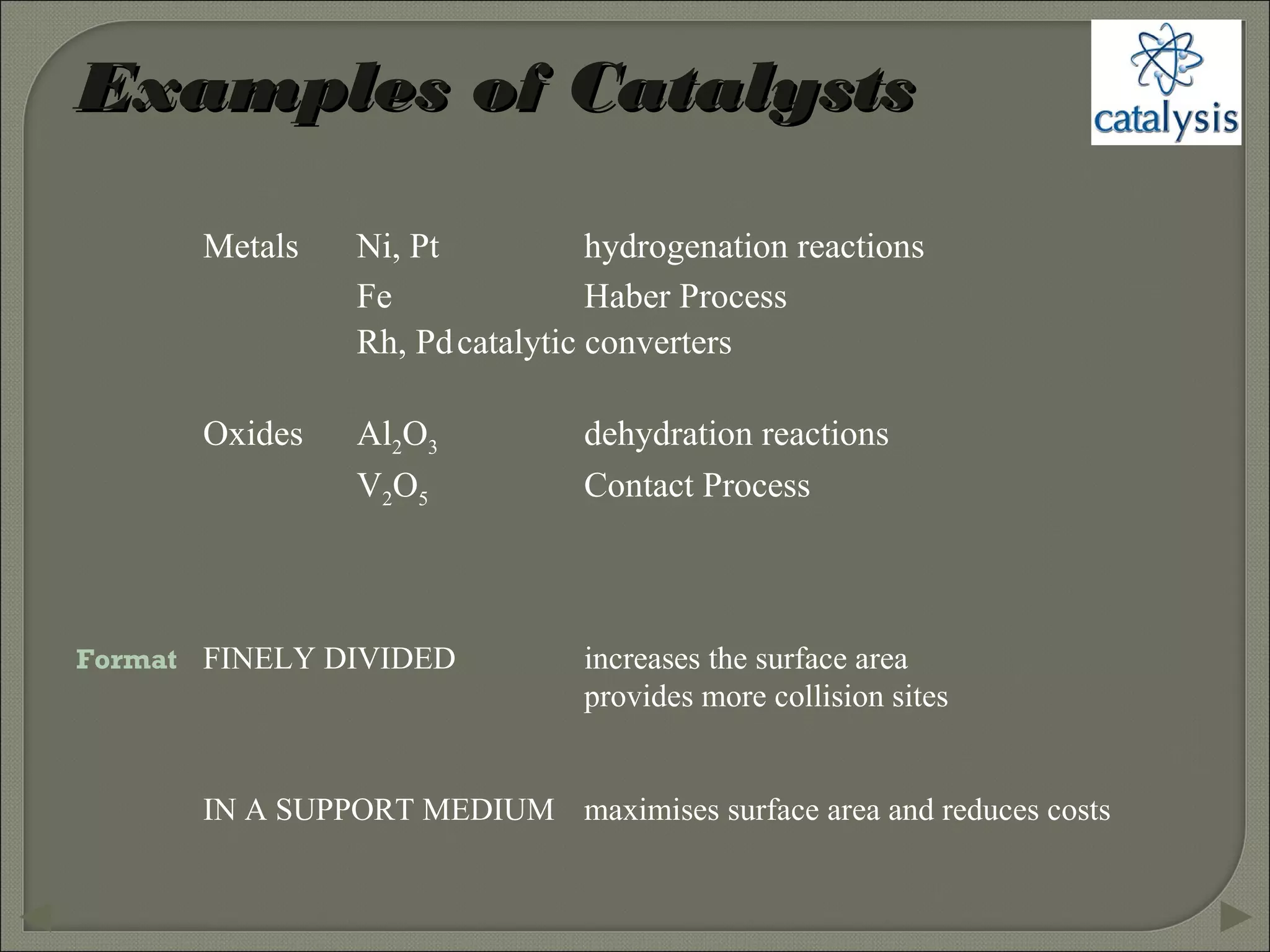
Examples of CatalystsExamples of Catalysts
Metals Ni, Pt hydrogenation reactions
Fe Haber Process
Rh, Pdcatalytic converters
Oxides Al2O3 dehydration reactions
V2O5 Contact Process
Format FINELY DIVIDED increases the surface area
provides more collision sites
IN A SUPPORT MEDIUM maximises surface area and reduces costs
There are two types of catalytic processes: -
1. Homogeneous catalysis
2. Heterogeneous catalysis
These two processes have industrial importance.
There is another mechanism involving catalysis i.e.
enzyme catalysis which possess biological
importance.
Homogeneous CatalysisHomogeneous Catalysis
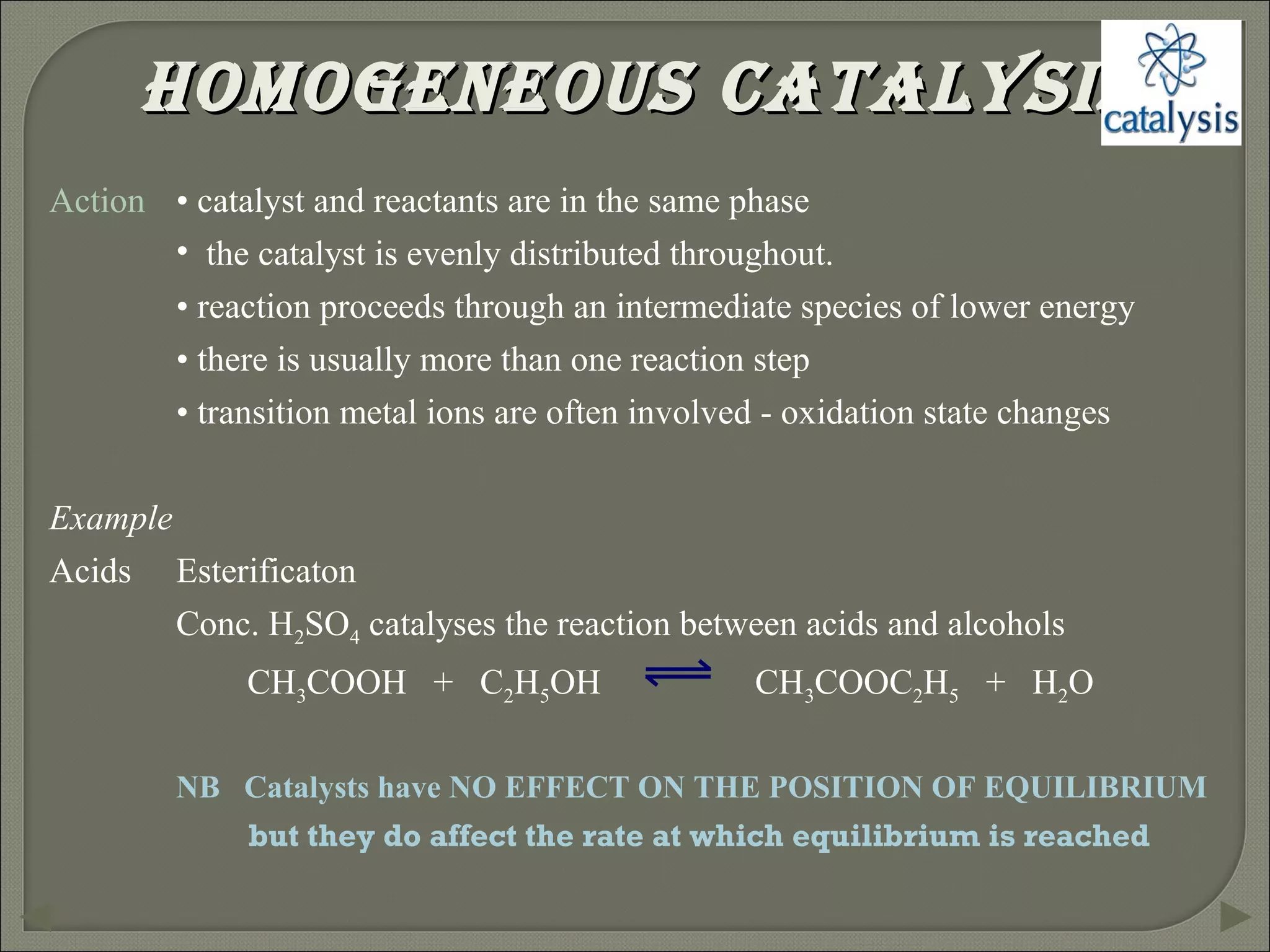
Action • catalyst and reactants are in the same phase
• the catalyst is evenly distributed throughout.
• reaction proceeds through an intermediate species of lower energy
• there is usually more than one reaction step
• transition metal ions are often involved - oxidation state changes
Example
Acids Esterificaton
Conc. H2SO4 catalyses the reaction between acids and alcohols
CH3COOH + C2H5OH CH3COOC2H5 + H2O
NB Catalysts have NO EFFECT ON THE POSITION OF EQUILIBRIUM
but they do affect the rate at which equilibrium is reached
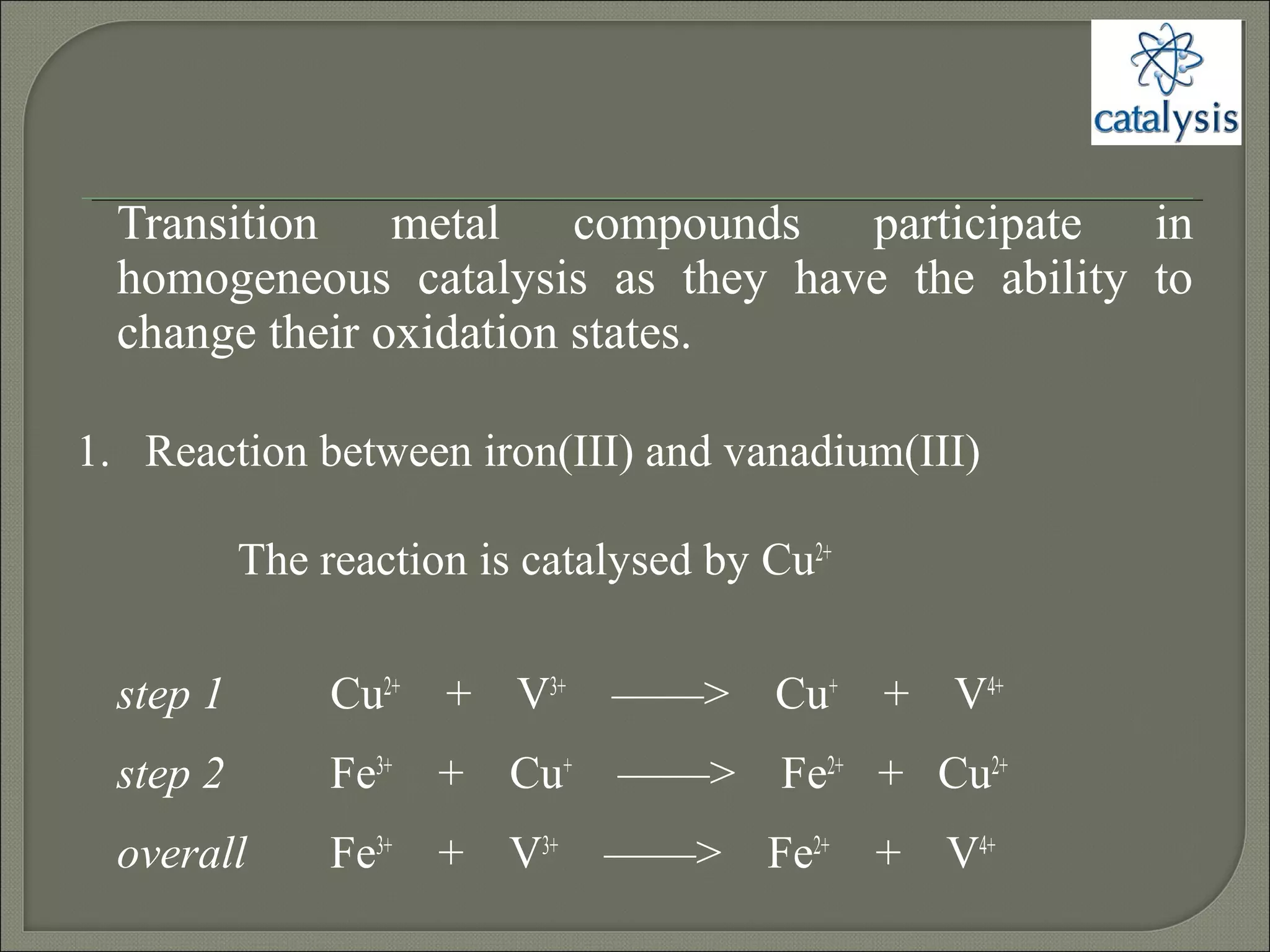
Transition metal compounds participate in
homogeneous catalysis as they have the ability to
change their oxidation states.
1. Reaction between iron(III) and vanadium(III)
The reaction is catalysed by Cu2+
step 1 Cu2+
+ V3+
——> Cu+
+ V4+
step 2 Fe3+
+ Cu+
——> Fe2+
+ Cu2+
overall Fe3+
+ V3+
——> Fe2+
+ V4+
 Catalyst is in different physical phase from the
reactants.
 It is also called Contact catalysis.
 It possesses great industrial importance.
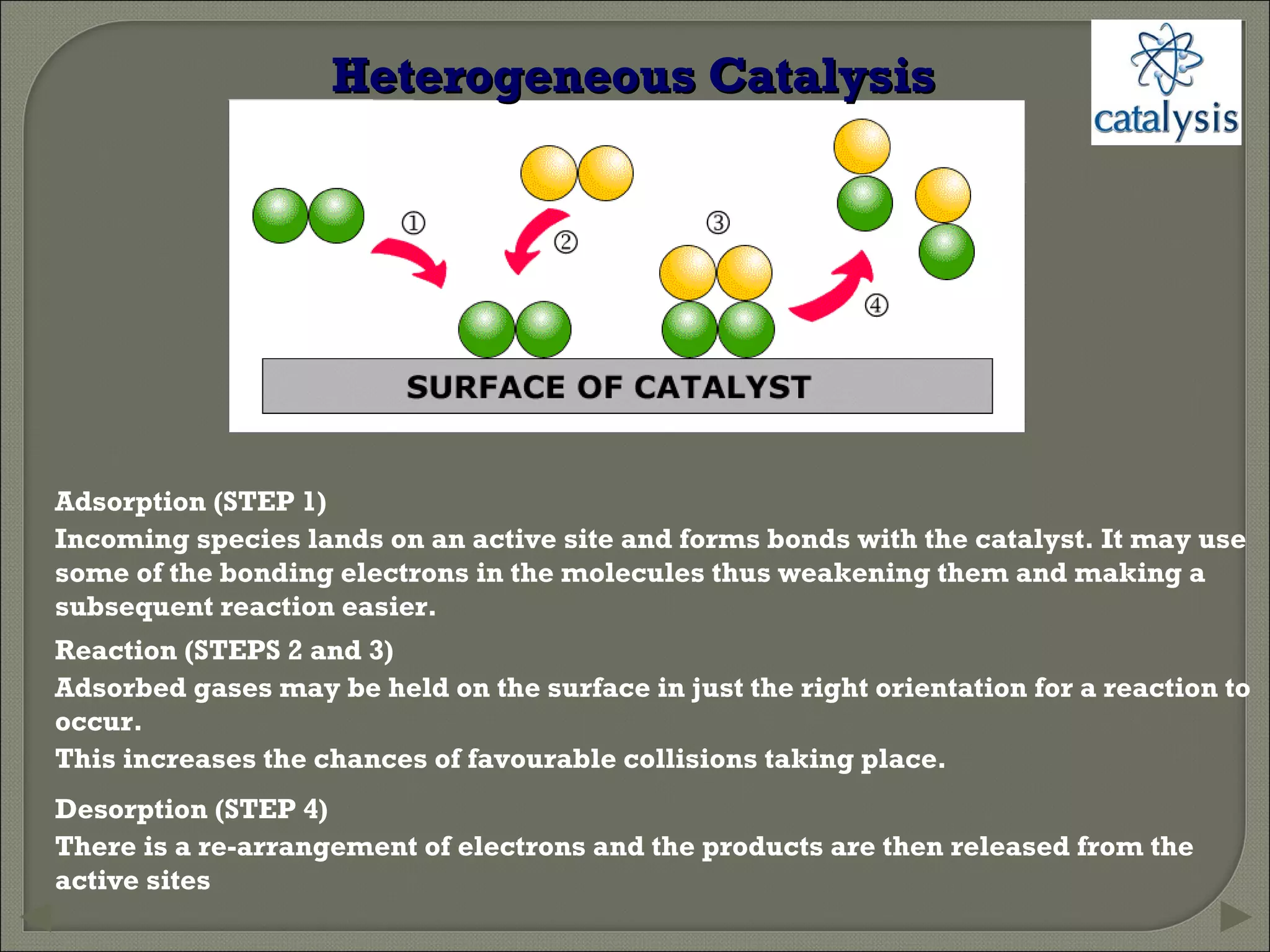
It works in three steps: -
- Adsorption
- Reaction
- Desorption
Heterogeneous CatalysisHeterogeneous Catalysis
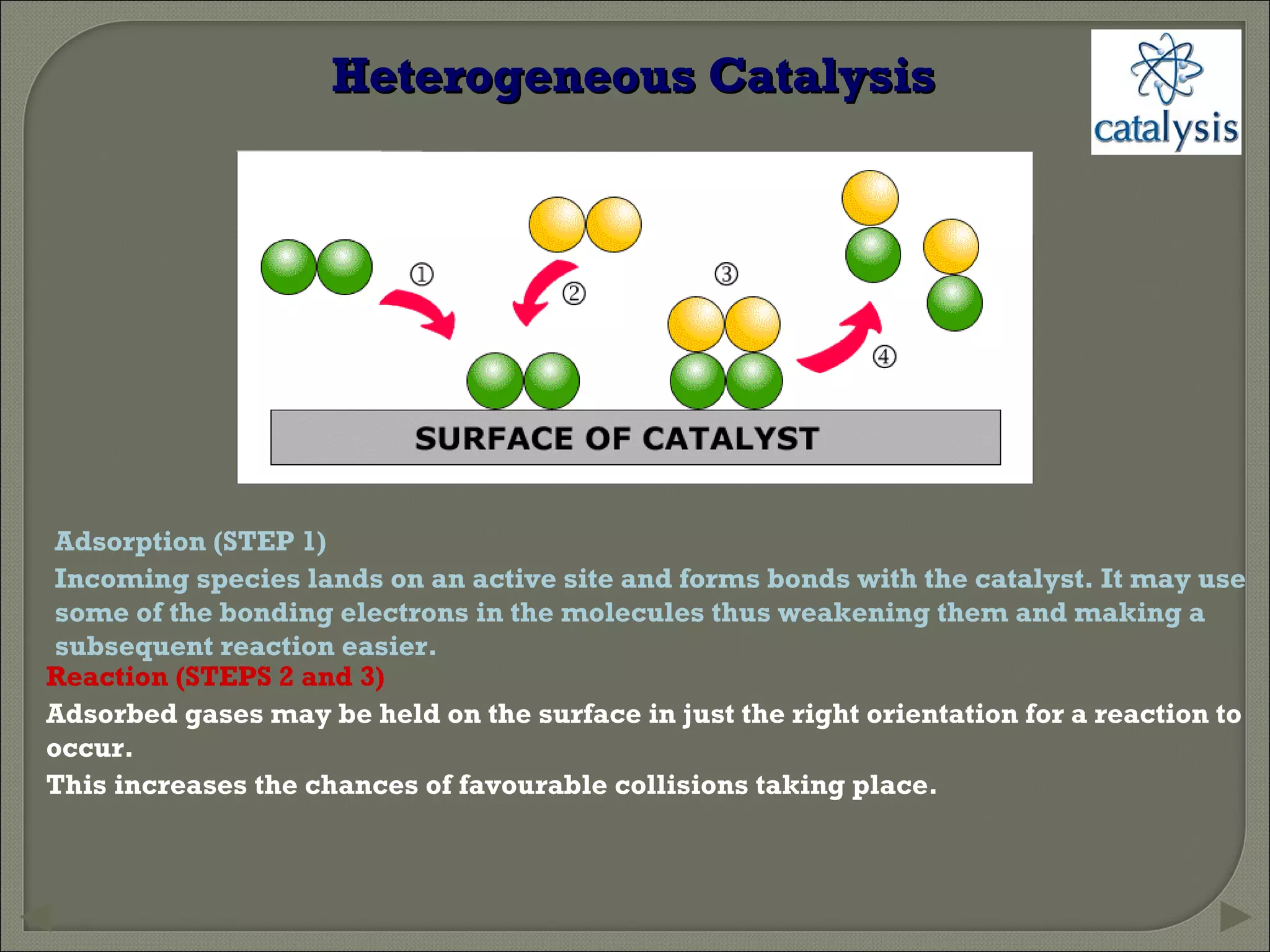
Adsorption (STEP 1)
Incoming species lands on an active site and forms bonds with the catalyst. It may use
some of the bonding electrons in the molecules thus weakening them and making a
subsequent reaction easier.
Heterogeneous CatalysisHeterogeneous Catalysis
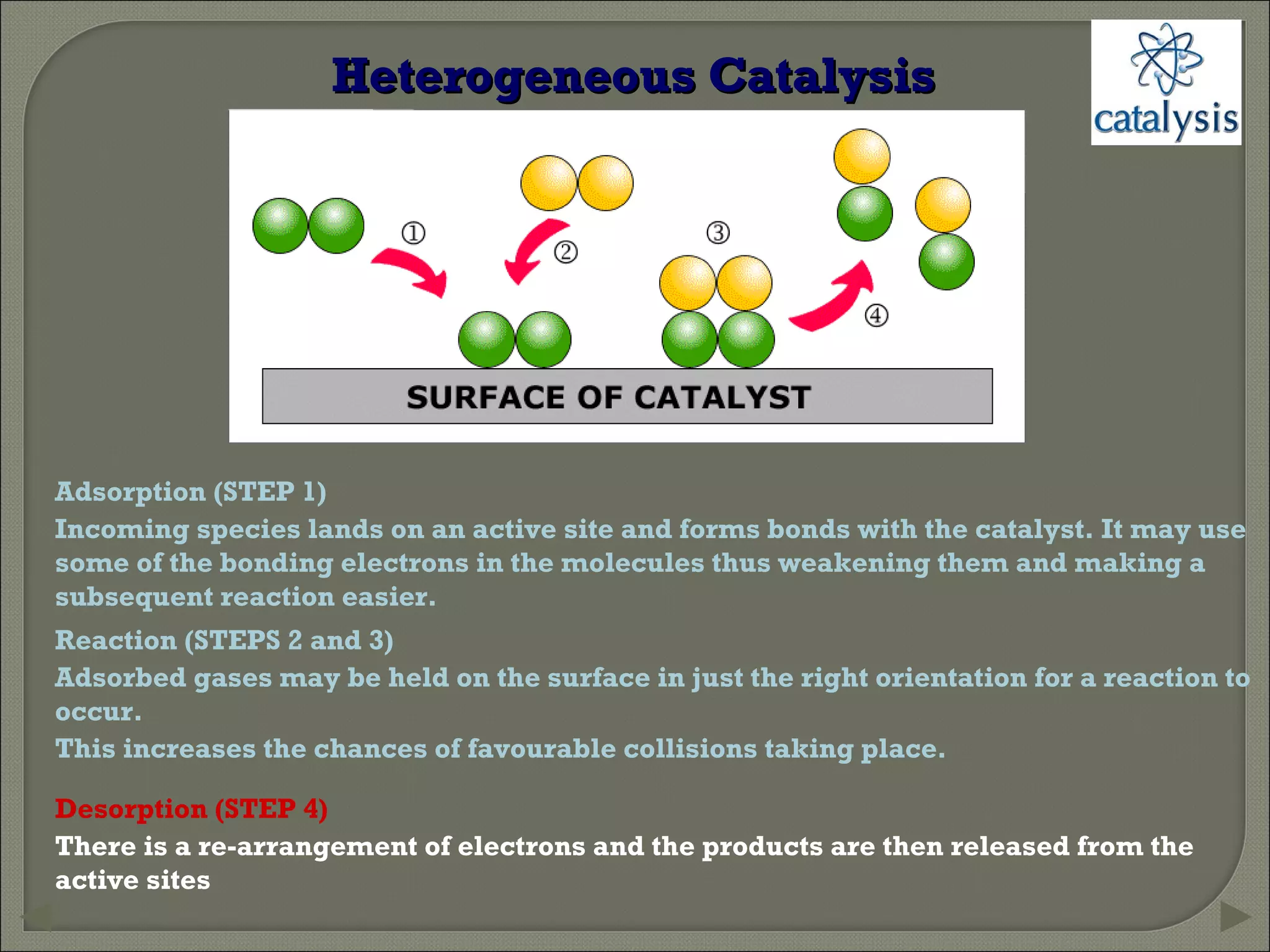
Adsorption (STEP 1)
Incoming species lands on an active site and forms bonds with the catalyst. It may use
some of the bonding electrons in the molecules thus weakening them and making a
subsequent reaction easier.
Reaction (STEPS 2 and 3)
Adsorbed gases may be held on the surface in just the right orientation for a reaction to
occur.
This increases the chances of favourable collisions taking place.
Heterogeneous CatalysisHeterogeneous Catalysis
Desorption (STEP 4)
There is a re-arrangement of electrons and the products are then released from the
active sites
Adsorption (STEP 1)
Incoming species lands on an active site and forms bonds with the catalyst. It may use
some of the bonding electrons in the molecules thus weakening them and making a
subsequent reaction easier.
Reaction (STEPS 2 and 3)
Adsorbed gases may be held on the surface in just the right orientation for a reaction to
occur.
This increases the chances of favourable collisions taking place.
Heterogeneous CatalysisHeterogeneous Catalysis
Desorption (STEP 4)
There is a re-arrangement of electrons and the products are then released from the
active sites
Adsorption (STEP 1)
Incoming species lands on an active site and forms bonds with the catalyst. It may use
some of the bonding electrons in the molecules thus weakening them and making a
subsequent reaction easier.
Reaction (STEPS 2 and 3)
Adsorbed gases may be held on the surface in just the right orientation for a reaction to
occur.
This increases the chances of favourable collisions taking place.
Examples of Heterogeneous Catalysis: -
1. Gas Phase
2SO2 + O2 + [Pt] 2SO3 + [Pt]
2. Liquid Phase
H2O2 + [Pt] 2 H2O + O2 + [Pt]
3. Solid Phase
2KClO3 + [MnO2] 2KCl + 3O2 + [MnO2]
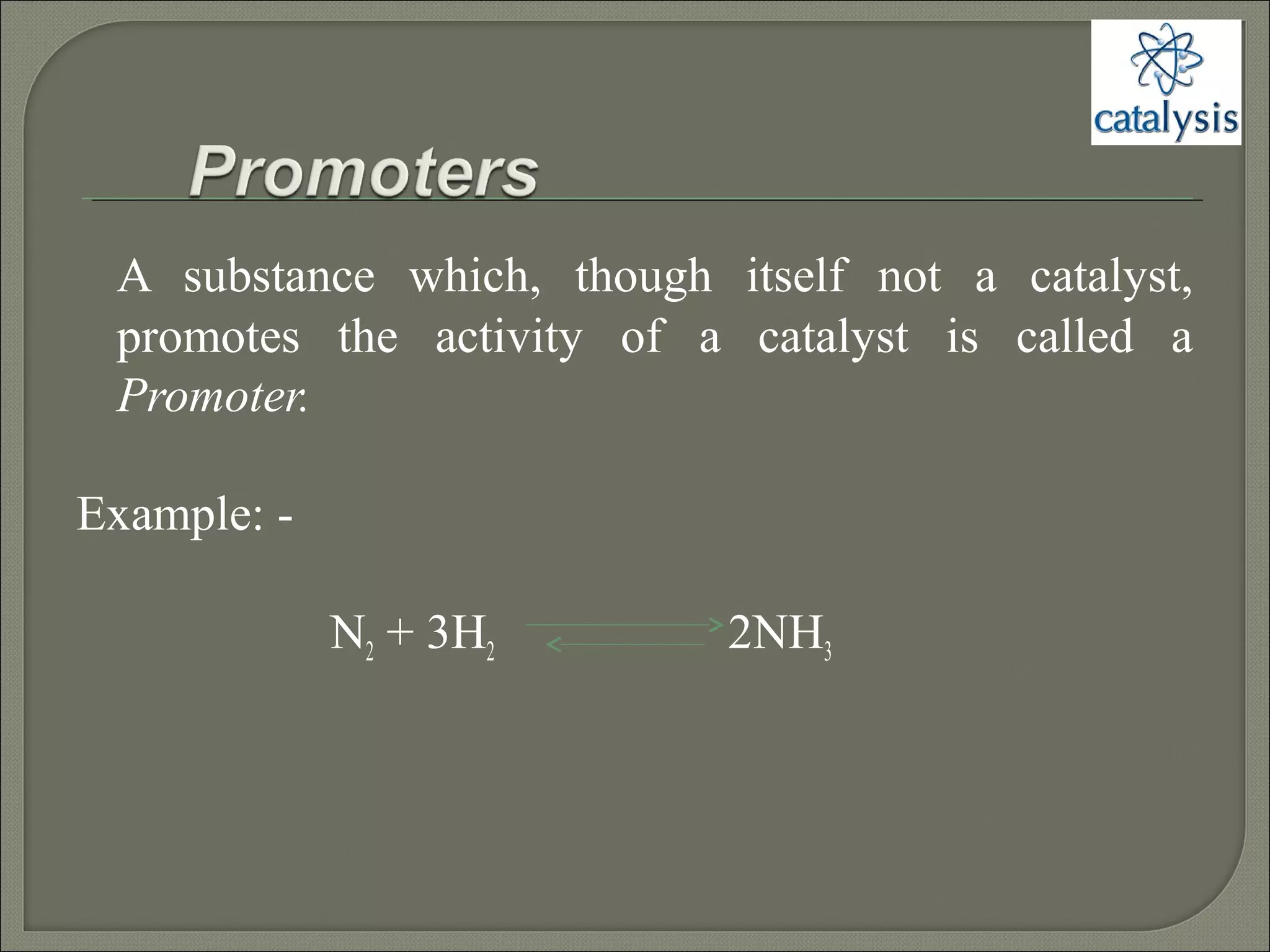
A substance which, though itself not a catalyst,
promotes the activity of a catalyst is called a
Promoter.
Example: -
N2 + 3H2 2NH3
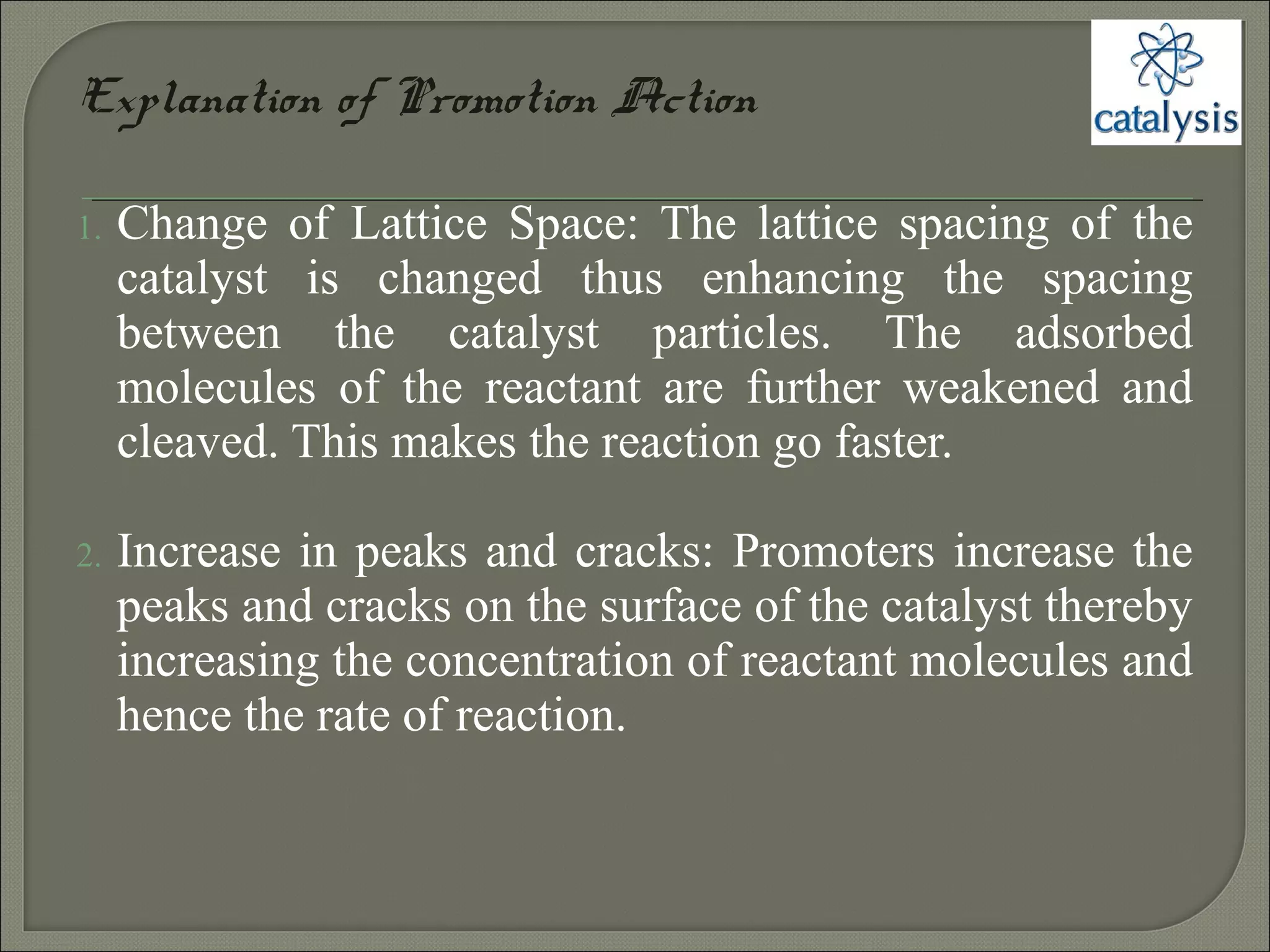
Explanation of Promotion Action
1. Change of Lattice Space: The lattice spacing of the
catalyst is changed thus enhancing the spacing
between the catalyst particles. The adsorbed
molecules of the reactant are further weakened and
cleaved. This makes the reaction go faster.
2. Increase in peaks and cracks: Promoters increase the
peaks and cracks on the surface of the catalyst thereby
increasing the concentration of reactant molecules and
hence the rate of reaction.
A substance which destroys the activity of the catalyst
to accelerate a reaction, is called a poison and the
process is called Catalytic Poisoning.
Example: -
2SO2 + O2 + [Pt] 2SO3
This is poisoned by As2O3
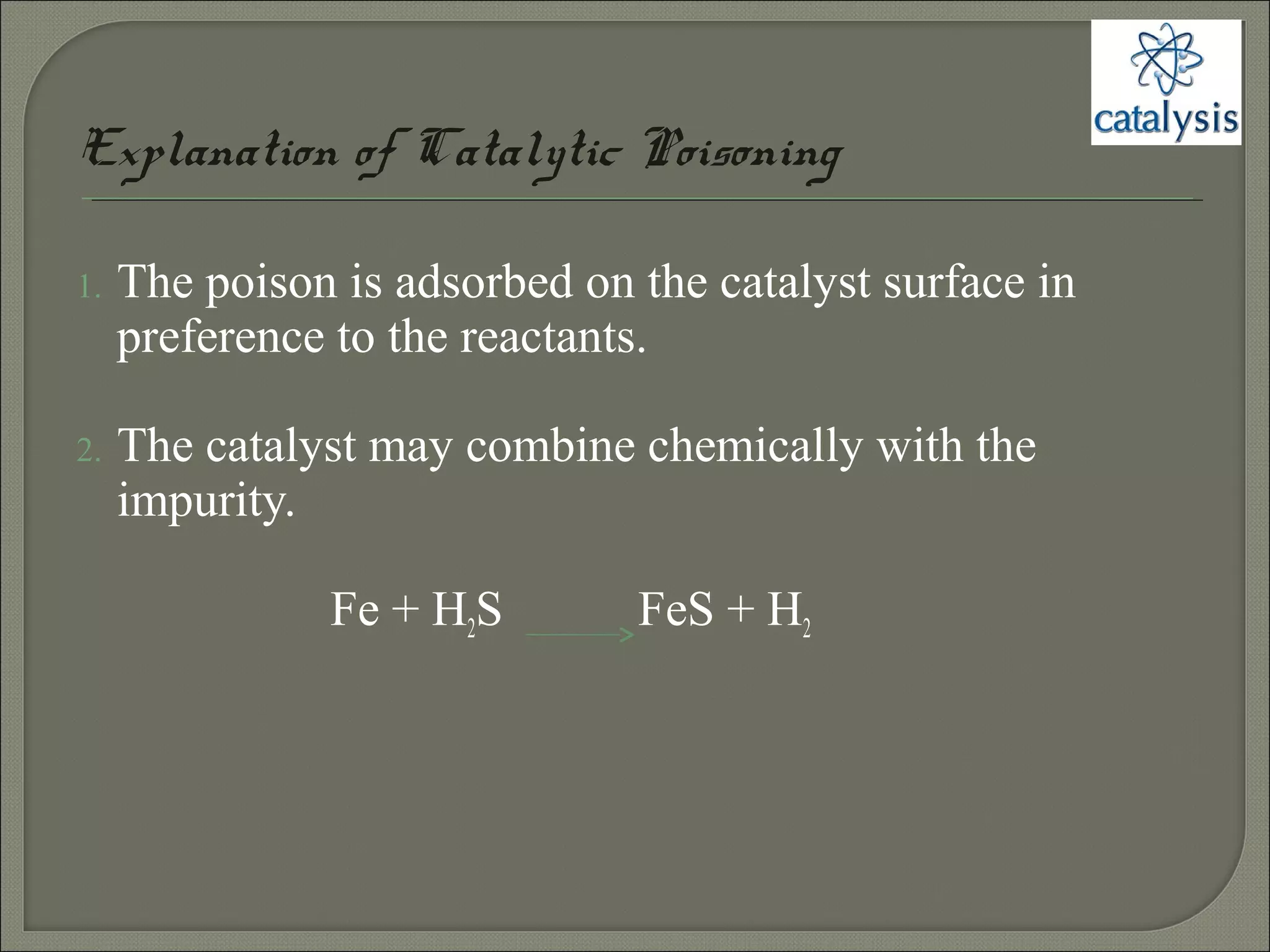
Explanation of Catalytic Poisoning
1. The poison is adsorbed on the catalyst surface in
preference to the reactants.
2. The catalyst may combine chemically with the
impurity.
Fe + H2S FeS + H2
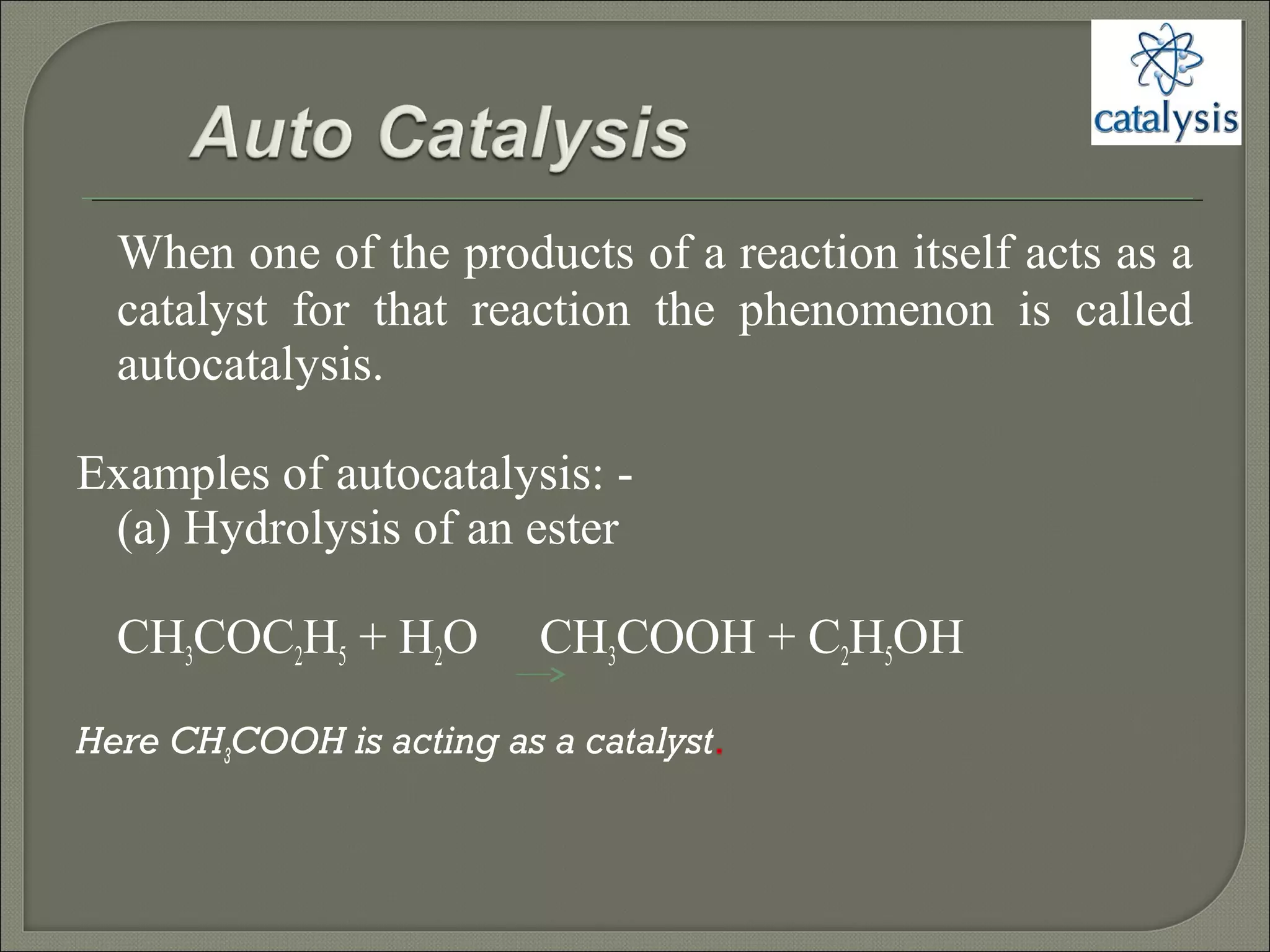
When one of the products of a reaction itself acts as a
catalyst for that reaction the phenomenon is called
autocatalysis.
Examples of autocatalysis: -
(a) Hydrolysis of an ester
CH3COC2H5 + H2O CH3COOH + C2H5OH
Here CH3COOH is acting as a catalyst.
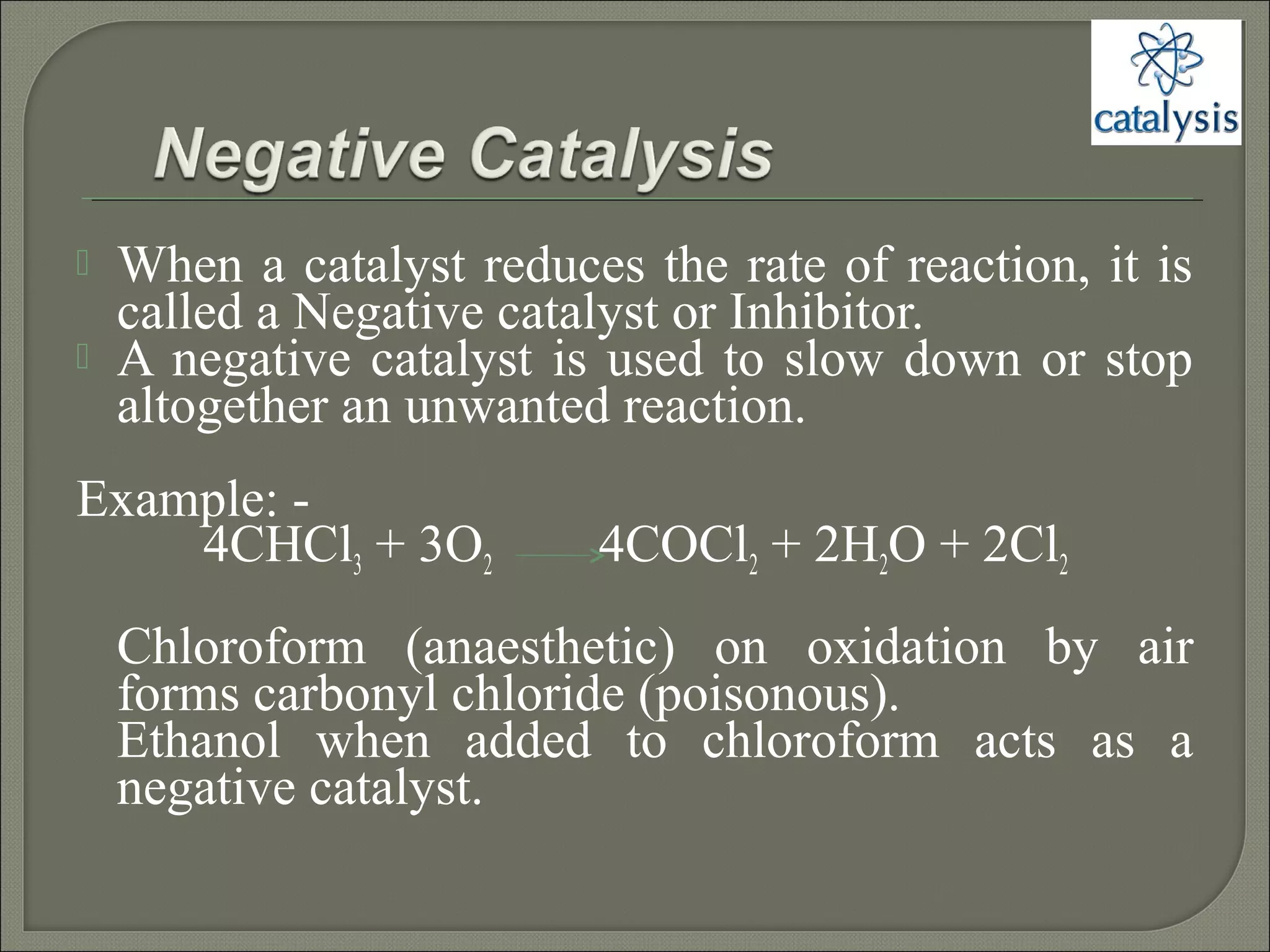
 When a catalyst reduces the rate of reaction, it is
called a Negative catalyst or Inhibitor.
 A negative catalyst is used to slow down or stop
altogether an unwanted reaction.
Example: -
4CHCl3 + 3O2 4COCl2 + 2H2O + 2Cl2
Chloroform (anaesthetic) on oxidation by air
forms carbonyl chloride (poisonous).
Ethanol when added to chloroform acts as a
negative catalyst.
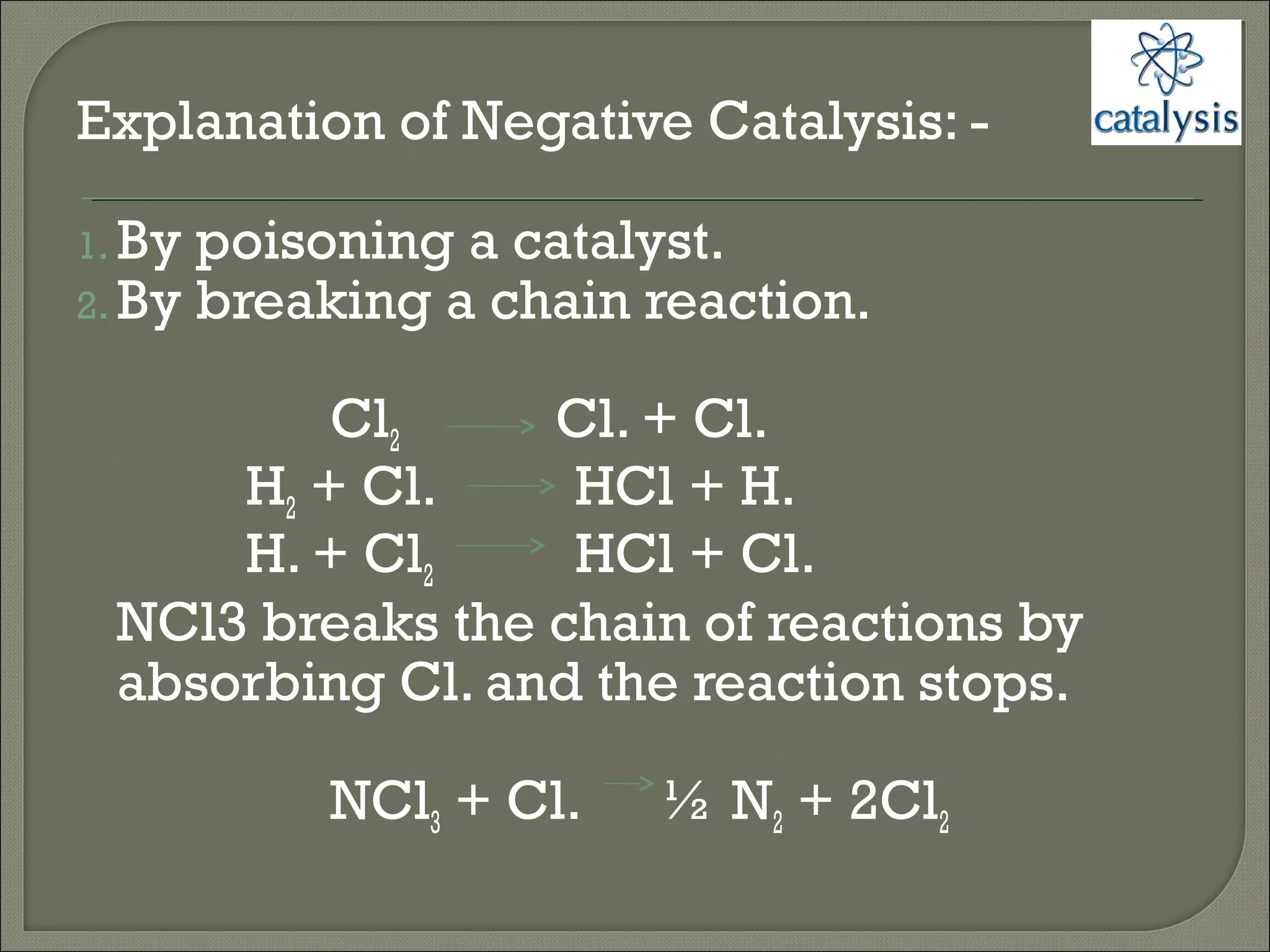
Explanation of Negative Catalysis: -
1. By poisoning a catalyst.
2. By breaking a chain reaction.
Cl2 Cl. + Cl.
H2 + Cl. HCl + H.
H. + Cl2 HCl + Cl.
NCl3 breaks the chain of reactions by
absorbing Cl. and the reaction stops.
NCl3 + Cl. ½ N2 + 2Cl2
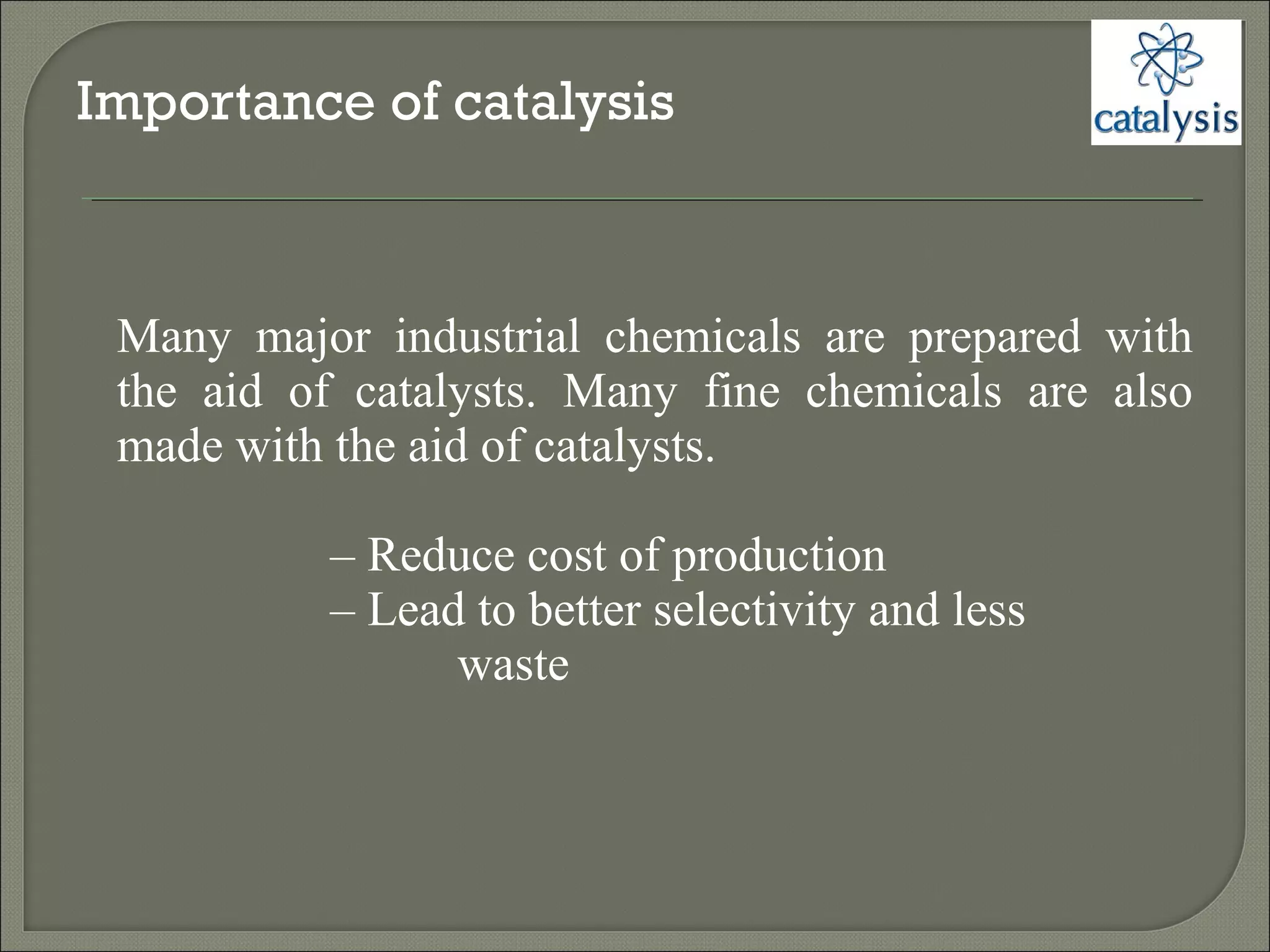
Importance of catalysis
Many major industrial chemicals are prepared with
the aid of catalysts. Many fine chemicals are also
made with the aid of catalysts.
– Reduce cost of production
– Lead to better selectivity and less
waste
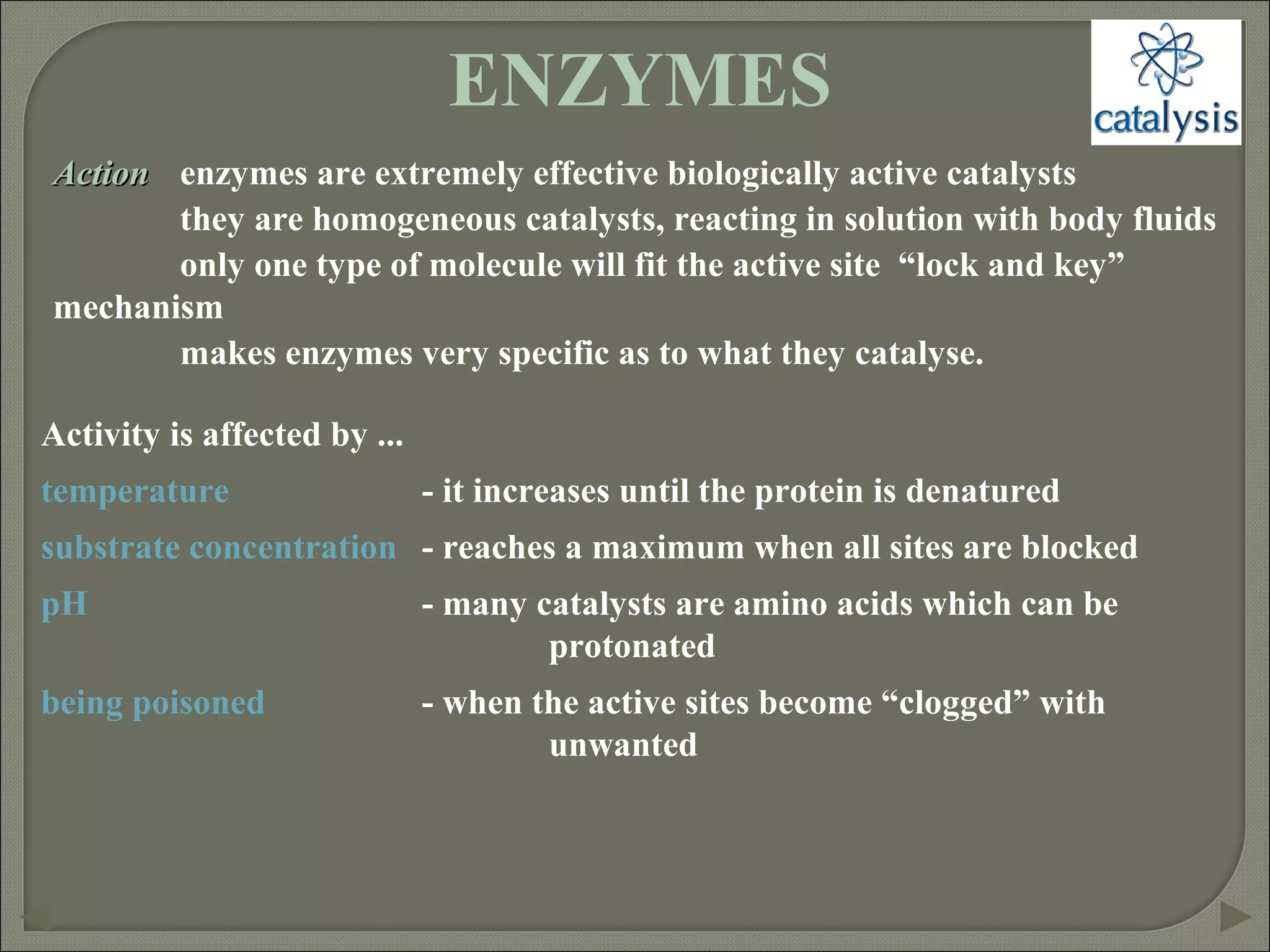
Activity is affected by ...
temperature - it increases until the protein is denatured
substrate concentration - reaches a maximum when all sites are blocked
pH - many catalysts are amino acids which can be
protonated
being poisoned - when the active sites become “clogged” with
unwanted
ENZYMES
ActionAction enzymes are extremely effective biologically active catalysts
they are homogeneous catalysts, reacting in solution with body fluids
only one type of molecule will fit the active site “lock and key”
mechanism
makes enzymes very specific as to what they catalyse.
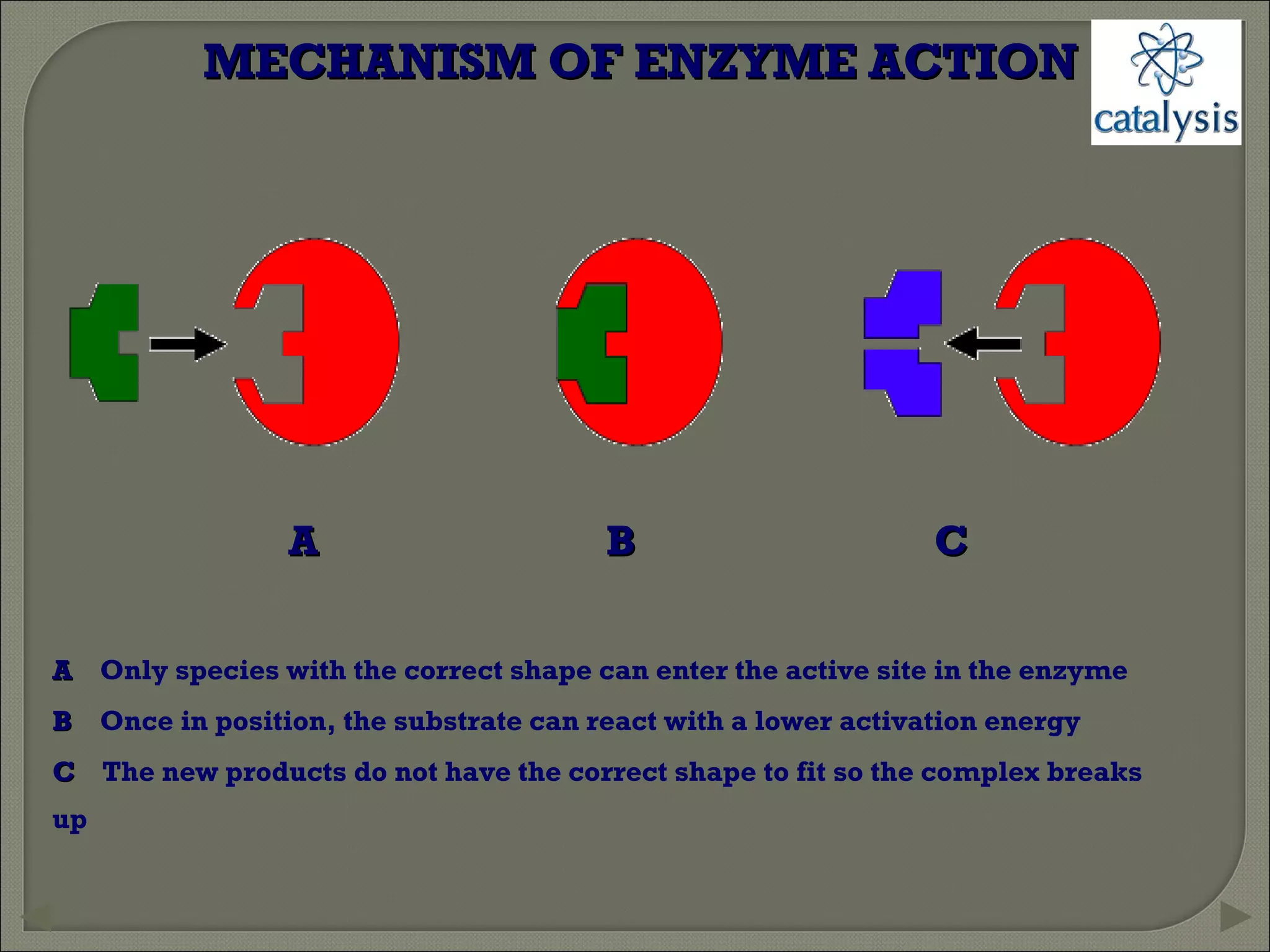
MECHANISM OF ENZYME ACTIONMECHANISM OF ENZYME ACTION
AA BB CC
AA Only species with the correct shape can enter the active site in the enzyme
BB Once in position, the substrate can react with a lower activation energy
CC The new products do not have the correct shape to fit so the complex breaks
up
ENZYMESENZYMES
ANIMATED ACTIONANIMATED ACTION
AA Only species with the correct shape can enter the active site in the enzyme
BB Once in position, the substrate can react with a lower activation energy
CC The new products do not have the correct shape to fit so the complex breaks up
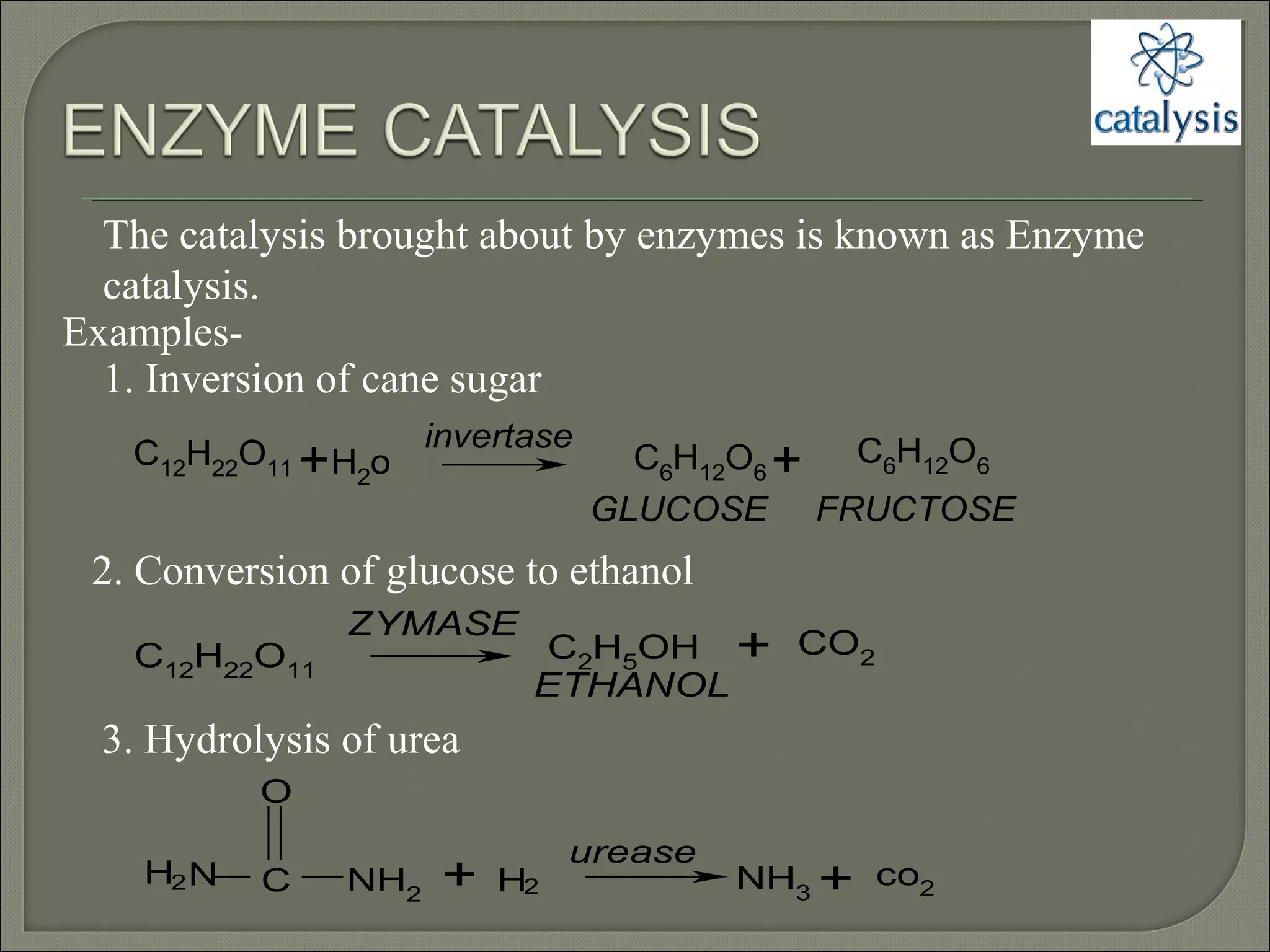
The catalysis brought about by enzymes is known as Enzyme
catalysis.
Examples-
1. Inversion of cane sugar
C12H22O11 +H2o
invertase
C6H12O6 + C6H12O6
GLUCOSE FRUCTOSE
C12H22O11
ZYMASE
+C2H5OH CO2
ETHANOL
2. Conversion of glucose to ethanol
3. Hydrolysis of urea
NH2C
O
NH2 + H2
urease
NH3 + co2
Catalysis

Catalysis

  • 1.
    -Naveen Kadian M.Pharm. FirstYear Department of Pharma Chemistry
  • 2.
     Introduction  Basis Importance  Classification • Homogeneous catalysis  Mechanism  Example • Heterogeneous catalysis  Mechanism  Examples
  • 3.
     Promoters  CatalyticPoisoning  Autocatalysis  Enzyme catalysis • Enzymes  References
  • 4.
    Catalyst: - The substancesthat alter the rate of a reaction but itself remains chemically unchanged at the end of the reaction is called a Catalyst. The process is called Catalysis.
  • 5.
    WITHOUT A CATALYSTWITH A CATALYST A catalyst lower the activation barrier for a transformation, by introducing a new reaction pathway
  • 7.
    Examples of CatalystsExamplesof Catalysts Metals Ni, Pt hydrogenation reactions Fe Haber Process Rh, Pdcatalytic converters Oxides Al2O3 dehydration reactions V2O5 Contact Process Format FINELY DIVIDED increases the surface area provides more collision sites IN A SUPPORT MEDIUM maximises surface area and reduces costs
  • 8.
    There are twotypes of catalytic processes: - 1. Homogeneous catalysis 2. Heterogeneous catalysis These two processes have industrial importance. There is another mechanism involving catalysis i.e. enzyme catalysis which possess biological importance.
  • 9.
    Homogeneous CatalysisHomogeneous Catalysis Action• catalyst and reactants are in the same phase • the catalyst is evenly distributed throughout. • reaction proceeds through an intermediate species of lower energy • there is usually more than one reaction step • transition metal ions are often involved - oxidation state changes Example Acids Esterificaton Conc. H2SO4 catalyses the reaction between acids and alcohols CH3COOH + C2H5OH CH3COOC2H5 + H2O NB Catalysts have NO EFFECT ON THE POSITION OF EQUILIBRIUM but they do affect the rate at which equilibrium is reached
  • 10.
    Transition metal compoundsparticipate in homogeneous catalysis as they have the ability to change their oxidation states. 1. Reaction between iron(III) and vanadium(III) The reaction is catalysed by Cu2+ step 1 Cu2+ + V3+ ——> Cu+ + V4+ step 2 Fe3+ + Cu+ ——> Fe2+ + Cu2+ overall Fe3+ + V3+ ——> Fe2+ + V4+
  • 11.
     Catalyst isin different physical phase from the reactants.  It is also called Contact catalysis.  It possesses great industrial importance. It works in three steps: - - Adsorption - Reaction - Desorption
  • 12.
    Heterogeneous CatalysisHeterogeneous Catalysis Adsorption(STEP 1) Incoming species lands on an active site and forms bonds with the catalyst. It may use some of the bonding electrons in the molecules thus weakening them and making a subsequent reaction easier.
  • 13.
    Heterogeneous CatalysisHeterogeneous Catalysis Adsorption(STEP 1) Incoming species lands on an active site and forms bonds with the catalyst. It may use some of the bonding electrons in the molecules thus weakening them and making a subsequent reaction easier. Reaction (STEPS 2 and 3) Adsorbed gases may be held on the surface in just the right orientation for a reaction to occur. This increases the chances of favourable collisions taking place.
  • 14.
    Heterogeneous CatalysisHeterogeneous Catalysis Desorption(STEP 4) There is a re-arrangement of electrons and the products are then released from the active sites Adsorption (STEP 1) Incoming species lands on an active site and forms bonds with the catalyst. It may use some of the bonding electrons in the molecules thus weakening them and making a subsequent reaction easier. Reaction (STEPS 2 and 3) Adsorbed gases may be held on the surface in just the right orientation for a reaction to occur. This increases the chances of favourable collisions taking place.
  • 15.
    Heterogeneous CatalysisHeterogeneous Catalysis Desorption(STEP 4) There is a re-arrangement of electrons and the products are then released from the active sites Adsorption (STEP 1) Incoming species lands on an active site and forms bonds with the catalyst. It may use some of the bonding electrons in the molecules thus weakening them and making a subsequent reaction easier. Reaction (STEPS 2 and 3) Adsorbed gases may be held on the surface in just the right orientation for a reaction to occur. This increases the chances of favourable collisions taking place.
  • 16.
    Examples of HeterogeneousCatalysis: - 1. Gas Phase 2SO2 + O2 + [Pt] 2SO3 + [Pt] 2. Liquid Phase H2O2 + [Pt] 2 H2O + O2 + [Pt] 3. Solid Phase 2KClO3 + [MnO2] 2KCl + 3O2 + [MnO2]
  • 17.
    A substance which,though itself not a catalyst, promotes the activity of a catalyst is called a Promoter. Example: - N2 + 3H2 2NH3
  • 18.
    Explanation of PromotionAction 1. Change of Lattice Space: The lattice spacing of the catalyst is changed thus enhancing the spacing between the catalyst particles. The adsorbed molecules of the reactant are further weakened and cleaved. This makes the reaction go faster. 2. Increase in peaks and cracks: Promoters increase the peaks and cracks on the surface of the catalyst thereby increasing the concentration of reactant molecules and hence the rate of reaction.
  • 19.
    A substance whichdestroys the activity of the catalyst to accelerate a reaction, is called a poison and the process is called Catalytic Poisoning. Example: - 2SO2 + O2 + [Pt] 2SO3 This is poisoned by As2O3
  • 20.
    Explanation of CatalyticPoisoning 1. The poison is adsorbed on the catalyst surface in preference to the reactants. 2. The catalyst may combine chemically with the impurity. Fe + H2S FeS + H2
  • 21.
    When one ofthe products of a reaction itself acts as a catalyst for that reaction the phenomenon is called autocatalysis. Examples of autocatalysis: - (a) Hydrolysis of an ester CH3COC2H5 + H2O CH3COOH + C2H5OH Here CH3COOH is acting as a catalyst.
  • 22.
     When acatalyst reduces the rate of reaction, it is called a Negative catalyst or Inhibitor.  A negative catalyst is used to slow down or stop altogether an unwanted reaction. Example: - 4CHCl3 + 3O2 4COCl2 + 2H2O + 2Cl2 Chloroform (anaesthetic) on oxidation by air forms carbonyl chloride (poisonous). Ethanol when added to chloroform acts as a negative catalyst.
  • 23.
    Explanation of NegativeCatalysis: - 1. By poisoning a catalyst. 2. By breaking a chain reaction. Cl2 Cl. + Cl. H2 + Cl. HCl + H. H. + Cl2 HCl + Cl. NCl3 breaks the chain of reactions by absorbing Cl. and the reaction stops. NCl3 + Cl. ½ N2 + 2Cl2
  • 24.
    Importance of catalysis Manymajor industrial chemicals are prepared with the aid of catalysts. Many fine chemicals are also made with the aid of catalysts. – Reduce cost of production – Lead to better selectivity and less waste
  • 26.
    Activity is affectedby ... temperature - it increases until the protein is denatured substrate concentration - reaches a maximum when all sites are blocked pH - many catalysts are amino acids which can be protonated being poisoned - when the active sites become “clogged” with unwanted ENZYMES ActionAction enzymes are extremely effective biologically active catalysts they are homogeneous catalysts, reacting in solution with body fluids only one type of molecule will fit the active site “lock and key” mechanism makes enzymes very specific as to what they catalyse.
  • 27.
    MECHANISM OF ENZYMEACTIONMECHANISM OF ENZYME ACTION AA BB CC AA Only species with the correct shape can enter the active site in the enzyme BB Once in position, the substrate can react with a lower activation energy CC The new products do not have the correct shape to fit so the complex breaks up
  • 28.
    ENZYMESENZYMES ANIMATED ACTIONANIMATED ACTION AAOnly species with the correct shape can enter the active site in the enzyme BB Once in position, the substrate can react with a lower activation energy CC The new products do not have the correct shape to fit so the complex breaks up
  • 29.
    The catalysis broughtabout by enzymes is known as Enzyme catalysis. Examples- 1. Inversion of cane sugar C12H22O11 +H2o invertase C6H12O6 + C6H12O6 GLUCOSE FRUCTOSE C12H22O11 ZYMASE +C2H5OH CO2 ETHANOL 2. Conversion of glucose to ethanol 3. Hydrolysis of urea NH2C O NH2 + H2 urease NH3 + co2