


1
BY
VANA JAGAN MOHAN RAO M.S.Pharm, MED.CHEM
NIPER-KOLKATA
Asst.Professor, MIPER-KURNOOL
Email: jaganvana6@gmail.com
Cycloalkanes
2
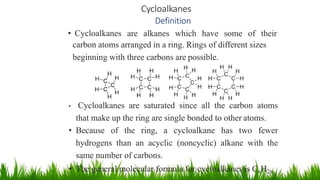
• Cycloalkanes are saturated since all the carbon atoms
that make up the ring are single bonded to other atoms.
• Because of the ring, a cycloalkane has two fewer
hydrogens than an acyclic (noncyclic) alkane with the
same number of carbons.
• The general molecular formula for cycloalkanes is CnH2n
• Cycloalkanes
Definition
are alkanes which have some of their
carbon atoms arranged in a ring. Rings of different sizes
beginning with three carbons are possible.
Nomenclature of Cycloalkanes
3
• Cycloalkanes are commonly drawn as line structures
whereby each vertex represents a carbon understood to
be connected to an appropriate number of hydrogens to
give carbon four bonds.
• Cycloalkanes are named by adding the prefix “cyclo” to
the ‘alkane’ name that has the same number of carbon
atoms as those in the ring.
• These most common cycloalkanes are represented as
shown below:
Nomenclature of Cycloalkanes
4
Substituted Cycloalkanes
The rules for naming cycloalkanes are similar to those used
for straight-chain alkanes:
i. The parent ring is the largest ring in the molecule.
ii. The parent name is generated by adding the prefix
cyclo- to the name of the alkane with the same number
of carbons.
iii. Identify the substituents and their location by
numbering the ring from the carbon containing
substituents so as to give the substituents the lowest
possible location numbers.
iv. Alphabetize the substituents in the full name of the
cycloalkane.
Nomenclature of Cycloalkanes
5
Substituted Cycloalkanes
Refer to the cycloalkanes below to illustrate the
nomenclature of cycloalkanes.
Nomenclature of Cycloalkanes
6
Substituted Cycloalkanes
Larger rings take precedence over smaller rings.
Nomenclature of Cycloalkanes
7
Substituted Cycloalkanes
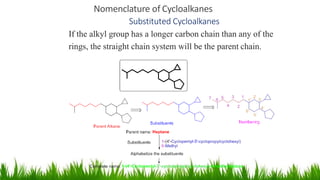
If the alkyl group has a longer carbon chain than any of the
rings, the straight chain system will be the parent chain.
Practice Questions
8
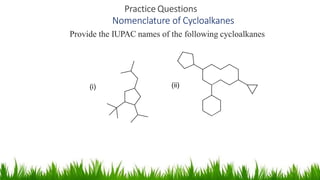
Nomenclature of Cycloalkanes
Provide the IUPAC names of the following cycloalkanes
Conformations of Cycloalkanes
9
The bond angles in straight chain alkanes is normally
109.50. This is expected for a tetrahedral arrangement of
bonds that are not restricted.
However, when the carbon atoms form part of a ring, the
angle will be controlled by the requirements of the ring.
Stability of Cycloalkanes
1
0
• Bayer (1885) postulated a theory of angle strain for
cycloalkanes in which the difference between a tetrahedral
angle (109.5o) and an internal angle of the appropriate
polygon is used as a measure of stability.
• The deviation of bond angles from the tetrahedral angle
causes the molecule to be strained and hence unstable
compared with molecules with tetrahedral bond angles.
Polygon Internal angle Polygon Internal angle
3
4
5
6
60
90
108
120
7
8
9
10
129
135
140
144
Stability of Cycloalkanes
11
• The angles of a regular pentagon (108o) are very close to
angle (109.5o) and therefore the
the least angle (Bayer) strain is
the tetrahedral
cycloalkane with
cyclopentane.
• Since the angles of a regular hexagon (120o) are somewhat
larger than the tetrahedral angle, Baeyer concluded
(incorrectly) that there is a certain amount of strain in
cyclohexane.
• Further, he suggested that as one proceeds to
cycloheptane, cyclooctane etc, the deviation of the bond
angles become progressively larger and the molecules
would become progressively more strained.
Baeyer Theory vs Experimental
Facts
1
2
• Heats of combustion can often furnish valuable
information on the relative stabilities of compounds.
• Apparently, cyclohexanes are just as stable as straight chain
alkanes.
Ring
size
Heat of combustion
per CH2
(kcal/mol)
Ring
size
Heat of combustion
per CH2
(kcal/mol)
3
4
5
6
166.6
164.0
158.7
157.4
7
8
9
10
158.3
158.6
158.8
157.4
Heat of combustion for an open chain alkane per –CH2- is
157.4 kcal/mol
Baeyer Strain vs Heats of
Combustion
1
3
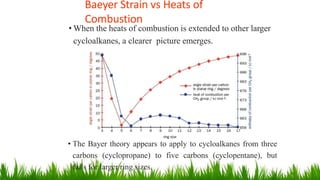
• When the heats of combustion is extended to other larger
cycloalkanes, a clearer picture emerges.
• The Bayer theory appears to apply to cycloalkanes from three
carbons (cyclopropane) to five carbons (cyclopentane), but
fails for larger ring sizes.
Where Does the Baeyer TheoryFail?
1
4
The Baeyer theory fails for larger rings because:
• The angles that Baeyer used for each ring were based on
the assumption that the rings were flat.
• In fact, all cycloalkanes except cyclopropane are not
planar (flat).
• The reality is that cycloalkanes tend to adopt puckered
three dimensional conformations that allow all the bond
angles to be nearly tetrahedral.
Conformations of Cycloalkanes
1
5
The stability of cycloalkanes are influenced by a
combination of three factors:
i. Baeyer strain or angle strain: The strain due to
expansion or compression of bond angles. There is
increase in energy when bonds deviate from the
optimum tetrahedral bond angle of 109.5o.
ii. Torsional strain or bond strain: The strain due to the
eclipsing of bonds on neighbouring atoms. There is
increase in energy when there are eclipsing
interactions.
iii. Steric strain: The strain due to the repulsive interactions
when atoms approach each other too closely. There is
increase in energy when atoms are forced too close to
one another.
Conformations of Cycloalkanes
1
6
• The ring strain of a cycloalkane is a combination of the
effects of angle strain, torsional strain and steric strain.
• The various arrangements in space that are available to
a molecule by rotation about single bonds is its
conformations.
• The investigations of various conformations of a
molecule and their relative stabilities is known as
conformational analysis.
• We will look at the conformational analysis of
cyclopropanes, cyclobutanes, cyclopentanes and
cyclohexanes to identify the lowest energy conformers.
Cyclopropanes
1
7
Structure and Bonding
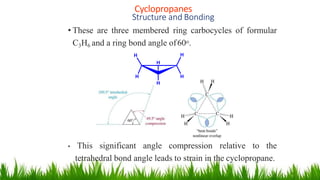
• These are three membered ring carbocycles of formular
C3H6 and a ring bond angle of60o.
• This significant angle compression relative to the
tetrahedral bond angle leads to strain in the cyclopropane.
H
H
H
H
H
H
Cyclopropanes
1
8
Bonding
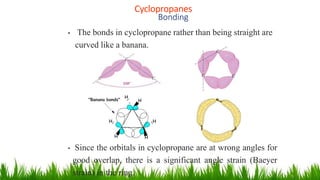
• The bonds in cyclopropane rather than being straight are
curved like a banana.
• Since the orbitals in cyclopropane are at wrong angles for
good overlap, there is a significant angle strain (Baeyer
strain) in the ring.
H
HH
H
HH
"Banana bonds"
Cyclopropanes
1
9
Bonding
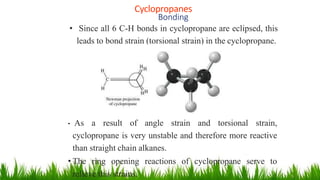
• Since all 6 C-H bonds in cyclopropane are eclipsed, this
leads to bond strain (torsional strain) in the cyclopropane.
• As a result of angle strain and torsional strain,
cyclopropane is very unstable and therefore more reactive
than straight chain alkanes.
• The ring opening reactions of cyclopropane serve to
relieve this strains.
Cyclobutanes
2
0
Bonding
• Cyclobutane is a four membered carbocycle of formula
C4H8.
• Just like cyclopropane, the bond angles in cyclobutane
are strained as a result of angle compression compared to
related linear or unstrained hydrocarbons.
• As a result of angle strain, cyclobutane is unstable above
500oC.
• But unlike cyclopropane, cyclobutane has slighltly
greater freedom of rotation.
Cyclobutanes
2
1
• The planar cyclobutane has all its 8 C-Hs in an eclipsed
arrangement with bond angles of 90o, while the puckered
conformation has a bond angle of 88o.
• Although the puckered conformation increases the angle
strain, it significantly reduces the torsional strain.
Conformations
• One can envisage two extreme forms of cyclobutane: A
planar form and a bent form (referred to as the puckered
form).
25º
Cyclobutanes
2
2
Conformations
• Cyclic molecules minimize the angle strain and
torsional strain in them by ring puckering (bending).
• Cyclobutane consists of two puckered conformations
which are in rapid equilibrium.
H H
HH
H
H
H
H HH
H H
H
H
H
H
Cyclobutanes
2
3
Conformations
• Note how in the puckered conformation of
cyclobutane there are two different kinds of C–H
bonds and hence two different kinds of H atoms.
There are those C–H bonds that are nearly anti to
other C–H bonds, and there are those C–H bonds that
are nearly anti to C–C bonds.
• When we will look at cyclohexanes, we will see that
this has great significance in the stability of the
cyclohexane rings.
Cyclopentanes
2
4
• Cyclopentane is a five membered carbocycle of formula
C5H10.
• There are two extreme conformations of cyclopentane
(the planar and envelope conformations).
• In the planar conformation, postulated in the Baeyer
theory, the bond angle in the ring is 108o and all 10 C-H
bonds are eclipsed.
H H
H
H
H H
H
H
H
H
H H
H
H
H
H
H
Puckering H
H
No TS
TS
Envelope conformerPlanar conformer
Cyclopentane
2
5
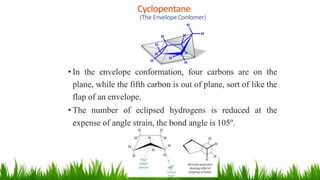
• In the envelope conformation, four carbons are on the
plane, while the fifth carbon is out of plane, sort of like the
flap of an envelope.
• The number of eclipsed hydrogens is reduced at the
expense of angle strain, the bond angle is 105º.
(The Envelope Confomer)
H
H
H
H
H
H
H
H
H
H
Cyclopentane
2
6
(The Envelope Confomation)
conformation undergoes• The envelop
conformational change in which the carbon
a rapid
at the
envelope alternates.
• Suppose the different C atoms in the ring are non-
identical, i.e. have different substituents. How do we know
which C atom in cyclopentane will pucker?
H
H
H
H
H
H
H
H
H
H
H
H
H
H
H
H
H
H
H
H
Substitued Cyclopentanes
(The prefered EnvelopeConfomation)
2
7
• When we have substituted cyclopentanes,
occurs preferably involving the substituted
puckering
carbon to
generate the envelope conformer with reduced tortional
strain.
• For 1,2-diisopropylcyclopentane, the prefered conformer
of lowest energy is the staggered envelope.
Cyclohexanes
2
8
• Cyclohexane is a six membered carbocycle of formula
C6H12.
• There are two extreme conformations of cyclohexane (the
planar and chair conformations) that can be envisaged.
• In the planar conformation postulated in the Baeyer
theory, the bond angle in the ring is 120o, all 12 C-H
bonds are eclipsed and as a result very unstable.
• Recall that the combustion data of cyclohexane suggests
that it is free from ring strain and torsional strain.
H
H
H
H
H
H H
Planar conformer Chair conformer
H
H H
H
H
H H
H
H
HH
H
H H
H H
puckering
Cyclohexanes
•In the chair conformation of cyclohexane, all 12 C-H bonds are
staggered and the bond angle is 109.5º (tetrahedral bond angle).
• With no angle strain and no torsional strain, the chair conformer
of cyclohexane is very stable and is the preferred conformation
in which cyclohexane systems exist in.
2
9
Chair conformer
H
H
H
H
H
H H
Planar conformer
H
HH
H
H
Conformations
H H
H
HH H
H
H H
H H
puckering
Cyclohexanes
Chair Conformers
3
0
• Looking at the chair conformation, one can identify a
back-rest, a seat and a leg-rest like that of a chair.
rChair conforme
Cyclohexanes
3
1
Boat Conformations
• Boat conformations are also possible with cyclohexane
systems, but they are of higher energy than the chair
conformations.
Cyclohexanes
Conformational Energy
3
2
• Of all conformations of cyclohexane, the chair
conformations are of least energy and thus most stable.
• Chair conformations are therefore the most realistic
representations of cyclohexanes.
Cyclohexanes
Chair Conformation: Axial and Equitorial
Bonds
3
3
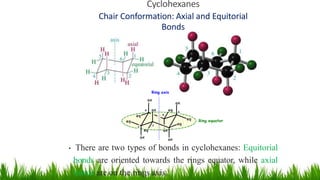
• There are two types of bonds in cyclohexanes: Equitorial
bonds are oriented towards the rings equator, while axial
bonds are on the rings axis.
ax
ax
ax
eq
eq
ax
eq
eq
eq 1
2
3
5
6
Ring axis
ax
4 ax eq
Ring equator
Substituted Cyclohexanes
3
4
• To ring flip, identify where the substituents are.
• In one conformer, push up at C-4 and down at C-1 to
obtain the 4C1 conformer.
• The other conformer is obtained by pushing up at C-1 and
down at C-1 to provide the 1C4 conformer.
ring flip
push this
carbon up
Ring flipping
pull this
carbon down
3
5
Drawing Chair Conformations of Cyclohexanes
• Draw two parallel lines, slanted down
ward and slightly offset from each other.
• Locate the topmost carbon atom above and
to the right of the plane and connect the
bonds.
• Locate the bottom-most carbon atom
below and to the left of the plane of the
middle four carbons and connect the bonds.
• Note that the bonds to the bottom-most carbon are parallel
to the bonds to the top-most carbon.
Substituted Cyclohexanes
Drawing Chair Conformations of Cyclohexanes
3
6
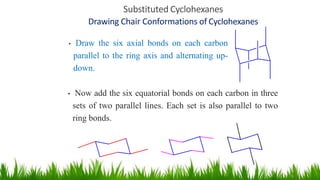
• Draw the six axial bonds on each carbon
parallel to the ring axis and alternating up-
down.
• Now add the six equatorial bonds on each carbon in three
sets of two parallel lines. Each set is also parallel to two
ring bonds.
Substituted Cyclohexanes
Chair Conformation: Axial and Equitorial
Bonds
3
7
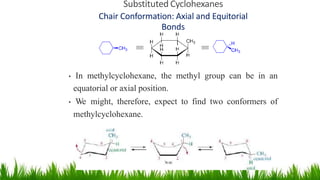
• In methylcyclohexane, the methyl group can be in an
equatorial or axial position.
• We might, therefore, expect to find two conformers of
methylcyclohexane.
3
9
Stability of Cyclohexane Conformers
• Although cyclohexane rings rapidly flip between
conformations at room temperature, the two conformers of
a monosubstituted cyclohexane are not of equal stability.
H
CH
H
H
H
H
H
H
H
H H
H
H
1
H
2
3
4
5
6
ring flip
HH
H
H
H
H
H
H
H
C
H
1
2
H
H
3
H
4 H 5
6
1C4 conformer = 5%
1
4C conformer = 95%
1C4• In the conformer, there is van der Waals strain
between hydrogens of the axial CH3 and hydrogens at C-3
and C-5, while in the 4C1 conformer, there is a smaller van
der Waals strain between hydrogens at C-1 and hydrogens
at C-3 and C-5.
Substituted Cyclohexanes
Conformational Free Energy of Methylcyclohexane
4
1
• The investigation of molecular conformations and their
relative energies is called conformational analysis.
• As a generalization, for other monosubstituted
cycloalkanes: “a substituent is almost always stable in
an equatorial position that in an axial position”.
G0
7.6 kJ/mol
H
H
H
H
H CH3
H
H
H
H
H
H
H
H
H
H
H
H
H
CH3
H
H
H
H
4
2
Stability of Conformers
• The exact amount of 1,3-diaxial steric strain for axial
groups depends, on the nature and size of the axial group.
• The steric strain increases through the series CH3- <
CH3CH2- < (CH3)2CH- < (CH3)3C- in parallel with
increasing bulk of the successively larger alkyl groups.
H
C
H
H
H
H
H
H
H
H3C CH3
CH3
H
1
H
2
3
4
5 H
6
ring flip
H
HH
H
H
H
C
H
H
H
H
CH3
CH3
CH3
1
2
H3
4 5
6
< 0.01% 99.99%
• There is severe 1,3-diaxial interaction involving the t-
butyl group in 1C4, while decreased van der Waals strain
in 4C1.
4
3
Stability of Conformers
• The exact amount of 1,3-diaxial steric strain for axial
groups depends, on the nature and size of the axial group.
• The steric strain increases through the series CH3- <
CH3CH2- < (CH3)2CH- < (CH3)3C- in parallel with
increasing bulk of the successively larger alkyl groups.
H
C
H
H
H
H
H
H
H
H3C CH3
CH3
H
1
H
2
3
4
5 H
6
ring flip
H
HH
H
H
H
C
H
H
H
H
CH3
CH3
CH3
1
2
H3
4 5
6
< 0.01% 99.99%
• There is severe 1,3-diaxial interaction involving the t-
butyl group in 1C4, while decreased van der Waals strain
in 4C1.
Cycloalkanes stability

Cycloalkanes stability

  • 1.
    1 BY VANA JAGAN MOHANRAO M.S.Pharm, MED.CHEM NIPER-KOLKATA Asst.Professor, MIPER-KURNOOL Email: jaganvana6@gmail.com
  • 2.
    Cycloalkanes 2 • Cycloalkanes aresaturated since all the carbon atoms that make up the ring are single bonded to other atoms. • Because of the ring, a cycloalkane has two fewer hydrogens than an acyclic (noncyclic) alkane with the same number of carbons. • The general molecular formula for cycloalkanes is CnH2n • Cycloalkanes Definition are alkanes which have some of their carbon atoms arranged in a ring. Rings of different sizes beginning with three carbons are possible.
  • 3.
    Nomenclature of Cycloalkanes 3 •Cycloalkanes are commonly drawn as line structures whereby each vertex represents a carbon understood to be connected to an appropriate number of hydrogens to give carbon four bonds. • Cycloalkanes are named by adding the prefix “cyclo” to the ‘alkane’ name that has the same number of carbon atoms as those in the ring. • These most common cycloalkanes are represented as shown below:
  • 4.
    Nomenclature of Cycloalkanes 4 SubstitutedCycloalkanes The rules for naming cycloalkanes are similar to those used for straight-chain alkanes: i. The parent ring is the largest ring in the molecule. ii. The parent name is generated by adding the prefix cyclo- to the name of the alkane with the same number of carbons. iii. Identify the substituents and their location by numbering the ring from the carbon containing substituents so as to give the substituents the lowest possible location numbers. iv. Alphabetize the substituents in the full name of the cycloalkane.
  • 5.
    Nomenclature of Cycloalkanes 5 SubstitutedCycloalkanes Refer to the cycloalkanes below to illustrate the nomenclature of cycloalkanes.
  • 6.
    Nomenclature of Cycloalkanes 6 SubstitutedCycloalkanes Larger rings take precedence over smaller rings.
  • 7.
    Nomenclature of Cycloalkanes 7 SubstitutedCycloalkanes If the alkyl group has a longer carbon chain than any of the rings, the straight chain system will be the parent chain.
  • 8.
    Practice Questions 8 Nomenclature ofCycloalkanes Provide the IUPAC names of the following cycloalkanes
  • 9.
    Conformations of Cycloalkanes 9 Thebond angles in straight chain alkanes is normally 109.50. This is expected for a tetrahedral arrangement of bonds that are not restricted. However, when the carbon atoms form part of a ring, the angle will be controlled by the requirements of the ring.
  • 10.
    Stability of Cycloalkanes 1 0 •Bayer (1885) postulated a theory of angle strain for cycloalkanes in which the difference between a tetrahedral angle (109.5o) and an internal angle of the appropriate polygon is used as a measure of stability. • The deviation of bond angles from the tetrahedral angle causes the molecule to be strained and hence unstable compared with molecules with tetrahedral bond angles. Polygon Internal angle Polygon Internal angle 3 4 5 6 60 90 108 120 7 8 9 10 129 135 140 144
  • 11.
    Stability of Cycloalkanes 11 •The angles of a regular pentagon (108o) are very close to angle (109.5o) and therefore the the least angle (Bayer) strain is the tetrahedral cycloalkane with cyclopentane. • Since the angles of a regular hexagon (120o) are somewhat larger than the tetrahedral angle, Baeyer concluded (incorrectly) that there is a certain amount of strain in cyclohexane. • Further, he suggested that as one proceeds to cycloheptane, cyclooctane etc, the deviation of the bond angles become progressively larger and the molecules would become progressively more strained.
  • 12.
    Baeyer Theory vsExperimental Facts 1 2 • Heats of combustion can often furnish valuable information on the relative stabilities of compounds. • Apparently, cyclohexanes are just as stable as straight chain alkanes. Ring size Heat of combustion per CH2 (kcal/mol) Ring size Heat of combustion per CH2 (kcal/mol) 3 4 5 6 166.6 164.0 158.7 157.4 7 8 9 10 158.3 158.6 158.8 157.4 Heat of combustion for an open chain alkane per –CH2- is 157.4 kcal/mol
  • 13.
    Baeyer Strain vsHeats of Combustion 1 3 • When the heats of combustion is extended to other larger cycloalkanes, a clearer picture emerges. • The Bayer theory appears to apply to cycloalkanes from three carbons (cyclopropane) to five carbons (cyclopentane), but fails for larger ring sizes.
  • 14.
    Where Does theBaeyer TheoryFail? 1 4 The Baeyer theory fails for larger rings because: • The angles that Baeyer used for each ring were based on the assumption that the rings were flat. • In fact, all cycloalkanes except cyclopropane are not planar (flat). • The reality is that cycloalkanes tend to adopt puckered three dimensional conformations that allow all the bond angles to be nearly tetrahedral.
  • 15.
    Conformations of Cycloalkanes 1 5 Thestability of cycloalkanes are influenced by a combination of three factors: i. Baeyer strain or angle strain: The strain due to expansion or compression of bond angles. There is increase in energy when bonds deviate from the optimum tetrahedral bond angle of 109.5o. ii. Torsional strain or bond strain: The strain due to the eclipsing of bonds on neighbouring atoms. There is increase in energy when there are eclipsing interactions. iii. Steric strain: The strain due to the repulsive interactions when atoms approach each other too closely. There is increase in energy when atoms are forced too close to one another.
  • 16.
    Conformations of Cycloalkanes 1 6 •The ring strain of a cycloalkane is a combination of the effects of angle strain, torsional strain and steric strain. • The various arrangements in space that are available to a molecule by rotation about single bonds is its conformations. • The investigations of various conformations of a molecule and their relative stabilities is known as conformational analysis. • We will look at the conformational analysis of cyclopropanes, cyclobutanes, cyclopentanes and cyclohexanes to identify the lowest energy conformers.
  • 17.
    Cyclopropanes 1 7 Structure and Bonding •These are three membered ring carbocycles of formular C3H6 and a ring bond angle of60o. • This significant angle compression relative to the tetrahedral bond angle leads to strain in the cyclopropane. H H H H H H
  • 18.
    Cyclopropanes 1 8 Bonding • The bondsin cyclopropane rather than being straight are curved like a banana. • Since the orbitals in cyclopropane are at wrong angles for good overlap, there is a significant angle strain (Baeyer strain) in the ring. H HH H HH "Banana bonds"
  • 19.
    Cyclopropanes 1 9 Bonding • Since all6 C-H bonds in cyclopropane are eclipsed, this leads to bond strain (torsional strain) in the cyclopropane. • As a result of angle strain and torsional strain, cyclopropane is very unstable and therefore more reactive than straight chain alkanes. • The ring opening reactions of cyclopropane serve to relieve this strains.
  • 20.
    Cyclobutanes 2 0 Bonding • Cyclobutane isa four membered carbocycle of formula C4H8. • Just like cyclopropane, the bond angles in cyclobutane are strained as a result of angle compression compared to related linear or unstrained hydrocarbons. • As a result of angle strain, cyclobutane is unstable above 500oC. • But unlike cyclopropane, cyclobutane has slighltly greater freedom of rotation.
  • 21.
    Cyclobutanes 2 1 • The planarcyclobutane has all its 8 C-Hs in an eclipsed arrangement with bond angles of 90o, while the puckered conformation has a bond angle of 88o. • Although the puckered conformation increases the angle strain, it significantly reduces the torsional strain. Conformations • One can envisage two extreme forms of cyclobutane: A planar form and a bent form (referred to as the puckered form). 25º
  • 22.
    Cyclobutanes 2 2 Conformations • Cyclic moleculesminimize the angle strain and torsional strain in them by ring puckering (bending). • Cyclobutane consists of two puckered conformations which are in rapid equilibrium. H H HH H H H H HH H H H H H H
  • 23.
    Cyclobutanes 2 3 Conformations • Note howin the puckered conformation of cyclobutane there are two different kinds of C–H bonds and hence two different kinds of H atoms. There are those C–H bonds that are nearly anti to other C–H bonds, and there are those C–H bonds that are nearly anti to C–C bonds. • When we will look at cyclohexanes, we will see that this has great significance in the stability of the cyclohexane rings.
  • 24.
    Cyclopentanes 2 4 • Cyclopentane isa five membered carbocycle of formula C5H10. • There are two extreme conformations of cyclopentane (the planar and envelope conformations). • In the planar conformation, postulated in the Baeyer theory, the bond angle in the ring is 108o and all 10 C-H bonds are eclipsed. H H H H H H H H H H H H H H H H H Puckering H H No TS TS Envelope conformerPlanar conformer
  • 25.
    Cyclopentane 2 5 • In theenvelope conformation, four carbons are on the plane, while the fifth carbon is out of plane, sort of like the flap of an envelope. • The number of eclipsed hydrogens is reduced at the expense of angle strain, the bond angle is 105º. (The Envelope Confomer) H H H H H H H H H H
  • 26.
    Cyclopentane 2 6 (The Envelope Confomation) conformationundergoes• The envelop conformational change in which the carbon a rapid at the envelope alternates. • Suppose the different C atoms in the ring are non- identical, i.e. have different substituents. How do we know which C atom in cyclopentane will pucker? H H H H H H H H H H H H H H H H H H H H
  • 27.
    Substitued Cyclopentanes (The preferedEnvelopeConfomation) 2 7 • When we have substituted cyclopentanes, occurs preferably involving the substituted puckering carbon to generate the envelope conformer with reduced tortional strain. • For 1,2-diisopropylcyclopentane, the prefered conformer of lowest energy is the staggered envelope.
  • 28.
    Cyclohexanes 2 8 • Cyclohexane isa six membered carbocycle of formula C6H12. • There are two extreme conformations of cyclohexane (the planar and chair conformations) that can be envisaged. • In the planar conformation postulated in the Baeyer theory, the bond angle in the ring is 120o, all 12 C-H bonds are eclipsed and as a result very unstable. • Recall that the combustion data of cyclohexane suggests that it is free from ring strain and torsional strain. H H H H H H H Planar conformer Chair conformer H H H H H H H H H HH H H H H H puckering
  • 29.
    Cyclohexanes •In the chairconformation of cyclohexane, all 12 C-H bonds are staggered and the bond angle is 109.5º (tetrahedral bond angle). • With no angle strain and no torsional strain, the chair conformer of cyclohexane is very stable and is the preferred conformation in which cyclohexane systems exist in. 2 9 Chair conformer H H H H H H H Planar conformer H HH H H Conformations H H H HH H H H H H H puckering
  • 30.
    Cyclohexanes Chair Conformers 3 0 • Lookingat the chair conformation, one can identify a back-rest, a seat and a leg-rest like that of a chair. rChair conforme
  • 31.
    Cyclohexanes 3 1 Boat Conformations • Boatconformations are also possible with cyclohexane systems, but they are of higher energy than the chair conformations.
  • 32.
    Cyclohexanes Conformational Energy 3 2 • Ofall conformations of cyclohexane, the chair conformations are of least energy and thus most stable. • Chair conformations are therefore the most realistic representations of cyclohexanes.
  • 33.
    Cyclohexanes Chair Conformation: Axialand Equitorial Bonds 3 3 • There are two types of bonds in cyclohexanes: Equitorial bonds are oriented towards the rings equator, while axial bonds are on the rings axis. ax ax ax eq eq ax eq eq eq 1 2 3 5 6 Ring axis ax 4 ax eq Ring equator
  • 34.
    Substituted Cyclohexanes 3 4 • Toring flip, identify where the substituents are. • In one conformer, push up at C-4 and down at C-1 to obtain the 4C1 conformer. • The other conformer is obtained by pushing up at C-1 and down at C-1 to provide the 1C4 conformer. ring flip push this carbon up Ring flipping pull this carbon down
  • 35.
    3 5 Drawing Chair Conformationsof Cyclohexanes • Draw two parallel lines, slanted down ward and slightly offset from each other. • Locate the topmost carbon atom above and to the right of the plane and connect the bonds. • Locate the bottom-most carbon atom below and to the left of the plane of the middle four carbons and connect the bonds. • Note that the bonds to the bottom-most carbon are parallel to the bonds to the top-most carbon.
  • 36.
    Substituted Cyclohexanes Drawing ChairConformations of Cyclohexanes 3 6 • Draw the six axial bonds on each carbon parallel to the ring axis and alternating up- down. • Now add the six equatorial bonds on each carbon in three sets of two parallel lines. Each set is also parallel to two ring bonds.
  • 37.
    Substituted Cyclohexanes Chair Conformation:Axial and Equitorial Bonds 3 7 • In methylcyclohexane, the methyl group can be in an equatorial or axial position. • We might, therefore, expect to find two conformers of methylcyclohexane.
  • 38.
    3 9 Stability of CyclohexaneConformers • Although cyclohexane rings rapidly flip between conformations at room temperature, the two conformers of a monosubstituted cyclohexane are not of equal stability. H CH H H H H H H H H H H H 1 H 2 3 4 5 6 ring flip HH H H H H H H H C H 1 2 H H 3 H 4 H 5 6 1C4 conformer = 5% 1 4C conformer = 95% 1C4• In the conformer, there is van der Waals strain between hydrogens of the axial CH3 and hydrogens at C-3 and C-5, while in the 4C1 conformer, there is a smaller van der Waals strain between hydrogens at C-1 and hydrogens at C-3 and C-5.
  • 39.
    Substituted Cyclohexanes Conformational FreeEnergy of Methylcyclohexane 4 1 • The investigation of molecular conformations and their relative energies is called conformational analysis. • As a generalization, for other monosubstituted cycloalkanes: “a substituent is almost always stable in an equatorial position that in an axial position”. G0 7.6 kJ/mol H H H H H CH3 H H H H H H H H H H H H H CH3 H H H H
  • 40.
    4 2 Stability of Conformers •The exact amount of 1,3-diaxial steric strain for axial groups depends, on the nature and size of the axial group. • The steric strain increases through the series CH3- < CH3CH2- < (CH3)2CH- < (CH3)3C- in parallel with increasing bulk of the successively larger alkyl groups. H C H H H H H H H H3C CH3 CH3 H 1 H 2 3 4 5 H 6 ring flip H HH H H H C H H H H CH3 CH3 CH3 1 2 H3 4 5 6 < 0.01% 99.99% • There is severe 1,3-diaxial interaction involving the t- butyl group in 1C4, while decreased van der Waals strain in 4C1.
  • 41.
    4 3 Stability of Conformers •The exact amount of 1,3-diaxial steric strain for axial groups depends, on the nature and size of the axial group. • The steric strain increases through the series CH3- < CH3CH2- < (CH3)2CH- < (CH3)3C- in parallel with increasing bulk of the successively larger alkyl groups. H C H H H H H H H H3C CH3 CH3 H 1 H 2 3 4 5 H 6 ring flip H HH H H H C H H H H CH3 CH3 CH3 1 2 H3 4 5 6 < 0.01% 99.99% • There is severe 1,3-diaxial interaction involving the t- butyl group in 1C4, while decreased van der Waals strain in 4C1.