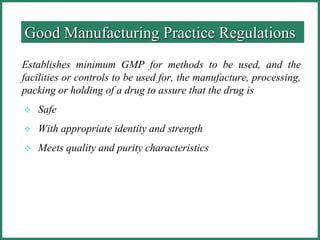
Good Manufacturing Practice Regulations
Establishes minimum GMP for methods to be used, and the
facilities or controls to be used for, the manufacture, processing,
packing or holding of a drug to assure that the drug is
 Safe
 With appropriate identity and strength
 Meets quality and purity characteristics
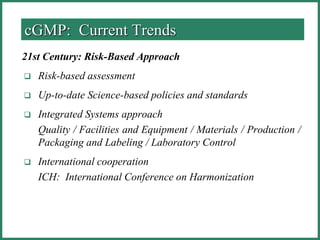
cGMP: Current Trends
21st Century: Risk-Based Approach
 Risk-based assessment
 Up-to-date Science-based policies and standards
 Integrated Systems approach
Quality / Facilities and Equipment / Materials / Production /
Packaging and Labeling / Laboratory Control
 International cooperation
ICH: International Conference on Harmonization
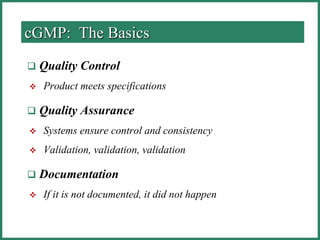
cGMP: The Basics
 Quality Control
 Product meets specifications
 Quality Assurance
 Systems ensure control and consistency
 Validation, validation, validation
 Documentation
 If it is not documented, it did not happen
cGMP: Raw Materials
 Active ingredients
 Excipients
 Audit suppliers on regular basis
 Before entering into contract, review regulatory history
 Monitor regulatory compliance
 Test incoming raw material
cGMP: Buildings and Facilities
 Separate or defined areas as are necessary to
prevent contamination or mix-ups
 Air filtration systems (HVAC) in production areas
 Sanitation
cGMP: Production and Process Controls
Written production and process control procedures shall be
followed in manufacturing and shall be documented at the time
of performance.
Any deviation from these procedures shall be recorded and
explained or justified.
(“SOPs”)
cGMP: In Process Testing
 Must have written procedures and testing of product
while being manufactured to assure batch uniformity and
integrity
 Control procedures shall be established to monitor output
and to validate manufacturing processes that could cause
variability
 To assure that a drug
product meets applicable
standards of identity,
strength, quality and
purity at the time of use, it
shall bear an expiration
date determined by
appropriate stability
testing described in
Section 211.166.
 Expiration dates shall be
related to any storage
conditions stated on the
labeling, as determined by
stability studies described
in Section 211.166.
cGMP: Expiration Dating
 Company must have written procedures designed to assure
that correct labels, labeling and packaging materials are
used for drug products; such written procedures shall be
followed.
 Label mix ups have been a major reason for drug product
recalls.
cGMP: Packaging and Labeling Operations
Testing and release for distribution
 For each batch of drug product, there shall be laboratory
determination of satisfactory conformance to final
specifications for the drug product, including the identity and
strength of each active ingredient prior to release.
 There shall be appropriate laboratory testing, as necessary,
of each batch required to be free of objectionable
microorganisms.
cGMP: Laboratory Controls
A written testing program designed to assess stability
characteristics is required.
Stability testing results must be used in determining
storage conditions and expiration dates.
cGMP: Stability Testing
Production and control records shall be reviewed and approved
by the quality control unit to determine compliance with all
established, approved written procedures before a batch is
released or distributed.
 Product Impact Assessment
 Trend Analysis
 Distributed Product
cGMP: Production Record Review
Any unexplained discrepancy or the failure of a batch or
any of its components to meet any of its specifications must
be investigated whether or not the batch has already been
distributed.
 Investigate other batches of same drug product
 Investigate other drug products that may have been
associated with the specific failure or discrepancy
 Written record of investigation
cGMP: Deviation Investigations
Documenting the Investigation is Critical
 Hypotheses should be scientifically based
 Subject matter experts should be consulted throughout the
investigation, including the initial identification of hypotheses
 Once a hypothesis is identified, it must be investigated
 All hypotheses should be validated or invalidated
cGMP: Deviation Investigations (cont….)
Corrective and Preventative Action Program
 As part of deviation investigations...
 Root cause identification and definitive corrective actions
• Company Program / System should audit:
– Timeliness of corrective / preventative actions
– Effectiveness of actions
– Documentation
• Example:
– Environmental monitoring/Cleaning
cGMP: Deviation Investigations (cont….)
Corrective and Preventative Action Program (cont…)
 After an FDA inspection...
 Establish scientifically sound corrective and preventative actions
Realistic timeframes
 Ensure compliance with commitments to FDA
• Systems
• Specific Issues
E.g., Change Control / Training
cGMP: Deviation Investigations (cont….)
Quality control unit “shall have the responsibility and authority to
approve or reject all components, drug product containers,
closures, in-process materials, packaging material, labeling, and
drug products, and the authority to review production records to
assure that no errors have occurred or, if errors have occurred,
that they have been fully investigated.
The quality control unit shall be responsible for approving or
rejecting drug products manufactured, processed, packed, or held
under contract by another company.”
cGMP: Responsibility and Authority of
Quality Control
 Written procedures describing the handling of all
written and oral complaints
 Review by Quality Control unit
 Possible failure to meet any specification
 Determine need for deviation investigation
 Adverse Drug Experience report assessment
 Documentation of complaint and investigation or
reason for not investigating
cGMP: Complaints
 Contemporaneous documentation critical
 Laboratory and production records
 Trending analysis
 Data Integrity
 Internal review : OOS results, complaints, R&D
 External review: FDA inspections, business deals (due
diligence), and products liability cases
cGMP: Records and Reports
 Field Alert Reports
 Labeling
 Failure to meet specifications — STABILITY FAILURES
 Within 3 working days of receipt
 Warner Lambert criminal case
 Adverse Drug Experience Reports
 ASAP but no later than 15 calendar days of initial receipt
 Foreign and domestic
 Recall Procedures and Preparation
cGMP: Reports (cont….)
 Independent Audit Group
 Resources
 Authority
 Global Approach - Harmonization of Quality Standards
 Audit priority systems / specific issues
 Follow-up audits
cGMP: Auditing
 Get the facility design right from the start
 Validate processes
 Write good Procedures and follow
 Identify who does what
 Keep good records
 Train and develop staff
 Practice good hygiene
 Maintain facilities and equipment
 Design quality into the whole product life cycle
 Perform regular audits
Golden Rules of GMP
 QC: Quality control; separation of production and quality
control (test of a single item)
 QA: Quality assurance; introduction of a statistical approach
to quality control, a broader quality approach
 QM: Quality management; understanding quality as a general
approach, with involvement of (nearly) all parts of a company
 TQM: Total quality management; broadest quality approach,
integrates all parts of a company, including safety,
environmental protection …
Understanding ‘quality in the 20th century (2/2)
The manufacturer shall establish and implement an
effective pharmaceutical quality assurance system,
involving the active participation of the management
and personnel of the different services involved.
 You must have a system.
 The system must be GMP compliant (pharmaceuticals !).
 Use the tools and the methodology of ISO and TQM to add to
your GMP system in order to gain the utmost benefit !
 A well designed and maintained QA system will allow you
to relax … from time to time.
ISO or GMP ?
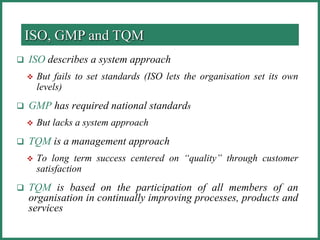
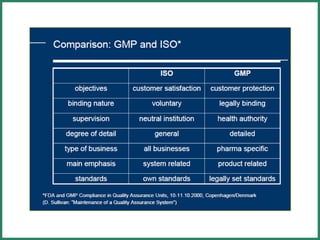
 ISO describes a system approach
 But fails to set standards (ISO lets the organisation set its own
levels)
 GMP has required national standards
 But lacks a system approach
 TQM is a management approach
 To long term success centered on “quality” through customer
satisfaction
 TQM is based on the participation of all members of an
organisation in continually improving processes, products and
services
ISO, GMP and TQM
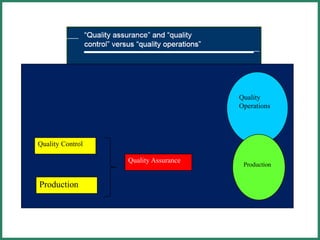
Quality Control
Production
Quality Assurance
Quality
Operations
Production
Raw Material
Processing
Equipments
Manufacturing Plant
Operators
Environment
Manufacturing
In Process
Testing
Finish Product
Packaging
Storage
Dispatch
Customer
TOP Management
Statistical Analysis
Strict CAPA
Failure Analysis
APR
APQR
Deviation Management
Change Control
OOS Management
Customer Complaint
Validation
 Man
 Material
 Machinery
 Manuals/Methodology ( SOP)
 Motivation
The 5 M’s of Quality
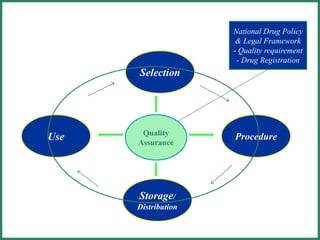
Quality
Assurance
ProcedureUse
Storage/
Distribution
Selection
National Drug Policy
& Legal Framework
- Quality requirement
- Drug Registration
Business
• Establish if the company is
manufacturer or wholesaler;
• Assess the size of business in
terms of staff. Capital value,
Sales turnover. etc.
Manufacturing
• Ensure GMP compliance
• WHO Certification can be
used;
• Crosscheck with QA
system description
Quality
• Evaluate QA System:
• GMP requires companies to
have QC laboratories
Product
• Formulate decision from
regulatory status of a product
with well- established DRS;
• WHO Certification Scheme;
- Therapeutic equivalence
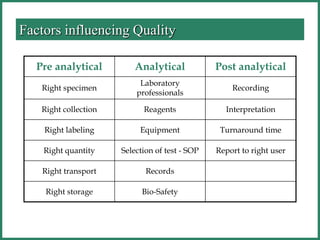
Pre analytical Analytical Post analytical
Right specimen
Laboratory
professionals
Recording
Right collection Reagents Interpretation
Right labeling Equipment Turnaround time
Right quantity Selection of test - SOP Report to right user
Right transport Records
Right storage Bio-Safety
Factors influencing Quality
There shall be a quality control unit that shall have the
responsibility and authority to approve or reject all components,
drug product containers, closures, in-process materials,
packaging material, labelling, and drug products, and the
authority to review production records to assure that no errors
have occurred or, if errors have occurred, that they have been
fully investigated.
The quality control unit shall be responsible for approving or
rejecting drug products manufactured, processed, packed, or
held under contract by another company.
FDA Requirements
 Unrealistic Commitments
 Process Execution
 Poorly Executed Unit Processes
 Inadequate Development Work
 Process Development
 Inadequate Batch Records
 Process Validation
 Data Integrity
 Supply Chain
 Facilities
 Quality System
Challanges
The paradigms are changing, the focus
is shifting and changes are inevitable
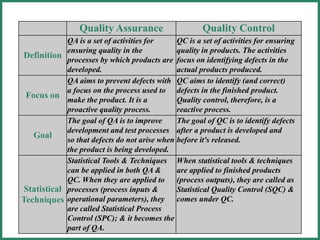
Quality Assurance Quality Control
Definition
QA is a set of activities for
ensuring quality in the
processes by which products are
developed.
QC is a set of activities for ensuring
quality in products. The activities
focus on identifying defects in the
actual products produced.
Focus on
QA aims to prevent defects with
a focus on the process used to
make the product. It is a
proactive quality process.
QC aims to identify (and correct)
defects in the finished product.
Quality control, therefore, is a
reactive process.
Goal
The goal of QA is to improve
development and test processes
so that defects do not arise when
the product is being developed.
The goal of QC is to identify defects
after a product is developed and
before it's released.
Statistical
Techniques
Statistical Tools & Techniques
can be applied in both QA &
QC. When they are applied to
processes (process inputs &
operational parameters), they
are called Statistical Process
Control (SPC); & it becomes the
part of QA.
When statistical tools & techniques
are applied to finished products
(process outputs), they are called as
Statistical Quality Control (SQC) &
comes under QC.
What
Prevention of quality problems
through planned and
systematic activities including
documentation.
The activities or techniques used to
achieve and maintain the product
quality, process and service.
How
Establish a good quality
management system and the
assessment of its adequacy &
conformance audit of the
operation system & the review
of the system itself.
Finding & eliminating sources of
quality problems through tools &
equipment so that customer's
requirements are continually met.
Example
Verification is an example of
QA
Validation/Software Testing is an
example of QC
Responsibility
Everyone on the team involved
in developing the product is
responsible for quality
assurance.
Quality control is usually the
responsibility of a specific team that
tests the product for defects.
“Quality is never an accident;
it is always the result of intelligent effort.”
- John Ruskin
Contact : hardik.mistry@hester.in

Pharmaceutical Good Manufacturing Practices

  • 2.
    Good Manufacturing PracticeRegulations Establishes minimum GMP for methods to be used, and the facilities or controls to be used for, the manufacture, processing, packing or holding of a drug to assure that the drug is  Safe  With appropriate identity and strength  Meets quality and purity characteristics
  • 3.
    cGMP: Current Trends 21stCentury: Risk-Based Approach  Risk-based assessment  Up-to-date Science-based policies and standards  Integrated Systems approach Quality / Facilities and Equipment / Materials / Production / Packaging and Labeling / Laboratory Control  International cooperation ICH: International Conference on Harmonization
  • 4.
    cGMP: The Basics Quality Control  Product meets specifications  Quality Assurance  Systems ensure control and consistency  Validation, validation, validation  Documentation  If it is not documented, it did not happen
  • 5.
    cGMP: Raw Materials Active ingredients  Excipients  Audit suppliers on regular basis  Before entering into contract, review regulatory history  Monitor regulatory compliance  Test incoming raw material
  • 6.
    cGMP: Buildings andFacilities  Separate or defined areas as are necessary to prevent contamination or mix-ups  Air filtration systems (HVAC) in production areas  Sanitation
  • 7.
    cGMP: Production andProcess Controls Written production and process control procedures shall be followed in manufacturing and shall be documented at the time of performance. Any deviation from these procedures shall be recorded and explained or justified. (“SOPs”)
  • 8.
    cGMP: In ProcessTesting  Must have written procedures and testing of product while being manufactured to assure batch uniformity and integrity  Control procedures shall be established to monitor output and to validate manufacturing processes that could cause variability
  • 9.
     To assurethat a drug product meets applicable standards of identity, strength, quality and purity at the time of use, it shall bear an expiration date determined by appropriate stability testing described in Section 211.166.  Expiration dates shall be related to any storage conditions stated on the labeling, as determined by stability studies described in Section 211.166. cGMP: Expiration Dating
  • 10.
     Company musthave written procedures designed to assure that correct labels, labeling and packaging materials are used for drug products; such written procedures shall be followed.  Label mix ups have been a major reason for drug product recalls. cGMP: Packaging and Labeling Operations
  • 11.
    Testing and releasefor distribution  For each batch of drug product, there shall be laboratory determination of satisfactory conformance to final specifications for the drug product, including the identity and strength of each active ingredient prior to release.  There shall be appropriate laboratory testing, as necessary, of each batch required to be free of objectionable microorganisms. cGMP: Laboratory Controls
  • 12.
    A written testingprogram designed to assess stability characteristics is required. Stability testing results must be used in determining storage conditions and expiration dates. cGMP: Stability Testing
  • 13.
    Production and controlrecords shall be reviewed and approved by the quality control unit to determine compliance with all established, approved written procedures before a batch is released or distributed.  Product Impact Assessment  Trend Analysis  Distributed Product cGMP: Production Record Review
  • 14.
    Any unexplained discrepancyor the failure of a batch or any of its components to meet any of its specifications must be investigated whether or not the batch has already been distributed.  Investigate other batches of same drug product  Investigate other drug products that may have been associated with the specific failure or discrepancy  Written record of investigation cGMP: Deviation Investigations
  • 15.
    Documenting the Investigationis Critical  Hypotheses should be scientifically based  Subject matter experts should be consulted throughout the investigation, including the initial identification of hypotheses  Once a hypothesis is identified, it must be investigated  All hypotheses should be validated or invalidated cGMP: Deviation Investigations (cont….)
  • 16.
    Corrective and PreventativeAction Program  As part of deviation investigations...  Root cause identification and definitive corrective actions • Company Program / System should audit: – Timeliness of corrective / preventative actions – Effectiveness of actions – Documentation • Example: – Environmental monitoring/Cleaning cGMP: Deviation Investigations (cont….)
  • 17.
    Corrective and PreventativeAction Program (cont…)  After an FDA inspection...  Establish scientifically sound corrective and preventative actions Realistic timeframes  Ensure compliance with commitments to FDA • Systems • Specific Issues E.g., Change Control / Training cGMP: Deviation Investigations (cont….)
  • 18.
    Quality control unit“shall have the responsibility and authority to approve or reject all components, drug product containers, closures, in-process materials, packaging material, labeling, and drug products, and the authority to review production records to assure that no errors have occurred or, if errors have occurred, that they have been fully investigated. The quality control unit shall be responsible for approving or rejecting drug products manufactured, processed, packed, or held under contract by another company.” cGMP: Responsibility and Authority of Quality Control
  • 19.
     Written proceduresdescribing the handling of all written and oral complaints  Review by Quality Control unit  Possible failure to meet any specification  Determine need for deviation investigation  Adverse Drug Experience report assessment  Documentation of complaint and investigation or reason for not investigating cGMP: Complaints
  • 20.
     Contemporaneous documentationcritical  Laboratory and production records  Trending analysis  Data Integrity  Internal review : OOS results, complaints, R&D  External review: FDA inspections, business deals (due diligence), and products liability cases cGMP: Records and Reports
  • 21.
     Field AlertReports  Labeling  Failure to meet specifications — STABILITY FAILURES  Within 3 working days of receipt  Warner Lambert criminal case  Adverse Drug Experience Reports  ASAP but no later than 15 calendar days of initial receipt  Foreign and domestic  Recall Procedures and Preparation cGMP: Reports (cont….)
  • 22.
     Independent AuditGroup  Resources  Authority  Global Approach - Harmonization of Quality Standards  Audit priority systems / specific issues  Follow-up audits cGMP: Auditing
  • 24.
     Get thefacility design right from the start  Validate processes  Write good Procedures and follow  Identify who does what  Keep good records  Train and develop staff  Practice good hygiene  Maintain facilities and equipment  Design quality into the whole product life cycle  Perform regular audits Golden Rules of GMP
  • 27.
     QC: Qualitycontrol; separation of production and quality control (test of a single item)  QA: Quality assurance; introduction of a statistical approach to quality control, a broader quality approach  QM: Quality management; understanding quality as a general approach, with involvement of (nearly) all parts of a company  TQM: Total quality management; broadest quality approach, integrates all parts of a company, including safety, environmental protection … Understanding ‘quality in the 20th century (2/2)
  • 28.
    The manufacturer shallestablish and implement an effective pharmaceutical quality assurance system, involving the active participation of the management and personnel of the different services involved.
  • 29.
     You musthave a system.  The system must be GMP compliant (pharmaceuticals !).  Use the tools and the methodology of ISO and TQM to add to your GMP system in order to gain the utmost benefit !  A well designed and maintained QA system will allow you to relax … from time to time. ISO or GMP ?
  • 30.
     ISO describesa system approach  But fails to set standards (ISO lets the organisation set its own levels)  GMP has required national standards  But lacks a system approach  TQM is a management approach  To long term success centered on “quality” through customer satisfaction  TQM is based on the participation of all members of an organisation in continually improving processes, products and services ISO, GMP and TQM
  • 32.
  • 33.
    Raw Material Processing Equipments Manufacturing Plant Operators Environment Manufacturing InProcess Testing Finish Product Packaging Storage Dispatch Customer TOP Management Statistical Analysis Strict CAPA Failure Analysis APR APQR Deviation Management Change Control OOS Management Customer Complaint Validation
  • 34.
     Man  Material Machinery  Manuals/Methodology ( SOP)  Motivation The 5 M’s of Quality
  • 35.
    Quality Assurance ProcedureUse Storage/ Distribution Selection National Drug Policy &Legal Framework - Quality requirement - Drug Registration
  • 36.
    Business • Establish ifthe company is manufacturer or wholesaler; • Assess the size of business in terms of staff. Capital value, Sales turnover. etc. Manufacturing • Ensure GMP compliance • WHO Certification can be used; • Crosscheck with QA system description Quality • Evaluate QA System: • GMP requires companies to have QC laboratories Product • Formulate decision from regulatory status of a product with well- established DRS; • WHO Certification Scheme; - Therapeutic equivalence
  • 37.
    Pre analytical AnalyticalPost analytical Right specimen Laboratory professionals Recording Right collection Reagents Interpretation Right labeling Equipment Turnaround time Right quantity Selection of test - SOP Report to right user Right transport Records Right storage Bio-Safety Factors influencing Quality
  • 38.
    There shall bea quality control unit that shall have the responsibility and authority to approve or reject all components, drug product containers, closures, in-process materials, packaging material, labelling, and drug products, and the authority to review production records to assure that no errors have occurred or, if errors have occurred, that they have been fully investigated. The quality control unit shall be responsible for approving or rejecting drug products manufactured, processed, packed, or held under contract by another company. FDA Requirements
  • 39.
     Unrealistic Commitments Process Execution  Poorly Executed Unit Processes  Inadequate Development Work  Process Development  Inadequate Batch Records  Process Validation  Data Integrity  Supply Chain  Facilities  Quality System Challanges
  • 40.
    The paradigms arechanging, the focus is shifting and changes are inevitable
  • 41.
    Quality Assurance QualityControl Definition QA is a set of activities for ensuring quality in the processes by which products are developed. QC is a set of activities for ensuring quality in products. The activities focus on identifying defects in the actual products produced. Focus on QA aims to prevent defects with a focus on the process used to make the product. It is a proactive quality process. QC aims to identify (and correct) defects in the finished product. Quality control, therefore, is a reactive process. Goal The goal of QA is to improve development and test processes so that defects do not arise when the product is being developed. The goal of QC is to identify defects after a product is developed and before it's released. Statistical Techniques Statistical Tools & Techniques can be applied in both QA & QC. When they are applied to processes (process inputs & operational parameters), they are called Statistical Process Control (SPC); & it becomes the part of QA. When statistical tools & techniques are applied to finished products (process outputs), they are called as Statistical Quality Control (SQC) & comes under QC.
  • 42.
    What Prevention of qualityproblems through planned and systematic activities including documentation. The activities or techniques used to achieve and maintain the product quality, process and service. How Establish a good quality management system and the assessment of its adequacy & conformance audit of the operation system & the review of the system itself. Finding & eliminating sources of quality problems through tools & equipment so that customer's requirements are continually met. Example Verification is an example of QA Validation/Software Testing is an example of QC Responsibility Everyone on the team involved in developing the product is responsible for quality assurance. Quality control is usually the responsibility of a specific team that tests the product for defects.
  • 43.
    “Quality is neveran accident; it is always the result of intelligent effort.” - John Ruskin Contact : hardik.mistry@hester.in