Welcome to MY
Presentation
Fareha Sultana Prema
session:2018-2019
Department of Chemistry
Comilla University
Presented by-
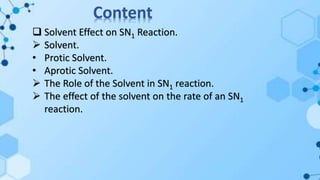
Content
 Solvent Effect on SN1 Reaction.
 Solvent.
• Protic Solvent.
• Aprotic Solvent.
 The Role of the Solvent in SN1 reaction.
 The effect of the solvent on the rate of an SN1
reaction.
 Solvent
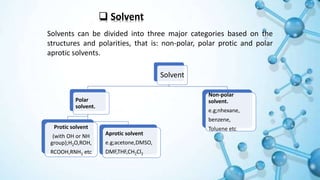
Solvents can be divided into three major categories based on the
structures and polarities, that is: non-polar, polar protic and polar
aprotic solvents.
Solvent
Polar
solvent.
Protic solvent
(with OH or NH
group);H2O,ROH,
RCOOH,RNH2 etc
Aprotic solvent
e.g;acetone,DMSO,
DMF,THF,CH2Cl2
Non-polar
solvent.
e.g;nhexane,
benzene,
Toluene etc
 Aprotic Solvent
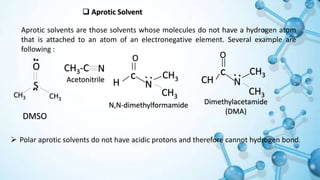
Aprotic solvents are those solvents whose molecules do not have a hydrogen atom
that is attached to an atom of an electronegative element. Several example are
following :
O
c
H N
CH3
CH3
N,N-dimethylformamide
O
c
CH N
CH3
CH3
Dimethylacetamide
(DMA)
CH3-C N
Acetonitrile
S
O
CH3 CH3
DMSO
 Polar aprotic solvents do not have acidic protons and therefore cannot hydrogen bond.
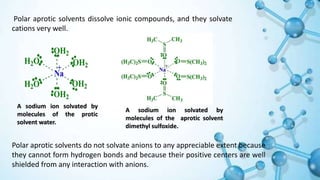
Polar aprotic solvents dissolve ionic compounds, and they solvate
cations very well.
A sodium ion solvated by
molecules of the protic
solvent water.
A sodium ion solvated by
molecules of the aprotic solvent
dimethyl sulfoxide.
Polar aprotic solvents do not solvate anions to any appreciable extent because
they cannot form hydrogen bonds and because their positive centers are well
shielded from any interaction with anions.
 Protic Solvent
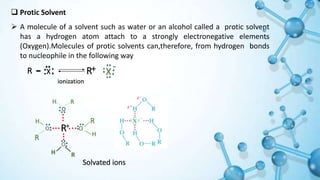
 A molecule of a solvent such as water or an alcohol called a protic solvent
has a hydrogen atom attach to a strongly electronegative elements
(Oxygen).Molecules of protic solvents can,therefore, from hydrogen bonds
to nucleophile in the following way
- + -
R X R X
ionization
R+ O
O
O
H R
R
H
O
R
H
H R
Solvated ions
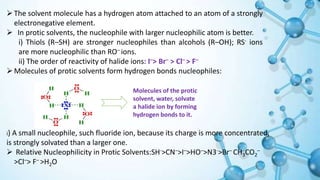
The solvent molecule has a hydrogen atom attached to an atom of a strongly
electronegative element.
 In protic solvents, the nucleophile with larger nucleophilic atom is better.
i) Thiols (R–SH) are stronger nucleophiles than alcohols (R–OH); RS- ions
are more nucleophilic than RO– ions.
ii) The order of reactivity of halide ions: I–> Br– > Cl– > F–
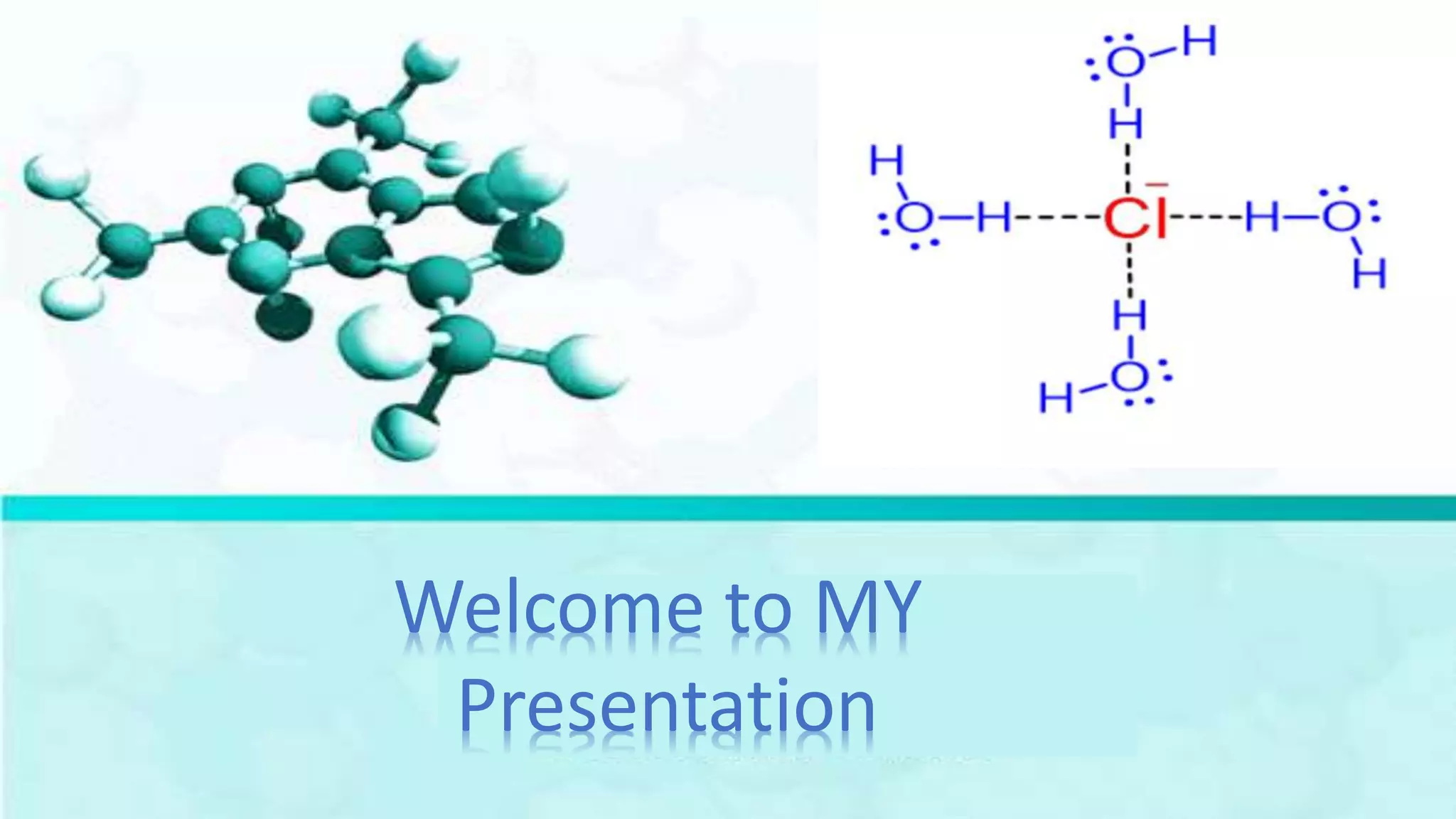
Molecules of protic solvents form hydrogen bonds nucleophiles:
Molecules of the protic
solvent, water, solvate
a halide ion by forming
hydrogen bonds to it.
i) A small nucleophile, such fluoride ion, because its charge is more concentrated,
is strongly solvated than a larger one.
 Relative Nucleophilicity in Protic Solvents:SH->CN–>I–>HO–>N3->Br– CH3CO2
–
>Cl–> F– >H2O
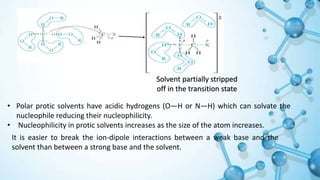
Solvent partially stripped
off in the transition state
• Polar protic solvents have acidic hydrogens (O—H or N—H) which can solvate the
nucleophile reducing their nucleophilicity.
• Nucleophilicity in protic solvents increases as the size of the atom increases.
It is easier to break the ion-dipole interactions between a weak base and the
solvent than between a strong base and the solvent.
 The role of the solvent in Sn1 reaction
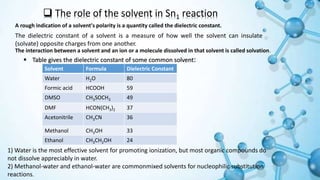
The dielectric constant of a solvent is a measure of how well the solvent can insulate
(solvate) opposite charges from one another.
The interaction between a solvent and an ion or a molecule dissolved in that solvent is called solvation.
A rough indication of a solvent's polarity is a quantity called the dielectric constant.
 Table gives the dielectric constant of some common solvent:
Solvent Formula Dielectric Constant
Water H2O 80
Formic acid HCOOH 59
DMSO CH3SOCH3 49
DMF HCON(CH3)2 37
Acetonitrile CH3CN 36
Methanol CH3OH 33
Ethanol CH3CH2OH 24
1) Water is the most effective solvent for promoting ionization, but most organic compounds do
not dissolve appreciably in water.
2) Methanol-water and ethanol-water are commonmixed solvents for nucleophilic substitution
reactions.
 The Effect of the Solvent on the Rate of an SN1 Reaction
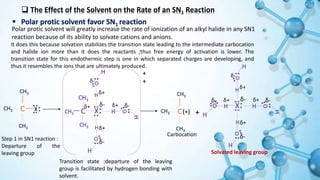
Polar protic solvent will greatly increase the rate of ionization of an alkyl halide in any SN1
reaction because of its ability to solvate cations and anions.
It does this because solvation stabilizes the transition state leading to the intermediate carbocation
and halide ion more than it does the reactants ;thus free energy of activation is lower. The
transition state for this endothermic step is one in which separated charges are developing, and
thus it resembles the ions that are ultimately produced.
 Polar protic solvent favor SN1 reaction
C
CH3
CH3
CH3
X C X
H
δ-
δ+
H
H
O
H
δ-
O
H
δ-
δ- δ+
δ+
δ+
CH3
CH3
CH3
+
+
C
CH3
CH3
CH3
(+)
X
H
δ-
H
H
O
H
δ-
O
H
δ-
δ- δ+
δ+
δ+
H
O
H
δ+
δ-
+
Step 1 in SN1 reaction :
Departure of the
leaving group
Transition state :departure of the leaving
group is facilitated by hydrogen bonding with
solvent.
Carbocation
Solvated leaving group
solvent effect on SN1 reaction.pptx

solvent effect on SN1 reaction.pptx

  • 1.
  • 2.
    Fareha Sultana Prema session:2018-2019 Departmentof Chemistry Comilla University Presented by-
  • 3.
    Content  Solvent Effecton SN1 Reaction.  Solvent. • Protic Solvent. • Aprotic Solvent.  The Role of the Solvent in SN1 reaction.  The effect of the solvent on the rate of an SN1 reaction.
  • 4.
     Solvent Solvents canbe divided into three major categories based on the structures and polarities, that is: non-polar, polar protic and polar aprotic solvents. Solvent Polar solvent. Protic solvent (with OH or NH group);H2O,ROH, RCOOH,RNH2 etc Aprotic solvent e.g;acetone,DMSO, DMF,THF,CH2Cl2 Non-polar solvent. e.g;nhexane, benzene, Toluene etc
  • 5.
     Aprotic Solvent Aproticsolvents are those solvents whose molecules do not have a hydrogen atom that is attached to an atom of an electronegative element. Several example are following : O c H N CH3 CH3 N,N-dimethylformamide O c CH N CH3 CH3 Dimethylacetamide (DMA) CH3-C N Acetonitrile S O CH3 CH3 DMSO  Polar aprotic solvents do not have acidic protons and therefore cannot hydrogen bond.
  • 6.
    Polar aprotic solventsdissolve ionic compounds, and they solvate cations very well. A sodium ion solvated by molecules of the protic solvent water. A sodium ion solvated by molecules of the aprotic solvent dimethyl sulfoxide. Polar aprotic solvents do not solvate anions to any appreciable extent because they cannot form hydrogen bonds and because their positive centers are well shielded from any interaction with anions.
  • 7.
     Protic Solvent A molecule of a solvent such as water or an alcohol called a protic solvent has a hydrogen atom attach to a strongly electronegative elements (Oxygen).Molecules of protic solvents can,therefore, from hydrogen bonds to nucleophile in the following way - + - R X R X ionization R+ O O O H R R H O R H H R Solvated ions
  • 8.
    The solvent moleculehas a hydrogen atom attached to an atom of a strongly electronegative element.  In protic solvents, the nucleophile with larger nucleophilic atom is better. i) Thiols (R–SH) are stronger nucleophiles than alcohols (R–OH); RS- ions are more nucleophilic than RO– ions. ii) The order of reactivity of halide ions: I–> Br– > Cl– > F– Molecules of protic solvents form hydrogen bonds nucleophiles: Molecules of the protic solvent, water, solvate a halide ion by forming hydrogen bonds to it. i) A small nucleophile, such fluoride ion, because its charge is more concentrated, is strongly solvated than a larger one.  Relative Nucleophilicity in Protic Solvents:SH->CN–>I–>HO–>N3->Br– CH3CO2 – >Cl–> F– >H2O
  • 9.
    Solvent partially stripped offin the transition state • Polar protic solvents have acidic hydrogens (O—H or N—H) which can solvate the nucleophile reducing their nucleophilicity. • Nucleophilicity in protic solvents increases as the size of the atom increases. It is easier to break the ion-dipole interactions between a weak base and the solvent than between a strong base and the solvent.
  • 10.
     The roleof the solvent in Sn1 reaction The dielectric constant of a solvent is a measure of how well the solvent can insulate (solvate) opposite charges from one another. The interaction between a solvent and an ion or a molecule dissolved in that solvent is called solvation. A rough indication of a solvent's polarity is a quantity called the dielectric constant.  Table gives the dielectric constant of some common solvent: Solvent Formula Dielectric Constant Water H2O 80 Formic acid HCOOH 59 DMSO CH3SOCH3 49 DMF HCON(CH3)2 37 Acetonitrile CH3CN 36 Methanol CH3OH 33 Ethanol CH3CH2OH 24 1) Water is the most effective solvent for promoting ionization, but most organic compounds do not dissolve appreciably in water. 2) Methanol-water and ethanol-water are commonmixed solvents for nucleophilic substitution reactions.
  • 11.
     The Effectof the Solvent on the Rate of an SN1 Reaction Polar protic solvent will greatly increase the rate of ionization of an alkyl halide in any SN1 reaction because of its ability to solvate cations and anions. It does this because solvation stabilizes the transition state leading to the intermediate carbocation and halide ion more than it does the reactants ;thus free energy of activation is lower. The transition state for this endothermic step is one in which separated charges are developing, and thus it resembles the ions that are ultimately produced.  Polar protic solvent favor SN1 reaction C CH3 CH3 CH3 X C X H δ- δ+ H H O H δ- O H δ- δ- δ+ δ+ δ+ CH3 CH3 CH3 + + C CH3 CH3 CH3 (+) X H δ- H H O H δ- O H δ- δ- δ+ δ+ δ+ H O H δ+ δ- + Step 1 in SN1 reaction : Departure of the leaving group Transition state :departure of the leaving group is facilitated by hydrogen bonding with solvent. Carbocation Solvated leaving group