11. Reactions of Alkyl Halides:
Nucleophilic Substitutions and
Eliminations
Based on McMurry’s Organic Chemistry, 6th
edition
Nucleophiles and Leaving Groups:
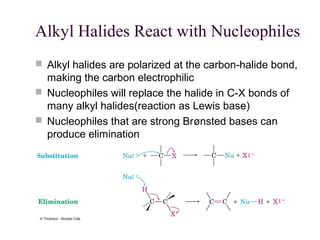
Alkyl Halides React with Nucleophiles
 Alkyl halides are polarized at the carbon-halide bond,
making the carbon electrophilic
 Nucleophiles will replace the halide in C-X bonds of
many alkyl halides(reaction as Lewis base)
 Nucleophiles that are strong Brønsted bases can
produce elimination
Reaction Kinetics
 The study of rates of reactions is called kinetics
 The order of a reaction is sum of the exponents of the
concentrations in the rate law – the first example is first
order, the second one second order.
NaOH + C
CH3
CH3
CH3 Br NaBr + C
CH3
CH3
CH3 OH
v = k[C4H9Br]
NaOH + NaBr +
v = k[CH3Br][NaOH]
CH3Br CH3OH
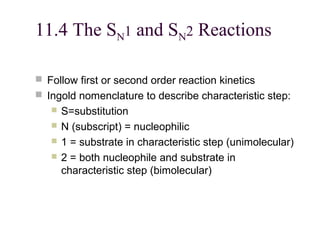
11.4 The SN1 and SN2 Reactions
 Follow first or second order reaction kinetics
 Ingold nomenclature to describe characteristic step:
 S=substitution
 N (subscript) = nucleophilic
 1 = substrate in characteristic step (unimolecular)
 2 = both nucleophile and substrate in
characteristic step (bimolecular)
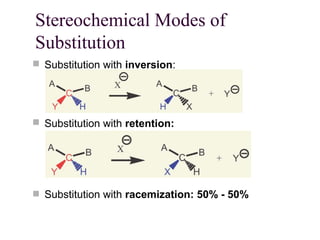
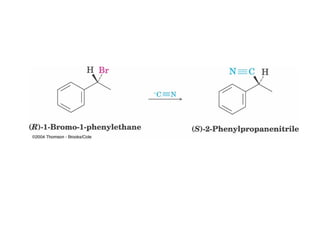
Stereochemical Modes of
Substitution
 Substitution with inversion:
 Substitution with retention:
 Substitution with racemization: 50% - 50%
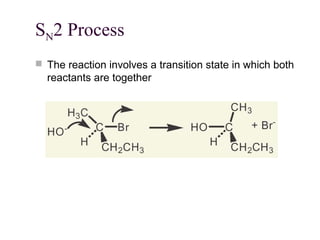
SN2 Process
 The reaction involves a transition state in which both
reactants are together
“Walden” Inversion
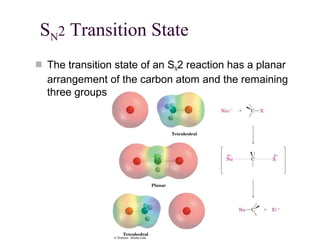
SN2 Transition State
 The transition state of an SN2 reaction has a planar
arrangement of the carbon atom and the remaining
three groups
Steric Effects on SN2 Reactions
The carbon atom in (a) bromomethane is readily accessible
resulting in a fast SN2 reaction. The carbon atoms in (b) bromoethane
(primary), (c) 2-bromopropane (secondary), and (d) 2-bromo-2-methylpropane
(tertiary) are successively more hindered, resulting in successively slower SN2
reactions.
Steric Hindrance Raises Transition
State Energy
 Steric effects destabilize transition states
 Severe steric effects can also destabilize ground
state
Very hindered
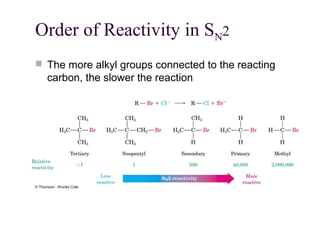
Order of Reactivity in SN2
 The more alkyl groups connected to the reacting
carbon, the slower the reaction
11.5 Characteristics of the SN2
Reaction
 Sensitive to steric effects
 Methyl halides are most reactive
 Primary are next most reactive
 Secondary might react
 Tertiary are unreactive by this path
 No reaction at C=C (vinyl halides)
The SN1 Reaction
 Tertiary alkyl halides react rapidly in protic solvents
by a mechanism that involves departure of the
leaving group prior to addition of the nucleophile
 Called an SN1 reaction – occurs in two distinct steps
while SN2 occurs with both events in same step
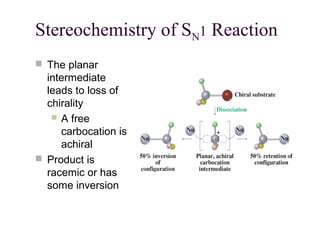
Stereochemistry of SN1 Reaction
 The planar
intermediate
leads to loss of
chirality
 A free
carbocation is
achiral
 Product is
racemic or has
some inversion
SN1 in Reality
 Carbocation is biased to react on side
opposite leaving group
 Suggests reaction occurs with carbocation
loosely associated with leaving group during
nucleophilic addition
Effects of Ion Pair Formation
 If leaving group remains
associated, then
product has more
inversion than retention
 Product is only partially
racemic with more
inversion than retention
 Associated carbocation
and leaving group is an
ion pair
SN1 Energy Diagram
 Rate-determining step is
formation of carbocation
Step through highest energy
point is rate-limiting (k1 in
forward direction)k1 k2
k-1
V = k[RX]
11.9 Characteristics of the SN1
Reaction
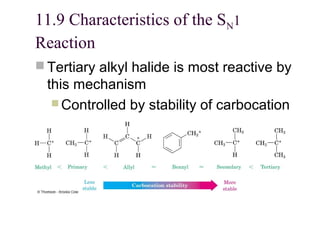
 Tertiary alkyl halide is most reactive by
this mechanism
 Controlled by stability of carbocation
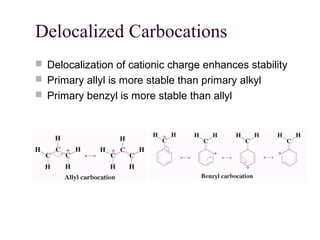
Delocalized Carbocations
 Delocalization of cationic charge enhances stability
 Primary allyl is more stable than primary alkyl
 Primary benzyl is more stable than allyl
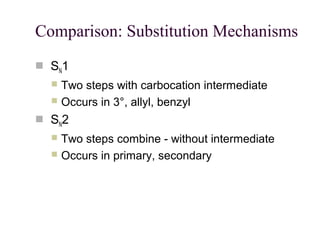
Comparison: Substitution Mechanisms
 SN1
 Two steps with carbocation intermediate
 Occurs in 3°, allyl, benzyl
 SN2
 Two steps combine - without intermediate
 Occurs in primary, secondary
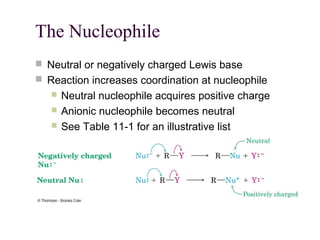
The Nucleophile
 Neutral or negatively charged Lewis base
 Reaction increases coordination at nucleophile
 Neutral nucleophile acquires positive charge
 Anionic nucleophile becomes neutral
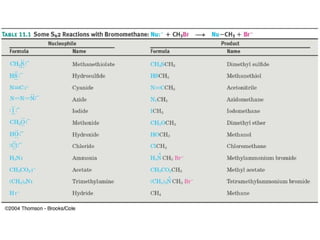
 See Table 11-1 for an illustrative list
Relative Reactivity of Nucleophiles
 Depends on reaction and conditions
 More basic nucleophiles react faster (for similar
structures. See Table 11-2)
 Better nucleophiles are lower in a column of the
periodic table
 Anions are usually more reactive than neutrals
The Leaving Group
 A good leaving group reduces the barrier to a
reaction
 Stable anions that are weak bases are usually
excellent leaving groups and can delocalize charge
“Super” Leaving Groups
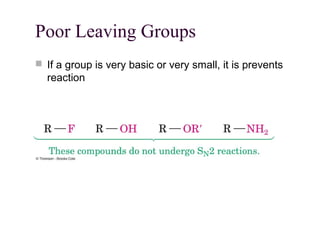
Poor Leaving Groups
 If a group is very basic or very small, it is prevents
reaction
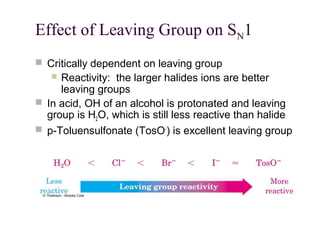
Effect of Leaving Group on SN1
 Critically dependent on leaving group
 Reactivity: the larger halides ions are better
leaving groups
 In acid, OH of an alcohol is protonated and leaving
group is H2O, which is still less reactive than halide
 p-Toluensulfonate (TosO-
) is excellent leaving group
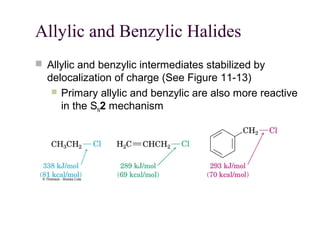
Allylic and Benzylic Halides
 Allylic and benzylic intermediates stabilized by
delocalization of charge (See Figure 11-13)
 Primary allylic and benzylic are also more reactive
in the SN2 mechanism
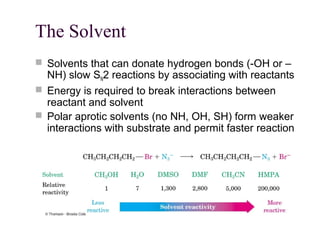
The Solvent
 Solvents that can donate hydrogen bonds (-OH or –
NH) slow SN2 reactions by associating with reactants
 Energy is required to break interactions between
reactant and solvent
 Polar aprotic solvents (no NH, OH, SH) form weaker
interactions with substrate and permit faster reaction
Polar Solvents Promote Ionization
 Polar, protic and unreactive Lewis base solvents
facilitate formation of R+
 Solvent polarity is measured as dielectric
polarization (P)
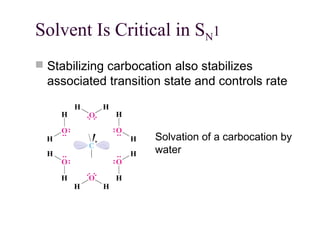
Solvent Is Critical in SN1
 Stabilizing carbocation also stabilizes
associated transition state and controls rate
Solvation of a carbocation by
water
Effects of Solvent on Energies
 Polar solvent stabilizes transition state and
intermediate more than reactant and product
Polar aprotic solvents
 Form dipoles that have well localized negative
sides, poorly defined positive sides.
 Examples: DMSO, HMPA (shown here)
+
-
+
+
O
P
N N NCH3
CH3
CH3
CH3
CH3
CH3
Common polar aprotic solvents
CH3
S
O
CH3
O
P
N
N
NCH3
CH3
CH3
CH3
CH3
CH3
CH
O
N
CH3
CH3
S
O O
dimethylsulfoxide (DMSO)
hexamethylphosphoramide (HMPA)
N,N-dimethylformamide (DMF)
sulfolane
+
-
++
+
-
++
+
-
++
+
-
++
Na
+
+
-
++
+
-
++
+
-
++
+
-
++
Cl
-
Polar aprotic solvents solvate cations well, anions poorly
good fit! bad fit!
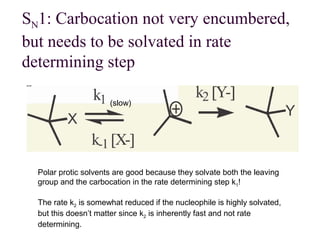
SN1: Carbocation not very encumbered,
but needs to be solvated in rate
determining step
Polar protic solvents are good because they solvate both the leaving
group and the carbocation in the rate determining step k1!
The rate k2 is somewhat reduced if the nucleophile is highly solvated,
but this doesn’t matter since k2 is inherently fast and not rate
determining.
(slow)
SN2: Things get tight if highly solvated
nucleophile tries to form pentacoordiante
transition state
Polar aprotic solvents favored! There is no carbocation to be solvated.
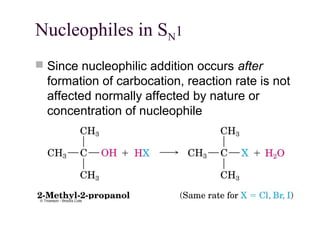
Nucleophiles in SN1
 Since nucleophilic addition occurs after
formation of carbocation, reaction rate is not
affected normally affected by nature or
concentration of nucleophile
11.10 Alkyl Halides: Elimination
 Elimination is an alternative pathway to substitution
 Opposite of addition
 Generates an alkene
 Can compete with substitution and decrease yield,
especially for SN1 processes
Zaitsev’s Rule for Elimination
Reactions (1875)
 In the elimination of HX from an alkyl halide, the more
highly substituted alkene product predominates
Mechanisms of Elimination
Reactions
 Ingold nomenclature: E – “elimination”
 E1: X-
leaves first to generate a carbocation
 a base abstracts a proton from the carbocation
 E2: Concerted transfer of a proton to a base and
departure of leaving group
11.11 The E2 Reaction Mechanism
 A proton is transferred to base as leaving group
begins to depart
 Transition state combines leaving of X and transfer of
H
 Product alkene forms stereospecifically
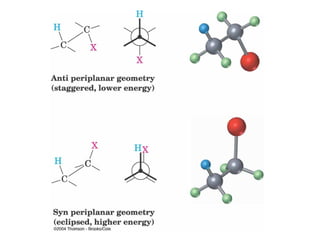
Geometry of Elimination – E2
 Antiperiplanar allows orbital overlap and minimizes
steric interactions
E2 Stereochemistry
 Overlap of the developing π orbital in the transition
state requires periplanar geometry, anti arrangement
Allows orbital overlap
Predicting Product
 E2 is stereospecific
 Meso-1,2-dibromo-1,2-diphenylethane with base
gives cis 1,2-diphenyl
 RR or SS 1,2-dibromo-1,2-diphenylethane gives trans
1,2-diphenyl
(E)-1bromo-1,2-diphenylethene
11.12 Elimination From Cyclohexanes
 Abstracted proton and leaving group should align
trans-diaxial to be anti periplanar (app) in
approaching transition state (see Figures 11-19 and
11-20)
 Equatorial groups are not in proper alignment
11.14 The E1 Reaction
 Competes with SN1 and E2 at 3° centers
 V = k [RX]
Stereochemistry of E1 Reactions
 E1 is not stereospecific and there is no requirement
for alignment
 Product has Zaitsev orientation because step that
controls product is loss of proton after formation of
carbocation
Comparing E1 and E2
 Strong base is needed for E2 but not for E1
 E2 is stereospecifc, E1 is not
 E1 gives Zaitsev orientation
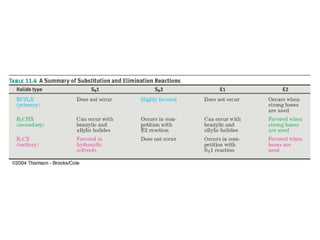
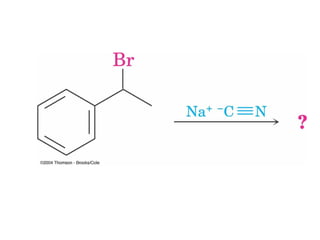
11.15 Summary of Reactivity: SN1,
SN2, E1, E2
 Alkyl halides undergo different reactions in
competition, depending on the reacting molecule and
the conditions
 Based on patterns, we can predict likely outcomes
Special cases, both SN1 and SN2
blocked (or exceedingly slow)
Br
Br
Br
CH3
CH3
CH3
CH2Br
Carbocation highly unstable, attack from behind blocked
Carbocation would be primary, attack from
behind difficult due to steric blockage
Carbocation can’t flatten out as required by sp2
hybridization, attack from behind blocked
Also: elimination not possible, can’t place double
bond at bridgehead in small cages (“Bredt’s rule”)
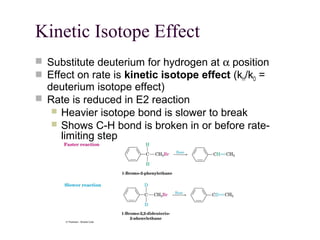
Kinetic Isotope Effect
 Substitute deuterium for hydrogen at α position
 Effect on rate is kinetic isotope effect (kH/kD =
deuterium isotope effect)
 Rate is reduced in E2 reaction
 Heavier isotope bond is slower to break
 Shows C-H bond is broken in or before rate-
limiting step
64
 www.ulm.edu/~junk/examkeys/pp230_10_ch
11.ppt
 31 januari 2010

Reaksi sn 1, sn-2, e-1, dan e-2.

  • 1.
    11. Reactions ofAlkyl Halides: Nucleophilic Substitutions and Eliminations Based on McMurry’s Organic Chemistry, 6th edition
  • 2.
  • 3.
    Alkyl Halides Reactwith Nucleophiles  Alkyl halides are polarized at the carbon-halide bond, making the carbon electrophilic  Nucleophiles will replace the halide in C-X bonds of many alkyl halides(reaction as Lewis base)  Nucleophiles that are strong Brønsted bases can produce elimination
  • 4.
    Reaction Kinetics  Thestudy of rates of reactions is called kinetics  The order of a reaction is sum of the exponents of the concentrations in the rate law – the first example is first order, the second one second order. NaOH + C CH3 CH3 CH3 Br NaBr + C CH3 CH3 CH3 OH v = k[C4H9Br] NaOH + NaBr + v = k[CH3Br][NaOH] CH3Br CH3OH
  • 5.
    11.4 The SN1and SN2 Reactions  Follow first or second order reaction kinetics  Ingold nomenclature to describe characteristic step:  S=substitution  N (subscript) = nucleophilic  1 = substrate in characteristic step (unimolecular)  2 = both nucleophile and substrate in characteristic step (bimolecular)
  • 6.
    Stereochemical Modes of Substitution Substitution with inversion:  Substitution with retention:  Substitution with racemization: 50% - 50%
  • 7.
    SN2 Process  Thereaction involves a transition state in which both reactants are together
  • 8.
  • 9.
    SN2 Transition State The transition state of an SN2 reaction has a planar arrangement of the carbon atom and the remaining three groups
  • 10.
    Steric Effects onSN2 Reactions The carbon atom in (a) bromomethane is readily accessible resulting in a fast SN2 reaction. The carbon atoms in (b) bromoethane (primary), (c) 2-bromopropane (secondary), and (d) 2-bromo-2-methylpropane (tertiary) are successively more hindered, resulting in successively slower SN2 reactions.
  • 11.
    Steric Hindrance RaisesTransition State Energy  Steric effects destabilize transition states  Severe steric effects can also destabilize ground state Very hindered
  • 12.
    Order of Reactivityin SN2  The more alkyl groups connected to the reacting carbon, the slower the reaction
  • 13.
    11.5 Characteristics ofthe SN2 Reaction  Sensitive to steric effects  Methyl halides are most reactive  Primary are next most reactive  Secondary might react  Tertiary are unreactive by this path  No reaction at C=C (vinyl halides)
  • 14.
    The SN1 Reaction Tertiary alkyl halides react rapidly in protic solvents by a mechanism that involves departure of the leaving group prior to addition of the nucleophile  Called an SN1 reaction – occurs in two distinct steps while SN2 occurs with both events in same step
  • 15.
    Stereochemistry of SN1Reaction  The planar intermediate leads to loss of chirality  A free carbocation is achiral  Product is racemic or has some inversion
  • 16.
    SN1 in Reality Carbocation is biased to react on side opposite leaving group  Suggests reaction occurs with carbocation loosely associated with leaving group during nucleophilic addition
  • 17.
    Effects of IonPair Formation  If leaving group remains associated, then product has more inversion than retention  Product is only partially racemic with more inversion than retention  Associated carbocation and leaving group is an ion pair
  • 18.
    SN1 Energy Diagram Rate-determining step is formation of carbocation Step through highest energy point is rate-limiting (k1 in forward direction)k1 k2 k-1 V = k[RX]
  • 19.
    11.9 Characteristics ofthe SN1 Reaction  Tertiary alkyl halide is most reactive by this mechanism  Controlled by stability of carbocation
  • 20.
    Delocalized Carbocations  Delocalizationof cationic charge enhances stability  Primary allyl is more stable than primary alkyl  Primary benzyl is more stable than allyl
  • 21.
    Comparison: Substitution Mechanisms SN1  Two steps with carbocation intermediate  Occurs in 3°, allyl, benzyl  SN2  Two steps combine - without intermediate  Occurs in primary, secondary
  • 22.
    The Nucleophile  Neutralor negatively charged Lewis base  Reaction increases coordination at nucleophile  Neutral nucleophile acquires positive charge  Anionic nucleophile becomes neutral  See Table 11-1 for an illustrative list
  • 23.
    Relative Reactivity ofNucleophiles  Depends on reaction and conditions  More basic nucleophiles react faster (for similar structures. See Table 11-2)  Better nucleophiles are lower in a column of the periodic table  Anions are usually more reactive than neutrals
  • 25.
    The Leaving Group A good leaving group reduces the barrier to a reaction  Stable anions that are weak bases are usually excellent leaving groups and can delocalize charge
  • 26.
  • 27.
    Poor Leaving Groups If a group is very basic or very small, it is prevents reaction
  • 28.
    Effect of LeavingGroup on SN1  Critically dependent on leaving group  Reactivity: the larger halides ions are better leaving groups  In acid, OH of an alcohol is protonated and leaving group is H2O, which is still less reactive than halide  p-Toluensulfonate (TosO- ) is excellent leaving group
  • 29.
    Allylic and BenzylicHalides  Allylic and benzylic intermediates stabilized by delocalization of charge (See Figure 11-13)  Primary allylic and benzylic are also more reactive in the SN2 mechanism
  • 31.
    The Solvent  Solventsthat can donate hydrogen bonds (-OH or – NH) slow SN2 reactions by associating with reactants  Energy is required to break interactions between reactant and solvent  Polar aprotic solvents (no NH, OH, SH) form weaker interactions with substrate and permit faster reaction
  • 33.
    Polar Solvents PromoteIonization  Polar, protic and unreactive Lewis base solvents facilitate formation of R+  Solvent polarity is measured as dielectric polarization (P)
  • 34.
    Solvent Is Criticalin SN1  Stabilizing carbocation also stabilizes associated transition state and controls rate Solvation of a carbocation by water
  • 35.
    Effects of Solventon Energies  Polar solvent stabilizes transition state and intermediate more than reactant and product
  • 36.
    Polar aprotic solvents Form dipoles that have well localized negative sides, poorly defined positive sides.  Examples: DMSO, HMPA (shown here) + - + + O P N N NCH3 CH3 CH3 CH3 CH3 CH3
  • 37.
    Common polar aproticsolvents CH3 S O CH3 O P N N NCH3 CH3 CH3 CH3 CH3 CH3 CH O N CH3 CH3 S O O dimethylsulfoxide (DMSO) hexamethylphosphoramide (HMPA) N,N-dimethylformamide (DMF) sulfolane
  • 38.
  • 39.
    SN1: Carbocation notvery encumbered, but needs to be solvated in rate determining step Polar protic solvents are good because they solvate both the leaving group and the carbocation in the rate determining step k1! The rate k2 is somewhat reduced if the nucleophile is highly solvated, but this doesn’t matter since k2 is inherently fast and not rate determining. (slow)
  • 40.
    SN2: Things gettight if highly solvated nucleophile tries to form pentacoordiante transition state Polar aprotic solvents favored! There is no carbocation to be solvated.
  • 41.
    Nucleophiles in SN1 Since nucleophilic addition occurs after formation of carbocation, reaction rate is not affected normally affected by nature or concentration of nucleophile
  • 42.
    11.10 Alkyl Halides:Elimination  Elimination is an alternative pathway to substitution  Opposite of addition  Generates an alkene  Can compete with substitution and decrease yield, especially for SN1 processes
  • 43.
    Zaitsev’s Rule forElimination Reactions (1875)  In the elimination of HX from an alkyl halide, the more highly substituted alkene product predominates
  • 44.
    Mechanisms of Elimination Reactions Ingold nomenclature: E – “elimination”  E1: X- leaves first to generate a carbocation  a base abstracts a proton from the carbocation  E2: Concerted transfer of a proton to a base and departure of leaving group
  • 45.
    11.11 The E2Reaction Mechanism  A proton is transferred to base as leaving group begins to depart  Transition state combines leaving of X and transfer of H  Product alkene forms stereospecifically
  • 46.
    Geometry of Elimination– E2  Antiperiplanar allows orbital overlap and minimizes steric interactions
  • 47.
    E2 Stereochemistry  Overlapof the developing π orbital in the transition state requires periplanar geometry, anti arrangement Allows orbital overlap
  • 49.
    Predicting Product  E2is stereospecific  Meso-1,2-dibromo-1,2-diphenylethane with base gives cis 1,2-diphenyl  RR or SS 1,2-dibromo-1,2-diphenylethane gives trans 1,2-diphenyl (E)-1bromo-1,2-diphenylethene
  • 51.
    11.12 Elimination FromCyclohexanes  Abstracted proton and leaving group should align trans-diaxial to be anti periplanar (app) in approaching transition state (see Figures 11-19 and 11-20)  Equatorial groups are not in proper alignment
  • 52.
    11.14 The E1Reaction  Competes with SN1 and E2 at 3° centers  V = k [RX]
  • 53.
    Stereochemistry of E1Reactions  E1 is not stereospecific and there is no requirement for alignment  Product has Zaitsev orientation because step that controls product is loss of proton after formation of carbocation
  • 54.
    Comparing E1 andE2  Strong base is needed for E2 but not for E1  E2 is stereospecifc, E1 is not  E1 gives Zaitsev orientation
  • 55.
    11.15 Summary ofReactivity: SN1, SN2, E1, E2  Alkyl halides undergo different reactions in competition, depending on the reacting molecule and the conditions  Based on patterns, we can predict likely outcomes
  • 58.
    Special cases, bothSN1 and SN2 blocked (or exceedingly slow) Br Br Br CH3 CH3 CH3 CH2Br Carbocation highly unstable, attack from behind blocked Carbocation highly unstable, attack from behind blocked Carbocation would be primary, attack from behind difficult due to steric blockage Carbocation can’t flatten out as required by sp2 hybridization, attack from behind blocked Also: elimination not possible, can’t place double bond at bridgehead in small cages (“Bredt’s rule”)
  • 59.
    Kinetic Isotope Effect Substitute deuterium for hydrogen at α position  Effect on rate is kinetic isotope effect (kH/kD = deuterium isotope effect)  Rate is reduced in E2 reaction  Heavier isotope bond is slower to break  Shows C-H bond is broken in or before rate- limiting step
  • 64.