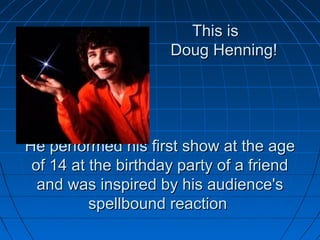
This isThis is
Doug Henning!Doug Henning!
He performed his first show at the ageHe performed his first show at the age
of 14 at the birthday party of a friendof 14 at the birthday party of a friend
and was inspired by his audience'sand was inspired by his audience's
spellbound reactionspellbound reaction
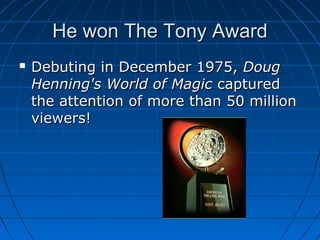
He won The Tony AwardHe won The Tony Award
 Debuting in December 1975,Debuting in December 1975, DougDoug
Henning's World of MagicHenning's World of Magic capturedcaptured
the attention of more than 50 millionthe attention of more than 50 million
viewers!viewers!
HughesHughes andand
Sir Christopher IngoldSir Christopher Ingold
InIn 19351935,, Edward D. HughesEdward D. Hughes andand
Sir Christopher IngoldSir Christopher Ingold studiedstudied
nucleophilic substitution reactions ofnucleophilic substitution reactions of
alkyl halidesalkyl halides and related compounds.and related compounds.
They proposed that there were twoThey proposed that there were two
main mechanisms at work, both ofmain mechanisms at work, both of
them competing with each other.them competing with each other.
Are just as spectacular!!!!!Are just as spectacular!!!!!
The two main mechanisms are theThe two main mechanisms are the SSNN
1 reaction1 reaction and theand the SSNN2 reaction2 reaction..
The “S” stands for chemicalThe “S” stands for chemical
substitution,substitution,
And the “N” stands for nucleophilic,And the “N” stands for nucleophilic,
and the number represents theand the number represents the
kinetic orderkinetic order of the reaction.of the reaction.
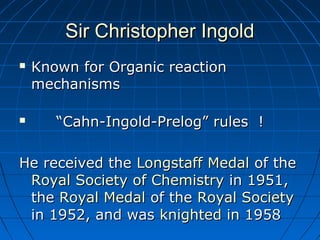
Sir Christopher IngoldSir Christopher Ingold
 Known for Organic reactionKnown for Organic reaction
mechanismsmechanisms
 ““Cahn-Ingold-Prelog” rules !Cahn-Ingold-Prelog” rules !
He received theHe received the Longstaff MedalLongstaff Medal of theof the
Royal Society of ChemistryRoyal Society of Chemistry in 1951,in 1951,
thethe Royal MedalRoyal Medal of theof the Royal SocietyRoyal Society
in 1952, and wasin 1952, and was knightedknighted in 1958in 1958
Just like Paul Macartney!!!Just like Paul Macartney!!!
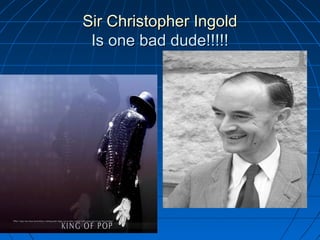
Sir Christopher IngoldSir Christopher Ingold
Is one bad dude!!!!!Is one bad dude!!!!!
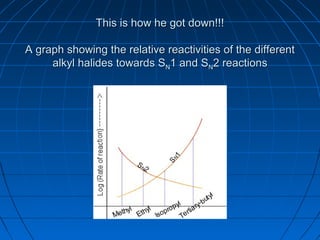
This is how he got down!!!This is how he got down!!!
A graph showing the relative reactivities of the differentA graph showing the relative reactivities of the different
alkyl halides towards Salkyl halides towards SNN1 and S1 and SNN2 reactions2 reactions
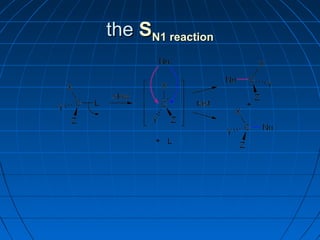
thethe SSNN1 reaction1 reaction
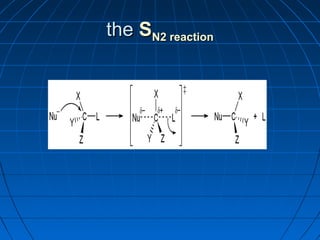
thethe SSNN2 reaction2 reaction
Effect of the NucleophileEffect of the Nucleophile
 The nucleophile takes part in theThe nucleophile takes part in the
slow step (the only step) of the Sslow step (the only step) of the SNN22
reaction but not in the slow step ofreaction but not in the slow step of
the Sthe SNN1. Therefore, a strong1. Therefore, a strong
nucleophile promotes the Snucleophile promotes the SNN2 but not2 but not
the Sthe SNN1.1.
Effect of the NucleophileEffect of the Nucleophile
 Weak nucleophiles fail to promoteWeak nucleophiles fail to promote
the Sthe SNN2 reaction; therefore, reactions2 reaction; therefore, reactions
with weak nucleophiles often go bywith weak nucleophiles often go by
the Sthe SNN1 mechanism if the substrate is1 mechanism if the substrate is
secondary or tertiarysecondary or tertiary
Effect of the NucleophileEffect of the Nucleophile
 SSNN1: Nucleophile strength is1: Nucleophile strength is
unimportant (usually weak).unimportant (usually weak).
Effect of the NucleophileEffect of the Nucleophile
 SSNN2: Strong nucleophiles are2: Strong nucleophiles are
required.required.
Effect of the SubstrateEffect of the Substrate
 The structure of the substrate (theThe structure of the substrate (the
alkyl halide) is an important factor inalkyl halide) is an important factor in
determining which of thesedetermining which of these
substitution mechanisms mightsubstitution mechanisms might
operate.operate.
Effect of the SubstrateEffect of the Substrate
 Methyl halides and primary halidesMethyl halides and primary halides
cannot easily ionize and undergo Scannot easily ionize and undergo SNN11
substitution because methyl andsubstitution because methyl and
primary carbocations are high inprimary carbocations are high in
energy. They are relativelyenergy. They are relatively
unhindered, however, so they makeunhindered, however, so they make
good Sgood SNN2 substrates.2 substrates.
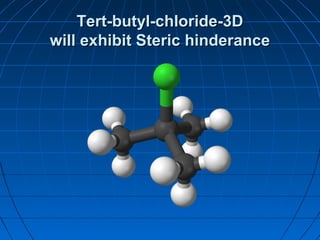
Tert-butyl-chloride-3DTert-butyl-chloride-3D
 Tertiary halides are too hindered toTertiary halides are too hindered to
undergo Sundergo SNN2 displacement, but they2 displacement, but they
can ionize to form tertiarycan ionize to form tertiary
carbocations. Tertiary halidescarbocations. Tertiary halides
undergo substitution exclusivelyundergo substitution exclusively
through the Sthrough the SNN1 mechanism.1 mechanism.
Secondary halides can undergoSecondary halides can undergo
substitution by either mechanism,substitution by either mechanism,
depending on the conditionsdepending on the conditions
Tert-butyl-chloride-3DTert-butyl-chloride-3D
will exhibit Steric hinderancewill exhibit Steric hinderance
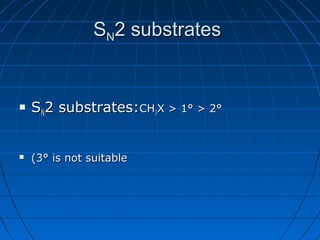
SSNN2 substrates2 substrates
 SSNN2 substrates:2 substrates:CHCH33X > 1° > 2°X > 1° > 2°
 (3° is not suitable(3° is not suitable
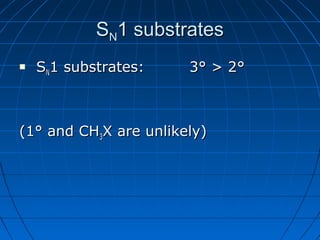
SSNN1 substrates1 substrates
 SSNN1 substrates: 3° > 2°1 substrates: 3° > 2°
(1° and CH(1° and CH33X are unlikely)X are unlikely)
silver nitrate (AgNOsilver nitrate (AgNO33))
 If silver nitrate (AgNOIf silver nitrate (AgNO33) is added to) is added to
an alkyl halide in a good ionizingan alkyl halide in a good ionizing
solvent, it removes the halide ion tosolvent, it removes the halide ion to
give a carbocation. This techniquegive a carbocation. This technique
can force some unlikely ionizations,can force some unlikely ionizations,
often giving interestingoften giving interesting
rearrangements (see Problem 6-29.)rearrangements (see Problem 6-29.)
Effect of the SolventEffect of the Solvent
 The slow step of the SThe slow step of the SNN1 reaction1 reaction
involves formation of two ions.involves formation of two ions.
Solvation of these ions is crucial toSolvation of these ions is crucial to
stabilizing them and lowering thestabilizing them and lowering the
activation energy for their formation.activation energy for their formation.
Very polar ionizing solvents such asVery polar ionizing solvents such as
water and alcohols are needed forwater and alcohols are needed for
the Sthe SNN1. The solvent may be heated1. The solvent may be heated
to reflux (boiling) to provide theto reflux (boiling) to provide the
energy needed for ionizationenergy needed for ionization
Effect of the SolventEffect of the Solvent
 Less charge separation is generatedLess charge separation is generated
in the transition state of the Sin the transition state of the SNN22
reaction.reaction.
 Strong solvation may weaken theStrong solvation may weaken the
strength of the nucleophile becausestrength of the nucleophile because
of the energy needed to strip off theof the energy needed to strip off the
solvent molecules.solvent molecules.
Effect of the SolventEffect of the Solvent
 Thus, the SThus, the SNN2 reaction often goes2 reaction often goes
faster in less polar solvents if thefaster in less polar solvents if the
nucleophile will dissolve. Polarnucleophile will dissolve. Polar
aprotic solvents may enhance theaprotic solvents may enhance the
strength of weak nucleophilesstrength of weak nucleophiles
Effect of the SolventEffect of the Solvent
The slow step of the SThe slow step of the SNN1 reaction1 reaction
involves formation of two ions.involves formation of two ions.
Solvation of these ions is crucial toSolvation of these ions is crucial to
stabilizing them and lowering thestabilizing them and lowering the
activation energy for their formation.activation energy for their formation.
Very polar ionizing solvents such asVery polar ionizing solvents such as
water and alcohols are needed forwater and alcohols are needed for
the Sthe SNN1.1.
Effect of the SolventEffect of the Solvent
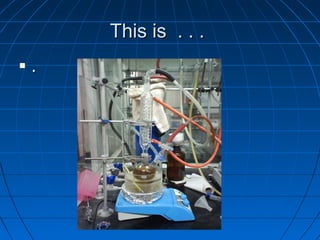
 The solvent may be heated to refluxThe solvent may be heated to reflux
(boiling) to provide the energy(boiling) to provide the energy
needed for ionizationneeded for ionization
This is . . .This is . . .
 ..
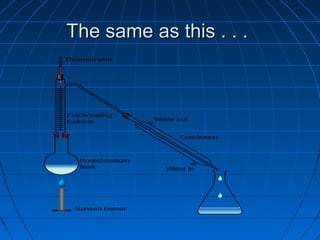
The same as this . . .The same as this . . .
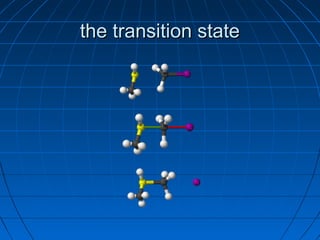
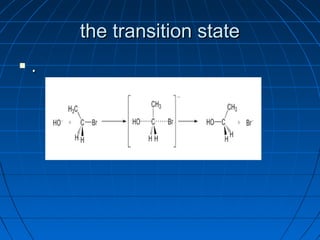
the transition statethe transition state
 Less charge separation is generated in theLess charge separation is generated in the
transition state of the Stransition state of the SNN2 reaction. Strong2 reaction. Strong
solvation may weaken the strength of thesolvation may weaken the strength of the
nucleophile because of the energy needednucleophile because of the energy needed
to strip off the solvent molecules. Thus,to strip off the solvent molecules. Thus,
the Sthe SNN2 reaction often goes faster in less2 reaction often goes faster in less
polar solvents if the nucleophile willpolar solvents if the nucleophile will
dissolve.dissolve.
 Polar aprotic solvents may enhance thePolar aprotic solvents may enhance the
strength of weak nucleophilesstrength of weak nucleophiles
the transition statethe transition state
 ..
aprotic solvents:aprotic solvents:
 Common characteristics of aproticCommon characteristics of aprotic
solvents:solvents:
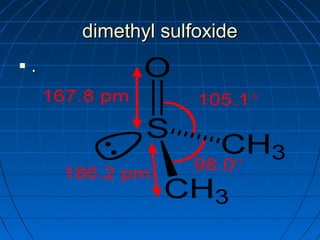
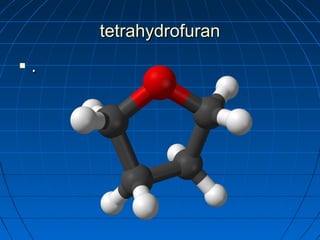
 Examples areExamples are dimethyl sulfoxidedimethyl sulfoxide,,
dimethylformamidedimethylformamide,, dioxanedioxane andand
hexamethylphosphorotriamidehexamethylphosphorotriamide,,
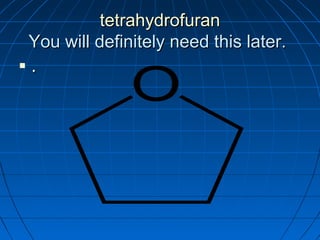
tetrahydrofurantetrahydrofuran
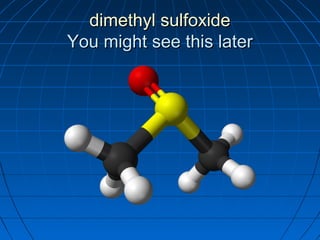
dimethyl sulfoxidedimethyl sulfoxide
You might see this laterYou might see this later
dimethyl sulfoxidedimethyl sulfoxide
 ..
tetrahydrofurantetrahydrofuran
 ..
tetrahydrofurantetrahydrofuran
You will definitely need this later.You will definitely need this later.
 ..
Effect of the SolventEffect of the Solvent
 Polar Protic SolventsPolar Protic Solvents
 Let's start with the meaning of the adjectiveLet's start with the meaning of the adjective
protic. In the context used here, protic refers to aprotic. In the context used here, protic refers to a
hydrogen atom attached to an electronegativehydrogen atom attached to an electronegative
atom. For our purposes that electronegative atomatom. For our purposes that electronegative atom
is almost exclusively oxygen.is almost exclusively oxygen.
 In other words, polar protic solvents areIn other words, polar protic solvents are
compounds that can be represented by thecompounds that can be represented by the
general formula ROH. The polarity of the polargeneral formula ROH. The polarity of the polar
protic solvents stems from the bond dipole of theprotic solvents stems from the bond dipole of the
O-H bond.O-H bond.
Effect of the SolventEffect of the Solvent
 The large difference in electronegativities of theThe large difference in electronegativities of the
oxygen and the hydrogen atom, combined withoxygen and the hydrogen atom, combined with
the small size of the hydrogen atom, warrantthe small size of the hydrogen atom, warrant
separating molecules that contain an OH groupseparating molecules that contain an OH group
from those polar compounds that do not.from those polar compounds that do not.
 Examples of polar protic solvents are water (HExamples of polar protic solvents are water (H22O),O),
methanol (CHmethanol (CH33OH), and acetic acid (CHOH), and acetic acid (CH33COCO22H).H).
 http://myphlip.pearsoncmg.com/altprodhttp://myphlip.pearsoncmg.com/altprod
The slow stepThe slow step
 The slow step of the SN1 reactionThe slow step of the SN1 reaction
involves formation of two ions.involves formation of two ions.
Solvation of these ions is crucial toSolvation of these ions is crucial to
stabilizing them and lowering thestabilizing them and lowering the
activation energy for their formation.activation energy for their formation.
Very polar ionizing solvents such asVery polar ionizing solvents such as
water and alcohols are needed forwater and alcohols are needed for
the SN1.the SN1.
The slow stepThe slow step
 The solvent may be heated to refluxThe solvent may be heated to reflux
(boiling) to provide the energy(boiling) to provide the energy
needed for ionization.needed for ionization.
The slow stepThe slow step
 Less charge separation is generated in theLess charge separation is generated in the
transition state of the SN2 reaction.transition state of the SN2 reaction.
Strong solvation may weaken the strengthStrong solvation may weaken the strength
of the nucleophile because of the energyof the nucleophile because of the energy
needed to strip off the solvent molecules.needed to strip off the solvent molecules.
less polar solventsless polar solvents
 Thus, the SN2 reaction often goesThus, the SN2 reaction often goes
faster in less polar solvents if thefaster in less polar solvents if the
nucleophile will dissolve. Polarnucleophile will dissolve. Polar
aprotic solvents may enhance theaprotic solvents may enhance the
strength of weak nucleophiles.strength of weak nucleophiles.
SN1SN1
 SN1: Good ionizing solvent required.SN1: Good ionizing solvent required.
SN2SN2
 SN2: May go faster in a less polarSN2: May go faster in a less polar
solventsolvent
KineticsKinetics
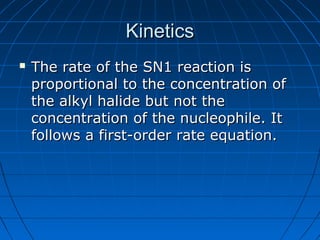
 The rate of the SN1 reaction isThe rate of the SN1 reaction is
proportional to the concentration ofproportional to the concentration of
the alkyl halide but not thethe alkyl halide but not the
concentration of the nucleophile. Itconcentration of the nucleophile. It
follows a first-order rate equation.follows a first-order rate equation.
KineticsKinetics
 The rate of the SN2 reaction isThe rate of the SN2 reaction is
proportional to the concentrations ofproportional to the concentrations of
both the alkyl halide [R—X] and theboth the alkyl halide [R—X] and the
nucleophile [Nuc: −]. It follows anucleophile [Nuc: −]. It follows a
second-order rate equation.second-order rate equation.
KineticsKinetics
 SN1 rate = kr[R—X]SN1 rate = kr[R—X]
 SN2 rate = kr[R—X][Nuc: −]SN2 rate = kr[R—X][Nuc: −]
StereochemistryStereochemistry
 The SN1 reaction involves a flatThe SN1 reaction involves a flat
carbocation intermediate that can becarbocation intermediate that can be
attacked from either face. Therefore,attacked from either face. Therefore,
the SN1 usually gives a mixture ofthe SN1 usually gives a mixture of
inversion and retention ofinversion and retention of
configurationconfiguration
StereochemistryStereochemistry
 The SN2 reaction takes placeThe SN2 reaction takes place
through a back-side attack, whichthrough a back-side attack, which
inverts the stereochemistry of theinverts the stereochemistry of the
carbon atom. Complete inversion ofcarbon atom. Complete inversion of
configuration is the result.configuration is the result.
StereochemistryStereochemistry
 SN1 stereochemistry:SN1 stereochemistry:
 Mixture of retention and inversion;Mixture of retention and inversion;
racemization.racemization.
StereochemistryStereochemistry
 SN2 stereochemistrySN2 stereochemistry
 Complete inversionComplete inversion
RearrangementsRearrangements
 The SN1 reaction involves aThe SN1 reaction involves a
carbocation intermediate. Thiscarbocation intermediate. This
intermediate can rearrange, usuallyintermediate can rearrange, usually
by a hydride shift or an alkyl shift, toby a hydride shift or an alkyl shift, to
give a more stable carbocation.give a more stable carbocation.
RearrangementsRearrangements
 The SN2 reaction takes place in oneThe SN2 reaction takes place in one
step with no intermediates.step with no intermediates.
 No rearrangement isNo rearrangement is
possible in the SN2possible in the SN2
reaction.reaction.
rearrangement reactionrearrangement reaction
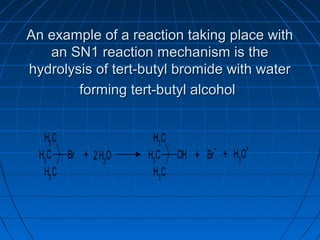
An example of a reaction taking place withAn example of a reaction taking place with
an SN1 reaction mechanism is thean SN1 reaction mechanism is the
hydrolysis of tert-butyl bromide with waterhydrolysis of tert-butyl bromide with water
forming tert-butyl alcoholforming tert-butyl alcohol
a tert-butyl carbocationa tert-butyl carbocation
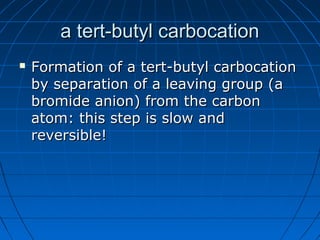
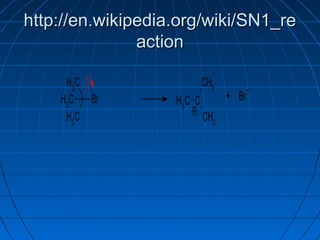
 Formation of a tert-butyl carbocationFormation of a tert-butyl carbocation
by separation of a leaving group (aby separation of a leaving group (a
bromide anion) from the carbonbromide anion) from the carbon
atom: this step is slow andatom: this step is slow and
reversible!reversible!
http://en.wikipedia.org/wiki/SN1_rehttp://en.wikipedia.org/wiki/SN1_re
actionaction
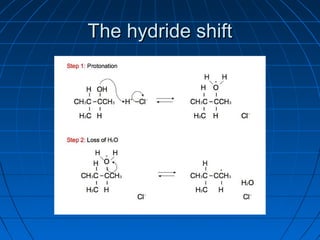
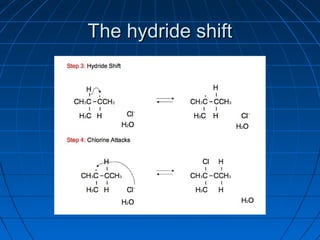
The hydride shiftThe hydride shift
 The mechanism for hydride shiftThe mechanism for hydride shift
occurs inoccurs in multiple stepsmultiple steps that includesthat includes
various intermediates and transitionvarious intermediates and transition
states. Below is the mechanism forstates. Below is the mechanism for
the given reaction above:the given reaction above:

The hydride shiftThe hydride shift
rearrangement reactionrearrangement reaction
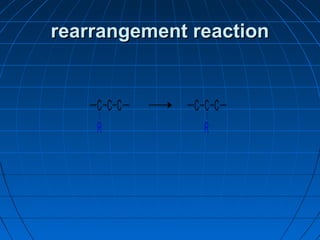
 AA rearrangement reactionrearrangement reaction is a broadis a broad
class of organic reactions where theclass of organic reactions where the
carbon skeleton of a molecule iscarbon skeleton of a molecule is
rearranged to give a structural isomer ofrearranged to give a structural isomer of
the original molecule [1] . Often athe original molecule [1] . Often a
substituent moves from one atom tosubstituent moves from one atom to
another atom in the same molecule. In theanother atom in the same molecule. In the
example below the substituent R movesexample below the substituent R moves
from carbon atom 1 to carbon atom 2from carbon atom 1 to carbon atom 2
RearrangementsRearrangements
 SN1: Rearrangements are common.SN1: Rearrangements are common.
RearrangementsRearrangements
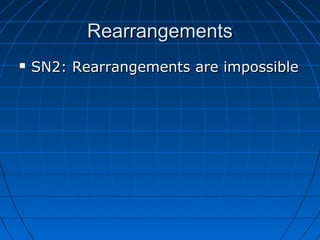
 SN2: Rearrangements are impossibleSN2: Rearrangements are impossible
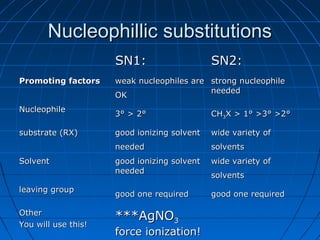
Nucleophillic substitutionsNucleophillic substitutions
SN1:SN1: SN2:SN2:
Promoting factorsPromoting factors weak nucleophiles areweak nucleophiles are
OKOK
strong nucleophilestrong nucleophile
neededneeded
NucleophileNucleophile
3° > 2°3° > 2° CHCH33X > 1° >3° >2°X > 1° >3° >2°
substrate (RX)substrate (RX) good ionizing solventgood ionizing solvent
neededneeded
wide variety ofwide variety of
solventssolvents
SolventSolvent good ionizing solventgood ionizing solvent
neededneeded
wide variety ofwide variety of
solventssolvents
leaving groupleaving group
good one requiredgood one required good one requiredgood one required
OtherOther
You will use this!You will use this!
***AgNO***AgNO33
force ionization!force ionization!
the nucleophile competes . . .the nucleophile competes . . .
 In both reactions, the nucleophile competes withIn both reactions, the nucleophile competes with
the leaving group. Because of this, one mustthe leaving group. Because of this, one must
realize what properties a leaving group shouldrealize what properties a leaving group should
have, and what constitutes a good nucleophile.have, and what constitutes a good nucleophile.
For this reason, it is worthwhile to know whichFor this reason, it is worthwhile to know which
factors will determine whether a reaction followsfactors will determine whether a reaction follows
an SN1 or SN2 pathway.an SN1 or SN2 pathway.
good leaving groupsgood leaving groups
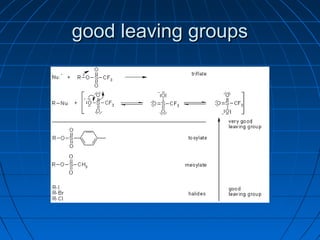
 Very good leaving groups, such asVery good leaving groups, such as
triflate, tosylate and mesylate,triflate, tosylate and mesylate,
stabilize an incipient negativestabilize an incipient negative
charge. The delocalization of thischarge. The delocalization of this
charge is reflected in the fact thatcharge is reflected in the fact that
these ions are not considered to bethese ions are not considered to be
nucleophilicnucleophilic
good leaving groupsgood leaving groups
 Very good leaving groups, such asVery good leaving groups, such as
triflate, tosylate and mesylate,triflate, tosylate and mesylate,
stabilize an incipient negativestabilize an incipient negative
charge. The delocalization of thischarge. The delocalization of this
charge is reflected in the fact thatcharge is reflected in the fact that
these ions are not considered to bethese ions are not considered to be
nucleophilicnucleophilic
good leaving groupsgood leaving groups
 Hydroxide and alkoxide ions are notHydroxide and alkoxide ions are not
good leaving groups; however, theygood leaving groups; however, they
can be activated by means of Lewiscan be activated by means of Lewis
or Brønsted acidsor Brønsted acids

Ppt0000015 feed the flame[1]this one (3)

  • 2.
    This isThis is DougHenning!Doug Henning! He performed his first show at the ageHe performed his first show at the age of 14 at the birthday party of a friendof 14 at the birthday party of a friend and was inspired by his audience'sand was inspired by his audience's spellbound reactionspellbound reaction
  • 3.
    He won TheTony AwardHe won The Tony Award  Debuting in December 1975,Debuting in December 1975, DougDoug Henning's World of MagicHenning's World of Magic capturedcaptured the attention of more than 50 millionthe attention of more than 50 million viewers!viewers!
  • 4.
    HughesHughes andand Sir ChristopherIngoldSir Christopher Ingold InIn 19351935,, Edward D. HughesEdward D. Hughes andand Sir Christopher IngoldSir Christopher Ingold studiedstudied nucleophilic substitution reactions ofnucleophilic substitution reactions of alkyl halidesalkyl halides and related compounds.and related compounds. They proposed that there were twoThey proposed that there were two main mechanisms at work, both ofmain mechanisms at work, both of them competing with each other.them competing with each other.
  • 5.
    Are just asspectacular!!!!!Are just as spectacular!!!!! The two main mechanisms are theThe two main mechanisms are the SSNN 1 reaction1 reaction and theand the SSNN2 reaction2 reaction.. The “S” stands for chemicalThe “S” stands for chemical substitution,substitution, And the “N” stands for nucleophilic,And the “N” stands for nucleophilic, and the number represents theand the number represents the kinetic orderkinetic order of the reaction.of the reaction.
  • 6.
    Sir Christopher IngoldSirChristopher Ingold  Known for Organic reactionKnown for Organic reaction mechanismsmechanisms  ““Cahn-Ingold-Prelog” rules !Cahn-Ingold-Prelog” rules ! He received theHe received the Longstaff MedalLongstaff Medal of theof the Royal Society of ChemistryRoyal Society of Chemistry in 1951,in 1951, thethe Royal MedalRoyal Medal of theof the Royal SocietyRoyal Society in 1952, and wasin 1952, and was knightedknighted in 1958in 1958
  • 7.
    Just like PaulMacartney!!!Just like Paul Macartney!!!
  • 8.
    Sir Christopher IngoldSirChristopher Ingold Is one bad dude!!!!!Is one bad dude!!!!!
  • 9.
    This is howhe got down!!!This is how he got down!!! A graph showing the relative reactivities of the differentA graph showing the relative reactivities of the different alkyl halides towards Salkyl halides towards SNN1 and S1 and SNN2 reactions2 reactions
  • 10.
  • 11.
  • 12.
    Effect of theNucleophileEffect of the Nucleophile  The nucleophile takes part in theThe nucleophile takes part in the slow step (the only step) of the Sslow step (the only step) of the SNN22 reaction but not in the slow step ofreaction but not in the slow step of the Sthe SNN1. Therefore, a strong1. Therefore, a strong nucleophile promotes the Snucleophile promotes the SNN2 but not2 but not the Sthe SNN1.1.
  • 13.
    Effect of theNucleophileEffect of the Nucleophile  Weak nucleophiles fail to promoteWeak nucleophiles fail to promote the Sthe SNN2 reaction; therefore, reactions2 reaction; therefore, reactions with weak nucleophiles often go bywith weak nucleophiles often go by the Sthe SNN1 mechanism if the substrate is1 mechanism if the substrate is secondary or tertiarysecondary or tertiary
  • 14.
    Effect of theNucleophileEffect of the Nucleophile  SSNN1: Nucleophile strength is1: Nucleophile strength is unimportant (usually weak).unimportant (usually weak).
  • 15.
    Effect of theNucleophileEffect of the Nucleophile  SSNN2: Strong nucleophiles are2: Strong nucleophiles are required.required.
  • 16.
    Effect of theSubstrateEffect of the Substrate  The structure of the substrate (theThe structure of the substrate (the alkyl halide) is an important factor inalkyl halide) is an important factor in determining which of thesedetermining which of these substitution mechanisms mightsubstitution mechanisms might operate.operate.
  • 17.
    Effect of theSubstrateEffect of the Substrate  Methyl halides and primary halidesMethyl halides and primary halides cannot easily ionize and undergo Scannot easily ionize and undergo SNN11 substitution because methyl andsubstitution because methyl and primary carbocations are high inprimary carbocations are high in energy. They are relativelyenergy. They are relatively unhindered, however, so they makeunhindered, however, so they make good Sgood SNN2 substrates.2 substrates.
  • 18.
    Tert-butyl-chloride-3DTert-butyl-chloride-3D  Tertiary halidesare too hindered toTertiary halides are too hindered to undergo Sundergo SNN2 displacement, but they2 displacement, but they can ionize to form tertiarycan ionize to form tertiary carbocations. Tertiary halidescarbocations. Tertiary halides undergo substitution exclusivelyundergo substitution exclusively through the Sthrough the SNN1 mechanism.1 mechanism. Secondary halides can undergoSecondary halides can undergo substitution by either mechanism,substitution by either mechanism, depending on the conditionsdepending on the conditions
  • 19.
  • 20.
    SSNN2 substrates2 substrates SSNN2 substrates:2 substrates:CHCH33X > 1° > 2°X > 1° > 2°  (3° is not suitable(3° is not suitable
  • 21.
    SSNN1 substrates1 substrates SSNN1 substrates: 3° > 2°1 substrates: 3° > 2° (1° and CH(1° and CH33X are unlikely)X are unlikely)
  • 22.
    silver nitrate (AgNOsilvernitrate (AgNO33))  If silver nitrate (AgNOIf silver nitrate (AgNO33) is added to) is added to an alkyl halide in a good ionizingan alkyl halide in a good ionizing solvent, it removes the halide ion tosolvent, it removes the halide ion to give a carbocation. This techniquegive a carbocation. This technique can force some unlikely ionizations,can force some unlikely ionizations, often giving interestingoften giving interesting rearrangements (see Problem 6-29.)rearrangements (see Problem 6-29.)
  • 23.
    Effect of theSolventEffect of the Solvent  The slow step of the SThe slow step of the SNN1 reaction1 reaction involves formation of two ions.involves formation of two ions. Solvation of these ions is crucial toSolvation of these ions is crucial to stabilizing them and lowering thestabilizing them and lowering the activation energy for their formation.activation energy for their formation. Very polar ionizing solvents such asVery polar ionizing solvents such as water and alcohols are needed forwater and alcohols are needed for the Sthe SNN1. The solvent may be heated1. The solvent may be heated to reflux (boiling) to provide theto reflux (boiling) to provide the energy needed for ionizationenergy needed for ionization
  • 24.
    Effect of theSolventEffect of the Solvent  Less charge separation is generatedLess charge separation is generated in the transition state of the Sin the transition state of the SNN22 reaction.reaction.  Strong solvation may weaken theStrong solvation may weaken the strength of the nucleophile becausestrength of the nucleophile because of the energy needed to strip off theof the energy needed to strip off the solvent molecules.solvent molecules.
  • 25.
    Effect of theSolventEffect of the Solvent  Thus, the SThus, the SNN2 reaction often goes2 reaction often goes faster in less polar solvents if thefaster in less polar solvents if the nucleophile will dissolve. Polarnucleophile will dissolve. Polar aprotic solvents may enhance theaprotic solvents may enhance the strength of weak nucleophilesstrength of weak nucleophiles
  • 26.
    Effect of theSolventEffect of the Solvent The slow step of the SThe slow step of the SNN1 reaction1 reaction involves formation of two ions.involves formation of two ions. Solvation of these ions is crucial toSolvation of these ions is crucial to stabilizing them and lowering thestabilizing them and lowering the activation energy for their formation.activation energy for their formation. Very polar ionizing solvents such asVery polar ionizing solvents such as water and alcohols are needed forwater and alcohols are needed for the Sthe SNN1.1.
  • 27.
    Effect of theSolventEffect of the Solvent  The solvent may be heated to refluxThe solvent may be heated to reflux (boiling) to provide the energy(boiling) to provide the energy needed for ionizationneeded for ionization
  • 28.
    This is .. .This is . . .  ..
  • 29.
    The same asthis . . .The same as this . . .
  • 30.
    the transition statethetransition state  Less charge separation is generated in theLess charge separation is generated in the transition state of the Stransition state of the SNN2 reaction. Strong2 reaction. Strong solvation may weaken the strength of thesolvation may weaken the strength of the nucleophile because of the energy needednucleophile because of the energy needed to strip off the solvent molecules. Thus,to strip off the solvent molecules. Thus, the Sthe SNN2 reaction often goes faster in less2 reaction often goes faster in less polar solvents if the nucleophile willpolar solvents if the nucleophile will dissolve.dissolve.  Polar aprotic solvents may enhance thePolar aprotic solvents may enhance the strength of weak nucleophilesstrength of weak nucleophiles
  • 31.
    the transition statethetransition state
  • 32.
    the transition statethetransition state  ..
  • 33.
    aprotic solvents:aprotic solvents: Common characteristics of aproticCommon characteristics of aprotic solvents:solvents:  Examples areExamples are dimethyl sulfoxidedimethyl sulfoxide,, dimethylformamidedimethylformamide,, dioxanedioxane andand hexamethylphosphorotriamidehexamethylphosphorotriamide,, tetrahydrofurantetrahydrofuran
  • 34.
    dimethyl sulfoxidedimethyl sulfoxide Youmight see this laterYou might see this later
  • 35.
  • 36.
  • 37.
    tetrahydrofurantetrahydrofuran You will definitelyneed this later.You will definitely need this later.  ..
  • 38.
    Effect of theSolventEffect of the Solvent  Polar Protic SolventsPolar Protic Solvents  Let's start with the meaning of the adjectiveLet's start with the meaning of the adjective protic. In the context used here, protic refers to aprotic. In the context used here, protic refers to a hydrogen atom attached to an electronegativehydrogen atom attached to an electronegative atom. For our purposes that electronegative atomatom. For our purposes that electronegative atom is almost exclusively oxygen.is almost exclusively oxygen.  In other words, polar protic solvents areIn other words, polar protic solvents are compounds that can be represented by thecompounds that can be represented by the general formula ROH. The polarity of the polargeneral formula ROH. The polarity of the polar protic solvents stems from the bond dipole of theprotic solvents stems from the bond dipole of the O-H bond.O-H bond.
  • 39.
    Effect of theSolventEffect of the Solvent  The large difference in electronegativities of theThe large difference in electronegativities of the oxygen and the hydrogen atom, combined withoxygen and the hydrogen atom, combined with the small size of the hydrogen atom, warrantthe small size of the hydrogen atom, warrant separating molecules that contain an OH groupseparating molecules that contain an OH group from those polar compounds that do not.from those polar compounds that do not.  Examples of polar protic solvents are water (HExamples of polar protic solvents are water (H22O),O), methanol (CHmethanol (CH33OH), and acetic acid (CHOH), and acetic acid (CH33COCO22H).H).
  • 40.
  • 41.
    The slow stepTheslow step  The slow step of the SN1 reactionThe slow step of the SN1 reaction involves formation of two ions.involves formation of two ions. Solvation of these ions is crucial toSolvation of these ions is crucial to stabilizing them and lowering thestabilizing them and lowering the activation energy for their formation.activation energy for their formation. Very polar ionizing solvents such asVery polar ionizing solvents such as water and alcohols are needed forwater and alcohols are needed for the SN1.the SN1.
  • 42.
    The slow stepTheslow step  The solvent may be heated to refluxThe solvent may be heated to reflux (boiling) to provide the energy(boiling) to provide the energy needed for ionization.needed for ionization.
  • 43.
    The slow stepTheslow step  Less charge separation is generated in theLess charge separation is generated in the transition state of the SN2 reaction.transition state of the SN2 reaction. Strong solvation may weaken the strengthStrong solvation may weaken the strength of the nucleophile because of the energyof the nucleophile because of the energy needed to strip off the solvent molecules.needed to strip off the solvent molecules.
  • 44.
    less polar solventslesspolar solvents  Thus, the SN2 reaction often goesThus, the SN2 reaction often goes faster in less polar solvents if thefaster in less polar solvents if the nucleophile will dissolve. Polarnucleophile will dissolve. Polar aprotic solvents may enhance theaprotic solvents may enhance the strength of weak nucleophiles.strength of weak nucleophiles.
  • 45.
    SN1SN1  SN1: Goodionizing solvent required.SN1: Good ionizing solvent required.
  • 46.
    SN2SN2  SN2: Maygo faster in a less polarSN2: May go faster in a less polar solventsolvent
  • 47.
    KineticsKinetics  The rateof the SN1 reaction isThe rate of the SN1 reaction is proportional to the concentration ofproportional to the concentration of the alkyl halide but not thethe alkyl halide but not the concentration of the nucleophile. Itconcentration of the nucleophile. It follows a first-order rate equation.follows a first-order rate equation.
  • 48.
    KineticsKinetics  The rateof the SN2 reaction isThe rate of the SN2 reaction is proportional to the concentrations ofproportional to the concentrations of both the alkyl halide [R—X] and theboth the alkyl halide [R—X] and the nucleophile [Nuc: −]. It follows anucleophile [Nuc: −]. It follows a second-order rate equation.second-order rate equation.
  • 49.
    KineticsKinetics  SN1 rate= kr[R—X]SN1 rate = kr[R—X]  SN2 rate = kr[R—X][Nuc: −]SN2 rate = kr[R—X][Nuc: −]
  • 50.
    StereochemistryStereochemistry  The SN1reaction involves a flatThe SN1 reaction involves a flat carbocation intermediate that can becarbocation intermediate that can be attacked from either face. Therefore,attacked from either face. Therefore, the SN1 usually gives a mixture ofthe SN1 usually gives a mixture of inversion and retention ofinversion and retention of configurationconfiguration
  • 51.
    StereochemistryStereochemistry  The SN2reaction takes placeThe SN2 reaction takes place through a back-side attack, whichthrough a back-side attack, which inverts the stereochemistry of theinverts the stereochemistry of the carbon atom. Complete inversion ofcarbon atom. Complete inversion of configuration is the result.configuration is the result.
  • 52.
    StereochemistryStereochemistry  SN1 stereochemistry:SN1stereochemistry:  Mixture of retention and inversion;Mixture of retention and inversion; racemization.racemization.
  • 53.
    StereochemistryStereochemistry  SN2 stereochemistrySN2stereochemistry  Complete inversionComplete inversion
  • 54.
    RearrangementsRearrangements  The SN1reaction involves aThe SN1 reaction involves a carbocation intermediate. Thiscarbocation intermediate. This intermediate can rearrange, usuallyintermediate can rearrange, usually by a hydride shift or an alkyl shift, toby a hydride shift or an alkyl shift, to give a more stable carbocation.give a more stable carbocation.
  • 55.
    RearrangementsRearrangements  The SN2reaction takes place in oneThe SN2 reaction takes place in one step with no intermediates.step with no intermediates.  No rearrangement isNo rearrangement is possible in the SN2possible in the SN2 reaction.reaction.
  • 56.
  • 57.
    An example ofa reaction taking place withAn example of a reaction taking place with an SN1 reaction mechanism is thean SN1 reaction mechanism is the hydrolysis of tert-butyl bromide with waterhydrolysis of tert-butyl bromide with water forming tert-butyl alcoholforming tert-butyl alcohol
  • 58.
    a tert-butyl carbocationatert-butyl carbocation  Formation of a tert-butyl carbocationFormation of a tert-butyl carbocation by separation of a leaving group (aby separation of a leaving group (a bromide anion) from the carbonbromide anion) from the carbon atom: this step is slow andatom: this step is slow and reversible!reversible!
  • 59.
  • 60.
    The hydride shiftThehydride shift  The mechanism for hydride shiftThe mechanism for hydride shift occurs inoccurs in multiple stepsmultiple steps that includesthat includes various intermediates and transitionvarious intermediates and transition states. Below is the mechanism forstates. Below is the mechanism for the given reaction above:the given reaction above: 
  • 61.
    The hydride shiftThehydride shift
  • 62.
    The hydride shiftThehydride shift
  • 63.
    rearrangement reactionrearrangement reaction AA rearrangement reactionrearrangement reaction is a broadis a broad class of organic reactions where theclass of organic reactions where the carbon skeleton of a molecule iscarbon skeleton of a molecule is rearranged to give a structural isomer ofrearranged to give a structural isomer of the original molecule [1] . Often athe original molecule [1] . Often a substituent moves from one atom tosubstituent moves from one atom to another atom in the same molecule. In theanother atom in the same molecule. In the example below the substituent R movesexample below the substituent R moves from carbon atom 1 to carbon atom 2from carbon atom 1 to carbon atom 2
  • 64.
    RearrangementsRearrangements  SN1: Rearrangementsare common.SN1: Rearrangements are common.
  • 65.
    RearrangementsRearrangements  SN2: Rearrangementsare impossibleSN2: Rearrangements are impossible
  • 66.
    Nucleophillic substitutionsNucleophillic substitutions SN1:SN1:SN2:SN2: Promoting factorsPromoting factors weak nucleophiles areweak nucleophiles are OKOK strong nucleophilestrong nucleophile neededneeded NucleophileNucleophile 3° > 2°3° > 2° CHCH33X > 1° >3° >2°X > 1° >3° >2° substrate (RX)substrate (RX) good ionizing solventgood ionizing solvent neededneeded wide variety ofwide variety of solventssolvents SolventSolvent good ionizing solventgood ionizing solvent neededneeded wide variety ofwide variety of solventssolvents leaving groupleaving group good one requiredgood one required good one requiredgood one required OtherOther You will use this!You will use this! ***AgNO***AgNO33 force ionization!force ionization!
  • 67.
    the nucleophile competes. . .the nucleophile competes . . .  In both reactions, the nucleophile competes withIn both reactions, the nucleophile competes with the leaving group. Because of this, one mustthe leaving group. Because of this, one must realize what properties a leaving group shouldrealize what properties a leaving group should have, and what constitutes a good nucleophile.have, and what constitutes a good nucleophile. For this reason, it is worthwhile to know whichFor this reason, it is worthwhile to know which factors will determine whether a reaction followsfactors will determine whether a reaction follows an SN1 or SN2 pathway.an SN1 or SN2 pathway.
  • 68.
    good leaving groupsgoodleaving groups  Very good leaving groups, such asVery good leaving groups, such as triflate, tosylate and mesylate,triflate, tosylate and mesylate, stabilize an incipient negativestabilize an incipient negative charge. The delocalization of thischarge. The delocalization of this charge is reflected in the fact thatcharge is reflected in the fact that these ions are not considered to bethese ions are not considered to be nucleophilicnucleophilic
  • 69.
    good leaving groupsgoodleaving groups  Very good leaving groups, such asVery good leaving groups, such as triflate, tosylate and mesylate,triflate, tosylate and mesylate, stabilize an incipient negativestabilize an incipient negative charge. The delocalization of thischarge. The delocalization of this charge is reflected in the fact thatcharge is reflected in the fact that these ions are not considered to bethese ions are not considered to be nucleophilicnucleophilic
  • 70.
  • 71.
    good leaving groupsgoodleaving groups  Hydroxide and alkoxide ions are notHydroxide and alkoxide ions are not good leaving groups; however, theygood leaving groups; however, they can be activated by means of Lewiscan be activated by means of Lewis or Brønsted acidsor Brønsted acids