Reactions of alkyl halides
Dr. B. R. Thorat
Department of Chemistry
Govt. of Maharashtra
Ismail Yusuf College, Jogeshwari (E), Maharashtra 400060
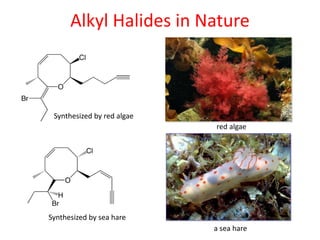
Alkyl Halides in Nature
Synthesized by red algae
Synthesized by sea hare
a sea hare
red algae
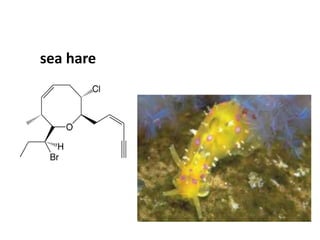
sea hare
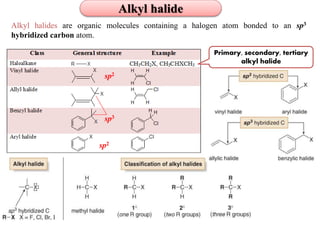
Alkyl halide
Primary, secondary, tertiary
alkyl halide
Alkyl halides are organic molecules containing a halogen atom bonded to an sp3
hybridized carbon atom.
sp2
sp2
sp3
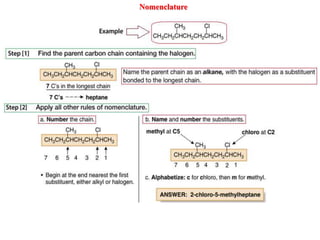
Nomenclature
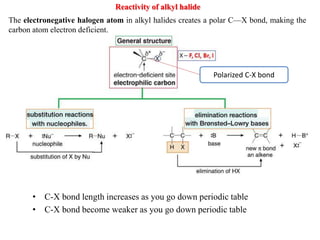
Reactivity of alkyl halide
The electronegative halogen atom in alkyl halides creates a polar C—X bond, making the
carbon atom electron deficient.
• C-X bond length increases as you go down periodic table
• C-X bond become weaker as you go down periodic table
Polarized C-X bond
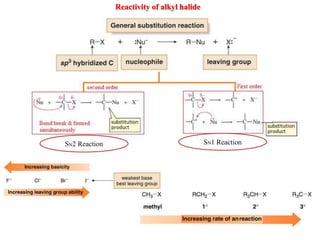
Reactivity of alkyl halide
SN2 Reaction SN1 Reaction
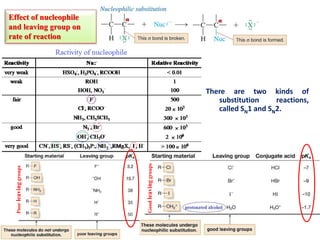
Effect of nucleophile
and leaving group on
rate of reaction
Poorleavinggroups
Goodleavinggroups
There are two kinds of
substitution reactions,
called SN1 and SN2.
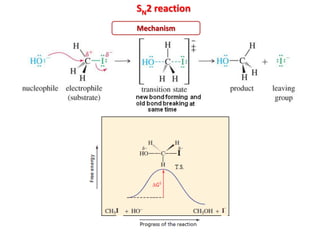
Reactivity of alkyl halide – SN2 Reaction
Bimolecular (or 2nd order) means that the rate of an SN2 reaction is directly proportional
to the molar concentration of two reacting molecules, the alkyl halide ‘substrate’ and
the nucleophile:
Example
Mechanism
SN2 reaction
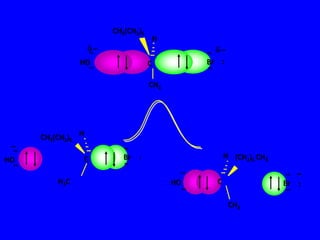
:BrC
H
..
..
–..
..HO
C
H
Br
d –..
..HO :
..
.. d –
C
H
HO
..
..
–..
..
:Br
CH3(CH2)5
H3C
(CH2)5 CH3
CH3(CH2)5
CH3
CH3
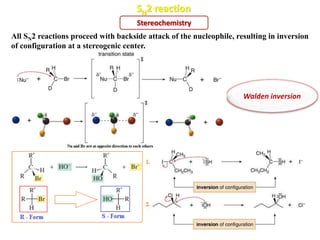
Stereochemistry
SN2 reaction
Walden inversion
All SN2 reactions proceed with backside attack of the nucleophile, resulting in inversion
of configuration at a stereogenic center.
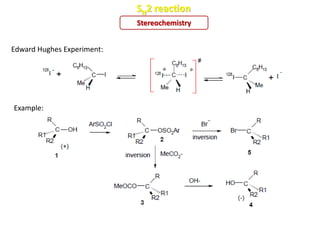
Stereochemistry
SN2 reaction
Edward Hughes Experiment:
Example:
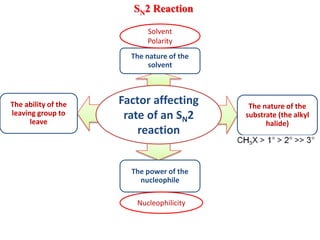
SN2 Reaction
Factor affecting
rate of an SN2
reaction
The nature of the
substrate (the alkyl
halide)
The ability of the
leaving group to
leave
The power of the
nucleophile
The nature of the
solvent
Nucleophilicity
Solvent
Polarity
Factor affecting rate of an SN2 reaction
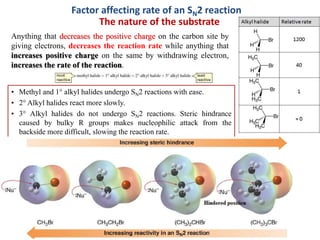
The nature of the substrate
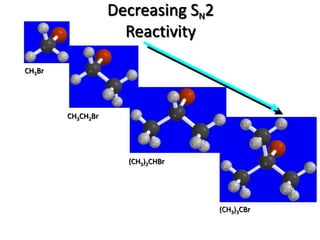
• Methyl and 1° alkyl halides undergo SN2 reactions with ease.
• 2° Alkyl halides react more slowly.
• 3° Alkyl halides do not undergo SN2 reactions. Steric hindrance
caused by bulky R groups makes nucleophilic attack from the
backside more difficult, slowing the reaction rate.
Anything that decreases the positive charge on the carbon site by
giving electrons, decreases the reaction rate while anything that
increases positive charge on the same by withdrawing electron,
increases the rate of the reaction.
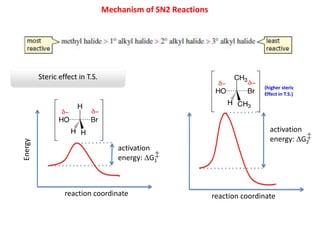
Mechanism of SN2 Reactions
activation
energy: DG1
activation
energy: DG2
Steric effect in T.S.
Energy
reaction coordinate reaction coordinate
(higher steric
Effect in T.S.)
Factor affecting rate of an SN2 reaction
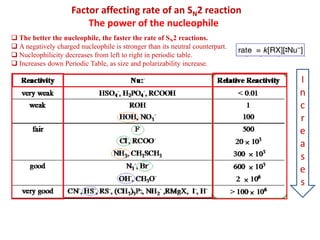
The power of the nucleophile
 The better the nucleophile, the faster the rate of SN2 reactions.
 A negatively charged nucleophile is stronger than its neutral counterpart.
 Nucleophilicity decreases from left to right in periodic table.
 Increases down Periodic Table, as size and polarizability increase.
I
n
c
r
e
a
s
e
s
CH3Br
CH3CH2Br
(CH3)2CHBr
(CH3)3CBr
Decreasing SN2
Reactivity
Factor affecting rate of an SN2 reaction
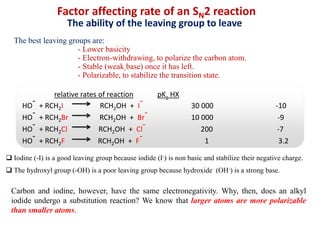
The ability of the leaving group to leave
The best leaving groups are:
- Lower basicity
- Electron-withdrawing, to polarize the carbon atom.
- Stable (weak base) once it has left.
- Polarizable, to stabilize the transition state.
 Iodine (-I) is a good leaving group because iodide (I-) is non basic and stabilize their negative charge.
 The hydroxyl group (-OH) is a poor leaving group because hydroxide (OH-) is a strong base.
relative rates of reaction pKa HX
HO
- + RCH2I RCH2OH + I
- 30 000 -10
HO
- + RCH2Br RCH2OH + Br
- 10 000 -9
HO
- + RCH2Cl RCH2OH + Cl
- 200 -7
HO
- + RCH2F RCH2OH + F
- 1 3.2
Carbon and iodine, however, have the same electronegativity. Why, then, does an alkyl
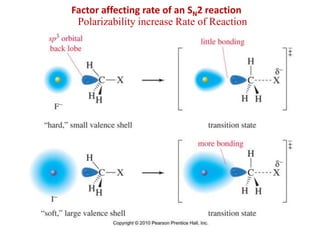
iodide undergo a substitution reaction? We know that larger atoms are more polarizable
than smaller atoms.
Polarizability increase Rate of Reaction
Factor affecting rate of an SN2 reaction
The nature solvent
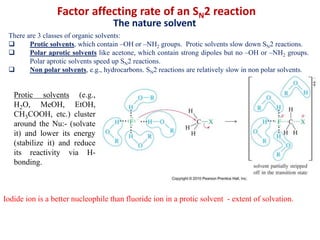
There are 3 classes of organic solvents:
 Protic solvents, which contain –OH or –NH2 groups. Protic solvents slow down SN2 reactions.
 Polar aprotic solvents like acetone, which contain strong dipoles but no –OH or –NH2 groups.
Polar aprotic solvents speed up SN2 reactions.
 Non polar solvents, e.g., hydrocarbons. SN2 reactions are relatively slow in non polar solvents.
Protic solvents (e.g.,
H2O, MeOH, EtOH,
CH3COOH, etc.) cluster
around the Nu:- (solvate
it) and lower its energy
(stabilize it) and reduce
its reactivity via H-
bonding.
Iodide ion is a better nucleophile than fluoride ion in a protic solvent - extent of solvation.
 Polar Aprotic Solvents solvate the cation counterion of the nucleophile but not the nucleophile.
 Examples include acetonitrile (CH3CN), acetone (CH3COCH3), dimethylformamide (DMF) [(CH3)2NC=OH],
dimethyl sulfoxide, DMSO [(CH3)2SO], hexamethylphosphoramide, HMPA {[(CH3)2N]3PO} and
dimethylacetamide (DMA).
The SN1 Reaction
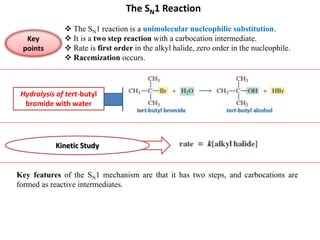
 The SN1 reaction is a unimolecular nucleophilic substitution.
 It is a two step reaction with a carbocation intermediate.
 Rate is first order in the alkyl halide, zero order in the nucleophile.
 Racemization occurs.
Key
points
Hydrolysis of tert-butyl
bromide with water
Kinetic Study
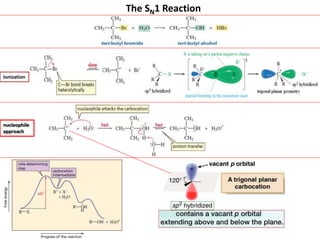
Key features of the SN1 mechanism are that it has two steps, and carbocations are
formed as reactive intermediates.
The SN1 Reaction
Ionization
nucleophile
approach
Stereochemistry of SN1 reaction
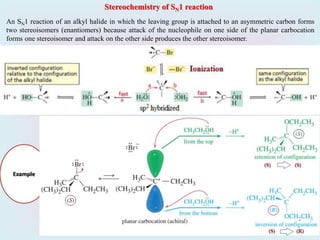
Example
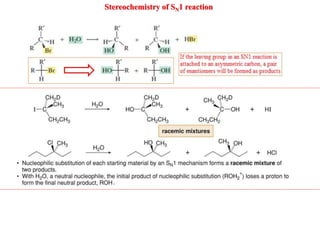
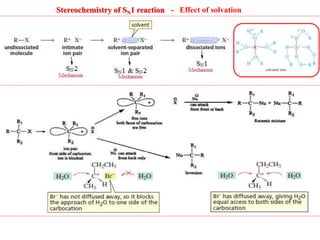
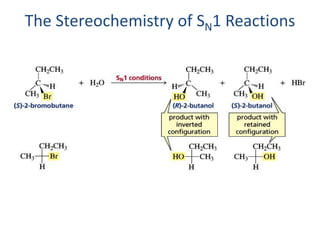
An SN1 reaction of an alkyl halide in which the leaving group is attached to an asymmetric carbon forms
two stereoisomers (enantiomers) because attack of the nucleophile on one side of the planar carbocation
forms one stereoisomer and attack on the other side produces the other stereoisomer.
Stereochemistry of SN1 reaction
Stereochemistry of SN1 reaction - Effect of solvation
The Stereochemistry of SN1 Reactions
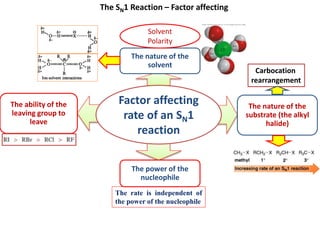
The SN1 Reaction – Factor affecting
Factor affecting
rate of an SN1
reaction
The nature of the
substrate (the alkyl
halide)
The ability of the
leaving group to
leave
The power of the
nucleophile
The nature of the
solvent
Solvent
Polarity
The rate is independent of
the power of the nucleophile
Carbocation
rearrangement
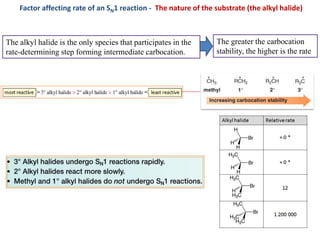
Factor affecting rate of an SN1 reaction - The nature of the substrate (the alkyl halide)
The alkyl halide is the only species that participates in the
rate-determining step forming intermediate carbocation.
The greater the carbocation
stability, the higher is the rate
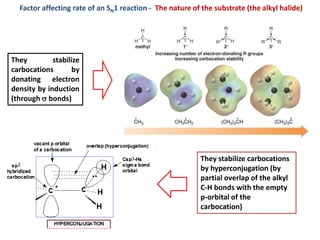
They stabilize
carbocations by
donating electron
density by induction
(through s bonds)
Factor affecting rate of an SN1 reaction - The nature of the substrate (the alkyl halide)
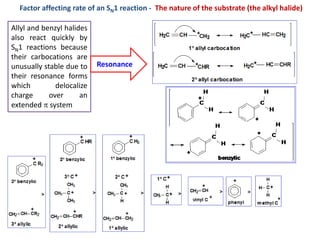
They stabilize carbocations
by hyperconjugation (by
partial overlap of the alkyl
C-H bonds with the empty
p-orbital of the
carbocation)
Factor affecting rate of an SN1 reaction - The nature of the substrate (the alkyl halide)
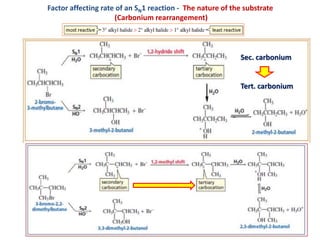
Allyl and benzyl halides
also react quickly by
SN1 reactions because
their carbocations are
unusually stable due to
their resonance forms
which delocalize
charge over an
extended  system
Resonance
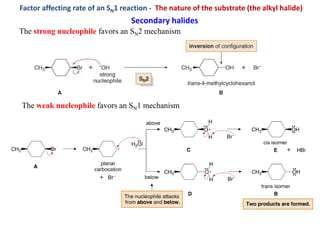
Factor affecting rate of an SN1 reaction - The nature of the substrate
(Carbonium rearrangement)
Sec. carbonium
Tert. carbonium
Factor affecting rate of an SN1 reaction - The nature of the substrate (the alkyl halide)
The strong nucleophile favors an SN2 mechanism
The weak nucleophile favors an SN1 mechanism
Secondary halides
Factor affecting rate of an SN1 reaction
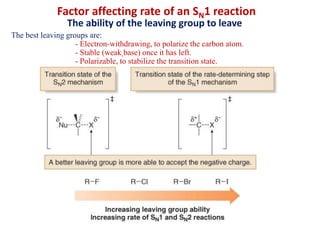
The ability of the leaving group to leave
The best leaving groups are:
- Electron-withdrawing, to polarize the carbon atom.
- Stable (weak base) once it has left.
- Polarizable, to stabilize the transition state.
Factor affecting rate of an SN1 reaction
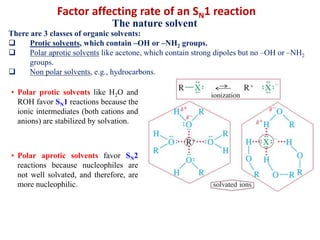
The nature solvent
There are 3 classes of organic solvents:
 Protic solvents, which contain –OH or –NH2 groups.
 Polar aprotic solvents like acetone, which contain strong dipoles but no –OH or –NH2
groups.
 Non polar solvents, e.g., hydrocarbons.
• Polar protic solvents like H2O and
ROH favor SN1 reactions because the
ionic intermediates (both cations and
anions) are stabilized by solvation.
• Polar aprotic solvents favor SN2
reactions because nucleophiles are
not well solvated, and therefore, are
more nucleophilic.
Cl
_
H
H
O
H
H
O
H
H
O
H
H
O
d +
d +
d +
d +
C
+
H
H
O
H
H
O
H
H
OH
H O
H
H
O
H
H
O
d _
d _
d _
d _
d _
d _
sp2
trigonal planar
C
R
R
R
Cl C
R
RR
Cl
d _
d +
H
H
O
H H
O
H
H
O
H
H O
H
H
O
H
H
O
‡
sp3
tetrahedral
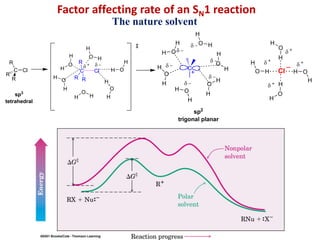
Factor affecting rate of an SN1 reaction
The nature solvent
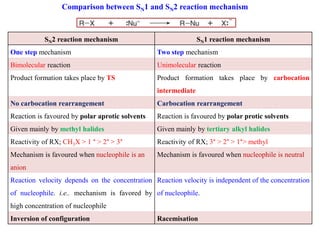
Comparison between SN1 and SN2 reaction mechanism
SN2 reaction mechanism SN1 reaction mechanism
One step mechanism Two step mechanism
Bimolecular reaction Unimolecular reaction
Product formation takes place by TS Product formation takes place by carbocation
intermediate
No carbocation rearrangement Carbocation rearrangement
Reaction is favoured by polar aprotic solvents Reaction is favoured by polar protic solvents
Given mainly by methyl halides Given mainly by tertiary alkyl halides
Reactivity of RX; CH3X > 1 ° > 2° > 3° Reactivity of RX; 3° > 2° > 1°> methyl
Mechanism is favoured when nucleophile is an
anion
Mechanism is favoured when nucleophile is neutral
Reaction velocity depends on the concentration
of nucleophile. i.e.. mechanism is favored by
high concentration of nucleophile
Reaction velocity is independent of the concentration
of nucleophile.
Inversion of configuration Racemisation
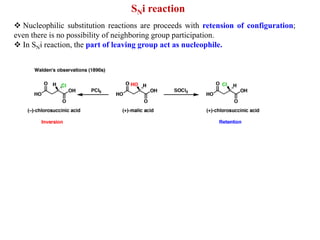
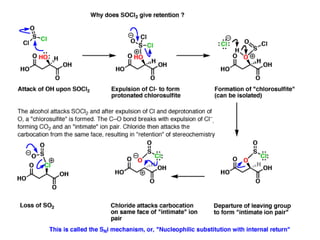
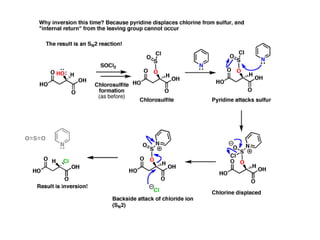
SNi reaction
 Nucleophilic substitution reactions are proceeds with retension of configuration;
even there is no possibility of neighboring group participation.
 In SNi reaction, the part of leaving group act as nucleophile.
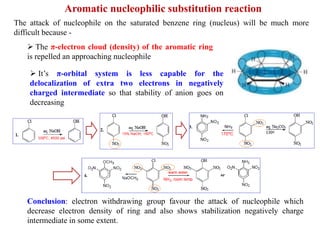
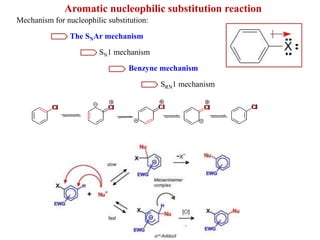
Aromatic nucleophilic substitution reaction
The attack of nucleophile on the saturated benzene ring (nucleus) will be much more
difficult because -
 The π-electron cloud (density) of the aromatic ring
is repelled an approaching nucleophile
 It’s π-orbital system is less capable for the
delocalization of extra two electrons in negatively
charged intermediate so that stability of anion goes on
decreasing
Conclusion: electron withdrawing group favour the attack of nucleophile which
decrease electron density of ring and also shows stabilization negatively charge
intermediate in some extent.
Aromatic nucleophilic substitution reaction
Mechanism for nucleophilic substitution:
The SNAr mechanism
SN1 mechanism
Benzyne mechanism
SRN1 mechanism
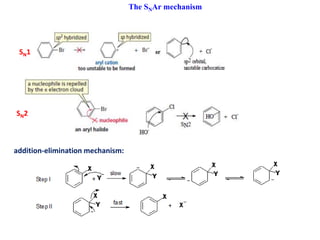
The SNAr mechanism
SN2
SN1
addition-elimination mechanism:
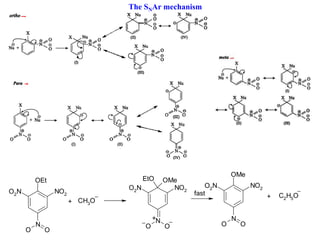
The SNAr mechanism
N
NO2O2N
OO
OEt
CH3O
N
NO2O2
N
OO
EtO OMe
N
NO2O2
N
OO
OMe
C2H5O
+
+
fast +
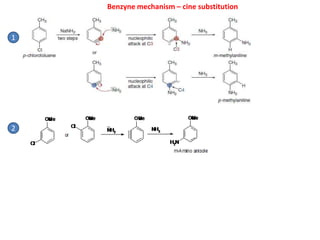
Benzyne mechanism – cine substitution
Cl
H
NaNH2 NH3
NH2
NH2
+ + +
[Chlorobenzene] [Benzyne]
Strong bases - sodamide NaNH2 or certain metal alcoxides RONa (e.g. Me3COK)
Structure of benzyne:
Mechanism
Order of halide reactivity is Br > I > Cl >> F, when the reaction is performed with NaNH2
in liquid ammonia
Benzyne mechanism – cine substitution
1
2
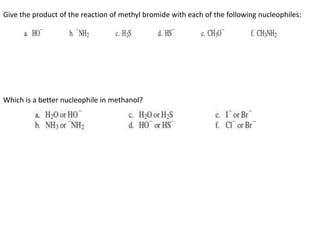
Give the product of the reaction of methyl bromide with each of the following nucleophiles:
Which is a better nucleophile in methanol?
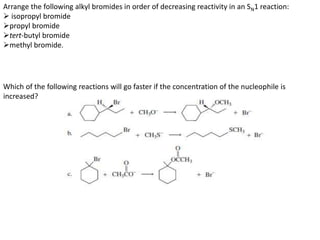
Arrange the following alkyl bromides in order of decreasing reactivity in an SN1 reaction:
 isopropyl bromide
propyl bromide
tert-butyl bromide
methyl bromide.
Which of the following reactions will go faster if the concentration of the nucleophile is
increased?
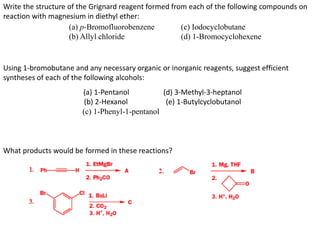
Write the structure of the Grignard reagent formed from each of the following compounds on
reaction with magnesium in diethyl ether:
(a) p-Bromofluorobenzene (c) Iodocyclobutane
(b) Allyl chloride (d) 1-Bromocyclohexene
Using 1-bromobutane and any necessary organic or inorganic reagents, suggest efficient
syntheses of each of the following alcohols:
(a) 1-Pentanol (d) 3-Methyl-3-heptanol
(b) 2-Hexanol (e) 1-Butylcyclobutanol
(c) 1-Phenyl-1-pentanol
What products would be formed in these reactions?
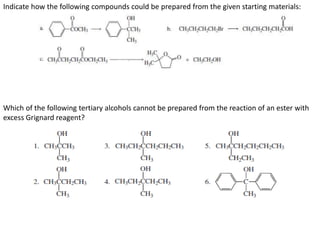
Indicate how the following compounds could be prepared from the given starting materials:
Which of the following tertiary alcohols cannot be prepared from the reaction of an ester with
excess Grignard reagent?

Alkyl halide reactions

  • 1.
    Reactions of alkylhalides Dr. B. R. Thorat Department of Chemistry Govt. of Maharashtra Ismail Yusuf College, Jogeshwari (E), Maharashtra 400060
  • 2.
    Alkyl Halides inNature Synthesized by red algae Synthesized by sea hare a sea hare red algae
  • 3.
  • 4.
    Alkyl halide Primary, secondary,tertiary alkyl halide Alkyl halides are organic molecules containing a halogen atom bonded to an sp3 hybridized carbon atom. sp2 sp2 sp3
  • 5.
  • 6.
    Reactivity of alkylhalide The electronegative halogen atom in alkyl halides creates a polar C—X bond, making the carbon atom electron deficient. • C-X bond length increases as you go down periodic table • C-X bond become weaker as you go down periodic table Polarized C-X bond
  • 7.
    Reactivity of alkylhalide SN2 Reaction SN1 Reaction
  • 8.
    Effect of nucleophile andleaving group on rate of reaction Poorleavinggroups Goodleavinggroups There are two kinds of substitution reactions, called SN1 and SN2.
  • 9.
    Reactivity of alkylhalide – SN2 Reaction Bimolecular (or 2nd order) means that the rate of an SN2 reaction is directly proportional to the molar concentration of two reacting molecules, the alkyl halide ‘substrate’ and the nucleophile: Example
  • 10.
  • 11.
    :BrC H .. .. –.. ..HO C H Br d –.. ..HO : .. ..d – C H HO .. .. –.. .. :Br CH3(CH2)5 H3C (CH2)5 CH3 CH3(CH2)5 CH3 CH3
  • 12.
    Stereochemistry SN2 reaction Walden inversion AllSN2 reactions proceed with backside attack of the nucleophile, resulting in inversion of configuration at a stereogenic center.
  • 13.
  • 14.
    SN2 Reaction Factor affecting rateof an SN2 reaction The nature of the substrate (the alkyl halide) The ability of the leaving group to leave The power of the nucleophile The nature of the solvent Nucleophilicity Solvent Polarity
  • 15.
    Factor affecting rateof an SN2 reaction The nature of the substrate • Methyl and 1° alkyl halides undergo SN2 reactions with ease. • 2° Alkyl halides react more slowly. • 3° Alkyl halides do not undergo SN2 reactions. Steric hindrance caused by bulky R groups makes nucleophilic attack from the backside more difficult, slowing the reaction rate. Anything that decreases the positive charge on the carbon site by giving electrons, decreases the reaction rate while anything that increases positive charge on the same by withdrawing electron, increases the rate of the reaction.
  • 16.
    Mechanism of SN2Reactions activation energy: DG1 activation energy: DG2 Steric effect in T.S. Energy reaction coordinate reaction coordinate (higher steric Effect in T.S.)
  • 17.
    Factor affecting rateof an SN2 reaction The power of the nucleophile  The better the nucleophile, the faster the rate of SN2 reactions.  A negatively charged nucleophile is stronger than its neutral counterpart.  Nucleophilicity decreases from left to right in periodic table.  Increases down Periodic Table, as size and polarizability increase. I n c r e a s e s
  • 18.
  • 19.
    Factor affecting rateof an SN2 reaction The ability of the leaving group to leave The best leaving groups are: - Lower basicity - Electron-withdrawing, to polarize the carbon atom. - Stable (weak base) once it has left. - Polarizable, to stabilize the transition state.  Iodine (-I) is a good leaving group because iodide (I-) is non basic and stabilize their negative charge.  The hydroxyl group (-OH) is a poor leaving group because hydroxide (OH-) is a strong base. relative rates of reaction pKa HX HO - + RCH2I RCH2OH + I - 30 000 -10 HO - + RCH2Br RCH2OH + Br - 10 000 -9 HO - + RCH2Cl RCH2OH + Cl - 200 -7 HO - + RCH2F RCH2OH + F - 1 3.2 Carbon and iodine, however, have the same electronegativity. Why, then, does an alkyl iodide undergo a substitution reaction? We know that larger atoms are more polarizable than smaller atoms.
  • 20.
    Polarizability increase Rateof Reaction Factor affecting rate of an SN2 reaction
  • 21.
    Factor affecting rateof an SN2 reaction The nature solvent There are 3 classes of organic solvents:  Protic solvents, which contain –OH or –NH2 groups. Protic solvents slow down SN2 reactions.  Polar aprotic solvents like acetone, which contain strong dipoles but no –OH or –NH2 groups. Polar aprotic solvents speed up SN2 reactions.  Non polar solvents, e.g., hydrocarbons. SN2 reactions are relatively slow in non polar solvents. Protic solvents (e.g., H2O, MeOH, EtOH, CH3COOH, etc.) cluster around the Nu:- (solvate it) and lower its energy (stabilize it) and reduce its reactivity via H- bonding. Iodide ion is a better nucleophile than fluoride ion in a protic solvent - extent of solvation.
  • 22.
     Polar AproticSolvents solvate the cation counterion of the nucleophile but not the nucleophile.  Examples include acetonitrile (CH3CN), acetone (CH3COCH3), dimethylformamide (DMF) [(CH3)2NC=OH], dimethyl sulfoxide, DMSO [(CH3)2SO], hexamethylphosphoramide, HMPA {[(CH3)2N]3PO} and dimethylacetamide (DMA).
  • 23.
    The SN1 Reaction The SN1 reaction is a unimolecular nucleophilic substitution.  It is a two step reaction with a carbocation intermediate.  Rate is first order in the alkyl halide, zero order in the nucleophile.  Racemization occurs. Key points Hydrolysis of tert-butyl bromide with water Kinetic Study Key features of the SN1 mechanism are that it has two steps, and carbocations are formed as reactive intermediates.
  • 24.
  • 25.
    Stereochemistry of SN1reaction Example An SN1 reaction of an alkyl halide in which the leaving group is attached to an asymmetric carbon forms two stereoisomers (enantiomers) because attack of the nucleophile on one side of the planar carbocation forms one stereoisomer and attack on the other side produces the other stereoisomer.
  • 26.
  • 27.
    Stereochemistry of SN1reaction - Effect of solvation
  • 28.
  • 29.
    The SN1 Reaction– Factor affecting Factor affecting rate of an SN1 reaction The nature of the substrate (the alkyl halide) The ability of the leaving group to leave The power of the nucleophile The nature of the solvent Solvent Polarity The rate is independent of the power of the nucleophile Carbocation rearrangement
  • 30.
    Factor affecting rateof an SN1 reaction - The nature of the substrate (the alkyl halide) The alkyl halide is the only species that participates in the rate-determining step forming intermediate carbocation. The greater the carbocation stability, the higher is the rate
  • 31.
    They stabilize carbocations by donatingelectron density by induction (through s bonds) Factor affecting rate of an SN1 reaction - The nature of the substrate (the alkyl halide) They stabilize carbocations by hyperconjugation (by partial overlap of the alkyl C-H bonds with the empty p-orbital of the carbocation)
  • 32.
    Factor affecting rateof an SN1 reaction - The nature of the substrate (the alkyl halide) Allyl and benzyl halides also react quickly by SN1 reactions because their carbocations are unusually stable due to their resonance forms which delocalize charge over an extended  system Resonance
  • 33.
    Factor affecting rateof an SN1 reaction - The nature of the substrate (Carbonium rearrangement) Sec. carbonium Tert. carbonium
  • 34.
    Factor affecting rateof an SN1 reaction - The nature of the substrate (the alkyl halide) The strong nucleophile favors an SN2 mechanism The weak nucleophile favors an SN1 mechanism Secondary halides
  • 35.
    Factor affecting rateof an SN1 reaction The ability of the leaving group to leave The best leaving groups are: - Electron-withdrawing, to polarize the carbon atom. - Stable (weak base) once it has left. - Polarizable, to stabilize the transition state.
  • 36.
    Factor affecting rateof an SN1 reaction The nature solvent There are 3 classes of organic solvents:  Protic solvents, which contain –OH or –NH2 groups.  Polar aprotic solvents like acetone, which contain strong dipoles but no –OH or –NH2 groups.  Non polar solvents, e.g., hydrocarbons. • Polar protic solvents like H2O and ROH favor SN1 reactions because the ionic intermediates (both cations and anions) are stabilized by solvation. • Polar aprotic solvents favor SN2 reactions because nucleophiles are not well solvated, and therefore, are more nucleophilic.
  • 37.
    Cl _ H H O H H O H H O H H O d + d + d+ d + C + H H O H H O H H OH H O H H O H H O d _ d _ d _ d _ d _ d _ sp2 trigonal planar C R R R Cl C R RR Cl d _ d + H H O H H O H H O H H O H H O H H O ‡ sp3 tetrahedral Factor affecting rate of an SN1 reaction The nature solvent
  • 38.
    Comparison between SN1and SN2 reaction mechanism SN2 reaction mechanism SN1 reaction mechanism One step mechanism Two step mechanism Bimolecular reaction Unimolecular reaction Product formation takes place by TS Product formation takes place by carbocation intermediate No carbocation rearrangement Carbocation rearrangement Reaction is favoured by polar aprotic solvents Reaction is favoured by polar protic solvents Given mainly by methyl halides Given mainly by tertiary alkyl halides Reactivity of RX; CH3X > 1 ° > 2° > 3° Reactivity of RX; 3° > 2° > 1°> methyl Mechanism is favoured when nucleophile is an anion Mechanism is favoured when nucleophile is neutral Reaction velocity depends on the concentration of nucleophile. i.e.. mechanism is favored by high concentration of nucleophile Reaction velocity is independent of the concentration of nucleophile. Inversion of configuration Racemisation
  • 39.
    SNi reaction  Nucleophilicsubstitution reactions are proceeds with retension of configuration; even there is no possibility of neighboring group participation.  In SNi reaction, the part of leaving group act as nucleophile.
  • 42.
    Aromatic nucleophilic substitutionreaction The attack of nucleophile on the saturated benzene ring (nucleus) will be much more difficult because -  The π-electron cloud (density) of the aromatic ring is repelled an approaching nucleophile  It’s π-orbital system is less capable for the delocalization of extra two electrons in negatively charged intermediate so that stability of anion goes on decreasing Conclusion: electron withdrawing group favour the attack of nucleophile which decrease electron density of ring and also shows stabilization negatively charge intermediate in some extent.
  • 43.
    Aromatic nucleophilic substitutionreaction Mechanism for nucleophilic substitution: The SNAr mechanism SN1 mechanism Benzyne mechanism SRN1 mechanism
  • 44.
  • 45.
    The SNAr mechanism N NO2O2N OO OEt CH3O N NO2O2 N OO EtOOMe N NO2O2 N OO OMe C2H5O + + fast +
  • 46.
    Benzyne mechanism –cine substitution Cl H NaNH2 NH3 NH2 NH2 + + + [Chlorobenzene] [Benzyne] Strong bases - sodamide NaNH2 or certain metal alcoxides RONa (e.g. Me3COK) Structure of benzyne: Mechanism Order of halide reactivity is Br > I > Cl >> F, when the reaction is performed with NaNH2 in liquid ammonia
  • 47.
    Benzyne mechanism –cine substitution 1 2
  • 48.
    Give the productof the reaction of methyl bromide with each of the following nucleophiles: Which is a better nucleophile in methanol?
  • 49.
    Arrange the followingalkyl bromides in order of decreasing reactivity in an SN1 reaction:  isopropyl bromide propyl bromide tert-butyl bromide methyl bromide. Which of the following reactions will go faster if the concentration of the nucleophile is increased?
  • 50.
    Write the structureof the Grignard reagent formed from each of the following compounds on reaction with magnesium in diethyl ether: (a) p-Bromofluorobenzene (c) Iodocyclobutane (b) Allyl chloride (d) 1-Bromocyclohexene Using 1-bromobutane and any necessary organic or inorganic reagents, suggest efficient syntheses of each of the following alcohols: (a) 1-Pentanol (d) 3-Methyl-3-heptanol (b) 2-Hexanol (e) 1-Butylcyclobutanol (c) 1-Phenyl-1-pentanol What products would be formed in these reactions?
  • 51.
    Indicate how thefollowing compounds could be prepared from the given starting materials: Which of the following tertiary alcohols cannot be prepared from the reaction of an ester with excess Grignard reagent?