

Salt Hydrolysis: reaction of the anions or
cations in a salt with water to form an
acidic or basic solution.
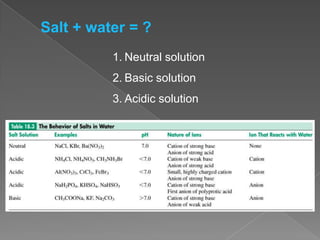
Salt + water = ?
1. Neutral solution
2. Basic solution
3. Acidic solution
Salt + water = ?
1. Neutral solution:
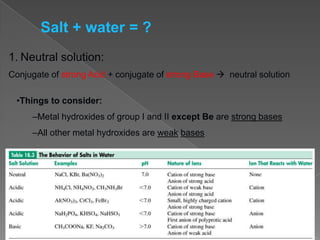
Conjugate of strong Acid + conjugate of strong Base  neutral solution
•Things to consider:
–Metal hydroxides of group I and II except Be are strong bases
–All other metal hydroxides are weak bases
Salt + water = ?
1. Neutral solution:
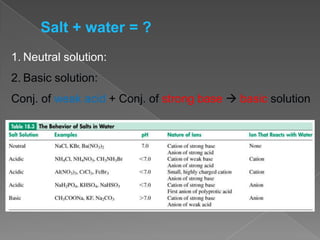
2. Basic solution:
Conj. of weak acid + Conj. of strong base  basic solution


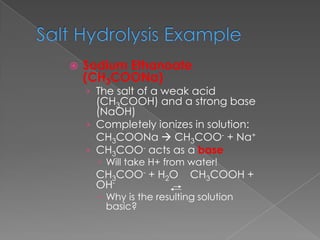
Sodium Ethanoate
(CH3COONa)

› The salt of a weak acid

(CH3COOH) and a strong base
(NaOH)
› Completely ionizes in solution:
CH3COONa  CH3COO- + Na+
› CH3COO- acts as a base
 Will take H+ from water!

CH3COO- + H2O
OH-

CH3COOH +

 Why is the resulting solution
basic?
Salt + water = ?
1. Neutral solution:
2. Basic solution:

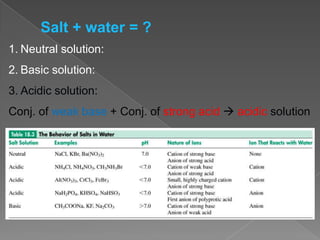
3. Acidic solution:
Conj. of weak base + Conj. of strong acid  acidic solution


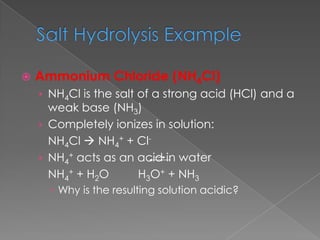
Ammonium Chloride (NH4Cl)
› NH4Cl is the salt of a strong acid (HCl) and a

weak base (NH3)
› Completely ionizes in solution:
NH4Cl  NH4+ + Cl› NH4+ acts as an acid in water
NH4+ + H2O
H3O+ + NH3

 Why is the resulting solution acidic?


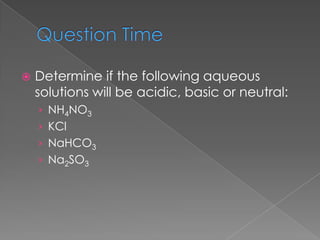
Determine if the following aqueous
solutions will be acidic, basic or neutral:
› NH4NO3

› KCl
› NaHCO3
› Na2SO3
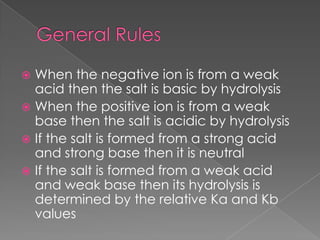
When the negative ion is from a weak
acid then the salt is basic by hydrolysis
 When the positive ion is from a weak
base then the salt is acidic by hydrolysis
 If the salt is formed from a strong acid
and strong base then it is neutral
 If the salt is formed from a weak acid
and weak base then its hydrolysis is
determined by the relative Ka and Kb
values



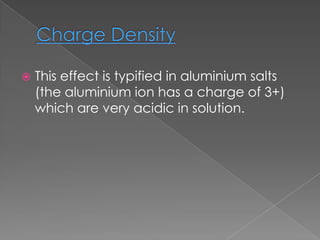
This effect is typified in aluminium salts
(the aluminium ion has a charge of 3+)
which are very acidic in solution.

Salt hydrolysis

  • 2.
     Salt Hydrolysis: reactionof the anions or cations in a salt with water to form an acidic or basic solution.
  • 3.
    Salt + water= ? 1. Neutral solution 2. Basic solution 3. Acidic solution
  • 4.
    Salt + water= ? 1. Neutral solution: Conjugate of strong Acid + conjugate of strong Base  neutral solution •Things to consider: –Metal hydroxides of group I and II except Be are strong bases –All other metal hydroxides are weak bases
  • 5.
    Salt + water= ? 1. Neutral solution: 2. Basic solution: Conj. of weak acid + Conj. of strong base  basic solution
  • 6.
     Sodium Ethanoate (CH3COONa) › Thesalt of a weak acid (CH3COOH) and a strong base (NaOH) › Completely ionizes in solution: CH3COONa  CH3COO- + Na+ › CH3COO- acts as a base  Will take H+ from water! CH3COO- + H2O OH- CH3COOH +  Why is the resulting solution basic?
  • 7.
    Salt + water= ? 1. Neutral solution: 2. Basic solution: 3. Acidic solution: Conj. of weak base + Conj. of strong acid  acidic solution
  • 8.
     Ammonium Chloride (NH4Cl) ›NH4Cl is the salt of a strong acid (HCl) and a weak base (NH3) › Completely ionizes in solution: NH4Cl  NH4+ + Cl› NH4+ acts as an acid in water NH4+ + H2O H3O+ + NH3  Why is the resulting solution acidic?
  • 9.
     Determine if thefollowing aqueous solutions will be acidic, basic or neutral: › NH4NO3 › KCl › NaHCO3 › Na2SO3
  • 10.
    When the negativeion is from a weak acid then the salt is basic by hydrolysis  When the positive ion is from a weak base then the salt is acidic by hydrolysis  If the salt is formed from a strong acid and strong base then it is neutral  If the salt is formed from a weak acid and weak base then its hydrolysis is determined by the relative Ka and Kb values 
  • 11.
     This effect istypified in aluminium salts (the aluminium ion has a charge of 3+) which are very acidic in solution.

Editor's Notes

  • #10 NH4NO3 acidic because NH4 is a weak acid that can interact with water!KCl neutral because the salt is made from a strong acid and baseNaHCO3 is basic because HCO3- can act as a weak baseNa2SO3 is basic because SO32- can act as a weak base