RADIOACTIVE DECAY  Understanding decay concepts Facts about Radioactive decay Types of radioactive decay Understanding Half-life concepts Graphing and calculating Half-life Using count rate to study and analyse radioactive decay Contents of this slide-share presentation Copyright www.sciencetutors.zoomshare.com
What is radioactive decay? Radioactive decay   is the process in which an unstable atomic nucleus loses energy by emitting ionizing particles and radiation transforming the parent nuclide atom into a different atom called daughter nuclide .
RADIOACTIVE COUNT RATE The count rate of a radioactive substance is the amount of radiation detected by GM counter coming from the radioactive substance . How to Calculate Count Rate knowing the half-life of a radioactive sample/substance, can be useful when calculating what the count rate will be at some time in the future
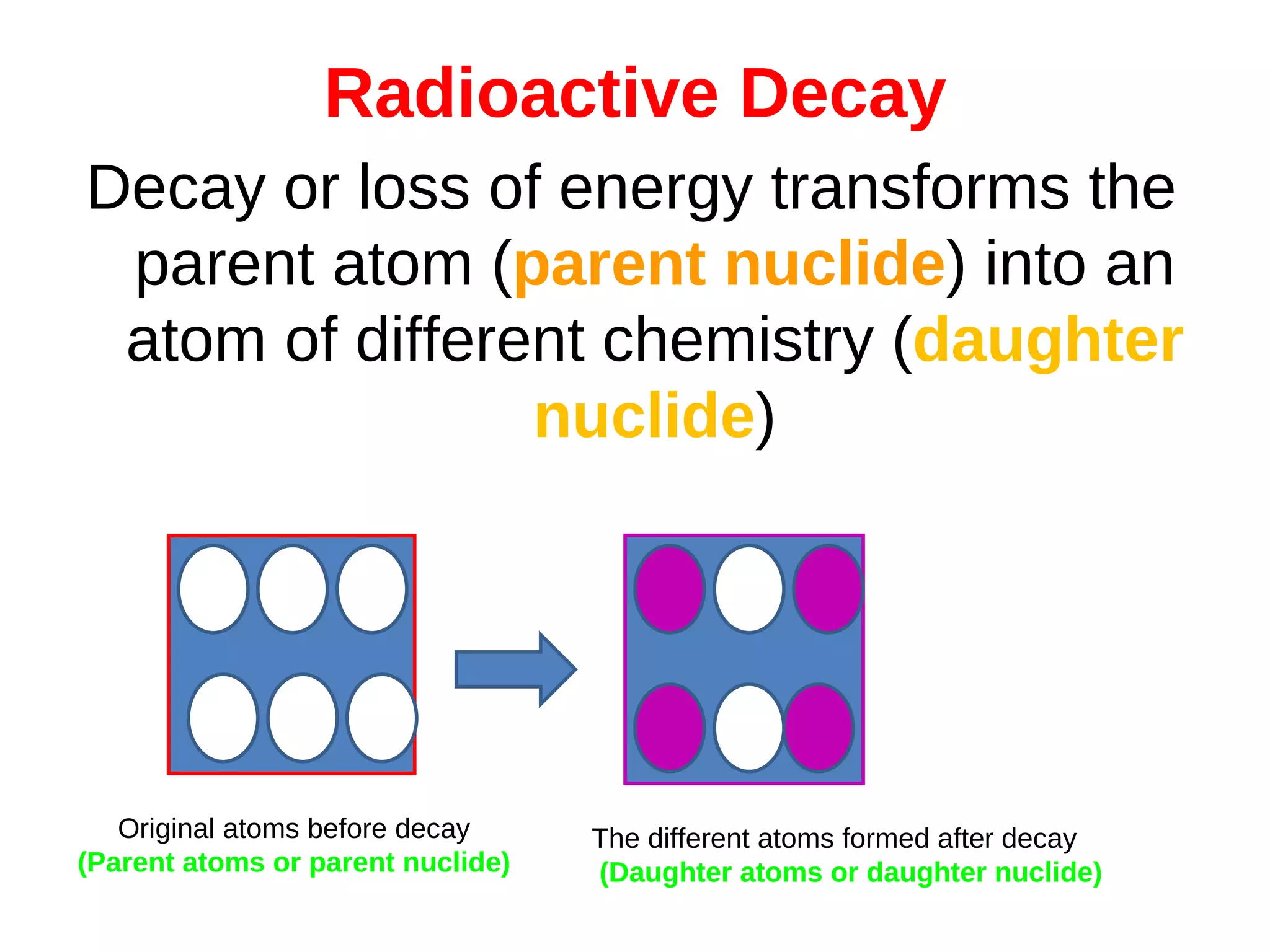
Radioactive Decay Decay or loss of energy transforms the parent atom ( parent nuclide ) into an atom of different chemistry ( daughter nuclide ) Original atoms before decay (Parent atoms or parent nuclide) The different atoms formed after decay (Daughter atoms or daughter nuclide)
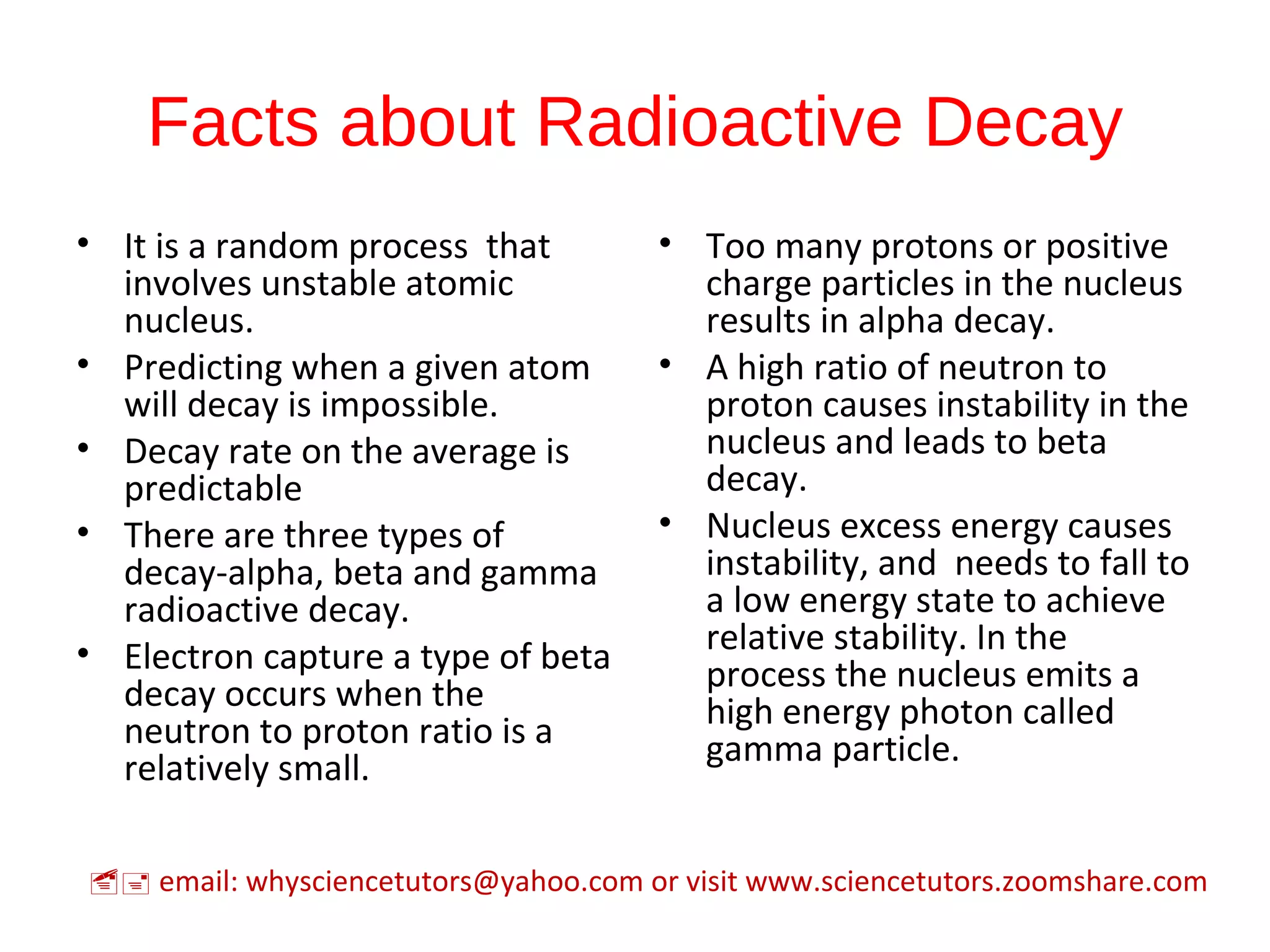
Facts about Radioactive Decay It is a random process  that involves unstable atomic nucleus. Predicting when a given atom will decay is impossible. Decay rate on the average is predictable There are three types of decay-alpha, beta and gamma radioactive decay. Electron capture a type of beta decay occurs when the neutron to proton ratio is a relatively small. Too many protons or positive charge particles in the nucleus results in alpha decay. A high ratio of neutron to proton causes instability in the nucleus and leads to beta decay. Nucleus excess energy causes instability, and  needs to fall to a low energy state to achieve  relative stability. In the process the nucleus emits a high energy photon called gamma particle.    email: whysciencetutors@yahoo.com or visit www.sciencetutors.zoomshare.com
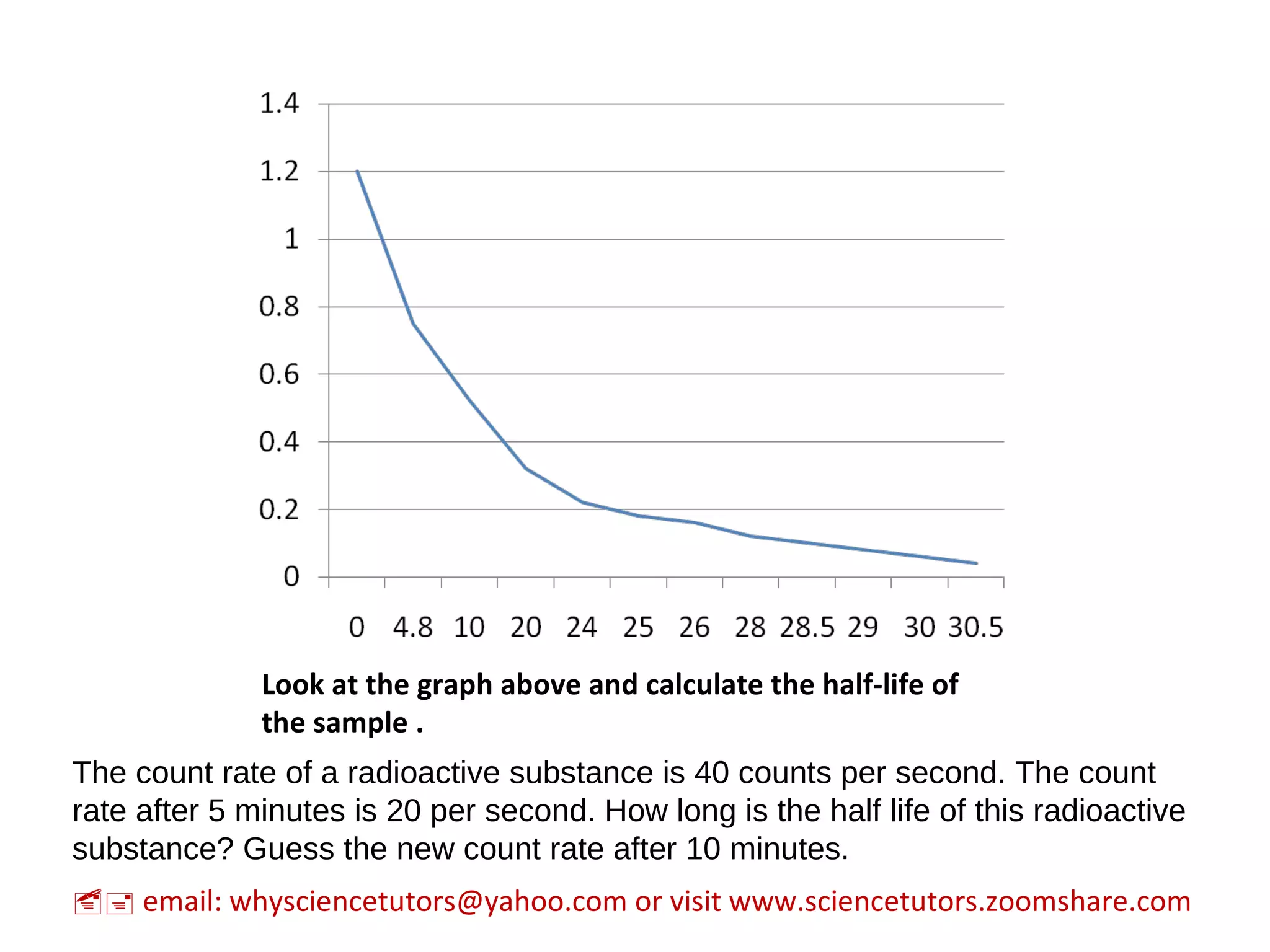
Look at the graph above and calculate the half-life of the sample . The count rate of a radioactive substance is 40 counts per second. The count rate after 5 minutes is 20 per second. How long is the half life of this radioactive substance? Guess the new count rate after 10 minutes.    email: whysciencetutors@yahoo.com or visit www.sciencetutors.zoomshare.com
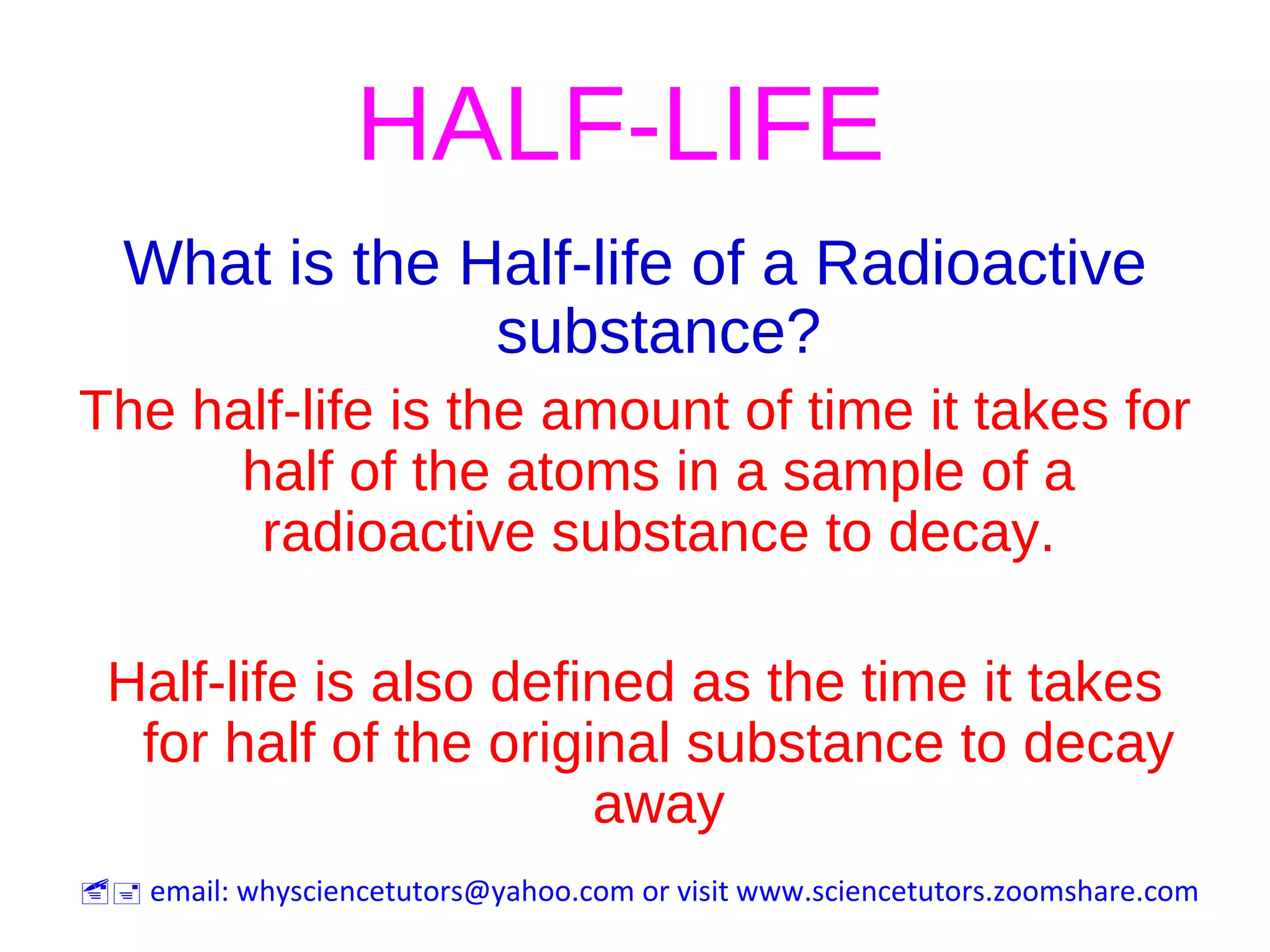
HALF-LIFE  What is the Half-life of a Radioactive substance? The half-life is the amount of time it takes for half of the atoms in a sample of a radioactive substance to decay. Half-life is also defined as the time it takes for half of the original substance to decay away    email: whysciencetutors@yahoo.com or visit www.sciencetutors.zoomshare.com
For more Half-life calculations and other related topics Visit  www.sciencetutors.zoomshare.com Or     email: whysciencetutors@yahoo.com

RADIOACTIVE DECAY AND HALF-LIFE CONCEPTS

  • 1.
    RADIOACTIVE DECAY Understanding decay concepts Facts about Radioactive decay Types of radioactive decay Understanding Half-life concepts Graphing and calculating Half-life Using count rate to study and analyse radioactive decay Contents of this slide-share presentation Copyright www.sciencetutors.zoomshare.com
  • 2.
    What is radioactivedecay? Radioactive decay is the process in which an unstable atomic nucleus loses energy by emitting ionizing particles and radiation transforming the parent nuclide atom into a different atom called daughter nuclide .
  • 3.
    RADIOACTIVE COUNT RATEThe count rate of a radioactive substance is the amount of radiation detected by GM counter coming from the radioactive substance . How to Calculate Count Rate knowing the half-life of a radioactive sample/substance, can be useful when calculating what the count rate will be at some time in the future
  • 4.
    Radioactive Decay Decayor loss of energy transforms the parent atom ( parent nuclide ) into an atom of different chemistry ( daughter nuclide ) Original atoms before decay (Parent atoms or parent nuclide) The different atoms formed after decay (Daughter atoms or daughter nuclide)
  • 5.
    Facts about RadioactiveDecay It is a random process that involves unstable atomic nucleus. Predicting when a given atom will decay is impossible. Decay rate on the average is predictable There are three types of decay-alpha, beta and gamma radioactive decay. Electron capture a type of beta decay occurs when the neutron to proton ratio is a relatively small. Too many protons or positive charge particles in the nucleus results in alpha decay. A high ratio of neutron to proton causes instability in the nucleus and leads to beta decay. Nucleus excess energy causes instability, and needs to fall to a low energy state to achieve relative stability. In the process the nucleus emits a high energy photon called gamma particle.  email: whysciencetutors@yahoo.com or visit www.sciencetutors.zoomshare.com
  • 6.
    Look at thegraph above and calculate the half-life of the sample . The count rate of a radioactive substance is 40 counts per second. The count rate after 5 minutes is 20 per second. How long is the half life of this radioactive substance? Guess the new count rate after 10 minutes.  email: whysciencetutors@yahoo.com or visit www.sciencetutors.zoomshare.com
  • 7.
    HALF-LIFE Whatis the Half-life of a Radioactive substance? The half-life is the amount of time it takes for half of the atoms in a sample of a radioactive substance to decay. Half-life is also defined as the time it takes for half of the original substance to decay away  email: whysciencetutors@yahoo.com or visit www.sciencetutors.zoomshare.com
  • 8.
    For more Half-lifecalculations and other related topics Visit www.sciencetutors.zoomshare.com Or  email: whysciencetutors@yahoo.com