RADIOACTIVE DECAY & HALF-LIFE
CALCULATION
Presenters: Damion Lawrence and MichaelWard
PREREQUISITE KNOWLEDGE
▪ For mastery of the content presented in this
presentation, students should have been taught:
– Atomic Structure
– Mass number
– Atomic number
– The difference between a parent atom and a daughter atom
– the nature of the three types of radioactive emissions
– Analyzing a graph
PRESENTATION OBJECTIVES
At the end of this presentation, students will be able to:
1. State what is meant be the term Radioactive decay
2. Define the term half-life
3. interpret nuclear reactions in the standard form
4. solve problems involving half-life
5. Explain how Carbon Dating is accomplished
RADIOACTIVE DECAY
(section E: Specific objective 3.2)
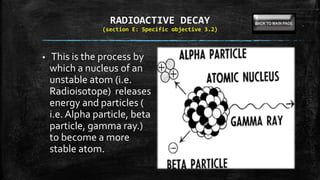
▪ This is the process by
which a nucleus of an
unstable atom (i.e.
Radioisotope) releases
energy and particles (
i.e. Alpha particle, beta
particle, gamma ray.)
to become a more
stable atom.
ALPHA DECAY
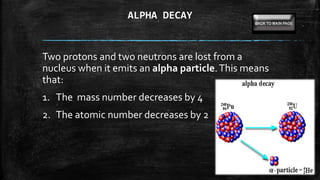
Two protons and two neutrons are lost from a
nucleus when it emits an alpha particle.This means
that:
1. The mass number decreases by 4
2. The atomic number decreases by 2
BETA DECAY
In beta decay, a neutron changes into a proton plus an
electron.The proton stays in the nucleus.The electron
leaves the atom with high energy as a beta particle.
The nucleus has one more proton and one less neutron
when it emits a beta particle.This means that:
1. The mass number stays the same
2. The atomic number increases by 1
GAMMA DECAY
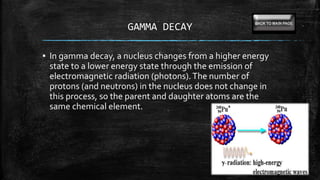
▪ In gamma decay, a nucleus changes from a higher energy
state to a lower energy state through the emission of
electromagnetic radiation (photons).The number of
protons (and neutrons) in the nucleus does not change in
this process, so the parent and daughter atoms are the
same chemical element.
TRANSMUTATION
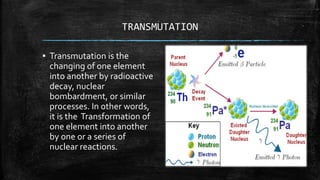
▪ Transmutation is the
changing of one element
into another by radioactive
decay, nuclear
bombardment, or similar
processes. In other words,
it is the Transformation of
one element into another
by one or a series of
nuclear reactions.
TRANSMUTATION
▪ When an unstable atom undergoes an Alpha or Beta decay,
it changes into a new element.This process is known as
Transmutation.
▪ This can be further examined by a Nuclear Equation . Since
each element in the periodic table has a unique atomic
number and this number changes when it undergoes an
Alpha decay or beta decay, it can be argued that
transmutation will occur during both decays.
TRANSMUTATION
▪ In the gamma decay as no
particles either protons or
nucleons are released so the
element before the
radioactive gamma decay
and after the gamma decay
remains same. In other
words, the number of
protons (and neutrons) in the
nucleus does not change in
this process, so the parent
and daughter atoms are the
same chemical element.
HALF-LIFE (T1/2)
(section E: Specific objective 3.10)
This is the amount of time required for half the amount
of a radioactive substance to decay.
The half life of any given radioactive isotope does not
vary with temperature ,pressure or any other condition.
Nothing can speed up or slow down the rate at which a
given isotope decays.
HALF-LIFE (T1/2)
▪ The half-life of some isotope is a fraction of a
second while others can be up to billions of years..
For example uranium-238 has a half-life of 4.5x 10⁹
years , while oxygen-19 has a half life of 29.4
seconds
HALF-LIFE (T1/2)
▪ consider what would happen to a 100g sample of
lead which has a half-life of 22 years. At the end of
the 22 years only 50g would be lead-210. At the end
of another 22 years 25g would be remaining.This
process will continue until extremely small
amounts of lead-210 remains.
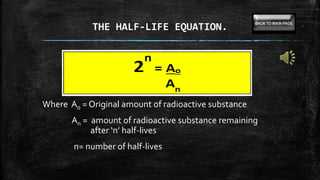
THE HALF-LIFE EQUATION.
Where A0 = Original amount of radioactive substance
An = amount of radioactive substance remaining
after ‘n’ half-lives
n= number of half-lives
TIME ELAPSE EQUATION
Time Elapse(T) = number of half-lives (n) x half-life (T1/2)
Example 3
▪ A radioactive isotope of xenon, xenon-125, has a half-life of
17 hours. If we start with 0.2500g, how many milligrams will
remain after 2 days and 3 hours?
Solution to Example 3
Add 17 hours
(half-life) each
time
Time (h) Amount(g)
Divide the
amount
remaining by 2
each time
0 0.2500
17 0.1250
34 0.0625
51 0.03125
Therefore 0.03125g or 31.25mg will remain after 2days and
3hours (51 hours)
Alternative Solution to example 3
Given
T1/2 = 17 hrs.
Time elapse = 2days 3hrs ( or 51 hrs)
Ao = 0.2500g
An =?
Alternative Solution to example 3
(cont’d)
Step 1 (find number of Half-lives)
From Time Elapse = number of half-lives (n) x half-lives (T1/2)
number of half-lives =Times Elapse/ half-life
Therefore , n = 51hrs/17hrs = 3
Step 2 (find An)
From 2n = Ao/An , An = Ao/2n
An = 0.2500g / 23 , An = 0.2500g/8 , An = 0.03125g or 31.25mg
(answer)
Example 4
▪ Strontium-90(2.500g) was in a 1960 atomic explosion at
Johnson Island at the pacific test site.The half life of
Strontium-90 is 28 years in what year will only 0.3125g
remain?
Solution to Example 4
Divide the
amount
remaining by 2
each time
Amounts (g) Time and year
Add 28
years(half-life )
each time.
2.500 0(1960)
1.250 28(1988)
0.625 56(2016)
0.312 84(2044)
Alternative Solution to example 4
Given
T1/2 = 28 years
Ao = 2.500g
An = 0.3125g
Alternative Solution to example 4
(cont’d)
Step 1 ( find the # of Half-lives (n) )
From 2n = Ao/An 2n = 2.500g/0.3125g 2n = 8
Therefore n = 3
Step 2 (find time elapse)
Time Elapse = n xT1/2 ,Time Elapse = 3 x 28 years, ,Time Elapse = 84yrs
Step 3 ( add elapse time to initial date )
The year in which 0.3125g remains= 1960 +84 = 2044 (answer)
CARBON DATING
(section E: Specific objective 3.11)
▪ A radiometric dating method
for determining the age of life
forms which have died in the
relatively recent past, having a
limit of accuracy of about
60,000 years. Carbon dating is
the result of cosmic radiation
which bombards the Earth’s
atmosphere, which constantly
produces more 14C isotopes
from 14N.
CARBON DATING
▪ For radiocarbon dating to be possible, the material must
once have been part of a living organism.This means that
things like stone, metal and pottery cannot usually be
directly dated by this means unless there is some organic
material embedded or left as a residue.
Activity 1
▪ A radioactive source is found to be emitting, on
average, 880 particles per second. If the source has
a half life of 25 minutes, how much time will elapse
before the average emission rate becomes 110 per
second?
( Source: CSEC Physics Paper-03 , May 2007)
Activity 2
a. How many half-lives would it take for a sample of
Carbon-14 to be reduced to 1/32 of its original mass?
b. Given that Carbon -14 has a half-life of 5700 years,
determine how long it would take for this reduction to
occur.
(Source: CSEC Physics Paper -02 May 2008)
Activity 3
▪ A gram of living plant material with carbon-14, decays at a rate of
about 16 disintegrations per minute. When the plant dies, the
carbon-14 decays, with a half-life of 5600 years. A gram of the dead
plant is found to decay at about 1 disintegration per minute.
Calculate the probable age of the plant.
(Source: CSEC Physics Paper -02 May 2011)
GLOSSARY OF TERMS
▪ Atomic number (or Proton number):
The number of proton in the nucleus of
an atom.The atomic number
determines which element an atom is.
GLOSSARY OF TERMS
▪ Daughter atom : A
daughter atom refers to
the isotope that is the
product atom formed
during the radioactive
decay in a nuclear
reaction.
GLOSSARY OF TERMS
▪ Emission: the act of sending
out gas, heat, light, etc
GLOSSARY OF TERMS
▪ Isotope : Any atom having
the same atomic number
but different mass
number. In other words,
they have the same
number of protons and
electrons but different
number of neutrons.
GLOSSARY OF TERMS
▪ Mass number (or Nucleon
number): The mass
number (A), also called
atomic mass number or
nucleon number, is the
total number of protons
and neutrons (together
known as nucleons) in an
atomic nucleus.
GLOSSARY OF TERMS
▪ Nuclei : plural of nucleus (
i.e. the central part of an
atom that comprises
nearly all of the atomic
mass and that consists of
protons and neutrons)
GLOSSARY OF TERMS
▪ Parent Atom: A parent
atom is a term used to
describe the original state
of an atom or element
before it undergoes a
chemical change.
GLOSSARY OF TERMS
▪ Radioisotope: radioactive
form of an element,
consisting of atoms with
unstable nuclei, which
undergo radioactive decay
to stable forms, emitting
characteristic alpha, beta,
or gamma radiation.
GLOSSARY OF TERMS
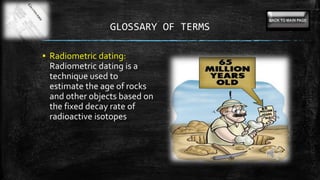
▪ Radiometric dating:
Radiometric dating is a
technique used to
estimate the age of rocks
and other objects based on
the fixed decay rate of
radioactive isotopes
REFERENCES
Caribbean Examinations Council (CXC) ,2014 . Physics CSEC Past Papers
How Carbon DatingWorks. Retrieved from:
https://www.youtube.com/watch?v=Kcuz1JiMk9k
How Does Radiocarbon DatingWork? - Instant Egghead #28. Retrieved from:
https://www.youtube.com/watch?v=phZeE7Att_s
Radioactive Decay & Nuclear Equations. Retrieved from:
https://www.youtube.com/watch?v=uF6EgMQ8STA
Solving half life problems. Retrieved from:
https://www.youtube.com/watch?v=_pcPz1VXVms
REFERENCES
▪ Nuclear Physics 8.1: NaturalTransmutations. Retrieved from:
https://www.youtube.com/watch?v=I7WTQD2xYtQ
▪ What are Alpha, Beta and Gamma Decay? Retrieved from:
https://www.youtube.com/watch?v=4FuvyIDM_eQ
▪ What does the term half-life mean? Retrieved from:
https://www.youtube.com/watch?v=tzM6aK5QbSU

Radioactive decay half-life calculation

  • 1.
    RADIOACTIVE DECAY &HALF-LIFE CALCULATION Presenters: Damion Lawrence and MichaelWard
  • 2.
    PREREQUISITE KNOWLEDGE ▪ Formastery of the content presented in this presentation, students should have been taught: – Atomic Structure – Mass number – Atomic number – The difference between a parent atom and a daughter atom – the nature of the three types of radioactive emissions – Analyzing a graph
  • 3.
    PRESENTATION OBJECTIVES At theend of this presentation, students will be able to: 1. State what is meant be the term Radioactive decay 2. Define the term half-life 3. interpret nuclear reactions in the standard form 4. solve problems involving half-life 5. Explain how Carbon Dating is accomplished
  • 4.
    RADIOACTIVE DECAY (section E:Specific objective 3.2) ▪ This is the process by which a nucleus of an unstable atom (i.e. Radioisotope) releases energy and particles ( i.e. Alpha particle, beta particle, gamma ray.) to become a more stable atom.
  • 5.
    ALPHA DECAY Two protonsand two neutrons are lost from a nucleus when it emits an alpha particle.This means that: 1. The mass number decreases by 4 2. The atomic number decreases by 2
  • 6.
    BETA DECAY In betadecay, a neutron changes into a proton plus an electron.The proton stays in the nucleus.The electron leaves the atom with high energy as a beta particle. The nucleus has one more proton and one less neutron when it emits a beta particle.This means that: 1. The mass number stays the same 2. The atomic number increases by 1
  • 7.
    GAMMA DECAY ▪ Ingamma decay, a nucleus changes from a higher energy state to a lower energy state through the emission of electromagnetic radiation (photons).The number of protons (and neutrons) in the nucleus does not change in this process, so the parent and daughter atoms are the same chemical element.
  • 8.
    TRANSMUTATION ▪ Transmutation isthe changing of one element into another by radioactive decay, nuclear bombardment, or similar processes. In other words, it is the Transformation of one element into another by one or a series of nuclear reactions.
  • 9.
    TRANSMUTATION ▪ When anunstable atom undergoes an Alpha or Beta decay, it changes into a new element.This process is known as Transmutation. ▪ This can be further examined by a Nuclear Equation . Since each element in the periodic table has a unique atomic number and this number changes when it undergoes an Alpha decay or beta decay, it can be argued that transmutation will occur during both decays.
  • 10.
    TRANSMUTATION ▪ In thegamma decay as no particles either protons or nucleons are released so the element before the radioactive gamma decay and after the gamma decay remains same. In other words, the number of protons (and neutrons) in the nucleus does not change in this process, so the parent and daughter atoms are the same chemical element.
  • 11.
    HALF-LIFE (T1/2) (section E:Specific objective 3.10) This is the amount of time required for half the amount of a radioactive substance to decay. The half life of any given radioactive isotope does not vary with temperature ,pressure or any other condition. Nothing can speed up or slow down the rate at which a given isotope decays.
  • 12.
    HALF-LIFE (T1/2) ▪ Thehalf-life of some isotope is a fraction of a second while others can be up to billions of years.. For example uranium-238 has a half-life of 4.5x 10⁹ years , while oxygen-19 has a half life of 29.4 seconds
  • 13.
    HALF-LIFE (T1/2) ▪ considerwhat would happen to a 100g sample of lead which has a half-life of 22 years. At the end of the 22 years only 50g would be lead-210. At the end of another 22 years 25g would be remaining.This process will continue until extremely small amounts of lead-210 remains.
  • 14.
    THE HALF-LIFE EQUATION. WhereA0 = Original amount of radioactive substance An = amount of radioactive substance remaining after ‘n’ half-lives n= number of half-lives
  • 15.
    TIME ELAPSE EQUATION TimeElapse(T) = number of half-lives (n) x half-life (T1/2)
  • 16.
    Example 3 ▪ Aradioactive isotope of xenon, xenon-125, has a half-life of 17 hours. If we start with 0.2500g, how many milligrams will remain after 2 days and 3 hours?
  • 17.
    Solution to Example3 Add 17 hours (half-life) each time Time (h) Amount(g) Divide the amount remaining by 2 each time 0 0.2500 17 0.1250 34 0.0625 51 0.03125 Therefore 0.03125g or 31.25mg will remain after 2days and 3hours (51 hours)
  • 18.
    Alternative Solution toexample 3 Given T1/2 = 17 hrs. Time elapse = 2days 3hrs ( or 51 hrs) Ao = 0.2500g An =?
  • 19.
    Alternative Solution toexample 3 (cont’d) Step 1 (find number of Half-lives) From Time Elapse = number of half-lives (n) x half-lives (T1/2) number of half-lives =Times Elapse/ half-life Therefore , n = 51hrs/17hrs = 3 Step 2 (find An) From 2n = Ao/An , An = Ao/2n An = 0.2500g / 23 , An = 0.2500g/8 , An = 0.03125g or 31.25mg (answer)
  • 20.
    Example 4 ▪ Strontium-90(2.500g)was in a 1960 atomic explosion at Johnson Island at the pacific test site.The half life of Strontium-90 is 28 years in what year will only 0.3125g remain?
  • 21.
    Solution to Example4 Divide the amount remaining by 2 each time Amounts (g) Time and year Add 28 years(half-life ) each time. 2.500 0(1960) 1.250 28(1988) 0.625 56(2016) 0.312 84(2044)
  • 22.
    Alternative Solution toexample 4 Given T1/2 = 28 years Ao = 2.500g An = 0.3125g
  • 23.
    Alternative Solution toexample 4 (cont’d) Step 1 ( find the # of Half-lives (n) ) From 2n = Ao/An 2n = 2.500g/0.3125g 2n = 8 Therefore n = 3 Step 2 (find time elapse) Time Elapse = n xT1/2 ,Time Elapse = 3 x 28 years, ,Time Elapse = 84yrs Step 3 ( add elapse time to initial date ) The year in which 0.3125g remains= 1960 +84 = 2044 (answer)
  • 24.
    CARBON DATING (section E:Specific objective 3.11) ▪ A radiometric dating method for determining the age of life forms which have died in the relatively recent past, having a limit of accuracy of about 60,000 years. Carbon dating is the result of cosmic radiation which bombards the Earth’s atmosphere, which constantly produces more 14C isotopes from 14N.
  • 25.
    CARBON DATING ▪ Forradiocarbon dating to be possible, the material must once have been part of a living organism.This means that things like stone, metal and pottery cannot usually be directly dated by this means unless there is some organic material embedded or left as a residue.
  • 26.
    Activity 1 ▪ Aradioactive source is found to be emitting, on average, 880 particles per second. If the source has a half life of 25 minutes, how much time will elapse before the average emission rate becomes 110 per second? ( Source: CSEC Physics Paper-03 , May 2007)
  • 27.
    Activity 2 a. Howmany half-lives would it take for a sample of Carbon-14 to be reduced to 1/32 of its original mass? b. Given that Carbon -14 has a half-life of 5700 years, determine how long it would take for this reduction to occur. (Source: CSEC Physics Paper -02 May 2008)
  • 28.
    Activity 3 ▪ Agram of living plant material with carbon-14, decays at a rate of about 16 disintegrations per minute. When the plant dies, the carbon-14 decays, with a half-life of 5600 years. A gram of the dead plant is found to decay at about 1 disintegration per minute. Calculate the probable age of the plant. (Source: CSEC Physics Paper -02 May 2011)
  • 29.
    GLOSSARY OF TERMS ▪Atomic number (or Proton number): The number of proton in the nucleus of an atom.The atomic number determines which element an atom is.
  • 30.
    GLOSSARY OF TERMS ▪Daughter atom : A daughter atom refers to the isotope that is the product atom formed during the radioactive decay in a nuclear reaction.
  • 31.
    GLOSSARY OF TERMS ▪Emission: the act of sending out gas, heat, light, etc
  • 32.
    GLOSSARY OF TERMS ▪Isotope : Any atom having the same atomic number but different mass number. In other words, they have the same number of protons and electrons but different number of neutrons.
  • 33.
    GLOSSARY OF TERMS ▪Mass number (or Nucleon number): The mass number (A), also called atomic mass number or nucleon number, is the total number of protons and neutrons (together known as nucleons) in an atomic nucleus.
  • 34.
    GLOSSARY OF TERMS ▪Nuclei : plural of nucleus ( i.e. the central part of an atom that comprises nearly all of the atomic mass and that consists of protons and neutrons)
  • 35.
    GLOSSARY OF TERMS ▪Parent Atom: A parent atom is a term used to describe the original state of an atom or element before it undergoes a chemical change.
  • 36.
    GLOSSARY OF TERMS ▪Radioisotope: radioactive form of an element, consisting of atoms with unstable nuclei, which undergo radioactive decay to stable forms, emitting characteristic alpha, beta, or gamma radiation.
  • 37.
    GLOSSARY OF TERMS ▪Radiometric dating: Radiometric dating is a technique used to estimate the age of rocks and other objects based on the fixed decay rate of radioactive isotopes
  • 38.
    REFERENCES Caribbean Examinations Council(CXC) ,2014 . Physics CSEC Past Papers How Carbon DatingWorks. Retrieved from: https://www.youtube.com/watch?v=Kcuz1JiMk9k How Does Radiocarbon DatingWork? - Instant Egghead #28. Retrieved from: https://www.youtube.com/watch?v=phZeE7Att_s Radioactive Decay & Nuclear Equations. Retrieved from: https://www.youtube.com/watch?v=uF6EgMQ8STA Solving half life problems. Retrieved from: https://www.youtube.com/watch?v=_pcPz1VXVms
  • 39.
    REFERENCES ▪ Nuclear Physics8.1: NaturalTransmutations. Retrieved from: https://www.youtube.com/watch?v=I7WTQD2xYtQ ▪ What are Alpha, Beta and Gamma Decay? Retrieved from: https://www.youtube.com/watch?v=4FuvyIDM_eQ ▪ What does the term half-life mean? Retrieved from: https://www.youtube.com/watch?v=tzM6aK5QbSU