Name ID
 Md.Ashaduzzaman 131-15-2392
 Md. Ruhul Amin 131-15-2353
 Shakir Sourov 131-15-2180
 Fdffgfg 131-15-545
 Dtfgfg 131-15-njj
An unstable atomic nucleus emits a form of radiation
(alpha, beta, or gamma) to become stable.
In other words, the nucleus decays into a different
atom.
4
Atoms and Radioactivity
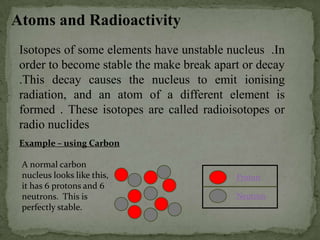
Isotopes of some elements have unstable nucleus .In
order to become stable the make break apart or decay
.This decay causes the nucleus to emit ionising
radiation, and an atom of a different element is
formed . These isotopes are called radioisotopes or
radio nuclides
Example – using Carbon
A normal carbon
nucleus looks like this,
it has 6 protons and 6
neutrons. This is
perfectly stable.
Proton
Neutron
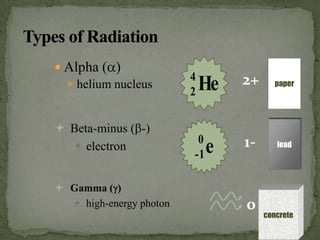
He4
2
 Alpha ( )
 helium nucleus paper2+
 Beta-minus ( -)
 electron e0
-1
1- lead
 Gamma ( )
 high-energy photon 0
concrete
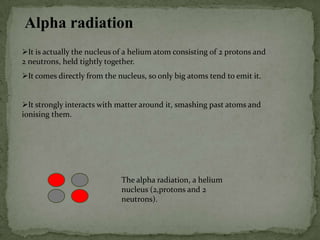
It is actually the nucleus of a helium atom consisting of 2 protons and
2 neutrons, held tightly together.
It comes directly from the nucleus, so only big atoms tend to emit it.
It strongly interacts with matter around it, smashing past atoms and
ionising them.
The alpha radiation, a helium
nucleus (2,protons and 2
neutrons).
Alpha radiation
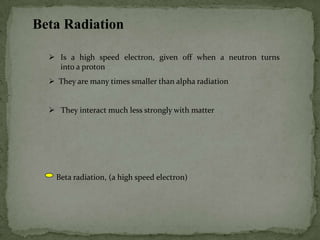
Beta Radiation
 Is a high speed electron, given off when a neutron turns
into a proton
 They are many times smaller than alpha radiation
 They interact much less strongly with matter
Beta radiation, (a high speed electron)
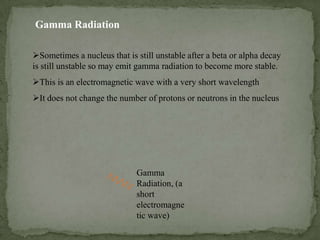
Sometimes a nucleus that is still unstable after a beta or alpha decay
is still unstable so may emit gamma radiation to become more stable.
This is an electromagnetic wave with a very short wavelength
It does not change the number of protons or neutrons in the nucleus
Gamma Radiation
Gamma
Radiation, (a
short
electromagne
tic wave)
 The decay process is random.
 No one can predict when 1 nucleus decays.
 The emission is spontaneous.
 It is possible to make a statistical prediction.
Betas and gammas are the most dangerous
 they can penetrate and reach the cells of organs
 They are absorbed and ionise the cells
 This can cause cancer
 Alphas are the least dangerous
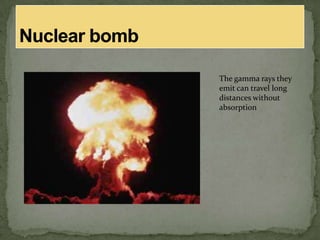
The gamma rays they
emit can travel long
distances without
absorption
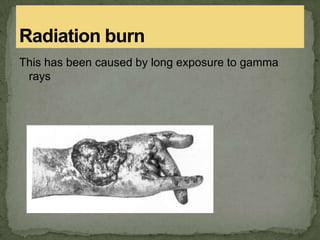
This has been caused by long exposure to gamma
rays
 Alpha radiation is the most dangerous as it
is strongly absorbed and ionises cells
 Betas and gammas are not strongly
absorbed and cause less ionisation damage
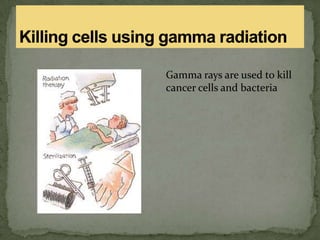
Gamma rays are used to kill
cancer cells and bacteria
Electricity Generation
Sterilization of hospital equipment
Checking leaks in pipes
Irradiation of food
19/17
Thank you
for your time .

Radioactivity.ppt

  • 2.
    Name ID  Md.Ashaduzzaman131-15-2392  Md. Ruhul Amin 131-15-2353  Shakir Sourov 131-15-2180  Fdffgfg 131-15-545  Dtfgfg 131-15-njj
  • 4.
    An unstable atomicnucleus emits a form of radiation (alpha, beta, or gamma) to become stable. In other words, the nucleus decays into a different atom. 4
  • 5.
    Atoms and Radioactivity Isotopesof some elements have unstable nucleus .In order to become stable the make break apart or decay .This decay causes the nucleus to emit ionising radiation, and an atom of a different element is formed . These isotopes are called radioisotopes or radio nuclides Example – using Carbon A normal carbon nucleus looks like this, it has 6 protons and 6 neutrons. This is perfectly stable. Proton Neutron
  • 6.
    He4 2  Alpha ()  helium nucleus paper2+  Beta-minus ( -)  electron e0 -1 1- lead  Gamma ( )  high-energy photon 0 concrete
  • 7.
    It is actuallythe nucleus of a helium atom consisting of 2 protons and 2 neutrons, held tightly together. It comes directly from the nucleus, so only big atoms tend to emit it. It strongly interacts with matter around it, smashing past atoms and ionising them. The alpha radiation, a helium nucleus (2,protons and 2 neutrons). Alpha radiation
  • 8.
    Beta Radiation  Isa high speed electron, given off when a neutron turns into a proton  They are many times smaller than alpha radiation  They interact much less strongly with matter Beta radiation, (a high speed electron)
  • 9.
    Sometimes a nucleusthat is still unstable after a beta or alpha decay is still unstable so may emit gamma radiation to become more stable. This is an electromagnetic wave with a very short wavelength It does not change the number of protons or neutrons in the nucleus Gamma Radiation Gamma Radiation, (a short electromagne tic wave)
  • 10.
     The decayprocess is random.  No one can predict when 1 nucleus decays.  The emission is spontaneous.  It is possible to make a statistical prediction.
  • 11.
    Betas and gammasare the most dangerous  they can penetrate and reach the cells of organs  They are absorbed and ionise the cells  This can cause cancer  Alphas are the least dangerous
  • 12.
    The gamma raysthey emit can travel long distances without absorption
  • 13.
    This has beencaused by long exposure to gamma rays
  • 14.
     Alpha radiationis the most dangerous as it is strongly absorbed and ionises cells  Betas and gammas are not strongly absorbed and cause less ionisation damage
  • 15.
    Gamma rays areused to kill cancer cells and bacteria
  • 16.
    Electricity Generation Sterilization ofhospital equipment Checking leaks in pipes Irradiation of food
  • 17.