NUCLEAR MATERIALS
Anuroop Ashok
Semester 4
Mechanical Dept.
What are nuclear materials?
• Nuclear materials are engineering materials used in Nuclear
power plants.
• There are two groups of nuclear materials:
The Primary group includes nuclear fuels, moderators and
coolants.
Secondary group includes Structural Materials and
Shielding materials.
• The Structural materials should be of desired properties to
enhance safety and maximum efficiency and material science
I concerned with these types of materials.
NUCLEAR POWER
ADVANTAGES
• Nuclear power generation does emit relatively low
amounts of carbon dioxide (CO2). The emissions of green
house gases and therefore the contribution of nuclear
power plants to global warming is therefore relatively
little.
• This technology is readily available, it does not have to be
developed first.
• It is possible to generate a high amount of electrical
energy in one single plant
NUCLEAR FUEL
• Nuclear fuel is any material that can be consumed to
derive nuclear energy. The most common type of nuclear
fuel is fissile elements that can be made to undergo
nuclear fission chain reactions in a nuclear reactor
• The most common nuclear fuels are 235U and 239Pu. Not
all nuclear fuels are used in fission chain reactions
• They are the most dense source of energy available
• They are used in the form of Rods, plates and wires which
are clad with suitable materials
NUCLEAR FISSION
• When a neutron strikes an atom of uranium, the uranium
splits into two lighter atoms and releases heat
simultaneously.
• Fission of heavy elements is an exothermic reaction which
can release large amounts of energy both as
electromagnetic radiation and as kinetic energy of the
fragments
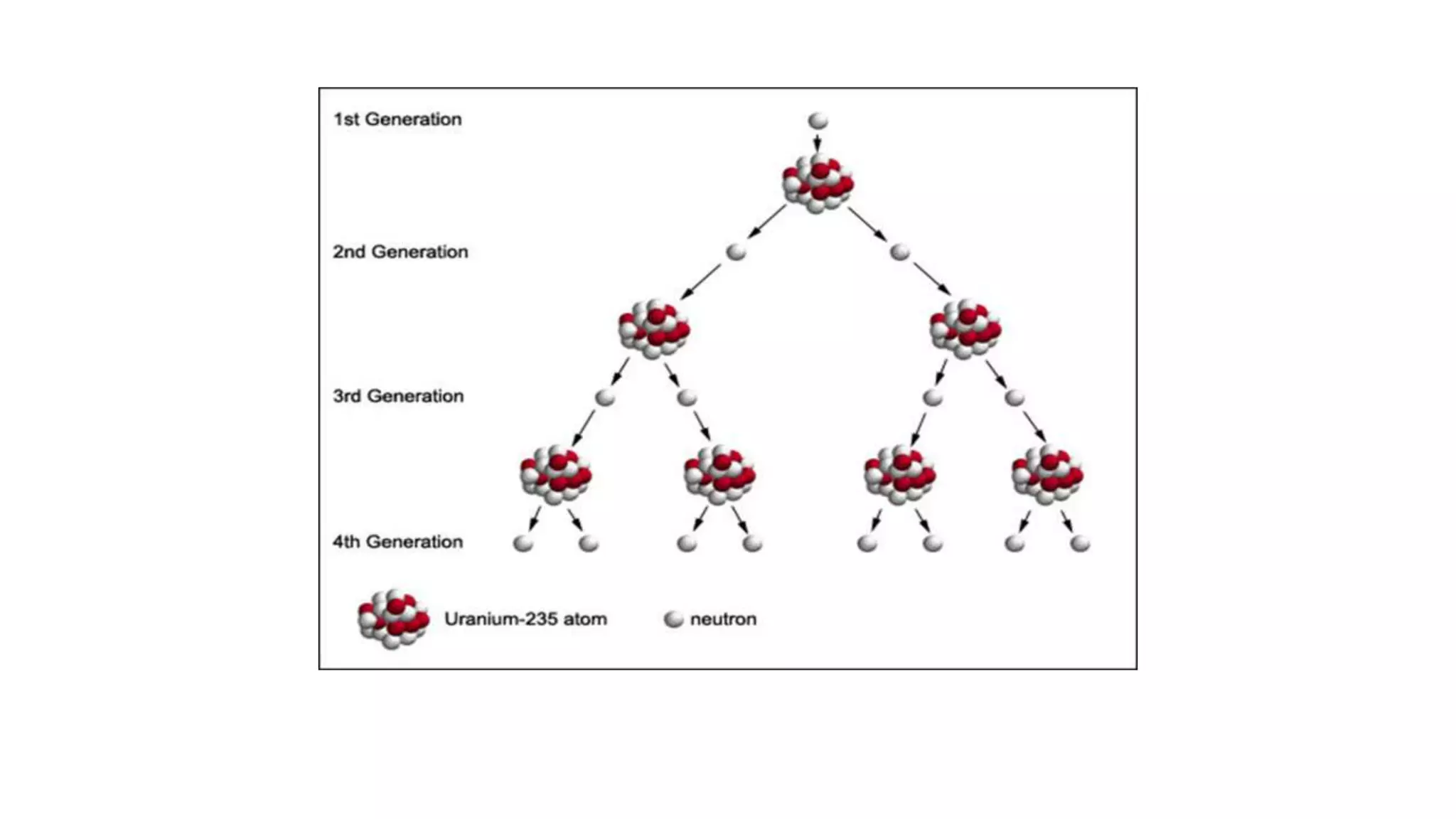
• A chain reaction refers to a process in which neutrons
released in fission produce an additional fission in at least
one further nucleus. This nucleus in turn produces
neutrons, and the process repeats. If the process is
controlled it is used for nuclear power or if uncontrolled
it is used for nuclear weapons
U235 + n → FP+ 2 or 3 n + 200 MeV
MODERATOR MATERIALS
• Neutron moderators control the nuclear chain reaction
and reduces the velocity of fast neutron
• Ideal moderator should have negligible neutron capture
cross section and high neutron scattering cross section
• It is convenient to use moderator as a coolant also
• Heavy water ,ordinary water and Graphite are three
commonly used moderators.
• Graphite – easy to fabricate ,no containment problems
• Light water – cheapest
• Heavy water – expensive but advantageous
NUCLEAR REACTOR
• A nuclear reactor is a device in which nuclear chain
reactions are initiated, controlled, and sustained at a
steady rate, as opposed to a nuclear bomb, in which the
chain reaction occurs in a fraction of a second and is
uncontrolled causing an explosion.
CONTROL RODS
• Control rods made of a material that absorbs neutrtons
are inserted into the bundle using a mechanism that can
rise or lower the control rods.
• . The control rods essentially contain neutron absorbers
like, boron, cadmium or indium.
STRUCTURAL MATERIALS
• Structural materials are materials used :
To construct the nuclear reactor
To clad the fuel to contain fission products
To form coolant conduits
To add strength and rigidity to control rods
Properties of cladding materials
• It should be resistant to abrasion, corrosion and resistant
to radiation damage and bond well with the Fuel.
• Generally used cladding materials are Aluminium
,stainless steels, Zirconium and alloys of zirconium like
Zircalloys
• Various Structural Engineering Materials are
Concrete , Carbon and Stainless steel, with smaller
quantities of Nickel alloys , Titanium ,Zirconium ,Hafnium
, Polymers and glass
• CONCRETE
- Building foundations
- Biological Shielding of operating areas
- Cost effective
• CARBON STEELS
- Structural steel works, cranes , lifting beams, drive
shafts , reinforcing bars , bolts..
• AUSTENITIC STAINLESS STEELS
- Main material for vessels and pipings
• NICKEL ALLOYS
- Used in high temperature operating spaces (Inconel
alloy is used)
- To treat large amounts of Solvent arising from
solvent extraction process
• CERAMIC MATERIALS
- In fusion power reactors
- As alternative for metallic materials
- Generally used SiC because of its low induced radio-
activity, capability of withstanding high temperatures
- Abundantly available
THANK YOU ..

Nuclear Materials

  • 1.
  • 2.
    What are nuclearmaterials? • Nuclear materials are engineering materials used in Nuclear power plants. • There are two groups of nuclear materials: The Primary group includes nuclear fuels, moderators and coolants. Secondary group includes Structural Materials and Shielding materials. • The Structural materials should be of desired properties to enhance safety and maximum efficiency and material science I concerned with these types of materials.
  • 3.
    NUCLEAR POWER ADVANTAGES • Nuclearpower generation does emit relatively low amounts of carbon dioxide (CO2). The emissions of green house gases and therefore the contribution of nuclear power plants to global warming is therefore relatively little. • This technology is readily available, it does not have to be developed first. • It is possible to generate a high amount of electrical energy in one single plant
  • 4.
    NUCLEAR FUEL • Nuclearfuel is any material that can be consumed to derive nuclear energy. The most common type of nuclear fuel is fissile elements that can be made to undergo nuclear fission chain reactions in a nuclear reactor • The most common nuclear fuels are 235U and 239Pu. Not all nuclear fuels are used in fission chain reactions • They are the most dense source of energy available • They are used in the form of Rods, plates and wires which are clad with suitable materials
  • 5.
    NUCLEAR FISSION • Whena neutron strikes an atom of uranium, the uranium splits into two lighter atoms and releases heat simultaneously. • Fission of heavy elements is an exothermic reaction which can release large amounts of energy both as electromagnetic radiation and as kinetic energy of the fragments • A chain reaction refers to a process in which neutrons released in fission produce an additional fission in at least one further nucleus. This nucleus in turn produces neutrons, and the process repeats. If the process is controlled it is used for nuclear power or if uncontrolled it is used for nuclear weapons U235 + n → FP+ 2 or 3 n + 200 MeV
  • 7.
    MODERATOR MATERIALS • Neutronmoderators control the nuclear chain reaction and reduces the velocity of fast neutron • Ideal moderator should have negligible neutron capture cross section and high neutron scattering cross section • It is convenient to use moderator as a coolant also • Heavy water ,ordinary water and Graphite are three commonly used moderators. • Graphite – easy to fabricate ,no containment problems • Light water – cheapest • Heavy water – expensive but advantageous
  • 8.
    NUCLEAR REACTOR • Anuclear reactor is a device in which nuclear chain reactions are initiated, controlled, and sustained at a steady rate, as opposed to a nuclear bomb, in which the chain reaction occurs in a fraction of a second and is uncontrolled causing an explosion.
  • 9.
    CONTROL RODS • Controlrods made of a material that absorbs neutrtons are inserted into the bundle using a mechanism that can rise or lower the control rods. • . The control rods essentially contain neutron absorbers like, boron, cadmium or indium.
  • 10.
    STRUCTURAL MATERIALS • Structuralmaterials are materials used : To construct the nuclear reactor To clad the fuel to contain fission products To form coolant conduits To add strength and rigidity to control rods
  • 11.
    Properties of claddingmaterials • It should be resistant to abrasion, corrosion and resistant to radiation damage and bond well with the Fuel. • Generally used cladding materials are Aluminium ,stainless steels, Zirconium and alloys of zirconium like Zircalloys
  • 12.
    • Various StructuralEngineering Materials are Concrete , Carbon and Stainless steel, with smaller quantities of Nickel alloys , Titanium ,Zirconium ,Hafnium , Polymers and glass • CONCRETE - Building foundations - Biological Shielding of operating areas - Cost effective • CARBON STEELS - Structural steel works, cranes , lifting beams, drive shafts , reinforcing bars , bolts.. • AUSTENITIC STAINLESS STEELS - Main material for vessels and pipings
  • 13.
    • NICKEL ALLOYS -Used in high temperature operating spaces (Inconel alloy is used) - To treat large amounts of Solvent arising from solvent extraction process • CERAMIC MATERIALS - In fusion power reactors - As alternative for metallic materials - Generally used SiC because of its low induced radio- activity, capability of withstanding high temperatures - Abundantly available
  • 14.