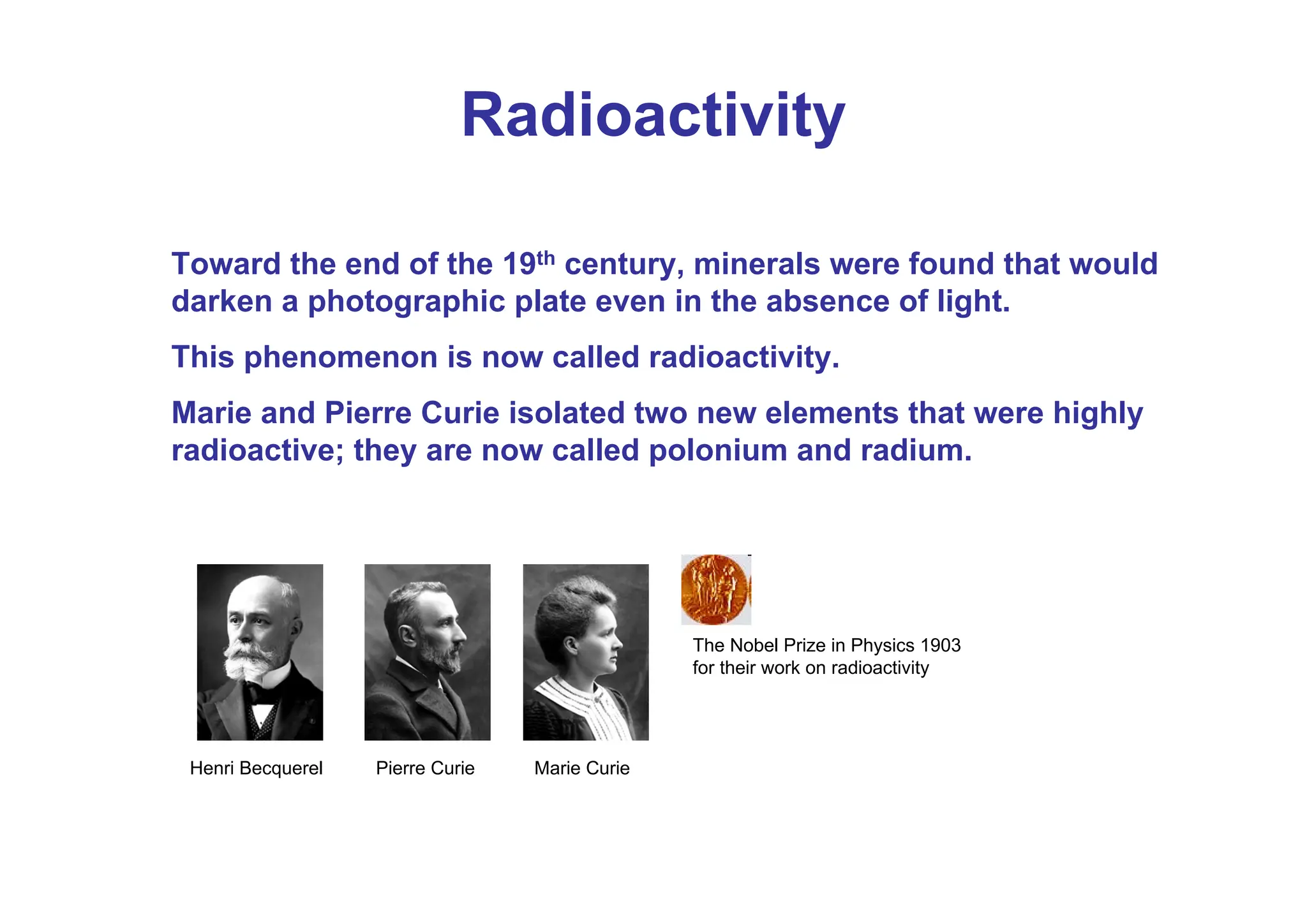
Toward the end of the 19th century, minerals were found that would
darken a photographic plate even in the absence of light.
This phenomenon is now called radioactivity.
Marie and Pierre Curie isolated two new elements that were highly
radioactive; they are now called polonium and radium.
Radioactivity
The Nobel Prize in Physics 1903
for their work on radioactivity
Henri Becquerel Pierre Curie Marie Curie
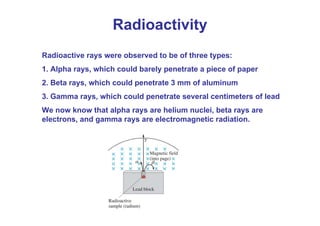
Radioactive rays were observed to be of three types:
1. Alpha rays, which could barely penetrate a piece of paper
2. Beta rays, which could penetrate 3 mm of aluminum
3. Gamma rays, which could penetrate several centimeters of lead
We now know that alpha rays are helium nuclei, beta rays are
electrons, and gamma rays are electromagnetic radiation.
Radioactivity
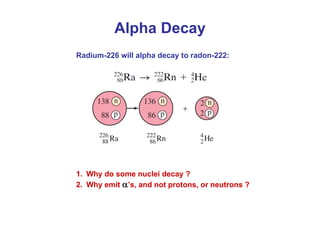
Radium-226 will alpha decay to radon-222:
Alpha Decay
1. Why do some nuclei decay ?
2. Why emit α’s, and not protons, or neutrons ?
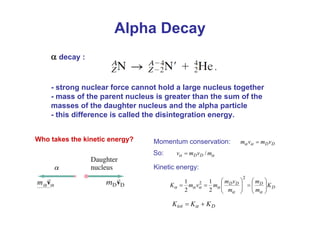
α decay :
- strong nuclear force cannot hold a large nucleus together
- mass of the parent nucleus is greater than the sum of the
masses of the daughter nucleus and the alpha particle
- this difference is called the disintegration energy.
Alpha Decay
D
tot K
K
K +
= α
D
Dv
m
v
m =
α
α
α
α m
v
m
v D
D /
=
Who takes the kinetic energy? Momentum conservation:
So:
Kinetic energy:
D
D
D
D
K
m
m
m
v
m
m
v
m
K ⎟
⎟
⎠
⎞
⎜
⎜
⎝
⎛
=
⎟
⎟
⎠
⎞
⎜
⎜
⎝
⎛
=
=
α
α
α
α
α
α
2
2
2
1
2
1
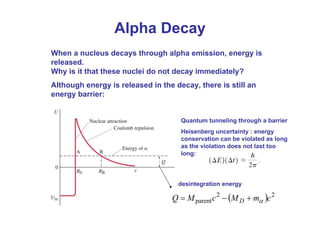
When a nucleus decays through alpha emission, energy is
released.
Why is it that these nuclei do not decay immediately?
Although energy is released in the decay, there is still an
energy barrier:
Alpha Decay
Quantum tunneling through a barrier
Heisenberg uncertainty : energy
conservation can be violated as long
as the violation does not last too
long:
( ) 2
2
parent c
m
M
c
M
Q D α
+
−
=
desintegration energy
quantum tunneling:
quantitative
Alpha Decay
( )[ ]dr
E
r
V
m
r
r
e
T
∫ −
−
≈
"
'
2
)
(
/
2
2 h
Heisenberg
The higher the barrier, the
less time the alpha particle
has to get through it, and the
less likely that is to happen.
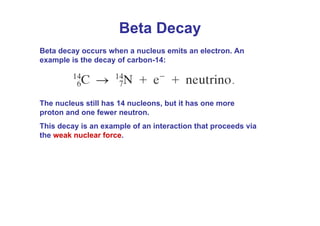
Beta decay occurs when a nucleus emits an electron. An
example is the decay of carbon-14:
The nucleus still has 14 nucleons, but it has one more
proton and one fewer neutron.
This decay is an example of an interaction that proceeds via
the weak nuclear force.
Beta Decay
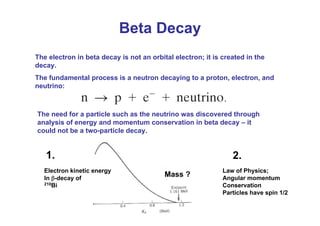
The electron in beta decay is not an orbital electron; it is created in the
decay.
The fundamental process is a neutron decaying to a proton, electron, and
neutrino:
The need for a particle such as the neutrino was discovered through
analysis of energy and momentum conservation in beta decay – it
could not be a two-particle decay.
Beta Decay
Electron kinetic energy
In β-decay of
210Bi
1. 2.
Law of Physics;
Angular momentum
Conservation
Particles have spin 1/2
Mass ?
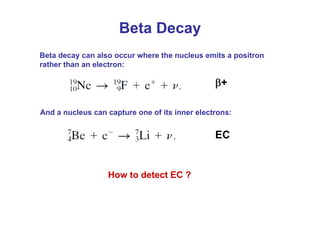
Beta decay can also occur where the nucleus emits a positron
rather than an electron:
And a nucleus can capture one of its inner electrons:
Beta Decay
β+
EC
How to detect EC ?
Beta Decay
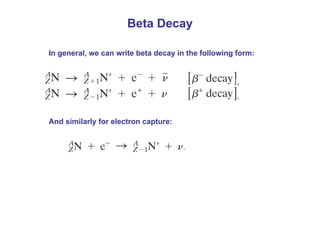
In general, we can write beta decay in the following form:
And similarly for electron capture:
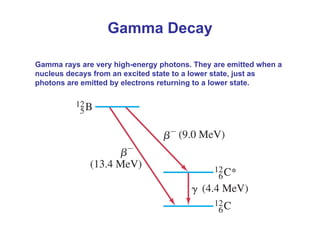
Gamma rays are very high-energy photons. They are emitted when a
nucleus decays from an excited state to a lower state, just as
photons are emitted by electrons returning to a lower state.
Gamma Decay
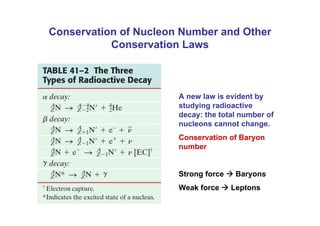
A new law is evident by
studying radioactive
decay: the total number of
nucleons cannot change.
Conservation of Baryon
number
Strong force Æ Baryons
Weak force Æ Leptons
Conservation of Nucleon Number and Other
Conservation Laws
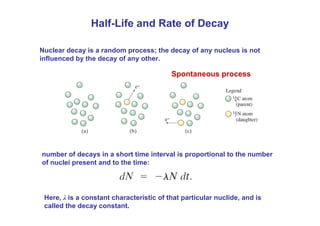
Nuclear decay is a random process; the decay of any nucleus is not
influenced by the decay of any other.
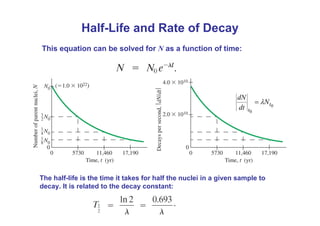
Half-Life and Rate of Decay
number of decays in a short time interval is proportional to the number
of nuclei present and to the time:
Here, λ is a constant characteristic of that particular nuclide, and is
called the decay constant.
Spontaneous process
This equation can be solved for N as a function of time:
Half-Life and Rate of Decay
The half-life is the time it takes for half the nuclei in a given sample to
decay. It is related to the decay constant:
0
0
t
t
N
dt
dN
λ
=
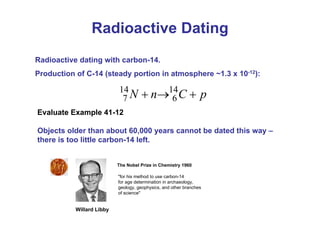
Radioactive dating with carbon-14.
Production of C-14 (steady portion in atmosphere ~1.3 x 10⁻¹²):
Radioactive Dating
p
C
n
N +
→
+ 14
6
14
7
Objects older than about 60,000 years cannot be dated this way –
there is too little carbon-14 left.
Evaluate Example 41-12
The Nobel Prize in Chemistry 1960
"for his method to use carbon-14
for age determination in archaeology,
geology, geophysics, and other branches
of science"
Willard Libby
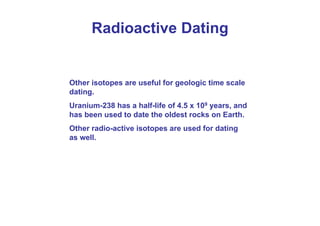
Other isotopes are useful for geologic time scale
dating.
Uranium-238 has a half-life of 4.5 x 10⁹ years, and
has been used to date the oldest rocks on Earth.
Other radio-active isotopes are used for dating
as well.
Radioactive Dating
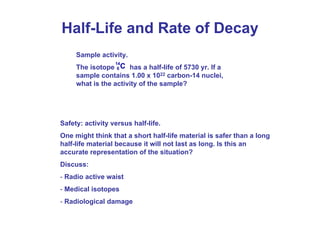
Half-Life and Rate of Decay
Sample activity.
The isotope has a half-life of 5730 yr. If a
sample contains 1.00 x 10²² carbon-14 nuclei,
what is the activity of the sample?
14
6 C
Safety: activity versus half-life.
One might think that a short half-life material is safer than a long
half-life material because it will not last as long. Is this an
accurate representation of the situation?
Discuss:
- Radio active waist
- Medical isotopes
- Radiological damage
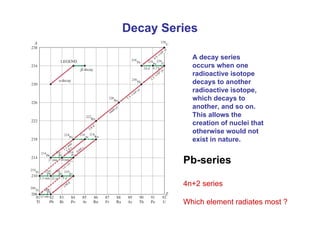
A decay series
occurs when one
radioactive isotope
decays to another
radioactive isotope,
which decays to
another, and so on.
This allows the
creation of nuclei that
otherwise would not
exist in nature.
Decay Series
Pb-series
4n+2 series
Which element radiates most ?
Decay Series
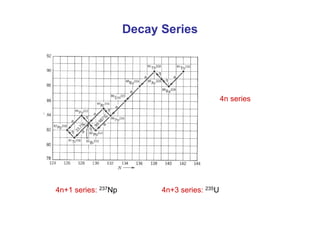
4n series
4n+1 series: 237Np 4n+3 series: 235U
Half lives and kinetic energies of α’s
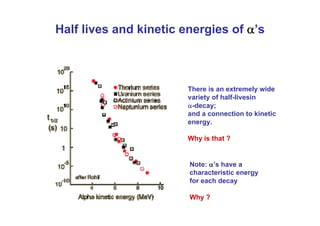
There is an extremely wide
variety of half-livesin
α-decay;
and a connection to kinetic
energy.
Why is that ?
Note: α’s have a
characteristic energy
for each decay
Why ?
Half lives and kinetic energies of α’s
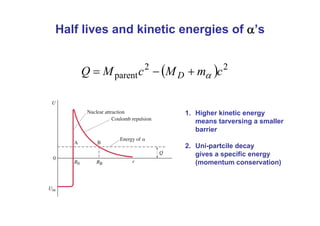
( ) 2
2
parent c
m
M
c
M
Q D α
+
−
=
1. Higher kinetic energy
means tarversing a smaller
barrier
2. Uni-partcile decay
gives a specific energy
(momentum conservation)
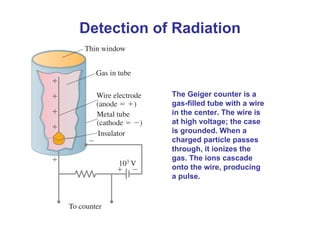
The Geiger counter is a
gas-filled tube with a wire
in the center. The wire is
at high voltage; the case
is grounded. When a
charged particle passes
through, it ionizes the
gas. The ions cascade
onto the wire, producing
a pulse.
Detection of Radiation
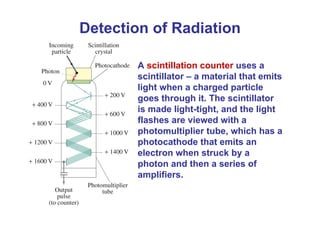
A scintillation counter uses a
scintillator – a material that emits
light when a charged particle
goes through it. The scintillator
is made light-tight, and the light
flashes are viewed with a
photomultiplier tube, which has a
photocathode that emits an
electron when struck by a
photon and then a series of
amplifiers.
Detection of Radiation
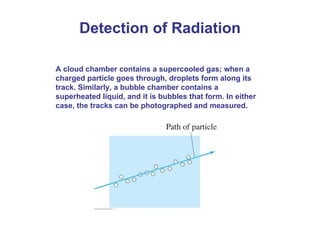
A cloud chamber contains a supercooled gas; when a
charged particle goes through, droplets form along its
track. Similarly, a bubble chamber contains a
superheated liquid, and it is bubbles that form. In either
case, the tracks can be photographed and measured.
Detection of Radiation

Physiczz shdhduusgshdhdudhdhdhduusgsyssh

  • 1.
    Toward the endof the 19th century, minerals were found that would darken a photographic plate even in the absence of light. This phenomenon is now called radioactivity. Marie and Pierre Curie isolated two new elements that were highly radioactive; they are now called polonium and radium. Radioactivity The Nobel Prize in Physics 1903 for their work on radioactivity Henri Becquerel Pierre Curie Marie Curie
  • 2.
    Radioactive rays wereobserved to be of three types: 1. Alpha rays, which could barely penetrate a piece of paper 2. Beta rays, which could penetrate 3 mm of aluminum 3. Gamma rays, which could penetrate several centimeters of lead We now know that alpha rays are helium nuclei, beta rays are electrons, and gamma rays are electromagnetic radiation. Radioactivity
  • 3.
    Radium-226 will alphadecay to radon-222: Alpha Decay 1. Why do some nuclei decay ? 2. Why emit α’s, and not protons, or neutrons ?
  • 4.
    α decay : -strong nuclear force cannot hold a large nucleus together - mass of the parent nucleus is greater than the sum of the masses of the daughter nucleus and the alpha particle - this difference is called the disintegration energy. Alpha Decay D tot K K K + = α D Dv m v m = α α α α m v m v D D / = Who takes the kinetic energy? Momentum conservation: So: Kinetic energy: D D D D K m m m v m m v m K ⎟ ⎟ ⎠ ⎞ ⎜ ⎜ ⎝ ⎛ = ⎟ ⎟ ⎠ ⎞ ⎜ ⎜ ⎝ ⎛ = = α α α α α α 2 2 2 1 2 1
  • 5.
    When a nucleusdecays through alpha emission, energy is released. Why is it that these nuclei do not decay immediately? Although energy is released in the decay, there is still an energy barrier: Alpha Decay Quantum tunneling through a barrier Heisenberg uncertainty : energy conservation can be violated as long as the violation does not last too long: ( ) 2 2 parent c m M c M Q D α + − = desintegration energy
  • 6.
    quantum tunneling: quantitative Alpha Decay ()[ ]dr E r V m r r e T ∫ − − ≈ " ' 2 ) ( / 2 2 h Heisenberg The higher the barrier, the less time the alpha particle has to get through it, and the less likely that is to happen.
  • 7.
    Beta decay occurswhen a nucleus emits an electron. An example is the decay of carbon-14: The nucleus still has 14 nucleons, but it has one more proton and one fewer neutron. This decay is an example of an interaction that proceeds via the weak nuclear force. Beta Decay
  • 8.
    The electron inbeta decay is not an orbital electron; it is created in the decay. The fundamental process is a neutron decaying to a proton, electron, and neutrino: The need for a particle such as the neutrino was discovered through analysis of energy and momentum conservation in beta decay – it could not be a two-particle decay. Beta Decay Electron kinetic energy In β-decay of 210Bi 1. 2. Law of Physics; Angular momentum Conservation Particles have spin 1/2 Mass ?
  • 9.
    Beta decay canalso occur where the nucleus emits a positron rather than an electron: And a nucleus can capture one of its inner electrons: Beta Decay β+ EC How to detect EC ?
  • 10.
    Beta Decay In general,we can write beta decay in the following form: And similarly for electron capture:
  • 11.
    Gamma rays arevery high-energy photons. They are emitted when a nucleus decays from an excited state to a lower state, just as photons are emitted by electrons returning to a lower state. Gamma Decay
  • 12.
    A new lawis evident by studying radioactive decay: the total number of nucleons cannot change. Conservation of Baryon number Strong force Æ Baryons Weak force Æ Leptons Conservation of Nucleon Number and Other Conservation Laws
  • 13.
    Nuclear decay isa random process; the decay of any nucleus is not influenced by the decay of any other. Half-Life and Rate of Decay number of decays in a short time interval is proportional to the number of nuclei present and to the time: Here, λ is a constant characteristic of that particular nuclide, and is called the decay constant. Spontaneous process
  • 14.
    This equation canbe solved for N as a function of time: Half-Life and Rate of Decay The half-life is the time it takes for half the nuclei in a given sample to decay. It is related to the decay constant: 0 0 t t N dt dN λ =
  • 15.
    Radioactive dating withcarbon-14. Production of C-14 (steady portion in atmosphere ~1.3 x 10⁻¹²): Radioactive Dating p C n N + → + 14 6 14 7 Objects older than about 60,000 years cannot be dated this way – there is too little carbon-14 left. Evaluate Example 41-12 The Nobel Prize in Chemistry 1960 "for his method to use carbon-14 for age determination in archaeology, geology, geophysics, and other branches of science" Willard Libby
  • 16.
    Other isotopes areuseful for geologic time scale dating. Uranium-238 has a half-life of 4.5 x 10⁹ years, and has been used to date the oldest rocks on Earth. Other radio-active isotopes are used for dating as well. Radioactive Dating
  • 17.
    Half-Life and Rateof Decay Sample activity. The isotope has a half-life of 5730 yr. If a sample contains 1.00 x 10²² carbon-14 nuclei, what is the activity of the sample? 14 6 C Safety: activity versus half-life. One might think that a short half-life material is safer than a long half-life material because it will not last as long. Is this an accurate representation of the situation? Discuss: - Radio active waist - Medical isotopes - Radiological damage
  • 18.
    A decay series occurswhen one radioactive isotope decays to another radioactive isotope, which decays to another, and so on. This allows the creation of nuclei that otherwise would not exist in nature. Decay Series Pb-series 4n+2 series Which element radiates most ?
  • 19.
    Decay Series 4n series 4n+1series: 237Np 4n+3 series: 235U
  • 20.
    Half lives andkinetic energies of α’s There is an extremely wide variety of half-livesin α-decay; and a connection to kinetic energy. Why is that ? Note: α’s have a characteristic energy for each decay Why ?
  • 21.
    Half lives andkinetic energies of α’s ( ) 2 2 parent c m M c M Q D α + − = 1. Higher kinetic energy means tarversing a smaller barrier 2. Uni-partcile decay gives a specific energy (momentum conservation)
  • 22.
    The Geiger counteris a gas-filled tube with a wire in the center. The wire is at high voltage; the case is grounded. When a charged particle passes through, it ionizes the gas. The ions cascade onto the wire, producing a pulse. Detection of Radiation
  • 23.
    A scintillation counteruses a scintillator – a material that emits light when a charged particle goes through it. The scintillator is made light-tight, and the light flashes are viewed with a photomultiplier tube, which has a photocathode that emits an electron when struck by a photon and then a series of amplifiers. Detection of Radiation
  • 24.
    A cloud chambercontains a supercooled gas; when a charged particle goes through, droplets form along its track. Similarly, a bubble chamber contains a superheated liquid, and it is bubbles that form. In either case, the tracks can be photographed and measured. Detection of Radiation