RADIOACTIVE
DECAYS
Alpha, Beta, and Gamma Decay
Outline
• Radioactive decays
• Alpha Decay
• Beta Decay
• Gamma decay
• Applications
• Summary
Introduction
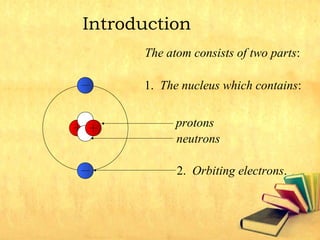
The atom consists of two parts:
1. The nucleus which contains:
2. Orbiting electrons.
protons
neutrons
All matter is made up of elements (e.g. carbon,
hydrogen, etc.).
The smallest part of an element is called an atom.
. Atom of different elements contain different numbers of
protons
The mass of an atom is almost entirely due to the
number of protons and neutrons.
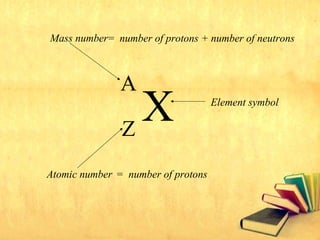
X
A
Z
Mass number
Atomic number
Element symbol
= number of protons + number of neutrons
= number of protons
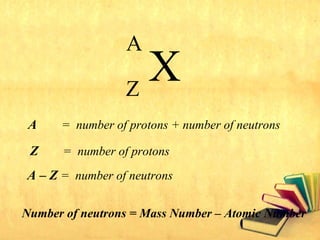
X
A
Z
A = number of protons + number of neutrons
Z = number of protons
A – Z = number of neutrons
Number of neutrons = Mass Number – Atomic Number
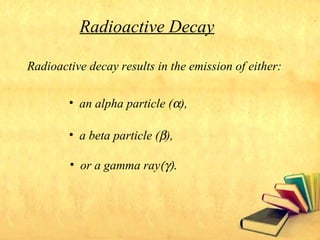
Radioactive decay results in the emission of either:
• an alpha particle (α),
• a beta particle (β),
• or a gamma ray(γ).
Radioactive Decay
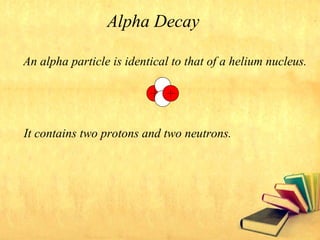
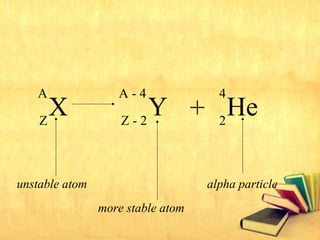
An alpha particle is identical to that of a helium nucleus.
It contains two protons and two neutrons.
Alpha Decay
X
A
Z
Y
A - 4
Z - 2
+ He
4
2
unstable atom
more stable atom
alpha particle
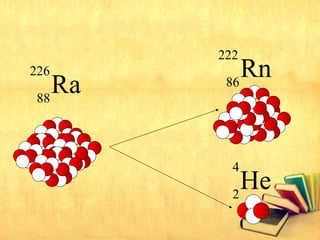
Ra
226
88
Rn
222
86
He
4
2
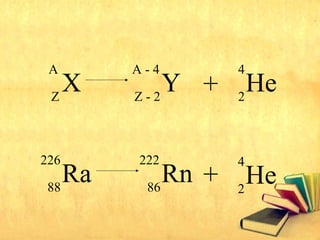
X
A
Z
Y
A - 4
Z - 2
+ He
4
2
Ra
226
88
Rn
222
86
+ He
4
2
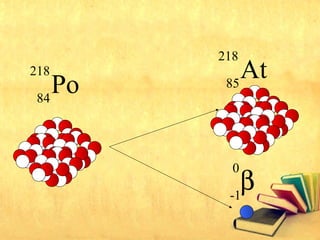
Beta Decay
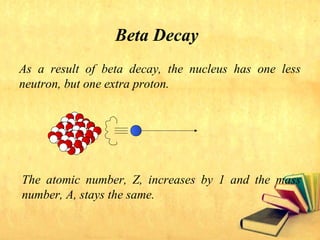
As a result of beta decay, the nucleus has one less
neutron, but one extra proton.
The atomic number, Z, increases by 1 and the mass
number, A, stays the same.
Po
218
84
β
0
-1
At
218
85
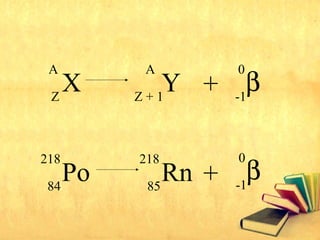
X
A
Z
Y
A
Z + 1
+ β
0
-1
Po
218
84
Rn
218
85
+ β
0
-1
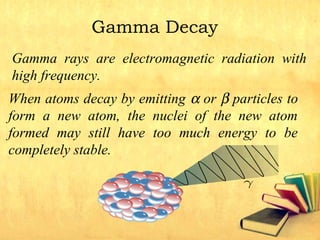
Gamma Decay
Gamma rays are electromagnetic radiation with
high frequency.
When atoms decay by emitting α or β particles to
form a new atom, the nuclei of the new atom
formed may still have too much energy to be
completely stable.
Applications
• Nuclear Medicine.
• Used and produce in nuclear reactor.
• Used to sterilize medical instruments and food
Summary
• Unstable atomic nucleus having atomic mass
greater than 82 becomes stable by emitting alpha
particle, beta particle or gamma rays.
• These three decay are alpha, beta and gamma

Radioactive decay

  • 1.
  • 2.
    Outline • Radioactive decays •Alpha Decay • Beta Decay • Gamma decay • Applications • Summary
  • 3.
    Introduction The atom consistsof two parts: 1. The nucleus which contains: 2. Orbiting electrons. protons neutrons
  • 4.
    All matter ismade up of elements (e.g. carbon, hydrogen, etc.). The smallest part of an element is called an atom. . Atom of different elements contain different numbers of protons The mass of an atom is almost entirely due to the number of protons and neutrons.
  • 5.
    X A Z Mass number Atomic number Elementsymbol = number of protons + number of neutrons = number of protons
  • 6.
    X A Z A = numberof protons + number of neutrons Z = number of protons A – Z = number of neutrons Number of neutrons = Mass Number – Atomic Number
  • 7.
    Radioactive decay resultsin the emission of either: • an alpha particle (α), • a beta particle (β), • or a gamma ray(γ). Radioactive Decay
  • 8.
    An alpha particleis identical to that of a helium nucleus. It contains two protons and two neutrons. Alpha Decay
  • 9.
    X A Z Y A - 4 Z- 2 + He 4 2 unstable atom more stable atom alpha particle
  • 10.
  • 11.
    X A Z Y A - 4 Z- 2 + He 4 2 Ra 226 88 Rn 222 86 + He 4 2
  • 12.
    Beta Decay As aresult of beta decay, the nucleus has one less neutron, but one extra proton. The atomic number, Z, increases by 1 and the mass number, A, stays the same.
  • 13.
  • 14.
    X A Z Y A Z + 1 +β 0 -1 Po 218 84 Rn 218 85 + β 0 -1
  • 15.
    Gamma Decay Gamma raysare electromagnetic radiation with high frequency. When atoms decay by emitting α or β particles to form a new atom, the nuclei of the new atom formed may still have too much energy to be completely stable.
  • 16.
    Applications • Nuclear Medicine. •Used and produce in nuclear reactor. • Used to sterilize medical instruments and food
  • 17.
    Summary • Unstable atomicnucleus having atomic mass greater than 82 becomes stable by emitting alpha particle, beta particle or gamma rays. • These three decay are alpha, beta and gamma