RADIOACTIVITY
Objectives
By the end of the topic the learner should be able to:
(a) Define radioactivity, half-life, radioisotopes and nuclides.
(b) State the types of radioactivity, name the particles emitted during
radioactive decay and state their properties.
(c) Carry out simple calculations involving half-life (t- ½).
(d) Write balanced nuclear equations.
(e) Distinguish between nuclear fission and fusion.
(f) State the uses of some radioisotopes and dangers associated with
radioactivity.
Nuclide.
• It is particular nucleus of an atom
characterised by its protons and neutrons
• Nuclides can either be stable or unstable.
• Most stable nuclides have a
neutron/proton (n/p) ratio of about 1 : 1.
• For example, 40
20Ca has 20 neutrons and
20 protons, hence the n/p ratio is 20 :
20= 1 : 1.
• For nuclides of high atomic number, the n/p ration increases
progressively up to about 1.6 : 1 which is still within the
stability region.
• Above this value the nucleus becomes too large and
unstable.
• The unstable nuclide normally undergoes some changes by
emitting radiation in form of particles and energy.
• Such emissions results in the production of new nuclides of
completely different composition.
Radioactivity as a Nuclear Reaction
• Radioactivity - The process where an unstable nuclide breaks up to
yield another nuclide of different composition with emission of
particles and energy.
• Radioactive substances -substances which undergo radioactivity.
• Radioisotopes-Isotopes which are radioactive.
• Radioactive decay-The spontaneous disintegration of radioactive
nuclides.
N/B Radioactivity is a nuclear process and not a chemical reaction.
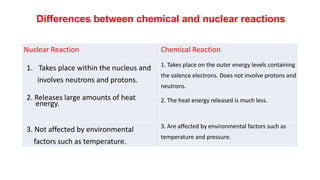
Differences between chemical and nuclear reactions
Nuclear Reaction Chemical Reaction
1. Takes place within the nucleus and involves neutrons and
protons.
Takes place on the outer energy levels containing the valence electrons. Does not involve protons and
neutrons.
2. Releases large amounts of heat energy. The heat energy released is much less.
3. Not affected by environmental factors such as temperature. Are affected by environmental factors such as temperature and pressure.
Nuclear Reaction Chemical Reaction
1. Takes place within the nucleus and
involves neutrons and protons.
1. Takes place on the outer energy levels containing
the valence electrons. Does not involve protons and
neutrons.
2. Releases large amounts of heat
energy. 2. The heat energy released is much less.
3. Not affected by environmental
factors such as temperature.
3. Are affected by environmental factors such as
temperature and pressure.
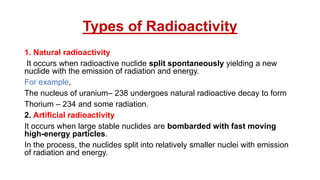
Types of Radioactivity
1. Natural radioactivity
It occurs when radioactive nuclide split spontaneously yielding a new
nuclide with the emission of radiation and energy.
For example,
The nucleus of uranium– 238 undergoes natural radioactive decay to form
Thorium – 234 and some radiation.
2. Artificial radioactivity
It occurs when large stable nuclides are bombarded with fast moving
high-energy particles.
In the process, the nuclides split into relatively smaller nuclei with emission
of radiation and energy.
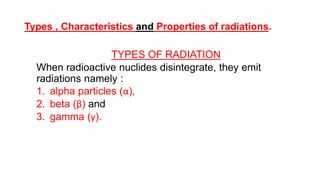
Types , Characteristics and Properties of radiations.
TYPES OF RADIATION
When radioactive nuclides disintegrate, they emit
radiations namely :
1. alpha particles (α),
2. beta (β) and
3. gamma (γ).
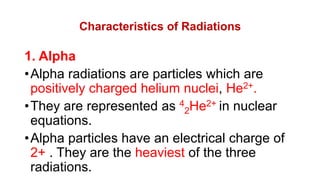
Characteristics of Radiations
1. Alpha
•Alpha radiations are particles which are
positively charged helium nuclei, He2+.
•They are represented as 4
2He2+ in nuclear
equations.
•Alpha particles have an electrical charge of
2+ . They are the heaviest of the three
radiations.
Characteristics of Radiations
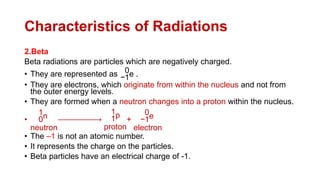
2.Beta
Beta radiations are particles which are negatively charged.
• They are represented as −1
0e .
• They are electrons, which originate from within the nucleus and not from
the outer energy levels.
• They are formed when a neutron changes into a proton within the nucleus.
• 0
1n
neutron
1
1p
proton
+ −1
0e
electron
• The –1 is not an atomic number.
• It represents the charge on the particles.
• Beta particles have an electrical charge of -1.
Characteristics of Radiations
Gama radiations are high energy rays.
•They do not have an electrical charge.
•They are not emitted on their own but
normally accompany the emission of alpha
or beta particles.
Properties of Radiations
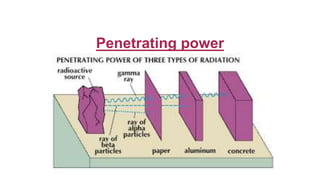
• Penetrating power
Alpha particles have very low penetrating power. They do not
pass through a sheet of paper. The have a range of only a few
centimetres in air.
Beta particles have higher penetrating power. They can pass
through a sheet of paper but are stopped by a sheet of aluminium
foil.
Gamma rays have the highest penetrating power. They pass
through a sheet of paper and a sheet of aluminium. They are
however stopped by a thick lead block.
Penetrating power
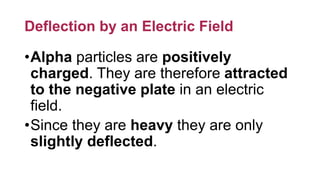
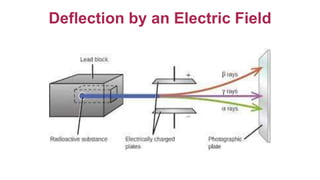
Deflection by an Electric Field
•Alpha particles are positively
charged. They are therefore attracted
to the negative plate in an electric
field.
•Since they are heavy they are only
slightly deflected.
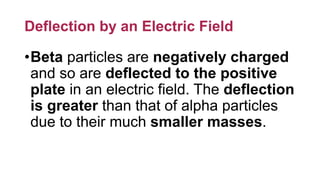
Deflection by an Electric Field
•Beta particles are negatively charged
and so are deflected to the positive
plate in an electric field. The deflection
is greater than that of alpha particles
due to their much smaller masses.
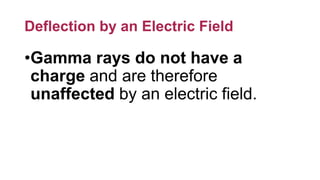
Deflection by an Electric Field
•Gamma rays do not have a
charge and are therefore
unaffected by an electric field.
Deflection by an Electric Field
Ionising Effect of Radiations
• Alpha particles have very high ionising power.
They produce a large number of ions as they pass
through gases due to their slow speed and high
charge. Their slow speed enables the alpha particles
to be in contact with target atoms for a longer time.
• Beta particles have lower ionising power and
produce fewer ions in gases.
• Gamma rays have very low ionising power.
end
Radioactive Decay and Half-Life
•When a radioactive nuclide decays, a new
nuclide is formed.
•As disintegration proceeds, fewer and fewer
unstable atoms remain.
•The Table below shows the radioactive decay
for a sample of 400 g of iodine – 131
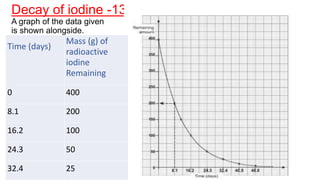
Decay of iodine -131
A graph of the data given
is shown alongside.
Time (days)
Mass (g) of
radioactive
iodine
Remaining
0 400
8.1 200
16.2 100
24.3 50
32.4 25
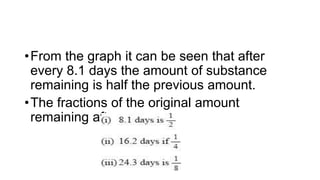
•From the graph it can be seen that after
every 8.1 days the amount of substance
remaining is half the previous amount.
•The fractions of the original amount
remaining after:
Deductions from the graph
•From the graph, it is also observed that the
remaining amount never reduces to zero.
• The time taken for the mass to reduce to
half the previous value is a constant, i.e., 8.1
days.
•This constant value is referred to as the half-
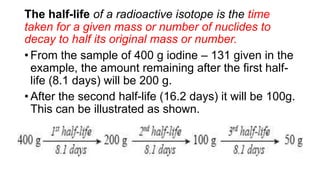
The half-life of a radioactive isotope is the time
taken for a given mass or number of nuclides to
decay to half its original mass or number.
• From the sample of 400 g iodine – 131 given in the
example, the amount remaining after the first half-
life (8.1 days) will be 200 g.
• After the second half-life (16.2 days) it will be 100g.
This can be illustrated as shown.
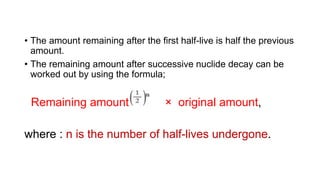
• The amount remaining after the first half-live is half the previous
amount.
• The remaining amount after successive nuclide decay can be
worked out by using the formula;
Remaining amount = × original amount,
where : n is the number of half-lives undergone.
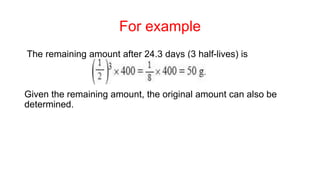
For example
The remaining amount after 24.3 days (3 half-lives) is
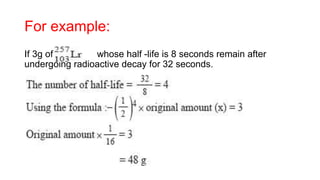
Given the remaining amount, the original amount can also be
determined.
For example:
If 3g of whose half -life is 8 seconds remain after
undergoing radioactive decay for 32 seconds.
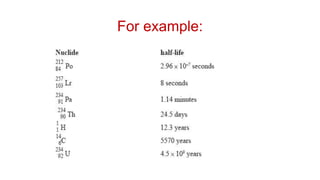
•Each radioactive isotope decays at its own rate
and therefore has its own half- life.
•Half-life range from fraction of a second
to millions of years.
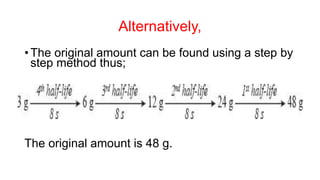
Alternatively,
• The original amount can be found using a step by
step method thus;
The original amount is 48 g.
•Each radioactive isotope decays at its own rate
and therefore has its own half- life.
•Half-life range from fraction of a second
to millions of years.
For example:
REMARKS
•The shorter the half-life, the faster the rate of
decay of the nuclide.
•The longer the half-life, the slower the rate of
decay of the nuclide.
• The rate of radioactive decay is unaffected
by any chemical or physical change.
• The half-life of radioactive isotopes is one of the
factors used to determine their application.
For example,
carbon-14 is used to determine the age of dead organic
matter. The process is known as carbon-dating.
The carbon in plants which is taken up during
photosynthesis contains a small portion of radioactive
carbon-14.
When the plant dies, the carbon-14 in the dead plant
continues decaying hence the amount decreases.
Carbon-14 has half-life a of about 5,600 years therefore
by determining the carbon content in the dead material
it is mathematically possible to determine the age of the
•Sodium-20 with a half-life of 0.3
seconds is used to detect leakages
because it has a short half-life.
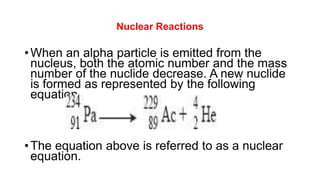
Nuclear Reactions
•When an alpha particle is emitted from the
nucleus, both the atomic number and the mass
number of the nuclide decrease. A new nuclide
is formed as represented by the following
equation
•The equation above is referred to as a nuclear
equation.
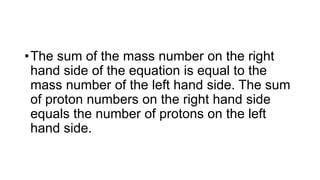
•The sum of the mass number on the right
hand side of the equation is equal to the
mass number of the left hand side. The sum
of proton numbers on the right hand side
equals the number of protons on the left
hand side.
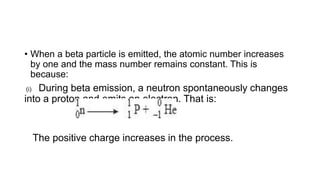
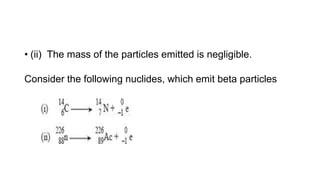
• When a beta particle is emitted, the atomic number increases
by one and the mass number remains constant. This is
because:
(i) During beta emission, a neutron spontaneously changes
into a proton and emits an electron. That is:
The positive charge increases in the process.
• (ii) The mass of the particles emitted is negligible.
Consider the following nuclides, which emit beta particles
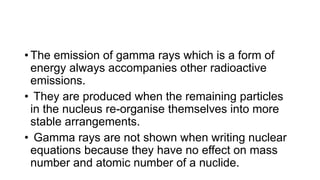
• The emission of gamma rays which is a form of
energy always accompanies other radioactive
emissions.
• They are produced when the remaining particles
in the nucleus re-organise themselves into more
stable arrangements.
• Gamma rays are not shown when writing nuclear
equations because they have no effect on mass
number and atomic number of a nuclide.
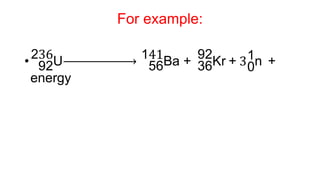
For example:
• 92
236
U 56
141
Ba + 36
92
Kr + 30
1n +
energy
Radioactive Decay Series.
•A radioactive decay series represents
the sequential and continuous
disintegration of unstable nuclide until a
stable nuclide is formed.
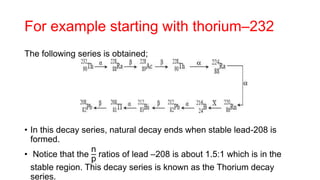
For example starting with thorium–232
The following series is obtained;
• In this decay series, natural decay ends when stable lead-208 is
formed.
• Notice that the
n
p
ratios of lead –208 is about 1.5:1 which is in the
stable region. This decay series is known as the Thorium decay
series.
END
Nuclear Fission
•It is the splitting process a heavy nuclide
undergoes when bombarded by a fast-
moving neutron.
•The large unstable nuclide absorbs a
neutron and immediately splits up into two
approximately equal fragments together with
a number of smaller particles such as a
neutron.
• During this process, much energy is
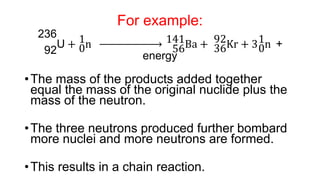
For example:
92
236
U + 0
1n 56
141Ba + 36
92Kr + 30
1n +
energy
•The mass of the products added together
equal the mass of the original nuclide plus the
mass of the neutron.
•The three neutrons produced further bombard
more nuclei and more neutrons are formed.
•This results in a chain reaction.
•Energy is liberated due to the fact that
the total mass of the products is slightly
less than the mass of the initial
nuclides.
•This difference in mass is radiated as
energy.
• A very small loss in mass results in an
enormous amount of energy being
released.
•This energy can be tapped and utilised to
generate electrical energy and other forms
of energy under controlled conditions.
•The enormous heat is used to heat water to
produce steam which then turns turbines to
produce electricity.
•The energy of an atomic bomb is due to
nuclear fission of uranium–235.
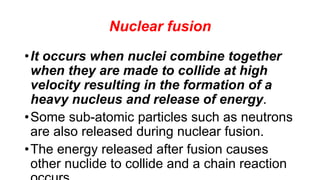
Nuclear fusion
•It occurs when nuclei combine together
when they are made to collide at high
velocity resulting in the formation of a
heavy nucleus and release of energy.
•Some sub-atomic particles such as neutrons
are also released during nuclear fusion.
•The energy released after fusion causes
other nuclide to collide and a chain reaction
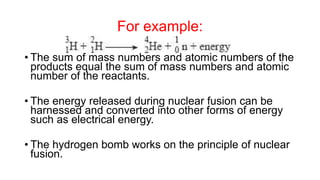
For example:
• The sum of mass numbers and atomic numbers of the
products equal the sum of mass numbers and atomic
number of the reactants.
• The energy released during nuclear fusion can be
harnessed and converted into other forms of energy
such as electrical energy.
• The hydrogen bomb works on the principle of nuclear
fusion.
Similarity between Nuclear fission and
fusion
1.In both cases a large quantity of energy is released.
2.Both processes results in chain reactions.
3.In both cases sub-atomic particles such as neutrons
accompany the process.
4.The energy released can be harnessed and
converted into other forms of useful energy such as
electrical energy.
5.The large amount of energy produced in both
reactions can be very destructive when misused
such as in nuclear warfare.
Applications of Radioactivity
Besides production of energy, other uses of radioactivity
include the following:
Medical applications
1. Used to destroy cancerous tissue when a patient is
exposed to correct dose of radiation from radioactive
nuclide such as a Cobalt–60 and Caesium–137, it is
possible to destroy cancerous growth without serious
damage to other tissues of the patient.
2. Sterilisation of surgical instruments using gamma
radiation.
3. Radioactive iodine (iodine–131) is used in patients with
defective thyroid to enable doctors to follow the path of
iodine through the body.
Agricultural applications
Radioactivity may be used in monitoring:
1.Photosynthesis and related process; Carbon(VI)
oxide containing radioactive carbon –14 is used,
and the path of this carbon can be followed during
the growth of the plant.
2.Absorption of phosphate fertilisers; radioactive
phosphorus can be used to determine the rate of
absorption of the fertiliser.
3.Detecting leakages in underground water or oil
pipes without digging them out.
Other uses
1. Preservation of food by exposing micro-
organisms to gamma radiation which kills them.
2. Gauging the thickness of thin metal and paper
sheets.
3. Measuring the level of food in canned and packed
food.
4. Determining the age of archeological materials in
fossils from carbon –14 dating.
5. Manufacture of nuclear weapons and atomic
bombs.
Dangers of Radioactivity
Environmental Pollution
1.Environmental pollution occurs when radioactive
materials emit radiation into the atmosphere.
Exposure to large amounts of radioactivity can cause nausea, vomiting,
hair loss, diarrhea, hemorrhage, destruction of the intestinal lining,
central nervous system damage, and death. It also causes DNA
damage(Genetic mutation) and raises the risk of cancer, particularly in
young children and fetuses
2.Disposal of nuclear waste is of particular concern
since some of the radioactive materials have very
long half-life.
Environmental Pollution
3. Testing of nuclear weapons in the oceans also
causes environmental pollution since plants and
other living organisms may take in the radioactive
materials released in the water.
4. When not put into proper use, radioisotopes can
be used as weapons of mass destruction as it
happened in the cities of Hiroshima and Nagasaki,
Japan during the Second World War.
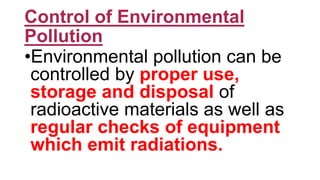
Control of Environmental
Pollution
•Environmental pollution can be
controlled by proper use,
storage and disposal of
radioactive materials as well as
regular checks of equipment
which emit radiations.
END OF TOPIC
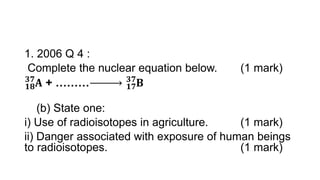
1. 2006 Q 4 :
Complete the nuclear equation below. (1 mark)
𝟏𝟖
𝟑𝟕
𝐀 + ……… 𝟏𝟕
𝟑𝟕
𝐁
(b) State one:
i) Use of radioisotopes in agriculture. (1 mark)
ii) Danger associated with exposure of human beings
to radioisotopes. (1 mark)
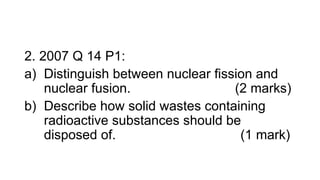
2. 2007 Q 14 P1:
a) Distinguish between nuclear fission and
nuclear fusion. (2 marks)
b) Describe how solid wastes containing
radioactive substances should be
disposed of. (1 mark)

RADIOACTIVITY TERM 3 2021 POWER POINT NOTES.pptx

  • 1.
    RADIOACTIVITY Objectives By the endof the topic the learner should be able to: (a) Define radioactivity, half-life, radioisotopes and nuclides. (b) State the types of radioactivity, name the particles emitted during radioactive decay and state their properties. (c) Carry out simple calculations involving half-life (t- ½). (d) Write balanced nuclear equations. (e) Distinguish between nuclear fission and fusion. (f) State the uses of some radioisotopes and dangers associated with radioactivity.
  • 2.
    Nuclide. • It isparticular nucleus of an atom characterised by its protons and neutrons • Nuclides can either be stable or unstable. • Most stable nuclides have a neutron/proton (n/p) ratio of about 1 : 1. • For example, 40 20Ca has 20 neutrons and 20 protons, hence the n/p ratio is 20 : 20= 1 : 1.
  • 3.
    • For nuclidesof high atomic number, the n/p ration increases progressively up to about 1.6 : 1 which is still within the stability region. • Above this value the nucleus becomes too large and unstable. • The unstable nuclide normally undergoes some changes by emitting radiation in form of particles and energy. • Such emissions results in the production of new nuclides of completely different composition.
  • 4.
    Radioactivity as aNuclear Reaction • Radioactivity - The process where an unstable nuclide breaks up to yield another nuclide of different composition with emission of particles and energy. • Radioactive substances -substances which undergo radioactivity. • Radioisotopes-Isotopes which are radioactive. • Radioactive decay-The spontaneous disintegration of radioactive nuclides. N/B Radioactivity is a nuclear process and not a chemical reaction.
  • 5.
    Differences between chemicaland nuclear reactions Nuclear Reaction Chemical Reaction 1. Takes place within the nucleus and involves neutrons and protons. Takes place on the outer energy levels containing the valence electrons. Does not involve protons and neutrons. 2. Releases large amounts of heat energy. The heat energy released is much less. 3. Not affected by environmental factors such as temperature. Are affected by environmental factors such as temperature and pressure. Nuclear Reaction Chemical Reaction 1. Takes place within the nucleus and involves neutrons and protons. 1. Takes place on the outer energy levels containing the valence electrons. Does not involve protons and neutrons. 2. Releases large amounts of heat energy. 2. The heat energy released is much less. 3. Not affected by environmental factors such as temperature. 3. Are affected by environmental factors such as temperature and pressure.
  • 6.
    Types of Radioactivity 1.Natural radioactivity It occurs when radioactive nuclide split spontaneously yielding a new nuclide with the emission of radiation and energy. For example, The nucleus of uranium– 238 undergoes natural radioactive decay to form Thorium – 234 and some radiation. 2. Artificial radioactivity It occurs when large stable nuclides are bombarded with fast moving high-energy particles. In the process, the nuclides split into relatively smaller nuclei with emission of radiation and energy.
  • 7.
    Types , Characteristicsand Properties of radiations. TYPES OF RADIATION When radioactive nuclides disintegrate, they emit radiations namely : 1. alpha particles (α), 2. beta (β) and 3. gamma (γ).
  • 8.
    Characteristics of Radiations 1.Alpha •Alpha radiations are particles which are positively charged helium nuclei, He2+. •They are represented as 4 2He2+ in nuclear equations. •Alpha particles have an electrical charge of 2+ . They are the heaviest of the three radiations.
  • 9.
    Characteristics of Radiations 2.Beta Betaradiations are particles which are negatively charged. • They are represented as −1 0e . • They are electrons, which originate from within the nucleus and not from the outer energy levels. • They are formed when a neutron changes into a proton within the nucleus. • 0 1n neutron 1 1p proton + −1 0e electron • The –1 is not an atomic number. • It represents the charge on the particles. • Beta particles have an electrical charge of -1.
  • 10.
    Characteristics of Radiations Gamaradiations are high energy rays. •They do not have an electrical charge. •They are not emitted on their own but normally accompany the emission of alpha or beta particles.
  • 11.
    Properties of Radiations •Penetrating power Alpha particles have very low penetrating power. They do not pass through a sheet of paper. The have a range of only a few centimetres in air. Beta particles have higher penetrating power. They can pass through a sheet of paper but are stopped by a sheet of aluminium foil. Gamma rays have the highest penetrating power. They pass through a sheet of paper and a sheet of aluminium. They are however stopped by a thick lead block.
  • 12.
  • 13.
    Deflection by anElectric Field •Alpha particles are positively charged. They are therefore attracted to the negative plate in an electric field. •Since they are heavy they are only slightly deflected.
  • 14.
    Deflection by anElectric Field •Beta particles are negatively charged and so are deflected to the positive plate in an electric field. The deflection is greater than that of alpha particles due to their much smaller masses.
  • 15.
    Deflection by anElectric Field •Gamma rays do not have a charge and are therefore unaffected by an electric field.
  • 16.
    Deflection by anElectric Field
  • 17.
    Ionising Effect ofRadiations • Alpha particles have very high ionising power. They produce a large number of ions as they pass through gases due to their slow speed and high charge. Their slow speed enables the alpha particles to be in contact with target atoms for a longer time. • Beta particles have lower ionising power and produce fewer ions in gases. • Gamma rays have very low ionising power.
  • 18.
  • 19.
    Radioactive Decay andHalf-Life •When a radioactive nuclide decays, a new nuclide is formed. •As disintegration proceeds, fewer and fewer unstable atoms remain. •The Table below shows the radioactive decay for a sample of 400 g of iodine – 131
  • 20.
    Decay of iodine-131 A graph of the data given is shown alongside. Time (days) Mass (g) of radioactive iodine Remaining 0 400 8.1 200 16.2 100 24.3 50 32.4 25
  • 21.
    •From the graphit can be seen that after every 8.1 days the amount of substance remaining is half the previous amount. •The fractions of the original amount remaining after:
  • 22.
    Deductions from thegraph •From the graph, it is also observed that the remaining amount never reduces to zero. • The time taken for the mass to reduce to half the previous value is a constant, i.e., 8.1 days. •This constant value is referred to as the half-
  • 23.
    The half-life ofa radioactive isotope is the time taken for a given mass or number of nuclides to decay to half its original mass or number. • From the sample of 400 g iodine – 131 given in the example, the amount remaining after the first half- life (8.1 days) will be 200 g. • After the second half-life (16.2 days) it will be 100g. This can be illustrated as shown.
  • 24.
    • The amountremaining after the first half-live is half the previous amount. • The remaining amount after successive nuclide decay can be worked out by using the formula; Remaining amount = × original amount, where : n is the number of half-lives undergone.
  • 25.
    For example The remainingamount after 24.3 days (3 half-lives) is Given the remaining amount, the original amount can also be determined.
  • 26.
    For example: If 3gof whose half -life is 8 seconds remain after undergoing radioactive decay for 32 seconds.
  • 27.
    •Each radioactive isotopedecays at its own rate and therefore has its own half- life. •Half-life range from fraction of a second to millions of years.
  • 28.
    Alternatively, • The originalamount can be found using a step by step method thus; The original amount is 48 g.
  • 29.
    •Each radioactive isotopedecays at its own rate and therefore has its own half- life. •Half-life range from fraction of a second to millions of years.
  • 30.
  • 31.
    REMARKS •The shorter thehalf-life, the faster the rate of decay of the nuclide. •The longer the half-life, the slower the rate of decay of the nuclide. • The rate of radioactive decay is unaffected by any chemical or physical change.
  • 32.
    • The half-lifeof radioactive isotopes is one of the factors used to determine their application. For example, carbon-14 is used to determine the age of dead organic matter. The process is known as carbon-dating. The carbon in plants which is taken up during photosynthesis contains a small portion of radioactive carbon-14. When the plant dies, the carbon-14 in the dead plant continues decaying hence the amount decreases. Carbon-14 has half-life a of about 5,600 years therefore by determining the carbon content in the dead material it is mathematically possible to determine the age of the
  • 33.
    •Sodium-20 with ahalf-life of 0.3 seconds is used to detect leakages because it has a short half-life.
  • 34.
    Nuclear Reactions •When analpha particle is emitted from the nucleus, both the atomic number and the mass number of the nuclide decrease. A new nuclide is formed as represented by the following equation •The equation above is referred to as a nuclear equation.
  • 35.
    •The sum ofthe mass number on the right hand side of the equation is equal to the mass number of the left hand side. The sum of proton numbers on the right hand side equals the number of protons on the left hand side.
  • 36.
    • When abeta particle is emitted, the atomic number increases by one and the mass number remains constant. This is because: (i) During beta emission, a neutron spontaneously changes into a proton and emits an electron. That is: The positive charge increases in the process.
  • 37.
    • (ii) Themass of the particles emitted is negligible. Consider the following nuclides, which emit beta particles
  • 38.
    • The emissionof gamma rays which is a form of energy always accompanies other radioactive emissions. • They are produced when the remaining particles in the nucleus re-organise themselves into more stable arrangements. • Gamma rays are not shown when writing nuclear equations because they have no effect on mass number and atomic number of a nuclide.
  • 39.
    For example: • 92 236 U56 141 Ba + 36 92 Kr + 30 1n + energy
  • 40.
    Radioactive Decay Series. •Aradioactive decay series represents the sequential and continuous disintegration of unstable nuclide until a stable nuclide is formed.
  • 41.
    For example startingwith thorium–232 The following series is obtained; • In this decay series, natural decay ends when stable lead-208 is formed. • Notice that the n p ratios of lead –208 is about 1.5:1 which is in the stable region. This decay series is known as the Thorium decay series.
  • 42.
  • 43.
    Nuclear Fission •It isthe splitting process a heavy nuclide undergoes when bombarded by a fast- moving neutron. •The large unstable nuclide absorbs a neutron and immediately splits up into two approximately equal fragments together with a number of smaller particles such as a neutron. • During this process, much energy is
  • 44.
    For example: 92 236 U +0 1n 56 141Ba + 36 92Kr + 30 1n + energy •The mass of the products added together equal the mass of the original nuclide plus the mass of the neutron. •The three neutrons produced further bombard more nuclei and more neutrons are formed. •This results in a chain reaction.
  • 45.
    •Energy is liberateddue to the fact that the total mass of the products is slightly less than the mass of the initial nuclides. •This difference in mass is radiated as energy. • A very small loss in mass results in an enormous amount of energy being released.
  • 46.
    •This energy canbe tapped and utilised to generate electrical energy and other forms of energy under controlled conditions. •The enormous heat is used to heat water to produce steam which then turns turbines to produce electricity. •The energy of an atomic bomb is due to nuclear fission of uranium–235.
  • 47.
    Nuclear fusion •It occurswhen nuclei combine together when they are made to collide at high velocity resulting in the formation of a heavy nucleus and release of energy. •Some sub-atomic particles such as neutrons are also released during nuclear fusion. •The energy released after fusion causes other nuclide to collide and a chain reaction
  • 48.
    For example: • Thesum of mass numbers and atomic numbers of the products equal the sum of mass numbers and atomic number of the reactants. • The energy released during nuclear fusion can be harnessed and converted into other forms of energy such as electrical energy. • The hydrogen bomb works on the principle of nuclear fusion.
  • 49.
    Similarity between Nuclearfission and fusion 1.In both cases a large quantity of energy is released. 2.Both processes results in chain reactions. 3.In both cases sub-atomic particles such as neutrons accompany the process. 4.The energy released can be harnessed and converted into other forms of useful energy such as electrical energy. 5.The large amount of energy produced in both reactions can be very destructive when misused such as in nuclear warfare.
  • 50.
    Applications of Radioactivity Besidesproduction of energy, other uses of radioactivity include the following: Medical applications 1. Used to destroy cancerous tissue when a patient is exposed to correct dose of radiation from radioactive nuclide such as a Cobalt–60 and Caesium–137, it is possible to destroy cancerous growth without serious damage to other tissues of the patient. 2. Sterilisation of surgical instruments using gamma radiation. 3. Radioactive iodine (iodine–131) is used in patients with defective thyroid to enable doctors to follow the path of iodine through the body.
  • 51.
    Agricultural applications Radioactivity maybe used in monitoring: 1.Photosynthesis and related process; Carbon(VI) oxide containing radioactive carbon –14 is used, and the path of this carbon can be followed during the growth of the plant. 2.Absorption of phosphate fertilisers; radioactive phosphorus can be used to determine the rate of absorption of the fertiliser. 3.Detecting leakages in underground water or oil pipes without digging them out.
  • 52.
    Other uses 1. Preservationof food by exposing micro- organisms to gamma radiation which kills them. 2. Gauging the thickness of thin metal and paper sheets. 3. Measuring the level of food in canned and packed food. 4. Determining the age of archeological materials in fossils from carbon –14 dating. 5. Manufacture of nuclear weapons and atomic bombs.
  • 53.
    Dangers of Radioactivity EnvironmentalPollution 1.Environmental pollution occurs when radioactive materials emit radiation into the atmosphere. Exposure to large amounts of radioactivity can cause nausea, vomiting, hair loss, diarrhea, hemorrhage, destruction of the intestinal lining, central nervous system damage, and death. It also causes DNA damage(Genetic mutation) and raises the risk of cancer, particularly in young children and fetuses 2.Disposal of nuclear waste is of particular concern since some of the radioactive materials have very long half-life.
  • 54.
    Environmental Pollution 3. Testingof nuclear weapons in the oceans also causes environmental pollution since plants and other living organisms may take in the radioactive materials released in the water. 4. When not put into proper use, radioisotopes can be used as weapons of mass destruction as it happened in the cities of Hiroshima and Nagasaki, Japan during the Second World War.
  • 55.
    Control of Environmental Pollution •Environmentalpollution can be controlled by proper use, storage and disposal of radioactive materials as well as regular checks of equipment which emit radiations.
  • 56.
  • 57.
    1. 2006 Q4 : Complete the nuclear equation below. (1 mark) 𝟏𝟖 𝟑𝟕 𝐀 + ……… 𝟏𝟕 𝟑𝟕 𝐁 (b) State one: i) Use of radioisotopes in agriculture. (1 mark) ii) Danger associated with exposure of human beings to radioisotopes. (1 mark)
  • 58.
    2. 2007 Q14 P1: a) Distinguish between nuclear fission and nuclear fusion. (2 marks) b) Describe how solid wastes containing radioactive substances should be disposed of. (1 mark)