Chapter 2
Basic Structure Concepts
January2015
1
2.0 : BASIC STRUCTURE CONCEPT
2.1 Forces
2.2 Equilibrium and Reactions
2.3 Moments
2.4 Stress and Strain
2.5 Elastic and plastic range
2.6 Primary Loads & Secondary Loads
January2015
2
2.1 Forces
A force is that which tends to exert motion, tension or
compression on an object.
The loads acting on a structure have mass which is usually
measured in kilograms(kg).
The basic unit of force is the newton (N). The force exerted on a
structure by a static load is dependent upon both its mass and the
force of gravity.
The force exerted by a body as a result of gravity can be described
as its weight.
F =W= m x g
 Therefore, the force exerted by a mass of 1 kg is:
F = m x g
= 1 x 9.81
=9.81 N @ 0.00981 kN
 1 kN = 1000 N
January2015
3
2.1 Forces
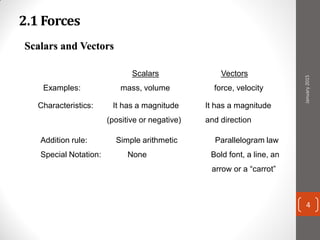
Scalars and Vectors
Scalars Vectors
Examples: mass, volume force, velocity
Characteristics: It has a magnitude It has a magnitude
(positive or negative) and direction
Addition rule: Simple arithmetic Parallelogram law
Special Notation: None Bold font, a line, an
arrow or a “carrot”
January2015
4
2.1 Forces
Application of Vector Addition
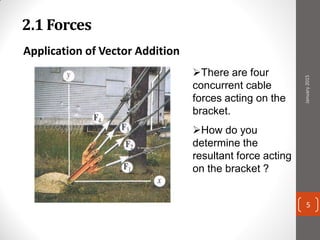
There are four
concurrent cable
forces acting on the
bracket.
How do you
determine the
resultant force acting
on the bracket ?
January2015
5
2.1 Forces
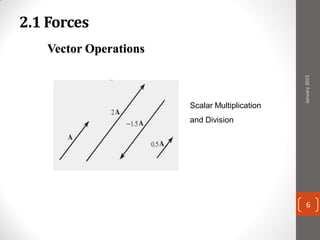
Vector Operations
Scalar Multiplication
and Division
January2015
6
2.1 Forces
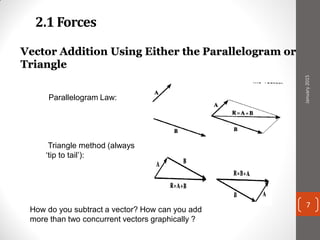
Vector Addition Using Either the Parallelogram or
Triangle
Parallelogram Law:
Triangle method (always
‘tip to tail’):
How do you subtract a vector? How can you add
more than two concurrent vectors graphically ?
January2015
7
2.1 Forces
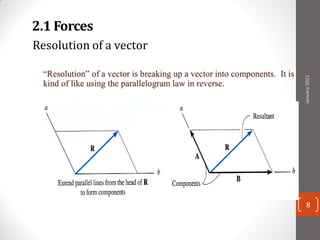
Resolution of a vector
“Resolution” of a vector is breaking up a vector into components. It is
kind of like using the parallelogram law in reverse.
January2015
8
2.1 Forces
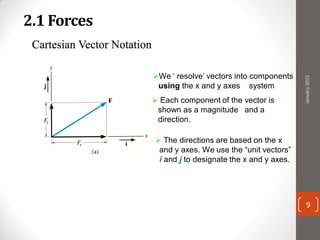
 Each component of the vector is
shown as a magnitude and a
direction.
Cartesian Vector Notation
We ‘ resolve’ vectors into components
using the x and y axes system
 The directions are based on the x
and y axes. We use the “unit vectors”
i and j to designate the x and y axes.
January2015
9
2.1 Forces
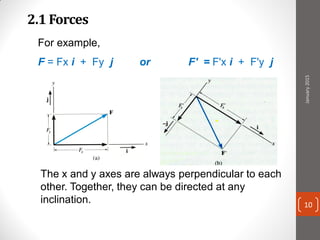
For example,
F = Fx i + Fy j or F' = F'x i + F'y j
The x and y axes are always perpendicular to each
other. Together, they can be directed at any
inclination.
January2015
10
2.1 Forces
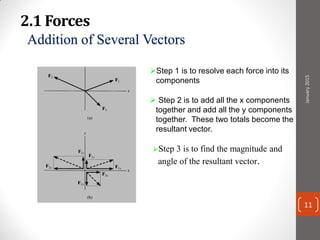
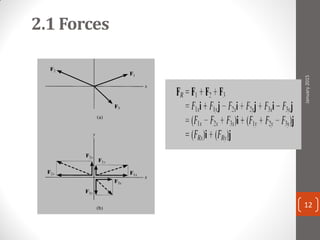
Addition of Several Vectors
Step 1 is to resolve each force into its
components
 Step 2 is to add all the x components
together and add all the y components
together. These two totals become the
resultant vector.
Step 3 is to find the magnitude and
angle of the resultant vector.
January2015
11
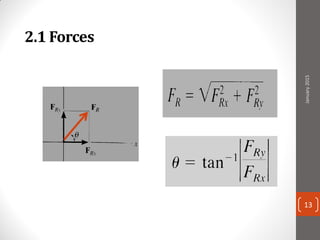
2.1 Forces
January2015
12
2.1 Forces
January2015
13
2.1 Forces
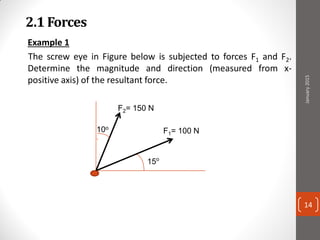
Example 1
The screw eye in Figure below is subjected to forces F1 and F2.
Determine the magnitude and direction (measured from x-
positive axis) of the resultant force.
F2= 150 N
F1= 100 N10o
15o
January2015
14
2.1 Forces
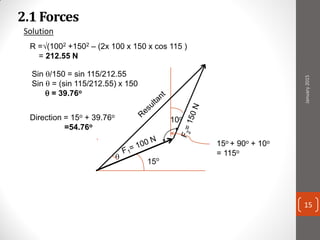
Solution
10o
15o
15o + 90o + 10o
= 115o
R =√(1002 +1502 – (2x 100 x 150 x cos 115 )
= 212.55 N

Sin /150 = sin 115/212.55
Sin  = (sin 115/212.55) x 150
 = 39.76o
Direction = 15o + 39.76o
=54.76o
January2015
15
2.1 Forces
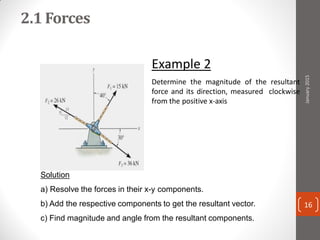
Example 2
Determine the magnitude of the resultant
force and its direction, measured clockwise
from the positive x-axis
Solution
a) Resolve the forces in their x-y components.
b) Add the respective components to get the resultant vector.
c) Find magnitude and angle from the resultant components.
January2015
16
2.1 Forces
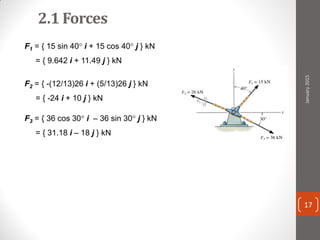
F1 = { 15 sin 40° i + 15 cos 40° j } kN
= { 9.642 i + 11.49 j } kN
F2 = { -(12/13)26 i + (5/13)26 j } kN
= { -24 i + 10 j } kN
F3 = { 36 cos 30° i – 36 sin 30° j } kN
= { 31.18 i – 18 j } kN
January2015
17
2.1 Forces
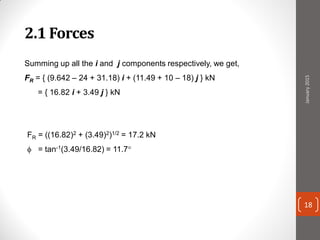
Summing up all the i and j components respectively, we get,
FR = { (9.642 – 24 + 31.18) i + (11.49 + 10 – 18) j } kN
= { 16.82 i + 3.49 j } kN
FR = ((16.82)2 + (3.49)2)1/2 = 17.2 kN
 = tan-1(3.49/16.82) = 11.7°
January2015
18
2.1 Forces
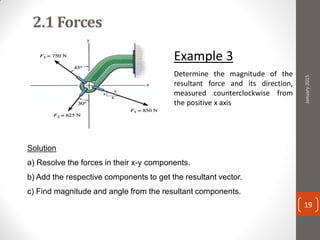
Example 3
Determine the magnitude of the
resultant force and its direction,
measured counterclockwise from
the positive x axis
Solution
a) Resolve the forces in their x-y components.
b) Add the respective components to get the resultant vector.
c) Find magnitude and angle from the resultant components.
January2015
19
2.1 Forces
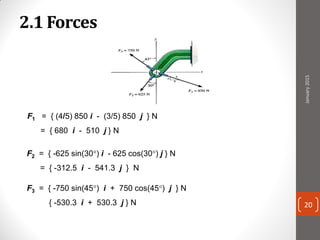
F1 = { (4/5) 850 i - (3/5) 850 j } N
= { 680 i - 510 j } N
F2 = { -625 sin(30°) i - 625 cos(30°) j } N
= { -312.5 i - 541.3 j } N
F3 = { -750 sin(45°) i + 750 cos(45°) j } N
{ -530.3 i + 530.3 j } N
January2015
20
2.1 Forces
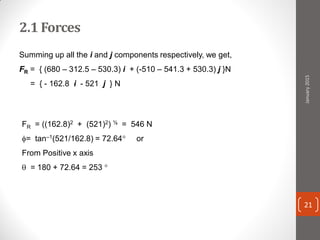
Summing up all the i and j components respectively, we get,
FR = { (680 – 312.5 – 530.3) i + (-510 – 541.3 + 530.3) j }N
= { - 162.8 i - 521 j } N
FR = ((162.8)2 + (521)2) ½ = 546 N
= tan–1(521/162.8) = 72.64° or
From Positive x axis
 = 180 + 72.64 = 253 °
January2015
21
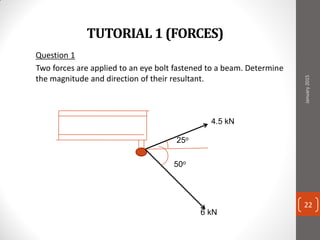
TUTORIAL 1 (FORCES)
Question 1
Two forces are applied to an eye bolt fastened to a beam. Determine
the magnitude and direction of their resultant.
6 kN
4.5 kN
25o
50o
January2015
22
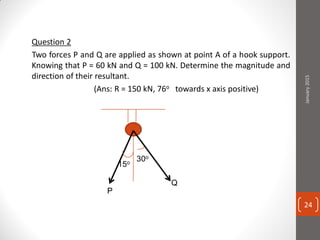
Question 2
Two forces P and Q are applied as shown at point A of a hook support.
Knowing that P = 60 kN and Q = 100 kN. Determine the magnitude and
direction of their resultant.
(Ans: R = 150 kN, 76o towards x axis positive)
P
Q
15o
30o
January2015
24
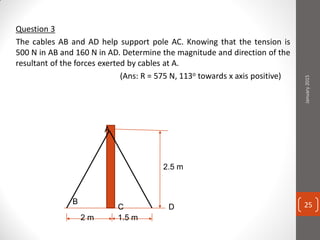
Question 3
The cables AB and AD help support pole AC. Knowing that the tension is
500 N in AB and 160 N in AD. Determine the magnitude and direction of the
resultant of the forces exerted by cables at A.
(Ans: R = 575 N, 113o towards x axis positive)
A
B
C D
2 m 1.5 m
2.5 m
January2015
25
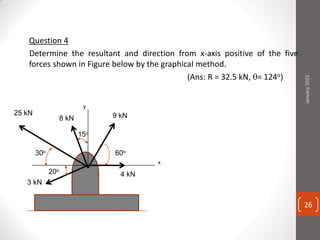
Question 4
Determine the resultant and direction from x-axis positive of the five
forces shown in Figure below by the graphical method.
(Ans: R = 32.5 kN, = 124o)
y
x
8 kN 9 kN
4 kN
60o
25 kN
3 kN
15o
30o
20o
January2015
26
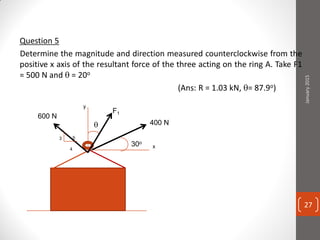
Question 5
Determine the magnitude and direction measured counterclockwise from the
positive x axis of the resultant force of the three acting on the ring A. Take F1
= 500 N and  = 20o
(Ans: R = 1.03 kN, = 87.9o)
y
x
600 N
F1
400 N
30o
3
4
5
January2015
27
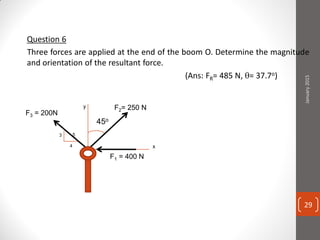
Question 6
Three forces are applied at the end of the boom O. Determine the magnitude
and orientation of the resultant force.
(Ans: FR= 485 N, = 37.7o)
y
x
F3 = 200N
F2= 250 N
F1 = 400 N
45o
3
4
5
January2015
29
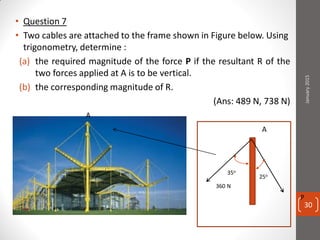
• Question 7
• Two cables are attached to the frame shown in Figure below. Using
trigonometry, determine :
(a) the required magnitude of the force P if the resultant R of the
two forces applied at A is to be vertical.
(b) the corresponding magnitude of R.
(Ans: 489 N, 738 N)
A
A
25o
35o
360 N
P
January2015
30
2.2 Equilibriumand Reactions
Any structure subjected to loads must be provided with
supports to prevent it from moving. The forces
generated on the structure by these supports are called
reactions. If the structure is in equilibrium (i.e. not
moving) then the net forces from the loads and
reactions must be zero in all directions.
Fx = 0
Fy = 0
 M = 0
January2015
31
January2015
32
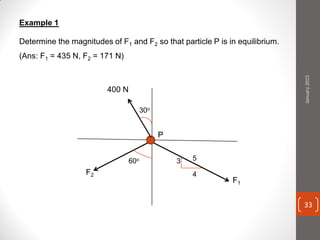
Example 1
Determine the magnitudes of F1 and F2 so that particle P is in equilibrium.
(Ans: F1 = 435 N, F2 = 171 N)
P
F1
F2
400 N
3
4
5
30o
60o
January2015
33
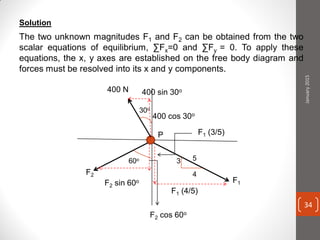
Solution
The two unknown magnitudes F1 and F2 can be obtained from the two
scalar equations of equilibrium, ∑Fx=0 and ∑Fy = 0. To apply these
equations, the x, y axes are established on the free body diagram and
forces must be resolved into its x and y components.
P
F1
F2
400 N
3
4
5
30o
60o
400 cos 30o
400 sin 30o
F2 cos 60o
F2 sin 60o
F1 (4/5)
F1 (3/5)
January2015
34
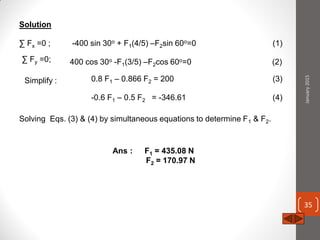
Solution
∑ Fx =0 ; -400 sin 30o + F1(4/5) –F2sin 60o=0
∑ Fy =0; 400 cos 30o -F1(3/5) –F2cos 60o=0
(1)
(2)
Simplify : 0.8 F1 – 0.866 F2 = 200 (3)
-0.6 F1 – 0.5 F2 = -346.61 (4)
Solving Eqs. (3) & (4) by simultaneous equations to determine F1 & F2.
Ans : F1 = 435.08 N
F2 = 170.97 N
January2015
35
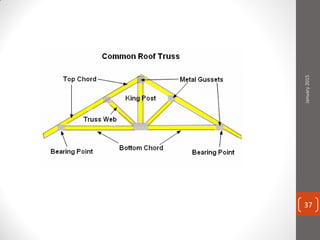
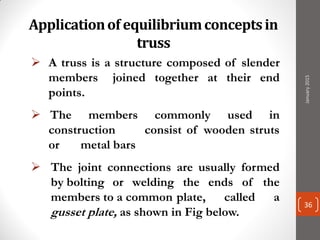
Applicationof equilibriumconceptsin
truss
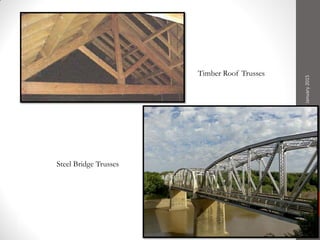
 A truss is a structure composed of slender
members joined together at their end
points.
 The members commonly used in
construction consist of wooden struts
or metal bars
 The joint connections are usually formed
by bolting or welding the ends of the
members to a common plate, called a
gusset plate, as shown in Fig below.
January2015
36
January2015
37
38
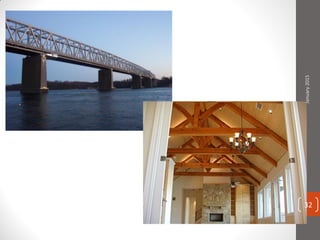
Timber Roof Trusses
Steel Bridge Trusses
January2015
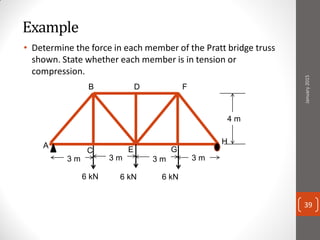
Example
• Determine the force in each member of the Pratt bridge truss
shown. State whether each member is in tension or
compression.
6 kN 6 kN 6 kN
4 m
3 m 3 m 3 m 3 m
A
B
C
D
E
F
G
H
January2015
39
2.3 Moments
APPLICATION
What is the net effect of the two
forces on the wheel?
January2015
40
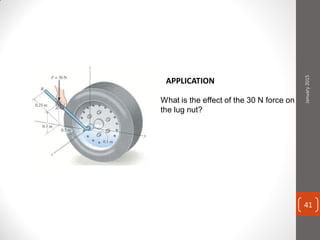
APPLICATION
What is the effect of the 30 N force on
the lug nut?
January2015
41
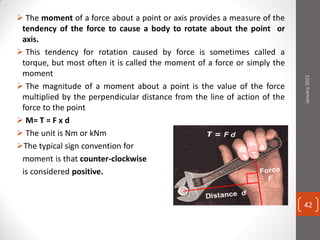
 The moment of a force about a point or axis provides a measure of the
tendency of the force to cause a body to rotate about the point or
axis.
 This tendency for rotation caused by force is sometimes called a
torque, but most often it is called the moment of a force or simply the
moment
 The magnitude of a moment about a point is the value of the force
multiplied by the perpendicular distance from the line of action of the
force to the point
 M= T = F x d
 The unit is Nm or kNm
The typical sign convention for
moment is that counter-clockwise
is considered positive.
January2015
42
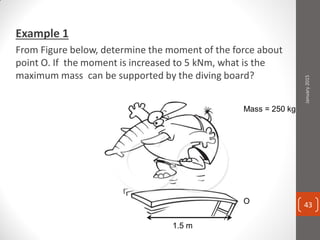
Example 1
From Figure below, determine the moment of the force about
point O. If the moment is increased to 5 kNm, what is the
maximum mass can be supported by the diving board?
1.5 m
Mass = 250 kg
January2015
43
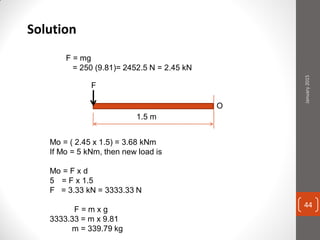
Solution
F = mg
= 250 (9.81)= 2452.5 N = 2.45 kN
1.5 m
Mo = ( 2.45 x 1.5) = 3.68 kNm
If Mo = 5 kNm, then new load is
Mo = F x d
5 = F x 1.5
F = 3.33 kN = 3333.33 N
F = m x g
3333.33 = m x 9.81
m = 339.79 kg
F
January2015
44
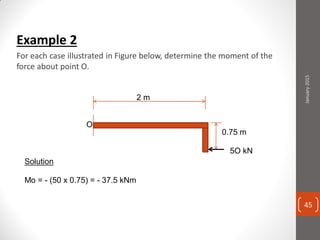
Example 2
For each case illustrated in Figure below, determine the moment of the
force about point O.
5O kN
2 m
0.75 m
Solution
Mo = - (50 x 0.75) = - 37.5 kNm
January2015
45
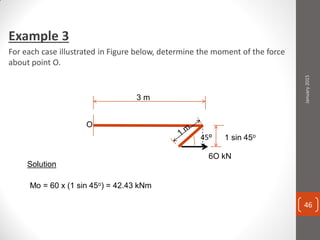
Example 3
For each case illustrated in Figure below, determine the moment of the force
about point O.
6O kN
3 m
45o
Solution
1 sin 45o
Mo = 60 x (1 sin 45o) = 42.43 kNm
January2015
46
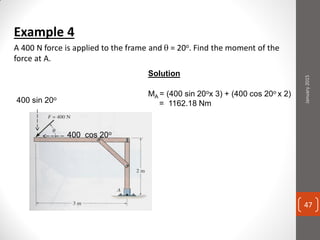
Example 4
A 400 N force is applied to the frame and  = 20o. Find the moment of the
force at A.
Solution
400 sin 20o
400 cos 20o
MA = (400 sin 20ox 3) + (400 cos 20o x 2)
= 1162.18 Nm
January2015
47
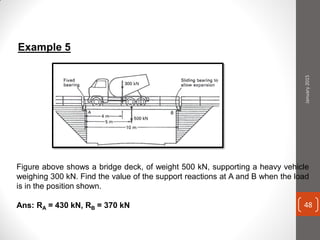
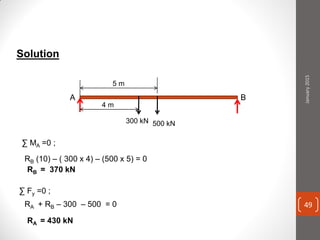
Figure above shows a bridge deck, of weight 500 kN, supporting a heavy vehicle
weighing 300 kN. Find the value of the support reactions at A and B when the load
is in the position shown.
Ans: RA = 430 kN, RB = 370 kN
Example 5
January2015
48
Solution
500 kN
5 m
300 kN
A B
4 m
∑ MA =0 ;
∑ Fy =0 ;
RB (10) – ( 300 x 4) – (500 x 5) = 0
RB = 370 kN
RA + RB – 300 – 500 = 0
RA = 430 kN
January2015
49
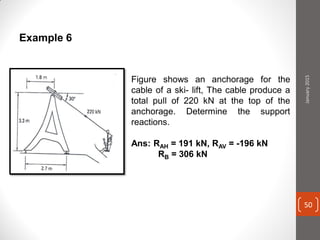
Example 6
Figure shows an anchorage for the
cable of a ski- lift, The cable produce a
total pull of 220 kN at the top of the
anchorage. Determine the support
reactions.
Ans: RAH = 191 kN, RAV = -196 kN
RB = 306 kN
January2015
50
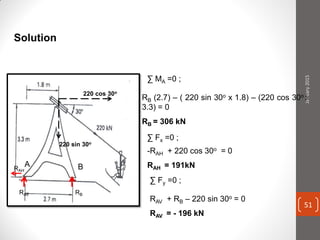
Solution
A B
220 cos 30o
220 sin 30o
RBRAV
RAH
∑ MA =0 ;
RB (2.7) – ( 220 sin 30o x 1.8) – (220 cos 30o x
3.3) = 0
RB = 306 kN
∑ Fx =0 ;
-RAH + 220 cos 30o = 0
RAH = 191kN
RAV + RB – 220 sin 30o = 0
RAV = - 196 kN
∑ Fy =0 ;
January2015
51
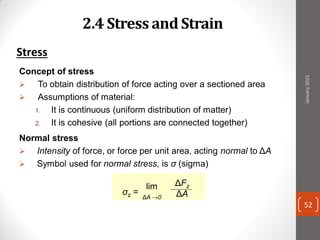
2.4 Stress and Strain
Stress
Concept of stress
 To obtain distribution of force acting over a sectioned area
 Assumptions of material:
1. It is continuous (uniform distribution of matter)
2. It is cohesive (all portions are connected together)
Normal stress
 Intensity of force, or force per unit area, acting normal to ΔA
 Symbol used for normal stress, is σ (sigma)
σz =
lim
ΔA →0
ΔFz
ΔA
January2015
52
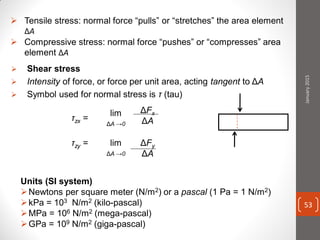
 Tensile stress: normal force “pulls” or “stretches” the area element
ΔA
 Compressive stress: normal force “pushes” or “compresses” area
element ΔA
 Shear stress
 Intensity of force, or force per unit area, acting tangent to ΔA
 Symbol used for normal stress is τ (tau)
τzx =
lim
ΔA →0
ΔFx
ΔA
τzy = lim
ΔA →0
ΔFy
ΔA
Units (SI system)
Newtons per square meter (N/m2) or a pascal (1 Pa = 1 N/m2)
kPa = 103 N/m2 (kilo-pascal)
MPa = 106 N/m2 (mega-pascal)
GPa = 109 N/m2 (giga-pascal)
January2015
53
Shear in Nature
January2015
54
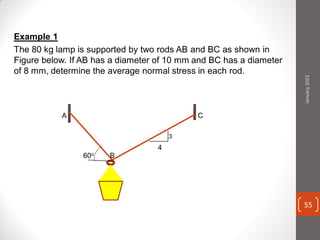
Example 1
The 80 kg lamp is supported by two rods AB and BC as shown in
Figure below. If AB has a diameter of 10 mm and BC has a diameter
of 8 mm, determine the average normal stress in each rod.
A
B
C
60o
3
4
January2015
55
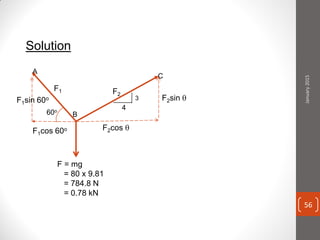
A
B
C
60o
3
4
F = mg
= 80 x 9.81
= 784.8 N
= 0.78 kN
F1 F2
F1cos 60o
F1sin 60o
F2cos 
F2sin 
Solution
January2015
56
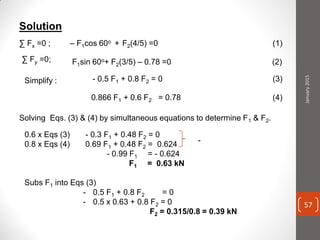
Solution
∑ Fx =0 ; – F1cos 60o + F2(4/5) =0
∑ Fy =0; F1sin 60o+ F2(3/5) – 0.78 =0
(1)
(2)
Simplify : - 0.5 F1 + 0.8 F2 = 0 (3)
0.866 F1 + 0.6 F2 = 0.78 (4)
Solving Eqs. (3) & (4) by simultaneous equations to determine F1 & F2.
0.6 x Eqs (3) - 0.3 F1 + 0.48 F2 = 0
0.8 x Eqs (4) 0.69 F1 + 0.48 F2 = 0.624
- 0.99 F1 = - 0.624
F1 = 0.63 kN
Subs F1 into Eqs (3)
-
- 0.5 F1 + 0.8 F2 = 0
- 0.5 x 0.63 + 0.8 F2 = 0
F2 = 0.315/0.8 = 0.39 kN
January2015
57
Solution
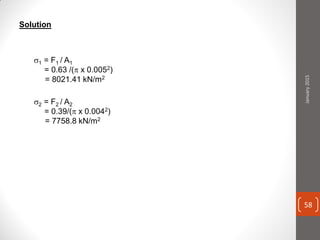
1 = F1 / A1
= 0.63 /( x 0.0052)
= 8021.41 kN/m2
2 = F2 / A2
= 0.39/( x 0.0042)
= 7758.8 kN/m2
January2015
58
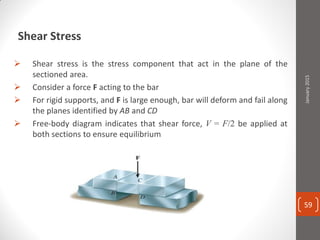
Shear Stress
 Shear stress is the stress component that act in the plane of the
sectioned area.
 Consider a force F acting to the bar
 For rigid supports, and F is large enough, bar will deform and fail along
the planes identified by AB and CD
 Free-body diagram indicates that shear force, V = F/2 be applied at
both sections to ensure equilibrium
January2015
59
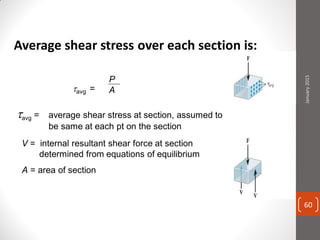
Average shear stress over each section is:
P
Aavg =
avg = average shear stress at section, assumed to
be same at each pt on the section
V = internal resultant shear force at section
determined from equations of equilibrium
A = area of section
January2015
60
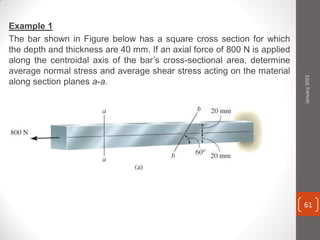
Example 1
The bar shown in Figure below has a square cross section for which
the depth and thickness are 40 mm. If an axial force of 800 N is applied
along the centroidal axis of the bar’s cross-sectional area, determine
average normal stress and average shear stress acting on the material
along section planes a-a.
January2015
61
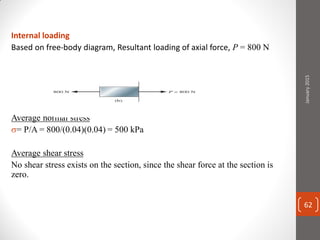
Internal loading
Based on free-body diagram, Resultant loading of axial force, P = 800 N
Average normal stress
= P/A = 800/(0.04)(0.04) = 500 kPa
Average shear stress
No shear stress exists on the section, since the shear force at the section is
zero.
January2015
62
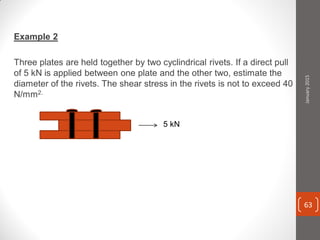
Example 2
Three plates are held together by two cyclindrical rivets. If a direct pull
of 5 kN is applied between one plate and the other two, estimate the
diameter of the rivets. The shear stress in the rivets is not to exceed 40
N/mm2.
5 kN
January2015
63
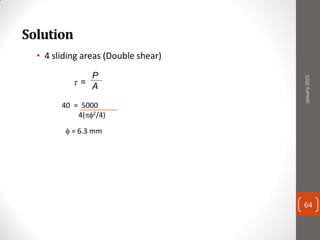
Solution
• 4 sliding areas (Double shear)
P
A =
40 = 5000
4(2/4)
 = 6.3 mm
January2015
64
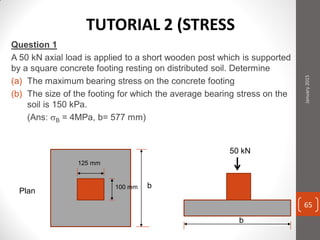
Question 1
A 50 kN axial load is applied to a short wooden post which is supported
by a square concrete footing resting on distributed soil. Determine
(a) The maximum bearing stress on the concrete footing
(b) The size of the footing for which the average bearing stress on the
soil is 150 kPa.
(Ans: B = 4MPa, b= 577 mm)
Plan
125 mm
100 mm b
b
50 kN
January2015
65
TUTORIAL 2 (STRESS
Question 2
The column is subjected to an axial force of 8 kN at its top. If the cross
sectional area has the dimensions shown in the figure, determine the
average normal stress at section a-a. (Ans:  = 1.74 MPa)
Plan
Front Elevation
160 mm
160 mm
a a
10 mm
10mm
10 mm
8 kN
160mm
January2015
66
Question 3
The 20 kg lamp is supported by two steel rods connected by a ring A.
Determine which rod is subjected to the greater average normal stress
and compute its value.
(Ans:  = 2.33 N/mm2)
B
A
C
60o
45o
12 mm
10 mm
January2015
67
Question 4
A square hole having 12 mm sides is to be punched out of a metal
plate 1.6 mm thick. The shear stress required to cause fracture is 350
N/mm2. What force must be applied to punch die? What would be the
compressive stress in the punch?
(Ans: 26.88 kN, 0.19 kN/mm2)
January2015
68
ALLOWABLE STRESS
 When designing a structural member or mechanical element, the
stress in it must be restricted to safe level
 Choose an allowable load that is less than the load the member
can fully support
 One method used is the factor of safety (F.S.)
F.S. =
Ffail
Fallow
 If load applied is linearly related to stress developed within
member, then F.S. can also be expressed as:
F.S. =
σfail
σallow
F.S. =
fail
allow
 In all the equations, F.S. is chosen to be greater than 1, to avoid
potential for failure
 Specific values will depend on types of material used and its
intended purpose
January2015
69
Strain
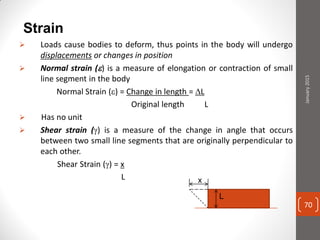
 Loads cause bodies to deform, thus points in the body will undergo
displacements or changes in position
 Normal strain () is a measure of elongation or contraction of small
line segment in the body
Normal Strain () = Change in length = L
Original length L
 Has no unit
 Shear strain () is a measure of the change in angle that occurs
between two small line segments that are originally perpendicular to
each other.
Shear Strain () = x
L
L
x
January2015
70
Conventional stress-strain diagram
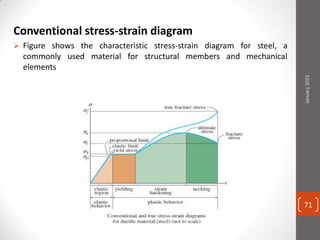
 Figure shows the characteristic stress-strain diagram for steel, a
commonly used material for structural members and mechanical
elements
January2015
71
Elastic behavior.
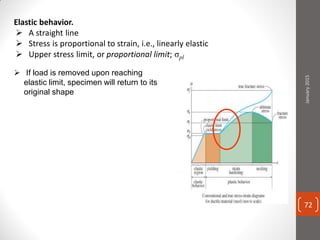
 A straight line
 Stress is proportional to strain, i.e., linearly elastic
 Upper stress limit, or proportional limit; σpl
 If load is removed upon reaching
elastic limit, specimen will return to its
original shape
January2015
72
Yielding.
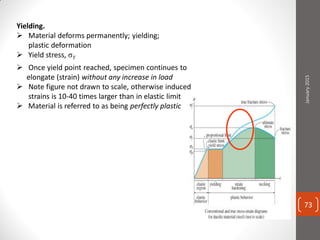
 Material deforms permanently; yielding;
plastic deformation
 Yield stress, σY
 Once yield point reached, specimen continues to
elongate (strain) without any increase in load
 Note figure not drawn to scale, otherwise induced
strains is 10-40 times larger than in elastic limit
 Material is referred to as being perfectly plastic
January2015
73
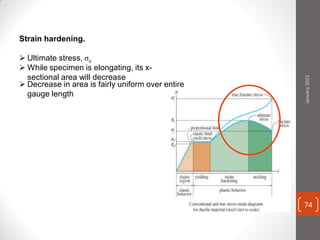
Strain hardening.
 Ultimate stress, σu
 While specimen is elongating, its x-
sectional area will decrease
 Decrease in area is fairly uniform over entire
gauge length
January2015
74
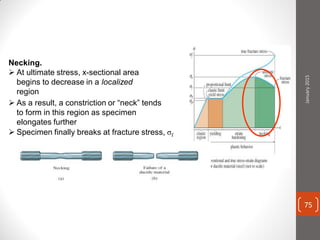
Necking.
 At ultimate stress, x-sectional area
begins to decrease in a localized
region
 As a result, a constriction or “neck” tends
to form in this region as specimen
elongates further
 Specimen finally breaks at fracture stress, σf
January2015
75
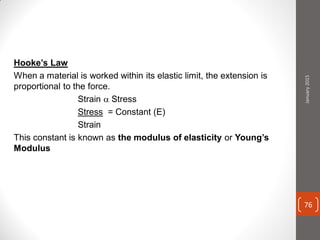
Hooke’s Law
When a material is worked within its elastic limit, the extension is
proportional to the force.
Strain  Stress
Stress = Constant (E)
Strain
This constant is known as the modulus of elasticity or Young’s
Modulus
January2015
76
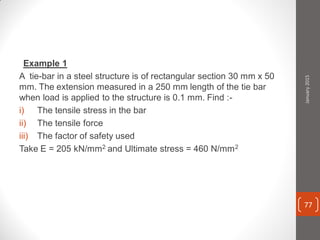
Example 1
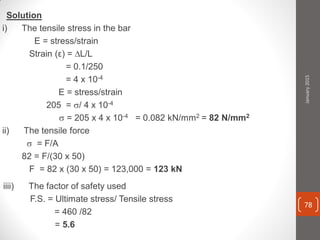
A tie-bar in a steel structure is of rectangular section 30 mm x 50
mm. The extension measured in a 250 mm length of the tie bar
when load is applied to the structure is 0.1 mm. Find :-
i) The tensile stress in the bar
ii) The tensile force
iii) The factor of safety used
Take E = 205 kN/mm2 and Ultimate stress = 460 N/mm2
January2015
77
Solution
i) The tensile stress in the bar
E = stress/strain
Strain (ε) = ∆L/L
= 0.1/250
= 4 x 10⁻⁴
E = stress/strain
205 = / 4 x 10⁻⁴
 = 205 x 4 x 10-4 = 0.082 kN/mm2 = 82 N/mm2
ii) The tensile force
 = F/A
82 = F/(30 x 50)
F = 82 x (30 x 50) = 123,000 = 123 kN
iiii) The factor of safety used
F.S. = Ultimate stress/ Tensile stress
= 460 /82
= 5.6
January2015
78
Example 2
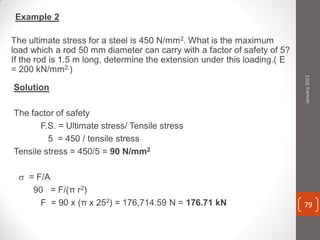
The ultimate stress for a steel is 450 N/mm2. What is the maximum
load which a rod 50 mm diameter can carry with a factor of safety of 5?
If the rod is 1.5 m long, determine the extension under this loading.( E
= 200 kN/mm2.)
Solution
The factor of safety
F.S. = Ultimate stress/ Tensile stress
5 = 450 / tensile stress
Tensile stress = 450/5 = 90 N/mm2
 = F/A
90 = F/(π r2)
F = 90 x (π x 252) = 176,714.59 N = 176.71 kN
January2015
79
Solution
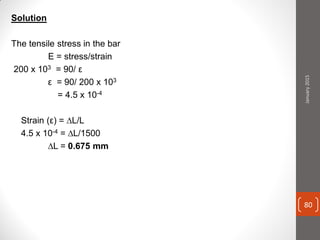
The tensile stress in the bar
E = stress/strain
200 x 103 = 90/ ε
ε = 90/ 200 x 103
= 4.5 x 10⁻⁴
Strain (ε) = ∆L/L
4.5 x 10-4 = ∆L/1500
∆L = 0.675 mm
January2015
80
Exercise 1
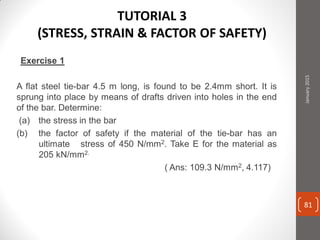
A flat steel tie-bar 4.5 m long, is found to be 2.4mm short. It is
sprung into place by means of drafts driven into holes in the end
of the bar. Determine:
(a) the stress in the bar
(b) the factor of safety if the material of the tie-bar has an
ultimate stress of 450 N/mm2. Take E for the material as
205 kN/mm2.
( Ans: 109.3 N/mm2, 4.117)
January2015
81
TUTORIAL 3
(STRESS, STRAIN & FACTOR OF SAFETY)
Exercise 2
A metal tube of outside diameter 75 mm and length 1.65 m is to
carry a compressive load of 60 kN. If the allowable axial stress is
75 N/mm2 , calculate the inside diameter of the tube. If E of the
material is 90 kN/mm2., by how much will the tube shorten under
this load?
Ans: 67.87 mm, 1.375 mm)
January2015
82
2.5 PrimaryLoads & Secondary Loads
 DEADLOADS
Dead Loads are those loads which are considered to act
permanently; they are "dead," stationary, and unable to
be removed. The self-weight of the structural members
normally provides the largest portion of the dead load of
a building. This will clearly vary with the actual materials
chosen. Permanent non-structural elements such as
roofing, concrete, flooring, pipes, ducts, interior partition
walls, Environmental Control Systems machinery,
elevator machinery and all other construction systems
within a building must also be included in the calculation
of the total dead load. These loads are represented by
the red arrow in the illustration.
Primary Loads are divided into three broad categories according to the way in
which they act upon the structure or structural element. These are DEAD
LOADS, LIVE LOADS(IMPOSED LOADS) and WIND LOADS
January2015
83
2.5PrimaryLoads
Unit weights of various building materials (kN/m3)
Materials Unit Weight
Aluminium 24
Bricks 22*
Concrete 24
Concrete blocks (lightweight) 12*
Concrete blocks (dense) 22*
Glass fibre composite 18
Steel 70
Timber 6*
* Subject to considerable variation
January2015
84
2.5 PrimaryLoads
Unit weights of various sheet materials (kN/m2)
The dead load of a floor or a roof is generally evaluated for one square meter of floor or roof area
Sheet materials kN/m2
Acoustic ceiling tiles 0.1
Asphalt (19 mm) 0.45
Aluminium roof sheeting 0.04
Glass (single glazing) 0.1
Plaster (per face of wall) 0.3
Plasterboard 0.15
Rafters, battens and felt 0.14
Sand/cement screed (25 mm) 0.6
Slates 0.6
Steel roof sheeting 0.15
Timber floorboards 0.15
Vinyl Tiles 0.05
January2015
85
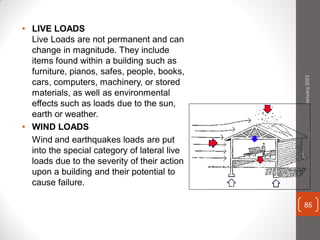
• LIVE LOADS
Live Loads are not permanent and can
change in magnitude. They include
items found within a building such as
furniture, pianos, safes, people, books,
cars, computers, machinery, or stored
materials, as well as environmental
effects such as loads due to the sun,
earth or weather.
• WIND LOADS
Wind and earthquakes loads are put
into the special category of lateral live
loads due to the severity of their action
upon a building and their potential to
cause failure.
January2015
86
Secondary loads
Structures can be subjected to secondary loads from
temperature changes, shrinkage of members and settlement of
supports.
January2015
87
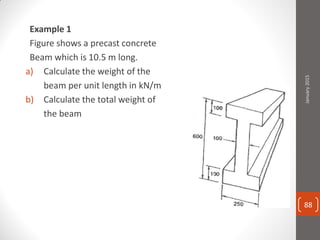
Example 1
Figure shows a precast concrete
Beam which is 10.5 m long.
a) Calculate the weight of the
beam per unit length in kN/m
b) Calculate the total weight of
the beam
January2015
88
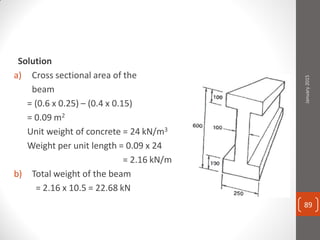
Solution
a) Cross sectional area of the
beam
= (0.6 x 0.25) – (0.4 x 0.15)
= 0.09 m2
Unit weight of concrete = 24 kN/m3
Weight per unit length = 0.09 x 24
= 2.16 kN/m
b) Total weight of the beam
= 2.16 x 10.5 = 22.68 kN
January2015
89
Example 2
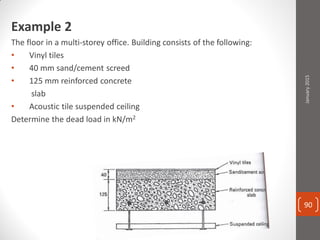
The floor in a multi-storey office. Building consists of the following:
• Vinyl tiles
• 40 mm sand/cement screed
• 125 mm reinforced concrete
slab
• Acoustic tile suspended ceiling
Determine the dead load in kN/m2
January2015
90
Solution
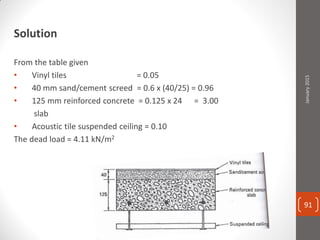
From the table given
• Vinyl tiles = 0.05
• 40 mm sand/cement screed = 0.6 x (40/25) = 0.96
• 125 mm reinforced concrete = 0.125 x 24 = 3.00
slab
• Acoustic tile suspended ceiling = 0.10
The dead load = 4.11 kN/m2
January2015
91
Exercise 1
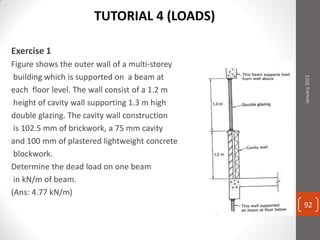
Figure shows the outer wall of a multi-storey
building which is supported on a beam at
each floor level. The wall consist of a 1.2 m
height of cavity wall supporting 1.3 m high
double glazing. The cavity wall construction
is 102.5 mm of brickwork, a 75 mm cavity
and 100 mm of plastered lightweight concrete
blockwork.
Determine the dead load on one beam
in kN/m of beam.
(Ans: 4.77 kN/m)
January2015
92
TUTORIAL 4 (LOADS)

Chapter 2 basic structure concepts

  • 1.
    Chapter 2 Basic StructureConcepts January2015 1
  • 2.
    2.0 : BASICSTRUCTURE CONCEPT 2.1 Forces 2.2 Equilibrium and Reactions 2.3 Moments 2.4 Stress and Strain 2.5 Elastic and plastic range 2.6 Primary Loads & Secondary Loads January2015 2
  • 3.
    2.1 Forces A forceis that which tends to exert motion, tension or compression on an object. The loads acting on a structure have mass which is usually measured in kilograms(kg). The basic unit of force is the newton (N). The force exerted on a structure by a static load is dependent upon both its mass and the force of gravity. The force exerted by a body as a result of gravity can be described as its weight. F =W= m x g  Therefore, the force exerted by a mass of 1 kg is: F = m x g = 1 x 9.81 =9.81 N @ 0.00981 kN  1 kN = 1000 N January2015 3
  • 4.
    2.1 Forces Scalars andVectors Scalars Vectors Examples: mass, volume force, velocity Characteristics: It has a magnitude It has a magnitude (positive or negative) and direction Addition rule: Simple arithmetic Parallelogram law Special Notation: None Bold font, a line, an arrow or a “carrot” January2015 4
  • 5.
    2.1 Forces Application ofVector Addition There are four concurrent cable forces acting on the bracket. How do you determine the resultant force acting on the bracket ? January2015 5
  • 6.
    2.1 Forces Vector Operations ScalarMultiplication and Division January2015 6
  • 7.
    2.1 Forces Vector AdditionUsing Either the Parallelogram or Triangle Parallelogram Law: Triangle method (always ‘tip to tail’): How do you subtract a vector? How can you add more than two concurrent vectors graphically ? January2015 7
  • 8.
    2.1 Forces Resolution ofa vector “Resolution” of a vector is breaking up a vector into components. It is kind of like using the parallelogram law in reverse. January2015 8
  • 9.
    2.1 Forces  Eachcomponent of the vector is shown as a magnitude and a direction. Cartesian Vector Notation We ‘ resolve’ vectors into components using the x and y axes system  The directions are based on the x and y axes. We use the “unit vectors” i and j to designate the x and y axes. January2015 9
  • 10.
    2.1 Forces For example, F= Fx i + Fy j or F' = F'x i + F'y j The x and y axes are always perpendicular to each other. Together, they can be directed at any inclination. January2015 10
  • 11.
    2.1 Forces Addition ofSeveral Vectors Step 1 is to resolve each force into its components  Step 2 is to add all the x components together and add all the y components together. These two totals become the resultant vector. Step 3 is to find the magnitude and angle of the resultant vector. January2015 11
  • 12.
  • 13.
  • 14.
    2.1 Forces Example 1 Thescrew eye in Figure below is subjected to forces F1 and F2. Determine the magnitude and direction (measured from x- positive axis) of the resultant force. F2= 150 N F1= 100 N10o 15o January2015 14
  • 15.
    2.1 Forces Solution 10o 15o 15o +90o + 10o = 115o R =√(1002 +1502 – (2x 100 x 150 x cos 115 ) = 212.55 N  Sin /150 = sin 115/212.55 Sin  = (sin 115/212.55) x 150  = 39.76o Direction = 15o + 39.76o =54.76o January2015 15
  • 16.
    2.1 Forces Example 2 Determinethe magnitude of the resultant force and its direction, measured clockwise from the positive x-axis Solution a) Resolve the forces in their x-y components. b) Add the respective components to get the resultant vector. c) Find magnitude and angle from the resultant components. January2015 16
  • 17.
    2.1 Forces F1 ={ 15 sin 40° i + 15 cos 40° j } kN = { 9.642 i + 11.49 j } kN F2 = { -(12/13)26 i + (5/13)26 j } kN = { -24 i + 10 j } kN F3 = { 36 cos 30° i – 36 sin 30° j } kN = { 31.18 i – 18 j } kN January2015 17
  • 18.
    2.1 Forces Summing upall the i and j components respectively, we get, FR = { (9.642 – 24 + 31.18) i + (11.49 + 10 – 18) j } kN = { 16.82 i + 3.49 j } kN FR = ((16.82)2 + (3.49)2)1/2 = 17.2 kN  = tan-1(3.49/16.82) = 11.7° January2015 18
  • 19.
    2.1 Forces Example 3 Determinethe magnitude of the resultant force and its direction, measured counterclockwise from the positive x axis Solution a) Resolve the forces in their x-y components. b) Add the respective components to get the resultant vector. c) Find magnitude and angle from the resultant components. January2015 19
  • 20.
    2.1 Forces F1 ={ (4/5) 850 i - (3/5) 850 j } N = { 680 i - 510 j } N F2 = { -625 sin(30°) i - 625 cos(30°) j } N = { -312.5 i - 541.3 j } N F3 = { -750 sin(45°) i + 750 cos(45°) j } N { -530.3 i + 530.3 j } N January2015 20
  • 21.
    2.1 Forces Summing upall the i and j components respectively, we get, FR = { (680 – 312.5 – 530.3) i + (-510 – 541.3 + 530.3) j }N = { - 162.8 i - 521 j } N FR = ((162.8)2 + (521)2) ½ = 546 N = tan–1(521/162.8) = 72.64° or From Positive x axis  = 180 + 72.64 = 253 ° January2015 21
  • 22.
    TUTORIAL 1 (FORCES) Question1 Two forces are applied to an eye bolt fastened to a beam. Determine the magnitude and direction of their resultant. 6 kN 4.5 kN 25o 50o January2015 22
  • 23.
    Question 2 Two forcesP and Q are applied as shown at point A of a hook support. Knowing that P = 60 kN and Q = 100 kN. Determine the magnitude and direction of their resultant. (Ans: R = 150 kN, 76o towards x axis positive) P Q 15o 30o January2015 24
  • 24.
    Question 3 The cablesAB and AD help support pole AC. Knowing that the tension is 500 N in AB and 160 N in AD. Determine the magnitude and direction of the resultant of the forces exerted by cables at A. (Ans: R = 575 N, 113o towards x axis positive) A B C D 2 m 1.5 m 2.5 m January2015 25
  • 25.
    Question 4 Determine theresultant and direction from x-axis positive of the five forces shown in Figure below by the graphical method. (Ans: R = 32.5 kN, = 124o) y x 8 kN 9 kN 4 kN 60o 25 kN 3 kN 15o 30o 20o January2015 26
  • 26.
    Question 5 Determine themagnitude and direction measured counterclockwise from the positive x axis of the resultant force of the three acting on the ring A. Take F1 = 500 N and  = 20o (Ans: R = 1.03 kN, = 87.9o) y x 600 N F1 400 N 30o 3 4 5 January2015 27
  • 27.
    Question 6 Three forcesare applied at the end of the boom O. Determine the magnitude and orientation of the resultant force. (Ans: FR= 485 N, = 37.7o) y x F3 = 200N F2= 250 N F1 = 400 N 45o 3 4 5 January2015 29
  • 28.
    • Question 7 •Two cables are attached to the frame shown in Figure below. Using trigonometry, determine : (a) the required magnitude of the force P if the resultant R of the two forces applied at A is to be vertical. (b) the corresponding magnitude of R. (Ans: 489 N, 738 N) A A 25o 35o 360 N P January2015 30
  • 29.
    2.2 Equilibriumand Reactions Anystructure subjected to loads must be provided with supports to prevent it from moving. The forces generated on the structure by these supports are called reactions. If the structure is in equilibrium (i.e. not moving) then the net forces from the loads and reactions must be zero in all directions. Fx = 0 Fy = 0  M = 0 January2015 31
  • 30.
  • 31.
    Example 1 Determine themagnitudes of F1 and F2 so that particle P is in equilibrium. (Ans: F1 = 435 N, F2 = 171 N) P F1 F2 400 N 3 4 5 30o 60o January2015 33
  • 32.
    Solution The two unknownmagnitudes F1 and F2 can be obtained from the two scalar equations of equilibrium, ∑Fx=0 and ∑Fy = 0. To apply these equations, the x, y axes are established on the free body diagram and forces must be resolved into its x and y components. P F1 F2 400 N 3 4 5 30o 60o 400 cos 30o 400 sin 30o F2 cos 60o F2 sin 60o F1 (4/5) F1 (3/5) January2015 34
  • 33.
    Solution ∑ Fx =0; -400 sin 30o + F1(4/5) –F2sin 60o=0 ∑ Fy =0; 400 cos 30o -F1(3/5) –F2cos 60o=0 (1) (2) Simplify : 0.8 F1 – 0.866 F2 = 200 (3) -0.6 F1 – 0.5 F2 = -346.61 (4) Solving Eqs. (3) & (4) by simultaneous equations to determine F1 & F2. Ans : F1 = 435.08 N F2 = 170.97 N January2015 35
  • 34.
    Applicationof equilibriumconceptsin truss  Atruss is a structure composed of slender members joined together at their end points.  The members commonly used in construction consist of wooden struts or metal bars  The joint connections are usually formed by bolting or welding the ends of the members to a common plate, called a gusset plate, as shown in Fig below. January2015 36
  • 35.
  • 36.
    38 Timber Roof Trusses SteelBridge Trusses January2015
  • 37.
    Example • Determine theforce in each member of the Pratt bridge truss shown. State whether each member is in tension or compression. 6 kN 6 kN 6 kN 4 m 3 m 3 m 3 m 3 m A B C D E F G H January2015 39
  • 38.
    2.3 Moments APPLICATION What isthe net effect of the two forces on the wheel? January2015 40
  • 39.
    APPLICATION What is theeffect of the 30 N force on the lug nut? January2015 41
  • 40.
     The momentof a force about a point or axis provides a measure of the tendency of the force to cause a body to rotate about the point or axis.  This tendency for rotation caused by force is sometimes called a torque, but most often it is called the moment of a force or simply the moment  The magnitude of a moment about a point is the value of the force multiplied by the perpendicular distance from the line of action of the force to the point  M= T = F x d  The unit is Nm or kNm The typical sign convention for moment is that counter-clockwise is considered positive. January2015 42
  • 41.
    Example 1 From Figurebelow, determine the moment of the force about point O. If the moment is increased to 5 kNm, what is the maximum mass can be supported by the diving board? 1.5 m Mass = 250 kg January2015 43
  • 42.
    Solution F = mg =250 (9.81)= 2452.5 N = 2.45 kN 1.5 m Mo = ( 2.45 x 1.5) = 3.68 kNm If Mo = 5 kNm, then new load is Mo = F x d 5 = F x 1.5 F = 3.33 kN = 3333.33 N F = m x g 3333.33 = m x 9.81 m = 339.79 kg F January2015 44
  • 43.
    Example 2 For eachcase illustrated in Figure below, determine the moment of the force about point O. 5O kN 2 m 0.75 m Solution Mo = - (50 x 0.75) = - 37.5 kNm January2015 45
  • 44.
    Example 3 For eachcase illustrated in Figure below, determine the moment of the force about point O. 6O kN 3 m 45o Solution 1 sin 45o Mo = 60 x (1 sin 45o) = 42.43 kNm January2015 46
  • 45.
    Example 4 A 400N force is applied to the frame and  = 20o. Find the moment of the force at A. Solution 400 sin 20o 400 cos 20o MA = (400 sin 20ox 3) + (400 cos 20o x 2) = 1162.18 Nm January2015 47
  • 46.
    Figure above showsa bridge deck, of weight 500 kN, supporting a heavy vehicle weighing 300 kN. Find the value of the support reactions at A and B when the load is in the position shown. Ans: RA = 430 kN, RB = 370 kN Example 5 January2015 48
  • 47.
    Solution 500 kN 5 m 300kN A B 4 m ∑ MA =0 ; ∑ Fy =0 ; RB (10) – ( 300 x 4) – (500 x 5) = 0 RB = 370 kN RA + RB – 300 – 500 = 0 RA = 430 kN January2015 49
  • 48.
    Example 6 Figure showsan anchorage for the cable of a ski- lift, The cable produce a total pull of 220 kN at the top of the anchorage. Determine the support reactions. Ans: RAH = 191 kN, RAV = -196 kN RB = 306 kN January2015 50
  • 49.
    Solution A B 220 cos30o 220 sin 30o RBRAV RAH ∑ MA =0 ; RB (2.7) – ( 220 sin 30o x 1.8) – (220 cos 30o x 3.3) = 0 RB = 306 kN ∑ Fx =0 ; -RAH + 220 cos 30o = 0 RAH = 191kN RAV + RB – 220 sin 30o = 0 RAV = - 196 kN ∑ Fy =0 ; January2015 51
  • 50.
    2.4 Stress andStrain Stress Concept of stress  To obtain distribution of force acting over a sectioned area  Assumptions of material: 1. It is continuous (uniform distribution of matter) 2. It is cohesive (all portions are connected together) Normal stress  Intensity of force, or force per unit area, acting normal to ΔA  Symbol used for normal stress, is σ (sigma) σz = lim ΔA →0 ΔFz ΔA January2015 52
  • 51.
     Tensile stress:normal force “pulls” or “stretches” the area element ΔA  Compressive stress: normal force “pushes” or “compresses” area element ΔA  Shear stress  Intensity of force, or force per unit area, acting tangent to ΔA  Symbol used for normal stress is τ (tau) τzx = lim ΔA →0 ΔFx ΔA τzy = lim ΔA →0 ΔFy ΔA Units (SI system) Newtons per square meter (N/m2) or a pascal (1 Pa = 1 N/m2) kPa = 103 N/m2 (kilo-pascal) MPa = 106 N/m2 (mega-pascal) GPa = 109 N/m2 (giga-pascal) January2015 53
  • 52.
  • 53.
    Example 1 The 80kg lamp is supported by two rods AB and BC as shown in Figure below. If AB has a diameter of 10 mm and BC has a diameter of 8 mm, determine the average normal stress in each rod. A B C 60o 3 4 January2015 55
  • 54.
    A B C 60o 3 4 F = mg =80 x 9.81 = 784.8 N = 0.78 kN F1 F2 F1cos 60o F1sin 60o F2cos  F2sin  Solution January2015 56
  • 55.
    Solution ∑ Fx =0; – F1cos 60o + F2(4/5) =0 ∑ Fy =0; F1sin 60o+ F2(3/5) – 0.78 =0 (1) (2) Simplify : - 0.5 F1 + 0.8 F2 = 0 (3) 0.866 F1 + 0.6 F2 = 0.78 (4) Solving Eqs. (3) & (4) by simultaneous equations to determine F1 & F2. 0.6 x Eqs (3) - 0.3 F1 + 0.48 F2 = 0 0.8 x Eqs (4) 0.69 F1 + 0.48 F2 = 0.624 - 0.99 F1 = - 0.624 F1 = 0.63 kN Subs F1 into Eqs (3) - - 0.5 F1 + 0.8 F2 = 0 - 0.5 x 0.63 + 0.8 F2 = 0 F2 = 0.315/0.8 = 0.39 kN January2015 57

  • 56.
    Solution 1 = F1/ A1 = 0.63 /( x 0.0052) = 8021.41 kN/m2 2 = F2 / A2 = 0.39/( x 0.0042) = 7758.8 kN/m2 January2015 58
  • 57.
    Shear Stress  Shearstress is the stress component that act in the plane of the sectioned area.  Consider a force F acting to the bar  For rigid supports, and F is large enough, bar will deform and fail along the planes identified by AB and CD  Free-body diagram indicates that shear force, V = F/2 be applied at both sections to ensure equilibrium January2015 59
  • 58.
    Average shear stressover each section is: P Aavg = avg = average shear stress at section, assumed to be same at each pt on the section V = internal resultant shear force at section determined from equations of equilibrium A = area of section January2015 60
  • 59.
    Example 1 The barshown in Figure below has a square cross section for which the depth and thickness are 40 mm. If an axial force of 800 N is applied along the centroidal axis of the bar’s cross-sectional area, determine average normal stress and average shear stress acting on the material along section planes a-a. January2015 61
  • 60.
    Internal loading Based onfree-body diagram, Resultant loading of axial force, P = 800 N Average normal stress = P/A = 800/(0.04)(0.04) = 500 kPa Average shear stress No shear stress exists on the section, since the shear force at the section is zero. January2015 62
  • 61.
    Example 2 Three platesare held together by two cyclindrical rivets. If a direct pull of 5 kN is applied between one plate and the other two, estimate the diameter of the rivets. The shear stress in the rivets is not to exceed 40 N/mm2. 5 kN January2015 63
  • 62.
    Solution • 4 slidingareas (Double shear) P A = 40 = 5000 4(2/4)  = 6.3 mm January2015 64
  • 63.
    Question 1 A 50kN axial load is applied to a short wooden post which is supported by a square concrete footing resting on distributed soil. Determine (a) The maximum bearing stress on the concrete footing (b) The size of the footing for which the average bearing stress on the soil is 150 kPa. (Ans: B = 4MPa, b= 577 mm) Plan 125 mm 100 mm b b 50 kN January2015 65 TUTORIAL 2 (STRESS
  • 64.
    Question 2 The columnis subjected to an axial force of 8 kN at its top. If the cross sectional area has the dimensions shown in the figure, determine the average normal stress at section a-a. (Ans:  = 1.74 MPa) Plan Front Elevation 160 mm 160 mm a a 10 mm 10mm 10 mm 8 kN 160mm January2015 66
  • 65.
    Question 3 The 20kg lamp is supported by two steel rods connected by a ring A. Determine which rod is subjected to the greater average normal stress and compute its value. (Ans:  = 2.33 N/mm2) B A C 60o 45o 12 mm 10 mm January2015 67
  • 66.
    Question 4 A squarehole having 12 mm sides is to be punched out of a metal plate 1.6 mm thick. The shear stress required to cause fracture is 350 N/mm2. What force must be applied to punch die? What would be the compressive stress in the punch? (Ans: 26.88 kN, 0.19 kN/mm2) January2015 68
  • 67.
    ALLOWABLE STRESS  Whendesigning a structural member or mechanical element, the stress in it must be restricted to safe level  Choose an allowable load that is less than the load the member can fully support  One method used is the factor of safety (F.S.) F.S. = Ffail Fallow  If load applied is linearly related to stress developed within member, then F.S. can also be expressed as: F.S. = σfail σallow F.S. = fail allow  In all the equations, F.S. is chosen to be greater than 1, to avoid potential for failure  Specific values will depend on types of material used and its intended purpose January2015 69
  • 68.
    Strain  Loads causebodies to deform, thus points in the body will undergo displacements or changes in position  Normal strain () is a measure of elongation or contraction of small line segment in the body Normal Strain () = Change in length = L Original length L  Has no unit  Shear strain () is a measure of the change in angle that occurs between two small line segments that are originally perpendicular to each other. Shear Strain () = x L L x January2015 70
  • 69.
    Conventional stress-strain diagram Figure shows the characteristic stress-strain diagram for steel, a commonly used material for structural members and mechanical elements January2015 71
  • 70.
    Elastic behavior.  Astraight line  Stress is proportional to strain, i.e., linearly elastic  Upper stress limit, or proportional limit; σpl  If load is removed upon reaching elastic limit, specimen will return to its original shape January2015 72
  • 71.
    Yielding.  Material deformspermanently; yielding; plastic deformation  Yield stress, σY  Once yield point reached, specimen continues to elongate (strain) without any increase in load  Note figure not drawn to scale, otherwise induced strains is 10-40 times larger than in elastic limit  Material is referred to as being perfectly plastic January2015 73
  • 72.
    Strain hardening.  Ultimatestress, σu  While specimen is elongating, its x- sectional area will decrease  Decrease in area is fairly uniform over entire gauge length January2015 74
  • 73.
    Necking.  At ultimatestress, x-sectional area begins to decrease in a localized region  As a result, a constriction or “neck” tends to form in this region as specimen elongates further  Specimen finally breaks at fracture stress, σf January2015 75
  • 74.
    Hooke’s Law When amaterial is worked within its elastic limit, the extension is proportional to the force. Strain  Stress Stress = Constant (E) Strain This constant is known as the modulus of elasticity or Young’s Modulus January2015 76
  • 75.
    Example 1 A tie-barin a steel structure is of rectangular section 30 mm x 50 mm. The extension measured in a 250 mm length of the tie bar when load is applied to the structure is 0.1 mm. Find :- i) The tensile stress in the bar ii) The tensile force iii) The factor of safety used Take E = 205 kN/mm2 and Ultimate stress = 460 N/mm2 January2015 77
  • 76.
    Solution i) The tensilestress in the bar E = stress/strain Strain (ε) = ∆L/L = 0.1/250 = 4 x 10⁻⁴ E = stress/strain 205 = / 4 x 10⁻⁴  = 205 x 4 x 10-4 = 0.082 kN/mm2 = 82 N/mm2 ii) The tensile force  = F/A 82 = F/(30 x 50) F = 82 x (30 x 50) = 123,000 = 123 kN iiii) The factor of safety used F.S. = Ultimate stress/ Tensile stress = 460 /82 = 5.6 January2015 78
  • 77.
    Example 2 The ultimatestress for a steel is 450 N/mm2. What is the maximum load which a rod 50 mm diameter can carry with a factor of safety of 5? If the rod is 1.5 m long, determine the extension under this loading.( E = 200 kN/mm2.) Solution The factor of safety F.S. = Ultimate stress/ Tensile stress 5 = 450 / tensile stress Tensile stress = 450/5 = 90 N/mm2  = F/A 90 = F/(π r2) F = 90 x (π x 252) = 176,714.59 N = 176.71 kN January2015 79
  • 78.
    Solution The tensile stressin the bar E = stress/strain 200 x 103 = 90/ ε ε = 90/ 200 x 103 = 4.5 x 10⁻⁴ Strain (ε) = ∆L/L 4.5 x 10-4 = ∆L/1500 ∆L = 0.675 mm January2015 80
  • 79.
    Exercise 1 A flatsteel tie-bar 4.5 m long, is found to be 2.4mm short. It is sprung into place by means of drafts driven into holes in the end of the bar. Determine: (a) the stress in the bar (b) the factor of safety if the material of the tie-bar has an ultimate stress of 450 N/mm2. Take E for the material as 205 kN/mm2. ( Ans: 109.3 N/mm2, 4.117) January2015 81 TUTORIAL 3 (STRESS, STRAIN & FACTOR OF SAFETY)
  • 80.
    Exercise 2 A metaltube of outside diameter 75 mm and length 1.65 m is to carry a compressive load of 60 kN. If the allowable axial stress is 75 N/mm2 , calculate the inside diameter of the tube. If E of the material is 90 kN/mm2., by how much will the tube shorten under this load? Ans: 67.87 mm, 1.375 mm) January2015 82
  • 81.
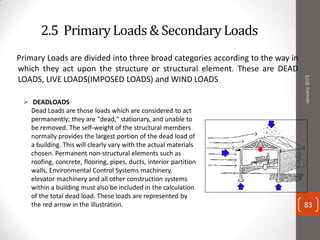
    2.5 PrimaryLoads &Secondary Loads  DEADLOADS Dead Loads are those loads which are considered to act permanently; they are "dead," stationary, and unable to be removed. The self-weight of the structural members normally provides the largest portion of the dead load of a building. This will clearly vary with the actual materials chosen. Permanent non-structural elements such as roofing, concrete, flooring, pipes, ducts, interior partition walls, Environmental Control Systems machinery, elevator machinery and all other construction systems within a building must also be included in the calculation of the total dead load. These loads are represented by the red arrow in the illustration. Primary Loads are divided into three broad categories according to the way in which they act upon the structure or structural element. These are DEAD LOADS, LIVE LOADS(IMPOSED LOADS) and WIND LOADS January2015 83
  • 82.
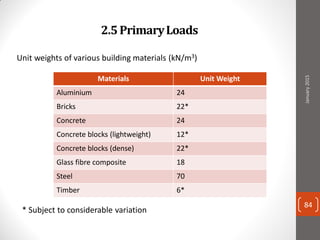
    2.5PrimaryLoads Unit weights ofvarious building materials (kN/m3) Materials Unit Weight Aluminium 24 Bricks 22* Concrete 24 Concrete blocks (lightweight) 12* Concrete blocks (dense) 22* Glass fibre composite 18 Steel 70 Timber 6* * Subject to considerable variation January2015 84
  • 83.
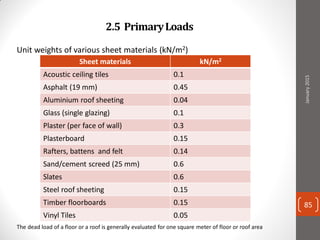
    2.5 PrimaryLoads Unit weightsof various sheet materials (kN/m2) The dead load of a floor or a roof is generally evaluated for one square meter of floor or roof area Sheet materials kN/m2 Acoustic ceiling tiles 0.1 Asphalt (19 mm) 0.45 Aluminium roof sheeting 0.04 Glass (single glazing) 0.1 Plaster (per face of wall) 0.3 Plasterboard 0.15 Rafters, battens and felt 0.14 Sand/cement screed (25 mm) 0.6 Slates 0.6 Steel roof sheeting 0.15 Timber floorboards 0.15 Vinyl Tiles 0.05 January2015 85
  • 84.
    • LIVE LOADS LiveLoads are not permanent and can change in magnitude. They include items found within a building such as furniture, pianos, safes, people, books, cars, computers, machinery, or stored materials, as well as environmental effects such as loads due to the sun, earth or weather. • WIND LOADS Wind and earthquakes loads are put into the special category of lateral live loads due to the severity of their action upon a building and their potential to cause failure. January2015 86
  • 85.
    Secondary loads Structures canbe subjected to secondary loads from temperature changes, shrinkage of members and settlement of supports. January2015 87
  • 86.
    Example 1 Figure showsa precast concrete Beam which is 10.5 m long. a) Calculate the weight of the beam per unit length in kN/m b) Calculate the total weight of the beam January2015 88
  • 87.
    Solution a) Cross sectionalarea of the beam = (0.6 x 0.25) – (0.4 x 0.15) = 0.09 m2 Unit weight of concrete = 24 kN/m3 Weight per unit length = 0.09 x 24 = 2.16 kN/m b) Total weight of the beam = 2.16 x 10.5 = 22.68 kN January2015 89
  • 88.
    Example 2 The floorin a multi-storey office. Building consists of the following: • Vinyl tiles • 40 mm sand/cement screed • 125 mm reinforced concrete slab • Acoustic tile suspended ceiling Determine the dead load in kN/m2 January2015 90
  • 89.
    Solution From the tablegiven • Vinyl tiles = 0.05 • 40 mm sand/cement screed = 0.6 x (40/25) = 0.96 • 125 mm reinforced concrete = 0.125 x 24 = 3.00 slab • Acoustic tile suspended ceiling = 0.10 The dead load = 4.11 kN/m2 January2015 91
  • 90.
    Exercise 1 Figure showsthe outer wall of a multi-storey building which is supported on a beam at each floor level. The wall consist of a 1.2 m height of cavity wall supporting 1.3 m high double glazing. The cavity wall construction is 102.5 mm of brickwork, a 75 mm cavity and 100 mm of plastered lightweight concrete blockwork. Determine the dead load on one beam in kN/m of beam. (Ans: 4.77 kN/m) January2015 92 TUTORIAL 4 (LOADS)