
RADIOACTIVE
DECAY
by : azyulail azra
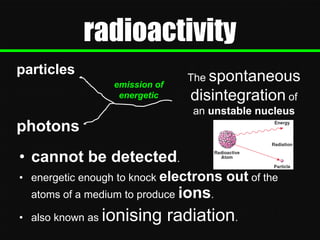
radioactivity
particles
emission of
energetic

The spontaneous

disintegration of
an unstable nucleus

photons
• cannot be detected.
• energetic enough to knock electrons

out of the

atoms of a medium to produce ions.
• also known as

ionising radiation.
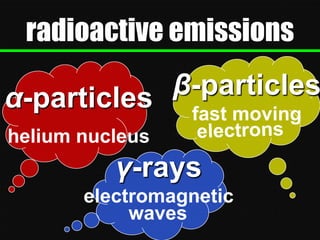
radioactive emissions
α-particles
helium nucleus

γ-rays
electromagnetic
waves
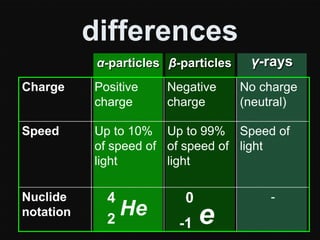
differences
α-particles β-particles
Charge

Positive
charge

Speed

Up to 10% Up to 99% Speed of
of speed of of speed of light
light
light

Nuclide
notation

4
He
2

Negative
charge

γ-rays

0
-1

e

No charge
(neutral)

-
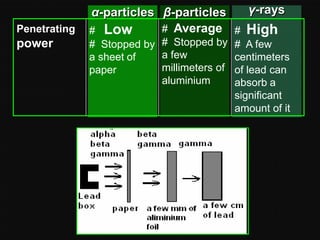
Penetrating

power

γ-rays
α-particles β-particles
# Average # High
# Low
# Stopped by # Stopped by
a few
a sheet of
millimeters of
paper
aluminium

# A few
centimeters
of lead can
absorb a
significant
amount of it
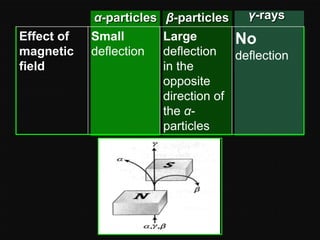
α-particles β-particles
Effect of
magnetic
field

Small
deflection

γ-rays

Large
No
deflection deflection
in the
opposite
direction of
the αparticles
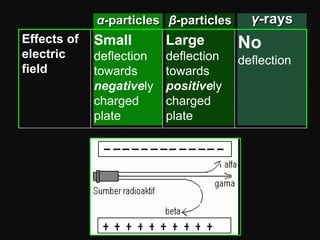
α-particles β-particles
Effects of
electric
field

Small

Large

deflection
towards
negatively
charged
plate

deflection
towards
positively
charged
plate

γ-rays

No
deflection
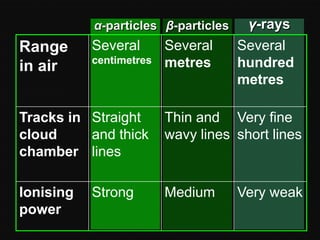
α-particles β-particles

Range
in air

Several
centimetres

Several
metres

γ-rays
Several
hundred
metres

Tracks in Straight
and thick
cloud
chamber lines

Thin and Very fine
wavy lines short lines

Ionising
power

Medium

Strong

Very weak
radioactive detectors

Cloud chamber
Photographic Film
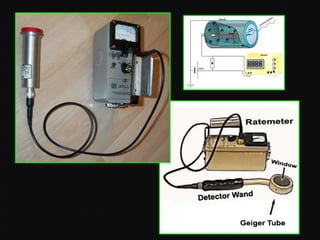
Geiger-Muller Tube
Spark counter
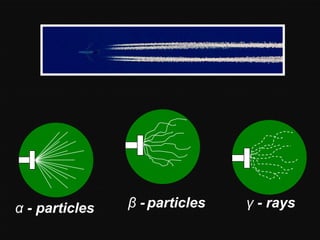
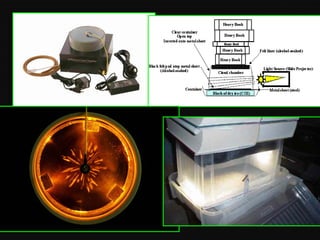
cloud chamber
- to show

the path of ionizing radiation.
- formed in the same way as the

condensation trails behind
a high-flying aeroplane
α - particles

β - particles

γ - rays
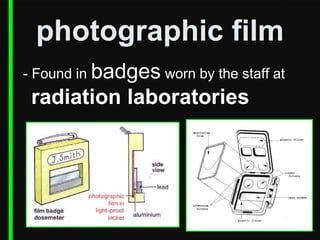
photographic film
- Found in badges worn by the staff at

radiation laboratories
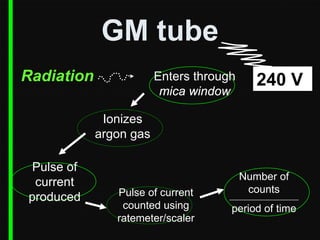
GM tube
Radiation

Enters through
mica window

240 V

Ionizes
argon gas
Pulse of
current
produced

Pulse of current
counted using
ratemeter/scaler

Number of
counts
period of time
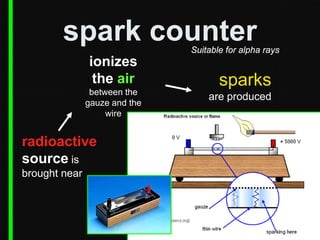
spark counter

Suitable for alpha rays

ionizes
the air
between the
gauze and the
wire

radioactive
source is
brought near

sparks
are produced
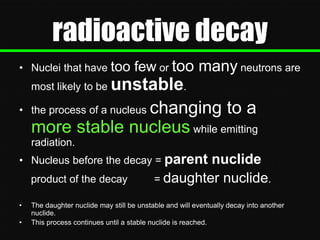
radioactive decay
• Nuclei that have too

few or too many neutrons are

unstable.
the process of a nucleus changing to a
more stable nucleus while emitting
most likely to be

•

radiation.
• Nucleus before the decay = parent
product of the decay
•
•

nuclide
= daughter nuclide.

The daughter nuclide may still be unstable and will eventually decay into another
nuclide.
This process continues until a stable nuclide is reached.
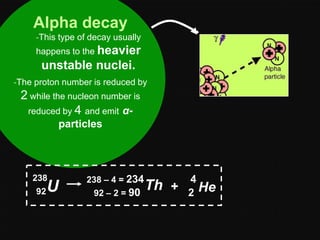
Alpha decay
-This type of decay usually
happens to the heavier

unstable nuclei.
-The proton number is reduced by

2 while the nucleon number is
reduced by 4 and emit αparticles

238
92

U

238 – 4 = 234
92 – 2 = 90

Th +

4
2 He
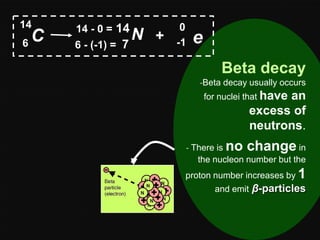
14

6C

14 - 0 = 14
N
6 - (-1) = 7

+

0
-1

e
Beta decay
-Beta decay usually occurs
for nuclei that have

an
excess of
neutrons.

- There is no change in
the nucleon number but the
proton number increases by 1
and emit β-particles
Gamma decay
-occurs when an unstable nucleus
releases its excess energy [ high

frequency electromagnetic
waves ] called γ-rays.
-no change in proton number and
nucleon number but emit γ-rays
-A nucleus that undergoes alpha or beta
decay may
60

Co
27

also emit γ-rays.
60
27

Co +

γ
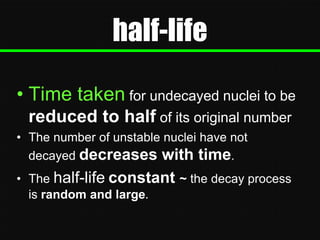
half-life
• Time taken for undecayed nuclei to be
reduced to half of its original number
• The number of unstable nuclei have not
decayed decreases with time.
• The half-life constant ~ the decay process
is random and large.
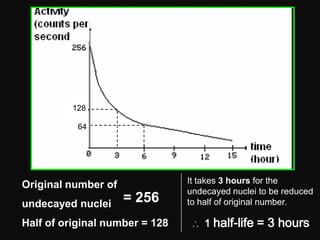
128
64

Original number of
undecayed nuclei

= 256

Half of original number = 128

It takes 3 hours for the
undecayed nuclei to be reduced
to half of original number.

∴ 1 half-life = 3 hours
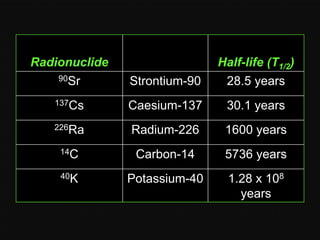
Radionuclide

Half-life (T1/2)

90Sr

Strontium-90

28.5 years

137Cs

Caesium-137

30.1 years

226Ra

Radium-226

1600 years

14C

Carbon-14

5736 years

40K

Potassium-40

1.28 x 10⁸
years
Thank
you !!!

Azra radioactive decay