FOSSIL EDUCATION FOSSIL EDUCATION FOSSIL EDUCATION
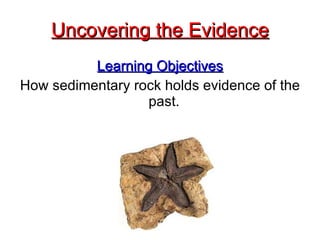
Uncovering the Evidence Learning Objectives How sedimentary rock holds evidence of the past.
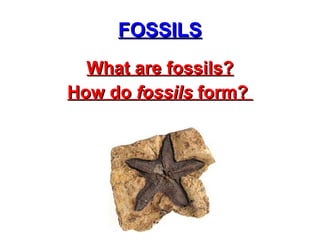
FOSSILS What are fossils? How do  fossils  form?
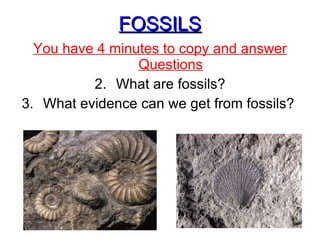
FOSSILS You have 4 minutes to copy and answer Questions What are fossils? What evidence can we get from fossils?
You have 3 minutes to copy and complete task into your science book Fossils  (from Latin fossus, literally "having been … …") are the …….remains or traces of animals and …… buried in the ground …… of …..ago. Dug up Thousands Years Plants Preserved
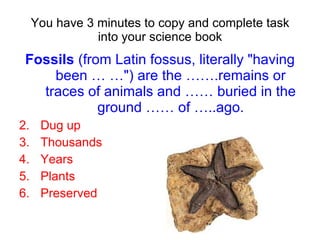
Fossils  (from Latin fossus, literally "having been dug up") are the preserved remains or traces of animals and plants buried in the ground thousands of years ago.
EVIDENCE FROM FOSSILS To review different types of fossil and how they were formed.
PREHISTORIC LIFE You will understand how plant and animal remains can be fossilised and how this allows understanding of prehistoric plant and animal life.
WEATHERING - WEARING AWAY Discuss how large rocks can be broken by natural forces called weathering.  Look at samples of sand and identify that it is made of small mineral particles
WRITING A LETTER Homework Write a letter to a friend explaining how the remains of plants and animals can be fossilised and how it can help us to understand prehistoric plant and animal life. Due date: 13 th  June 2011 Note: Your letter will be read in class as part of your assessment. More resources please visit:  www.sciencetutors.zoomshare.com
To model fossil formation by casting from an impression.
WEATHERING - WEARING AWAY Briefly explain how acid rain is formed. Use diagram to reinforce your explanation
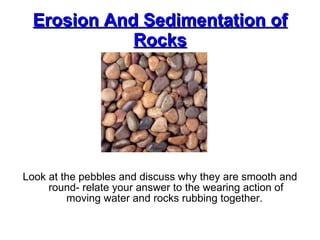
Erosion And Sedimentation of Rocks Look at the pebbles and discuss why they are smooth and round- relate your answer to the wearing action of moving water and rocks rubbing together.
The term ' acid rain ' means any form of precipitation like rain, fog, snow, or hail that contains harmful substances such as nitrogen and sulphur oxides.  ...

Weathering WEARING AWAY

  • 1.
    FOSSIL EDUCATION FOSSILEDUCATION FOSSIL EDUCATION
  • 2.
    Uncovering the EvidenceLearning Objectives How sedimentary rock holds evidence of the past.
  • 3.
    FOSSILS What arefossils? How do fossils form?
  • 4.
    FOSSILS You have4 minutes to copy and answer Questions What are fossils? What evidence can we get from fossils?
  • 5.
    You have 3minutes to copy and complete task into your science book Fossils (from Latin fossus, literally "having been … …") are the …….remains or traces of animals and …… buried in the ground …… of …..ago. Dug up Thousands Years Plants Preserved
  • 6.
    Fossils (fromLatin fossus, literally "having been dug up") are the preserved remains or traces of animals and plants buried in the ground thousands of years ago.
  • 7.
    Fossils (fromLatin fossus, literally "having been dug up") are the preserved remains or traces of animals and plants buried in the ground thousands of years ago.
  • 8.
    EVIDENCE FROM FOSSILSTo review different types of fossil and how they were formed.
  • 9.
    PREHISTORIC LIFE Youwill understand how plant and animal remains can be fossilised and how this allows understanding of prehistoric plant and animal life.
  • 10.
    WEATHERING - WEARINGAWAY Discuss how large rocks can be broken by natural forces called weathering. Look at samples of sand and identify that it is made of small mineral particles
  • 11.
    WRITING A LETTERHomework Write a letter to a friend explaining how the remains of plants and animals can be fossilised and how it can help us to understand prehistoric plant and animal life. Due date: 13 th June 2011 Note: Your letter will be read in class as part of your assessment. More resources please visit: www.sciencetutors.zoomshare.com
  • 12.
    To model fossilformation by casting from an impression.
  • 13.
    WEATHERING - WEARINGAWAY Briefly explain how acid rain is formed. Use diagram to reinforce your explanation
  • 14.
    Erosion And Sedimentationof Rocks Look at the pebbles and discuss why they are smooth and round- relate your answer to the wearing action of moving water and rocks rubbing together.
  • 15.
    The term 'acid rain ' means any form of precipitation like rain, fog, snow, or hail that contains harmful substances such as nitrogen and sulphur oxides. ...