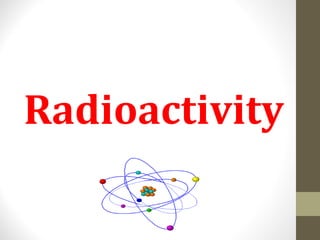
Radioactivityfigure
What we are going to
explain
 what is radioactivity?
 Discovery of radioactivity.
 Radiation and where does radiation comes from?
 Three types of radiation.
 Uses field of radiation.
 Effects of radiation.
 Radiation controls.
 Half life of radiation.
 Advantages and disadvantages.
Discovery of
Radioactivity
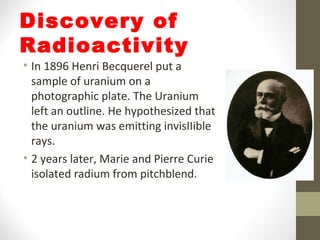
• In 1896 Henri Becquerel put a
sample of uranium on a
photographic plate. The Uranium
left an outline. He hypothesized that
the uranium was emitting invisIIible
rays.
• 2 years later, Marie and Pierre Curie
isolated radium from pitchblend.
Radiation
Radiation: The process of emitting
energy in the form of waves or
particles.
Where does radiation come from?
Radiation is generally produced
when particles interact or decay.
A large contribution of the radiation
on earth is from the sun (solar) or
from radioactive isotopes of the
elements (terrestrial).
Radiation is going through you at
this very moment
Three types of radiation were known
1)Alpha particles (α)
2)Beta particles (β)
3)Gamma-rays (γ)
Alpha particle

Alpha particle - these are fast
moving helium atoms. They have
high energy, typically in the MeV
range, but due to their large mass,
they are stopped by just a few
inches of air, or a piece of paper.
• 238
92U → 4
2He + 234
90Th
• The helium
nucleus is the alpha particle.
Beta particle
• Beta particle - these are fast moving
electrons. They typically have energies in
the range of a few hundred keV to several
MeV. Since electrons are might lighter than
helium atoms, they are able to penetrate
further, through several feet of air, or
several millimeters of plastic or less of very
light metals.
•
• 234
90 → 0
-1e + 234
91Pa
•
• The electron is the beta particle.
Gamma particle
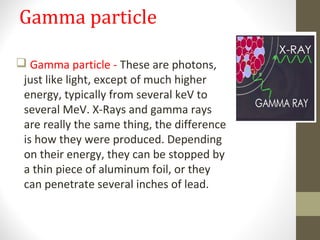
 Gamma particle - These are photons,
just like light, except of much higher
energy, typically from several keV to
several MeV. X-Rays and gamma rays
are really the same thing, the difference
is how they were produced. Depending
on their energy, they can be stopped by
a thin piece of aluminum foil, or they
can penetrate several inches of lead.
Uses field of radiation
a. Cancer Treatment
b. Killing Microbes
c. Carbon Dating
d. Dating rocks
Cancer treatment
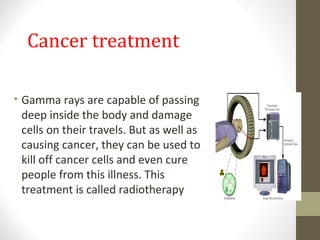
• Gamma rays are capable of passing
deep inside the body and damage
cells on their travels. But as well as
causing cancer, they can be used to
kill off cancer cells and even cure
people from this illness. This
treatment is called radiotherapy
Killing microbes
• Gamma rays successfully kill microbes
that cause food to decay. So food
treated with this radiation have a
longer shelf life. Surgical instruments
and syringes are also treated with
gamma rays, in order, to prevent
infections been transferred from
patient to patient.
Carbon Dating
• When an animal or plant dies it stops
taking in carbon. But its carbon-14
content continues to decay. If we
compare the carbon-14 with that from a
living thing, and knowing the half-life of
carbon-14, the age of animal and plant
remains can be calculated. This is known
as carbon dating.
Dating rocks
•Twelve out of every 1000
potassium atoms is the radioistope
potassium-40. Its half life is a
staggering twelve thousand years
and decays to eventually form the
stable argon atom. By measuring
the argon content of many rocks
that contain potassium, scientists
can calculate the age of the rock.
RADIATION CONTROLS
• Time: Minimize time of exposure to minimize total dose. Rotate
employees to restrict individual dose.
• Distance: Maximize distance to source to maximize attenuation in
air. The effect of distance can be estimated from equations.
• Shielding: Minimize exposure by placing absorbing shield between
worker and source.
Half-Life
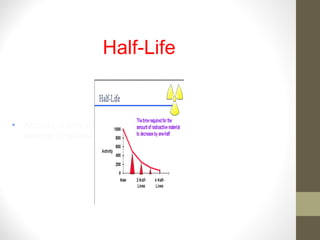
• Amount of time it takes for one half of a
sample of radioactive atoms to decay
Medical Applications of Half-
Life
Nuclide Half-Life Area of Body
I–131 8.1 days Thyroid
Fe–59 45.1 days
Red Blood
Cells
Sr–87 2.8 hours Bones
Tc–99 6.0 hours Heart
Na–24 14.8 hours
Circulatory
System
Half-Life Calculation #1
• You have 400 mg of a radioisotope with a half-life of 5 minutes.
How much will be left after 30 minutes?
Answer: 6.25 mg
Half-Life Calculation #2
• Suppose you have a 100 mg sample of Au-191, which has a half-life
of 3.4 hours. How much will remain after 10.2 hours?
Answer: 12.5 mg
Examples of Half-Life
Isotope Half life
C-15 2.4 sec
Ra-224 3.6 days
Ra-223 12 days
I-125 60 days
C-14 5700 years
U-235 710 000 000 years
ADVANTAGES
1. Radiation needs no medium in order to be
able to take place.
2. It travels very fast.
3. Doctors sometimes insert a little amount
of radioactive element inside us in order to
be able to see cancerous cells or broken
bones.
4. Radioactive elements contain a huge
amount of energy stored inside them.
DISADVANTAGES
• 1. Radiation is dangerous (Ultra violet light is divided into U.V.A and
U.V.B, and U.V.B is dangerous and causes cancer. radiation from
radioactive elements are lethal to human beings)
2. Radiation waves are present everywhere in our everyday live( radio
waves, WI-FI, Bluetooth) Ant these cause infertility and develop
cancerous cells, with time.

Radioactivity

  • 1.
  • 2.
    What we aregoing to explain  what is radioactivity?  Discovery of radioactivity.  Radiation and where does radiation comes from?  Three types of radiation.  Uses field of radiation.  Effects of radiation.  Radiation controls.  Half life of radiation.  Advantages and disadvantages.
  • 3.
    Discovery of Radioactivity • In1896 Henri Becquerel put a sample of uranium on a photographic plate. The Uranium left an outline. He hypothesized that the uranium was emitting invisIIible rays. • 2 years later, Marie and Pierre Curie isolated radium from pitchblend.
  • 4.
    Radiation Radiation: The processof emitting energy in the form of waves or particles. Where does radiation come from? Radiation is generally produced when particles interact or decay. A large contribution of the radiation on earth is from the sun (solar) or from radioactive isotopes of the elements (terrestrial). Radiation is going through you at this very moment
  • 5.
    Three types ofradiation were known 1)Alpha particles (α) 2)Beta particles (β) 3)Gamma-rays (γ)
  • 6.
    Alpha particle  Alpha particle- these are fast moving helium atoms. They have high energy, typically in the MeV range, but due to their large mass, they are stopped by just a few inches of air, or a piece of paper. • 238 92U → 4 2He + 234 90Th • The helium nucleus is the alpha particle.
  • 7.
    Beta particle • Betaparticle - these are fast moving electrons. They typically have energies in the range of a few hundred keV to several MeV. Since electrons are might lighter than helium atoms, they are able to penetrate further, through several feet of air, or several millimeters of plastic or less of very light metals. • • 234 90 → 0 -1e + 234 91Pa • • The electron is the beta particle.
  • 8.
    Gamma particle  Gammaparticle - These are photons, just like light, except of much higher energy, typically from several keV to several MeV. X-Rays and gamma rays are really the same thing, the difference is how they were produced. Depending on their energy, they can be stopped by a thin piece of aluminum foil, or they can penetrate several inches of lead.
  • 9.
    Uses field ofradiation a. Cancer Treatment b. Killing Microbes c. Carbon Dating d. Dating rocks
  • 10.
    Cancer treatment • Gammarays are capable of passing deep inside the body and damage cells on their travels. But as well as causing cancer, they can be used to kill off cancer cells and even cure people from this illness. This treatment is called radiotherapy
  • 11.
    Killing microbes • Gammarays successfully kill microbes that cause food to decay. So food treated with this radiation have a longer shelf life. Surgical instruments and syringes are also treated with gamma rays, in order, to prevent infections been transferred from patient to patient.
  • 12.
    Carbon Dating • Whenan animal or plant dies it stops taking in carbon. But its carbon-14 content continues to decay. If we compare the carbon-14 with that from a living thing, and knowing the half-life of carbon-14, the age of animal and plant remains can be calculated. This is known as carbon dating.
  • 13.
    Dating rocks •Twelve outof every 1000 potassium atoms is the radioistope potassium-40. Its half life is a staggering twelve thousand years and decays to eventually form the stable argon atom. By measuring the argon content of many rocks that contain potassium, scientists can calculate the age of the rock.
  • 14.
    RADIATION CONTROLS • Time:Minimize time of exposure to minimize total dose. Rotate employees to restrict individual dose. • Distance: Maximize distance to source to maximize attenuation in air. The effect of distance can be estimated from equations. • Shielding: Minimize exposure by placing absorbing shield between worker and source.
  • 15.
    Half-Life • Amount oftime it takes for one half of a sample of radioactive atoms to decay
  • 16.
    Medical Applications ofHalf- Life Nuclide Half-Life Area of Body I–131 8.1 days Thyroid Fe–59 45.1 days Red Blood Cells Sr–87 2.8 hours Bones Tc–99 6.0 hours Heart Na–24 14.8 hours Circulatory System
  • 17.
    Half-Life Calculation #1 •You have 400 mg of a radioisotope with a half-life of 5 minutes. How much will be left after 30 minutes? Answer: 6.25 mg
  • 18.
    Half-Life Calculation #2 •Suppose you have a 100 mg sample of Au-191, which has a half-life of 3.4 hours. How much will remain after 10.2 hours? Answer: 12.5 mg
  • 19.
    Examples of Half-Life IsotopeHalf life C-15 2.4 sec Ra-224 3.6 days Ra-223 12 days I-125 60 days C-14 5700 years U-235 710 000 000 years
  • 20.
    ADVANTAGES 1. Radiation needsno medium in order to be able to take place. 2. It travels very fast. 3. Doctors sometimes insert a little amount of radioactive element inside us in order to be able to see cancerous cells or broken bones. 4. Radioactive elements contain a huge amount of energy stored inside them.
  • 21.
    DISADVANTAGES • 1. Radiationis dangerous (Ultra violet light is divided into U.V.A and U.V.B, and U.V.B is dangerous and causes cancer. radiation from radioactive elements are lethal to human beings) 2. Radiation waves are present everywhere in our everyday live( radio waves, WI-FI, Bluetooth) Ant these cause infertility and develop cancerous cells, with time.