Radioactive Isotopes
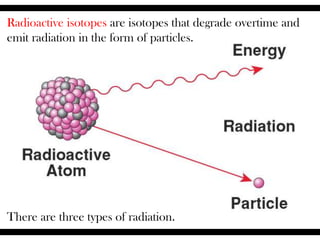
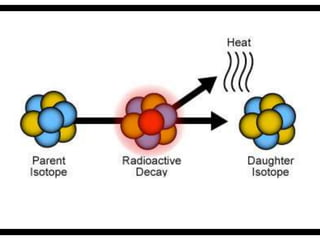
Radioactive isotopes are isotopes that degrade overtime and
emit radiation in the form of particles.
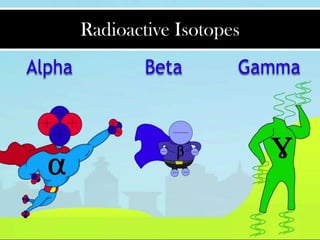
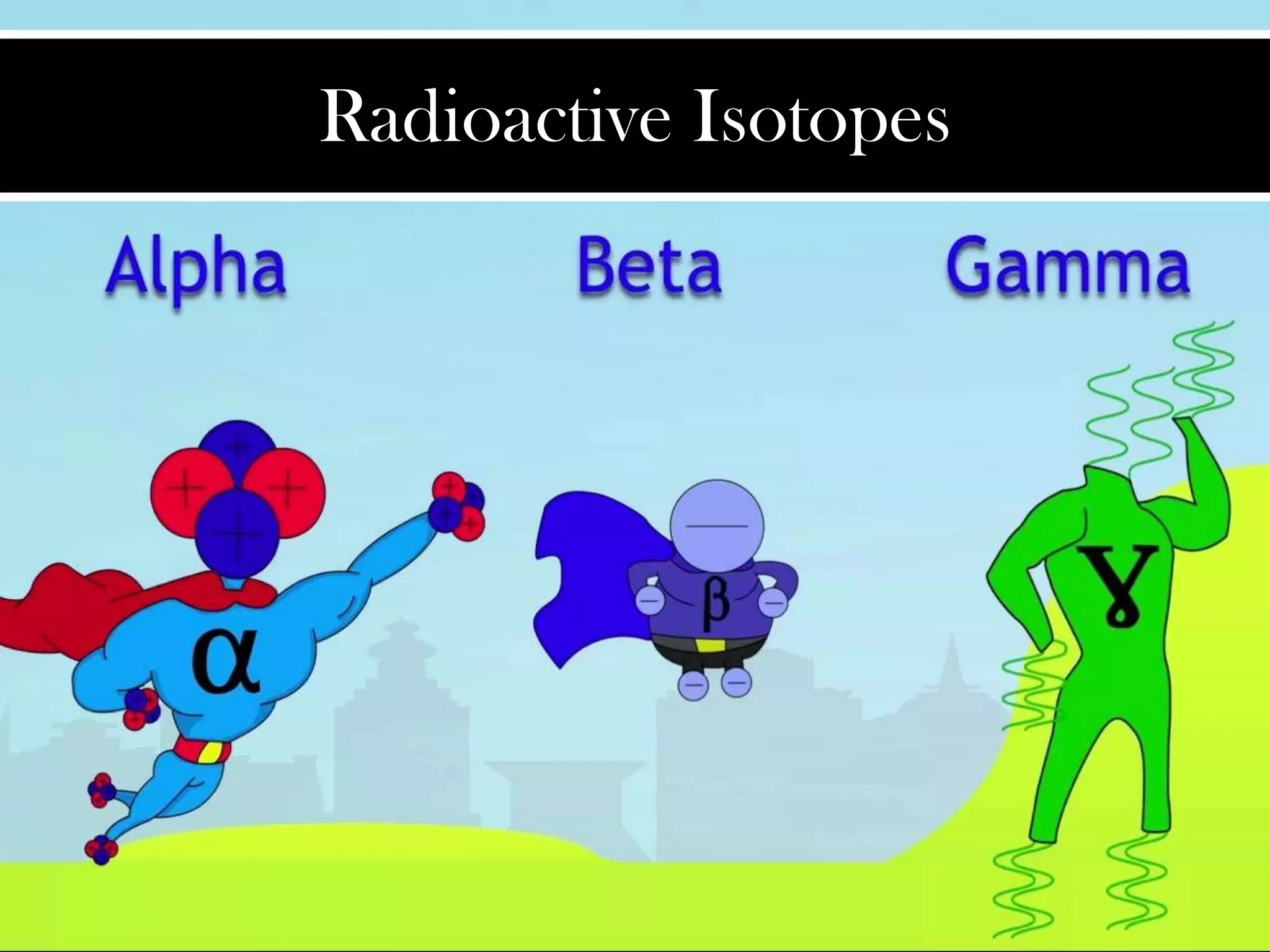
There are three types of radiation.
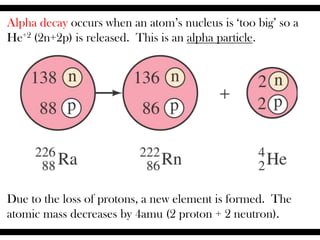
Alpha decay occurs when an atom’s nucleus is ‘too big’ so a
He+2 (2n+2p) is released. This is an alpha particle.
Due to the loss of protons, a new element is formed. The
atomic mass decreases by 4amu (2 proton + 2 neutron).
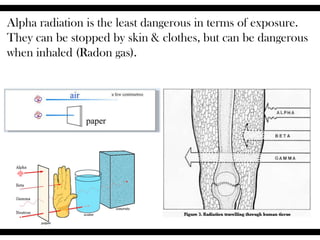
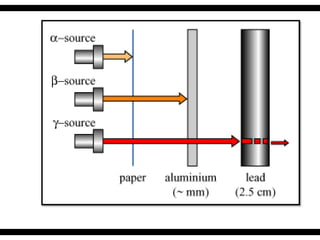
Alpha radiation is the least dangerous in terms of exposure.
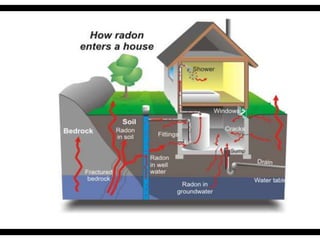
They can be stopped by skin & clothes, but can be dangerous
when inhaled (Radon gas).
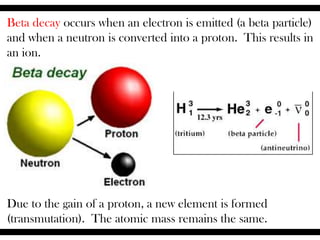
Beta decay occurs when an electron is emitted (a beta particle)
and when a neutron is converted into a proton. This results in
an ion.
Due to the gain of a proton, a new element is formed
(transmutation). The atomic mass remains the same.
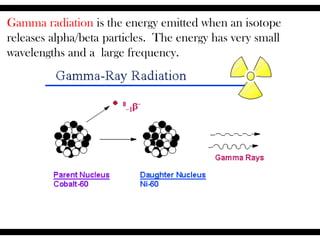
Gamma radiation is the energy emitted when an isotope
releases alpha/beta particles. The energy has very small
wavelengths and a large frequency.
Review Questions
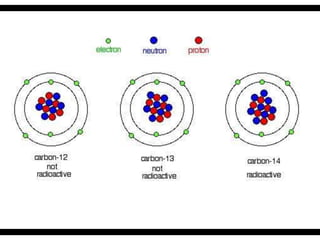
1. If C-14 undergoes beta decay, what will the daughter
element be?
2. If C-14 undergoes alpha decay, what will the daughter
element be?
3. Write the equations if the following underwent alpha
decay:
Pb-210 Th-235 Pu-240
4. Write the equations if the following underwent beta
decay:
Pt-196 Fe-58 Pd-108
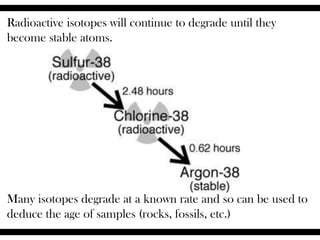
Radioactive isotopes will continue to degrade until they
become stable atoms.
Many isotopes degrade at a known rate and so can be used to
deduce the age of samples (rocks, fossils, etc.)
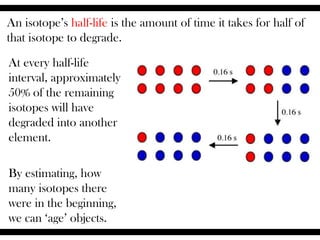
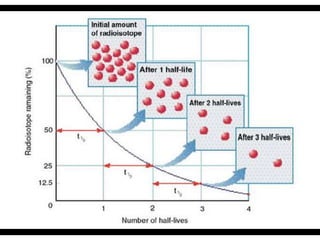
An isotope’s half-life is the amount of time it takes for half of
that isotope to degrade.
At every half-life
interval, approximately
50% of the remaining
isotopes will have
degraded into another
element.
By estimating, how
many isotopes there
were in the beginning,
we can ‘age’ objects.
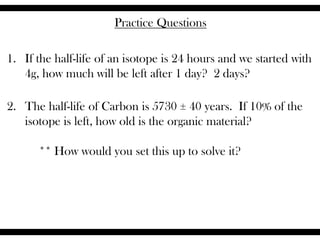
Practice Questions
1. If the half-life of an isotope is 24 hours and we started with
4g, how much will be left after 1 day? 2 days?
2. The half-life of Carbon is 5730 ± 40 years. If 10% of the
isotope is left, how old is the organic material?
** How would you set this up to solve it?
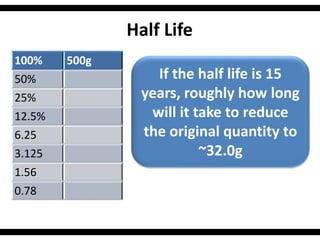
100% 500g
50%
25%
12.5%
6.25
3.125
1.56
0.78
Half Life
If the half life is 15
years, roughly how long
will it take to reduce
the original quantity to
~32.0g

Radiation & types (site)

  • 1.
  • 2.
    Radioactive isotopes areisotopes that degrade overtime and emit radiation in the form of particles. There are three types of radiation.
  • 5.
    Alpha decay occurswhen an atom’s nucleus is ‘too big’ so a He+2 (2n+2p) is released. This is an alpha particle. Due to the loss of protons, a new element is formed. The atomic mass decreases by 4amu (2 proton + 2 neutron).
  • 6.
    Alpha radiation isthe least dangerous in terms of exposure. They can be stopped by skin & clothes, but can be dangerous when inhaled (Radon gas).
  • 7.
    Beta decay occurswhen an electron is emitted (a beta particle) and when a neutron is converted into a proton. This results in an ion. Due to the gain of a proton, a new element is formed (transmutation). The atomic mass remains the same.
  • 8.
    Gamma radiation isthe energy emitted when an isotope releases alpha/beta particles. The energy has very small wavelengths and a large frequency.
  • 11.
    Review Questions 1. IfC-14 undergoes beta decay, what will the daughter element be? 2. If C-14 undergoes alpha decay, what will the daughter element be? 3. Write the equations if the following underwent alpha decay: Pb-210 Th-235 Pu-240 4. Write the equations if the following underwent beta decay: Pt-196 Fe-58 Pd-108
  • 12.
    Radioactive isotopes willcontinue to degrade until they become stable atoms. Many isotopes degrade at a known rate and so can be used to deduce the age of samples (rocks, fossils, etc.)
  • 13.
    An isotope’s half-lifeis the amount of time it takes for half of that isotope to degrade. At every half-life interval, approximately 50% of the remaining isotopes will have degraded into another element. By estimating, how many isotopes there were in the beginning, we can ‘age’ objects.
  • 15.
    Practice Questions 1. Ifthe half-life of an isotope is 24 hours and we started with 4g, how much will be left after 1 day? 2 days? 2. The half-life of Carbon is 5730 ± 40 years. If 10% of the isotope is left, how old is the organic material? ** How would you set this up to solve it?
  • 16.
    100% 500g 50% 25% 12.5% 6.25 3.125 1.56 0.78 Half Life Ifthe half life is 15 years, roughly how long will it take to reduce the original quantity to ~32.0g