Radioactive
Decay
Presented by:
SABA ALI
Semester#03
Roll#43
Early pioneers of
Radioactivity
Roentgen Becquerel
Rutherford
Marie curie
Pierre curie
Discover
Alpha Beta
particles and
Gamma
particles.
Discovery of
Radioactive
elements.
Discovered
Radium and
Polonium in
1900-1908
Henry
Becquerel
Radioactive Decay
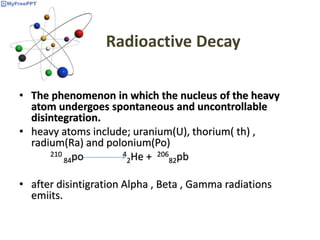
• The phenomenon in which the nucleus of the heavy
atom undergoes spontaneous and uncontrollable
disintegration.
• heavy atoms include; uranium(U), thorium( th) ,
radium(Ra) and polonium(Po)
210
84po 4
2He + 206
82pb
• after disintigration Alpha , Beta , Gamma radiations
emiits.
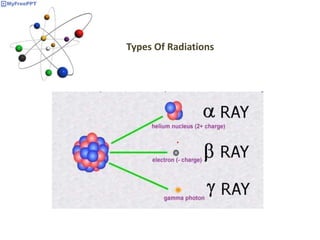
Types Of Radiations
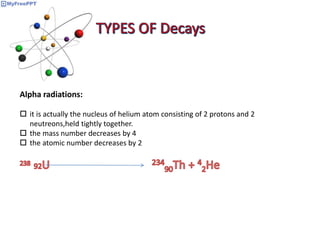
Alpha radiations:
 it is actually the nucleus of helium atom consisting of 2 protons and 2
neutreons,held tightly together.
 the mass number decreases by 4
 the atomic number decreases by 2
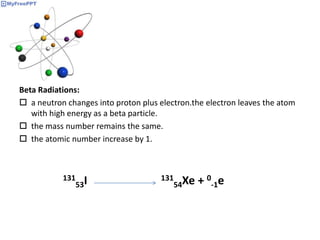
Beta Radiations:
 a neutron changes into proton plus electron.the electron leaves the atom
with high energy as a beta particle.
 the mass number remains the same.
 the atomic number increase by 1.
131
53I 131
54Xe + 0
-1e
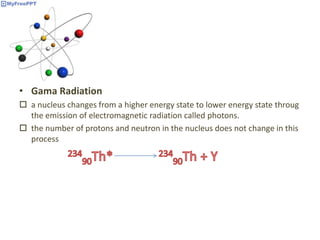
• Gama Radiation
 a nucleus changes from a higher energy state to lower energy state throug
the emission of electromagnetic radiation called photons.
 the number of protons and neutron in the nucleus does not change in this
process
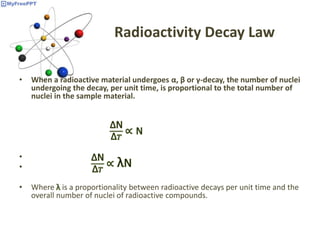
Radioactivity Decay Law
• When a radioactive material undergoes α, β or γ-decay, the number of nuclei
undergoing the decay, per unit time, is proportional to the total number of
nuclei in the sample material.
•
•
• Where is a proportionality between radioactive decays per unit time and the
overall number of nuclei of radioactive compounds.
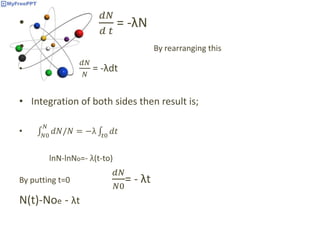
•
𝑑𝑁
𝑑 𝑡
= -λN
• By rearranging this
•
𝑑𝑁
𝑁
= -λdt
• Integration of both sides then result is;
• 𝑁0
𝑁
𝑑𝑁/𝑁 = −λ 𝑡0
𝑑𝑡
lnN-lnNo=- λ(t-to)
By putting t=0
𝑑𝑁
𝑁0
= - λt
N(t)-Noe - λt
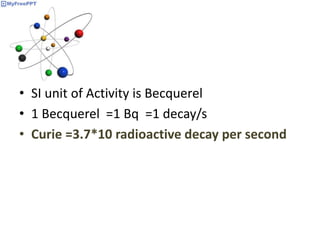
• SI unit of Activity is Becquerel
• 1 Becquerel =1 Bq =1 decay/s
• Curie =3.7*10 radioactive decay per second
Half - Life
T1/2
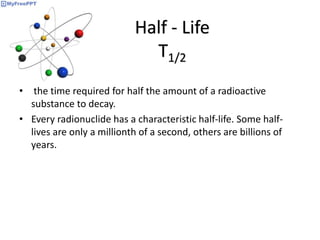
• the time required for half the amount of a radioactive
substance to decay.
• Every radionuclide has a characteristic half-life. Some half-
lives are only a millionth of a second, others are billions of
years.
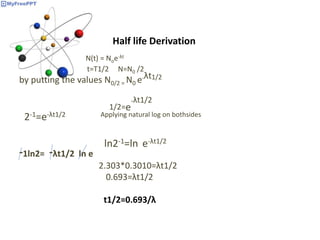
Half life Derivation
N(t) = Noe-λt
t=T1/2 N=N0 /2
by putting the values N0/2 = N0 e-λt1/2
1/2=e
-λt1/2
2-1=e-λt1/2 Applying natural log on bothsides
ln2-1=ln e-λt1/2
-1ln2= -λt1/2 ln e
2.303*0.3010=λt1/2
0.693=λt1/2
t1/2=0.693/λ
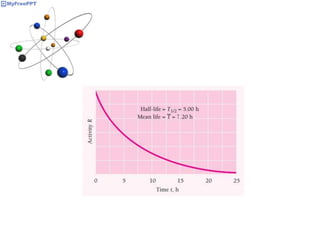
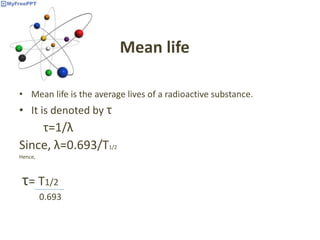
Mean life
• Mean life is the average lives of a radioactive substance.
• It is denoted by τ
τ=1/λ
Since, λ=0.693/T1/2
Hence,
τ= T1/2
0.693
Radioactivity

Radioactivity

  • 1.
  • 2.
    Early pioneers of Radioactivity RoentgenBecquerel Rutherford Marie curie Pierre curie Discover Alpha Beta particles and Gamma particles. Discovery of Radioactive elements. Discovered Radium and Polonium in 1900-1908 Henry Becquerel
  • 3.
    Radioactive Decay • Thephenomenon in which the nucleus of the heavy atom undergoes spontaneous and uncontrollable disintegration. • heavy atoms include; uranium(U), thorium( th) , radium(Ra) and polonium(Po) 210 84po 4 2He + 206 82pb • after disintigration Alpha , Beta , Gamma radiations emiits.
  • 4.
  • 5.
    Alpha radiations:  itis actually the nucleus of helium atom consisting of 2 protons and 2 neutreons,held tightly together.  the mass number decreases by 4  the atomic number decreases by 2
  • 6.
    Beta Radiations:  aneutron changes into proton plus electron.the electron leaves the atom with high energy as a beta particle.  the mass number remains the same.  the atomic number increase by 1. 131 53I 131 54Xe + 0 -1e
  • 7.
    • Gama Radiation a nucleus changes from a higher energy state to lower energy state throug the emission of electromagnetic radiation called photons.  the number of protons and neutron in the nucleus does not change in this process
  • 8.
    Radioactivity Decay Law •When a radioactive material undergoes α, β or γ-decay, the number of nuclei undergoing the decay, per unit time, is proportional to the total number of nuclei in the sample material. • • • Where is a proportionality between radioactive decays per unit time and the overall number of nuclei of radioactive compounds.
  • 9.
    • 𝑑𝑁 𝑑 𝑡 = -λN •By rearranging this • 𝑑𝑁 𝑁 = -λdt • Integration of both sides then result is; • 𝑁0 𝑁 𝑑𝑁/𝑁 = −λ 𝑡0 𝑑𝑡 lnN-lnNo=- λ(t-to) By putting t=0 𝑑𝑁 𝑁0 = - λt N(t)-Noe - λt
  • 11.
    • SI unitof Activity is Becquerel • 1 Becquerel =1 Bq =1 decay/s • Curie =3.7*10 radioactive decay per second
  • 12.
    Half - Life T1/2 •the time required for half the amount of a radioactive substance to decay. • Every radionuclide has a characteristic half-life. Some half- lives are only a millionth of a second, others are billions of years.
  • 13.
    Half life Derivation N(t)= Noe-λt t=T1/2 N=N0 /2 by putting the values N0/2 = N0 e-λt1/2 1/2=e -λt1/2 2-1=e-λt1/2 Applying natural log on bothsides ln2-1=ln e-λt1/2 -1ln2= -λt1/2 ln e 2.303*0.3010=λt1/2 0.693=λt1/2 t1/2=0.693/λ
  • 15.
    Mean life • Meanlife is the average lives of a radioactive substance. • It is denoted by τ τ=1/λ Since, λ=0.693/T1/2 Hence, τ= T1/2 0.693