Jonathan Lalrinmawia
Research Scholar
Supervisor Co-supervisor
Prof. R.C Tiwari Dr. Kham Suan Pau
Dean S. P. S., MZU RSO & Med. Phy. MSCI
Department of Physics, MZU - 2015
RADIATION DETECTORS
Presented by
OUTLINE
• Introduction
• Why to Detect Radiation?
• Interaction of Radiation with Matter
• Types of Detectors
• How to Detect Radiation?
• Conclusion
• References
INTRODUCTION
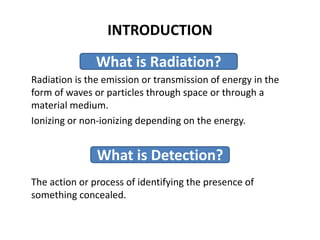
Radiation is the emission or transmission of energy in the
form of waves or particles through space or through a
material medium.
Ionizing or non-ionizing depending on the energy.
The action or process of identifying the presence of
something concealed.
What is Radiation?
What is Detection?
INTRODUCTION
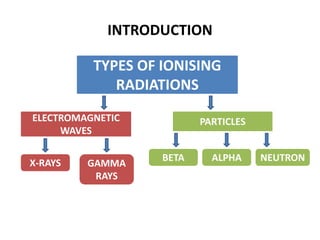
TYPES OF IONISING
RADIATIONS
ELECTROMAGNETIC
WAVES
PARTICLES
X-RAYS GAMMA
RAYS
BETA ALPHA NEUTRON
WHY TO DETECT RADIATION?
1. Research application
2. Environmental Safety
3. Power regulation in nuclear reactors
4. Personal protection of occupational workers
5. Estimation of Radiation dose in treatment of
patients
6. Calibration of radioactive isotopes etc..
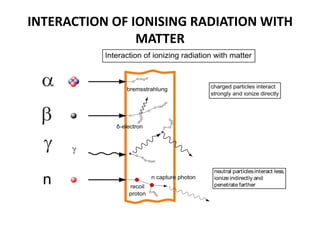
INTERACTION OF IONISING RADIATION WITH
MATTER
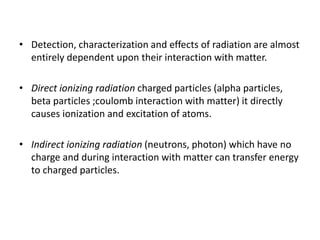
• Detection, characterization and effects of radiation are almost
entirely dependent upon their interaction with matter.
• Direct ionizing radiation charged particles (alpha particles,
beta particles ;coulomb interaction with matter) it directly
causes ionization and excitation of atoms.
• Indirect ionizing radiation (neutrons, photon) which have no
charge and during interaction with matter can transfer energy
to charged particles.
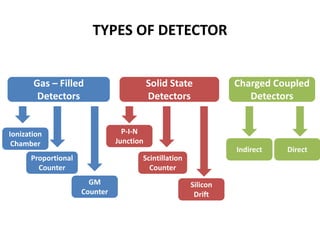
TYPES OF DETECTOR
Gas – Filled
Detectors
Charged Coupled
Detectors
Solid State
Detectors
Ionization
Chamber
Proportional
Counter
GM
Counter
P-I-N
Junction
Scintillation
Counter
Silicon
Drift
Indirect Direct
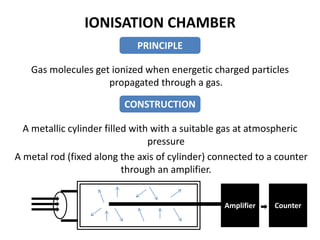
IONISATION CHAMBER
Gas molecules get ionized when energetic charged particles
propagated through a gas.
A metallic cylinder filled with with a suitable gas at atmospheric
pressure
A metal rod (fixed along the axis of cylinder) connected to a counter
through an amplifier.
PRINCIPLE
CONSTRUCTION
Amplifier Counter
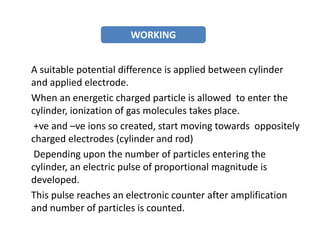
A suitable potential difference is applied between cylinder
and applied electrode.
When an energetic charged particle is allowed to enter the
cylinder, ionization of gas molecules takes place.
+ve and –ve ions so created, start moving towards oppositely
charged electrodes (cylinder and rod)
Depending upon the number of particles entering the
cylinder, an electric pulse of proportional magnitude is
developed.
This pulse reaches an electronic counter after amplification
and number of particles is counted.
WORKING
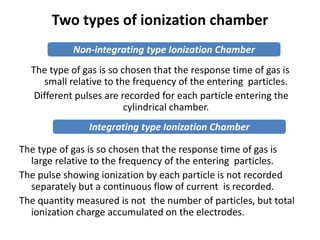
Two types of ionization chamber
The type of gas is so chosen that the response time of gas is
small relative to the frequency of the entering particles.
Different pulses are recorded for each particle entering the
cylindrical chamber.
The type of gas is so chosen that the response time of gas is
large relative to the frequency of the entering particles.
The pulse showing ionization by each particle is not recorded
separately but a continuous flow of current is recorded.
The quantity measured is not the number of particles, but total
ionization charge accumulated on the electrodes.
Non-integrating type Ionization Chamber
Integrating type Ionization Chamber
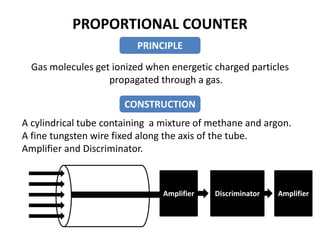
PROPORTIONAL COUNTER
Gas molecules get ionized when energetic charged particles
propagated through a gas.
PRINCIPLE
CONSTRUCTION
A cylindrical tube containing a mixture of methane and argon.
A fine tungsten wire fixed along the axis of the tube.
Amplifier and Discriminator.
Amplifier Discriminator Amplifier
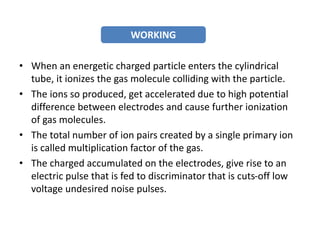
• When an energetic charged particle enters the cylindrical
tube, it ionizes the gas molecule colliding with the particle.
• The ions so produced, get accelerated due to high potential
difference between electrodes and cause further ionization
of gas molecules.
• The total number of ion pairs created by a single primary ion
is called multiplication factor of the gas.
• The charged accumulated on the electrodes, give rise to an
electric pulse that is fed to discriminator that is cuts-off low
voltage undesired noise pulses.
WORKING
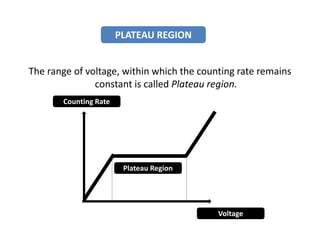
The range of voltage, within which the counting rate remains
constant is called Plateau region.
PLATEAU REGION
Counting Rate
Voltage
Plateau Region
G M COUNTER
PRINCIPLE
Gas molecules get ionized when energetic charged particles
propagated through a gas.
The electrons produced by ionization, if accelerated by a high
potential can cause further ionization of gas molecules
thereby generating a large number of more electrons.
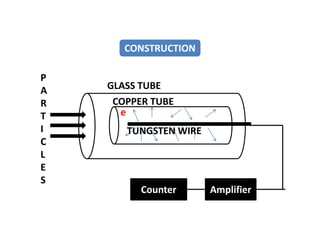
CONSTRUCTION
Counter Amplifier
GLASS TUBE
COPPER TUBE
TUNGSTEN WIRE
P
A
R
T
I
C
L
E
S
e
• Its consists of hollow cylindrical tube of length about 15 – 50
cm and is made of copper. ( called GM Tube)
• The GM tube is filled with some inert gas (generally argon) at
a pressure of 10 cm of HG, with 10% vapors of ethyl alcohol.
• GM tube is enclosed in a partially evacuated glass tube.
• A tungsten wire of about 0.5mm of diameter is fixed along
the axis of GM tube (but insulated from the tube).
• The tungsten wire is connected to the positive terminal and
metallic GM tube to the negative terminal of HT (about
1000V)
• A thin window (generally made of mica), is provided on one
side of tube for entrance of particles to be detected.
• When an energetic charged particle enters GM tube through
the window, the gas molecules which interact with the
charged particle get ionized.
• The generated electrons, get accelerated towards the central
anode and +ve ions towards cathode tube.
• The accelerated electrons cause ionization of more gas
molecules, generating large number of electrons within a very
short interval of time (called avalanche)
• The avalanche gives rise to a high current pulse.
• For each particle entering the tube, successive current pulses
are produced and counting is done by a suitable device.
WORKING
• During the working of GM counter, the heavier +ve ions take
enough time to reach the surface of cathode tube. Until all
the +ve ions have reached the surface of the cathode tube,
the next particle is not detected.
• The time interval for which GM counter is completely
insensitive to the incoming particles, is called dead time of
GM Counter (Generally of the order of a few hundred
microseconds)
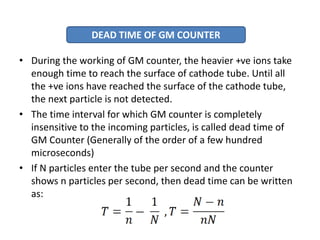
• If N particles enter the tube per second and the counter
shows n particles per second, then dead time can be written
as:
DEAD TIME OF GM COUNTER
• Just on the completion of dead time of GM Tube, the slow
moving +ve ions reach the surface of cathode tube and get
discharged there. As a result a current pulse is again
generated, that gives and indication, as if another particle has
entered the GM tube, which is not the case in reality.
• Thus a single particle is counted twice (once at the starting
and the other the end of DEAD TIME INTERVAL)
• It is desirable that the +ve ion sheath formed around the
anode wire, must be eliminated before it reaches the cathode
tube.
• The process of eliminating undesired +ve ions sheath around
the central anode wire in GM tube is called quenching.
• Many methods have been suggested for quenching, but the
most acceptable method is “SELF QUENCHING METHOD”.
QUENCHING OF GM TUBE
• Some halogen gas is introduced along with inert gas in GM
Tube. The accelerated inert gas +ve ions, collide with halogen
gas molecules and ionize them.
• The electrons so created neutralize the already existing innert
gas +ve ions and the +ve halogen gas ions get very rapidly
drifted towards the surface of cathode tube where they get
neutralized.
SELF QUENCHING METHOD
HOW TO DETECT RADIATION ?
Choose a radiation detector working on a particular principle of
interaction (ionization, scintillation/etc) with known sensitivity
to estimate the radiation under detection.
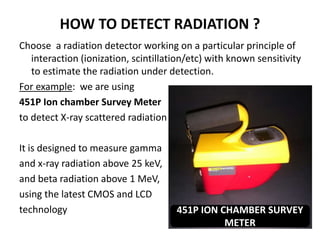
For example: we are using
451P Ion chamber Survey Meter
to detect X-ray scattered radiation
It is designed to measure gamma
and x-ray radiation above 25 keV,
and beta radiation above 1 MeV,
using the latest CMOS and LCD
technology 451P ION CHAMBER SURVEY
METER
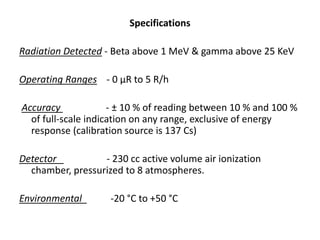
Specifications
Radiation Detected - Beta above 1 MeV & gamma above 25 KeV
Operating Ranges - 0 μR to 5 R/h
Accuracy - ± 10 % of reading between 10 % and 100 %
of full-scale indication on any range, exclusive of energy
response (calibration source is 137 Cs)
Detector - 230 cc active volume air ionization
chamber, pressurized to 8 atmospheres.
Environmental -20 °C to +50 °C
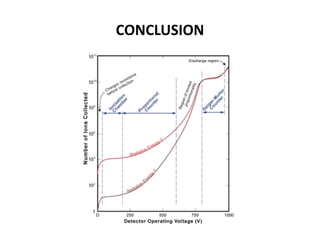
CONCLUSION
REFERENCES
1. PN FBC-0059 September 2013, Rev. 1 © 2013 Fluke
Corporation.
2. https://en.wikipedia.org/wiki/Radiation
3. https://www.google.co.in/webhp?source=search_app&gws_
rd=ssl#q=Detection+means
4. https://www.google.co.in/search?q=interaction+of+radiation
+with+matter&biw=1366&bih=623&site=webhp&source=ln
ms&tbm=isch&sa=X&ved=0ahUKEwiFw5f1mJ_JAhWVB44KH
eaKDaAQ_AUIBigB#imgrc=HgH4ev5grOq18M%3A
5. http://www.tesec-int.org/TechHaz-site%2008/Radiation-
interaction.pdf
6. Jones, R. Clark (1949). "A New Classification System for
Radiation Detectors". Journal of the Optical Society of
America 39 (5): 327–341.
7. Jones, R. Clark (1949). "Erratum: The Ultimate Sensitivity of
Radiation Detectors". Journal of the Optical Society of
America 39 (5): 343.
8. Jones, R. Clark (1949). "Factors of Merit for Radiation
Detectors". Journal of the Optical Society of America 39 (5):
344–356
9. Knoll, Glenn F (1999). Radiation detection and
measurement (3rd ed.). New York: Wiley.
Radiation detectors

Radiation detectors

  • 1.
    Jonathan Lalrinmawia Research Scholar SupervisorCo-supervisor Prof. R.C Tiwari Dr. Kham Suan Pau Dean S. P. S., MZU RSO & Med. Phy. MSCI Department of Physics, MZU - 2015 RADIATION DETECTORS Presented by
  • 2.
    OUTLINE • Introduction • Whyto Detect Radiation? • Interaction of Radiation with Matter • Types of Detectors • How to Detect Radiation? • Conclusion • References
  • 3.
    INTRODUCTION Radiation is theemission or transmission of energy in the form of waves or particles through space or through a material medium. Ionizing or non-ionizing depending on the energy. The action or process of identifying the presence of something concealed. What is Radiation? What is Detection?
  • 4.
  • 5.
    WHY TO DETECTRADIATION? 1. Research application 2. Environmental Safety 3. Power regulation in nuclear reactors 4. Personal protection of occupational workers 5. Estimation of Radiation dose in treatment of patients 6. Calibration of radioactive isotopes etc..
  • 6.
    INTERACTION OF IONISINGRADIATION WITH MATTER
  • 7.
    • Detection, characterizationand effects of radiation are almost entirely dependent upon their interaction with matter. • Direct ionizing radiation charged particles (alpha particles, beta particles ;coulomb interaction with matter) it directly causes ionization and excitation of atoms. • Indirect ionizing radiation (neutrons, photon) which have no charge and during interaction with matter can transfer energy to charged particles.
  • 8.
    TYPES OF DETECTOR Gas– Filled Detectors Charged Coupled Detectors Solid State Detectors Ionization Chamber Proportional Counter GM Counter P-I-N Junction Scintillation Counter Silicon Drift Indirect Direct
  • 9.
    IONISATION CHAMBER Gas moleculesget ionized when energetic charged particles propagated through a gas. A metallic cylinder filled with with a suitable gas at atmospheric pressure A metal rod (fixed along the axis of cylinder) connected to a counter through an amplifier. PRINCIPLE CONSTRUCTION Amplifier Counter
  • 10.
    A suitable potentialdifference is applied between cylinder and applied electrode. When an energetic charged particle is allowed to enter the cylinder, ionization of gas molecules takes place. +ve and –ve ions so created, start moving towards oppositely charged electrodes (cylinder and rod) Depending upon the number of particles entering the cylinder, an electric pulse of proportional magnitude is developed. This pulse reaches an electronic counter after amplification and number of particles is counted. WORKING
  • 11.
    Two types ofionization chamber The type of gas is so chosen that the response time of gas is small relative to the frequency of the entering particles. Different pulses are recorded for each particle entering the cylindrical chamber. The type of gas is so chosen that the response time of gas is large relative to the frequency of the entering particles. The pulse showing ionization by each particle is not recorded separately but a continuous flow of current is recorded. The quantity measured is not the number of particles, but total ionization charge accumulated on the electrodes. Non-integrating type Ionization Chamber Integrating type Ionization Chamber
  • 12.
    PROPORTIONAL COUNTER Gas moleculesget ionized when energetic charged particles propagated through a gas. PRINCIPLE CONSTRUCTION A cylindrical tube containing a mixture of methane and argon. A fine tungsten wire fixed along the axis of the tube. Amplifier and Discriminator. Amplifier Discriminator Amplifier
  • 13.
    • When anenergetic charged particle enters the cylindrical tube, it ionizes the gas molecule colliding with the particle. • The ions so produced, get accelerated due to high potential difference between electrodes and cause further ionization of gas molecules. • The total number of ion pairs created by a single primary ion is called multiplication factor of the gas. • The charged accumulated on the electrodes, give rise to an electric pulse that is fed to discriminator that is cuts-off low voltage undesired noise pulses. WORKING
  • 14.
    The range ofvoltage, within which the counting rate remains constant is called Plateau region. PLATEAU REGION Counting Rate Voltage Plateau Region
  • 15.
    G M COUNTER PRINCIPLE Gasmolecules get ionized when energetic charged particles propagated through a gas. The electrons produced by ionization, if accelerated by a high potential can cause further ionization of gas molecules thereby generating a large number of more electrons.
  • 16.
    CONSTRUCTION Counter Amplifier GLASS TUBE COPPERTUBE TUNGSTEN WIRE P A R T I C L E S e
  • 17.
    • Its consistsof hollow cylindrical tube of length about 15 – 50 cm and is made of copper. ( called GM Tube) • The GM tube is filled with some inert gas (generally argon) at a pressure of 10 cm of HG, with 10% vapors of ethyl alcohol. • GM tube is enclosed in a partially evacuated glass tube. • A tungsten wire of about 0.5mm of diameter is fixed along the axis of GM tube (but insulated from the tube). • The tungsten wire is connected to the positive terminal and metallic GM tube to the negative terminal of HT (about 1000V) • A thin window (generally made of mica), is provided on one side of tube for entrance of particles to be detected.
  • 18.
    • When anenergetic charged particle enters GM tube through the window, the gas molecules which interact with the charged particle get ionized. • The generated electrons, get accelerated towards the central anode and +ve ions towards cathode tube. • The accelerated electrons cause ionization of more gas molecules, generating large number of electrons within a very short interval of time (called avalanche) • The avalanche gives rise to a high current pulse. • For each particle entering the tube, successive current pulses are produced and counting is done by a suitable device. WORKING
  • 19.
    • During theworking of GM counter, the heavier +ve ions take enough time to reach the surface of cathode tube. Until all the +ve ions have reached the surface of the cathode tube, the next particle is not detected. • The time interval for which GM counter is completely insensitive to the incoming particles, is called dead time of GM Counter (Generally of the order of a few hundred microseconds) • If N particles enter the tube per second and the counter shows n particles per second, then dead time can be written as: DEAD TIME OF GM COUNTER
  • 20.
    • Just onthe completion of dead time of GM Tube, the slow moving +ve ions reach the surface of cathode tube and get discharged there. As a result a current pulse is again generated, that gives and indication, as if another particle has entered the GM tube, which is not the case in reality. • Thus a single particle is counted twice (once at the starting and the other the end of DEAD TIME INTERVAL) • It is desirable that the +ve ion sheath formed around the anode wire, must be eliminated before it reaches the cathode tube. • The process of eliminating undesired +ve ions sheath around the central anode wire in GM tube is called quenching. • Many methods have been suggested for quenching, but the most acceptable method is “SELF QUENCHING METHOD”. QUENCHING OF GM TUBE
  • 21.
    • Some halogengas is introduced along with inert gas in GM Tube. The accelerated inert gas +ve ions, collide with halogen gas molecules and ionize them. • The electrons so created neutralize the already existing innert gas +ve ions and the +ve halogen gas ions get very rapidly drifted towards the surface of cathode tube where they get neutralized. SELF QUENCHING METHOD
  • 22.
    HOW TO DETECTRADIATION ? Choose a radiation detector working on a particular principle of interaction (ionization, scintillation/etc) with known sensitivity to estimate the radiation under detection. For example: we are using 451P Ion chamber Survey Meter to detect X-ray scattered radiation It is designed to measure gamma and x-ray radiation above 25 keV, and beta radiation above 1 MeV, using the latest CMOS and LCD technology 451P ION CHAMBER SURVEY METER
  • 23.
    Specifications Radiation Detected -Beta above 1 MeV & gamma above 25 KeV Operating Ranges - 0 μR to 5 R/h Accuracy - ± 10 % of reading between 10 % and 100 % of full-scale indication on any range, exclusive of energy response (calibration source is 137 Cs) Detector - 230 cc active volume air ionization chamber, pressurized to 8 atmospheres. Environmental -20 °C to +50 °C
  • 24.
  • 25.
    REFERENCES 1. PN FBC-0059September 2013, Rev. 1 © 2013 Fluke Corporation. 2. https://en.wikipedia.org/wiki/Radiation 3. https://www.google.co.in/webhp?source=search_app&gws_ rd=ssl#q=Detection+means 4. https://www.google.co.in/search?q=interaction+of+radiation +with+matter&biw=1366&bih=623&site=webhp&source=ln ms&tbm=isch&sa=X&ved=0ahUKEwiFw5f1mJ_JAhWVB44KH eaKDaAQ_AUIBigB#imgrc=HgH4ev5grOq18M%3A 5. http://www.tesec-int.org/TechHaz-site%2008/Radiation- interaction.pdf
  • 26.
    6. Jones, R.Clark (1949). "A New Classification System for Radiation Detectors". Journal of the Optical Society of America 39 (5): 327–341. 7. Jones, R. Clark (1949). "Erratum: The Ultimate Sensitivity of Radiation Detectors". Journal of the Optical Society of America 39 (5): 343. 8. Jones, R. Clark (1949). "Factors of Merit for Radiation Detectors". Journal of the Optical Society of America 39 (5): 344–356 9. Knoll, Glenn F (1999). Radiation detection and measurement (3rd ed.). New York: Wiley.