DR NILESH KATE
MBBS,MD
ASSOCIATE PROF
DEPT. OF PHYSIOLOGY
PULMONARY
DIFFUSION
OBJECTIVES
 Physics of gas diffusion & gas partial
pressure.
 Alveolar ventilation.
 Alveolar ventilation : perfusion ratio
 Alveolar air.
 Diffusion of gases through respiratory
membrane.
Wednesday, June 22, 2016
INTRODUCTION.
 External Respiration done by
 Pulmonary ventilation
 Pulmonary diffusion
 Transport of gases.
 Main content
 Physics of gas diffusion & gas partial pressure
 Alveolar ventilation
 Ventilation-Perfusion ratio
 Diffusion of gases through respiratory membrane.
Wednesday, June 22, 2016
PHYSICS OF GAS DIFFUSION &
GAS PARTIAL PRESSURE.
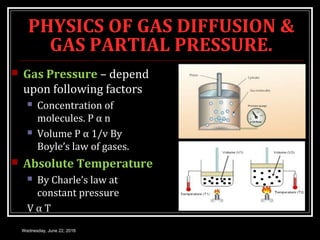
 Gas Pressure – depend
upon following factors
 Concentration of
molecules. P α n
 Volume P α 1/v By
Boyle’s law of gases.
 Absolute Temperature
 By Charle’s law at
constant pressure
V α T
Wednesday, June 22, 2016
PHYSICS OF GAS DIFFUSION &
GAS PARTIAL PRESSURE.
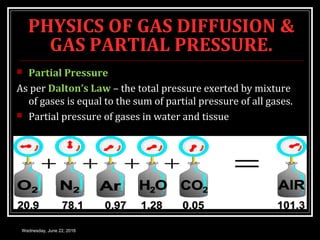
 Partial Pressure
As per Dalton’s Law – the total pressure exerted by mixture
of gases is equal to the sum of partial pressure of all gases.
 Partial pressure of gases in water and tissue
Wednesday, June 22, 2016
PHYSICS OF GAS DIFFUSION &
GAS PARTIAL PRESSURE.
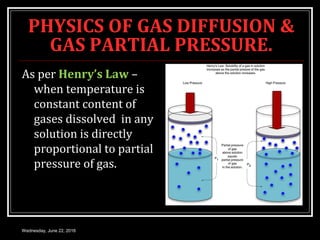
As per Henry’s Law –
when temperature is
constant content of
gases dissolved in any
solution is directly
proportional to partial
pressure of gas.
Wednesday, June 22, 2016
PHYSICS OF GAS DIFFUSION &
GAS PARTIAL PRESSURE.
 Partial Pressure – At equilibrium partial pressure in liquid
phase is equal to partial pressure in gas
 In absence of equilibrium partial pressure of gas in liquid
phase is less than in gas phase.
 Solubility Coefficient – solubility coefficient of CO2 is 24
times more & that of N2 is half of that of oxygen.
Wednesday, June 22, 2016
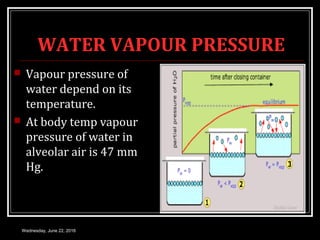
WATER VAPOUR PRESSURE
 Vapour pressure of
water depend on its
temperature.
 At body temp vapour
pressure of water in
alveolar air is 47 mm
Hg.
Wednesday, June 22, 2016
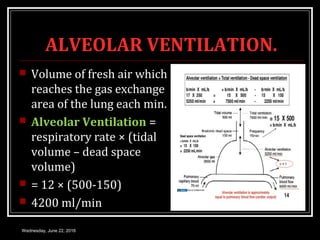
ALVEOLAR VENTILATION.
 Volume of fresh air which
reaches the gas exchange
area of the lung each min.
 Alveolar Ventilation =
respiratory rate × (tidal
volume – dead space
volume)
 = 12 × (500-150)
 4200 ml/min
Wednesday, June 22, 2016
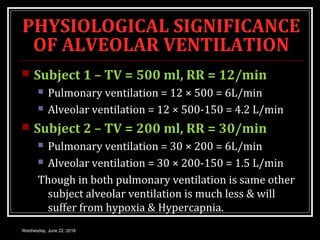
PHYSIOLOGICAL SIGNIFICANCE
OF ALVEOLAR VENTILATION
 Subject 1 – TV = 500 ml, RR = 12/min
 Pulmonary ventilation = 12 × 500 = 6L/min
 Alveolar ventilation = 12 × 500-150 = 4.2 L/min
 Subject 2 – TV = 200 ml, RR = 30/min
 Pulmonary ventilation = 30 × 200 = 6L/min
 Alveolar ventilation = 30 × 200-150 = 1.5 L/min
Though in both pulmonary ventilation is same other
subject alveolar ventilation is much less & will
suffer from hypoxia & Hypercapnia.
Wednesday, June 22, 2016
DEAD SPACE
DEAD SPACE AIR
 Anatomical dead space air.
 Alveolar dead space air.
 Physiological dead space.
 Measurement of anatomical dead space.
 Measurement of physiological dead space.
Wednesday, June 22, 2016
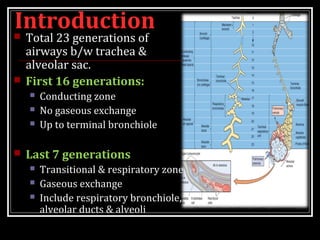
Introduction Total 23 generations of
airways b/w trachea &
alveolar sac.
 First 16 generations:
 Conducting zone
 No gaseous exchange
 Up to terminal bronchiole
 Last 7 generations
 Transitional & respiratory zone
 Gaseous exchange
 Include respiratory bronchiole,
alveolar ducts & alveoli
DEAD SPACE
 Part of the tidal volume that does not take
part in gaseous exchange with pulmonary
capillary blood.
 This can be:
 Anatomical dead space
 Alveolar dead space
 Total (Physiological) dead space
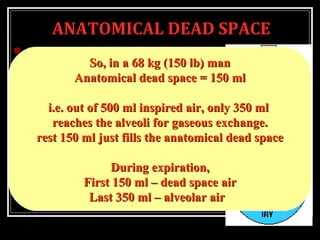
ANATOMICAL DEAD SPACE
 Gas in the conducting areas of the
respiratory passage, where no
gaseous exchange occurs.
 Volume of air from nose to
terminal bronchiole.
 Approximately equal to the body
weight in pounds.
So, in a 68 kg (150 lb) manSo, in a 68 kg (150 lb) man
Anatomical dead space = 150 mlAnatomical dead space = 150 ml
i.e. out of 500 ml inspired air, only 350 mli.e. out of 500 ml inspired air, only 350 ml
reaches the alveoli for gaseous exchange.reaches the alveoli for gaseous exchange.
rest 150 ml just fills the anatomical dead spacerest 150 ml just fills the anatomical dead space
During expiration,During expiration,
First 150 ml – dead space airFirst 150 ml – dead space air
Last 350 ml – alveolar airLast 350 ml – alveolar air
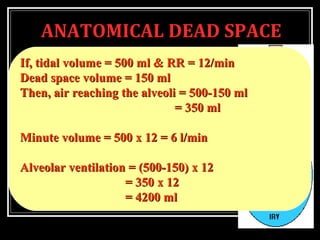
ANATOMICAL DEAD SPACE
 Alveolar ventilation (amount of air
reaching the alveoli per min) is less
than the respiratory minute volume.
If, tidal volume = 500 ml & RR = 12/minIf, tidal volume = 500 ml & RR = 12/min
Dead space volume = 150 mlDead space volume = 150 ml
Then, air reaching the alveoli = 500-150 mlThen, air reaching the alveoli = 500-150 ml
= 350 ml= 350 ml
Minute volume = 500 x 12 = 6 l/minMinute volume = 500 x 12 = 6 l/min
Alveolar ventilation = (500-150) x 12Alveolar ventilation = (500-150) x 12
= 350 x 12= 350 x 12
= 4200 ml= 4200 ml
ANATOMICAL DEAD SPACE
 Rapid shallow breathing produces
much less alveolar ventilation than
slow deep breathing at the same
respiratory minute volume.
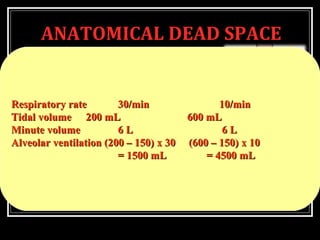
Respiratory rateRespiratory rate 30/min30/min 10/min10/min
Tidal volumeTidal volume 200 mL200 mL 600 mL600 mL
Minute volumeMinute volume 6 L6 L 6 L6 L
Alveolar ventilation (200 – 150) x 30 (600 – 150) x 10Alveolar ventilation (200 – 150) x 30 (600 – 150) x 10
= 1500 mL = 4500 mL= 1500 mL = 4500 mL
ALVEOLAR DEAD SPACE
 Gas present in under-
perfused or non-perfused
alveoli and excess gas
present in over-ventilated
alveoli.
 Alveolar air that is not
equilibrating with the
pulmonar capillary blood.
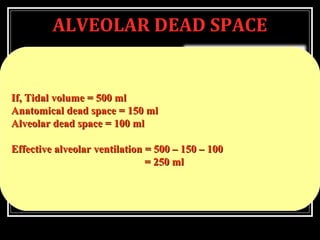
If, Tidal volume = 500 mlIf, Tidal volume = 500 ml
Anatomical dead space = 150 mlAnatomical dead space = 150 ml
Alveolar dead space = 100 mlAlveolar dead space = 100 ml
Effective alveolar ventilation = 500 – 150 – 100Effective alveolar ventilation = 500 – 150 – 100
= 250 ml= 250 ml
TOTAL (PHYSIOLOGICAL) DEAD
SPACE
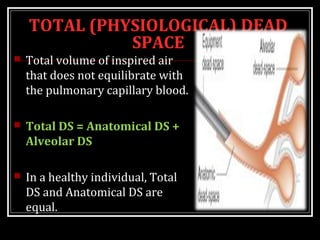
 Total volume of inspired air
that does not equilibrate with
the pulmonary capillary blood.
 Total DS = Anatomical DS +
Alveolar DS
 In a healthy individual, Total
DS and Anatomical DS are
equal.
MEASUREMENT OF DEAD SPACE
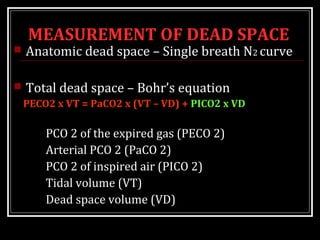
 Anatomic dead space – Single breath N2 curve
 Total dead space – Bohr’s equation
PECO2 x VT = PaCO2 x (VT – VD) + PICO2 x VD
PCO 2 of the expired gas (PECO 2)
Arterial PCO 2 (PaCO 2)
PCO 2 of inspired air (PICO 2)
Tidal volume (VT)
Dead space volume (VD)
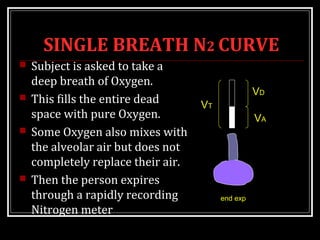
SINGLE BREATH N2 CURVE
 Subject is asked to take a
deep breath of Oxygen.
 This fills the entire dead
space with pure Oxygen.
 Some Oxygen also mixes with
the alveolar air but does not
completely replace their air.
 Then the person expires
through a rapidly recording
Nitrogen meter
end exp
VT
VD
VA
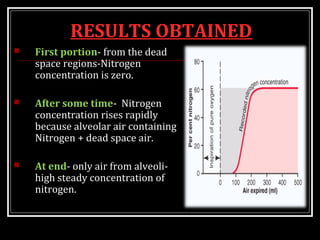
RESULTS OBTAINED
 First portion- from the dead
space regions-Nitrogen
concentration is zero.
 After some time- Nitrogen
concentration rises rapidly
because alveolar air containing
Nitrogen + dead space air.
 At end- only air from alveoli-
high steady concentration of
nitrogen.
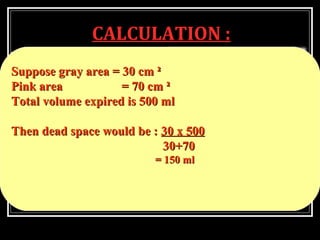
CALCULATION :
 VE = total volume of
expired air.
 VD = dead space air
Suppose gray area = 30 cm ²Suppose gray area = 30 cm ²
Pink areaPink area = 70 cm ²= 70 cm ²
Total volume expired is 500 mlTotal volume expired is 500 ml
Then dead space would be :Then dead space would be : 30 x 50030 x 500
30+7030+70
= 150 ml= 150 ml
EFFECT OF GRAVITY ON
ALVEOLAR VENTILATION
 In Supine Position – alveolar ventilation evenly
distributed
 In Upright Position –
 Alveolar pressure is zero throughout lung
 Intrapleural pressure – at apex -10 mmHg & at base -2
mm Hg.
 So transpulmonary pressure -10 & -2 at apex & base
respectively.
 So linear reduction in regional alveolar ventilation from
base to apex.
Wednesday, June 22, 2016
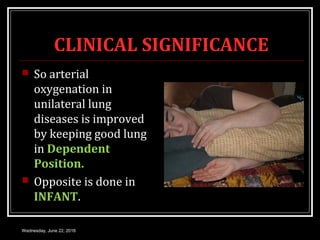
CLINICAL SIGNIFICANCE
 So arterial
oxygenation in
unilateral lung
diseases is improved
by keeping good lung
in Dependent
Position.
 Opposite is done in
INFANT.
Wednesday, June 22, 2016
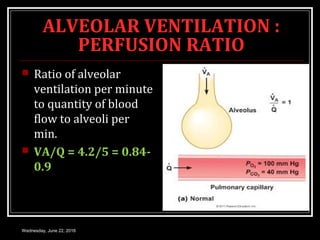
ALVEOLAR VENTILATION :
PERFUSION RATIO
 Ratio of alveolar
ventilation per minute
to quantity of blood
flow to alveoli per
min.
 VA/Q = 4.2/5 = 0.84-
0.9
Wednesday, June 22, 2016
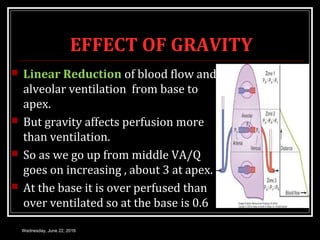
EFFECT OF GRAVITY
 Linear Reduction of blood flow and
alveolar ventilation from base to
apex.
 But gravity affects perfusion more
than ventilation.
 So as we go up from middle VA/Q
goes on increasing , about 3 at apex.
 At the base it is over perfused than
over ventilated so at the base is 0.6
Wednesday, June 22, 2016
CAUSES OF ALTERATION.
 Causes of altered
alveolar ventilation
 Bronchial asthma
 Emphysema
 Pulmonary fibrosis
 Pneumothorax
 Congestive heart failure
 Causes of altered
pulmonary perfusion.
 Anatomical shunts
 Pulmonary embolism
 Decrease in pulmonary
vascular bed in
emphysema
 Increase pulmonary
resistance in pulmonary
fibrosis, Pneumothorax,
CHF
Wednesday, June 22, 2016
EFFECTS OF ALTERATION IN
VA/Q RATIO.
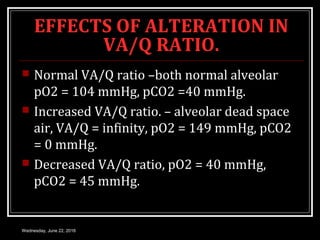
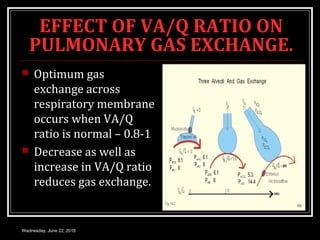
 Normal VA/Q ratio –both normal alveolar
pO2 = 104 mmHg, pCO2 =40 mmHg.
 Increased VA/Q ratio. – alveolar dead space
air, VA/Q = infinity, pO2 = 149 mmHg, pCO2
= 0 mmHg.
 Decreased VA/Q ratio, pO2 = 40 mmHg,
pCO2 = 45 mmHg.
Wednesday, June 22, 2016
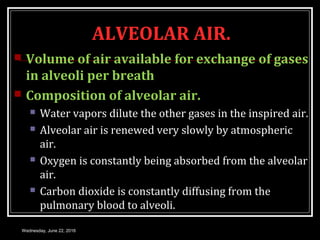
ALVEOLAR AIR.
 Volume of air available for exchange of gases
in alveoli per breath
 Composition of alveolar air.
 Water vapors dilute the other gases in the inspired air.
 Alveolar air is renewed very slowly by atmospheric
air.
 Oxygen is constantly being absorbed from the alveolar
air.
 Carbon dioxide is constantly diffusing from the
pulmonary blood to alveoli.
Wednesday, June 22, 2016
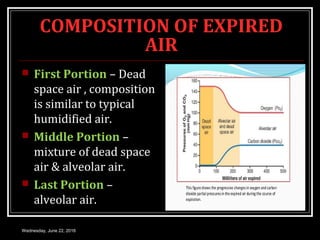
COMPOSITION OF EXPIRED
AIR
 First Portion – Dead
space air , composition
is similar to typical
humidified air.
 Middle Portion –
mixture of dead space
air & alveolar air.
 Last Portion –
alveolar air.
Wednesday, June 22, 2016
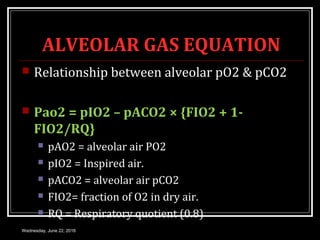
ALVEOLAR GAS EQUATION
 Relationship between alveolar pO2 & pCO2
 Pao2 = pIO2 – pACO2 × {FIO2 + 1-
FIO2/RQ}
 pAO2 = alveolar air PO2
 pIO2 = Inspired air.
 pACO2 = alveolar air pCO2
 FIO2= fraction of O2 in dry air.
 RQ = Respiratory quotient (0.8)
Wednesday, June 22, 2016
DIFFUSION OF GASES THROUGH
RESPIRATORY MEMBRANE.
 Respiratory unit & respiratory membrane.
 Factors affecting diffusion across respiratory
membrane.
 Diffusion & equilibrium of gases through
respiratory membrane.
 Perfusion limited versus diffusion limited gas
exchange.
 Effect of VA/Q ratio on pulmonary gas exchange.
 Diffusion capacity of lungs.
Wednesday, June 22, 2016
RESPIRATORY UNIT &
RESPIRATORY MEMBRANE.
 Respiratory Unit –
composed of
respiratory
bronchiole, alveolar
ducts, atria & alveoli.
 Respiratory
Membrane – separate
capillary blood from
alveolar air.
Wednesday, June 22, 2016
STRUCTURE OF RESPIRATORY
MEMBRANE
Wednesday, June 22, 2016
FACTORS AFFECTING DIFFUSION
ACROSS RESPIRATORY MEMBRANE.
 Thickness of respiratory membrane – rate of
diffusion inversely proportional to thickness.
 Thickness increases in pulmonary oedema & fibrosis.
 Surface area of respiratory membrane – R@A
 Diffusion coefficient V@ D
 DC of CO2 20 times that of O2
 Pressure gradient across respiratory
membrane – V@(Pc-PA)
Wednesday, June 22, 2016
DIFFUSION & EQUILIBRIUM OF GASES
THROUGH RESPIRATORY
MEMBRANE.
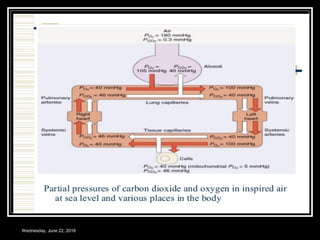
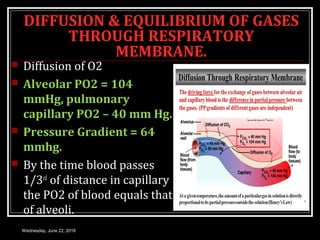
 Diffusion of O2
 Alveolar PO2 = 104
mmHg, pulmonary
capillary PO2 – 40 mm Hg.
 Pressure Gradient = 64
mmhg.
 By the time blood passes
1/3rd
of distance in capillary
the PO2 of blood equals that
of alveoli.
Wednesday, June 22, 2016
EQUILIBRATION TIME.
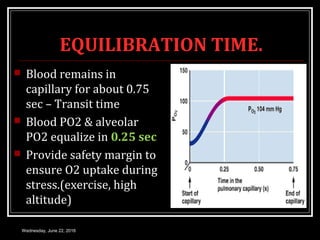
 Blood remains in
capillary for about 0.75
sec – Transit time
 Blood PO2 & alveolar
PO2 equalize in 0.25 sec
 Provide safety margin to
ensure O2 uptake during
stress.(exercise, high
altitude)
Wednesday, June 22, 2016
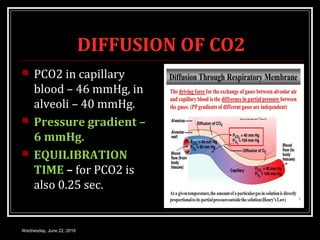
DIFFUSION OF CO2
 PCO2 in capillary
blood – 46 mmHg, in
alveoli – 40 mmHg.
 Pressure gradient –
6 mmHg.
 EQUILIBRATION
TIME – for PCO2 is
also 0.25 sec.
Wednesday, June 22, 2016
EFFECT OF VA/Q RATIO ON
PULMONARY GAS EXCHANGE.
 Optimum gas
exchange across
respiratory membrane
occurs when VA/Q
ratio is normal – 0.8-1
 Decrease as well as
increase in VA/Q ratio
reduces gas exchange.
Wednesday, June 22, 2016
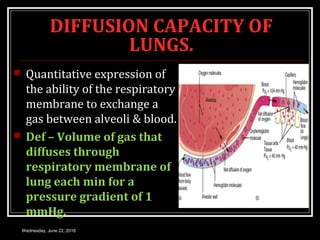
DIFFUSION CAPACITY OF
LUNGS.
 Quantitative expression of
the ability of the respiratory
membrane to exchange a
gas between alveoli & blood.
 Def – Volume of gas that
diffuses through
respiratory membrane of
lung each min for a
pressure gradient of 1
mmHg.
Wednesday, June 22, 2016
FACTORS AFFECTING DIFFUSION
CAPACITY
 Diffusion Distance – Inversely proportional
to thickness of membrane.
 Surface Area – Directly Proportional
 Diffusion Coefficient - Directly Proportional
 Pressure Gradient - Directly Proportional
Wednesday, June 22, 2016
DIFFUSION CAPACITY OF
LUNGS FOR O2
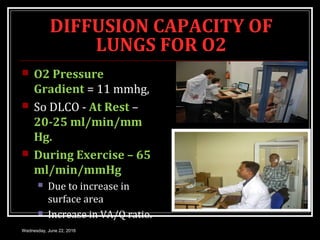
 O2 Pressure
Gradient = 11 mmhg,
 So DLCO - At Rest –
20-25 ml/min/mm
Hg.
 During Exercise – 65
ml/min/mmHg
 Due to increase in
surface area
 Increase in VA/Q ratio.
Wednesday, June 22, 2016
DIFFUSION CAPACITY OF
LUNGS FOR CO2
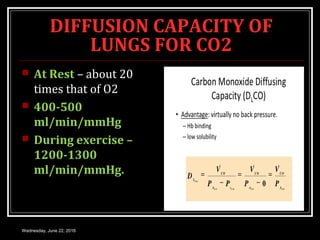
 At Rest – about 20
times that of O2
 400-500
ml/min/mmHg
 During exercise –
1200-1300
ml/min/mmHg.
Wednesday, June 22, 2016
MEASUREMENT OF DIFFUSION
CAPACITY OF LUNGS
 By Fick’s law
v
 DL =--------
(pA-pC)
DL – diffusion capacity
V = volume of gas uptake in
1 min
pA-pC – presure gradient
between alveoli & blood.
 So DLO2
 = O2 consumption/min
---------------------
pAO2-pO2
CO is preferred for
measuring DLCO.
Wednesday, June 22, 2016
Thank
You

PULMONARY DIFFUSION

  • 1.
    DR NILESH KATE MBBS,MD ASSOCIATEPROF DEPT. OF PHYSIOLOGY PULMONARY DIFFUSION
  • 2.
    OBJECTIVES  Physics ofgas diffusion & gas partial pressure.  Alveolar ventilation.  Alveolar ventilation : perfusion ratio  Alveolar air.  Diffusion of gases through respiratory membrane. Wednesday, June 22, 2016
  • 3.
    INTRODUCTION.  External Respirationdone by  Pulmonary ventilation  Pulmonary diffusion  Transport of gases.  Main content  Physics of gas diffusion & gas partial pressure  Alveolar ventilation  Ventilation-Perfusion ratio  Diffusion of gases through respiratory membrane. Wednesday, June 22, 2016
  • 4.
    PHYSICS OF GASDIFFUSION & GAS PARTIAL PRESSURE.  Gas Pressure – depend upon following factors  Concentration of molecules. P α n  Volume P α 1/v By Boyle’s law of gases.  Absolute Temperature  By Charle’s law at constant pressure V α T Wednesday, June 22, 2016
  • 5.
    PHYSICS OF GASDIFFUSION & GAS PARTIAL PRESSURE.  Partial Pressure As per Dalton’s Law – the total pressure exerted by mixture of gases is equal to the sum of partial pressure of all gases.  Partial pressure of gases in water and tissue Wednesday, June 22, 2016
  • 6.
    PHYSICS OF GASDIFFUSION & GAS PARTIAL PRESSURE. As per Henry’s Law – when temperature is constant content of gases dissolved in any solution is directly proportional to partial pressure of gas. Wednesday, June 22, 2016
  • 7.
    PHYSICS OF GASDIFFUSION & GAS PARTIAL PRESSURE.  Partial Pressure – At equilibrium partial pressure in liquid phase is equal to partial pressure in gas  In absence of equilibrium partial pressure of gas in liquid phase is less than in gas phase.  Solubility Coefficient – solubility coefficient of CO2 is 24 times more & that of N2 is half of that of oxygen. Wednesday, June 22, 2016
  • 8.
    WATER VAPOUR PRESSURE Vapour pressure of water depend on its temperature.  At body temp vapour pressure of water in alveolar air is 47 mm Hg. Wednesday, June 22, 2016
  • 9.
    ALVEOLAR VENTILATION.  Volumeof fresh air which reaches the gas exchange area of the lung each min.  Alveolar Ventilation = respiratory rate × (tidal volume – dead space volume)  = 12 × (500-150)  4200 ml/min Wednesday, June 22, 2016
  • 10.
    PHYSIOLOGICAL SIGNIFICANCE OF ALVEOLARVENTILATION  Subject 1 – TV = 500 ml, RR = 12/min  Pulmonary ventilation = 12 × 500 = 6L/min  Alveolar ventilation = 12 × 500-150 = 4.2 L/min  Subject 2 – TV = 200 ml, RR = 30/min  Pulmonary ventilation = 30 × 200 = 6L/min  Alveolar ventilation = 30 × 200-150 = 1.5 L/min Though in both pulmonary ventilation is same other subject alveolar ventilation is much less & will suffer from hypoxia & Hypercapnia. Wednesday, June 22, 2016
  • 11.
  • 12.
    DEAD SPACE AIR Anatomical dead space air.  Alveolar dead space air.  Physiological dead space.  Measurement of anatomical dead space.  Measurement of physiological dead space. Wednesday, June 22, 2016
  • 13.
    Introduction Total 23generations of airways b/w trachea & alveolar sac.  First 16 generations:  Conducting zone  No gaseous exchange  Up to terminal bronchiole  Last 7 generations  Transitional & respiratory zone  Gaseous exchange  Include respiratory bronchiole, alveolar ducts & alveoli
  • 14.
    DEAD SPACE  Partof the tidal volume that does not take part in gaseous exchange with pulmonary capillary blood.  This can be:  Anatomical dead space  Alveolar dead space  Total (Physiological) dead space
  • 15.
    ANATOMICAL DEAD SPACE Gas in the conducting areas of the respiratory passage, where no gaseous exchange occurs.  Volume of air from nose to terminal bronchiole.  Approximately equal to the body weight in pounds. So, in a 68 kg (150 lb) manSo, in a 68 kg (150 lb) man Anatomical dead space = 150 mlAnatomical dead space = 150 ml i.e. out of 500 ml inspired air, only 350 mli.e. out of 500 ml inspired air, only 350 ml reaches the alveoli for gaseous exchange.reaches the alveoli for gaseous exchange. rest 150 ml just fills the anatomical dead spacerest 150 ml just fills the anatomical dead space During expiration,During expiration, First 150 ml – dead space airFirst 150 ml – dead space air Last 350 ml – alveolar airLast 350 ml – alveolar air
  • 16.
    ANATOMICAL DEAD SPACE Alveolar ventilation (amount of air reaching the alveoli per min) is less than the respiratory minute volume. If, tidal volume = 500 ml & RR = 12/minIf, tidal volume = 500 ml & RR = 12/min Dead space volume = 150 mlDead space volume = 150 ml Then, air reaching the alveoli = 500-150 mlThen, air reaching the alveoli = 500-150 ml = 350 ml= 350 ml Minute volume = 500 x 12 = 6 l/minMinute volume = 500 x 12 = 6 l/min Alveolar ventilation = (500-150) x 12Alveolar ventilation = (500-150) x 12 = 350 x 12= 350 x 12 = 4200 ml= 4200 ml
  • 17.
    ANATOMICAL DEAD SPACE Rapid shallow breathing produces much less alveolar ventilation than slow deep breathing at the same respiratory minute volume. Respiratory rateRespiratory rate 30/min30/min 10/min10/min Tidal volumeTidal volume 200 mL200 mL 600 mL600 mL Minute volumeMinute volume 6 L6 L 6 L6 L Alveolar ventilation (200 – 150) x 30 (600 – 150) x 10Alveolar ventilation (200 – 150) x 30 (600 – 150) x 10 = 1500 mL = 4500 mL= 1500 mL = 4500 mL
  • 18.
    ALVEOLAR DEAD SPACE Gas present in under- perfused or non-perfused alveoli and excess gas present in over-ventilated alveoli.  Alveolar air that is not equilibrating with the pulmonar capillary blood. If, Tidal volume = 500 mlIf, Tidal volume = 500 ml Anatomical dead space = 150 mlAnatomical dead space = 150 ml Alveolar dead space = 100 mlAlveolar dead space = 100 ml Effective alveolar ventilation = 500 – 150 – 100Effective alveolar ventilation = 500 – 150 – 100 = 250 ml= 250 ml
  • 19.
    TOTAL (PHYSIOLOGICAL) DEAD SPACE Total volume of inspired air that does not equilibrate with the pulmonary capillary blood.  Total DS = Anatomical DS + Alveolar DS  In a healthy individual, Total DS and Anatomical DS are equal.
  • 20.
    MEASUREMENT OF DEADSPACE  Anatomic dead space – Single breath N2 curve  Total dead space – Bohr’s equation PECO2 x VT = PaCO2 x (VT – VD) + PICO2 x VD PCO 2 of the expired gas (PECO 2) Arterial PCO 2 (PaCO 2) PCO 2 of inspired air (PICO 2) Tidal volume (VT) Dead space volume (VD)
  • 21.
    SINGLE BREATH N2CURVE  Subject is asked to take a deep breath of Oxygen.  This fills the entire dead space with pure Oxygen.  Some Oxygen also mixes with the alveolar air but does not completely replace their air.  Then the person expires through a rapidly recording Nitrogen meter end exp VT VD VA
  • 22.
    RESULTS OBTAINED  Firstportion- from the dead space regions-Nitrogen concentration is zero.  After some time- Nitrogen concentration rises rapidly because alveolar air containing Nitrogen + dead space air.  At end- only air from alveoli- high steady concentration of nitrogen.
  • 23.
    CALCULATION :  VE= total volume of expired air.  VD = dead space air Suppose gray area = 30 cm ²Suppose gray area = 30 cm ² Pink areaPink area = 70 cm ²= 70 cm ² Total volume expired is 500 mlTotal volume expired is 500 ml Then dead space would be :Then dead space would be : 30 x 50030 x 500 30+7030+70 = 150 ml= 150 ml
  • 24.
    EFFECT OF GRAVITYON ALVEOLAR VENTILATION  In Supine Position – alveolar ventilation evenly distributed  In Upright Position –  Alveolar pressure is zero throughout lung  Intrapleural pressure – at apex -10 mmHg & at base -2 mm Hg.  So transpulmonary pressure -10 & -2 at apex & base respectively.  So linear reduction in regional alveolar ventilation from base to apex. Wednesday, June 22, 2016
  • 25.
    CLINICAL SIGNIFICANCE  Soarterial oxygenation in unilateral lung diseases is improved by keeping good lung in Dependent Position.  Opposite is done in INFANT. Wednesday, June 22, 2016
  • 26.
    ALVEOLAR VENTILATION : PERFUSIONRATIO  Ratio of alveolar ventilation per minute to quantity of blood flow to alveoli per min.  VA/Q = 4.2/5 = 0.84- 0.9 Wednesday, June 22, 2016
  • 27.
    EFFECT OF GRAVITY Linear Reduction of blood flow and alveolar ventilation from base to apex.  But gravity affects perfusion more than ventilation.  So as we go up from middle VA/Q goes on increasing , about 3 at apex.  At the base it is over perfused than over ventilated so at the base is 0.6 Wednesday, June 22, 2016
  • 28.
    CAUSES OF ALTERATION. Causes of altered alveolar ventilation  Bronchial asthma  Emphysema  Pulmonary fibrosis  Pneumothorax  Congestive heart failure  Causes of altered pulmonary perfusion.  Anatomical shunts  Pulmonary embolism  Decrease in pulmonary vascular bed in emphysema  Increase pulmonary resistance in pulmonary fibrosis, Pneumothorax, CHF Wednesday, June 22, 2016
  • 29.
    EFFECTS OF ALTERATIONIN VA/Q RATIO.  Normal VA/Q ratio –both normal alveolar pO2 = 104 mmHg, pCO2 =40 mmHg.  Increased VA/Q ratio. – alveolar dead space air, VA/Q = infinity, pO2 = 149 mmHg, pCO2 = 0 mmHg.  Decreased VA/Q ratio, pO2 = 40 mmHg, pCO2 = 45 mmHg. Wednesday, June 22, 2016
  • 30.
    ALVEOLAR AIR.  Volumeof air available for exchange of gases in alveoli per breath  Composition of alveolar air.  Water vapors dilute the other gases in the inspired air.  Alveolar air is renewed very slowly by atmospheric air.  Oxygen is constantly being absorbed from the alveolar air.  Carbon dioxide is constantly diffusing from the pulmonary blood to alveoli. Wednesday, June 22, 2016
  • 31.
    COMPOSITION OF EXPIRED AIR First Portion – Dead space air , composition is similar to typical humidified air.  Middle Portion – mixture of dead space air & alveolar air.  Last Portion – alveolar air. Wednesday, June 22, 2016
  • 32.
    ALVEOLAR GAS EQUATION Relationship between alveolar pO2 & pCO2  Pao2 = pIO2 – pACO2 × {FIO2 + 1- FIO2/RQ}  pAO2 = alveolar air PO2  pIO2 = Inspired air.  pACO2 = alveolar air pCO2  FIO2= fraction of O2 in dry air.  RQ = Respiratory quotient (0.8) Wednesday, June 22, 2016
  • 33.
    DIFFUSION OF GASESTHROUGH RESPIRATORY MEMBRANE.  Respiratory unit & respiratory membrane.  Factors affecting diffusion across respiratory membrane.  Diffusion & equilibrium of gases through respiratory membrane.  Perfusion limited versus diffusion limited gas exchange.  Effect of VA/Q ratio on pulmonary gas exchange.  Diffusion capacity of lungs. Wednesday, June 22, 2016
  • 34.
    RESPIRATORY UNIT & RESPIRATORYMEMBRANE.  Respiratory Unit – composed of respiratory bronchiole, alveolar ducts, atria & alveoli.  Respiratory Membrane – separate capillary blood from alveolar air. Wednesday, June 22, 2016
  • 35.
  • 36.
    FACTORS AFFECTING DIFFUSION ACROSSRESPIRATORY MEMBRANE.  Thickness of respiratory membrane – rate of diffusion inversely proportional to thickness.  Thickness increases in pulmonary oedema & fibrosis.  Surface area of respiratory membrane – R@A  Diffusion coefficient V@ D  DC of CO2 20 times that of O2  Pressure gradient across respiratory membrane – V@(Pc-PA) Wednesday, June 22, 2016
  • 37.
    DIFFUSION & EQUILIBRIUMOF GASES THROUGH RESPIRATORY MEMBRANE.  Diffusion of O2  Alveolar PO2 = 104 mmHg, pulmonary capillary PO2 – 40 mm Hg.  Pressure Gradient = 64 mmhg.  By the time blood passes 1/3rd of distance in capillary the PO2 of blood equals that of alveoli. Wednesday, June 22, 2016
  • 38.
    EQUILIBRATION TIME.  Bloodremains in capillary for about 0.75 sec – Transit time  Blood PO2 & alveolar PO2 equalize in 0.25 sec  Provide safety margin to ensure O2 uptake during stress.(exercise, high altitude) Wednesday, June 22, 2016
  • 39.
    DIFFUSION OF CO2 PCO2 in capillary blood – 46 mmHg, in alveoli – 40 mmHg.  Pressure gradient – 6 mmHg.  EQUILIBRATION TIME – for PCO2 is also 0.25 sec. Wednesday, June 22, 2016
  • 40.
  • 41.
    EFFECT OF VA/QRATIO ON PULMONARY GAS EXCHANGE.  Optimum gas exchange across respiratory membrane occurs when VA/Q ratio is normal – 0.8-1  Decrease as well as increase in VA/Q ratio reduces gas exchange. Wednesday, June 22, 2016
  • 42.
    DIFFUSION CAPACITY OF LUNGS. Quantitative expression of the ability of the respiratory membrane to exchange a gas between alveoli & blood.  Def – Volume of gas that diffuses through respiratory membrane of lung each min for a pressure gradient of 1 mmHg. Wednesday, June 22, 2016
  • 43.
    FACTORS AFFECTING DIFFUSION CAPACITY Diffusion Distance – Inversely proportional to thickness of membrane.  Surface Area – Directly Proportional  Diffusion Coefficient - Directly Proportional  Pressure Gradient - Directly Proportional Wednesday, June 22, 2016
  • 44.
    DIFFUSION CAPACITY OF LUNGSFOR O2  O2 Pressure Gradient = 11 mmhg,  So DLCO - At Rest – 20-25 ml/min/mm Hg.  During Exercise – 65 ml/min/mmHg  Due to increase in surface area  Increase in VA/Q ratio. Wednesday, June 22, 2016
  • 45.
    DIFFUSION CAPACITY OF LUNGSFOR CO2  At Rest – about 20 times that of O2  400-500 ml/min/mmHg  During exercise – 1200-1300 ml/min/mmHg. Wednesday, June 22, 2016
  • 46.
    MEASUREMENT OF DIFFUSION CAPACITYOF LUNGS  By Fick’s law v  DL =-------- (pA-pC) DL – diffusion capacity V = volume of gas uptake in 1 min pA-pC – presure gradient between alveoli & blood.  So DLO2  = O2 consumption/min --------------------- pAO2-pO2 CO is preferred for measuring DLCO. Wednesday, June 22, 2016
  • 47.