Gas exchange and
Ventilation of the lungs
Dr. Farhad Shaker
 Define the terms 'Functional Residual
Capacity', 'Residual Volume', 'Vital Capacity'
and 'Inspiratory Capacity'.
 Define the terms 'Serial dead space' and
'Physiological dead space' and state in
general terms how these variables are
measured.
 Calculate alveolar ventilation rate given
pulmonary ventilation rate, dead space
volume and respiratory rate.
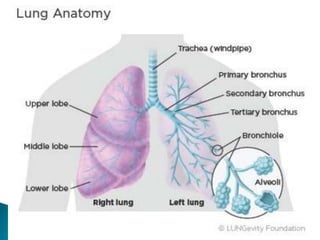
 Ventilation V: is the air that reaches the
alveoli
 perfusion Q: is the blood that reaches the
alveoli via the capillaries
 ventilation/perfusion ratio (V/Q ratio) is a
ratio used to assess the efficiency and
adequacy of the matching of two variables.
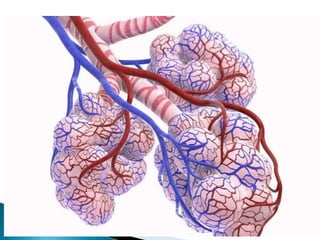
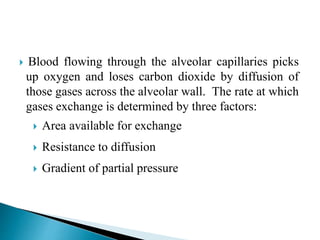
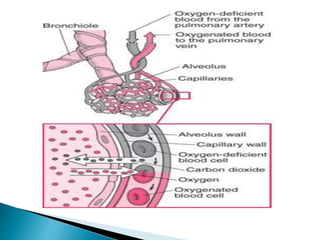
 Blood flowing through the alveolar capillaries picks
up oxygen and loses carbon dioxide by diffusion of
those gases across the alveolar wall. The rate at which
gases exchange is determined by three factors:
 Area available for exchange
 Resistance to diffusion
 Gradient of partial pressure
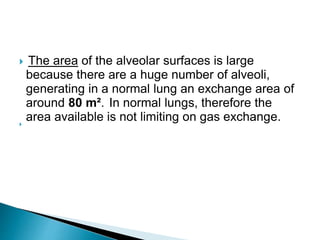
 The area of the alveolar surfaces is large
because there are a huge number of alveoli,
generating in a normal lung an exchange area of
around 80 m². In normal lungs, therefore the
area available is not limiting on gas exchange.
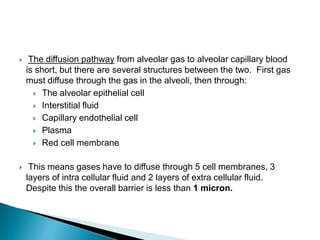
 The diffusion pathway from alveolar gas to alveolar capillary blood
is short, but there are several structures between the two. First gas
must diffuse through the gas in the alveoli, then through:
 The alveolar epithelial cell
 Interstitial fluid
 Capillary endothelial cell
 Plasma
 Red cell membrane
 This means gases have to diffuse through 5 cell membranes, 3
layers of intra cellular fluid and 2 layers of extra cellular fluid.
Despite this the overall barrier is less than 1 micron.
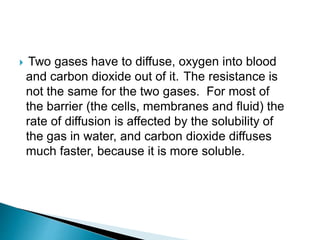
 Two gases have to diffuse, oxygen into blood
and carbon dioxide out of it. The resistance is
not the same for the two gases. For most of
the barrier (the cells, membranes and fluid) the
rate of diffusion is affected by the solubility of
the gas in water, and carbon dioxide diffuses
much faster, because it is more soluble.
 Overall, carbon dioxide diffuses 21 times as fast
as oxygen for a given gradient. This means that
anything affecting diffusion will only change
oxygen transport, as that is limiting.
 The rate of exchange of oxygen is normally very
rapid, so that within half a second of blood
arriving in the alveolar capillary it has
equilibrated with the gas in the alveoli. This
means that: In a normal subject, the partial
pressures of oxygen and carbon dioxide in
arterial blood will be the same as the partial
pressures in the alveolar gas.
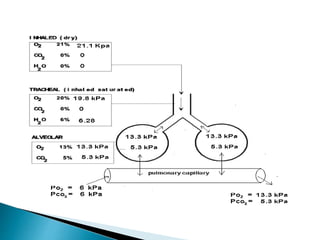
 The partial pressure of oxygen and carbon
dioxide in the alveolar gas must therefore be
kept very close to their normal values of 13.3
kPa and 5.3 kPa respectively if the tissues of
the body are to be properly supplied with
oxygen and lose their carbon dioxide. This is
achieved by exchange of gas between alveolar
gas and atmospheric air brought close to it
through the airways of the lung by the process
of ventilation.
 There are no valves in the respiratory
system - movement of air is tidal.
 The movement of air during breathing can
be measured by Spirometry.
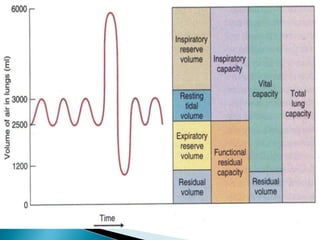
 A certain volume enters and leaves the lungs
with each breath - The Tidal Volume.
 During normal respiration the increase in lung
volume is not maximal - it can be increased to
the extent of the Inspiratory Reserve Volume.
We can also breathe out more than at rest, by
using the Expiratory Reserve Volume.
 We cannot however empty our lungs
completely, so even after a forced expiration
a residual volume will remain. Lung volumes
change with changes in tidal volume.
 Lung capacities do not change with tidal
volume, as they are defined relative to fixed
points in the breathing cycle. These are
maximum inspiration, maximum expiration,
and the end of a quiet expiration.
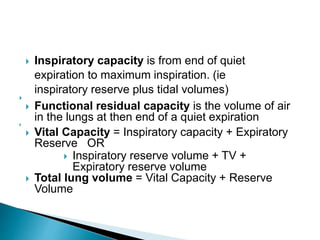
 Inspiratory capacity is from end of quiet
expiration to maximum inspiration. (ie
inspiratory reserve plus tidal volumes)

 Functional residual capacity is the volume of air
in the lungs at then end of a quiet expiration

 Vital Capacity = Inspiratory capacity + Expiratory
Reserve OR
 Inspiratory reserve volume + TV +
Expiratory reserve volume
 Total lung volume = Vital Capacity + Reserve
Volume
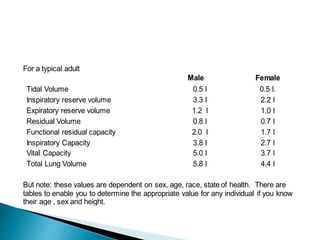
For a typical adult
Male Female
Tidal Volume 0.5 l 0.5 l.
Inspiratory reserve volume 3.3 l 2.2 l
Expiratory reserve volume 1.2 l 1.0 l
Residual Volume 0.8 l 0.7 l
Functional residual capacity 2.0 l 1.7 l
Inspiratory Capacity 3.8 l 2.7 l
Vital Capacity 5.0 l 3.7 l
Total Lung Volume 5.8 l 4.4 l
But note: these values are dependent on sex, age, race, state of health. There are
tables to enable you to determine the appropriate value for any individual if you know
their age , sex and height.
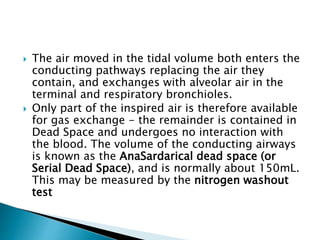
 The air moved in the tidal volume both enters the
conducting pathways replacing the air they
contain, and exchanges with alveolar air in the
terminal and respiratory bronchioles.
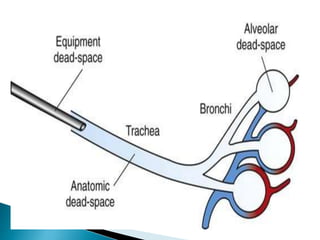
 Only part of the inspired air is therefore available
for gas exchange - the remainder is contained in
Dead Space and undergoes no interaction with
the blood. The volume of the conducting airways
is known as the AnaSardarical dead space (or
Serial Dead Space), and is normally about 150mL.
This may be measured by the nitrogen washout
test
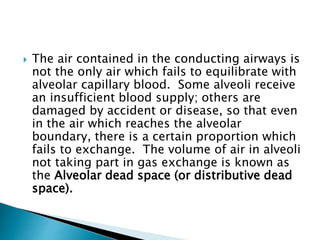
 The air contained in the conducting airways is
not the only air which fails to equilibrate with
alveolar capillary blood. Some alveoli receive
an insufficient blood supply; others are
damaged by accident or disease, so that even
in the air which reaches the alveolar
boundary, there is a certain proportion which
fails to exchange. The volume of air in alveoli
not taking part in gas exchange is known as
the Alveolar dead space (or distributive dead
space).
 The sum of the AnaSardarical dead space +
Alveolar dead space is known as the
Physiological Dead Space. The
physiological dead space can be determined
by measuring pCO2 (or pO2) of expired and
alveolar air. Alveolar air is diluted by dead
space air to form the expired air, and the
degree of dilution is a measurement of the
physiological dead space.
 The total rate of movement of air into and out of
the lungs - the Pulmonary Ventilation Rate, is
therefore composed of two components -
movement of air into and out of the dead space
- Dead Space Ventilation - which has no effect
upon the blood, and Alveolar Ventilation.
The ideal parameter to measure is therefore:-
 Alveolar Ventilation Rate
 At each breath the dead space is fully
ventilated. The deeper the breath the higher
the proportion of air available for gas
exchange. All other things being equal,
deeper breathing is more effective breathing.
In practice the ideal depth of respiration is
limited by mechanical factors.
THANK YOU

Lesson 2 ventilation and gas exchange

  • 1.
    Gas exchange and Ventilationof the lungs Dr. Farhad Shaker
  • 2.
     Define theterms 'Functional Residual Capacity', 'Residual Volume', 'Vital Capacity' and 'Inspiratory Capacity'.  Define the terms 'Serial dead space' and 'Physiological dead space' and state in general terms how these variables are measured.  Calculate alveolar ventilation rate given pulmonary ventilation rate, dead space volume and respiratory rate.
  • 3.
     Ventilation V:is the air that reaches the alveoli  perfusion Q: is the blood that reaches the alveoli via the capillaries  ventilation/perfusion ratio (V/Q ratio) is a ratio used to assess the efficiency and adequacy of the matching of two variables.
  • 7.
     Blood flowingthrough the alveolar capillaries picks up oxygen and loses carbon dioxide by diffusion of those gases across the alveolar wall. The rate at which gases exchange is determined by three factors:  Area available for exchange  Resistance to diffusion  Gradient of partial pressure
  • 8.
     The areaof the alveolar surfaces is large because there are a huge number of alveoli, generating in a normal lung an exchange area of around 80 m². In normal lungs, therefore the area available is not limiting on gas exchange.
  • 9.
     The diffusionpathway from alveolar gas to alveolar capillary blood is short, but there are several structures between the two. First gas must diffuse through the gas in the alveoli, then through:  The alveolar epithelial cell  Interstitial fluid  Capillary endothelial cell  Plasma  Red cell membrane  This means gases have to diffuse through 5 cell membranes, 3 layers of intra cellular fluid and 2 layers of extra cellular fluid. Despite this the overall barrier is less than 1 micron.
  • 11.
     Two gaseshave to diffuse, oxygen into blood and carbon dioxide out of it. The resistance is not the same for the two gases. For most of the barrier (the cells, membranes and fluid) the rate of diffusion is affected by the solubility of the gas in water, and carbon dioxide diffuses much faster, because it is more soluble.
  • 12.
     Overall, carbondioxide diffuses 21 times as fast as oxygen for a given gradient. This means that anything affecting diffusion will only change oxygen transport, as that is limiting.
  • 13.
     The rateof exchange of oxygen is normally very rapid, so that within half a second of blood arriving in the alveolar capillary it has equilibrated with the gas in the alveoli. This means that: In a normal subject, the partial pressures of oxygen and carbon dioxide in arterial blood will be the same as the partial pressures in the alveolar gas.
  • 14.
     The partialpressure of oxygen and carbon dioxide in the alveolar gas must therefore be kept very close to their normal values of 13.3 kPa and 5.3 kPa respectively if the tissues of the body are to be properly supplied with oxygen and lose their carbon dioxide. This is achieved by exchange of gas between alveolar gas and atmospheric air brought close to it through the airways of the lung by the process of ventilation.
  • 15.
     There areno valves in the respiratory system - movement of air is tidal.  The movement of air during breathing can be measured by Spirometry.
  • 17.
     A certainvolume enters and leaves the lungs with each breath - The Tidal Volume.  During normal respiration the increase in lung volume is not maximal - it can be increased to the extent of the Inspiratory Reserve Volume. We can also breathe out more than at rest, by using the Expiratory Reserve Volume.
  • 19.
     We cannothowever empty our lungs completely, so even after a forced expiration a residual volume will remain. Lung volumes change with changes in tidal volume.  Lung capacities do not change with tidal volume, as they are defined relative to fixed points in the breathing cycle. These are maximum inspiration, maximum expiration, and the end of a quiet expiration.
  • 20.
     Inspiratory capacityis from end of quiet expiration to maximum inspiration. (ie inspiratory reserve plus tidal volumes)   Functional residual capacity is the volume of air in the lungs at then end of a quiet expiration   Vital Capacity = Inspiratory capacity + Expiratory Reserve OR  Inspiratory reserve volume + TV + Expiratory reserve volume  Total lung volume = Vital Capacity + Reserve Volume
  • 21.
    For a typicaladult Male Female Tidal Volume 0.5 l 0.5 l. Inspiratory reserve volume 3.3 l 2.2 l Expiratory reserve volume 1.2 l 1.0 l Residual Volume 0.8 l 0.7 l Functional residual capacity 2.0 l 1.7 l Inspiratory Capacity 3.8 l 2.7 l Vital Capacity 5.0 l 3.7 l Total Lung Volume 5.8 l 4.4 l But note: these values are dependent on sex, age, race, state of health. There are tables to enable you to determine the appropriate value for any individual if you know their age , sex and height.
  • 22.
     The airmoved in the tidal volume both enters the conducting pathways replacing the air they contain, and exchanges with alveolar air in the terminal and respiratory bronchioles.  Only part of the inspired air is therefore available for gas exchange - the remainder is contained in Dead Space and undergoes no interaction with the blood. The volume of the conducting airways is known as the AnaSardarical dead space (or Serial Dead Space), and is normally about 150mL. This may be measured by the nitrogen washout test
  • 23.
     The aircontained in the conducting airways is not the only air which fails to equilibrate with alveolar capillary blood. Some alveoli receive an insufficient blood supply; others are damaged by accident or disease, so that even in the air which reaches the alveolar boundary, there is a certain proportion which fails to exchange. The volume of air in alveoli not taking part in gas exchange is known as the Alveolar dead space (or distributive dead space).
  • 24.
     The sumof the AnaSardarical dead space + Alveolar dead space is known as the Physiological Dead Space. The physiological dead space can be determined by measuring pCO2 (or pO2) of expired and alveolar air. Alveolar air is diluted by dead space air to form the expired air, and the degree of dilution is a measurement of the physiological dead space.
  • 25.
     The totalrate of movement of air into and out of the lungs - the Pulmonary Ventilation Rate, is therefore composed of two components - movement of air into and out of the dead space - Dead Space Ventilation - which has no effect upon the blood, and Alveolar Ventilation. The ideal parameter to measure is therefore:-
  • 26.
     Alveolar VentilationRate  At each breath the dead space is fully ventilated. The deeper the breath the higher the proportion of air available for gas exchange. All other things being equal, deeper breathing is more effective breathing. In practice the ideal depth of respiration is limited by mechanical factors.
  • 27.