Unless otherwise noted, the content of this course material is licensed under a Creative Commons Attribution 3.0 License.  Copyright 2008, Thomas Sisson The following information is intended to inform and educate and is not a tool for self-diagnosis or a replacement for medical evaluation, advice, diagnosis or treatment by a healthcare professional. You should speak to your physician or make an appointment to be seen if you have questions or concerns about this information or your medical condition.  You assume all responsibility for use and potential liability associated with any use of the material. Material contains copyrighted content, used in accordance with U.S. law. Copyright holders of content included in this material should contact open.michigan@umich.edu with any questions, corrections, or clarifications regarding the use of content.  The Regents of the University of Michigan do not license the use of third party content posted to this site unless such a license is specifically granted in connection with particular content objects. Users of content are responsible for their compliance with applicable law. Mention of specific products in this recording solely represents the opinion of the speaker and does not represent an endorsement by the University of Michigan. Viewer discretion advised: Material may contain medical images that may be disturbing to some viewers.
Ventilation/Perfusion Matching Thomas H. Sisson, M.D.
Objectives To recognize the importance of matching ventilation and perfusion To explain the consequences of mismatched ventilation and perfusion To define shunt and dead space physiology To be able to determine the alveolar pO 2 To be able to determine the A-a O 2  gradient and understand the implications of an increased gradient To explain and understand the consequences of regional differences in ventilation and perfusion due to effects of gravity
Ventilation and Perfusion at the Level of the Whole Lung BY: University of Michigan Medical School http://creativecommons.org/licenses/by/3.0/deed.en
Gas Composition in the Alveolar Space PiO2 = (barometric pressure-H2O vapor pressure)xFiO2 = (760 – 47) x 0.21 =150 mmHg In the alveolar space, oxygen diffuses  into the blood and CO2 diffuses  into the alveolus from the blood. Trachea: partial pressure of CO2 is approximately 0 BY: University of Michigan Medical School http://creativecommons.org/licenses/by/3.0/deed.en
Alveolar Gas Equation PAO 2  = (PiO 2 ) – (PaCO 2 /R). PaCO 2  approximates PACO 2  due to the rapid diffusion of CO 2 R = Respiratory Quotient (VCO2/V02) = 0.8 In a normal individual breathing room air: PAO 2  = 150 – 40/0.8 = 100 mmHg
Gas Composition in the Normal Alveolar Space PiO2 = (barometric pressure-H2O vapor pressure)xFiO2 = (760 – 47) x 0.21 =150 mmHg In the alveolar space, oxygen diffuses  into the blood and CO2 diffuses  into the alveolus from the blood. Trachea: partial pressure of CO2 is approximately 0 BY: University of Michigan Medical School http://creativecommons.org/licenses/by/3.0/deed.en
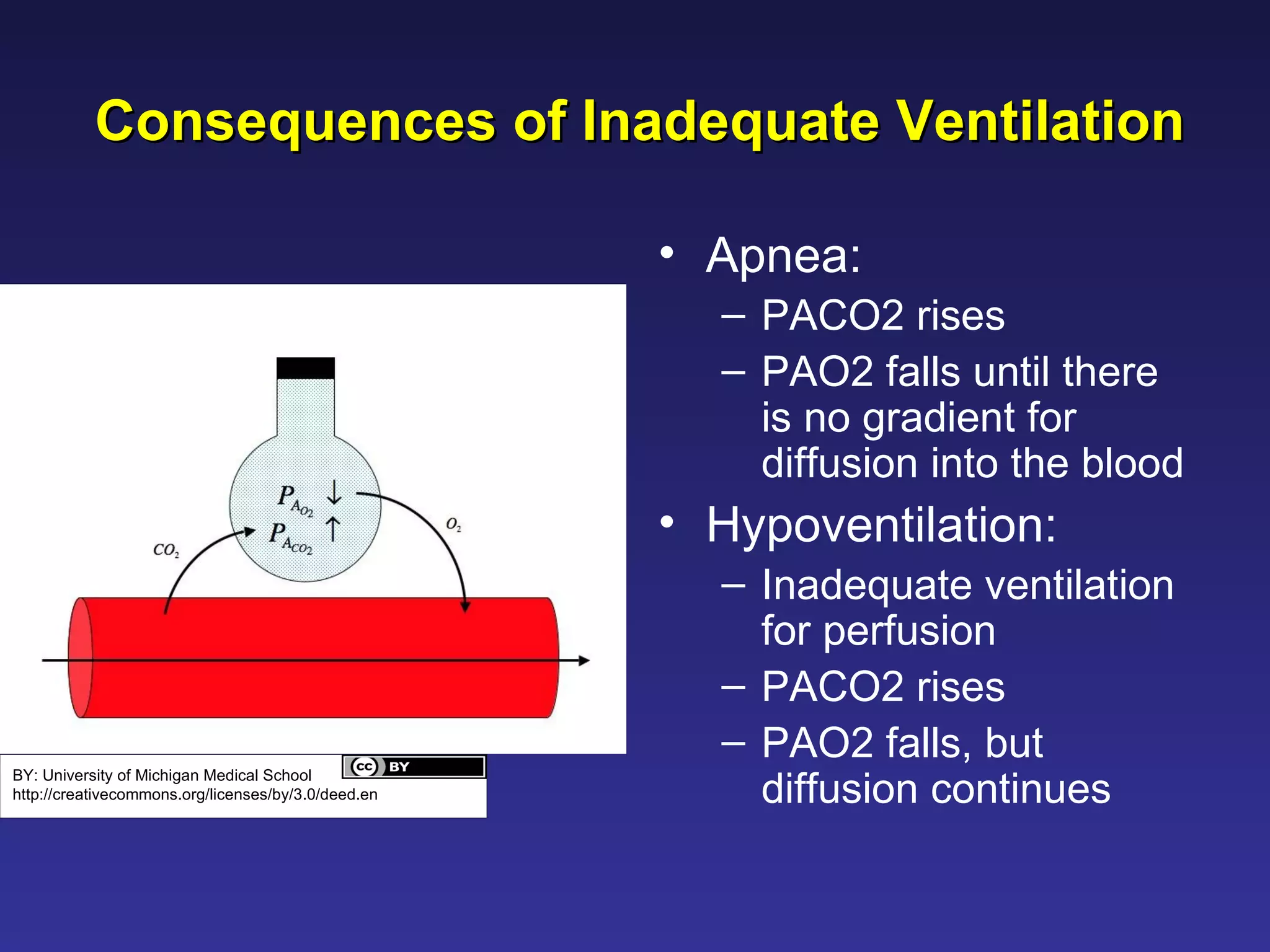
Consequences of Inadequate Ventilation Apnea: PACO2 rises PAO2 falls until there is no gradient for diffusion into the blood Hypoventilation: Inadequate ventilation for perfusion PACO2 rises PAO2 falls, but diffusion continues BY: University of Michigan Medical School http://creativecommons.org/licenses/by/3.0/deed.en
How Can We Tell if Alveolar Ventilation is Adequate?
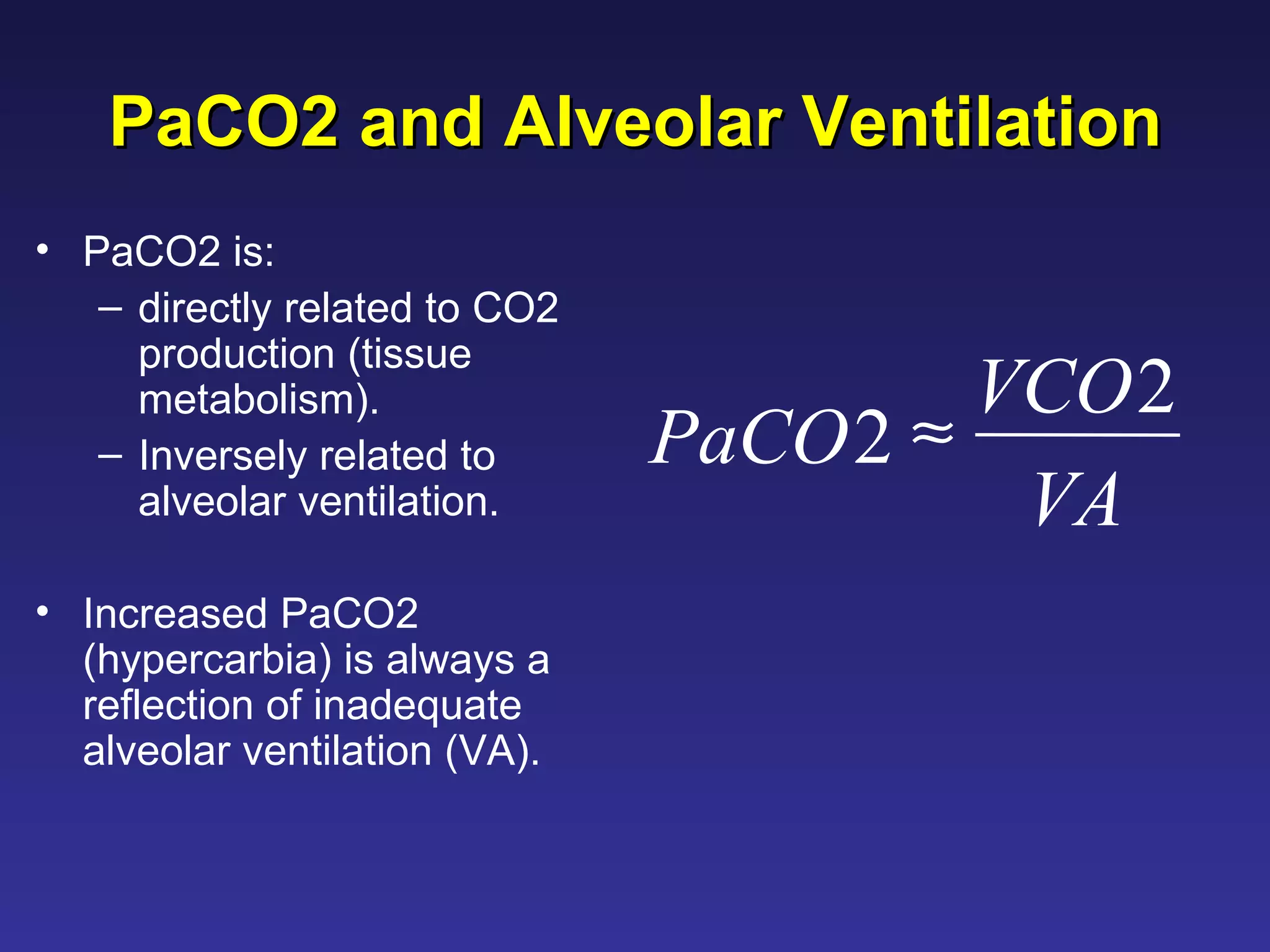
PaCO2 and Alveolar Ventilation PaCO2 is:  directly related to CO2 production (tissue metabolism). Inversely related to alveolar ventilation. Increased PaCO2 (hypercarbia) is always a reflection of inadequate alveolar ventilation (VA). VA VCO PaCO 2 2 
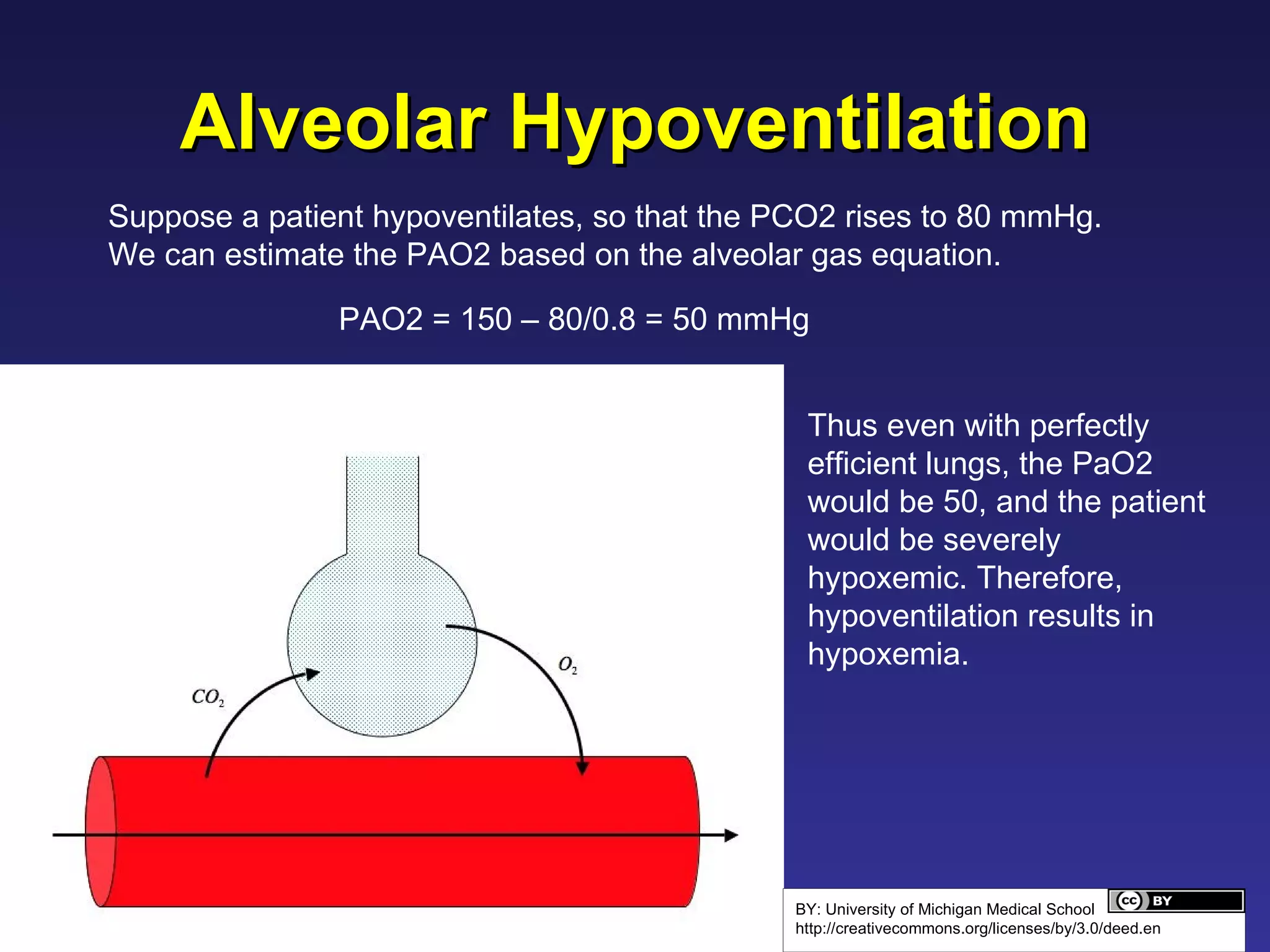
Alveolar Hypoventilation Suppose a patient hypoventilates, so that the PCO2 rises to 80 mmHg. We can estimate the PAO2 based on the alveolar gas equation. PAO2 = 150 – 80/0.8 = 50 mmHg  Thus even with perfectly efficient lungs, the PaO2 would be 50, and the patient would be severely hypoxemic. Therefore, hypoventilation results in hypoxemia. BY: University of Michigan Medical School http://creativecommons.org/licenses/by/3.0/deed.en
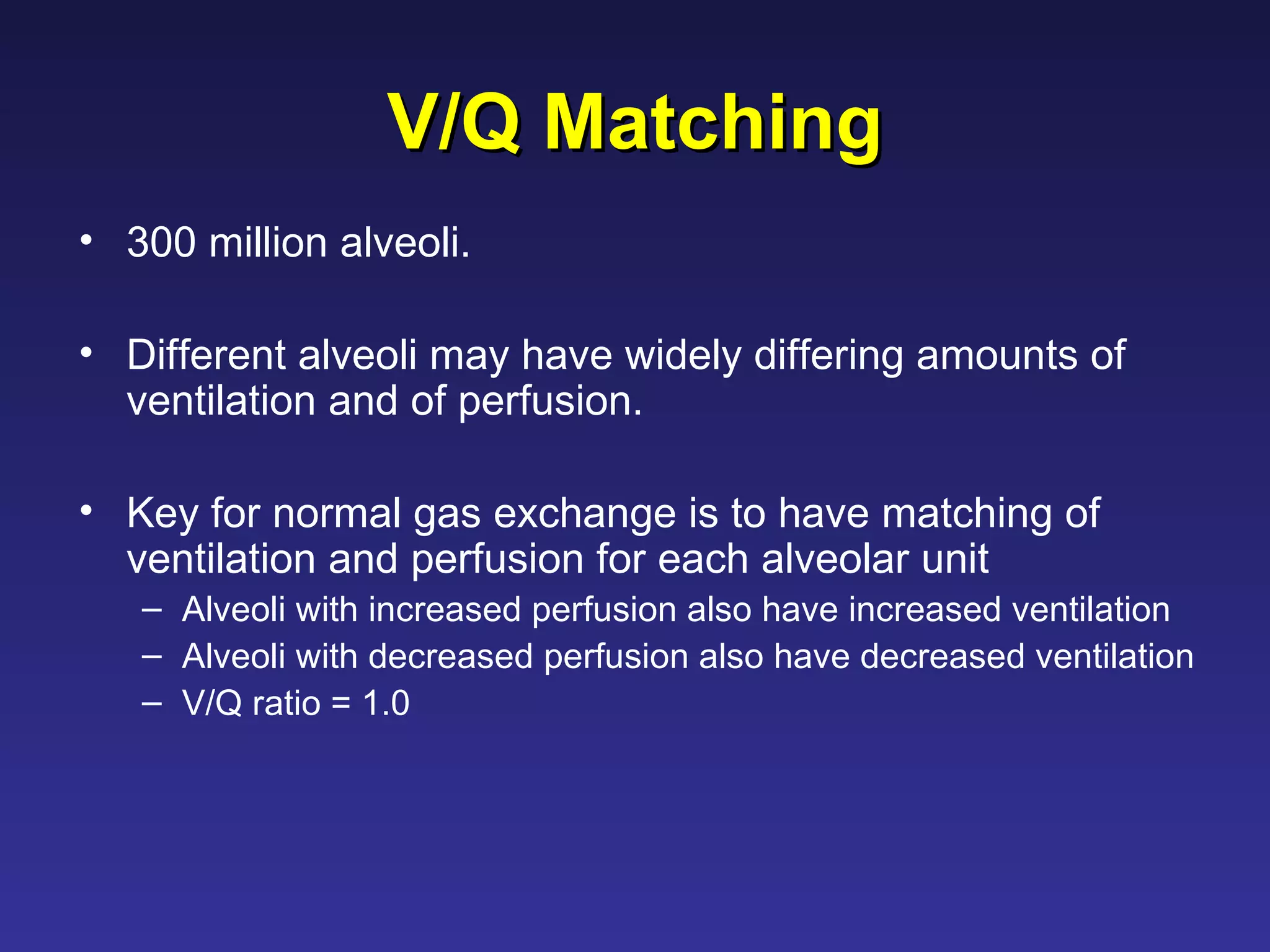
V/Q Matching 300 million alveoli. Different alveoli may have widely differing amounts of ventilation and of perfusion. Key for normal gas exchange is to have matching of ventilation and perfusion for each alveolar unit Alveoli with increased perfusion also have increased ventilation Alveoli with decreased perfusion also have decreased ventilation V/Q ratio = 1.0
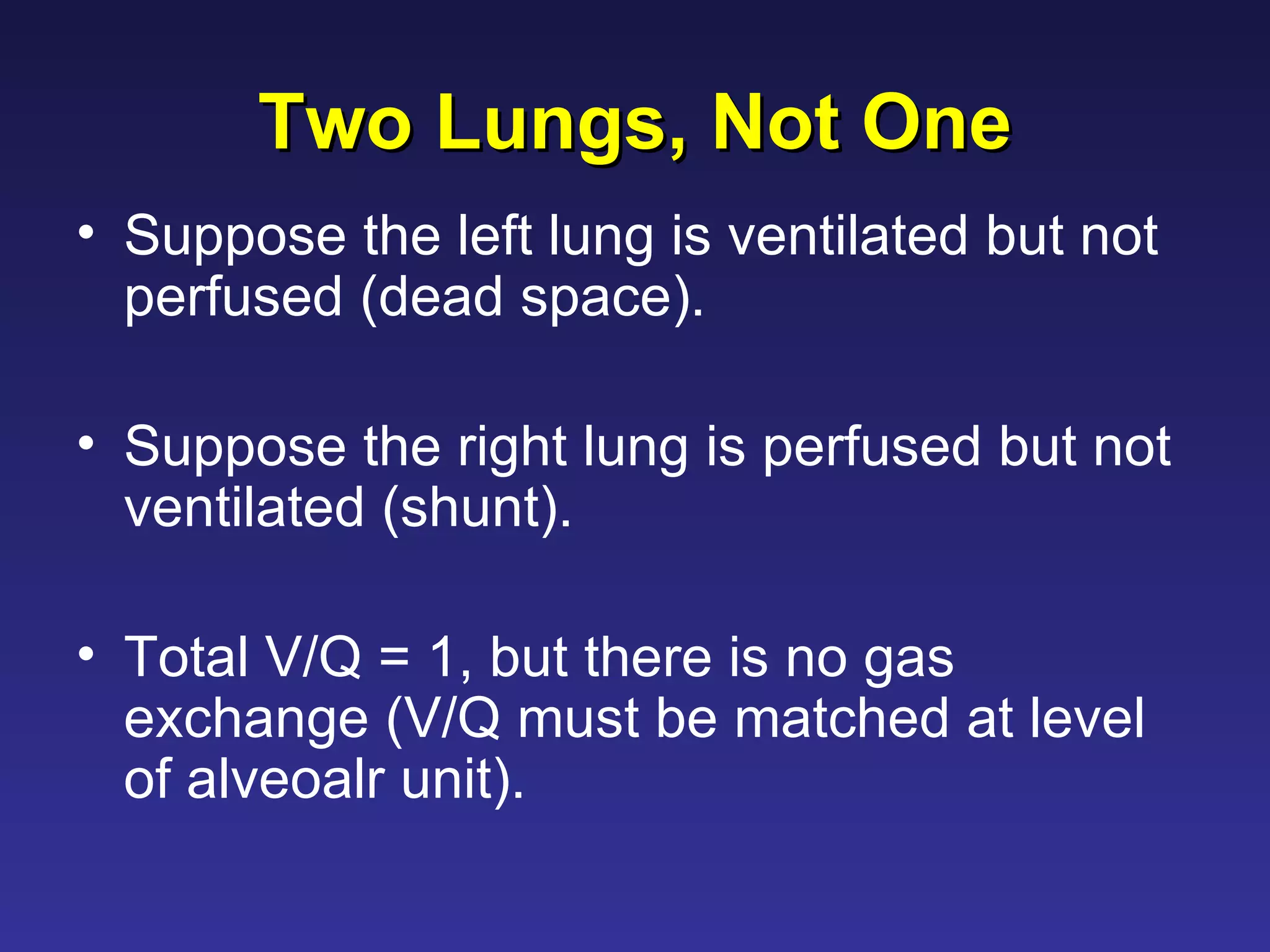
Two Lungs, Not One Suppose the left lung is ventilated but not perfused (dead space). Suppose the right lung is perfused but not ventilated (shunt). Total V/Q = 1, but there is no gas exchange (V/Q must be matched at level of alveoalr unit).
Low V/Q Effect on Oxygenation PO2 114 PO2 50 Normal Low V/Q PO2 ? One lung unit has normal ventilation and perfusion, while the  has inadequate ventilation    PCO2    PO2
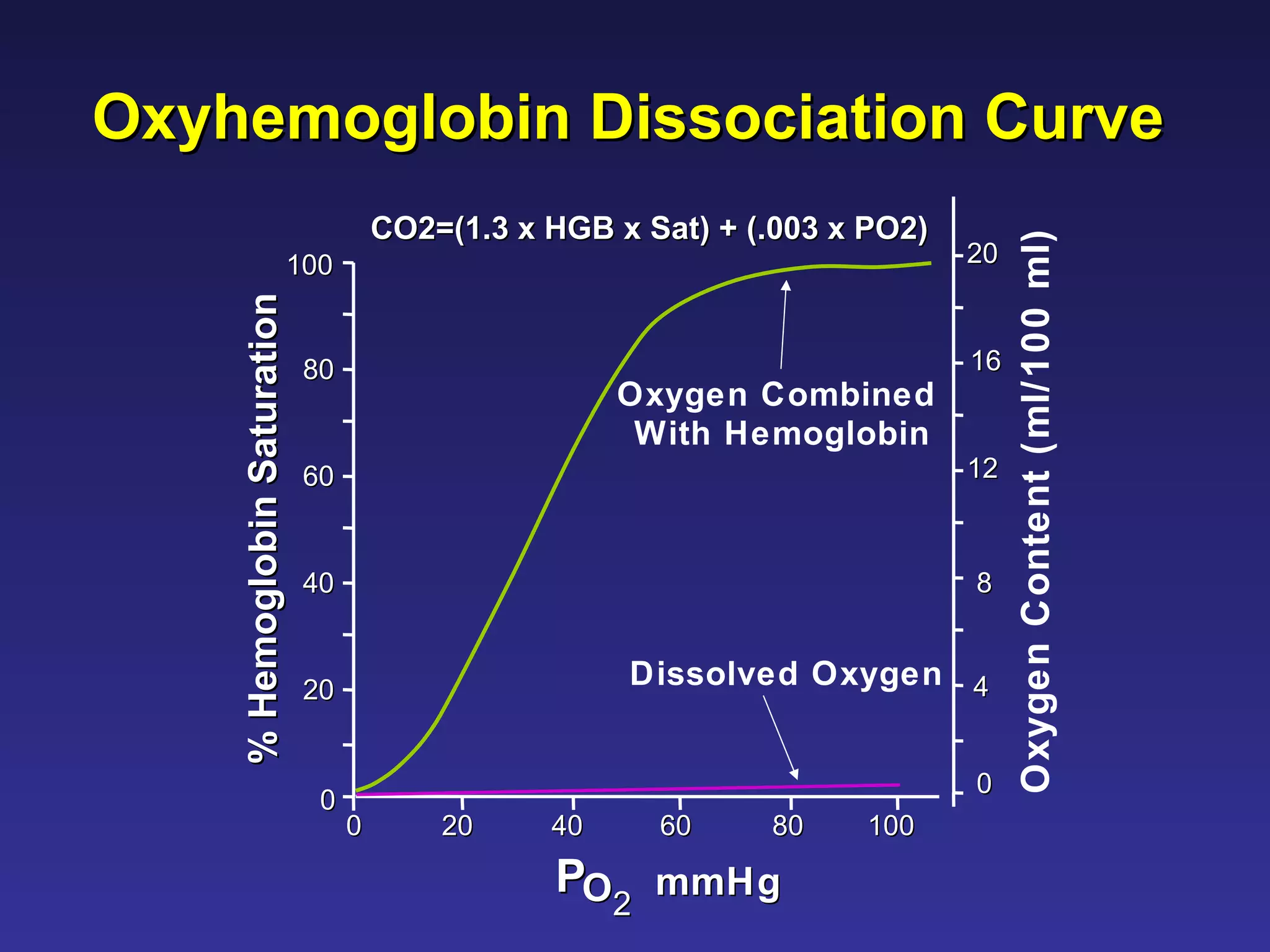
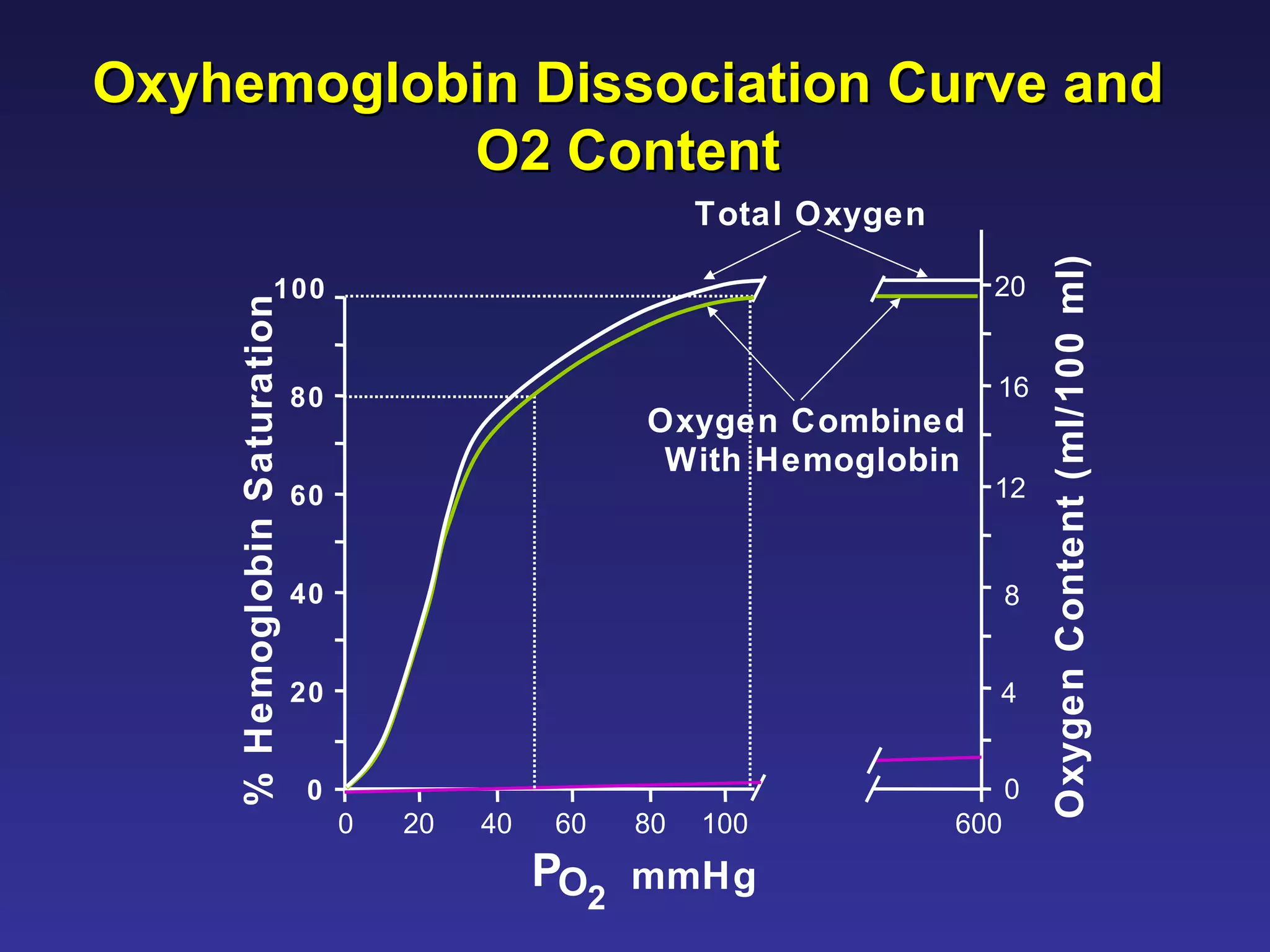
Mixing Blood What is the PO2 of a mixture of two volumes of blood with different initial PO2? Determined by interaction of oxygen with hemoglobin. the partition of oxygen between plasma (and thus the pO2) and bound to hemoglobin is determined by the oxyhemoglobin dissociation curve.
Oxyhemoglobin Dissociation Curve 20 40 60 80 100 0 0 20 40 60 80 100 % Hemoglobin Saturation Oxygen Combined  With Hemoglobin Dissolved Oxygen CO2=(1.3 x HGB x Sat) + (.003 x PO2) 0 4 8 12 16 20 Oxygen Content (ml/100 ml) P O 2 mmHg
Low V/Q Effect on Oxygenation PO2 114 PO2 50 Normal Low V/Q PO2 ? One lung unit has normal ventilation and perfusion, while the  has inadequate ventilation    PCO2    PO2
20 40 60 80 100 600 0 4 8 12 16 20 Total Oxygen Oxygen Combined  With Hemoglobin % Hemoglobin Saturation Oxygen Content (ml/100 ml) 0 Oxyhemoglobin Dissociation Curve and O2 Content P O 2 mmHg 20 40 60 80 100 0
PO2 114 mmHg O2sat 100% O2 content 20ml/dl PO2 50 mmHg O2sat 80% O2 content 16ml/dl PO2 114 PO2 50 Normal Low V/Q One lung unit has normal ventilation and perfusion, while the  has inadequate ventilation Low V/Q Effect on Oxygenation
Oxyhemoglobin Dissociation Curve and O2 Content 600 0 Total Oxygen Oxygen Combined  With Hemoglobin % Hemoglobin Saturation Oxygen Content (ml/100 ml) 4 8 12 16 20 P O 2 mmHg 20 40 60 80 100 0 20 40 60 80 100 0
PO2 60mmHg PO2 114 mmHg O2sat 100% O2 content 20ml/dl PO2 50 mmHg O2sat 80% O2 content 16ml/dl PO2 114 PO2 50 Normal Low V/Q One lung unit has normal ventilation and perfusion, while the  has inadequate ventilation Low V/Q Effect on Oxygenation
PCO2 in V/Q Mismatch Increased ventilation can compensate for low V/Q units. Shape of CO2 curve Total ventilation (VE) must increase for this compensation. 80 60 40 20 0 20 40 60 80 P CO 2 (mmHg) CO  CONTENT (ml/100 ml) 2
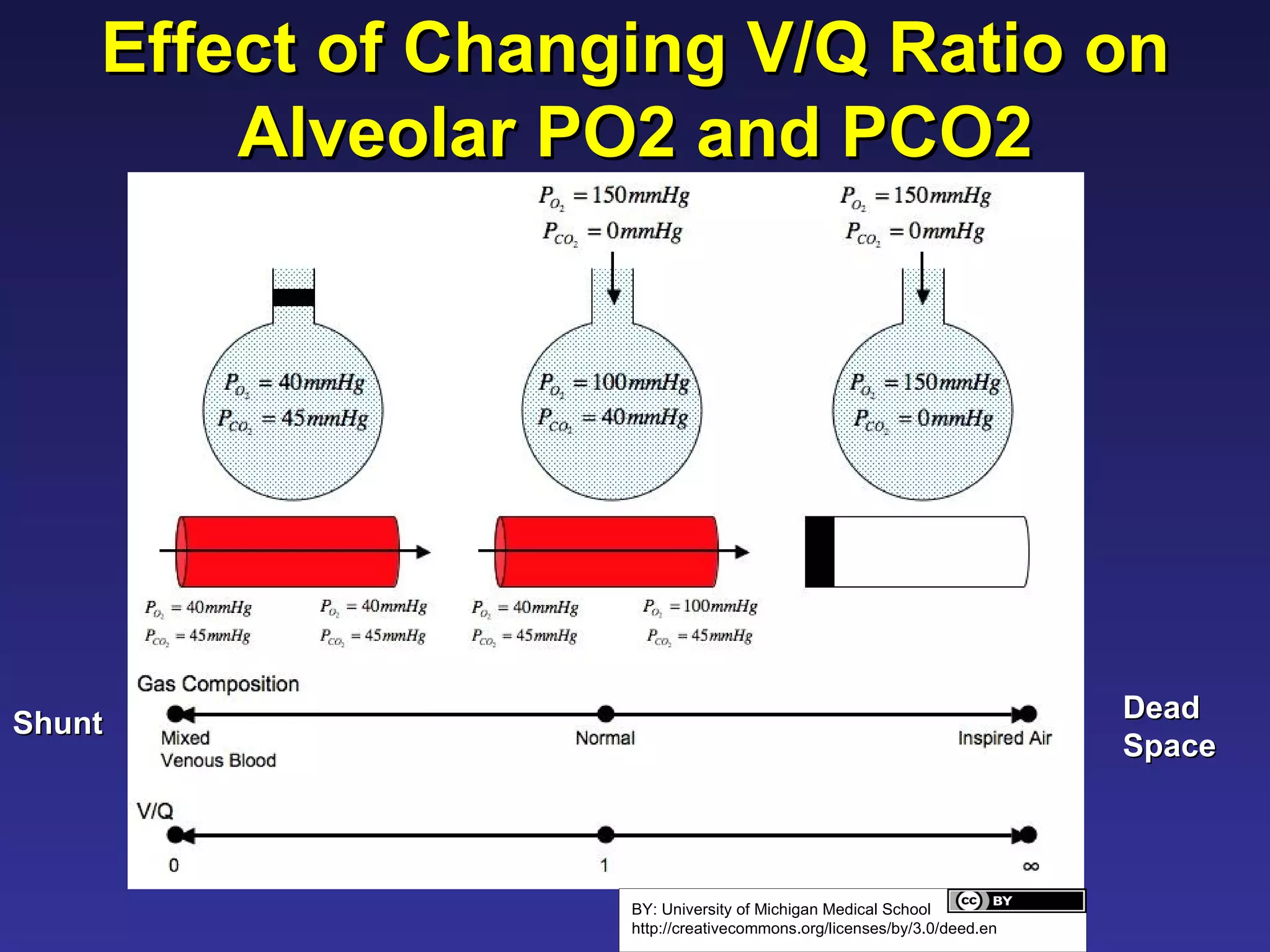
Extremes of V/Q Inequality Shunt Perfusion of lung units without ventilation Unoxygenated blood enters the systemic circulation V/Q = 0 Dead space Ventilation of lung units without perfusion Gas enters and leaves lung units without contacting blood Wasted ventilation V/Q is infinite
Effect of Changing V/Q Ratio on Alveolar PO2 and PCO2 Shunt Dead Space BY: University of Michigan Medical School http://creativecommons.org/licenses/by/3.0/deed.en
Effects of V/Q Relationships on Alveolar PO2 and PCO2 BY: University of Michigan Medical School http://creativecommons.org/licenses/by/3.0/deed.en
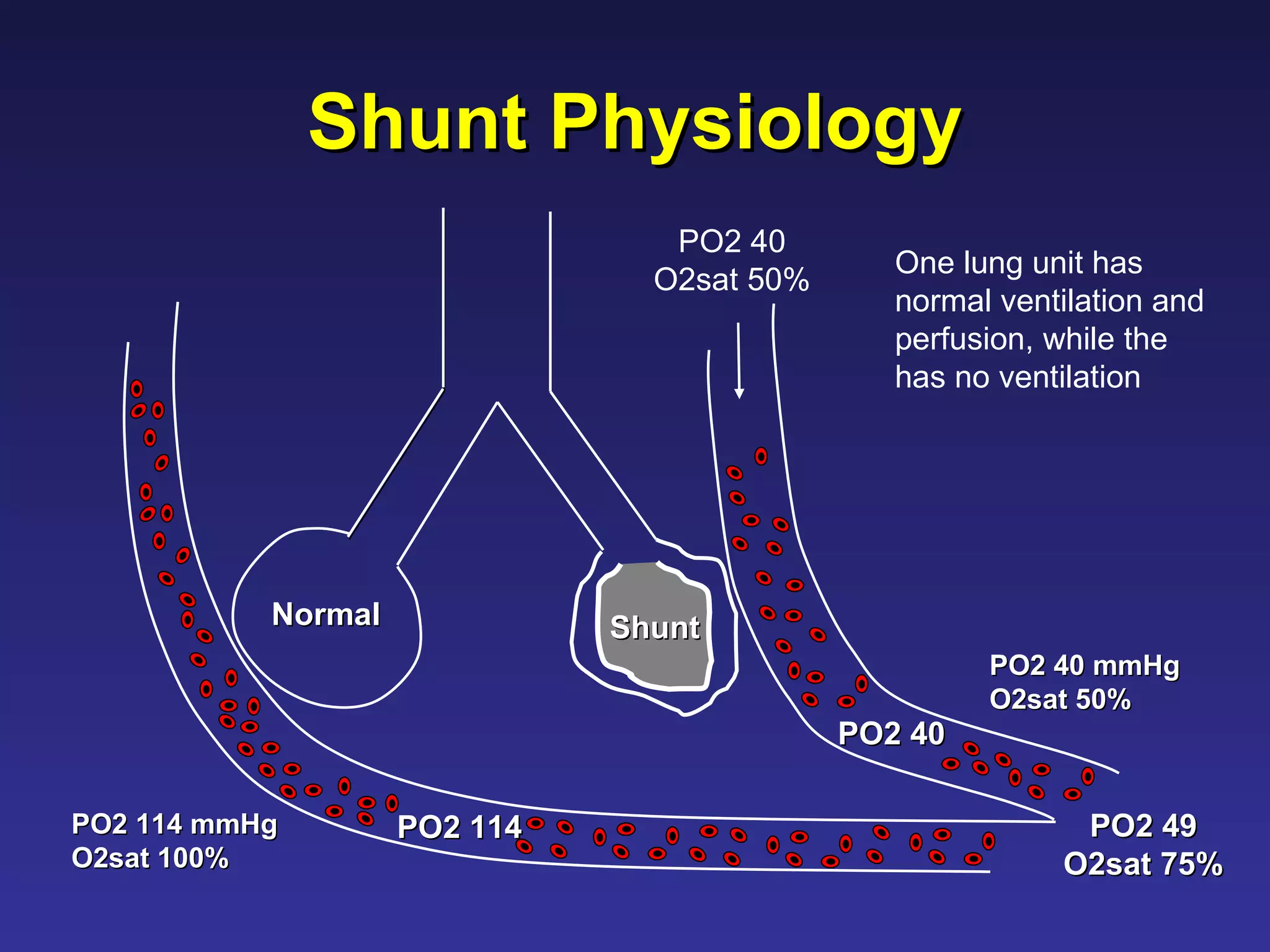
Shunt Physiology PO2 114 PO2 40 O2sat 50% PO2 40 PO2 49 O2sat 75% PO2 114 mmHg O2sat 100% PO2 40 mmHg O2sat 50% Normal One lung unit has normal ventilation and perfusion, while the  has no ventilation Shunt
Response to Breathing 100% Oxygen Alveolar hypoventilation or V/Q mismatch responds to 100% oxygen breathing. Nitrogen will be washed out of low ventilation lung units over time. PaO2 will rise to > 550 mmHg. Limited response to oxygen in shunt. Use this characteristic to diagnose shunt.
Shunt Calculation Qt x CaO2 = total volume of oxygen per time entering systemic arteries Qt = total perfusion Qs = shunt perfusion CaO2, Cc’O2, CvO2 are oxygen contents of arterial, capillary and venous blood (Qt-Qs) x Cc’O2 = oxygen coming from normally functioning lung units Qs x CvO2 = oxygen coming from shunt blood flow
Shunt BY: University of Michigan Medical School http://creativecommons.org/licenses/by/3.0/deed.en
Shunt Equation Qt  x  CaO2 = [(Qt – Qs)  x  CcO2] + [Qs x CvO2]  2 2 ' 2 2 ' CvO O Cc CaO O Cc Qt Qs   
Causes of Shunt Physiologic shunts: Bronchial veins, pleural veins Pathologic shunts: Intracardiac Intrapulmonary Vascular malformations Unventilated or collapsed alveoli
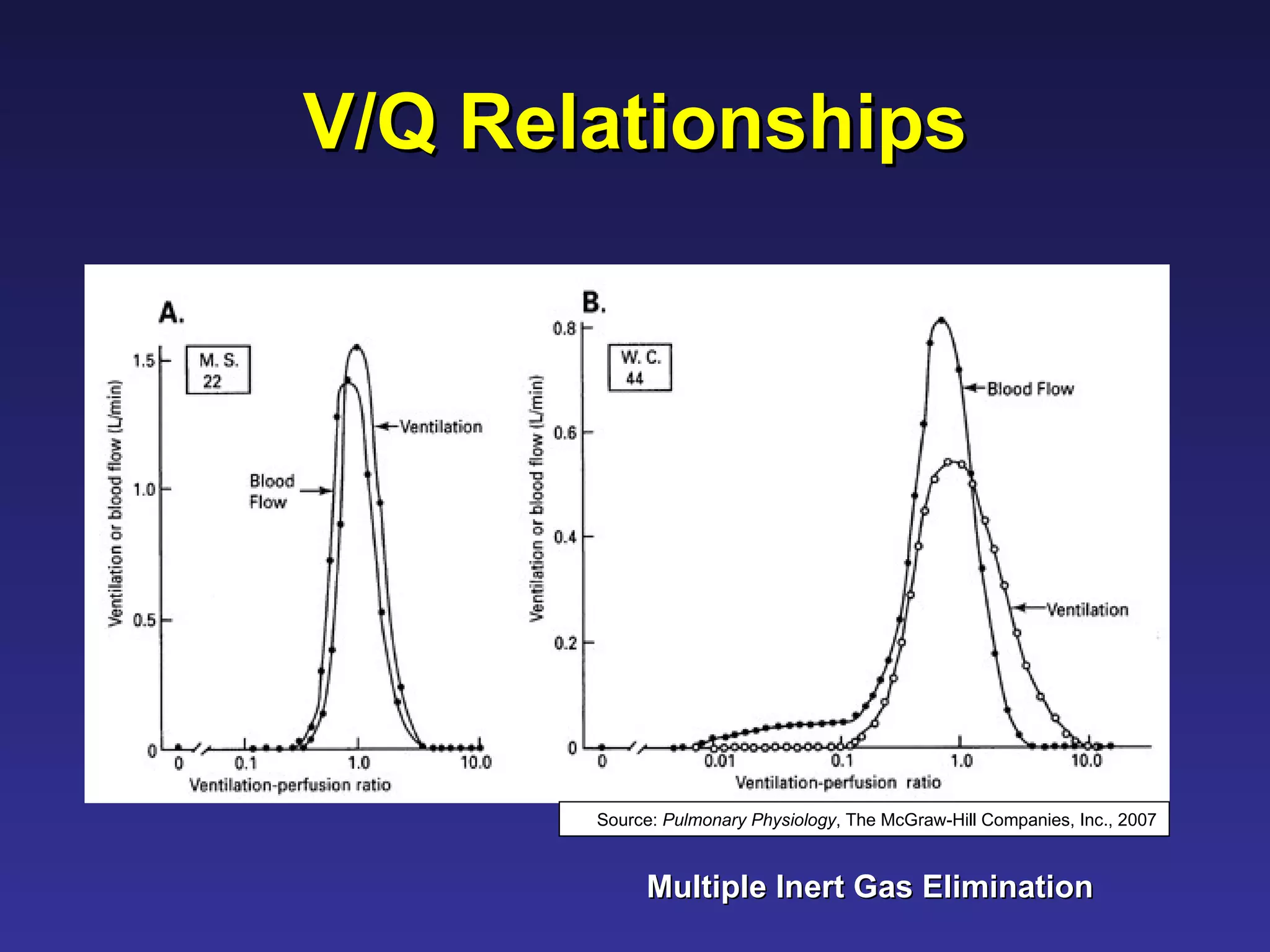
Detecting V/Q Mismatching and Shunt Radiotracer assessments of regional ventilation and perfusion. Multiple inert gas elimination. Takes advantage of the fact that rate of elimination of a gas at any given V/Q ratio varies with its solubility. A-aO2 Gradient.
V/Q Relationships Multiple Inert Gas Elimination  Source:  Pulmonary Physiology , The McGraw-Hill Companies, Inc., 2007
A-a O2 gradient In a totally efficient lung unit with matched V/Q, alveolar and capillary PO2 would be equal. Admixture of venous blood (or of blood from low V/Q lung units) will decrease the arterial PaO2, without effecting alveolar O2 (PAO2). Calculate the PAO2 using the alveolar gas equation, then subtract the arterial PaO2:  [(PiO 2 ) – (PaCO 2 /R)] –PaO2. The A-a O2 gradient (or difference) is < 10-15 mmHg in normal subjects Why is it not 0?
Apical and Basilar Alveoli in the Upright Posture Elastic recoil of the individual alveoli is similar throughout the normal lung. At end expiration (FRC) apical alveoli see more negative pressure and are larger than basilar alveoli. During inspiration, basilar alveoli undergo larger volume increase than apical alveoli. Thus at rest there is more ventilation at the base than the apex. Also More Perfusion to Lung Bases Due to Gravity.
Effects of Gravity on Ventilation and Perfusion Source:  Pulmonary Physiology , The McGraw-Hill Companies, Inc., 2007
Effects of Gravity on Ventilation and Perfusion Matching BY: University of Michigan Medical School http://creativecommons.org/licenses/by/3.0/deed.en
Causes of Abnormal Oxygenation Hypoventilation V/Q mismatch Shunt Diffusion block
Ventilation and Perfusion must be matched at the alveolar capillary level. V/Q ratios close to 1.0 result in alveolar PO2 close to 100 mmHg and PCO2 close to 40 mmHg. V/Q greater than 1.0 increase PO2 and Decrease PCO2.  V/Q less than 1.0 decrease PO2 and Increase PCO2. Shunt and Dead Space are Extremes of V/Q mismatching. A-a Gradient of 10-15 Results from gravitational effects on V/Q and Physiologic Shunt. Key Concepts:

Ventilation Perfusion Matching

  • 1.
    Unless otherwise noted,the content of this course material is licensed under a Creative Commons Attribution 3.0 License. Copyright 2008, Thomas Sisson The following information is intended to inform and educate and is not a tool for self-diagnosis or a replacement for medical evaluation, advice, diagnosis or treatment by a healthcare professional. You should speak to your physician or make an appointment to be seen if you have questions or concerns about this information or your medical condition. You assume all responsibility for use and potential liability associated with any use of the material. Material contains copyrighted content, used in accordance with U.S. law. Copyright holders of content included in this material should contact open.michigan@umich.edu with any questions, corrections, or clarifications regarding the use of content. The Regents of the University of Michigan do not license the use of third party content posted to this site unless such a license is specifically granted in connection with particular content objects. Users of content are responsible for their compliance with applicable law. Mention of specific products in this recording solely represents the opinion of the speaker and does not represent an endorsement by the University of Michigan. Viewer discretion advised: Material may contain medical images that may be disturbing to some viewers.
  • 2.
  • 3.
    Objectives To recognizethe importance of matching ventilation and perfusion To explain the consequences of mismatched ventilation and perfusion To define shunt and dead space physiology To be able to determine the alveolar pO 2 To be able to determine the A-a O 2 gradient and understand the implications of an increased gradient To explain and understand the consequences of regional differences in ventilation and perfusion due to effects of gravity
  • 4.
    Ventilation and Perfusionat the Level of the Whole Lung BY: University of Michigan Medical School http://creativecommons.org/licenses/by/3.0/deed.en
  • 5.
    Gas Composition inthe Alveolar Space PiO2 = (barometric pressure-H2O vapor pressure)xFiO2 = (760 – 47) x 0.21 =150 mmHg In the alveolar space, oxygen diffuses into the blood and CO2 diffuses into the alveolus from the blood. Trachea: partial pressure of CO2 is approximately 0 BY: University of Michigan Medical School http://creativecommons.org/licenses/by/3.0/deed.en
  • 6.
    Alveolar Gas EquationPAO 2 = (PiO 2 ) – (PaCO 2 /R). PaCO 2 approximates PACO 2 due to the rapid diffusion of CO 2 R = Respiratory Quotient (VCO2/V02) = 0.8 In a normal individual breathing room air: PAO 2 = 150 – 40/0.8 = 100 mmHg
  • 7.
    Gas Composition inthe Normal Alveolar Space PiO2 = (barometric pressure-H2O vapor pressure)xFiO2 = (760 – 47) x 0.21 =150 mmHg In the alveolar space, oxygen diffuses into the blood and CO2 diffuses into the alveolus from the blood. Trachea: partial pressure of CO2 is approximately 0 BY: University of Michigan Medical School http://creativecommons.org/licenses/by/3.0/deed.en
  • 8.
    Consequences of InadequateVentilation Apnea: PACO2 rises PAO2 falls until there is no gradient for diffusion into the blood Hypoventilation: Inadequate ventilation for perfusion PACO2 rises PAO2 falls, but diffusion continues BY: University of Michigan Medical School http://creativecommons.org/licenses/by/3.0/deed.en
  • 9.
    How Can WeTell if Alveolar Ventilation is Adequate?
  • 10.
    PaCO2 and AlveolarVentilation PaCO2 is: directly related to CO2 production (tissue metabolism). Inversely related to alveolar ventilation. Increased PaCO2 (hypercarbia) is always a reflection of inadequate alveolar ventilation (VA). VA VCO PaCO 2 2 
  • 11.
    Alveolar Hypoventilation Supposea patient hypoventilates, so that the PCO2 rises to 80 mmHg. We can estimate the PAO2 based on the alveolar gas equation. PAO2 = 150 – 80/0.8 = 50 mmHg Thus even with perfectly efficient lungs, the PaO2 would be 50, and the patient would be severely hypoxemic. Therefore, hypoventilation results in hypoxemia. BY: University of Michigan Medical School http://creativecommons.org/licenses/by/3.0/deed.en
  • 12.
    V/Q Matching 300million alveoli. Different alveoli may have widely differing amounts of ventilation and of perfusion. Key for normal gas exchange is to have matching of ventilation and perfusion for each alveolar unit Alveoli with increased perfusion also have increased ventilation Alveoli with decreased perfusion also have decreased ventilation V/Q ratio = 1.0
  • 13.
    Two Lungs, NotOne Suppose the left lung is ventilated but not perfused (dead space). Suppose the right lung is perfused but not ventilated (shunt). Total V/Q = 1, but there is no gas exchange (V/Q must be matched at level of alveoalr unit).
  • 14.
    Low V/Q Effecton Oxygenation PO2 114 PO2 50 Normal Low V/Q PO2 ? One lung unit has normal ventilation and perfusion, while the has inadequate ventilation  PCO2  PO2
  • 15.
    Mixing Blood Whatis the PO2 of a mixture of two volumes of blood with different initial PO2? Determined by interaction of oxygen with hemoglobin. the partition of oxygen between plasma (and thus the pO2) and bound to hemoglobin is determined by the oxyhemoglobin dissociation curve.
  • 16.
    Oxyhemoglobin Dissociation Curve20 40 60 80 100 0 0 20 40 60 80 100 % Hemoglobin Saturation Oxygen Combined With Hemoglobin Dissolved Oxygen CO2=(1.3 x HGB x Sat) + (.003 x PO2) 0 4 8 12 16 20 Oxygen Content (ml/100 ml) P O 2 mmHg
  • 17.
    Low V/Q Effecton Oxygenation PO2 114 PO2 50 Normal Low V/Q PO2 ? One lung unit has normal ventilation and perfusion, while the has inadequate ventilation  PCO2  PO2
  • 18.
    20 40 6080 100 600 0 4 8 12 16 20 Total Oxygen Oxygen Combined With Hemoglobin % Hemoglobin Saturation Oxygen Content (ml/100 ml) 0 Oxyhemoglobin Dissociation Curve and O2 Content P O 2 mmHg 20 40 60 80 100 0
  • 19.
    PO2 114 mmHgO2sat 100% O2 content 20ml/dl PO2 50 mmHg O2sat 80% O2 content 16ml/dl PO2 114 PO2 50 Normal Low V/Q One lung unit has normal ventilation and perfusion, while the has inadequate ventilation Low V/Q Effect on Oxygenation
  • 20.
    Oxyhemoglobin Dissociation Curveand O2 Content 600 0 Total Oxygen Oxygen Combined With Hemoglobin % Hemoglobin Saturation Oxygen Content (ml/100 ml) 4 8 12 16 20 P O 2 mmHg 20 40 60 80 100 0 20 40 60 80 100 0
  • 21.
    PO2 60mmHg PO2114 mmHg O2sat 100% O2 content 20ml/dl PO2 50 mmHg O2sat 80% O2 content 16ml/dl PO2 114 PO2 50 Normal Low V/Q One lung unit has normal ventilation and perfusion, while the has inadequate ventilation Low V/Q Effect on Oxygenation
  • 22.
    PCO2 in V/QMismatch Increased ventilation can compensate for low V/Q units. Shape of CO2 curve Total ventilation (VE) must increase for this compensation. 80 60 40 20 0 20 40 60 80 P CO 2 (mmHg) CO CONTENT (ml/100 ml) 2
  • 23.
    Extremes of V/QInequality Shunt Perfusion of lung units without ventilation Unoxygenated blood enters the systemic circulation V/Q = 0 Dead space Ventilation of lung units without perfusion Gas enters and leaves lung units without contacting blood Wasted ventilation V/Q is infinite
  • 24.
    Effect of ChangingV/Q Ratio on Alveolar PO2 and PCO2 Shunt Dead Space BY: University of Michigan Medical School http://creativecommons.org/licenses/by/3.0/deed.en
  • 25.
    Effects of V/QRelationships on Alveolar PO2 and PCO2 BY: University of Michigan Medical School http://creativecommons.org/licenses/by/3.0/deed.en
  • 26.
    Shunt Physiology PO2114 PO2 40 O2sat 50% PO2 40 PO2 49 O2sat 75% PO2 114 mmHg O2sat 100% PO2 40 mmHg O2sat 50% Normal One lung unit has normal ventilation and perfusion, while the has no ventilation Shunt
  • 27.
    Response to Breathing100% Oxygen Alveolar hypoventilation or V/Q mismatch responds to 100% oxygen breathing. Nitrogen will be washed out of low ventilation lung units over time. PaO2 will rise to > 550 mmHg. Limited response to oxygen in shunt. Use this characteristic to diagnose shunt.
  • 28.
    Shunt Calculation Qtx CaO2 = total volume of oxygen per time entering systemic arteries Qt = total perfusion Qs = shunt perfusion CaO2, Cc’O2, CvO2 are oxygen contents of arterial, capillary and venous blood (Qt-Qs) x Cc’O2 = oxygen coming from normally functioning lung units Qs x CvO2 = oxygen coming from shunt blood flow
  • 29.
    Shunt BY: Universityof Michigan Medical School http://creativecommons.org/licenses/by/3.0/deed.en
  • 30.
    Shunt Equation Qt x CaO2 = [(Qt – Qs) x CcO2] + [Qs x CvO2] 2 2 ' 2 2 ' CvO O Cc CaO O Cc Qt Qs   
  • 31.
    Causes of ShuntPhysiologic shunts: Bronchial veins, pleural veins Pathologic shunts: Intracardiac Intrapulmonary Vascular malformations Unventilated or collapsed alveoli
  • 32.
    Detecting V/Q Mismatchingand Shunt Radiotracer assessments of regional ventilation and perfusion. Multiple inert gas elimination. Takes advantage of the fact that rate of elimination of a gas at any given V/Q ratio varies with its solubility. A-aO2 Gradient.
  • 33.
    V/Q Relationships MultipleInert Gas Elimination Source: Pulmonary Physiology , The McGraw-Hill Companies, Inc., 2007
  • 34.
    A-a O2 gradientIn a totally efficient lung unit with matched V/Q, alveolar and capillary PO2 would be equal. Admixture of venous blood (or of blood from low V/Q lung units) will decrease the arterial PaO2, without effecting alveolar O2 (PAO2). Calculate the PAO2 using the alveolar gas equation, then subtract the arterial PaO2: [(PiO 2 ) – (PaCO 2 /R)] –PaO2. The A-a O2 gradient (or difference) is < 10-15 mmHg in normal subjects Why is it not 0?
  • 35.
    Apical and BasilarAlveoli in the Upright Posture Elastic recoil of the individual alveoli is similar throughout the normal lung. At end expiration (FRC) apical alveoli see more negative pressure and are larger than basilar alveoli. During inspiration, basilar alveoli undergo larger volume increase than apical alveoli. Thus at rest there is more ventilation at the base than the apex. Also More Perfusion to Lung Bases Due to Gravity.
  • 36.
    Effects of Gravityon Ventilation and Perfusion Source: Pulmonary Physiology , The McGraw-Hill Companies, Inc., 2007
  • 37.
    Effects of Gravityon Ventilation and Perfusion Matching BY: University of Michigan Medical School http://creativecommons.org/licenses/by/3.0/deed.en
  • 38.
    Causes of AbnormalOxygenation Hypoventilation V/Q mismatch Shunt Diffusion block
  • 39.
    Ventilation and Perfusionmust be matched at the alveolar capillary level. V/Q ratios close to 1.0 result in alveolar PO2 close to 100 mmHg and PCO2 close to 40 mmHg. V/Q greater than 1.0 increase PO2 and Decrease PCO2. V/Q less than 1.0 decrease PO2 and Increase PCO2. Shunt and Dead Space are Extremes of V/Q mismatching. A-a Gradient of 10-15 Results from gravitational effects on V/Q and Physiologic Shunt. Key Concepts: