DR NILESH KATE
MBBS,MD
ASSOCIATE PROF
ESIC MEDICAL COLLEGE, GULBARGA.
DEPT. OF PHYSIOLOGY
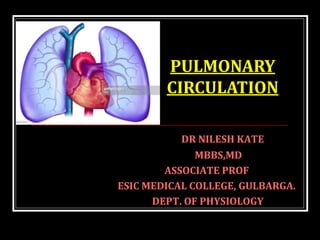
PULMONARY
CIRCULATION
OBJECTIVES.
 FUNCTIONAL ANATOMY
 CHARACTERISTIC FEATURES
 FUNCTIONS
 REGULATION OF PULMONARY BLOOD FLOW.
FUNCTIONAL ANATOMY
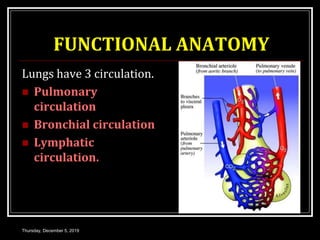
Lungs have 3 circulation.
 Pulmonary
circulation
 Bronchial circulation
 Lymphatic
circulation.
Thursday, December 5, 2019
PULMONARY CIRCULATION
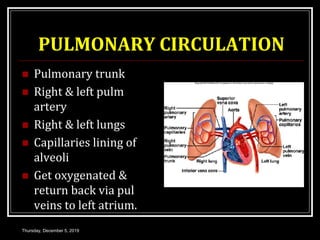
 Pulmonary trunk
 Right & left pulm
artery
 Right & left lungs
 Capillaries lining of
alveoli
 Get oxygenated &
return back via pul
veins to left atrium.
Thursday, December 5, 2019
BRONCHIAL CIRCULATION
 Descending thoracic aorta
give right & left bronchial
arteries
 Supply oxygenated blood to
lungs (connective tissue,
septa & bronchi) & after joins
pulm veins without (Bypass)
oxygenation.
 So forms Physiological
shunt.
Thursday, December 5, 2019
OTHER EXAMPLE OF
PHYSIOLOGICAL SHUNT
 Drainage of Coronary vessel in to left side of
heart.
 Effects of shunts –
 Reduce oxygenation of arterial blood slightly.
 Increase left ventricular output by 1-2% than right.
Thursday, December 5, 2019
LYMPHATIC CIRCULATION.
 Present in walls of
terminal bronchioles
& supportive tissues
of lung.
 Removes particulate
matter, plasma
proteins – thus
prevents pulmonary
oedema
Thursday, December 5, 2019
LYMPHATIC CIRCULATION.
Drainage pathway
 Deep lymphatic
 Pulmonary nodes
 Bronchopulmonary
nodes
 Tracheobronchial
nodes
 Bronchomediastinal
trunk.
Thursday, December 5, 2019
PULMONARY CIRCULATION
CHARACTERISTIC FEATURES.
 Pulmonary circulation is low pressure, low
resistance & high capacitance system.
 Thickness of Right ventricle and pulmonary
artery 1/3rd of left ventricle & aorta
 Pulmonary capillaries are larger in diameter
than systemic capillaries.
 Each alveolus is enclosed in basket of
capillaries.
Thursday, December 5, 2019
PRESSURES IN PULMONARY
SYSTEM.
 Right ventricular pressure.
 Pulmonary artery pressure.
 Left atrial pressure.
 Pulmonary capillary pressure.
Thursday, December 5, 2019
RIGHT VENTRICULAR
PRESSURE.
 During each cardiac cycle,
 During Systole – reaches peak 25 mm
Hg.(120 mm Hg in Left ventricle)
 During Diastole – 0-1 mm Hg (5 mm Hg in
left ventricle)
Thursday, December 5, 2019
PULMONARY ARTERY
PRESSURE.
 Systolic pressure 25 mm Hg (120 mm Hg in
Aorta)
 Diastolic pressure 8 mm Hg (8 mm Hg in
Aorta)
 Mean arterial pressure 15 mm Hg (100 mm
Hg in Aorta)
 Pulse pressure 17 mm Hg (40 mm Hg in
Aorta)
Thursday, December 5, 2019
LEFT ATRIAL PRESSURE.
 Major pulmonary veins pressure avg 5 mm
Hg
 So Pressure gradient in pulmonary system
Mean pulmonary artery pressure – mean
pulmonary vein pressure
15-5 = 10 mm Hg.
Thursday, December 5, 2019
PULMONARY CAPILLARY
PRESSURE.
 10 mm Hg.
 Colloidal osmotic pressure is 25 mm Hg
 So net suction force of 15 mm Hg draw fluid
from pulmonary interstitial fluid into
pulmonary capillary
 So keeps Alveoli dry
Thursday, December 5, 2019
SIGNIFICANCE OF LOW PULMONARY
CAPILLARY PRESSURE
 So if pulmonary capillary pressure rises above
25 mm Hg
 Fluid escapes into interstitial spaces
 Lead to pulmonary oedema
 Conditions raising this pressue
 Exercise at high altitude
 Left heart failure
 Mitral stenosis
 Pulmonary fibrosis.
Thursday, December 5, 2019
PULMONARY WEDGE
PRESSURE
 Estimate left atrial
pressure.
 Measured by passing a
catheter through right
ventricle, pulmonary artery
up to smallest branch of
pulmonary artery.
 Used to study left atrial
pressure in patients of CCF
Thursday, December 5, 2019
PULMONARY BLOOD VOLUME
 Pulmonary vessels contains – 600 ml; its
capacitance vary from 200-900 ml
 Pulmonary blood volume decreases during
standing & during haemorrhage to
compensate , so acts as Reservoir.
Thursday, December 5, 2019
PULMONARY BLOOD FLOW
 Pulmonary blood flow
nearly equal to cardiac
output.
 Blood flow through lung
depend on –
 Relationship between
pressures of Pulmonary
artery, pulmonary vein &
alveolar artery.
Thursday, December 5, 2019
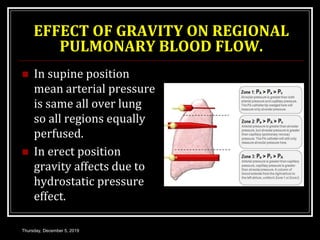
EFFECT OF GRAVITY ON REGIONAL
PULMONARY BLOOD FLOW.
 In supine position
mean arterial pressure
is same all over lung
so all regions equally
perfused.
 In erect position
gravity affects due to
hydrostatic pressure
effect.
Thursday, December 5, 2019
EFFECT OF GRAVITY ON REGIONAL
PULMONARY BLOOD FLOW.
 Zero reference plane is
at level of right atrium.
 So pulmonary arterial
pressure
 In middle of lung –is 15
mm Hg
 At apex – 4 mm Hg
 At the base 26 mm Hg.
Thursday, December 5, 2019
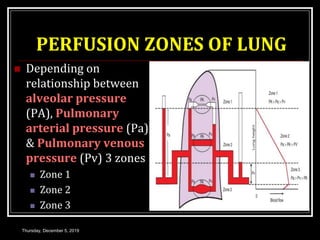
PERFUSION ZONES OF LUNG
 Depending on
relationship between
alveolar pressure
(PA), Pulmonary
arterial pressure (Pa)
& Pulmonary venous
pressure (Pv) 3 zones
 Zone 1
 Zone 2
 Zone 3
Thursday, December 5, 2019
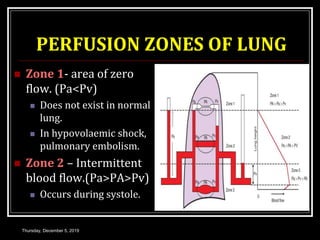
PERFUSION ZONES OF LUNG
 Zone 1- area of zero
flow. (Pa<Pv)
 Does not exist in normal
lung.
 In hypovolaemic shock,
pulmonary embolism.
 Zone 2 – Intermittent
blood flow.(Pa>PA>Pv)
 Occurs during systole.
Thursday, December 5, 2019
PERFUSION ZONES OF LUNG
 Blood flow is
determined by arterial-
alveolar pressure
gradient not arterio-
venous gradient. so
called Waterfall effect.
Thursday, December 5, 2019
PERFUSION ZONES OF LUNG
 Zone 3
 Continuous high blood
flow. (Pa>Pv>PA)
 Generally occurs near
bottom of the lung.
Thursday, December 5, 2019
EFFECT OF GRAVITY ON
ALVEOLAR VENTILATION
 In Supine Position – alveolar ventilation evenly
distributed
 In Upright Position –
 Alveolar pressure is zero throughout lung
 Intrapleural pressure – at apex -10 mmHg & at base -2
mm Hg.
 So transpulmonary pressure -10 & -2 at apex & base
respectively.
 So linear reduction in regional alveolar ventilation from
base to apex.
Thursday, December 5, 2019
CLINICAL SIGNIFICANCE
 So arterial
oxygenation in
unilateral lung
diseases is improved
by keeping good lung
in Dependent
Position.
 Opposite is done in
INFANT.
Thursday, December 5, 2019
ALVEOLAR VENTILATION :
PERFUSION RATIO
 Ratio of alveolar
ventilation per minute
to quantity of blood
flow to alveoli per
min.
 VA/Q = 4.2/5 = 0.84-
0.9
Thursday, December 5, 2019
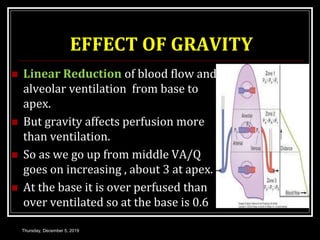
EFFECT OF GRAVITY
 Linear Reduction of blood flow and
alveolar ventilation from base to
apex.
 But gravity affects perfusion more
than ventilation.
 So as we go up from middle VA/Q
goes on increasing , about 3 at apex.
 At the base it is over perfused than
over ventilated so at the base is 0.6
Thursday, December 5, 2019
CAUSES OF ALTERATION.
 Causes of altered
alveolar ventilation
 Bronchial asthma
 Emphysema
 Pulmonary fibrosis
 Pneumothorax
 Congestive heart failure
 Causes of altered
pulmonary perfusion.
 Anatomical shunts
 Pulmonary embolism
 Decrease in pulmonary
vascular bed in
emphysema
 Increase pulmonary
resistance in pulmonary
fibrosis, Pneumothorax,
CHF
Thursday, December 5, 2019
EFFECTS OF ALTERATION IN
VA/Q RATIO.
 Normal VA/Q ratio –both normal alveolar
pO2 = 104 mmHg, pCO2 =40 mmHg.
 Increased VA/Q ratio. – alveolar dead space
air, VA/Q = infinity, pO2 = 149 mmHg, pCO2
= 0 mmHg.
 Decreased VA/Q ratio, pO2 = 40 mmHg,
pCO2 = 45 mmHg.
Thursday, December 5, 2019
EFFECT OF EXERCISE ON REGIONAL
PULMONARY BLOOD FLOW
 During exercise blood flow
increases in all regions of
blood.
 Near base increased by 2-3
time
 Near apex increased by 8
times.
 It occurs due to
 Recruitment of capillaries.
 Distension of capillaries.
Thursday, December 5, 2019
PULMONARY CAPILLARY
DYNAMICS
 Pulmonary transit time – mean transit time
in pulmonary circulation from pulmonary
valves to left atrium – 4 sec.
 Capillary transit time for RBC is 0.8 sec at
rest and 0.3 sec during exercise.
Thursday, December 5, 2019
MEAN FILTRATION PRESSURE AT
PULMONARY CAPILLARY = 1 mm Hg.
 Starling’s forces at capillary membrane
are
 Outward forces (29 mm Hg)
 Interstitial oncotic pressure – 14 mmHg
 Interstitial hydrostatic pressure - -8 mm Hg
 Capillary Hydrostatic pressure 7 mm Hg
 Inward forces (28 mm Hg)
 Plasma oncotic pressure 28 mm Hg.
Thursday, December 5, 2019
PULMONARY OEDEMA
 Occur due to increase capillary filtration
from pulmonary capillary.
 Conditions –
 Increase capillary hydrostatic pressure from 7 mm
Hg to 28 mm Hg (safety factor of 21 mm Hg)
 Capillary permeability increase – due to infection,
irritant gases.
 Acute left heart failure – increase in capillary
pressure to 50 mm Hg.
Thursday, December 5, 2019
FUNCTIONS
 Respiratory gas exchange
 Other functions
 Reservoir for left ventricle
 Filter for removal of emboli & other particles from
blood.
 Removal of fluid from alveoli.
 Role in absorption of drugs.
 Synthesis of Angiotensin converting enzyme.
Thursday, December 5, 2019
REGULATION OF PULMONARY
BLOOD FLOW.
 Neural control.
 Efferent sympathetic vasoconstrictor
nerves
 Innervates pulmonary blood vessels.
 Participate in vasomotor reflexes.
 Baroreceptor stimulation – causes reflex
dilatation of pulmonary vessels
 Chemoreceptor stimulation – causes pulmonary
vasoconstriction.
Thursday, December 5, 2019
Afferent control through vagus
is mediated through receptors.
 Pulmonary
baroreceptors
 pulmonary volume
receptors
 J receptors.
Thursday, December 5, 2019
CHEMICAL CONTROL
 Local Hypoxia – causes
change in blood flow by
vasoconstriction.
 Hypercapnia &
acidosis – causes
vasoconstriction.(Vasod
ilatation in systemic
circulation)
Thursday, December 5, 2019
CHEMICAL CONTROL
 Chronic Hypoxia
 Occurs in high altitude dwellers associated with
pulmonary hypertension followed by right
ventricular hypertrophy, right heart heart failure &
pulmonary oedema.
Thursday, December 5, 2019
THANK YOU

Pulmonary circulation

  • 1.
    DR NILESH KATE MBBS,MD ASSOCIATEPROF ESIC MEDICAL COLLEGE, GULBARGA. DEPT. OF PHYSIOLOGY PULMONARY CIRCULATION
  • 2.
    OBJECTIVES.  FUNCTIONAL ANATOMY CHARACTERISTIC FEATURES  FUNCTIONS  REGULATION OF PULMONARY BLOOD FLOW.
  • 3.
    FUNCTIONAL ANATOMY Lungs have3 circulation.  Pulmonary circulation  Bronchial circulation  Lymphatic circulation. Thursday, December 5, 2019
  • 4.
    PULMONARY CIRCULATION  Pulmonarytrunk  Right & left pulm artery  Right & left lungs  Capillaries lining of alveoli  Get oxygenated & return back via pul veins to left atrium. Thursday, December 5, 2019
  • 5.
    BRONCHIAL CIRCULATION  Descendingthoracic aorta give right & left bronchial arteries  Supply oxygenated blood to lungs (connective tissue, septa & bronchi) & after joins pulm veins without (Bypass) oxygenation.  So forms Physiological shunt. Thursday, December 5, 2019
  • 6.
    OTHER EXAMPLE OF PHYSIOLOGICALSHUNT  Drainage of Coronary vessel in to left side of heart.  Effects of shunts –  Reduce oxygenation of arterial blood slightly.  Increase left ventricular output by 1-2% than right. Thursday, December 5, 2019
  • 7.
    LYMPHATIC CIRCULATION.  Presentin walls of terminal bronchioles & supportive tissues of lung.  Removes particulate matter, plasma proteins – thus prevents pulmonary oedema Thursday, December 5, 2019
  • 8.
    LYMPHATIC CIRCULATION. Drainage pathway Deep lymphatic  Pulmonary nodes  Bronchopulmonary nodes  Tracheobronchial nodes  Bronchomediastinal trunk. Thursday, December 5, 2019
  • 9.
    PULMONARY CIRCULATION CHARACTERISTIC FEATURES. Pulmonary circulation is low pressure, low resistance & high capacitance system.  Thickness of Right ventricle and pulmonary artery 1/3rd of left ventricle & aorta  Pulmonary capillaries are larger in diameter than systemic capillaries.  Each alveolus is enclosed in basket of capillaries. Thursday, December 5, 2019
  • 10.
    PRESSURES IN PULMONARY SYSTEM. Right ventricular pressure.  Pulmonary artery pressure.  Left atrial pressure.  Pulmonary capillary pressure. Thursday, December 5, 2019
  • 11.
    RIGHT VENTRICULAR PRESSURE.  Duringeach cardiac cycle,  During Systole – reaches peak 25 mm Hg.(120 mm Hg in Left ventricle)  During Diastole – 0-1 mm Hg (5 mm Hg in left ventricle) Thursday, December 5, 2019
  • 12.
    PULMONARY ARTERY PRESSURE.  Systolicpressure 25 mm Hg (120 mm Hg in Aorta)  Diastolic pressure 8 mm Hg (8 mm Hg in Aorta)  Mean arterial pressure 15 mm Hg (100 mm Hg in Aorta)  Pulse pressure 17 mm Hg (40 mm Hg in Aorta) Thursday, December 5, 2019
  • 13.
    LEFT ATRIAL PRESSURE. Major pulmonary veins pressure avg 5 mm Hg  So Pressure gradient in pulmonary system Mean pulmonary artery pressure – mean pulmonary vein pressure 15-5 = 10 mm Hg. Thursday, December 5, 2019
  • 14.
    PULMONARY CAPILLARY PRESSURE.  10mm Hg.  Colloidal osmotic pressure is 25 mm Hg  So net suction force of 15 mm Hg draw fluid from pulmonary interstitial fluid into pulmonary capillary  So keeps Alveoli dry Thursday, December 5, 2019
  • 15.
    SIGNIFICANCE OF LOWPULMONARY CAPILLARY PRESSURE  So if pulmonary capillary pressure rises above 25 mm Hg  Fluid escapes into interstitial spaces  Lead to pulmonary oedema  Conditions raising this pressue  Exercise at high altitude  Left heart failure  Mitral stenosis  Pulmonary fibrosis. Thursday, December 5, 2019
  • 16.
    PULMONARY WEDGE PRESSURE  Estimateleft atrial pressure.  Measured by passing a catheter through right ventricle, pulmonary artery up to smallest branch of pulmonary artery.  Used to study left atrial pressure in patients of CCF Thursday, December 5, 2019
  • 17.
    PULMONARY BLOOD VOLUME Pulmonary vessels contains – 600 ml; its capacitance vary from 200-900 ml  Pulmonary blood volume decreases during standing & during haemorrhage to compensate , so acts as Reservoir. Thursday, December 5, 2019
  • 18.
    PULMONARY BLOOD FLOW Pulmonary blood flow nearly equal to cardiac output.  Blood flow through lung depend on –  Relationship between pressures of Pulmonary artery, pulmonary vein & alveolar artery. Thursday, December 5, 2019
  • 19.
    EFFECT OF GRAVITYON REGIONAL PULMONARY BLOOD FLOW.  In supine position mean arterial pressure is same all over lung so all regions equally perfused.  In erect position gravity affects due to hydrostatic pressure effect. Thursday, December 5, 2019
  • 20.
    EFFECT OF GRAVITYON REGIONAL PULMONARY BLOOD FLOW.  Zero reference plane is at level of right atrium.  So pulmonary arterial pressure  In middle of lung –is 15 mm Hg  At apex – 4 mm Hg  At the base 26 mm Hg. Thursday, December 5, 2019
  • 21.
    PERFUSION ZONES OFLUNG  Depending on relationship between alveolar pressure (PA), Pulmonary arterial pressure (Pa) & Pulmonary venous pressure (Pv) 3 zones  Zone 1  Zone 2  Zone 3 Thursday, December 5, 2019
  • 22.
    PERFUSION ZONES OFLUNG  Zone 1- area of zero flow. (Pa<Pv)  Does not exist in normal lung.  In hypovolaemic shock, pulmonary embolism.  Zone 2 – Intermittent blood flow.(Pa>PA>Pv)  Occurs during systole. Thursday, December 5, 2019
  • 23.
    PERFUSION ZONES OFLUNG  Blood flow is determined by arterial- alveolar pressure gradient not arterio- venous gradient. so called Waterfall effect. Thursday, December 5, 2019
  • 24.
    PERFUSION ZONES OFLUNG  Zone 3  Continuous high blood flow. (Pa>Pv>PA)  Generally occurs near bottom of the lung. Thursday, December 5, 2019
  • 25.
    EFFECT OF GRAVITYON ALVEOLAR VENTILATION  In Supine Position – alveolar ventilation evenly distributed  In Upright Position –  Alveolar pressure is zero throughout lung  Intrapleural pressure – at apex -10 mmHg & at base -2 mm Hg.  So transpulmonary pressure -10 & -2 at apex & base respectively.  So linear reduction in regional alveolar ventilation from base to apex. Thursday, December 5, 2019
  • 26.
    CLINICAL SIGNIFICANCE  Soarterial oxygenation in unilateral lung diseases is improved by keeping good lung in Dependent Position.  Opposite is done in INFANT. Thursday, December 5, 2019
  • 27.
    ALVEOLAR VENTILATION : PERFUSIONRATIO  Ratio of alveolar ventilation per minute to quantity of blood flow to alveoli per min.  VA/Q = 4.2/5 = 0.84- 0.9 Thursday, December 5, 2019
  • 28.
    EFFECT OF GRAVITY Linear Reduction of blood flow and alveolar ventilation from base to apex.  But gravity affects perfusion more than ventilation.  So as we go up from middle VA/Q goes on increasing , about 3 at apex.  At the base it is over perfused than over ventilated so at the base is 0.6 Thursday, December 5, 2019
  • 29.
    CAUSES OF ALTERATION. Causes of altered alveolar ventilation  Bronchial asthma  Emphysema  Pulmonary fibrosis  Pneumothorax  Congestive heart failure  Causes of altered pulmonary perfusion.  Anatomical shunts  Pulmonary embolism  Decrease in pulmonary vascular bed in emphysema  Increase pulmonary resistance in pulmonary fibrosis, Pneumothorax, CHF Thursday, December 5, 2019
  • 30.
    EFFECTS OF ALTERATIONIN VA/Q RATIO.  Normal VA/Q ratio –both normal alveolar pO2 = 104 mmHg, pCO2 =40 mmHg.  Increased VA/Q ratio. – alveolar dead space air, VA/Q = infinity, pO2 = 149 mmHg, pCO2 = 0 mmHg.  Decreased VA/Q ratio, pO2 = 40 mmHg, pCO2 = 45 mmHg. Thursday, December 5, 2019
  • 31.
    EFFECT OF EXERCISEON REGIONAL PULMONARY BLOOD FLOW  During exercise blood flow increases in all regions of blood.  Near base increased by 2-3 time  Near apex increased by 8 times.  It occurs due to  Recruitment of capillaries.  Distension of capillaries. Thursday, December 5, 2019
  • 32.
    PULMONARY CAPILLARY DYNAMICS  Pulmonarytransit time – mean transit time in pulmonary circulation from pulmonary valves to left atrium – 4 sec.  Capillary transit time for RBC is 0.8 sec at rest and 0.3 sec during exercise. Thursday, December 5, 2019
  • 33.
    MEAN FILTRATION PRESSUREAT PULMONARY CAPILLARY = 1 mm Hg.  Starling’s forces at capillary membrane are  Outward forces (29 mm Hg)  Interstitial oncotic pressure – 14 mmHg  Interstitial hydrostatic pressure - -8 mm Hg  Capillary Hydrostatic pressure 7 mm Hg  Inward forces (28 mm Hg)  Plasma oncotic pressure 28 mm Hg. Thursday, December 5, 2019
  • 34.
  • 35.
    PULMONARY OEDEMA  Occurdue to increase capillary filtration from pulmonary capillary.  Conditions –  Increase capillary hydrostatic pressure from 7 mm Hg to 28 mm Hg (safety factor of 21 mm Hg)  Capillary permeability increase – due to infection, irritant gases.  Acute left heart failure – increase in capillary pressure to 50 mm Hg. Thursday, December 5, 2019
  • 36.
    FUNCTIONS  Respiratory gasexchange  Other functions  Reservoir for left ventricle  Filter for removal of emboli & other particles from blood.  Removal of fluid from alveoli.  Role in absorption of drugs.  Synthesis of Angiotensin converting enzyme. Thursday, December 5, 2019
  • 37.
    REGULATION OF PULMONARY BLOODFLOW.  Neural control.  Efferent sympathetic vasoconstrictor nerves  Innervates pulmonary blood vessels.  Participate in vasomotor reflexes.  Baroreceptor stimulation – causes reflex dilatation of pulmonary vessels  Chemoreceptor stimulation – causes pulmonary vasoconstriction. Thursday, December 5, 2019
  • 38.
    Afferent control throughvagus is mediated through receptors.  Pulmonary baroreceptors  pulmonary volume receptors  J receptors. Thursday, December 5, 2019
  • 39.
    CHEMICAL CONTROL  LocalHypoxia – causes change in blood flow by vasoconstriction.  Hypercapnia & acidosis – causes vasoconstriction.(Vasod ilatation in systemic circulation) Thursday, December 5, 2019
  • 40.
    CHEMICAL CONTROL  ChronicHypoxia  Occurs in high altitude dwellers associated with pulmonary hypertension followed by right ventricular hypertrophy, right heart heart failure & pulmonary oedema. Thursday, December 5, 2019
  • 41.