DR NILESH KATE
MBBS,MD
ASSOCIATE PROF
DEPT. OF PHYSIOLOGY
BLOOD
VOLUME
OBJECTIVES
 Definition
 Physiological variations
 Pathological variations
 Measurement of blood
volume
 Factors regulating
blood volume
 Applied physiology
Thursday, November 10, 2016
DEFINITION

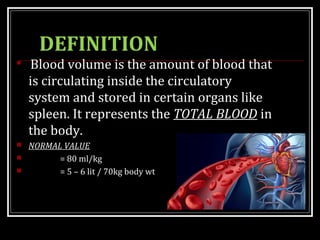
Blood volume is the amount of blood that
is circulating inside the circulatory
system and stored in certain organs like
spleen. It represents the TOTAL BLOOD in
the body.
 NORMAL VALUE
 = 80 ml/kg
 = 5 – 6 lit / 70kg body wt
PHYSIOLOGICAL VARIATIONS
Sex : female < male
Muscular exercise :
exercise : increases
High altitude : increases
Pregnancy :
increases
Age : infants – more
compared to adults
Surface area of body
Body weight
Atmospheric temperature
Posture
Emotion
PATHOLOGICAL VARIATION
PATHOLOGICAL INCREASE
1.Hemorrhage or blood
loss
2. Fluid loss
3. Haemolysis
4. Anemia
5. Obesity
6. Hypothyroidism
PATHOLOGICAL DECREASE
1. Hyperthyroidism
2. Hyperaldosteronism
3. Cirrhosis of liver
4. Congestive Cardiac
Failure
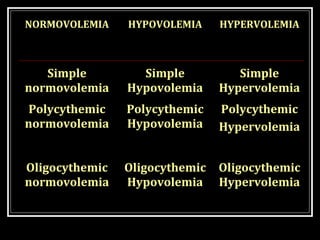
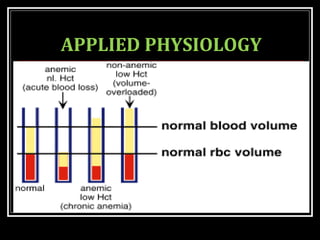
NORMOVOLEMIANORMOVOLEMIA HYPOVOLEMIAHYPOVOLEMIA HYPERVOLEMIAHYPERVOLEMIA
SimpleSimple
normovolemianormovolemia
SimpleSimple
HypovolemiaHypovolemia
SimpleSimple
HypervolemiaHypervolemia
PolycythemicPolycythemic
normovolemianormovolemia
PolycythemicPolycythemic
HypovolemiaHypovolemia
PolycythemicPolycythemic
HypervolemiaHypervolemia
OligocythemicOligocythemic
normovolemianormovolemia
OligocythemicOligocythemic
HypovolemiaHypovolemia
OligocythemicOligocythemic
HypervolemiaHypervolemia
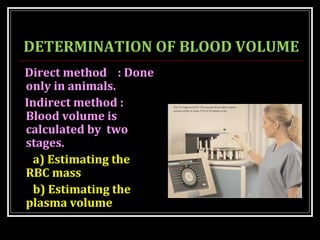
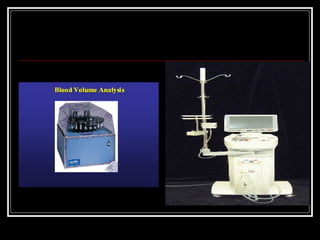
DETERMINATION OF BLOOD VOLUME
Direct method : Done
only in animals.
Indirect method :
Blood volume is
calculated by two
stages.
a) Estimating the
RBC mass
b) Estimating the
plasma volume
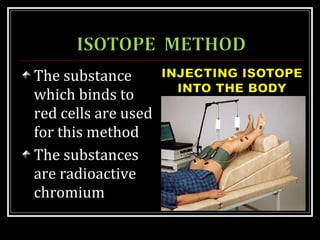
The substance
which binds to
red cells are used
for this method
The substances
are radioactive
chromium
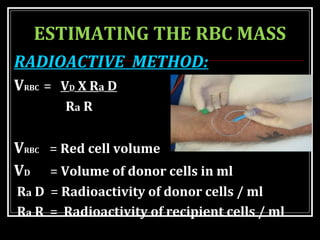
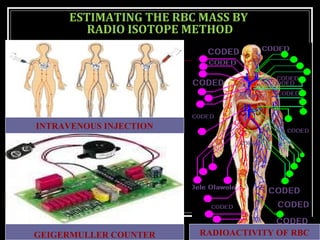
ESTIMATING THE RBC MASS
RADIOACTIVE METHOD:
VRBC = VD X Ra D
Ra R
VRBC = Red cell volume
VD = Volume of donor cells in ml
Ra D = Radioactivity of donor cells / ml
Ra R = Radioactivity of recipient cells / ml
ESTIMATING THE RBC MASS BY
RADIO ISOTOPE METHOD
GEIGERMULLER COUNTER RADIOACTIVITY OF RBC
INTRAVENOUS INJECTION
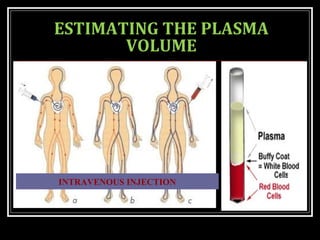
ESTIMATING THE PLASMA
VOLUME
INTRAVENOUS INJECTION
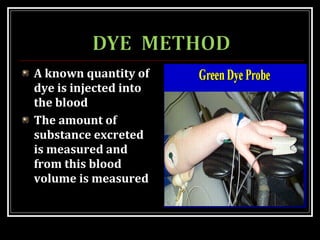
A known quantity of
dye is injected into
the blood
The amount of
substance excreted
is measured and
from this blood
volume is measured
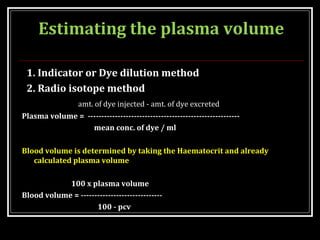
Estimating the plasma volume
1. Indicator or Dye dilution method
2. Radio isotope method
amt. of dye injected - amt. of dye excreted
Plasma volume = --------------------------------------------------------
mean conc. of dye / ml
Blood volume is determined by taking the Haematocrit and already
calculated plasma volume
100 x plasma volume
Blood volume = ------------------------------
100 - pcv
REGULATION OF BLOOD
VOLUME
Maintenance of blood volume depends on:
Balance between water
Adjustment of fluid and
intake water loss
interchange.
1.Regulation of volume (water level)
2.Regulation of RBC mass
3.Regulation of plasma proteins
4.Regulation of electrolytes
REGULATION OF VOLUME
(WATER LEVEL)
1.Capillary fluid shift
2.Osmoreceptors
3.Volume receptors
4.Baroreceptors
5.Renin Angiotensin System
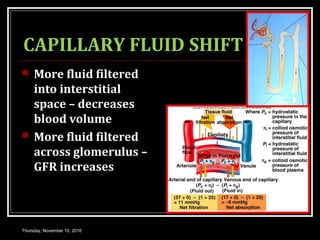
CAPILLARY FLUID SHIFT
 More fluid filtered
into interstitial
space – decreases
blood volume
 More fluid filtered
across glomerulus –
GFR increases
Thursday, November 10, 2016
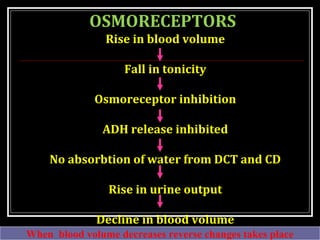
OSMORECEPTORS
Rise in blood volume
Fall in tonicity
Osmoreceptor inhibition
ADH release inhibited
No absorbtion of water from DCT and CD
Rise in urine output
Decline in blood volume
When blood volume decreases reverse changes takes place
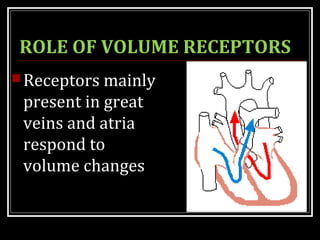
ROLE OF VOLUME RECEPTORS
Receptors mainly
present in great
veins and atria
respond to
volume changes
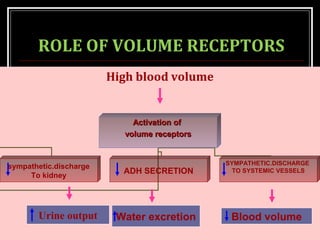
ROLE OF VOLUME RECEPTORS
High blood volume
Activation ofActivation of
volume receptorsvolume receptors
sympathetic.discharge
To kidney
ADH SECRETION
SYMPATHETIC.DISCHARGE
TO SYSTEMIC VESSELS
Urine output Water excretion Blood volumeUrine output
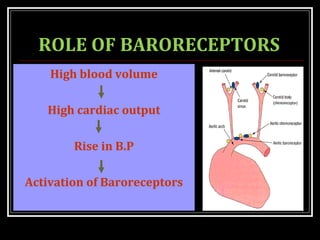
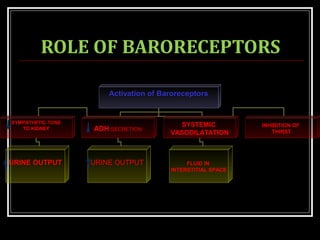
ROLE OF BARORECEPTORS
High blood volume
High cardiac output
Rise in B.P
Activation of Baroreceptors
ROLE OF BARORECEPTORS
Activation of BaroreceptorsActivation of Baroreceptors
SYMPATHETIC.TONE
TO KIDNEY ADH SECRETION
SYSTEMIC
VASODILATATION
URINE OUTPUT FLUID IN
INTERSTITIAL SPACE
INHIBITION OF
THIRST
URINE OUTPUT
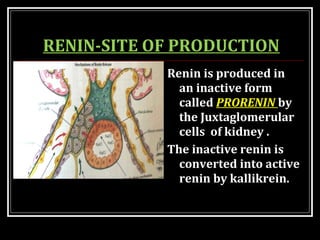
RENIN-SITE OF PRODUCTION
Renin is produced in
an inactive form
called PRORENIN by
the Juxtaglomerular
cells of kidney .
The inactive renin is
converted into active
renin by kallikrein.
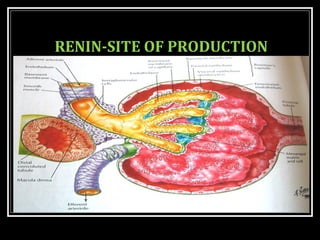
RENIN-SITE OF PRODUCTION
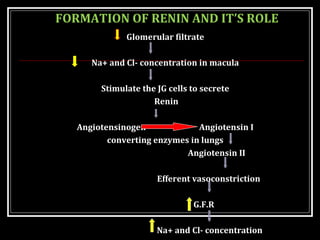
FORMATION OF RENIN AND IT’S ROLE
Glomerular filtrate
Na+ and Cl- concentration in macula
Stimulate the JG cells to secrete
Renin
Angiotensinogen Angiotensin I
converting enzymes in lungs
Angiotensin II
Efferent vasoconstriction
G.F.R
Na+ and Cl- concentration
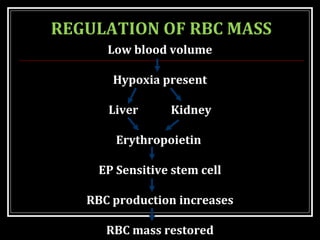
REGULATION OF RBC MASS
Low blood volume
Hypoxia present
Liver Kidney
Erythropoietin
EP Sensitive stem cell
RBC production increases
RBC mass restored
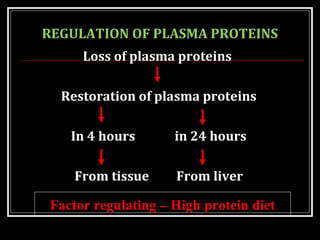
REGULATION OF PLASMA PROTEINS
Loss of plasma proteins
Restoration of plasma proteins
In 4 hours in 24 hours
From tissue From liver
Factor regulating – High protein diet
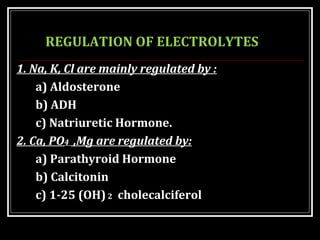
REGULATION OF ELECTROLYTES
1. Na, K, Cl are mainly regulated by :
a) Aldosterone
b) ADH
c) Natriuretic Hormone.
2. Ca, PO4 ,Mg are regulated by:
a) Parathyroid Hormone
b) Calcitonin
c) 1-25 (OH)2 cholecalciferol
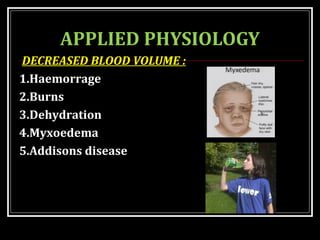
APPLIED PHYSIOLOGY
DECREASED BLOOD VOLUME :
1.Haemorrage
2.Burns
3.Dehydration
4.Myxoedema
5.Addisons disease
APPLIED PHYSIOLOGY
INCREASED BLOOD VOLUME DUE
TO IN WHOLE BLOOD:
1.Polycythemia Vera
2.Cushings syndrome
3.Thyrotoxicosis
APPLIED PHYSIOLOGY
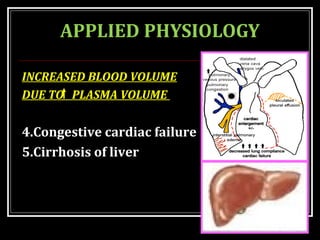
INCREASED BLOOD VOLUME
DUE TO PLASMA VOLUME
4.Congestive cardiac failure
5.Cirrhosis of liver
APPLIED PHYSIOLOGY
RECAP
Definition
Physiological variations
Pathological variations
Measurement of blood volume
Factors regulating blood volume
Applied physiology
Thank
You

BLOOD VOLUME